






Abstract
The author examined the speed of research dissemination by determining the time elapsed from publication to first citation for 617 articles in the Journal of Research in Music Education (JRME). Google Scholar was used to create a unique data set of 6,930 references originating from journals in the arts, education, music, and other fields. An original computer script linked the journal citations to individual articles and calculated the elapsed time from publication to first citation in journals dedicated to music and other disciplines. Kaplan-Meier estimators determined the cumulative failure function and probability of a first citation by year. Failure plots revealed citations to the articles originated more quickly from journals in music than from other fields, highlighting the importance of the JRME to music scholars and gradual influence on other fields. Cumulative first-citation proportions from music journals reached 50% in 4 years and 75% in 8 years. Cox proportional-hazards regression revealed multiauthored studies were cited more quickly after publication than single-author studies, and citation speed changed under different editorships. This study reinforces the importance of JRME to the dissemination of research results throughout the music profession and highlights a need to connect music research with other disciplines.
Keywords
The reliance of researchers on the work of other scholars is inherent to scientific inquiry. Indeed, what has been studied (and published) profoundly influences the research process from formulation of the initial hypothesis to determination of the methodology and statistical analysis to final interpretation and constructed meaning. An article’s review of literature can be viewed as a researcher’s acknowledgement of the headwaters that give rise to a new inquiry, with each citation essentially functioning as an affirming “vote” of importance. When an article is cited repeatedly, it seems to develop a gravity of its own, gains more citations, and eventually is recognized as important and influential or even indicative of prominent lines of research over time (Rutkowski, Thompson, & Huang, 2011; Schmidt & Zdzinski, 1993). Similarly, authors who frequently publish and garner scores of citations are identified as important and influential (Sample, 1992), are considered eminent and productive (Brittin & Standley, 1997), and are recognized for making an impact on a discipline over years (e.g., Flowers, 2012; Madsen, 1988).
If “research activity is a primary indicator of the intellectual health and academic status of a field” (Schmidt & Zdzinski, 1993, p. 5), then knowing how research activity varies with time should be considered a vital component of assessing a profession’s academic well-being. Studies of music education research across time reveal an evolving number of outlets for research (Geringer, 2000; Price & Chang, 2000; Price, Madsen, Cornacchio, & Webb, 2010), increased scholarship from seasoned researchers (Yarbrough, 2006), improved mentorship of doctoral students by experienced hands (Humphreys, 2006), well-defined areas of research (e.g., Geringer, Madsen, & Gregory, 2004), and a mass of scholarship in the United States surpassing the production of other countries (Price, 2004).
Furthermore, observations related to the authorship of research reveal the changing nature of the enterprise. For example, Sims (2013b) noted an increase in the number of multiauthored studies and highlighted the publication of the first eight-author study in the Journal of Research in Music Education (JRME). This increase in cooperative scholarship lends support to the importance of a community of researchers to the sustained advancement of scholarship in music education (Flowers, 2012) and reflects the larger pattern of inquiry found in the sciences, medicine, and other disciplines (Wuchty, Jones, & Uzzi, 2007).
To many, the JRME is the flagship journal for research in music education. Hamann and Lucas (1998) clarified its relationship to other journals when they tabulated references found in six nationally distributed music education journals published from 1990 to 1996. A three-tiered hierarchy of 15 cited music research journals emerged, with the first tier accounting for 81% of the citations, the second tier 11%, and the third tier 8%. Journals in the first tier consisted of the Bulletin of the Council for Research in Music Education (CRME), the JRME, and Psychology of Music (POM); the second tier comprised the Journal of Music Therapy (JMT), Update: Applications of Research in Music Education (UPDATE), and Contributions to Music Education. Interestingly, music journals composed only 23% of the 576 cited journals, suggesting the breadth of scholarship informing music education research relies on a multitude of sources beyond the discipline of music.
Surveying research citations in music and nonmusic journals provides some insight as to how music education research is influenced by and influences research in other disciplines. One approach summarizes the influence of research from two moments in time: research done before an article is published (i.e., citations in the article) and research resulting from publication of the article (i.e., references to the article).
Applying this method, Hancock (2009) examined articles published in the JRME from 1999 to 2009 and cataloged studies cited by JRME authors and studies referencing the JRME. Citations were confined to journals indexed through the HighWire Citation Mapper provided by Sage Publications (http://highwire.stanford.edu). Results revealed that of the 10 most frequently cited and referenced journals, five were not in music. These journals were American Educational Research Journal, Journal of Teacher Education, Review of Educational Research, Educational Researcher, and Science. Among music journals, the JRME and POM accounted for 81% of the citations and references. These results suggested that a core network of scholarly and scientific communication existed between the JRME and other music research journals and that the influence of scholarship from nonmusic journals on the JRME was small but present.
A factor to consider when reading research using citation analysis is whether the analysis focused on examining citations in an examined article or citations to an examined article. One common sampling strategy found in music education research involves choosing a set of journals and articles to study, examining the references listed in each article, tabulating the fields of interest from the citations, and grouping the data for analysis. This method can be used to analyze the sources cited by the authors of the studies, so these studies look at citations through the eyes of JRME authors. Another sampling method involves choosing a set of journals and articles to examine, finding all references to each article, tabulating the fields of interest from the referencing articles, and grouping these data for analysis. This method is used to analyze the sources citing the examined articles and has yet to be applied in music education research.
In addition to approaches based on the examination of references, assessment of the impact of published research can be measured by considering how quickly results are disseminated and cited by another author. For example, one study in the field of scientometrics used Kaplan-Meier survival methods to graphically compare the cumulative time-to-first-citation response time curves for four journals in the field of cellular biology (Glänzel, Rousseau, & Zhang, 2012). Time-to-citation data for each journal were graphed and compared to the average time-to-citation data for all journals in the field. Results indicated that the response time for the journal Cell was significantly faster than the discipline mean initially and later was slower than the rest of the field. Two other journals, though prestigious, were significantly slower to disseminate research results than the discipline mean. The differences in response time curves were used to classify journals by research dissemination speed, and the authors suggested that time to first citation was an additional measure of a journal’s impact on a profession.
If one of the goals of conducting research is to explain and understand how something works and dissemination of results cultivates an informed public, knowledgeable profession, and informed scholars (Duke, 2010), then it seems important to understand how quickly research results are adopted by the profession and transferred among disciplines. Analysis of the speed to first citation is an endeavor that has yet to be attempted in music education, and the inclusion of time as a covariate to citation analysis may supplement current thinking on journal eminence and research dissemination. As noted by de Solla Price (1965), the total research front of science has never . . . been a single row of knitting. It is, instead, divided by dropped stitches into quite small segments and strips. . . . Such strips represent objectively defined subjects whose description may vary materially from year to year. . . . If one would work out the nature of such strips, it might lead to a method for delineating the topography of current scientific literature. . . . Journal citations provide the most readily available data for a test of such methods. (p. 510)
The eminence of the JRME to the profession has been verified empirically on more than one occasion, and the centrality of the journal to music education research continues to inspire a multitude of formal and informal studies of the journal sometimes as a proxy for the entire discipline (e.g., Ebie, 2002; Miksza & Johnson, 2012).
The purpose of this study was to examine the speed in which articles published in the JRME were cited in music and nonmusic journals. The following research questions were examined:
What was the rate of first citation for articles published in the JRME from 1988 to 2013?
Was the first-citation rate affected by the referencing journal or discipline?
Did the first-citation rate change if one of the article authors was considered a prolific researcher during the examined time period (Yarbrough, 2006)?
Did the number of article authors affect the first-citation rate?
How did the first-citation rate change during the tenures of the four presiding editors of the JRME from 1988 to 2013?
Method
Data Collection
Data for this study consisted of references to articles published in the JRME (N = 617) from 1988 (Volume 36, Issue 4) to 2013 (Volume 60, Issue 4). All references were extracted from Google Scholar (GS; N = 14,349) via article links posted on the Sage Publications web portal for the JRME and imported into a custom relational database constructed using Filemaker Pro (Version 12). 1 Each reference was evaluated for false positives, incorrect information, and missing information; supplemental searches aided the reconstruction of partial references to compensate for previously identified strengths and concerns with GS output (Falagas, Pitsouni, Malietzis, & Pappas, 2008; Kulkarni, Aziz, Shams, & Busse, 2009; Meho & Yang, 2007; Nourbakhsh, Nugent, Wang, Cevik, & Nugent, 2012). Incomplete references were discarded if additional information eluded display after five pages of search results (approximately 50 potential sources). Results of this process reduced the number of references to scholarship in the JRME to 13,618, with 6,930 (50.9%) originating from journal articles, 4,337 (31.9%) from dissertations and theses, 1,437 (10.6%) from books and book sections, 509 (3.7%) from conference proceedings and papers, 172 (1.3%) from manuscripts and class projects, 90 (0.7%) from websites and electronic papers, 79 (0.6%) from unidentifiable sources, and 64 (0.5%) from reports and pamphlets. References originating from journal articles were retained and the other references were discarded for the present study.
Journal Collections
Journal-based references were classified manually as originating from one of five journal collections. Each collection represented a specific discipline or emphasis that was either related to the music profession or not. This permitted broad comparisons of first-citation speed by proximity to music education research as a proxy for research dissemination across disciplines and within the field. References originating from CRME, JMT, POM, UPDATE, and the JRME were assigned to the music-core collection. This collection represented a known structure of scholarly and scientific communication established through extensive citation analyses conducted in the field of music education research and therefore met the requirements for establishing a baseline of knowledge transfer for novel scientometric and bibliometric studies (Moed, 2006). All other references originating from a music journal—including other music research journals—were assigned to the music-other collection based on the assumption that the journal–journal relationships (i.e., intradisciplinarity) between these publications and those in the music-core collection were similar (Leydesdorff, 2006). The remaining references were examined and assigned based on key terms found in the title of the originating journal. References with journal titles related to any of the arts or humanities were assigned to the arts collection, journal titles emphasizing education were designated to the education collection, and all remaining references were placed in the other collection. See Table S1 in the online supplemental materials (http://jrme.sagepub.com/supplemental) for a sample of journals in the binned collections.
Selected Journals
Journals selected for detailed comparison were CRME, JMT, the JRME, POM, UPDATE, and the Journal of Music Teacher Education (JMTE). Each journal represented an archetype of research publication (e.g., teacher training, democratization of research, specialized research focus) and met at least three of the following criteria: peer reviewed, distinctive purpose, established eminence (Hamann & Lucas, 1998), reciprocal citation and referencing to the JRME (Hancock, 2009), or formalized fraternal relationship to the examined journal indicative of a microsystem of referencing suitable for scientometric measure of a field (de Solla Price, 1965; Moed, 2006). A search for systematic studies on these music research journals was used to verify the bibliographic importance of the content in these journals to researchers investigating scientific and scholarly practices in music education. Studies on the journals previously assigned to the music-core collection were plentiful; an emerging group of peer-reviewed articles on JMTE supported the addition of the journal as an important node to understanding research dissemination (e.g., Killian, Liu, & Reid, 2013; Nichols, 2013; Silveira & Frank, 2014).
Prime Covariates
Editor era
A four-level categorical variable representing the tenure of different editors of the JRME from 1988 to 2013 was created to account for the 25-year difference in production practices, editorial policies, journal access, and research productivity (e.g., Sims 2013a, 2013b; Yarbrough, 2002, 2006). For the purposes of this study, editor eras commenced with the first published volume and issue listing the new editor as chair of the editorial committee. Table S2 (online supplemental materials, http://jrme.sagepub.com/supplemental) describes the different eras.
Prolific researcher
A two-level variable was created to determine whether authorship of a named member of the “researchers who contributed five or more articles to the JRME” (Yarbrough, 2006, p. 94) affected the onset to first citation. These 26 researchers produced a body of citable research across at least two of the examined editor eras and conceptually represented authors with high lifetime citation counts (de Solla Price, 1965; Moed, 2006). Articles written or cowritten by an author mentioned by Yarbrough (2006) were coded as 1, otherwise as 0.
Number of authors
An additional two-level variable accounted for the possible influence of multiple authors on the speed to first citation. Wuchty et al. (2007) observed a “broad tendency for teams to produce more highly cited work than individual authors . . . [and] this pattern prevails for comparisons between teams of any fixed size versus solo authors” (p. 1037). I coded multiauthor studies as 1 and single-author studies as 0.
Data Preparation for Survival Analysis
Data needed for the planned statistical analyses and graphing of failure and hazard rates required the creation of three new variables representing the time elapsed between publication and first citation (difference in publication year), observed citation status (cited/not cited), and determination of the specific strata to be examined (journal or journal collection referencing the article). In addition, a mechanism for identifying self-citation, left censoring (citation before publication), right censoring (no citation or unknown status), and sorting of matching references to determine the earliest citation by journal strata was needed.
Script authoring
To automate the process of sorting and creating the required data, I created a set of computer scripts (1) to identify which reference was the first to cite a specific article from the JRME, (2) to calculate the time elapsed from initial publication to first citation, and (3) to record the status of the article as cited. In the event no references were found to an article in the JRME, the script calculated the time elapsed from initial publication to the year 2013 and recorded the status of the article as uncited. The script then was set to automatically advance to the next article and loop the process 617 times. This process was repeated 11 times, with each run focused on a different journal stratum. The first six strata were generated for select music education research journals (CRME, JMT, JMTE, the JRME, POM, and UPDATE). The last five runs generated time data for the five research journals collections (music core, music other, arts, education, and other). While operating, the script also assessed whether a reference would result in a self-citation or negative time-elapsed calculation. If examining a reference generated a self-citation, the script advanced to the next reference, assessed it for self-citation, and continued with the script. If a reference was published before the article—a result of citing a prepublished version of the study (e.g., conference poster, dissertation, in press)—the script immediately advanced to the next reference, assessed it, and continued with the script.
Incidence of left and right censoring
To calculate the elapsed time to first citation, the difference of the year of publication for the cited article and the reference article was compared. Reference articles published before the cited article were rejected from additional consideration as previously described, and data from the next reference were recorded. Negative time to citation (i.e., left censoring) occurred 12 (0.3%) times during the coding process for the individual music research journals and 57 (1.2%) times when coding the journal collections. Articles that were not referenced by any source during the coding process (i.e., not cited by 2013) were considered right censored (Cleves, Gould, Gutierrez, & Marchenko, 2008). Table 1 shows the distribution of first citation to right-censored records across the music journal and journal collection strata.
Rank Order of First-Citation Velocity and Descriptive Statistics for Journals and Journal Collections Referencing the Journal of Research in Music Education (JRME).
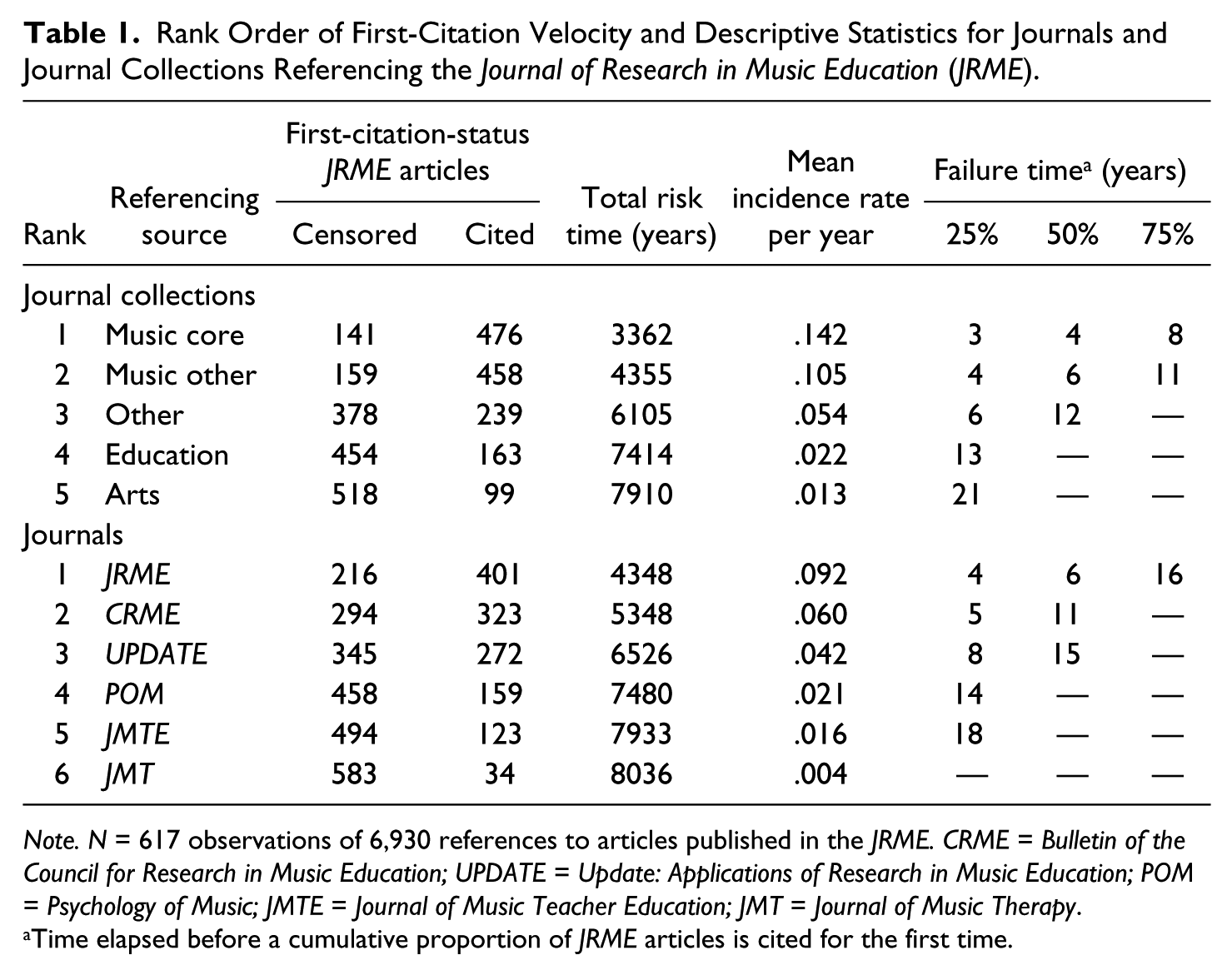
Note. N = 617 observations of 6,930 references to articles published in the JRME. CRME = Bulletin of the Council for Research in Music Education; UPDATE = Update: Applications of Research in Music Education; POM = Psychology of Music; JMTE = Journal of Music Teacher Education; JMT = Journal of Music Therapy.
Time elapsed before a cumulative proportion of JRME articles is cited for the first time.
Data Analysis
Data analysis was conducted using Stata (Version 12.1) and comprised three phases. The first phase applied the nonparametric Kaplan-Meier cumulative failure function to identify stratification of citation rates by journal and collection. The second phase utilized Cox proportional hazard modeling to test the effect of covariates on first-citation rates and a time-dependent covariate to control for variation in available publication outlets over time. The third phase compared Kaplan-Meier failure functions to determine visual and statistical stratification of citation rates by significant covariates in the second phase among the journals and collections.
Kaplan-Meier analyses followed standard procedures for survival analysis as outlined by Cleves et al. (2008). However, procedures for the Cox regressions were modified to include reorganization of the data structure to account for multiple failure-time survival data with unordered failure events of different types as summarized by Cleves (2009). The selected modification assumed individual journals and collections functioned as different strata clustered within the 617 articles from the JRME. In essence, the modification accounted for repeated measurement. An additional procedure produced an adjusted R2 to explain the variance for a survival analysis with censored events due to noncitation at the end of the observation period (Royston, 2006). Although not a standard practice for survival analysis, the addition facilitated approximated interpretations of the data.
A post hoc linktest (Stata command) confirmed the inclusion of covariates and structure for both Cox models. Visual inspection of the Kaplan-Meier hazard and survival plots confirmed the assumption of proportional hazards.
Results
In the first analysis, I examined all references to the JRME originating from any journal. Results from the Kaplan-Meier cumulative failure function revealed that the cumulative probability for a JRME article to receive a citation after publication was 0.25 after 2 years, 0.50 after 3 years, and 0.75 after 5 years (see online Figure S1, http://jrme.sagepub.com/supplemental). Following a common practice for interpreting survival analyses in medical research as an alternative way of representing the results (cf. New England Journal of Medicine, Journal of the American Medical Association), the cumulative probability of citation (failure) also described an anticipated cumulative proportion (i.e., percentage) of JRME articles that experienced a first citation by a certain point of time. When this nomenclature is applied, results indicate that an anticipated proportion of 50% of the articles in the JRME would receive a first citation after 3 years, 75% after 5 years, and 90% after 10 years (Figure S1, http://jrme.sagepub.com/supplemental). For the reported smoothed hazard estimates (i.e., conditional failure rate), the highest yearly probability for receiving a first citation from any source peaked at 0.23 during the 5th to 6th year after publication and gradually declined to 0.08 by the 14th year; thereafter, the probability remained constant.
The first graph in Figure 1 illustrates the stratification of the Kaplan-Meier cumulative failure estimates for the five journal collections. A Tarone-Ware (Tarone & Ware, 1977) test for equality of survival functions indicated different first-citation rates to the JRME from references in the five journal collections, χ2(4) = 32.00, p < .001. Comparison of data in Table 1 reveals the journal collections could be ranked by the time elapsed to meet a specific cumulative probability of first citation (i.e., proportion of cited studies) based on milestone quartiles (25%, 50%, 75%). For example, the probability of a citation to a journal article in the JRME originating from a referencing journal in the music-core collection reached 0.50 by Year 4 and 0.75 by the end of Year 8, which was “faster” than the first-citation rate of the music-other collection, which reached 0.50 in Year 6 and 0.75 in Year 11.
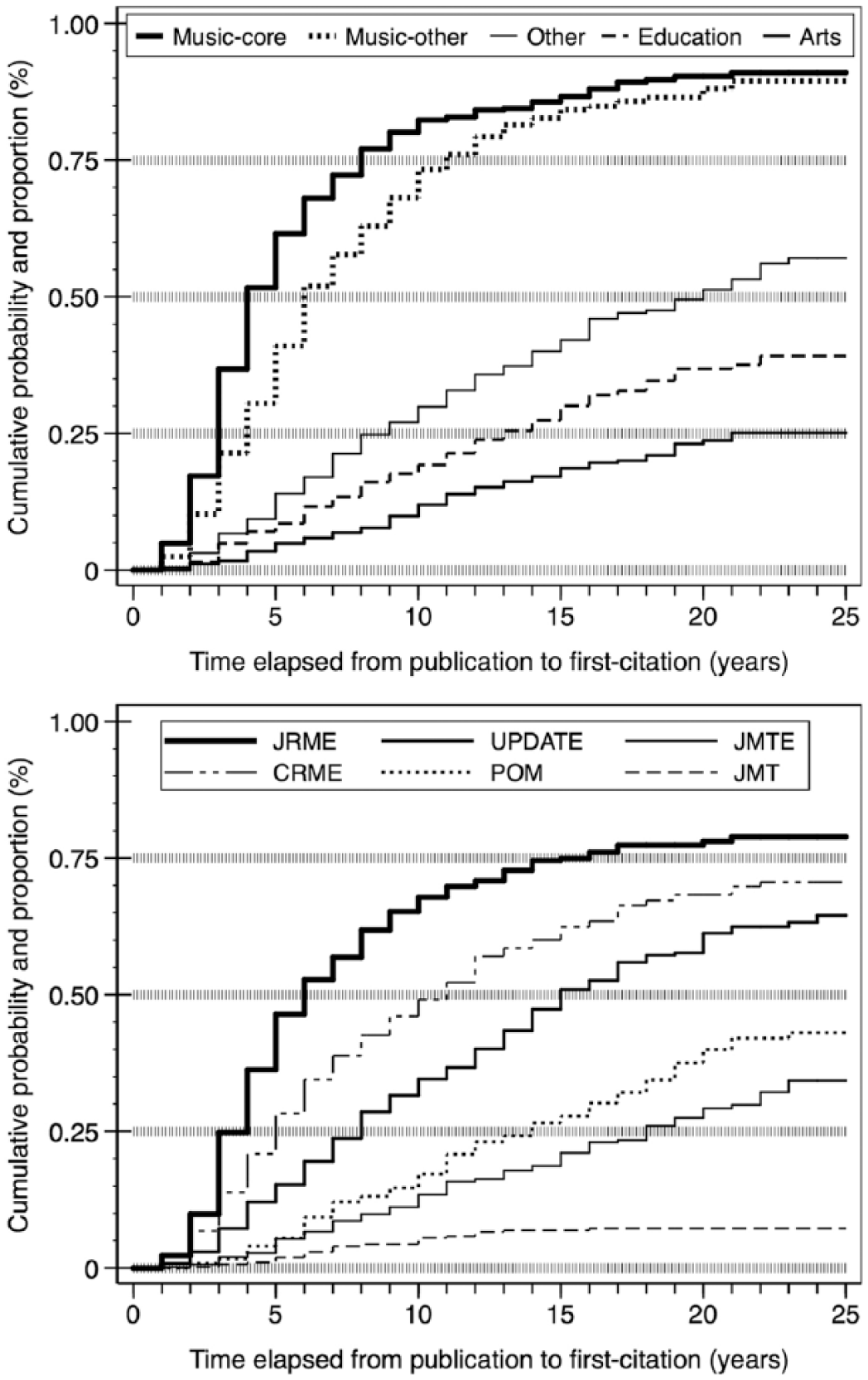
Stratified Kaplan-Meier failure function plots for the probability of citation and proportion of Journal of Research in Music Education articles receiving a citation from another article published in a specific journal collection or music research journal, milestone quartiles emphasized.
The first graph in Figure 2 illustrates the stratification of the smoothed year-to-year probability of a first citation to the JRME originating from a reference in a journal collection during a given year after publication. Music-core and music-other collections had the highest probability of citation during Years 5 to 6 and Years 7 to 8, respectively. The probability declined each year until Year 18, when it remained unchanged and constant. The probability of a citation originating from a reference in the arts, education, and other journal collections remained low throughout the observation period. Data from these two journal collection graphs indicate more first citations to the JRME came quickly from journals in the two music collections when compared with nonmusic collections.
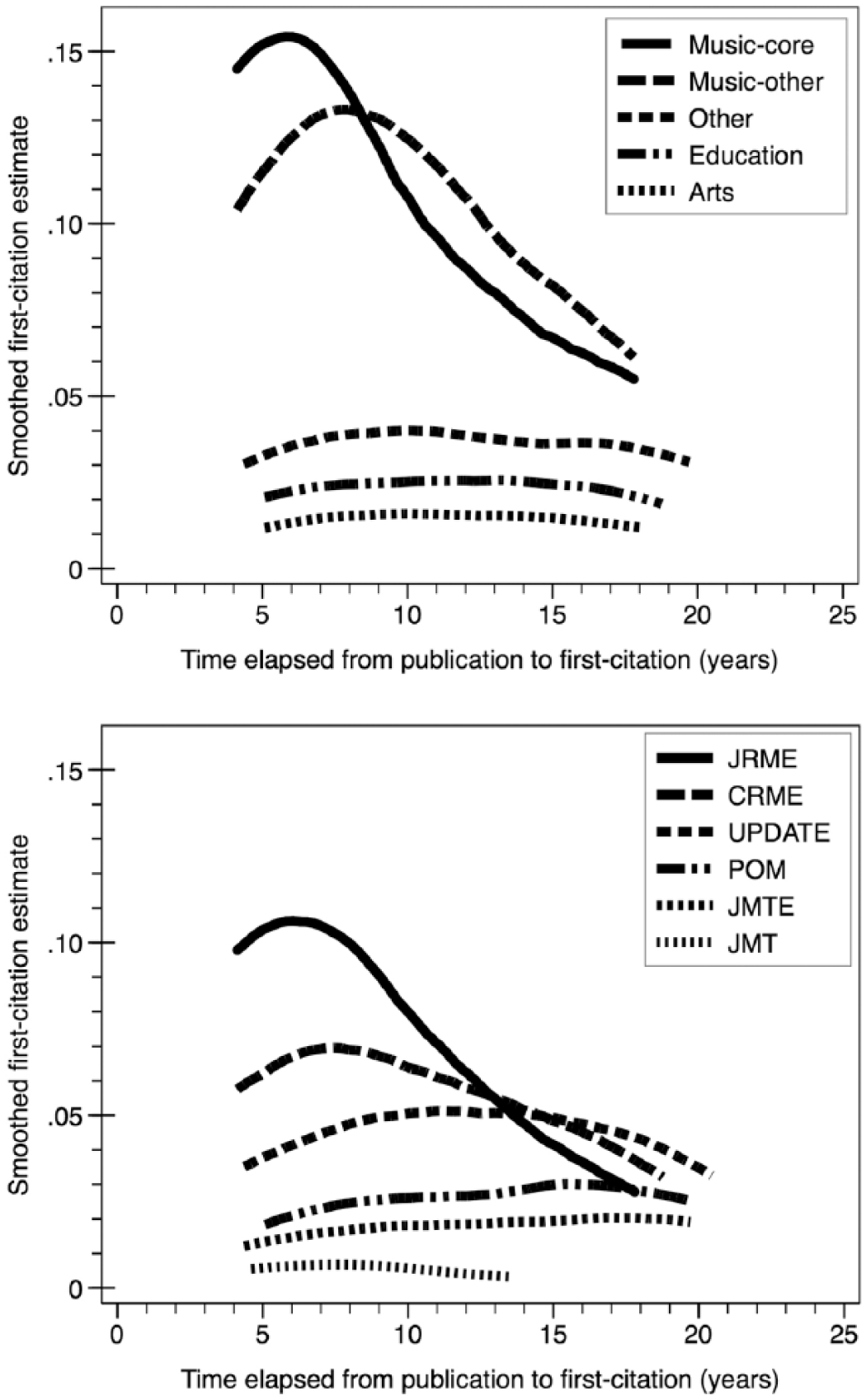
Stratified smoothed hazard estimates of the probability of a Journal of Research in Music Education article receiving a first citation from a journal collection or music research journal during a given year after publication.
The second plots in Figures 1 and 2 illustrate the stratification of the Kaplan-Meier cumulative failure and smoothed first-citation estimates among six select music research journals. Results from a Tarone-Ware test revealed a difference in the first-citation rates to the JRME among the journals, χ2(5) = 56.66, p < .001. A comparison of data in the two graphs with the summarized data in Table 1 suggested the six journals could be ranked by the elapsed time to meet a specific probability of citation and then used to examine the speed of adopting scholarship in the JRME by individual journals. For example, the cumulative probability of a citation originating from the JRME or CRME—Tier 1 journals in the discipline of music education (Hamann & Lucas, 1998)—surpassed 0.25 by Year 4 and Year 5, respectively. This subtle difference was negligible and suggested both journals referenced 25% of new JRME research within 5 years of publication. As time progressed, the two journals reached 50% by Year 6 for the JRME and Year 11 for the CRME. In essence, more of the examined articles were more likely to be cited by another article in the JRME than in the CRME as time progressed. However, these two journals were substantially faster to reference scholarship in the JRME when compared with the slow and constant pace of referencing by articles published in POM, JMTE, and JMT.
Table 2 documents the hazard ratios, robust standard errors, and 95% confidence intervals for two Cox regression analyses. Cox regression was used to determine whether values in the multiple authors, editor era, or prolific authors covariates stratified the time-to-first-citation velocity for articles published in the JRME. An additional time covariate representing publishing outlets available between 1988 and 2013 accounted for possible differences in the rate of citation attributable to the increased number of new music education journals available from 1990 to 2013 (Price & Chang, 2000).
Cox Regression Analysis for Covariates Affecting Time-to-First-Citation Velocity to the Journal of Research in Music Education.
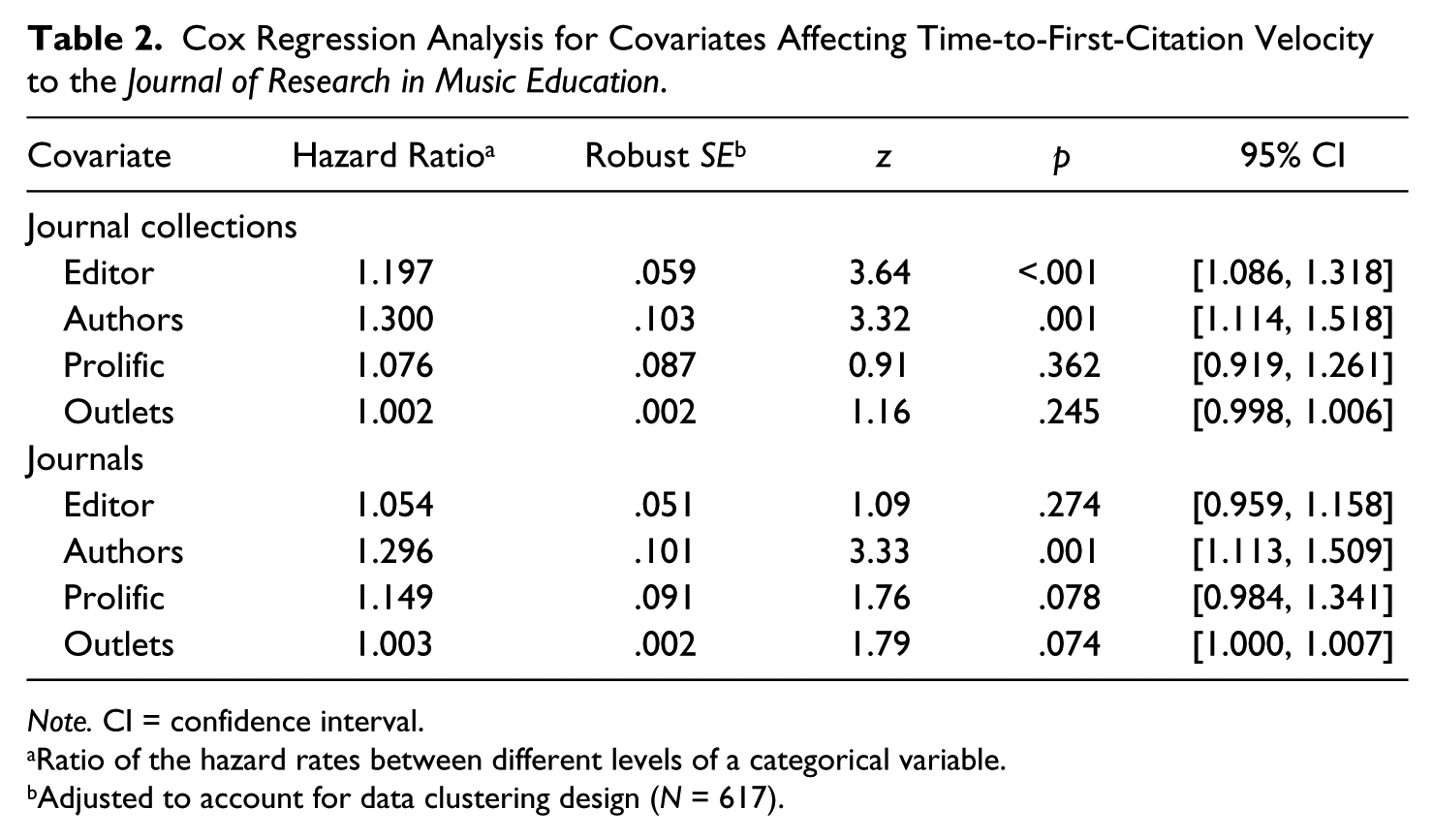
Note. CI = confidence interval.
Ratio of the hazard rates between different levels of a categorical variable.
Adjusted to account for data clustering design (N = 617).
The first model was used to examine the onset of first citation to the JRME among the journal collections. Hazard estimates stratified with the inclusion of the four covariates, G2(3) = 56.53, p < .0001. Multiple authors and editor variables significantly affected time to first citation (p < .001) as described by the hazard ratios in Table 2; however, the effect was small (adjusted R2 = .04).
The second model was used to examine the onset of citation to the JRME originating from the six music research journals chosen for their known network of scholarly communication with the JRME (i.e., CRME, JMT, JMTE, JRME, POM, UPDATE). Hazard estimates stratified with the inclusion of the covariates, G2(3) = 36.33, p < .0001. Only the presence of the multiauthor covariate significantly affected the time to first citation (p = .001). The total Cox model accounted for little of the overall variability in the time-to-first-citation rates (adjusted R2 = .02). From both models, it appeared that multiauthored studies experienced an increase in first-citation velocity approaching 1.3 times that of single-authored studies whether the referencing journal was in music, music research, or other fields. Moreover, first-citation velocity was 1.2 times faster under editors Sims and Yarbrough when compared with earlier editor eras.
To examine the effect of the significant covariates on the likelihood of first citation, the Kaplan-Meier cumulative failure function was stratified by collections and journals and plotted for analysis of the significant covariates (see online Figure S2, Graphs 1 and 2, http://jrme.sagepub.com/supplemental). Visual inspection and nonparametric statistical analyses (p < .001; see online Table S3, http://jrme.sagepub.com/supplemental) revealed the Yarbrough and Sims editor eras clearly experienced faster citation rates from journals in the music-other, arts, education, and other collections when compared with the earlier editor eras shepherded by Radocy and Price. Additional comparisons revealed that multiple-author studies tended to obtain a first citation more quickly than single-author studies from CRME, the JRME, and UPDATE and across all of the journal collections (see Figure S3, Graph 1 and Table S3, http://jrme.sagepub.com/supplemental).
Discussion
Results revealed that the time to first citation for research published in the JRME was significantly faster among music journals than for other fields, suggesting the timeliness and importance of the JRME in shaping the direction of music education scholarship and the slow yet present impact of the JRME on other fields. The cumulative proportion of cited articles originating from references in the music-core collection reached 50% within 4 years and 75% in 8 years, with similar results from journals in the music-other collection. The first-citation rates to the JRME from individual music research journals suggest an order of citation velocity for the dissemination and adoption of scholarship published in the JRME (first, JRME; second, CRME; third, UPDATE; fourth, POM; fifth, JMTE; sixth, JMT). Dissemination was especially fast within the field when compared to journals outside music education, lending support for the importance of the JRME to the music profession and the need for additional efforts to connect music education research to other disciplines, especially those related to the arts and education. Other results indicated that multiauthored studies were more quickly cited than single-authored studies. This result confirms prior research in the sciences and other disciplines.
Observations of Citation Probabilities
The music education research journals examined in this study may be labeled as either slow or fast responding to citing research in the JRME by examining the stratification of the Kaplan-Meier failure function curves (Glänzel et al., 2012). This hierarchy of research uptake may be another useful metric for determining journal eminence, supplementing studies based on citation tabulation. Results of this study largely parallel established taxonomies, although POM ranked lower than UPDATE, which stands out against the backdrop of prior research findings (Hamann & Lucas, 1998).
The fast response time by the music-core collection over all other examined journal collections supports the JRME’s pronounced collective impact on five major research journals. Within 4 years, 50% of citable JRME articles were referenced by one of the music-core journals and 75% in 8 years. Journals in the music-other collection took a little longer to reference the JRME, yet the impact was unmistakable. After 6 years, 50% of published JRME articles were referenced by these journals. It appears that the JRME not only produces more cited research than other journals (Hamann & Lucas, 1998); it also generates research that is quickly adopted and remains citable over a long period of time.
Other Disciplines
After publication, an article in the JRME was most likely to receive its first citation within 3 to 7 years from a music or music research journal. The longer response times for other journals suggest that while the music education research community and music community respond quickly to new scholarship, the research published in the JRME takes decades to impact other venues. The limited reach of the leading journal of our profession suggests that we are currently mostly informing ourselves.
Given the breadth of scholarship music education researchers draw upon, including journals with high impact factors (e.g., Science, Nature), it was interesting to discover that our own scholarship does not seem to return the contribution. A body of evidence suggests that the music education research community continues to mature and grow in sophistication, size, and productivity (Flowers, 2012; Humphreys, 2006; Yarbrough, 2002, 2006); and yet even with the popularization of research and a “public appetite for research headlines and stories” (Flowers, 2012, p. 145), we seem to struggle with the dissemination of results within (Geringer, 2000) and beyond music (e.g., Vedantam, 2012). Policies and practices to increase the cachet of research by democratizing results through podcasts, briefs, and press releases combined with purposeful efforts to contribute to the scholarly activities in education, sciences, and the arts should actively be explored and encouraged without compromising inquiry in our own field.
Influence of Editorship Era
Results indicated that the cumulative time to first citation varied according to editor era and trended for journals not listed as music-core. This finding suggests that editor era mostly affected the citation rate for journals other than those designated as a music-core journal (CRME, POM, JRME, JMT, and UPDATE) and that the effect seemed to increase with each editor change over time. The clear demarcation of a Radocy/Price and Yarbrough/Sims difference in first-time-to-citation rates suggests a shift occurred roughly around the year 2000. Yarbrough (2006) notes that editor Price presided over a larger number of articles than usual—mostly as a result of addressing article backlogs—and shepherded the implementation of short-format articles. In addition, Price (1996), in an editor’s forum, announced the reimplementation of indexing of the JRME by the American Psychological Association, which was discontinued in 1987, a year before the editorship of Radocy. Together, these changes may have paved the way for faster citation rates experienced by subsequent editors. However, the effect of indexing a journal on scholarship dissemination in the 1990s is vague. Geringer (2000) and Brittin and Standley (1997) attempted to find known scholarship in music education and music therapy using electronic databases (e.g., ERIC, PsychLit) and found unreliable results and unlisted scholarship, suggesting a prevalence of lackluster indexing services.
A plausible and parsimonious explanation for the difference in rates between editor eras may be the rise of database access to the JRME ushered in by Yarbrough via her efforts with JSTOR and Sims’s work moving the journal to Sage Publications. Another explanation suggests increased research productivity may have given rise to a multitude of specialized journals to meet the needs of a growing community of active researchers, thus providing additional opportunities for the publication of articles referencing the JRME (Humphreys, 2006; Van den Besselaar & Leydesdorff, 1996). Clearly, the prominence of the JRME has risen with the growth of international research efforts and concomitant citations (Price et al., 2010).
Influence of Multiauthor Studies
Results indicated a multiauthored study published in the JRME was approximately 1.3 times more likely to receive a first citation in any given year after publication than a study by a single author even after controlling for a common validity threat: self-citation. These results largely parallel citation research in all disciplines, including the humanities and arts, where “individuals were never more likely than teams to produce more-influential work” (Wuchty et al., 2007, p. 1037). However, an interesting conundrum exists. In the humanities and arts, the citation advantage for multiauthored studies gradually increased from 1975 to 2000 with little to no change in the mean number of authors, while the citation advantage in other disciplines—especially in science and engineering—was strongly related to increased team sizes during the same period. The Cox regression modeling used in the present study determined a constant value for the influence of multiple authors on first-citation speed in any given year. Additional investigation is needed to understand whether the uptake of multiauthored works in music education fluctuated over time with the observed changes in authorship noted by Sims (2013b).
Suggestions for Future Research
Authors of future studies should replicate the methods used in this study and compare results with data from other indexing services to determine the citation rates of the JRME among journals not found by GS. Citations from JMT and state journals were negligible, which stands in contrast to earlier studies (Brittin & Standley, 1997; Schmidt & Zdzinski, 1993; Standley, 1984). The underrepresentation of these journals was related to the methods used by GS to find citations to the JRME. False negatives are present in all indexing services; however, studies of GS suggest the service produces more false positives than negatives for journal articles (Falagas et al., 2008; Meho & Yang, 2007; Nourbakhsh et al., 2012; Van Aalst, 2010). Indeed, GS found citations to the JRME despite incorrect information for authors, titles, non-English text, and abbreviations (e.g., J. Rch., Mus.). Furthermore, contemporary music therapy research depends less on kindred references to music education studies, which peppered the bibliographies found in JMT 30 years ago, and instead draws almost entirely on articles in nursing, medicine, and music therapy (cf. Standley, 1984; Standley et al., 2010).
Articles and editorials published in journals composed a substantial part of the known universe of scholarship referencing the JRME. However, GS also identified an additional 6,688 references originating from dissertations, theses, books, conference papers, and other sources. Future researchers should explore the extent these sources reference the JRME to illuminate this essential patchwork of scientific communication.
Limitations
Time-to-first-citation studies are dependent on the overall yearly output of the examined journal. Inclusion of a measure of the total number of articles produced by each journal per year can be constructed from the created data set and included in future investigations. At the same time, journals publishing more articles per year than others contribute more to the overall scholarly output of the profession, which in turn provides additional material to cite and more opportunities to reference other articles. Another consideration is that four issues of the JRME are produced across a year, introducing some variation in elapsed time not captured in the study. This subtle difference did not seem to be a significant predictor of relative response times during preliminary data screening for the Cox regression models.
The processes chosen by editors and editorial boards to review, assess, and publish journal content also affects citation counts and citation speeds. For example, a journal may print papers from symposia or issue a call for a special issue on a research topic, which may instigate a bloom of citations about a dormant area of research or accelerate the time-to-first-citation rate for the journal. At the same time, the publication of individual manuscripts may be delayed or accelerated to accommodate the printing of a dedicated issue. Access to online-before-print articles also needs to be considered as the lag time from submission to publication adds variability. Obviously these practices are intended to foster scholarship and thereby affect citation counts and speed to first citation—authors of future studies should account for the printing of special issues and online early release dates among the music research journals.
Conclusion
Examination of the response times of research journals is a relatively new method in scientometric and bibliometric analyses. As noted, response times are not the same as impact measures widely reported for journals in other disciplines. Sometimes quick response times are associated with penultimate journals or new journals. However, when combined with other measures, response times can be used as another indicator of a journal’s influence and health. Evidence from this study suggests the scholarship published in the JRME is quickly cited, is in high demand, and retains a high likelihood of citation for decades.
Footnotes
Declaration of Conflicting Interests
The author declared no potential conflicts of interest with respect to the research, authorship, and/or publication of this article.
Funding
The author received no financial support for the research, authorship, and/or publication of this article.

Notes
Author Biography
References
Supplementary Material
Please find the following supplemental material available below.
For Open Access articles published under a Creative Commons License, all supplemental material carries the same license as the article it is associated with.
For non-Open Access articles published, all supplemental material carries a non-exclusive license, and permission requests for re-use of supplemental material or any part of supplemental material shall be sent directly to the copyright owner as specified in the copyright notice associated with the article.
