






Abstract
Findings from a nationally representative telephone survey of 1,560 young Internet users revealed youth receiving special education services in schools were more likely to report receiving an online interpersonal victimization in the past year, even after adjusting for other explanatory factors. These findings suggest that special education staff and other professionals should assess students for risk of online victimization.
Youth with disabilities are considered a highly vulnerable population (Cohen & Warren, 1990; Govindshenoy & Spencer, 2007). Research indicates that children with disabilities are at heightened risk of victimization compared with those without disabilities (Kendall-Tackett, Lyon, Taliaferro, & Little, 2005; Mishan, 2003; Rand & Harrell, 2009; Spencer et al., 2005; Sullivan, 2009; Van Cleave & Davis, 2006). Furthermore, emerging research suggests that youth with specific types of disabilities may be at risk for different forms of victimization. For instance, Turner, Vanderminden, Finkelhor, Hamby, and Shattuck (2011) found that some psychological disorders increase the risk of sexual victimization, while being diagnosed with attention-deficit disorder or attention-deficit hyperactivity disorder (ADD/ADHD) may be associated with risk of peer victimization.
There is evidence of a gap in Internet access and use for people with some types of disabilities (Gerber & Kirchner, 2001; Kaye, 2000; Kessler Foundation, 2010; Vicente & Lopez, 2010). Although studied to a lesser degree, this gap in usage applies to youth as well as adults (National Center for Education Statistics, 2001). Beyond this, there is a paucity of research available about how youth with varying types of disabilities use the Internet, including the potential of this technology to pose an additional victimization risk among this population
Online interpersonal victimization in the form of harassment and unwanted sexual solicitation has been identified as having clinical and practical implications for mental health and school professionals. Online harassment can include threats, embarrassment of others, and making rude or nasty comments using the Internet or other online technology. Research based on a nationally representative sample of young Internet users, ages 10 through 17 years, suggests that 11% of youth are harassed online each year (Jones, Mitchell, & Finkelhor, 2011). Those youth more likely to be harassed online include older youth (Ybarra, Mitchell, & Korchmaros, 2011; Ybarra, Mitchell, Wolak, & Finkelhor, 2006) and frequent Internet users (Ybarra et al., 2011). Those youth who report harassing others online are more likely to also be victims of harassment (Ybarraet al., 2006), as are those youth who experience harassment offline (Ybarra et al., 2006). Research suggests that male and female youth experience online harassment at equal rates (Ybarra et al., 2006). Youth who are victims of harassment online are more likely to also report problems related to school performance (Ybarra, Diener-West, & Leaf, 2007) and delinquent behaviors (Ybarra & Mitchell, 2004). However, existing research has not examined whether youth with a disability, including those youth receiving special education services or with a physical disability are more likely to experience online harassment.
Unwanted sexual solicitations online may include requests to talk about sex, to share personal sexual information, or do sexual acts (Finkelhor, Mitchell, & Wolak, 2000; Wolak, Mitchell, & Finkelhor, 2006). Estimates from a national study indicate that 9% of youth report being sexually solicited online in the past year (Jones et al., 2011). While research has not examined the impact of disability status, including special education services and physical disability, on likelihood of online sexual solicitation, some co-occurring factors related to increased likelihood of solicitation have been identified. For instance, how youth use the Internet, such as whether they use chat rooms and talk to people they do not know offline has been found to be related to online sexual solicitation (Mitchell, Finkelhor, & Wolak, 2001, 2007). Similarly, older youth and girls are more likely than boys and younger youth to report unwanted sexual solicitations online (Mitchell et al., 2001, 2007). Specific features of some disability types may affect victimization risk (Turner et al., 2011). The current paper explores general Internet use patterns among youth with different types of disabilities as well as whether they are at increased risk of unwanted sexual solicitation and online harassment; two forms of online interpersonal victimization deemed significant public health concerns (David-Ferdon & Hertz, 2007). Given that different disabilities have different consequences depending on the individual and the situation, we differentiate between two forms of disability, receiving special education services at school and being diagnosed with a physical disability, as well as the overlap in these types of disability.
Two primary research questions are examined here. First, we consider whether youth with specific types of disability differ from other youth in terms of Internet use, online behavior, and online interpersonal victimization. Second, we use multivariate statistical analyses to assess whether disability status and these domains are related to risk for online sexual solicitation specifically.
Method
The third Youth Internet Safety Survey (YISS-3) was conducted to quantify and detail unwanted or problematic technology-facilitated experiences among youth. Data collection occurred between August, 2010, and January, 2011. YISS-3 was conducted via telephone surveys with a national sample of 1,560 youth Internet users, ages 10 to 17 years who had used the Internet at least once a month for the past 6 months from any location, and a caregiver in each household. Eligibility criteria were consistent with two previous YISSs (Finkelhor et al., 2000; Wolak et al., 2006). Human subject participation was reviewed and approved by the (University of New Hampshire) IRB and conformed to the rules mandated for research projects funded by the U.S. Department of Justice.
Participants
The overall sample of youth was equally male and female (50% each category) and 73% reported being of White race/ethnicity. Two thirds of the youth lived with both biological parents and the highest education level in the household was a college graduate in over a third (37%) of the sample. Thirty percent of the sample reported a household income of under US$50,000 in 2010.
Eleven percent (n = 167) of youth were receiving special education services at school (individualized education plan [IEP], 504 plan, or other special education services) at the time of data collection. Six percent (n = 98) of youth had been diagnosed with a physical disability. Overall, 2%(n = 31) of parents reported their child having both a physical disability and receiving special education services at school.
Procedure
The main sample was drawn from a national sample of households with telephones developed by random digit dialing (RDD). The study’s data collection procedures were consistent with previous YISSs and are described in other publications (Finkelhor et al., 2000; Wolak et al., 2006). Interviewers asked caregivers most familiar with their child’s Internet use a series of questions about that Internet use. Then the interviewer requested permission to conduct a confidential interview with the child, which would include questions about “sexual material your child may have seen on the Internet.” At the beginning of each youth interview, study staff described the study, confidentiality of data collected, and the intended use of study data. This introduction also included a statement that asked respondents to let interviewers know if there were any questions that they did not understand. To maximize candid responses, the interviewers told youth that if “there are too many people around for you to talk freely, just let me know and I can call back later.” In households with more than one eligible youth, the one who used the Internet the most often was chosen as the respondent. The average adult interview lasted 10 min and youth interviews lasted 30 min, with participating youths receiving US$10.
Using standard dispositions as defined by the American Association for Public Opinion Research (AAPOR; 2011) the cooperation rate was 65% and the refusal rate was 24%. Due to increasing reliance of the U.S. population on cell phones only (Brick et al., 2007; Hu, Balluz, Battaglia, & Frankel, 2010) a cell phone RDD sample was included in addition to the landline sample in the YISS-3 study. More details about the methodology are available elsewhere (http://unh.edu/ccrc/pdf/YISS_Methods_Report_final.pdf).
Measures
Defining disability
Caregivers were asked two questions to assess whether their child had received special education services or had been diagnosed with a physical disability. The first question, “Has your child ever received special services at school? These might include an IEP, 504 plan, or special education services” had answer options “yes,” “no,” and “not sure.” If the parent answered yes to the question regarding special services, the next question was “Does your child currently receive special services at school?” with answer options “yes,” “no,” and “not sure.” This analysis only included those youth whose parents reported current special education service provision. The second question, “Has your [child’s age] year-old ever been diagnosed with a physical disability? This would be a physical health or medical problem that affects the kinds of activities that [he/she] can do?” had the same three answer options (yes, no, and not sure).
Internet usage and online behavior
Youth reported on Internet use characteristics, including amount, types, and location of use. Youth reported on whether they had engaged in sexual behavior online (i.e., talking about sex online with someone not known in person, send or receive text or instant messages that were sexual but did not include sexual pictures) and harassing behavior online (made rude or nasty comment to someone online; used the Internet to harass or embarrass someone you were mad at; spread rumors about someone through the Internet, whether they were true or not; share something about someone with others online that was meant to be private; post or forward a video or picture of someone online that showed them being hurt; involved in a group on a social networking site or other online site where the focus was making fun of someone else). Youth also indicated whether they had “gone to X-rated sites on the Internet on purpose.”
Online victimization
Unwanted sexual solicitation was indicated if youth responded positively to at least one of three screener questions (talking online about sex, requests for sexual information, or requests for sexual acts in the past year). In addition, youth who said they had an online sexual relationship with an adult were included to capture possible statutory sex crimes (n = 1). Online relationships were considered sexual if youth said the relationship was “sexual in any way.”
Youth who responded positively to at least one of the following two questions were classified as being the target of harassing behavior online: (a) In the past year, did you ever feel worried or threatened because someone was bothering or harassing you online? and (b) In the past year, did anyone ever use the Internet to threaten or embarrass you by posting or sending messages about you for other people to see.
Psychosocial characteristics
Youth answered a series of closed-ended questions regarding parent–child relationship. Parental conflict was derived from a factor analysis of three items (i.e., nagging, yelling, and taking away privileges) scored with a 5-point Likert-type scale. Likert-type scale answer options were “all of the time,” “most of the time,” “sometimes,” “never or rarely,” or “don’t know/not sure.” Based on a common latent factor a composite variable was created to measure parent–child conflict (M = 1.79, SD = 0.63). Due to indications of nonlinearity, this was dichotomized at 1 SD above the mean to reflect high conflict.
Youth were asked about experiences with offline victimization in the past year. Offline victimization types included physical or sexual abuse, peer or sibling abuse, dating violence, and statutory rape (affirmative answer to the question “In the last year, did you do sexual things with anyone 18 or older, even things you both wanted?”). Each of these measures included answer categories “yes,” “no,” and “don’t know/not sure.”
Depression was measured using the depression subscale of the Trauma Symptom Checklist (TSCC) for Children (M = 42.03, SD = 6.89; Briere, 1996). Any delinquency was coded if youth responded positively to any of a series of six questions referring to behaviors occurring in the past30 days (e.g., been on suspension, cheated on a test). Any substance use was indicated if youth said they had drunk beer or wine, smoked cigarettes, been drunk, or used marijuana at least once in the past 30 days.
Statistical Analysis
SPSS 19.0 was used for all analyses (IBM SPSS 19.0, 2011). First, we conducted three sets of bivariate cross-tabulations to determine whether differences existed in terms of demographic characteristics, Internet use patterns, online behavior, online victimization, and psychosocial characteristics between youth: (a) currently receiving special services at school, (b) diagnosed with a physical disability versus those who were not, and (c) currently receiving special services and diagnosed with a physical disability, respectively.
Next, since one of our primary interests is the relationship between disability and online victimization, we conducted bivariate cross-tabulations among youth receiving special services at school and report of online sexual solicitation. For those variables significant at the bivariate level, a logistic regression was conducted to identify those characteristics related to online sexual solicitation while adjusting for other contributing factors.
Results
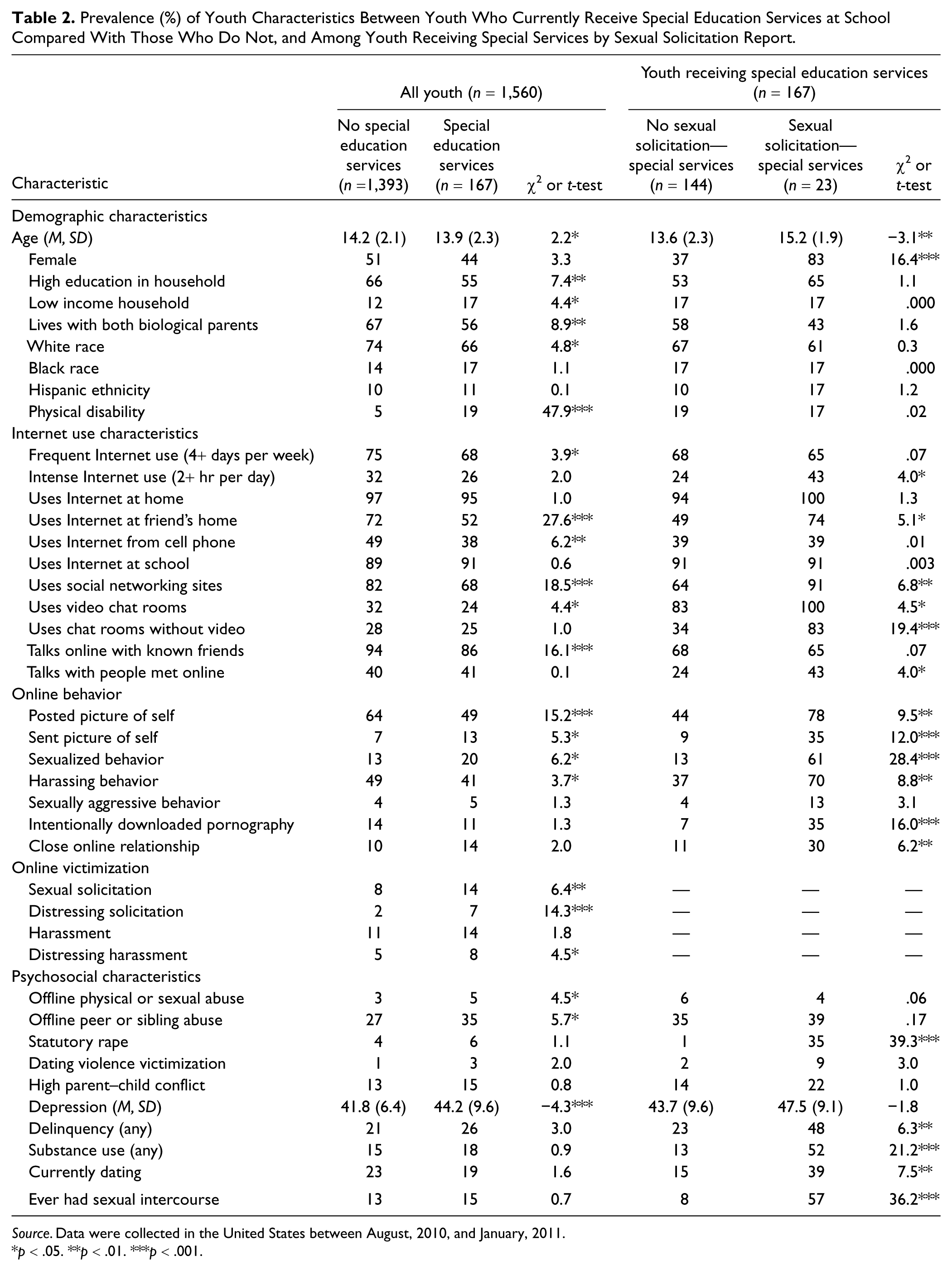
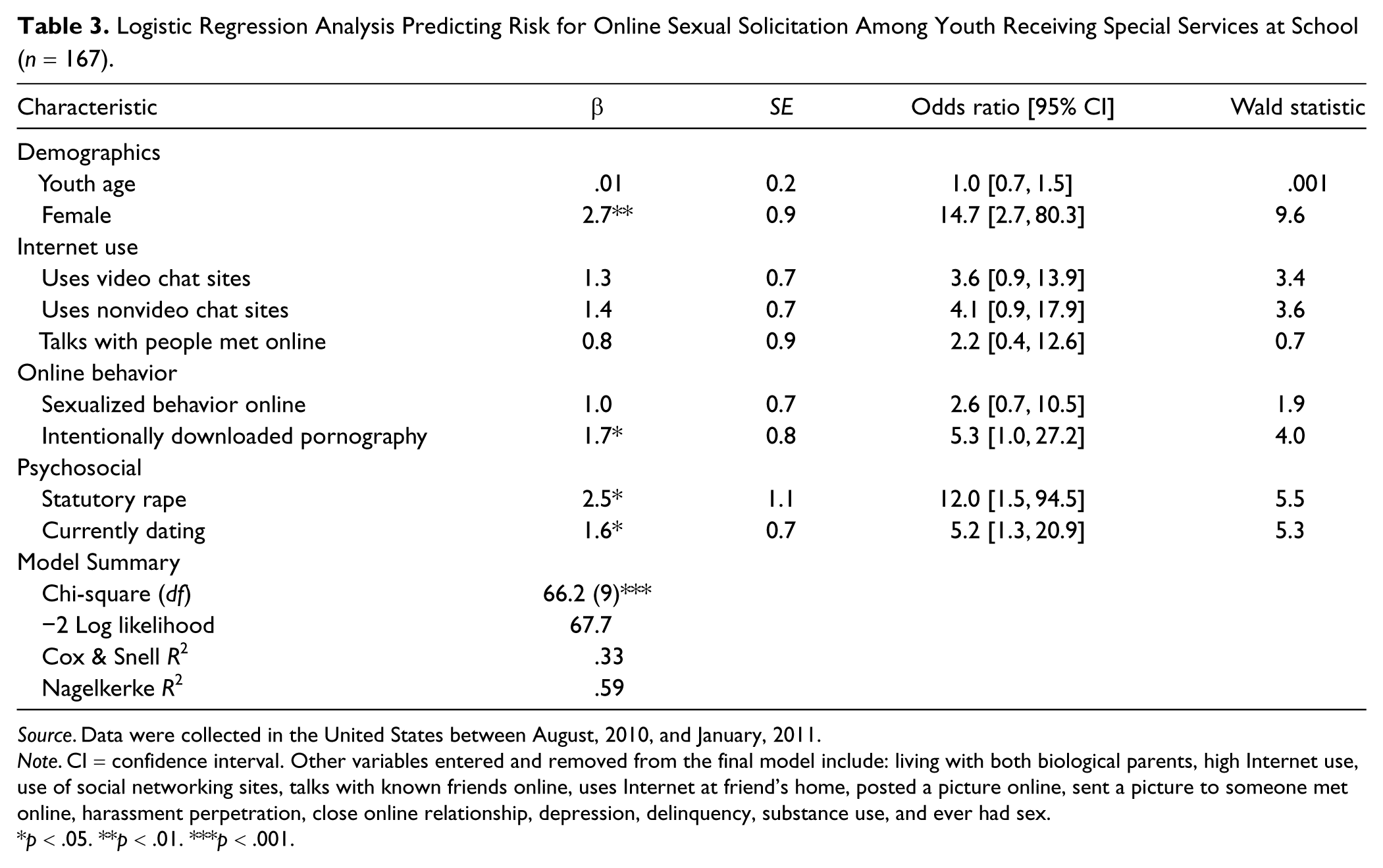
These results illustrate differences among youth with specific types of disability and other youth in terms of Internet use, online behavior, online victimization, and psychosocial characteristics. Results reflect bivariate analyses of prevalence of these characteristics between youth with a physical disability (Table 1) and bivariate and multivariate analyses among youth receiving special services at school (Tables 2 and 3).
Prevalence (%) of Youth Characteristics Between Youth Who Have Been Diagnosed With a Physical Disability Compared With Those Who Have Not (n = 1,560).

Source. Data were collected in the United States between August, 2010, and January, 2011.
p < .05. **p < .01. ***p < .001.
Prevalence (%) of Youth Characteristics Between Youth Who Currently Receive Special Education Services at School Compared With Those Who Do Not, and Among Youth Receiving Special Services by Sexual Solicitation Report.
Source. Data were collected in the United States between August, 2010, and January, 2011.
p < .05. **p < .01. ***p < .001.
Logistic Regression Analysis Predicting Risk for Online Sexual Solicitation Among Youth Receiving Special Services at School (n = 167).
Source. Data were collected in the United States between August, 2010, and January, 2011.
Note. CI = confidence interval. Other variables entered and removed from the final model include: living with both biological parents, high Internet use, use of social networking sites, talks with known friends online, uses Internet at friend’s home, posted a picture online, sent a picture to someone met online, harassment perpetration, close online relationship, depression, delinquency, substance use, and ever had sex.
p < .05. **p < .01. ***p < .001.
An additional set of bivariate analyses were conducted for youth who had a physical disability and received special services at school (n = 31). Youth currently receiving special education services at school and having a physical disability generally used the Internet fewer days per week than other youth (results not shown in table). They also were less likely to use the Internet at home, were less likely to use the Internet at a friend’s home or from a cell phone, and less likely to use social networking sites and talk to known friends online (although this is still reported by the majority—74%). Youth receiving special education services at school and reporting a physical disability were less likely to post a picture of themselves or be currently dating. No differences were noted in terms of risk for online victimization in bivariate analyses, so multivariate analyses were not conducted to examine online sexual solicitation among youth with both types of disability.
Internet Use Characteristicsand Disability Type
Few differences between youth with a physical disability and those without such a disability existed in terms of how they used the Internet (see Table 1). When differences were apparent, youth with a physical disability were less likely to use the Internet at home (although the majority did—92%), use the Internet at a friend’s home, and talk with known friends online.
Youth receiving special education services at school generally used the Internet less often than youth not receiving such services (see Table 2). These youth also used the Internet less frequently in terms of days per week, they were less likely to use the Internet at a friend’s home or from a cell phone, and less likely to use social networking sites, use video chat rooms, and talk to known friends online (although this is still reported by the majority—86%). Youth receiving special education services at school were less likely to post a picture of themselves or harass others while online.
Online Behavior and Victimization Among Youth With and Without Disabilities
Youth with a physical disability were similar to those without a physical disability in terms of their online behavior with one exception; youth with a physical disability were more likely to form a close online relationship (see Table 1). Youth with a physical disability were not significantly more likely than those without to report an online victimization—either an unwanted sexual solicitation or harassment. As such, multivariate analyses were not conducted to examine factors related to online sexual solicitation among youth with a physical disability.
Youth receiving special education services were more likely to send a picture of themselves to someone they met online and engage in sexual behavior online (e.g., talk about sex with someone they met online; see Table 2). These youth were more likely to report an online interpersonal victimization at the bivariate level. Specifically, youth receiving special services at school were more likely to report an unwanted sexual solicitation (14%) than those not receiving such services (8%). They were also more likely to report receiving a distressing sexual solicitation, one that left them feeling very or extremely upset or afraid (7% vs. 2%). No differences were noted for reports of any online harassment; however, distressing harassment was more commonly reported among this population (8% vs. 5%).
Psychosocial and Demographic Comparisons Among Youth With and Without Disabilities
Youth with a physical disability significantly differed from other youth in terms of gender, household education, household income, whether youth lived with both biological parents, and race (Table 1). These youth also reported significantly higher levels of depression and were less likely to be currently dating.
Youth currently receiving special education services at school significantly differed from other youth in terms of age, household education, household income, whether youth lived with both biological parents, and race (Table 2). Youth receiving special education services at school reported significantly higher rates of offline physical or sexual abuse, offline peer or sibling abuse, and levels of depression.
Predictors of Online Sexual Solicitation
Among youth receiving special services at school, reports of an unwanted sexual solicitation were more common among older girls; intense Internet users (2+ hr per day); youth who used the Internet from a friend’s home; and using social networking sites, video, and nonvideo chat rooms, and among youth who talked with people they met online (Table 2). Solicitation was also more common if youth had posted a picture of themselves online, sent a picture to someone met online, were sexual online, harassed others online, intentionally downloaded pornography and had a close online relationship. Offline characteristics among youth receiving special services at school found to be related to reports of sexual solicitation included being a victim of statutory rape, delinquency, substance use, currently dating and ever having sexual intercourse.
Holding all of the above-mentioned factors equal, girls receiving special services at school were almost three times more likely than boys receiving such services to report a sexual solicitation (OR = 2.7, p < .01; Table 3). Intentionally downloading pornography was related to an almost twofolds increased odds of sexual solicitation (OR = 1.7). Being a victim of statutory rape (OR = 2.5) and currently dating (OR = 1.6) were also related to reports of sexual solicitation among this population. Case-level analyses revealed that those youth reporting statutory rape and also receiving special education services were all girls ages 16 and 17 years (n = 8).
Discussion
This analysis explores Internet use patterns and risk of online victimization between youth with and without two specific types of disabilities. These findings provide some support for the position that youth receiving special education services use the Internet differently from other youth, but there were not notable differences for youth with a physical disability or youth with both types of disabilities, as compared with other youth. The finding that receiving special education services at school was related to increased risk of online sexual solicitation indicates that the specific features of disability types may provide a context for online risk.
In many ways, youth receiving special services appear to be at less risk than those without such services—They use the Internet less frequently (Mitchell et al., 2001), are less likely to access the Internet from someone else’s home (Mitchell et al., 2001), or use social networking sites (Jones, Mitchell, & Finkelhor, in press)—factors related to risk for online victimization among the population of 10- to 17-year-old youth in the United States.
Yet, they still are more likely to report an unwanted sexual solicitation than youth not receiving special education services. The subgroup of youth reporting a sexual solicitation, however, looks remarkably like other youth reporting sexual solicitations; they are female, use the Internet intensely, use the Internet from someone else’s home, use chat rooms, and engage in a variety of potentially risky behaviors online (Mitchell et al., 2001). Clearly, there is great diversity among youth who receive special education services at school. These findings illustrate a need for additional research and careful assessment of risk of online victimization among youth receiving special education services.
There is increasing evidence that different types of disabilities should not be aggregated into one global measure of disability (Turner et al., 2011). Children with a range of disability diagnoses may be receiving special education services in a school setting. Previous research has suggested, for instance, that teachers’ estimates of victimization differ for youth with learning disabilities as compared with those with behavioral disabilities (Lang & Kahn, 1986). Future research should include more specific disability status information, so that a more nuanced analysis can be considered. Features of any one disability may have very different implications in an online environment, particularly as related to risk of online victimization.
Implications for Special Education
Special education teachers work with a wide range of students, including those with learning, mental health, behavioral, and physical disabilities. These results have implications for special education professionals who work with students on independent living skills, interpersonal communication, as well as online safety and literacy. These professionals are uniquely positioned to work directly with students in school settings, as they can provide instruction and guidance regarding the likely overlap in online and offline behavior.
Our findings provide some suggestions for special education professionals seeking to update programs to incorporate online victimization and behaviors. First, professionals should keep in mind that new technologies do appear to provide an environment that is suited to the kinds of behaviors likely seen among a more high risk population. Programs should make sure they are targeting skills that can help youth negotiate peer conflict and anger issues that may lead to relational and verbal harassment behaviors online and offline. Such online behaviors have been found to present heightened risk for online sexual solicitation (Ybarra, Espelage, & Mitchell, 2007; Ybarra, Mitchell, Finkelhor, & Wolak, 2007). Role-playing and discussion exercises could be introduced that reflect conflict patterns and scenarios typical among social networks to allow students to identify and practice prosocial skills relevant to their peer culture.
Special education professionals could also develop assessment tools to assist in identifying the role that the Internet plays in youths’ lives. The results of this type of assessment could be utilized in Individual Education Plan meetings, in consultations with parents and classroom teachers, as well as a means of opening avenues of discussion with youth.
Schools will also need to make sure that their policies have incorporated online victimization and behaviors. Even though some of these behaviors occur away from school, they can result in disruptions in school functioning, safety, or security for students. School districts should be clear about their response policies to disclosures or discoveries of online victimization. Legislation is increasingly requiring schools to adopt policies on cyberbullying, for example, and consequences for ignoring the impact of this new environment on school bullying policy or dismissing the problem as “not school-related” can result in even more complicated legal crises when they occur (Willard, 2007). Policy recommendations are available for school districts seeking to amend policy and for advice on defining how and when online bullying behaviors come under authority for school (Cross, Monks, Campbell, Spears, & Slee, 2011; Hinduja & Patchin, 2009; Willard, 2007).
Given increasing requirements on schools during an era of decreasing resources, professionals can perhaps make the biggest difference for youth by implementing evidence-based programs and social emotional learning programs and skills that have incorporated information about online victimization and behavior into their curricula. The most successful prevention efforts focus on teaching youth relational and social skills such as perspective taking, emotional regulation, communication skills, and effective bystander intervention skills (Durlak, Weissberg, Dymnicki, Taylor, & Schellinger, 2011). These are skills that would likely translate to any environment or communication modality, including the Internet, and would minimize the concern adults have about predicting the next problematic development in websites or technologies.
Special education administrators may consider opportunities to enhance education regarding the Internet and the ways that youth are using this technology. Special education professionals work directly with youth and their families in ways that may facilitate meaningful discussions about online risk. For instance, special education staff can assess whether tendencies to post pictures or engage in sexualized behaviors affect school functioning. If that is the case, discussions of these or other online behaviors may be included in special education team meetings, accommodation recommendations, or other activities.
Existing research suggests that students with disabilities are more likely to experience sexual abuse in the offline environment and it is possible that there are similar online vulnerabilities (Skarbek, Hahn, & Parrish, 2009; Sullivan & Knutson, 2000). In the current study, some youth who received special education services and who experienced online sexual solicitations also reported that they had been victims of statutory rape. There is awareness that certain teens enter into sexual relationships with adults in a manner that appears to be voluntary and even enthusiastic, although still prohibited by law (Hines & Finkelhor, 2007). Conceivably, some older teenage girls may engage in online communications with young adult men, which may result in subsequent online sexual solicitations and being victims of statuary rape. Or existing relationships with young adult men may very well have a technological component wherein an unwanted sexual solicitation could occur. More research is necessary, however, because only a small percentage of youth reported statutory rape in the past year in this study.
It is apparent that some youth who received unwanted sexual solicitations and harassment were not taking the situation lightly, youth receiving special education services in particular. Youth receiving such services were more likely to receive a distressing sexual solicitation or harassment (ones that left them feeling very or extremely upset or afraid) than youth who were not receiving these services. This suggests that teachers and other professionals working with youth need to be aware of the impact and potential ramifications of these online experiences, particularly if there is a co-occurring mental health or behavioral condition to take into account. Such youth may require more targeted interventions, as these online experiences could aggravate an existing concern or condition.
Limitations
Several limitations of this study deserve note. First, these data are cross-sectional so causal inferences cannot be made. Second, this analysis relies on parental report of disability and some parents may be hesitant to disclose this information in a telephone interview. In addition, it is possible that some parents whose children did not receive special education services, but who were receiving Title I services (such as math or reading support) answered “yes” to the question about receipt of special services at school. Similarly, some parents with children coded as gifted or talented may have responded affirmatively to this question. As a result, the youth identified here as having received special education services may include youth who are coded as gifted or talented, or those whose services are not technically considered to be special education services. Future research should include more specific directions for parent respondents to more clearly delineate this population of youth. Third, some of the constructs examined in this analysis assume that youth interpret intent in behaviors, such as an understanding of what might “embarrass you.” For some youth included in this sample, it is possible that impairments related to specific disabilities may affect capacity to accurately answer the questions. Future research should solicit feedback from youth with specific types of disability to assess whether these constructs are clearly understood. Fourth, some measures used in this analysis could be considered outdated or in need of revision. For instance, the measures of substance use do not include items such as inhalants and over-the-counter medications. Finally, the response rate for the study likely reflects a more general decline in respondents’ willingness to participate in telephone surveys (Curtin, Presser, & Singer, 2005). However, national telephone surveys continue to provide accurate data and representative samples (Pew Research Center, 2004).
Conclusion
Assessment of online activities and experiences among youth receiving special education services at school may be beneficial and could introduce opportunities for conversations about behavior as well as prospects for intervention. Future analyses should consider additional exploration of how issues of online interpersonal victimization and online behaviors may affect school functioning and performance among youth with disabilities. Although this analysis introduces some preliminary considerations, additional analyses may suggest targeted practice and policy implications for special education professionals.
Footnotes
Authors’ Note
For the purposes of compliance with Section 507 of PL 104-208 (the “Stevens Amendment”), readers are advised that 100% of the funds for this program are derived from federal sources. Points of view or opinions in this document are those of the authors and do not necessarily represent the official position or policies of the U.S. Department of Justice.
Declaration of Conflicting Interests
The author(s) declared no potential conflicts of interest with respect to the research, authorship, and/or publication of this article.
Funding
The author(s) disclosed receipt of the following financial support for the research, authorship, and/or publication of this article: This project was supported by Grant No. 2009-SN-B9-0002 awarded by the Office of Juvenile Justice and Delinquency Prevention, Office of Justice Programs, U.S. Department of Justice. The total amount of federal funding involved is US$734,900.