







Abstract
This study evaluated an intervention developed through an Institute of Education Sciences-funded Goal 2 research project to teach students with moderate intellectual disability (moderate ID) to solve addition and subtraction word problems. The intervention involved modified schema-based instruction that embedded effective practices (e.g., pictorial task analysis, graphic organizers, systematic prompting with feedback) for teaching mathematics skills to students with moderate ID. The dependent variables included steps performed correctly on a problem solving task analysis, number of problems solved, problem type discrimination, and generalization of problem solving skills. Results of a multiple probe across student dyads design indicated a functional relation between three dependent variables and the intervention. Upon completion of the intervention, all eight participants with moderate ID correctly followed the task analysis, discriminated problem types, and solved word problems. Key discussion items include feasibility of teaching problem solving skills, types of modifications needed, and the generality of these skills to novel formats.
Many adults do not realize the extent to which they use mathematical problem solving to manage tasks of daily living because of their fluency in applying these skills (e.g., a quick glance in the produce bin can reveal whether there are enough apples for next week’s lunches). In everyday life, the need for mathematical competence rarely presents itself in computation ready form (e.g., 6 + 2 =). Instead, situations must be organized by what is known and unknown, and a strategy must be employed to arrive at a solution. Problem solving has been deemed as the cornerstone of mathematical learning (National Council of Teachers of Mathematics [NCTM], 2000); it is one of the five process standards in NCTM and one of the eight standards of mathematical practice in the Common Core State Standards in Mathematics (National Governors Association Center for Best Practices & Council of Chief State School Officers, 2010). Without problem solving, students only learn the how of computation, rather than the why and when to use mathematical skills.
Despite the importance of problem solving, research on mathematics for students with moderate intellectual disability (moderate ID) has primarily focused on computation (Browder, Spooner, Ahlgrim-Delzell, Harris, & Wakeman, 2008) with limited attention to teaching students when or why to apply skills. Some researchers have addressed the application of computation to one specific real-life scenario such as determining sales tax (Collins, Hager, & Galloway, 2011) or making a purchase (Hansen & Morgan, 2008). Although instruction specific to real-life tasks is highly valuable for students with moderate ID, it does not necessarily teach students generalized problem solving skills that would be applicable across a wide range of activities. For example, learning to count up to make a purchase (increasing size of a set) likely would not generalize to other situations requiring addition (combining two sets of items).
Recent research has shown that students with moderate ID can learn more advanced problem solving skills like solving algebraic equations (Browder, Jimenez, & Trela, 2012) and applying the Pythagorean theorem (Creech-Galloway, Collins, Knight, & Bausch, 2013). These studies offer guidelines for teaching problem solving, which include the use of scenarios that are familiar to students, systematic prompting of the task analyzed steps to solve problems, and graphic organizers to manage the problem solving steps using manipulatives. Even though these studies demonstrated students with moderate ID can learn more advanced concepts, the students were given the graphic organizer that matched the problem type, bypassing the need for students to determine what type of problem the scenario presented, thus limiting the generality of learning when or why to apply these skills.
To facilitate problem solving including identification of the operation, Neef, Nelles, Iwata, and Page (2003) taught one young adult with moderate ID (a second participant had mild ID) “precurrent operations.” Both students learned to identify five components of word problems (i.e., the initial set, the change set, the operation, the result set, and the solution) by using a graphic organizer worksheet to enter known information and find the solution. The intervention included massed practice trials with a teacher model. Both students demonstrated generalized problem solving by correctly completing the result set and/or the solution after mastering other precurrent behaviors. Although this study showed promise that an adult with moderate ID could learn to identify the operation, it only focused on one problem type (i.e., change problems) and the participant’s discrimination skill of problem types (i.e., group, compare, change) is unknown.
Solving word problems can be a challenge for any student who has difficulty in mathematics. Schema-based instruction has been shown to effectively teach word problem solving of all problem types to students at risk of mathematics difficulties or those with high incidence disabilities (Jitendra, Nelson, Pulles, Kiss, & Houseworth, 2016; Jitendra et al., 2015). In schema-based instruction, students learn to identify the underlying problem structure before solving the problem, represent the problem with a visual representation (e.g., schematic diagram), execute a plan for solving using a heuristic taught through direct instruction, and check the solution (Jitendra et al., 2015). Similar strategies have been used with a student with autism and intellectual disability (ID) with the support of discrimination training to teach discrimination between problem types (Rockwell, Griffin, & Jones, 2011). Despite its potential effects, there are multiple challenges in applying schema-based instruction to word problem solving instruction for students with moderate ID. First, deficits in literacy, comprehension, and language in many students with moderate ID present barriers for them to access and understand key information in word problems. Many of the strategies used to teach word problems also rely on students’ reading skills to remember a heuristic (e.g., to memorize “RUNS” as read the problem, use a diagram, number sentence, and state the answer; Rockwell et al., 2011). Without mastery of initial letter sounds and letter names, a student with moderate ID may find it difficult to remember a heuristic such as RUNS. Students with moderate ID also have short-term memory challenges that make it difficult to keep track of a multistep problem solving sequence. Finally, students with moderate ID may have deficits in math fact fluency and lack the skills necessary to solve addition and subtraction problems after the operation is identified.
To adequately address the challenges in applying schema-based instruction to word problem solving instruction for students with moderate ID, modifications based on prior research support with students with moderate ID may be made in the following ways. First, Browder, Trela, et al. (2012) showed that to make the written problem accessible, scenarios from the students’ own lives can be used as themes, the text can present the problem in easily comprehensible language, and the problem itself can be read aloud. They also suggest using manipulatives to represent the problem. Second, a task analysis can be used with systematic prompting and feedback to teach the steps used to solve the problem (Browder, Jimenez, et al., 2012; Creech-Galloway et al., 2013). In addition, research in daily living skills for students with moderate ID suggests students can be taught to self-instruct and self-monitor their progress in task analytic instruction through using written steps (Smith et al., 2016). Finally, discrimination training, along with graphic organizers, offers an effective way to teach identification of problem types (Rockwell et al., 2011).
The purpose of the current study was to evaluate a multicomponent intervention with modified schema-based instruction (MSBI) to teach problem solving to students with moderate ID that was developed over 2 years in an IES-funded Goal 2 research project. Components of the intervention, including task analysis, graphic organizers, self-monitoring, and manipulatives, had been used successfully in studies with students with autism spectrum disorders (Root, Browder, Saunders, & Lo, 2017; Saunders, 2014) and students with moderate ID (Ley Davis, 2016; Root, Saunders, Spooner, & Brosh, 2017). Characteristics of the MSBI included (a) visual representations of problem types in the form of premade graphic organizers with visual supports, (b) a heuristic in the form of a 12-step task analysis with embedded self-monitoring and self-instruction rather than a mnemonic, (c) explicit instruction with the addition of systematic instruction with feedback and error correction, and (d) metacognitive strategy instruction with think-alouds modeled by the instructor and rules taught as chants with hand motions representing the underlying problem structures. Evaluation of the MSBI centered on its effects on (a) correct steps of problem solving during teacher instruction and a problem solving test, (b) total number of problems solved and discriminations of problem type during a problem solving test, and (c) generalization of problem solving skills across platforms (i.e., video problems and problems presented on the SMART board) with elementary and middle school students with moderate ID.
Method
Participants
Teachers were asked to nominate students who had (a) a full-scale IQ < 55, (b) adequate vision and hearing to interact with materials, (c) a consistent response mode, (d) some concept of print, and (e) precursor early numeracy skills including rote counting to 10, counting with 1:1 correspondence to 10 objects, making sets of up to 10 objects, and identifying numerals to 10 in random order. All students for whom parental permission was obtained were then prescreened to confirm precursor early numeracy skills. From this, eight students were selected who had the aforementioned early numeracy skills, but did not yet solve word problems. All eight students participated in the state’s alternate assessment aligned to alternate achievement standards. Table 1 provides demographic information for each participant.
Demographic Information for Student Participants.
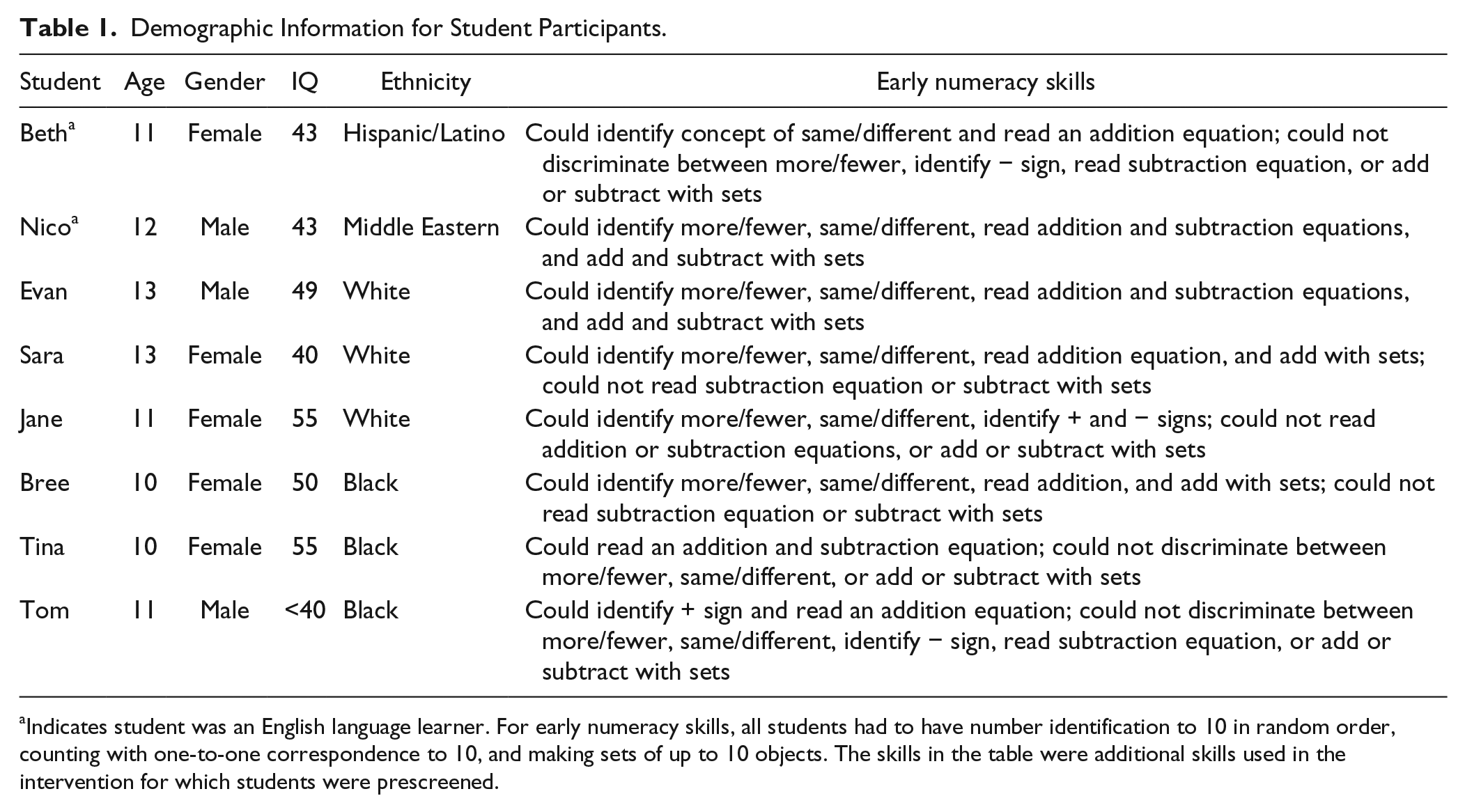
Indicates student was an English language learner. For early numeracy skills, all students had to have number identification to 10 in random order, counting with one-to-one correspondence to 10, and making sets of up to 10 objects. The skills in the table were additional skills used in the intervention for which students were prescreened.
Setting
The study took place in four self-contained classrooms for students with moderate/severe ID across two elementary and two middle schools within a large urban school system in the southeastern United States. The research team administered all problem solving tests in one-on-one sessions in each participant’s special education classroom. All classrooms in the study were equipped with an iPad and a SMART board. Four classroom teachers implemented the intervention with a researcher delivering the instruction in the teacher’s absence. The teachers were all fully licensed in special education; two teachers had extensive experience (15–20 years), one had 3 years, and one was a first-year teacher.
Materials
Student materials included 500 word problems, three graphic organizers (one for each problem type), a laminated task analysis, a problem solving mat with placement boundaries to help with organization of materials, manipulatives (counting cubes), dry erase markers, and erasers. For the video problem sessions, additional materials included the video-simulation problems and an iPad or laptop computer to display videos.
The 500 word problems were developed in consultation with classroom teachers using familiar themes (e.g., sports events) and high interest activities (e.g., going to the zoo) to teach three addition and subtraction problem types—group, change, and compare (Marshall, 1995). Each problem type was written using a formulaic approach, structured in a four-line format (i.e., the first sentence provided the context, anchoring instruction; the second and third sentences provided the numerals, key nouns, and the action; and the fourth line presented the question for which the students were solving). Names for the actors in the problems were chosen from list of popular children’s names from America’s major cultural groups. An example of a word problem is as follows: José went to the grocery store. He bought four apples and five bananas. How many pieces of fruit did José buy? The key nouns (e.g., apples, bananas) in the problem had a picture above them so students could follow the problem as it was read aloud by the teacher. Because of the students’ emerging numeracy skills, which required using manipulatives, all problems were written with sums of 10 or less and no differences of zero.
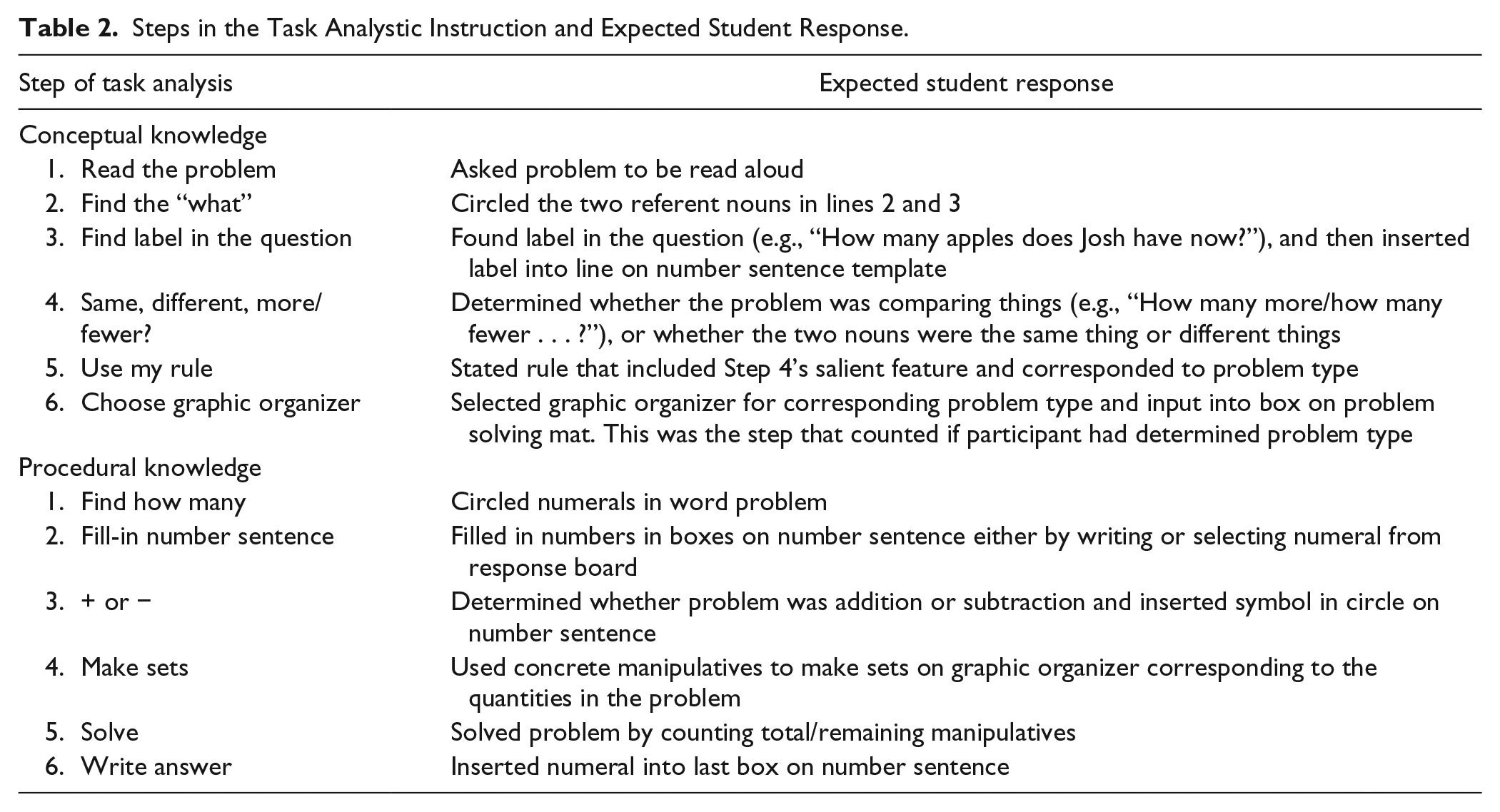
Graphic organizers were created for each problem type on 8.5" × 11" paper and laminated for durability. The figures in the graphic organizers were large enough for students to manipulate the counting cubes and demonstrate the operation on the graphic organizer. One student-friendly task analysis was used across problem types as shown in Table 2. The student version had picture cues to visually represent each step of the problem beside the written step, and students used dry erase markers to check off each step as they were completed (see Table 2).
Steps in the Task Analystic Instruction and Expected Student Response.
Scripted lesson plans were developed in the first phase of this Goal 2 IES Grant and were validated by content experts in schema-based instruction and in elementary mathematics. The lessons were sequentially delivered by unit: (a) Unit 1: Introduction Unit With Review of Early Numeracy Skills, (b) Unit 2: Group, (c) Unit 3: Compare, (d) Unit 4: Group and Compare Discrimination, (e) Unit 5: Change-Addition, (f) Unit 6: Change-Subtraction, (g) Unit 7: Change-Mixed, and (h) Unit 8: Discrimination of All Problem Types. Teachers were given a binder with scripted lesson plans for all units.
Video problems were created using Camtasia® software after filming videos with a smartphone video camera or a FlipCamera® in community environments familiar to the students (e.g., grocery store, supercenter, sporting goods store, pet store, chores at home, yard chores, school setting). Actors were filmed portraying mathematical problems representing each problem type. The actor presented but did not solve the problem, and the video did not show the solution. An example of video word problem is as follows: Xavier was bagging leaves in his yard. There were five bags of leaves (all five bags shown). Xavier hauled away two bags (showing boy starting to haul away bags). How many bags are left to haul away? (screen goes to question not showing the three bags left). This prevented the student from simply counting the final set from the items in the video to obtain the answer. The videos were shown on either a laptop computer or an iPad.
Chants for problem types
Problem types were taught using rules in the form of chants with hand motions to represent the underlying problem structures. The first problem type was group, which shows a part–part–whole relationship and combines two sets of things into one larger group. The group chant was “small group (left hand making an ‘O’), small group (right hand making an ‘O’), BIG group (bring hands together in big ‘O’).” The second problem type was compare, which contrasts quantities of items with some similarity and requires solving by subtraction. The compare chant was compare—more (arms parallel and top arm moves perpendicular upward) or fewer (arms back to parallel and bottom arm lowers), bigger number (hands held about a foot apart with palms facing), smaller number (bring hands closer together), difference between the two (draw a circle in air with right hand to indicate difference).
The third problem type was change, which shows a dynamic relationship where an initial set is either increased (solved using addition; for example, apples were added to a basket) or decreased (solved using subtraction; e.g., apples fell out of basket) resulting in a new ending amount. The change chant was “one thing—same (left hand held out with flat palm), add to it OR take away (right hand pantomimes putting something in right hand or taking it away), change (move left hand horizontally to indicate a change).” Participants performed the chants and hand motions directly over the graphic organizer or in front of the body.
Dependent Variables and Measurement
Four dependent variables were measured across phases. For mathematical problem solving, problems solved, and discriminations, data were taken during both problem solving tests and daily instructional sessions. The primary difference between the problem solving tests and daily instruction was the absence of prompting and feedback on the test. The problem solving test included six untrained word problems, two from each problem type, and was administered during baseline, at the end of each instructional phase, and during maintenance as described in the procedures. There were five versions of the problem solving test to minimize repetition with different numbers in each test. Data also were taken on problem solving during the first problem in instructional sessions to determine students’ performance progress toward mastery of skills before introducing the next instructional unit. Generalization probes were taken in baseline and at the end of each intervention phase.
Mathematical problem solving
Mathematical problem solving was defined as the number of independent steps performed on the 12-step task analysis for problem solving as shown in Table 2. The use of this task analysis captured the subtle daily progress students made toward following the problem solving steps during teacher instruction with prompting and feedback, and on problem solving tests without prompting or feedback. During instruction, teachers scored the number of steps independently correct on the first problem presented. For the problem solving test that consisted of six novel problems, a researcher used the first problem of each problem type to score steps correct. It should be noted that if a student performed Step 12 correctly, skipping all other steps, the problem was solved (see next dependent variable). In contrast, the prior steps of the task analysis required students to “show their work” allowing the researcher and teacher to check for conceptual and procedural understanding. Each step of the task analysis was scored as correct (+) or an incorrect (−). If the participant did not attempt to solve the problem, all steps were recorded as incorrect.
Problems solved and discriminations of problem type
The second and third dependent variables were problems solved and discriminations of problem type, measured by the total number of problems solved and discriminations of problem type on the problem solving test. The number of problems solved was based on performance on Step 12 of the task analysis (“write answer”) out of six total problems. The number of discriminations of problem type was based on performance on Step 6 of the task analysis (“choose graphic organizer”) out of six total problems. Figure 2 in the Results section captures student performance on problem solving tests without prompting and feedback.
Generalization
Generalization of problem solving skills was measured in two ways: (a) generalization to problems presented on the SMART board using virtual materials and manipulatives and (b) generalization to video problems using real-world mathematical scenarios. Each SMART board generalization session included presentation of two problems of the targeted problem type(s). The SMART board screen portrayed all materials including the problem, the graphic organizers, and the task analysis used for self-monitoring. Similar to the paper-and-pencil format, the number of independent steps performed on the 12-step task analysis for problem solving on SMART board problems was recorded. During the video generalization sessions, the students were shown two video problems of the targeted problem type(s) and given the opportunity (vs. required) to use the student materials to solve each problem if needed. For video problems, only the number of problems solved correctly was recorded. The researcher offered no prompting or feedback, but praised on-task performance.
Experimental Design
The experimental design was a single case multiple probe across dyads of participants design (Horner & Baer, 1978). The implementation of the design adhered to the criteria established by the What Works Clearinghouse (WWC; Kratochwill et al., 2013). The mathematical problem solving (i.e., independent correct steps on task analysis) was the primary dependent variable used to determine when to introduce the next dyad to the intervention. There were three experimental conditions of baseline, intervention, and maintenance for determining existence of a functional relation between the intervention and the dependent variables. The intervention condition consisted of five phases, including group, compare, group and compare discrimination, change, and discrimination of all three problem types to resemble possible instructional sequence in the classroom (i.e., phases representing units of instruction that were broken down to reduce cognitive load demands placed on learners when acquiring skills). When both members of a dyad showed an accelerating trend for correct number of steps in the group problem phase, the next dyad entered intervention. Each dyad continued through all intervention phases at their own pace of learning with the potential for overall performance increasing with each additional iteration of the intervention.
Procedures
General procedures
Throughout the study, participants received mathematics instruction from their respective special education teachers. Ongoing classroom instruction included computation using manipulatives or worksheets without word problems. Word problem solving was only taught during the implementation of the study. Prior to each problem solving test or instructional session in any phase, each participant had the opportunity to select a reinforcer from a menu (e.g., 5-min iPad time, sticker) to receive upon completion of the session.
Baseline and ongoing problem solving tests
The problem solving test was administered during each baseline session for at least five sessions. To ensure student performance did not differ across the researcher and special education teacher, problem solving tests were administered by both researchers and the special education teacher. During each problem solving test, the teacher or researcher provided the participant with the task analysis, the word problem solving mat, three graphic organizers, manipulatives, and said the instructional cue, “solve this word problem,” as she laid the word problem on the participant’s problem solving mat. The participant had 15 s to initiate the first step and if there was no response toward solving, the problem was removed and the next problem was presented. If the participant initiated some type of response, the researcher or teacher waited until the participant was no longer performing an action, verified the participant was finished, and removed the word problem. The researcher then administered baseline probes for both SMART board and video problems using six problems, two from each problem type.
Teacher training
Prior to implementation of each intervention phase, the teachers received training in the upcoming lesson plans in three professional development days on the university campus. Each day consisted of a preview of the plans, researcher demonstration, and teacher role-playing until 100% fidelity was demonstrated. After the first training day, the teachers viewed videos of themselves and scored their own procedural fidelity to check for any improvement areas. When a new phase of the intervention was introduced in the classroom, the research staff implemented the first lesson to model the approach. On the second day, the teacher implemented the lesson with the researcher coaching and delivering feedback as needed. If the teacher missed any instructional steps, the researcher provided feedback and modeled if needed.
Intervention (MSBI)
The teachers implemented the fully scripted lesson plans daily and each session lasted approximately 30 min. A minimum of two problems were presented during a session (this was increased in later phases when participants became more proficient to build stamina). The intervention was implemented using a model-lead-test approach with (a) 2 days of modeling by the instructor (i.e., researcher on Day 1, teacher on Day 2), (b) the student initiating all steps with the instructor using the system of least prompts with feedback and error correction as needed until the student could perform all steps independently, and (c) implementation of the problem solving test and generalization assessments at the end of the phase. During modeling, the task analysis was taught using total task presentation and each step of the task analysis was modeled followed by an immediate opportunity for the participants to perform the steps. No data were taken on student responses during modeling. Beginning on the third day, the instructor moved into “lead” where the student was provided with a 5-s opportunity to independently perform each step of the chained task. Using the script, the instructor provided (a) specific positive feedback for an independent correct response, (b) the system of least prompts if the student did not respond, or (c) error correction in the form of a model retest for an incorrect response. The instructor used a three-level prompting hierarchy: (a) gesture paired with verbal prompt where the instructor pointed to the step on the student’s task analysis and read it aloud, (b) specific verbal prompt where the instructor stated the step and what to do (e.g., “Step 3 says find the label in the question. The label is what we are solving for.”), and (c) model retest where the instructor showed the student what to do and then gave the participant a chance to redo.
During early acquisition of a unit, the instructor provided specific positive feedback for all independent correct steps. Once a participant demonstrated consistent performance on a step, specific positive feedback was thinned to Steps 1, 6, 8, 9, and 12 only. By the end of the “discrimination of all” unit, specific positive feedback was thinned to only Step 12. Mastery criterion was set at eight out of 12 steps performed independently correct and both problems solved for two consecutive sessions. During discriminations phases, the participant was required to get both discriminations correct to meet mastery.
Maintenance
When a participant met the mastery criteria for the “discrimination of all” unit by (a) solving and (b) discriminating the problem type for five out of six problems correctly for two consecutive sessions, he or she entered the maintenance condition. A maintenance problem solving test was administered 1 week after the final phase assessment.
Interobserver Agreement (IOA)
A member of the research team collected IOA data for all dependent variables. For teaching sessions, IOA data were collected during an average of 54% of instructional sessions across all conditions and participants. During researcher-administered problem solving tests, a second member of the research team collected IOA data during an average of 22% of sessions across all conditions and participants. IOA was calculated using the item-by-item method by dividing the number of agreed items by the total number of agreements plus disagreements and multiplying by 100. An agreement occurred when both observers score a step or the discrimination the same. There was a mean of 98.9% (range = 94%–100%) for the task analysis during instruction, 99% (range = 99%–100%) for the problem solving test, and 99% (range = 99.5%–100%) for generalization probes across conditions and participants.
Procedural Fidelity
Researchers recorded procedural fidelity data during 99.4% teacher intervention sessions by coding each step of the task analysis correctly taught. The researchers also assessed quality of teacher delivery (3 = high [enthusiastic, engaging, supported students, good pace], 2 = moderate [delivery was adequate, included all steps but missed some student feedback, slow pace], 1 = low [boring, missed/skipped steps, discouraging to students, very slow pace >25 min]), and overall student engagement on a 4-point scale (3 = actively engaged, 2 = cooperative/passive, 1 = not attending, 0 = resistant or dismissed from group). The researcher provided the teacher with immediate feedback following the lesson on any steps missed or performed out of order, and if quality of instruction was 2 or below or if student engagement was less than 3 (occurring during less than 1% of all sessions). Procedural fidelity data were calculated by dividing the number of steps performed correctly by the number of applicable steps and multiplying by 100%. Across all phases and participants, procedural fidelity was 100% for baseline probes, 99% (range = 98.3%–100%) for instructional sessions, and 99% (range = 99.3%–100%) for generalization probes.
Social Validity
Five teachers completed a social validity survey following the completion of the intervention to indicate their level of agreement with statements about the intervention and materials, the impact of the intervention on their instruction, the coaching model, generalization materials, and benefits for their students. Teachers responded to 24 questions using a 4-point Likert-type scale (i.e., 1 = strongly disagree, 4 = strongly agree). Students also were interviewed at the end of the intervention on whether or not they liked participating in the intervention, whether they would like to continue, and whether they liked the SMART board and video problems.
Results
Mathematical Problem Solving
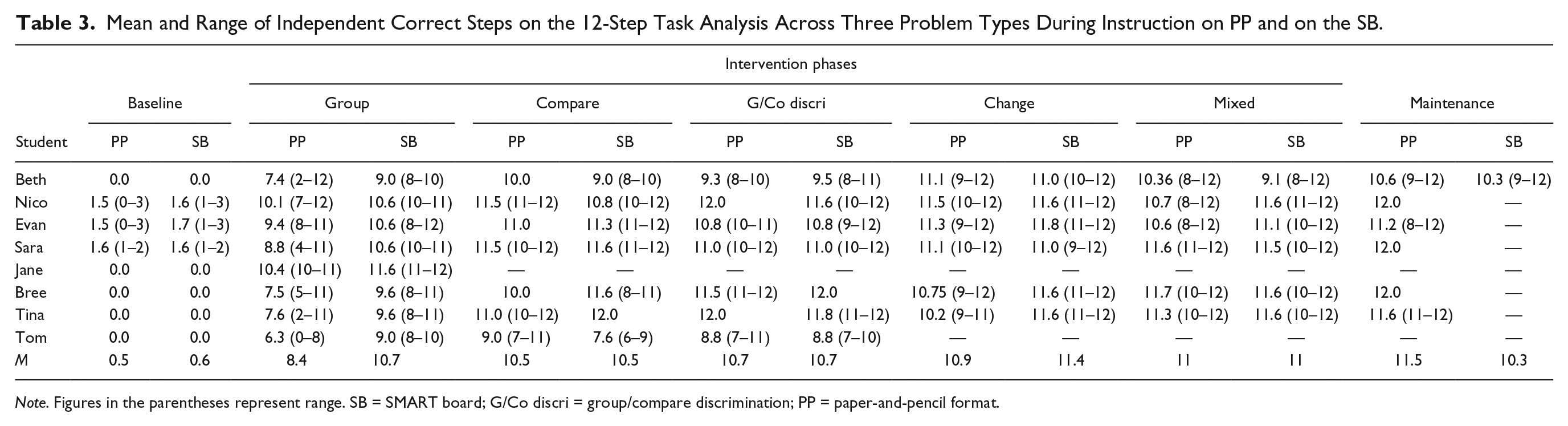
Figure 1 shows the effect of MSBI on the 12-step task analysis for problem solving across four dyads of students. Probe data (closed symbols) were from the problem solving test based on first problem of all problem types. Instructional data (open symbols) were collected for the problem types during instructional sessions. During baseline, five students had zero level of responding, and three students (i.e., Nico, Evan, Sara) showed low levels of responding with no more than three independent steps correct, which typically included finding the numbers and adding them together using various strategies (e.g., finger counting, tick marks). During the intervention condition, all students showed an immediate increase in level or an increasing trend with an overall mean of 8.4 steps for group, 10.5 steps for compare, 10.7 steps for group/compare discrimination, 10.9 steps for change, 11 steps for mixed discrimination of all problems, and 11.5 steps for maintenance for the targeted problem type(s) across students. Visual analysis of the graph shows a functional relation between MSBI and the number of steps performed independently correct for solving a word problem with intervention staggered across dyads in typical multiple probe fashion. Improvements continued across all intervention phases for all students, with exceptions for Jane who left the school system prior to completing the study and Tom who made steady progress but did not complete all phases of the intervention before the school year. All the remaining six students mastered the problem solving steps in every phase (see Figure 1).
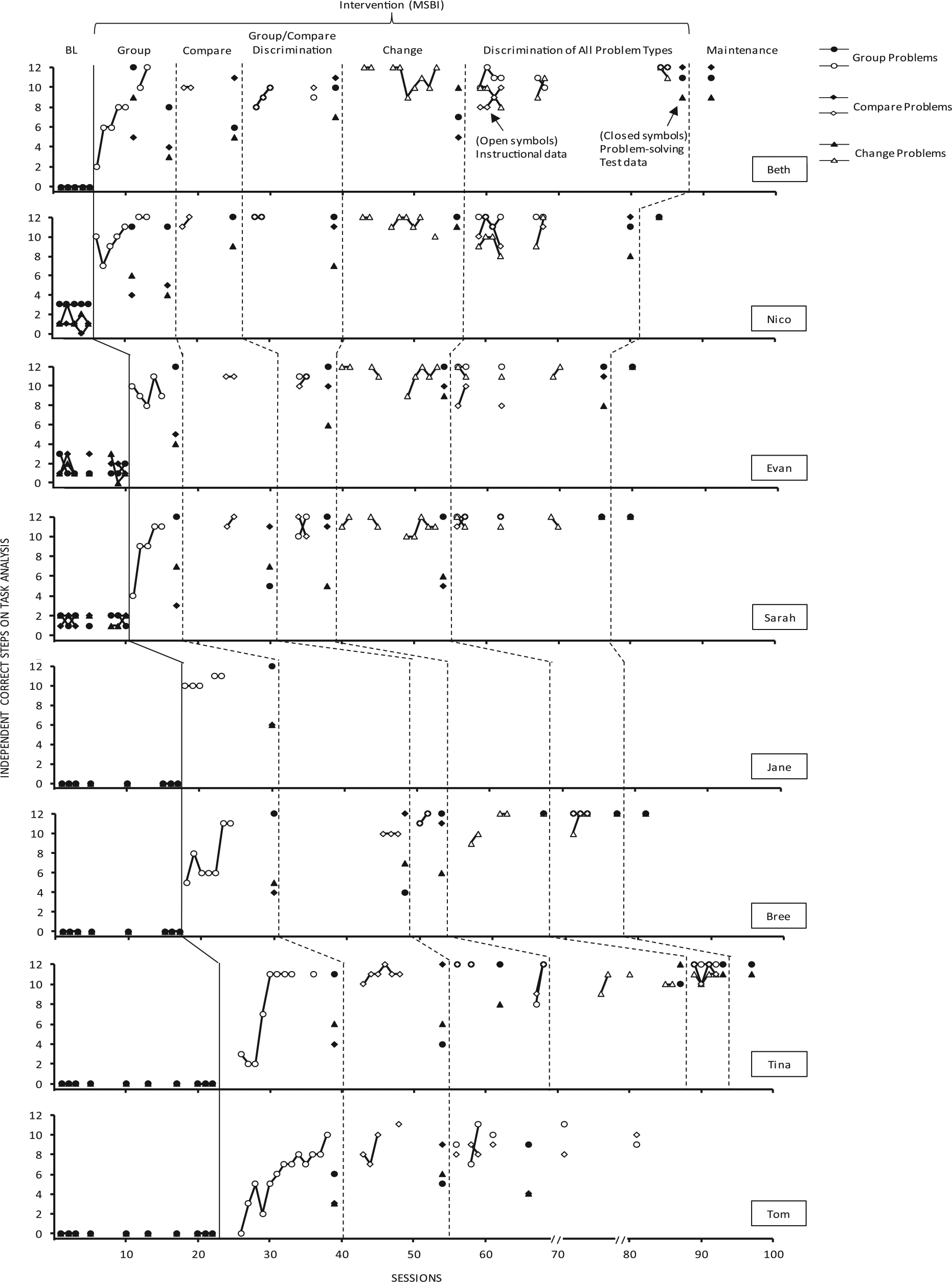
Number of correct step completion on a 12-step task analysis by problem type (group, compare, change).
Problems Solved and Discriminations of Problem Type
Figure 2 shows the effects of MSBI on total problems solved and discriminations of problem type made on problem solving tests. During baseline, six students had zero correct responses and two students (i.e., Nico and Evan) solved some addition problems. None of the participants discriminated among problem types during baseline. During intervention, all students showed a steady increase in solving and discriminating problems across intervention phases. Six participants solved at least five out of six problems in the problem solving test and discriminated all six problems at the end of the intervention and during maintenance condition. Visual analysis of the graph shows a functional relation between MSBI and the number of problems solved and discriminations made on problem solving tests for the six students who completed all phases. Tom had some increase in the number of problems solved and discrimination of problem types, but needed more time to complete all phases (see Figure 2).
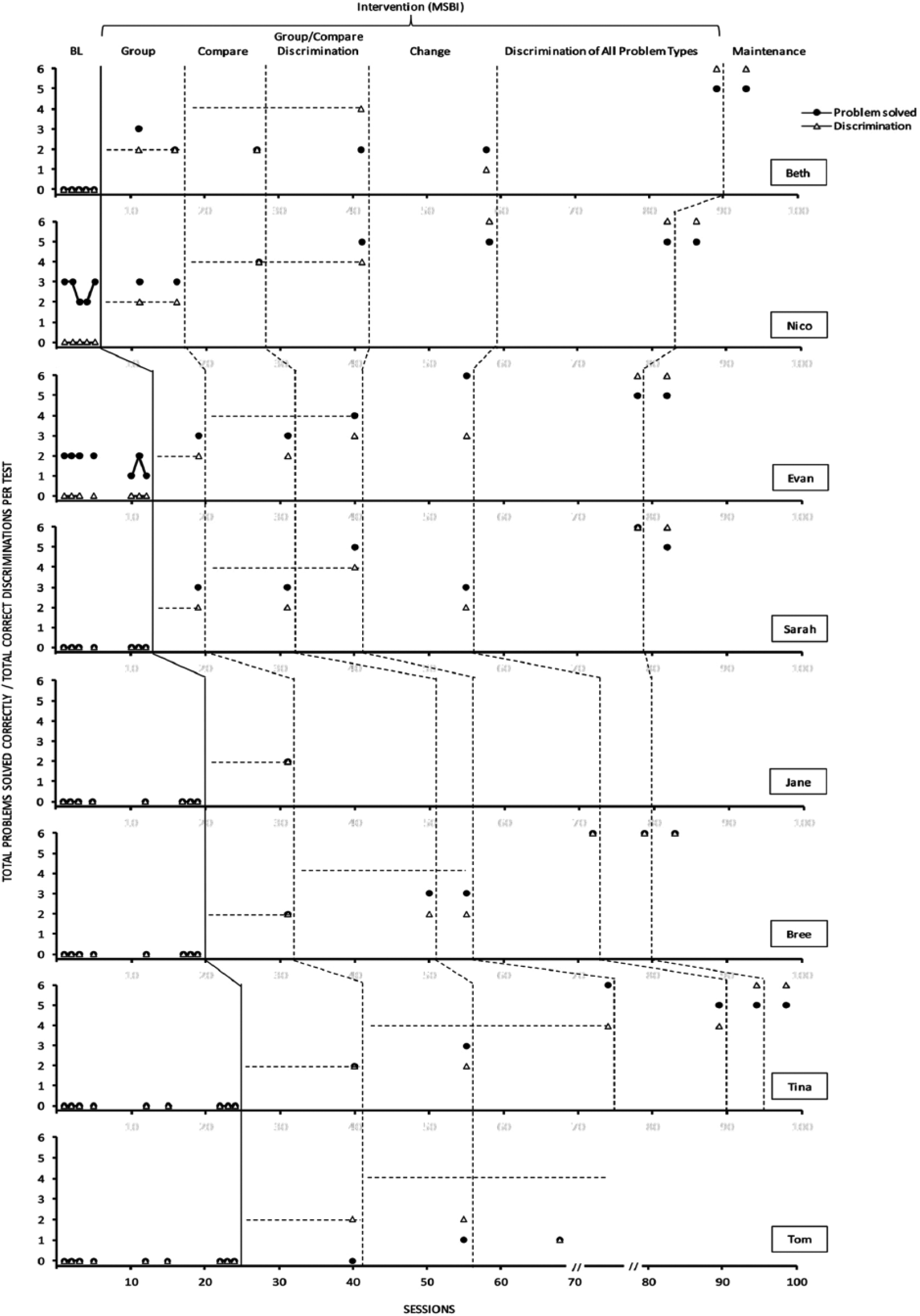
Number of problems solved correctly (Step 12) and correct discriminations of problem types (Step 6) on problem solving test out of six problems.
Generalization
Table 3 displays the mean and range of independent correct steps on the task analysis across the three targeted problem types during instruction on paper-and-pencil formats and on the SMART board generalization probes. Participants were able to generalize the number of steps they performed independently correct from the paper-and-pencil format used in instruction to similar materials displayed using a SMART board as shown in the comparable number of steps correct across both formats (see Table 3). Data on video-simulation problems showed an increase from an average of 1.0 (range = 0–3) video problems solved correctly during baseline to 11.0 (range = 0–22) video problems by the end of the intervention. Four participants generalized their problem solving to video problems and three students did not generalize their skills.
Mean and Range of Independent Correct Steps on the 12-Step Task Analysis Across Three Problem Types During Instruction on PP and on the SB.
Note. Figures in the parentheses represent range. SB = SMART board; G/Co discri = group/compare discrimination; PP = paper-and-pencil format.
Social Validity
All teachers agreed the intervention was useful, practical, and beneficial to their students. Teachers felt the intervention not only helped build problem solving skills but also improved students’ self-monitoring skills, early numeracy skills, and their independence on completing a task. Teachers commented that they liked the coaching model with a researcher modeling the first day of a unit, followed by them taking on the teaching role with feedback from the researchers. Teachers also reported that it improved their confidence in teaching mathematics to students with moderate ID and their implementation of systematic instruction. Students reported liking participating in the intervention, learning mathematics, and approximately half reported liking the videos and the SMART board.
Discussion
This study investigated the effects of MSBI on mathematical problem solving for students with moderate ID. Modifications to traditional schema-based instruction included visual representations of the problem types, a task analysis with self-monitoring and self-instruction, addition of systematic instruction with feedback and error correction, and metacognitive strategy instruction with think alouds modeled by the instructor and rules taught as chants. Six out of eight participants completed the intervention and mastered the problem solving steps for all problem types. During the problem solving test, they increased both number of problems solved and discrimination of problem types. All six students also generalized these skills to a technology (SMART board) platform with some generalization to the video-based format.
Feasibility of Teaching Problem Solving
The current study was the first to demonstrate that students with moderate ID can learn to solve word problems including how to discriminate problem types. Most research has focused on computation without word problems or applying problem solving to one highly specific context like making a purchase (Browder et al., 2008). Unfortunately, the real world neither presents mathematical problems with computation formulas provided (e.g., 3 + 5 =) nor signals the problem type (e.g., that it is a change problem). Furthermore, teaching problem solving through one specific activity at a time limits the number of skills students will have to function as adults and prevents students’ full access to general curriculum content.
In the current study, students with moderate ID not only learned to solve word problems by following the 12-step task analysis but also acquired the complex skill of discriminating between three problem types (i.e., group, change, compare) that included two operations of addition and subtraction. Although it was feasible for students to solve problems correctly without completing most of the steps, the task analysis provided a means for students to “show their work” and for researchers and teachers to check students’ conceptual and procedural understanding of problem solving. An examination of data in Figures 1 and 2 shows that as students improved their completion of problem solving steps across intervention phases, they also increased the overall number of problems solved and problem types discriminated. The students who completed the intervention mastered both correct problem solving and discrimination of problem types. All students were able to show how sets were grouped, changed, or compared with either physical or virtual manipulatives. Students’ improved performance on discriminations (Step 6) may suggest they were able to identify salient features of the problem structures; whereas solving problems correctly (Step 12) may imply students were also able to create a number sentence and to make sets with manipulatives. The students also used the chants as a portable system for remembering how sets were manipulated in each problem type. The high level of student engagement across nearly all sessions suggested that the intervention might be motivational for the students. Although the current study was limited in focusing on small sums (under 10) and two operations (addition and subtraction), it offers a possible foundation for building future mathematics interventions for students with moderate ID with findings supporting research by Ley Davis (2016) and Root, Saunders, et al. (2017).
The six students who mastered the entire intervention did so in one school year through daily instruction in dyads provided by the classroom teacher, demonstrating this is a feasible learning goal for students with moderate ID in typical school contexts. The students in the current study were learning to add and subtract concurrently with problem solving, and for three of the four elementary students, this was the first time they had been given explicit instruction in subtraction. Although Tom progressed slower than the other participants and would need more than a school year to complete all phases of the intervention, he steadily improved in all measures. These findings suggest that MSBI provided an effective means for students with moderate ID to access and learn problem solving.
Types of Modifications Needed
In MSBI, modifications addressed challenges faced by students with ID by adopting effective strategies for the students while maintaining key components of traditional schema-based instruction. One of the first steps in acquiring a schema to solve a word problem is to represent the problem. In research with students with high incidence disabilities, the participant draws the representation (Jitendra, 2008). Students in the current study selected a premade graphic organizer for each problem type and used manipulatives (physical or virtual) to solve. The graphic organizers not only offered a visual referent for the students but also showed whether students conceptually understood the mathematical processes (i.e., combining sets, composing and decomposing sets, and finding the difference between sets). Although drawing a schematic diagram might be an option for some students with moderate ID, an area for future research is to determine whether and how graphic organizers could be faded over time.
Using the task analysis as a student checklist also served as a way for students to show their work, by self-instructing and self-monitoring their behavior as they completed the problem. Task analytic instruction, or teaching each step in a chain of responding, has been highly effective for students with ID in academic tasks like mathematics (e.g., Creech-Galloway et al., 2013). Self-monitoring also has a long history of effectiveness with this population and has the added benefit of promoting student self-direction in learning (Smith et al., 2016). The steps of the task analysis were taught first through explicit instruction, with two initial sessions of modeling the task, followed by sessions using the system of least prompts as the student was encouraged to initiate each step of the task analysis to solve the problem.
In addition, the MSBI included use of metacognitive instructional strategies. In traditional schema-based instruction, students use a think aloud process, follow the mnemonic for problem solving (e.g., RUNS), and draw their own schematic diagram to recall problem type. In the current study, teachers modeled think-aloud processes for identifying problem types and for solving. Students also were taught chants specific to each problem type to promote metacognition. The chants were easily memorized and engaging for students, described salient features of each problem type, and the corresponding hand motions helped students recall the problem type because the motions mimicked the relationships between quantities on the graphic organizers.
Generalization of Problem Solving
Students in the current study were quick to generalize their skills to a technology (SMART board) format where they used the on-screen version of the task analysis and graphic organizers with virtual manipulatives. Some teachers informally reported their desire to have the option to switch between using paper and virtual formats as a way to maintain student motivation. Because students with moderate ID need extensive repetition to learn new skills, varied formats may help to make the same skill set appear novel. In addition, using multiple themes of the problems with interchangeable numerals offers variety in instruction while maintaining focus on a specific skill set over multiple sessions. On the problem solving tests, students encountered new problems, and their improved performance may have suggested generalization to novel problems and themes.
Students’ generalized skills to the real-world video problems showed improvement, but not at the same level of mastery as the paper and SMART board formats. This, in part, may have been due to limitations in the structure of the videos. Although the videos went blank before the sets were formed so the students could not simply count to get the answer, this also removed the natural visual cue students can use in real-life mathematical problem solving. Another problem was the videos required listening skills not typical of real-life scenarios. In future research, it may be preferable to have actual objects for the students to manipulate so the generalization probe more closely approximates the real-world context. Given these limitations, it is still notable that half of the students generalized their word problem solving skills to the video problems.
Limitations and Recommendations for Future Research
This study presents several limitations that also offer directions for future research. First, as mentioned previously, the structure of the video problems may have limited some participants’ performance. Future research may examine video-simulation mathematical problems and directly measure generalization in authentic settings. Second, although this study is the first to teach students with moderate ID to solve and discriminate three problem types, the scope and sequence of mathematical competences goes far beyond the skills targeted in the current study. Future research on the effectiveness of MSBI on problem solving across other domains (e.g., algebra and data analysis) and operations (e.g., multiplication and division) with greater numbers (e.g., sum > 10) is warranted. The study also did not involve fading of supports (such as pictorial cues and graphic organizers) based on individual student’s performance. Many students in the study began to naturally “chunk” steps of the task analysis (Steps 1–3, 4–6, 7–9, and 10–12). Future researchers may investigate using sequential modification to remove or modify supports as students demonstrate mastery. Finally, because the intervention included multiple components, the contribution of each component is not known and a component analysis will be important in future research.
Implications for Classroom Practice
Findings from this study suggest students with moderate ID can learn to solve and discriminate between problem types. This study supports the use of MSBI to teach students to access, conceptually comprehend, and procedurally solve mathematical word problems as well as to generalize problem solving multiple ways. Transfer to actual classroom practice may be feasible given that the participating teachers were able to deliver instruction with a high level of fidelity to students in small groups (dyads). Both teachers and students also reported high acceptability of the teaching approach, supporting its feasibility.
To replicate the intervention in a classroom context, it is important to apply each of the intervention components. Specifically, students may need the visual referents of the graphic organizers to represent each problem type and a pictorial task analysis to self-monitor each problem solving step. Chants may help students discriminate between problem types by recalling salient features and the relationships between quantities. Students may need weeks to learn each problem type, but this repetition can be made novel by changing themes across sessions. Students also will likely need a specific sequence to learn problem types individually (group, compare, change) with planned discrimination training of problem type. Through manipulation of sets, students can become more fluent in addition and subtraction.
Conclusion
In this study, students with moderate ID learned to solve word problems with one-digit addition and subtraction and to discriminate between three problem types (i.e., group, compare, and change). Although prior studies have addressed teaching students with moderate ID to solve word problems, the current study was the first to include discrimination of problem type. Six students mastered the problem solving and an additional student mastered two of the three problem types by the end of the study. The intervention was a modification of schema-based instruction with the additional supports of graphic organizers, chants of the rules, and self-monitoring of a task analysis of steps to solve the problem. Although this study shows promise that students with moderate ID can learn to solve word problems, more research is needed to replicate the findings and to evaluate the intervention for other mathematical skills.
Footnotes
Authors’ Note
The opinions expressed do not necessarily reflect the position or policy of the Department of Education, and no official endorsement should be inferred.
Declaration of Conflicting Interests
The author(s) declared no potential conflicts of interest with respect to the research, authorship, and/or publication of this article.
Funding
The author(s) disclosed receipt of the following financial support for the research, authorship, and/or publication of this article: Support for this research was provided in part by the U.S. Department of Education, Institute of Education Sciences Award R324A130001, The Solutions Project.