






Abstract
The individualized education program (IEP) meeting is a key component of the special education process wherein parents, the student (as appropriate), and school professionals come together at least annually to determine goals and needed supports and services for students with disabilities. Though existing research has highlighted parent experiences in IEP meetings, there is little representation of Black families. Such limited research is problematic, especially given that, compared to White families of children with disabilities, Black families are more likely to experience systemic barriers to family-school partnerships. To address this gap in the literature, we interviewed 24 Black parents of students with IEPs to explore their IEP meeting experiences, including barriers to participation. Participants also shared advice for other Black families including, encouraging them to advocate for their children and collaborate with other IEP team members. Findings have implications for research, practice, and policy.
Introduction
Due to their exceptional learning needs, students with disabilities often require access to specialized supports and services, such as special education, in school settings (Rodgers et al., 2021). A student’s eligibility for special education supports is determined through the individualized education program (IEP) process (Individuals with Disabilities Education Act [IDEA], 2004). The IEP process revolves around procedures for the development of the IEP, a legally binding document that reflects the student’s present levels of performance, specific supports and services, and annual goals. To develop an IEP, an IEP meeting is required at least annually. According to IDEA (2004), the IEP team includes the student (as appropriate) and the student’s parents. Certain school professionals are also IEP team members including general and special education teachers, relevant related service providers, a professional who can accurately interpret educational assessments, and a representative from the local education agency. Each member of the IEP team offers expertise toward the development of the IEP. For instance, special education teachers provide knowledge on individualized instruction. As a key member of the IEP team, parents are experts on their children and should be equal partners in educational decision-making (Kurth et al., 2019).
IEP meetings are meant to be collaborative undertakings between families and school professionals (Mueller et al., 2019; Reiman et al., 2010). Ideally, during the IEP meeting, the team works together to create meaningful goals for the student and agree upon needed supports. Parents report positive perceptions of IEP meetings when school professionals take a strengths-based view of the student, focus on addressing the student’s needs, and work together with parents as a team (Gershwin et al., 2023; Sanderson & Goldman, 2023).
Unfortunately, some parents have reported negative experiences with IEP meetings. For instance, parents report that school professionals often present predetermined IEPs, leaving little room for parent input (Kurth et al., 2019). Rather than agreeing on needed supports and services, parents are often forced to fight schools to secure services for their child (Zeitlin & Curcic, 2014). Further, many parents face barriers that hinder their participation in IEP meetings, including logistical barriers (e.g., limited access to childcare and/or transportation, conflicting work schedules; Cavendish & Connor, 2018); cultural barriers (e.g., cultural unresponsiveness and inadequate information in the parents’ language; Blackwell & Rossetti, 2014); and/or informational barriers (e.g., the use of jargon by educators and a lack of understanding of special education laws and processes; Rossetti et al., 2017). Even when parents do participate in IEP meetings, many feel that their input is not valued by school professionals (Rossetti et al., 2020).
Most of the aforementioned research focuses on the experiences of White families, leaving the IEP meeting experiences of marginalized groups, including Black families, underrepresented (Wilson, 2015). Black families face unique challenges as they navigate the special education system (Koffer Miller et al., 2023). In the United States, school professionals are predominantly White, leading to cultural misunderstandings (e.g., discounting Black parent involvement in their child’s schooling) between Black families and school professionals (Love et al., 2023; Marchand et al., 2019). Racism and bias among school professionals may lead to disrespect and discrimination toward Black families (Sanderson & Sarti, 2026; Wolfe & Duran, 2013). Black families may be multiply marginalized due to their various intersecting identities (e.g., race, parent of a child with a disability, socioeconomic status, gender, and/or sexuality; Watson-Singleton et al., 2023). In turn, Black families must overcome even greater barriers to effective collaboration with the school (Bottiani et al., 2020; Rossetti et al., 2020; Zionts et al., 2003). Systemic barriers such as limited access to resources and power structures that marginalize parents of color can also contribute to negative experiences when Black families advocate for their child with disabilities and navigate the special education system (Marchand et al., 2019; Pearson et al., 2020). Such barriers to parent participation may contribute to poor outcomes for Black students with disabilities, including receiving disability diagnoses at a later age (Pearson et al., 2020), racial disproportionalities in obtaining an IEP (Morgan et al., 2017), and higher rates of unmet service needs (Koffer Miller et al., 2023).
To navigate the special education process, and in particular, IEP meetings, Black parents may want advice from other Black families of children with disabilities, given their shared experiences. Parent-to-parent support offers parents of children with disabilities the opportunity to learn and gain information from parents with similar experiences (Santelli, 2018). In Sanderson’s (2023) national study of more than 800 parents of children with disabilities, parents gave advice about the IEP meeting to other families of students with disabilities. Advice included, preparing for the IEP meeting by educating themselves about special education laws and processes, asking questions during the meeting, advocating for their child’s best interests, being a team player, taking the IEP document home for review before signing, and emotionally preparing themselves for negative experiences. While this advice may be universally helpful, the majority of participants in this study identified as White. Further, much of the advice does not directly mitigate the barriers Black families of children with disabilities face (e.g., stigma, racial discrimination, lack of cultural responsiveness). When attending IEP meetings and advocating for their children, Black parents of students with disabilities may benefit from hearing directly from other Black families who share similar circumstances, including similar racial and cultural backgrounds (Burke & Goldman, 2018).
Theoretical Framework
Yosso’s (2005) Cultural Wealth Model is the theoretical framework for this study. The Cultural Wealth Model offers an asset-based view of families of color, acknowledging the variety of strengths these families possess. Specifically, this framework posits that families of color, such as Black families, encompass various forms of cultural capital. Four forms of cultural capital suggested by Yosso are particularly relevant to the current study: familial (i.e., a sense of kinship among community members), social (i.e., shared supports and resources among community members), navigational (i.e., skills to navigate social institutions [such as schools] that were designed around the values of the dominant culture), and resistant capital (i.e., skills to oppose inequities against their community). As IEP team members, Black parents of students with disabilities tap into each of these forms of capital as they work with school professionals to develop IEPs that meet the needs of their children.
Given the importance of IEP meetings for students with disabilities, it is essential to learn more about the experiences of Black families. Through advice offered by Black parents, other Black families can receive guidance on navigating special education. Listening to the experiences of Black parents of students with disabilities, including barriers faced in participating in IEP meetings, can also support special education professionals to understand and change power structures and address systemic barriers to meaningfully improve the IEP process for those who have historically been marginalized. Thus, for this study, we aimed to address a gap in the literature by exploring the IEP meeting experiences and advice of Black families of students with disabilities. We addressed the following research questions:
Method
Participants
To be eligible to participate in this study, individuals were required to: (a) be 18 years or older, (b) identify as Black or African American, (c) be the parent or legal guardian of a school-aged child with a current IEP, and (d) have attended one or more of their child’s IEP meetings. The term “Black” is used throughout the manuscript to describe participants’ racial identities. This term was selected to be inclusive of the range of participants’ ethnic identities and ancestral origins, including African Americans (National Institutes of Health, 2024).
The Qualtrics interest form from our recruitment flyer was completed by 92 individuals. After removing respondents who failed to provide contact information (n = 6), there were 86 eligible respondents. The research team contacted 33 eligible participants based on responses to demographic questions on the Qualtrics participant interest form. We aimed to include Black caregivers of a child with an IEP from a variety of backgrounds (e.g., diverse genders, household incomes, child disability diagnoses, residing across a variety of U.S. states). Nine of the respondents we contacted were unavailable (two did not respond to repeated attempts at communication and seven did not attend their scheduled interview date), leaving a final sample of 24 parents who participated in interviews; one interview was conducted with two parents from the same family. Interviews concluded when saturation was achieved.
Although participation was open to parents and legal guardians of school-aged children with disabilities, all identified as parents. Participants were 48% male (n = 11), resided in 12 U.S. states (California, n = 7; Florida, n = 5; Texas, n = 2; Georgia, Illinois, Indiana, Maine, Maryland, Michigan, New York, Ohio, and Utah, all n = 1), and had a median annual household income of $40,000 to $49,999. Participants’ children were 43.5% female (n = 10) and ranged in age from 5 to 18 years (M = 9.6 years). Participants reported six different special education eligibility categories for their children. Participants were assigned pseudonyms (see Table 1).
Participants.
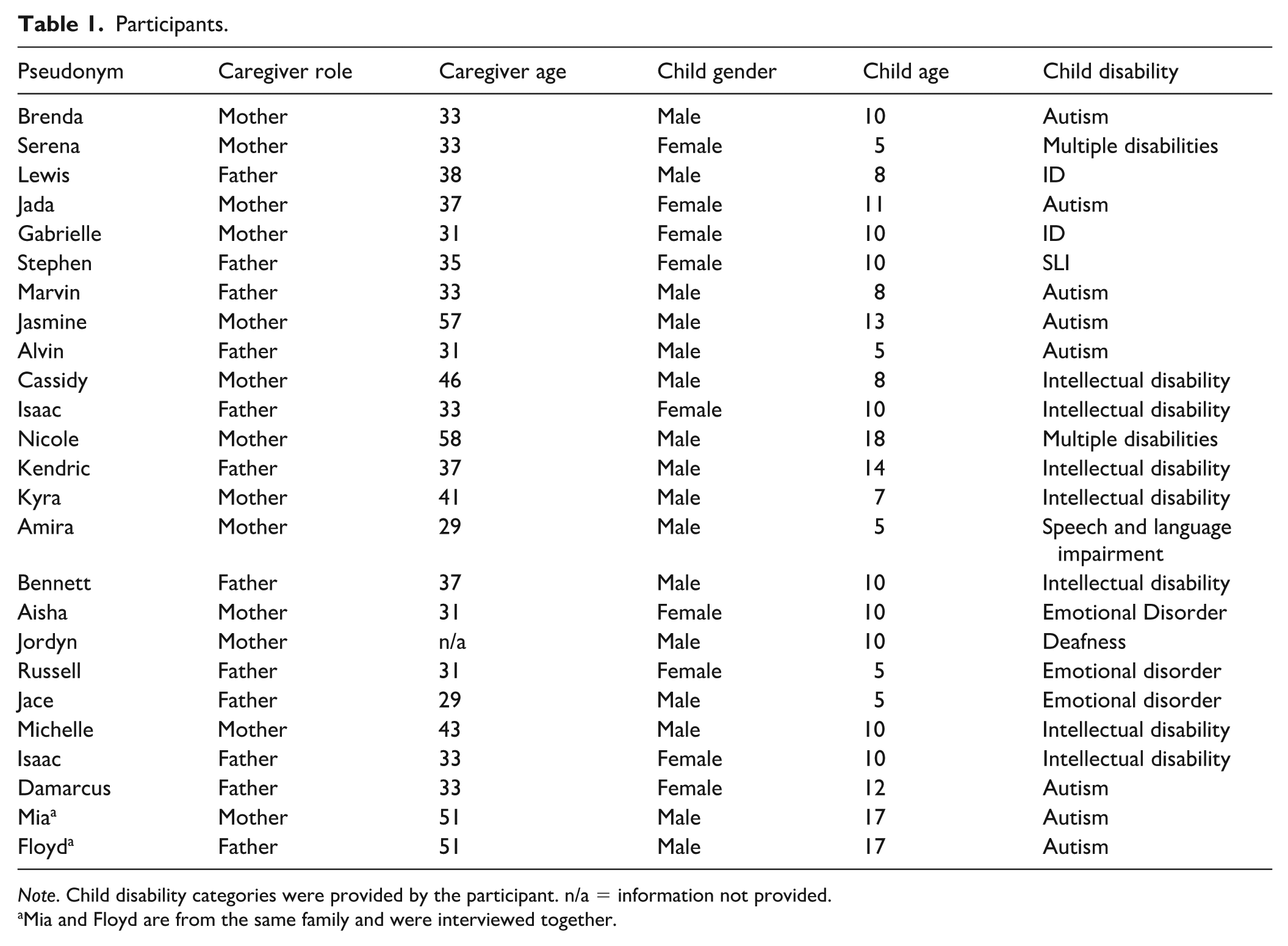
Note. Child disability categories were provided by the participant. n/a = information not provided.
Mia and Floyd are from the same family and were interviewed together.
Recruitment
Recruitment was conducted through e-mails that were distributed to the 107 Parent Training and Information Centers (PTIs) and Community Parent Resource Centers (CPRCs) listed by the Center for Parent Information and Resources. Recruitment e-mails described the purpose of the study and contained electronic flyers. PTIs and CPRCs were asked to share the study flyer with Black parents or legal guardians of students with disabilities who may be interested in participating. Flyers contained a description of the study, participant eligibility information, compensation information, the principal investigator’s contact information, and a link to a Qualtrics form. Each participant received a $50 electronic gift card to their choice of Amazon, Target, or Walmart for completing the demographic questionnaire and the interview.
Measure: Demographic Survey
Each participant completed a short demographic questionnaire on Qualtrics, which took approximately 5 min. The survey asked questions about participants’ racial identity (i.e., Black or African American), caregiver role (i.e., mother, father, legal guardian), age, gender, education, household income, marital status, and state of residence. Additional survey questions asked about the participant’s child, including age, gender, and primary disability category.
Procedures
Interview questions were developed by the first author based on existing literature (e.g., Burke et al., 2020; Haines et al., 2015; Harry, 2008). Interview questions were reviewed by a university Special Education faculty member who identified as Black. They were piloted by a Black mother of a school-aged individual with a disability; no changes were suggested or made. See Appendix A for the interview protocol.
Recruitment began once the study was approved by the university’s institutional review board. Interested individuals clicked on the link on the flyer and were taken to a screening that ensured they met the inclusionary criteria based on self-report. Then, they provided electronic consent. After providing consent, they completed the demographic survey. In February and March of 2023, one-on-one semi-structured interviews with participants were conducted by two university faculty members and two graduate students. The interviewers embodied diverse racial identities: one faculty member identified as Black, one graduate student identified as Latino, and one faculty member and one graduate student identified as White. Interviews were conducted using the modality (n = 18 on Zoom®, an online video communication platform; n = 5 by phone), date, and time preferred by the participant. All interviews were audio recorded. Each interview lasted approximately 30 min, with a range from 20 to 60 min.
Data Analysis
Each interview was transcribed verbatim from the audio recording. Next, all identifying information was removed from the transcripts. We aimed to reduce bias by using multiple researchers to code the data (Jonsen & Jehn, 2009). Two researchers trained in qualitative coding (i.e., the first author and a graduate student research assistant) manually analyzed data (i.e., no software) using a constant comparative approach, rooted in grounded theory (Corbin & Strauss, 2014). The constant comparative method emphasizes an iterative approach to data analysis, with multiple stages of refining and categorizing data (Kolb, 2012). This method allows researchers to develop theories from the data. Given that relatively little is known about the experiences of Black parents during IEP meetings, this was the most appropriate analytical approach for this study.
For this study, the researchers familiarized themselves with the data by reading through each interview, before using open-coding to independently code the data line-by-line. The researchers then met to compare their codes and collaboratively develop a set of codes. Next, they each returned to the data separately, analyzing the data using the agreed-upon codes. The researchers met again to compare coding. At this meeting, the researchers addressed any discrepancies through discussion until consensus was reached. Next, the two researchers drew connections between codes, grouping them into overarching themes using axial coding. Finally, the second and third authors reviewed the codes and themes and provided feedback. The authors engaged in discussion until consensus was reached. At this point, themes were finalized. After identifying themes, the researchers examined the data to identify whether there were patterns between demographic characteristics and the themes (e.g., gender, child age); no patterns were identified. See Supplemental Materials for the codebook.
Author Positionality
The three authors identify as White women who work in the field of Special Education. All are professors of Special Education at different ranks in varying types of universities located in states that are diverse geographically, politically, and in terms of special education practice and policy. All authors previously worked as special education teachers and, in those roles, experienced building partnerships with Black families of students with disabilities at different grade levels. The authors represent different social identities in terms of marital status, sexual orientation, and religion. One of the authors is the parent of a child with a disability. Although we reflected on our personal biases through regular peer debriefing throughout the data analysis and writing process and aimed to capture the participants’ authentic voices, we recognize that implicit biases may have impacted our interpretation and presentation of findings. Therefore, though we hope readers consider our interpretation of findings, we urge readers to use their personal experiences and viewpoints to draw meaning from the data we share.
Trustworthiness
Member checking was conducted to enhance the validity of our data (Coleman, 2022). Each participant was sent their full transcript via email and asked to verify the accuracy of their interview transcript. Participants were given the option to retract, clarify, and/or expand on any statements. All participants (100%) verified the accuracy of their transcriptions within 1 week. No changes, clarifications, or expansions were requested.
Findings
IEP Meeting Experiences
Main themes related to the IEP meeting experiences of Black parents of children with disabilities are shown in Table 2.
Main Themes With Supporting Quotes.
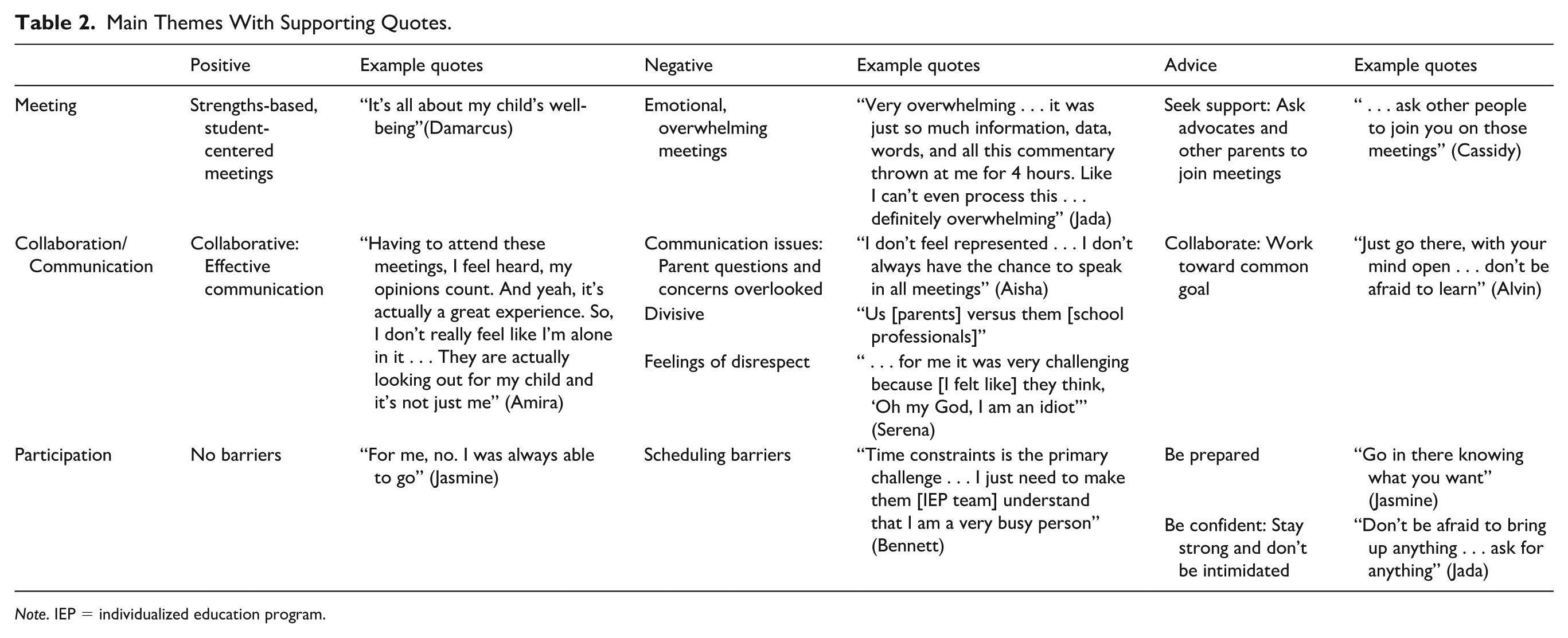
Note. IEP = individualized education program.
Positive IEP Meetings
Participants described positive IEP meetings as student-centered and collaborative.
Student-Centered
Participants appreciated when IEP meetings were student-centered. Specifically, when meetings were focused on their child, participants reported that team members knew their child well and/or educators had the child’s best interests at heart. For instance, Alvin, father of a 5-year-old with autism, shared that his son’s IEP meetings shifted once his son began attending and participating in those meetings. He stated, I notice that there’s a positive change . . . They tend to, you know, talk to him like he is in charge, like he is his own person. You know, irrespective of his age and stuff. With children with autism also, you know, they want to be in a place where you respect them, their stuff, their boundaries.
IEP meetings were viewed as beneficial when they centered on the child’s strengths and needs.
Collaboration
Participants reported that collaboration between parents and school professionals contributed to positive IEP meetings. A collaborative IEP team that encouraged parent participation made families feel valued by school professionals. Alvin reported, “I feel like I’m part of the whole thing . . . my opinion is being, you know, sorted. And just like – they [school professionals] listen . . . when it comes to them making decisions, they actually listen to what you have to say.” A key part of collaboration involved communication – specifically, participants appreciated when school professionals listened to their thoughts and allowed parents to make decisions. Jordyn, the mother of a 10-year-old with Deafness, described how her child’s IEP team considered her input during IEP meetings: The current teacher and principal see my opinion. . . they want me to be heard. Because they get to tell me that I’m actually very important in my child’s education, since I am actually his caregiver, and I spend, like most of my time having to care for him. So, they feel like my opinion matters, so they don’t just get to shut me out. I feel like I can actually contribute anything to how to support my child.
Participants reported that IEP meetings were useful and engaging when the IEP team worked together, sharing ideas to support the child. Isaac, the father of a 10-year-old with ID, shared, The meetings are helpful. Sometimes they give me ideas and such. They help me come up with ways to help my student . . . The meetings are interactive; they ask questions and answer. We interact with each other. Those interactive meetings makes them more interesting . . . That way, we get along with each other.
Negative IEP Meetings
Negative IEP meetings were described as divisive, emotional, and disrespectful.
Divisive
Negative IEP meetings were described as divisive by many participants. These meetings lacked collaboration among IEP team members, wherein parents are not provided with opportunities to share and team members do not see eye to eye. Cassidy, the mother of an 8-year-old son with ID, shared her frustrations with trying to work with an IEP team comprised of people with different perspectives and goals: You say IEP team, but it’s not necessarily a team . . . you have differing goals and objectives . . . we [parents] are focusing in on the child, but they [school professionals] are focusing on the classroom, the administration, the county, or the state. If I’m saying my child needs extra services and you’re [school professional] going back to budget – that doesn’t work. Your [school professional] focus is on the budget, the administration. Your [school professional] focus is not on getting the child the things that they need.
Mia, the mother of a 17-year-old son with autism, likened her son’s past IEP meetings to a “battle”. She shared, “Every IEP was a battle. It was like me and my husband and the principal against the other team. Against everybody . . . everybody else against us pretty much.”
Emotional
Participants reported that difficult IEP meetings, described as overwhelming and stressful, took an emotional toll. Due to the emotional nature of the meetings, some participants shared that they cried during their child’s IEP meetings. Gabrielle, the mother of a 10-year-old daughter with ID, described a time when her child’s IEP meeting became emotional, and she fought back tears: “It [the IEP meeting] was hard. And so, I just had to stay strong because I didn’t want to break down. I was really, really sad. If I broke down, I would have cried my eyes out.” Jasmine, the mother of a 13-year-old son with autism, shared how she processed emotional IEP meetings: You know the whole Black woman yelling emotional thing, you know. Theres that stereotype, you know. But I didn’t care. I said, “I’m gonna be that mom, if they don’t like it, that’s too bad.” I’m gonna be that mom, where I’m gonna, you know, definitely, if I have to raise my voice a little bit I will.
Feeling Disrespected
Several participants reported encountering disrespectful or rude school professionals in IEP meetings. Gabrielle reflected on her experience encountering a rude teacher who left her reluctant to participate in her child’s future IEP meetings: During the first meeting I attended, and she [teacher] was present, and she was giving me this negative vibe. And I wasn’t getting it. So, it kind of – how would I say it? – kind of discouraged me from attending such meetings. And I felt really, really bad because it was like she was placing a direct attack on me.
Serena, the mother of a 5-year-old with multiple disabilities, described a situation where she felt slighted by school professionals and the services they offered her child: [After the IEP meeting] I went on Facebook because the Down Syndrome Association has a first-year group, and I was humiliated seeing what the other moms had gotten for their children. How many minutes of pull out they have gotten in comparison to what I had gotten. I just felt like a smile on my face. [I] felt like “Okay, okay, I ate the shit they [school professionals] gave me,” to be honest. That really hurt my feelings because they were so nice to me. What they were giving me was what was not best for me and that was just a huge life lesson for me.
Barriers to IEP Meeting Participation
Participants reported barriers to IEP meeting participation (or lack thereof) that related to three themes: no barriers, scheduling issues, and communication challenges.
No Barriers
Eight participants reported no barriers to participating in IEP meetings, although several acknowledged barriers that other families face. Jasmine stated, “For me, no. I was always able to go . . . I’ve been very lucky . . . I know, for some parents, it’s hard to attend, it’s hard to get there. You know, it’s hard to participate, hard to listen what they have to say.”
Scheduling
Many parents faced difficulties participating in IEP meetings related to scheduling. Such barriers included, conflicting work schedules, childcare issues, and general time constraints. Kyra, the mother of a 7-year-old with ID, shared childcare challenges: What’s really hard is that I am a single parent. So, when you call an IEP . . . I cannot leave [work] in the middle of the day and do an IEP meeting. And then after school, I’m a single parent so obviously my child is going to be with me and at this age I don’t necessarily want him to hear all the conversations.
Brenda, the mother of a 10-year-old son with autism, echoed these scheduling issues. She described how she turned to a family member to step in for her because she was not able to participate in her child’s IEP meetings: [I have scheduling issues] especially for work. Actually, right now it’s a bit stable . . . [but] I remember there was, late last year, I really had my mother help me in the meetings, a lot. My mom was acting as a second parent to my child . . . that time was hectic, so I most often used to send my mom to school.
Communication
Communication issues between IEP team members were another barrier to parent participation in IEP meetings. Communication issues presented in varying ways. Some participants reported that their communication was limited by other IEP team members during meetings. Even when parents were able to share or ask questions during IEP meetings, some reported they did not receive useful feedback from school professionals. Isaac reported that he could not get a straight answer from school professionals: “What got in the way [of my participation in IEP meetings] mostly was the way they [school professionals] are answering the questions. Instead of answering me directly, they were beating around the bush.” These communication issues left parents feeling frustrated and overlooked by school professionals on their child’s IEP team.
Advice for Black Families Participating in IEP Meetings
Participants’ advice for other Black families focused on advocacy and collaboration.
Advocate
Several participants encouraged other Black families to use their time in IEP meetings to advocate for their child with a disability by speaking up, asking questions, and keeping the meeting focused on the well-being of the child. Jordyn stated, [Families] shouldn’t forget that they should always be an advocate for their child. So, they should speak up when they feel they are not being heard, or when they feel wronged, or when they feel something isn’t going as plan or as it’s supposed to.
Three advocacy-related subthemes emerged: be prepared, seek support, and be confident.
Be Prepared
Many participants encouraged families to come to IEP meetings prepared with knowledge and resources. Participants encouraged other Black families to learn as much as they could about special education. Jasmine shared, I think that for the IEP process, the onus is on the parent . . . I think that as a parent of color, I think you need to go in there armed with knowledge . . . You can’t go in there unarmed. And how you arm yourself is with knowledge – talking to other parents, doing research, knowing what your rights are.
Nicole, the mother of an 18-year-old son with multiple disabilities, had similar advice: My advice for a Black parent would be get those laws, those rights, and read them . . . . read them, know them. If you don’t understand, get your dictionary out and look it up and make sure you understand it like you know that this is your right and that’s your left because your child’s education is at stake when you don’t know your rights . . . See if you can find it on Google, research yourself. Don’t leave it for somebody to tell you what it is. Figure it out yourself.
Seek Support
Participants also encouraged other Black families to seek support as they advocate for their child at IEP meetings. This support came in various forms. Kyra encouraged other families, “Take advantage of the advocates that are out there . . . it’s even great to have somebody there that they [the families] trust even if they just sit and listen.” Participants also suggested that Black families of students with disabilities connect with one another. As Cassidy stated, “My advice would be also talk to other parents. Talk to the other ones who’s been in those communities and ask other people to join you on those meetings.” Connecting with others can help families access more information, resources, and support for participating in IEP meetings.
Be Confident
Several participants reported that confidence was key to advocacy. They encouraged other Black families to be avoid feeling intimidated and to never give up when advocating for their child. Jordyn put it this way, “They [Black families] shouldn’t feel intimidated to like, speak up, because it’s their child’s life so they have every right to speak up and say their mind.” Gabrielle encouraged Black families to remain strong, even when IEP meetings feel difficult. She shared, I feel that they [Black families of students with disabilities] should stay strong . . . Because it’s emotional, it breaks down sometimes and it’s frustrating, but you have to stay strong, you have to keep it together. And as a Black person, you don’t let your color or your race make you feel you’re not important like the Whites. You should feel the same way and you shouldn’t feel oppressed.
Collaborate
Black parents also advised other Black families to collaborate with school professionals during their child’s IEP meetings. Parents felt that listening to team members and working together toward a common goal of supporting the child is beneficial. Jada shared the following: Come in there with the mindset that I want to factor the best school environment for my child and so that I have to work together with all of these different people, and I need to trust and put faith in them that they have our best interests at heart.
Alvin expanded on this, encouraging Black families to go into IEP meetings with an open mind, assuming the best of school professionals. He stated, “Just open your mind. Don’t go in there with any hate or so from your past experience with other people from different races and stuff.”
Discussion
In this study, we explored the experiences of Black families of children with disabilities in IEP meetings. Parents shared their overall perceptions of IEP meetings, barriers they faced to IEP meeting participation, and advice for other Black families who are navigating the IEP meeting process. Several of these findings connect to research on the experiences of Black families of children with disabilities in the special education process more broadly, while others have unique applications to IEP meetings.
First, parents in this study discussed being discouraged from participation due to rude or disrespectful interactions with IEP team members. Unfortunately, this issue of disrespect is not confined to the IEP meeting, nor a new issue for Black parents of children with disabilities. In 2003, Zionts and colleagues described Black parents’ experiences with disrespectful and negative interactions with teachers and principals. However, just as in this study, these negative interactions were not the case for all. Some Black parents do experience positive communication and collaboration with school teams both within and outside of the IEP meeting (Zionts et al., 2003). Such positive experiences can provide an opportunity to learn and share these lessons with others, as suggested in this study.
A novel finding from this study highlights the tension Black families experience in IEP meetings. Several participants communicated the importance of advocating but not seeming too assertive. Participants also mentioned wanting to collaborate but, at the same time, not wanting to be taken advantage of by school professionals. This is consistent with findings from previous research showing Black parents connect the use of questioning in IEP meetings with forcefulness and advocacy (Wilson, 2015). These experiences of Black parents align with the potential for alienated advocacy (Shapiro et al., 2004), wherein participants know the importance of advocacy but fear being framed as too aggressive. Indeed, this tension may be difficult for Black families to navigate − being characterized as extreme in either respect (e.g., too assertive or too timid) can lead to negative consequences for their children (e.g., poor partnerships with educators or lack of receipt of services, respectively).
This finding also extends the research about Black parents, especially Black mothers, worrying about others’ perceptions of their advocacy. Parents shared the emotional toll of negative IEP meetings, including their reactions—some parents wanted to cry, while others felt angry and wanted to yell. There are several stereotypes characterizing Black women as aggressive, angry, or hostile (Ashley, 2014). Concern over being perceived as “angry” among Black parents of autistic children has been reflected in other research (Pearson et al., 2024). Black parents encounter myriad systemic barriers, including racism and bias, as they navigate the special education process (Marchand et al., 2019). Taking a systems approach to addressing this concern, it is important to break down such stereotypes among educators who may subconsciously hold and act on these beliefs and parents who may have developed these concerns based on previous experiences in the special education system (Wilson, 2015).
Another finding emphasizes the importance of special education knowledge for Black parents advocating in IEP meetings (Wilson, 2015). Parents reported that knowledge of special education rights was critical to their involvement in IEP meetings, just as it is perceived by Black parents as critical for broader involvement in the special education process (Zionts et al., 2003). This finding aligns with prior research suggesting that strategic advocacy (i.e., knowledge of one’s special education rights, Trainor, 2010) is critical for families of students with disabilities. Further, this study extends the literature by suggesting that special education knowledge could be especially important among Black families who must counter teachers’ deficit-framed conceptualizations of their knowledge and the child’s disability (Fish, 2022). More research is still needed to discern whether the importance of knowledge varies by racial and cultural background (Buren et al., 2020).
An additional finding relates to family-school partnerships. In this study, family-school partnerships impacted the experiences of Black families in IEP meetings. This finding aligns with decades of prior research about the importance of family-school partnerships (Turnbull & Turnbull, 2021), as well as education policy (e.g., IDEA, Elementary and Secondary Student Act). While IEP meetings are required annually, this finding suggests that the broader nature of the family-school partnership matters, especially for Black families in the United States who have reasons to mistrust the special education process (Fish, 2022) and the broader educational system. Thus, future research may consider examining everyday interactions between families and educators and how schools support or interfere with building trusting relationships with families that experience multiple intersecting forms of marginalization (Buren et al., 2020; Zionts et al., 2003).
Limitations and Direction for Future Research
Future research may consider whether the background of the researchers impacts the data. In this study, the authors identified as White, while the participants identified as Black. Seminal research suggests that race matching (i.e., pairing a researcher and a participant with similar racial backgrounds) is the most effective way to conduct research (Ladner, 1973). The assumption is that the shared racial background will enable participants to feel more comfortable with divulging their experiences. Although the authors reflected on their positionality throughout the process, their own experiences and biases may have framed how findings were interpreted and presented. The conversation about the importance of race matching continues in qualitative research today (Young, 2008) and may be especially relevant in this study, given the focus of the research questions and the races of the researchers and participants. However, in the context of special education and studies about families of individuals with color, the conversation may become more complex. For example, when conducting research with Black families of children with disabilities, is race matching important in addition to having interviewers who are also parents of children with disabilities? While unaddressed in the current study, future research should consider the role of the shared identities between the participant and the researcher.
Another direction for future research is to identify what distinguishes Black families who have different IEP meeting experiences (e.g., families who experience positive vs. negative IEP meetings; families who experience no barriers vs. significant barriers to participating in IEP meetings). In this study, there were no obvious patterns between the families who reported positive vs. negative IEP meetings and those who experienced participation barriers vs. no barriers. Thus, there may be an unexplored dimension or characteristic that distinguishes families, but additional research is needed to further explore these findings. Research has also suggested that access to different forms of capital (e.g., social capital, navigational capital; Harry & Ocasio-Stoutenburg, 2021; Yosso, 2005) may impact the experiences of families of color. Future research may consider a case study approach to more closely examine the context within which Black families live and function to identify the system’s characteristics and intersectional identities that may impact their experiences in IEP meetings.
Implications for Practice and Policy
This study has several implications for practice and policy related to ensuring a more equitable IEP process for Black families. First, in-service and pre-service teachers should be trained to facilitate collaborative, student-focused IEP meetings. Consistent with findings from other studies (e.g., Gershwin et al., 2023; Wilson, 2015), participants in this study repeatedly highlighted the benefits of working collaboratively with other IEP team members toward a common goal of helping the student. Though not a novel finding, teacher preparation programs need to do better at preparing special educators in culturally responsive collaborative practices that consider the experiences and values of Black families and those from other marginalized communities (Buren et al., 2020).
Practical and policy-related changes can be made to address family-school collaboration. Schools should hold IEP meetings at a time that is convenient for the parent, respect the emotional toll IEP meetings can take on Black families (e.g., include breaks), and ensure there is time for parents’ questions to be answered. Policies can be implemented at the district or state-level to make these practices more likely (e.g., require educators to share documents and review procedures/expectations before the IEP meeting). Further, historical policies that perpetuate systemic bias and barriers in special education for Black families should be examined to improve the IEP process and ensure legal requirements are implemented in ways that do not restrict participation for Black families (Gershwin et al., 2023; Harry & Ocasio-Stoutenburg, 2021).
An additional implication of our findings is the need to identify and leverage ways to educate Black families about their special education rights. This can happen through formal and informal community mechanisms. In every state, there is a PTI that is funded by the federal government and primarily staffed by parents of children with disabilities. The mission of the PTI is to educate and empower families of children with disabilities about their special education rights. Research about PTIs and their involvement with families of color suggests that it is critical for PTIs to develop strong partnerships with the community and develop parent leaders (Rossetti & Burke, 2019). This study provides further justification for PTIs to develop an infrastructure that more successfully provides access to information about special education rights to Black families. In addition, findings from this study suggest that PTIs may also need to target the mental health of Black families when working toward this goal. It may not only be important to educate families about their rights but also to help families develop tools to reduce their stress. To that end, PTIs may consider embedding evidence-based practices (e.g., mindfulness; Neece et al., 2023) into their parent trainings so families can implement such practices during stressful interactions with schools, such as IEP meetings.
Another implication for practice is to consider the value of social support and community connections for families from diverse racial, ethnic, and linguistic backgrounds (Burke & Goldman, 2018). Parents in our study reported the importance of peer support in navigating the IEP process. PTIs and other community-based organizations may consider social support as they develop training and other less formal resources for families. For example, PTIs and other organizations may offer training in cohorts with cultural affiliations such that they can educate families while also creating social support networks among families with shared experiences. Organizations may also consider offering in-person and/or virtual spaces enabling families to meet and connect with one another outside of the formal service delivery system (Burke & Goldman, 2018).
This study provides insights into an understudied area related to the experiences of Black parents of children with disabilities in IEP meetings. Although the IEP meeting represents only one part of the special education process, it is a critical time when the team determines individualized services and supports. Conversations, interactions, and decisions that happen during these meetings can have important implications for family-school partnerships and student progress. Further exploration is needed to understand how Black parents experience IEP meetings and to implement interventions that build on strengths and mitigate systemic barriers.
Supplemental Material
sj-docx-1-sed-10.1177_00224669261455880 – Supplemental material for Black Parents’ Reflections on Individualized Education Program Meeting Experiences
Supplemental material, sj-docx-1-sed-10.1177_00224669261455880 for Black Parents’ Reflections on Individualized Education Program Meeting Experiences by Kelli A. Sanderson, Meghan M. Burke and Samantha E. Goldman in The Journal of Special Education
Footnotes
Acknowledgements
The authors acknowledge with great appreciation the parents who participated in our study.

Funding
The authors received no financial support for the research, authorship, and/or publication of this article.
Declaration of Conflicting Interests
The authors declared no potential conflicts of interest with respect to the research, authorship, and/or publication of this article.
Supplemental Material
Supplemental material for this article is available online.
References
Supplementary Material
Please find the following supplemental material available below.
For Open Access articles published under a Creative Commons License, all supplemental material carries the same license as the article it is associated with.
For non-Open Access articles published, all supplemental material carries a non-exclusive license, and permission requests for re-use of supplemental material or any part of supplemental material shall be sent directly to the copyright owner as specified in the copyright notice associated with the article.
