







Abstract
This article has two aims: (a) to offer a new model for a teacher preparation course that features reflection and teaching as integral, inseparable actions and (b) to provide empirical evidence from an exploratory ethnography to demonstrate teacher development possibilities with this model. The model, termed Transformative Reflection, was founded on principles from cultural-historical activity theory (CHAT) and empirical work on reflection. This study examines two CHAT-based mediation practices that became a focus of 12 childhood education masters students inquiry during reflection sessions: (a) posture as a tool for working with students and (b) open questions as a tool to re/orient learners. Based on analysis of observations, interviews, journals, and video, we found candidates took action individually and collectively to interrogate and, in many cases, change how they planned learning activities, how they re/oriented learners to the learning object, and how they viewed students as agents.
Addressing teaching and learning problems in K-12 classrooms typically requires changes in practice initiated through reflection and learning. For example, changes in a teacher’s beliefs (Turner, Warzon, & Christensen, 2011) and practices (Caudle & Moran, 2012) are often necessary before particular solutions can even be recognized as viable by that teacher. Reflection is one of teacher education’s most important actions yet it has been criticized as ineffective in advancing teachers’ roles in schools (Zeichner & Liston, 1996), merely a description of teaching episodes without questioning the nature of the issues in the classrooms (Ward & McCotter, 2004), ineffective in challenging assumptions, yet effective in reinforcing existing beliefs (McIntosh, 2010) and excluding issues of social justice for a focus on curriculum and instruction (Valli, 1992). In an effort to resolve some of these problems, especially those raised by Ward and McCotter (2004) and McIntosh (2010), we developed and piloted a new teacher development process called Transformative Reflection (TR).
In the following sections, we introduce the concept of TR and highlight the supporting literature for the three main components of this process. We provide evidence for and discuss how TR actually stimulated change in candidates’ teaching practices from deficit views of children and themselves to views and practices more consistent with developmental instruction. Finally, we explain how TR could contribute to education, support the development of prospective educators, and address some of the criticisms of reflection in teacher education.
Transformative Reflection
We define reflection as a form of active learning in which individuals work collectively to pose problems that emerge in their experience from acting in the world. In the process of developing and enacting solutions to address a problem, the critical participant (a) recognizes his or her own assumptions, beliefs, and theories in the company of others who assist in that recognition and (b) is willing to challenge and change these assumptions, beliefs, theories, as needed during the process and in the company of others such that, in the future, they perceive the problem and possible solutions quite differently than they did prior to the reflective problem-solving actions. This definition reflects four concepts one each from Dewey, Freire, Smyth and Vygotsky. First, we adopted Dewey’s (1910/1997) empirical approach, whereby people learn by problem posing and problem solving. Dewey, however, does not discuss the notion of mediation or criticality. For the latter, we looked to Freire (1970/1993) and drew on the dialectic of action/reflection. At the heart of his conceptualization of praxis, Freire argued that it is not enough for people to gather and talk; they must also act on their environment—only then can they critically reflect on their realty and transform it through action and further critical reflection. For the problem of mediation (the use of an object or symbol to represent a specific behavior or another object in the environment (Bodrova & Leong, 2007)) we looked to Vygotsky and CHAT. Finally, for the notion of challenging candidates’ assumptions, we drew from Smyth (1989).
TR was conceived of and practiced within a comprehensive model of human development. We derived the following design principles for TR from CHAT: (a) any teaching and learning activity is multi-perspectival and polyphonic (Bahktin, 1981) because it is a community of multiple points of views, experiences, and traditions; (b) the problems and potentials of any system can only be understood in their broad historical context (Leont’ev, 1978); (c) mediation is integral to any teaching and learning activity as teachers and students construct meaning on a social plane (Vygotsky, 1978); (d) the object of learning should be related to the everyday knowledge and interests of candidates (e.g., Kirch, Chiang, Naidoo, Stetsenko, & Milne, 2010); (e) learning outcomes depend on providing students with tools for theoretical generalizations, which allow candidates to orient in a systematic way to the studied subject (e.g., Kirch et al., 2010); (f) candidates can master theoretical concepts if they are provided within a context where their practical relevance is revealed (e.g., by applying the concepts in meaningful activities); and (g) how people transform themselves and the world around them can be understood, partially, through their active use and re-use of tools in context. An alignment of TR components with these principles is presented in Table 1.
Design Principles Aligned With Components of TR.
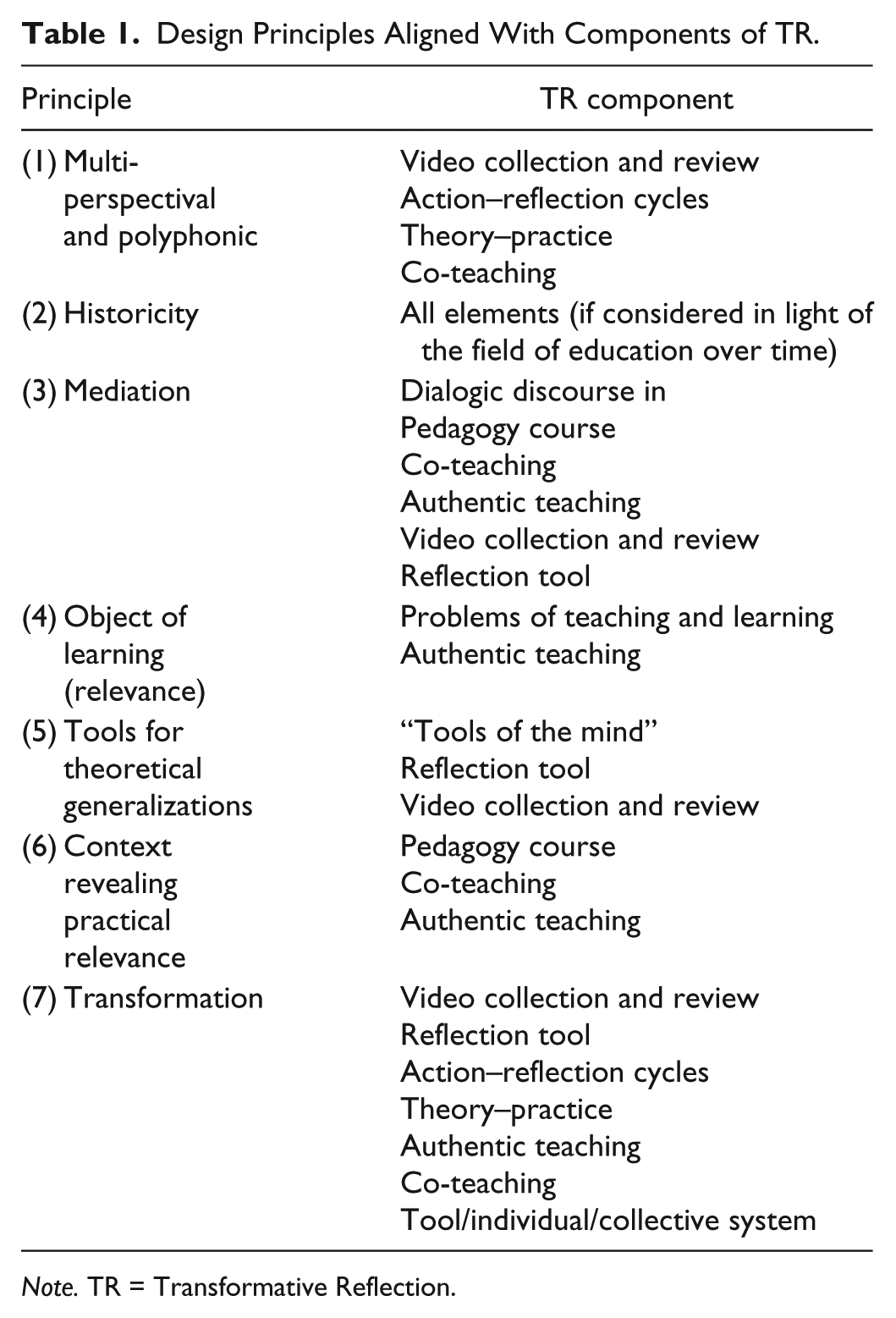
Note. TR = Transformative Reflection.
TR is an integrated development process founded on principles from cultural-historical activity theory (CHAT), pragmatism, constructivism, and empirical work on reflection. TR attempts to seamlessly combine and reinterpret tools, processes, and philosophies of reflection. To accomplish this goal, we united three main components for transformation (see Figure 1): (a) tools (digital video and reflection guide), (b) structures (pedagogy course, action–reflection cycles, and shared authentic teaching experiences), and (c) relationships (tool/individual/collective system and dialogic discourse). Although many of the components of TR look familiar (e.g., Bahktin, 1981; Dewey, 1910/1997; Freire, 1970/1993; Korthagen & Kressels, 1999; Schön, 1983; Siry, 2011; Smyth, 1989), we argue that TR is a new type of learning process. It is an overarching process for teacher development and expansion that builds on previous work and uses known tools for reflection in a new way to promote and effect change and development.
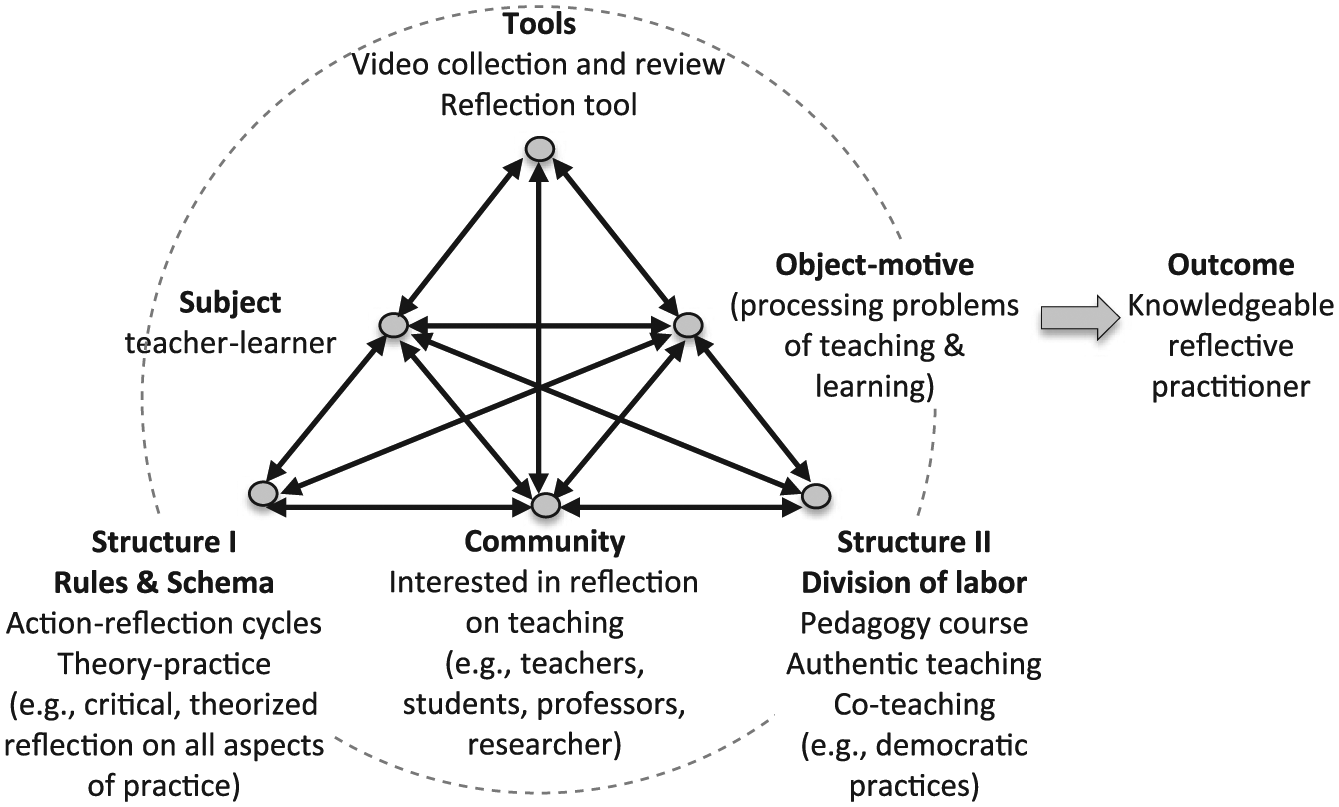
TR Activity System represents a system of teaching and learning activity where all the arrows throughout represent the dynamic nature of TR.
Tools for Transformation
Video
We conceptualize video recordings as a key tool in TR necessary for leading change in candidates’ practice. Although McCurry (2000) theorized video allows for the examination of all interactions in the classroom and can be used as a tool to gather information about the self while performing teaching tasks, Erickson (2007) reminds us that minimally edited footage of social action is “ambiguous and equivocal” (p. 148). Depending on what we expect to see, some behaviors will be unanticipated, notable, or meaningful to one viewer and not another. Video captures, to some extent, events in the classroom allowing them to be subjected to reflection with a rigorous reflection tool.
The recorded shared teaching sessions with elementary school students followed by individual and then collective video reflection sessions with peers and instructors allows candidates to problematize actual teaching experiences, which can lead to the solution posing and plans for action to transform practice. In addition, examining video of teaching episodes with peers and instructors allows candidates to learn how to interpret and reflect on their practice throughout their career (Yung, Wong, Cheng, Hui, & Hodson, 2007). Using video to investigate teaching is not novel in education: Sherin (2000) and Shanahan and Tochelli (2014) studied video clubs of inservice teachers analyzing video from their classroom, Santagata and Guarino (2011) examined the effectiveness of lesson analysis framework using video clips from a database and field experience, and Harford and MacRuairc (2008) evaluated candidates’ development using collective video analysis of teaching episodes from field placements. These studies all demonstrate teachers are able to develop, to a varying degree, reflection skills through coursework and professional development. However, TR provides a unique reflection process as it allows both individual and collective (peers and instructors) video reflections based on shared experiences from teaching elementary students together (all candidates and instructors) while providing support and opportunity to put into practice strategies identified during video reflection. This structure addresses the sparse research concerning how reflecting with peers and professors can influence teacher behavior (Arya, Christ, & Chiu, 2014).
Reflection Tool
The major TR instructional tool used to support video reflection referenced Smyth’s (1989) four forms of reflection and accompanying questions: What do I do? (describing), what does this mean? (informing), how did I come to be like this? (confronting), and how might I do things differently? (reconstructing). This questioning process was used as a written reflection tool in the course to support candidates in being open to difference, to Others (e.g., students, peers, instructors), and the possibility of new understandings (Shields, 2007). After individually watching video of the recorded teaching sessions and answering Smyth’s reflections questions, the candidates participated in collective problem posing, or problematizing, concerning beliefs, practices, and traditions in classrooms. TR is consistent with Smyth’s (1989) reasoning that educators must learn about teaching by reflecting on situations in the context of practice and through dialogue with their peers in which they are able to question assumptions and practices and test newly formulated theories about teaching and learning.
Structures for Transformation
Pedagogy Course
The pedagogy course, which is described in the “Method” section, provides the overarching structure for TR and used developmental instruction, which refers to a group of approaches to teaching and learning created by scholars interested in applying Vygotsky’s theory of learning activity to the classroom (Kozulin, 2004). According to these approaches, knowledge (e.g., cultural tools) is recreated on the social plane for, with, and by learners with teachers before being internalized for subsequent use (Stetsenko, 2010). In developmental instruction, instructional tasks must include promoting students learning motivation in relation to a given topic and creating problem situations for investigation (e.g., Davydov, 1998). The pedagogy course was designed to promote candidates’ learning motivation for problems of instruction by learning “about practice in practice, so that concrete applications can be made and problems of practice can be raised, analyzed, and addressed” (Darling-Hammond, 2006, p. 115).
Nearly all of the research on models or processes of reflection focus on a specific reflection tool or series of tools and changes in candidates as a result of using the tool (e.g., web-based portfolios and level of reflective skills; Oner & Adadan, 2011). The pedagogy course itself was not considered part of the reflection tool as it is in the TR model. Assuming that changes in practice requires exploring a clearly articulated model of teaching as well as planning, implementing, reflecting on, and potentially changing that model of teaching, the course must be considered a central component of the transformation process, yet often, it is not.
Action–Reflection Cycles
A TR action–reflection cycle includes learning concepts to be taught, planning future instruction, implementing the plan, reflecting on the plan (individually and collectively), and revising future plans for instruction. Action–reflection cycles are complex cycles of action generating opportunities for candidates, students, and instructors as they bring varied subjectivities and tools to bear on a particular problem (Stetsenko, 2005). During the action–reflection cycle, candidates are asked to attend to the historical origins of their own perspectives (e.g., beliefs, assumptions, and practices), which are uncovered during teaching with elementary school students. Candidates can then ask, in conjunction with instructors, what the implications are for current planning and practice and whether particular beliefs, assumptions, or practices should be challenged and changed or highlighted and further developed (Smyth, 1989).
Theory–Practice and Authentic Teaching
Candidates frequently learn to teach in university classes in the absence of children or in a K-12 classroom in the absence of a university professor (Zeichner, 2010), or are placed in the field without any mentoring in residency-based models (Walsh & Jacobs, 2007). There are multiple studies that have examined methods to overcome the theory–practice divide, such as candidates participating in action research (Gade, 2015), content-specific inservice teacher development programs (Zapata-Cardona, 2014), and developing a “realistic approach” to teacher education (Korthagen, 2011). What is typically missing from these authentic teaching experiences, however, is a connection to the accompanying coursework. Zeichner (2010) described the problem well: “The disconnect between what students are taught in campus courses and their opportunities for learning to enact these practices in their school placements is often very great” (p. 91).
TR addresses the deficits named by Zeichner (2010) by connecting shared teaching experiences to theories and practices learned. In other words, curriculum is constructed by using real teaching problems experienced by the candidates and reconstructed through dialogic discourse that incorporates theory, instructional strategies, and multiple perspectives from candidates, instructors, and students (Loughran, 2002). We argue that these experiences are profound for candidates because they are engaged in an object-oriented activity (i.e., teaching and learning) of their own creation and interest—what we (and many others) have called authentic teaching. The role of the instructor during TR is to incorporate theories to support the candidates in framing and reframing the self-identified teaching problems (Korthagen & Kressels, 1999).
Relationships for Transformation
Tool/Individual/Collective System
According to CHAT theorist Anna Stetsenko (2005), human development, such as teacher development, can be thought of as a “three-fold dialectical system” of interactions, which includes the three processes at the foundation of human development: the production of tools and materials, the social exchanges among people, and the work of individuals regulating this production and these exchanges (p. 74). The system is multilectical because while these components are distinct, they are a complex interplay of mutually interrelated factors that are capable of referencing multiple meanings (e.g., Fellner, 2014). This threefold system is useful for TR for several reasons. It reminds us that individual learning and social interactions are co-occurring and necessary for learning (Vygotsky, 1978). Not only are these interactions essential, participants in any activity must be involved in the re/production of the tool/material itself because it is the creation of tools/materials that drives human activity and is the reason for interaction and learning. Finally, it reminds us that the individual and the collective cannot be thought of separately as the “mental” realm versus the sociological realm of “collective discourses and practices” (Stetsenko, 2005, p. 72). Instead, they must be thought of as processes (individual and social) that are bound up with tool/material production.
We used Stetsenko’s representation of the tool/individual/collective system to design several aspects of the TR process including: (a) course instructional method, (b) structuring cycles of problem posing and solution testing, and (c) providing candidates with opportunities to test newly developed theories and solutions as part of their planning, implementation, and reflection sessions. Very few studies of university coursework in teacher education take advantage of Stetsenko’s representation of the relationship between the individual, collective, and tool. For example, Siry (2011) associated remarkable transformations in candidates’ identities and practices with the support and practice of collaborative teaching and collective reflection focused on the complexities of teaching and future actions. Although she did focus on what the candidates achieved in these varied social interactions (collective work), she did not study tool use and development to explore the threefold system in her work.
Dialogic Discourse
Bakhtin (1981) argued that all language is dynamic, relational, and engaged in a process of endless re-descriptions of the world. For Bakhtin, dialog was a way of being that allowed “one to remain open to the Other, to difference, and to the possibility of new understandings” (Shields, 2007, p. 9). In addition, Leont’ev (1978) demonstrated a co-evolution of teachers’ practices and student learning through the development of tools for their work teaching and learning.
There is much evidence in the literature demonstrating how teachers benefit from the opportunity to participate in dialogic discourse to question, explore, and improve their practice. For example, encouraging candidates to engage in such discourse has been found to positively influence teachers’ perception and use of reflection (Hatton & Smith, 1995) and increase the ratio of student utterance to teacher utterance (Caughlan, Juzwick, Borsheim-Black, Kelly, & Fine, 2013). Based on these findings, and our theoretical framework, dialogic discourse was promoted in all components of the TR model especially during the reflection phases of the action–reflection cycles when candidates were re/developing tools for teaching and learning.
Purpose
This article has two overarching aims: (a) to offer a new model for teacher preparation that features reflection and teaching as integral, inseparable actions and (b) to provide empirical evidence from an exploratory ethnography to demonstrate the teacher development possibilities with this new model. This study examines two CHAT-based teacher mediation practices that were embodied in the course and became a focus of candidates’ inquiry during reflection sessions:
Posture as a tool for delegating responsibility to students.
Open questions as a tool to re/orient learners.
Research Design
In this article, we report on a study of preservice teachers learning to teach elementary school science in the context of TR. Our ethnographic approach moved back and forth within a cyclic process of observing, interviewing, participating, and making interpretations (Whitehead, 2005). The first author observed and analyzed candidates’ practices in a 15-week science pedagogy course offered at a large, private university in the mid-Atlantic United States. The ethnographic cycle began with participant observation (Merriam, 1998) and data collection including videotaping and taking field notes during all class sessions, conducting in-depth interviews with candidates and instructors, and receiving copies of all assignments. The second author was one of two instructor participants who ran the course. The cycle continued with data analysis and interpretation using thematic analysis (Aronson, 1994) during and after data collection leading to new questions for participant observation.
Participants
The 12 candidates, 11 females and one male, enrolled in the course all volunteered to participate in this study. All but two candidates self-identified as Caucasian. The sample size was demographically similar to the typical childhood teacher in the United States (National Center for Education Research, 2008). All were enrolled in a Masters of Art in Childhood Education. None of the participants had prior science teaching experiences. There were 16 fourth-grade students, eight boys and eight girls, enrolled in the after-school program (ASP) and two instructors (Walsh and Fletcher) ran the course.
Science Pedagogy Course Design
During the initial 5 weeks of the course, the candidates investigated science topics related to engineering and physics while building skyscrapers and bridges and using simple machines and electric motors. The beginning of the semester positioned candidates as science learners and curriculum developers. Candidates collaboratively participated in demonstration labs and building challenges as students, and then, as teachers, collectively planned the science lessons about the same scientific concept for the ASP. In other words, candidates first experienced several models of science teaching, and then used their experiences to plan similar strategies they would implement with elementary school students.
The last 10 weeks of the course consisted of the ASP on Thursdays and a collective reflection/planning session on Tuesdays. Groups of three candidates were responsible for planning and leading two consecutive ASP and reflection sessions, and directing the other candidates on how to assist children during their lessons. All whole class and small group interactions in the ASP were video recorded. The recordings were posted on the course’s password protected, online platform. The first half of the class on Tuesdays was dedicated to a collective reflection session based around video clips and shared experiences from the ASP. The lead teacher team from the previous ASP selected a video clip of an interaction they thought went well and an interaction they thought could be improved to stimulate critical reflections and discussions with peers and instructors. The instructors provided individual and collective tools to facilitate the reflection process, but the candidates selected the topics for reflection as well as video clips, leading us to believe that these topics were important to the candidates for their development.
Using the new information and insights from the reflection session, the purpose of the second half of Tuesday’s class was to collectively prepare for the ensuing ASP on Thursday. To collectively structure learning activities, lead teacher teams reflected on their lesson plans with the class and received critical feedback from peers and instructors to improve teacher mediation and student learning opportunities. The instructors were not the immediate source of knowledge, but instead helped to direct the attention of the candidates to actions that can assist them in developing an understanding of effective mediation practices (Davydov, 1998).
Data Collection
Data collection occurred throughout the semester. All class and ASP sessions were video recorded using multiple cameras and wireless microphones to capture conversations and interactions in small groups. All candidates maintained weekly electronic reflective journals as part of the course requirement. The candidates designed and answered their own reflection questions as part of the journal entry. Candidates submitted a final written reflection at the end of semester that required them to read all of their previous journal entries and discuss their development throughout the course using evidence from the journal entries to support their claims of development.
Data Analysis
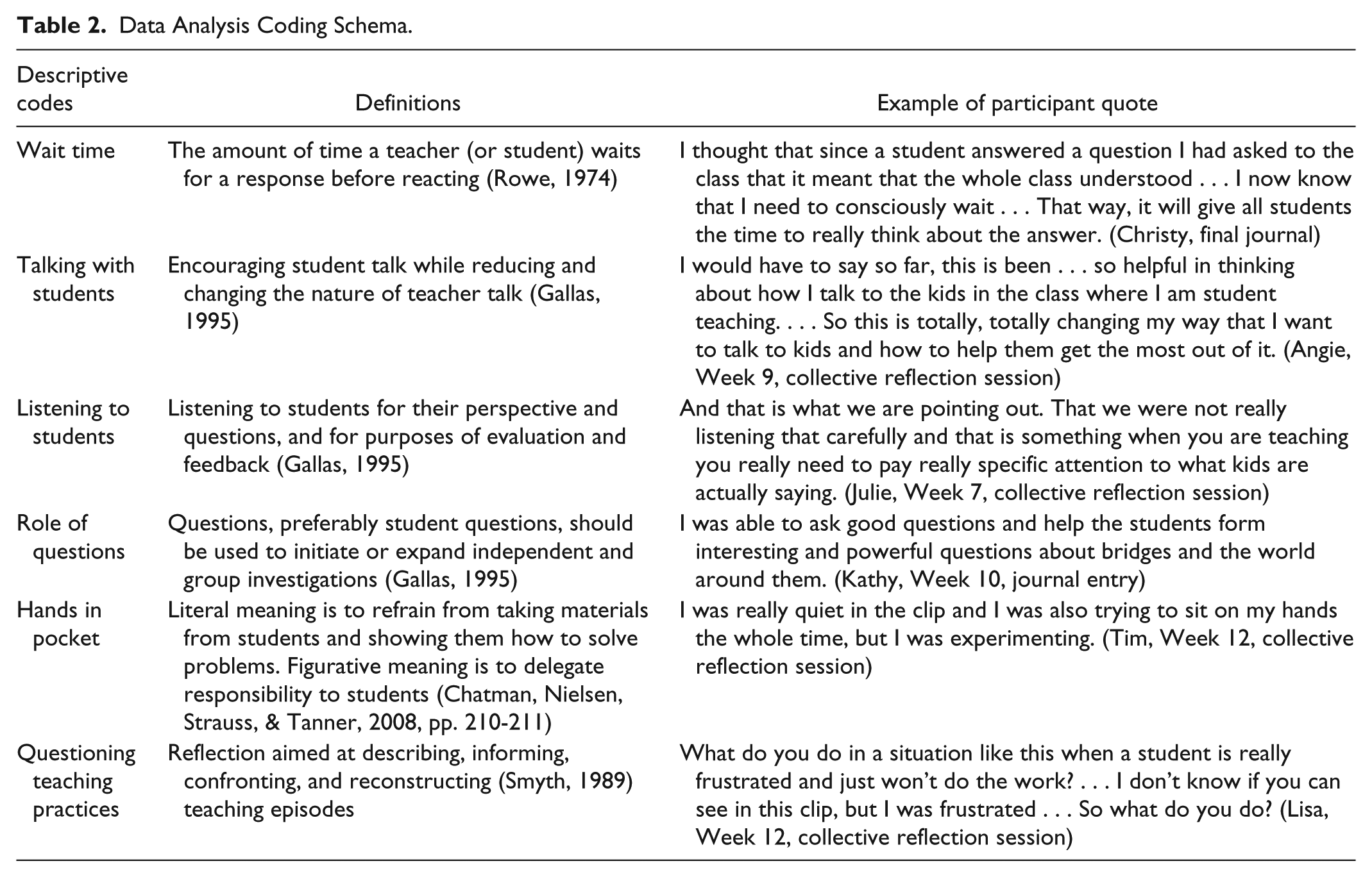
In this study, we wanted to test claims we were making about candidate performance using TR. Specifically, we were curious about the “tools of the mind” they reinvented around problems of teaching and learning. To explore this, we examined tool re/use and mediation practices throughout the course. First, transcripts were coded for mediation categories. Provisional codes for mediation categories were developed before coding began and included many of the categories covered in the course readings or class sessions. The descriptive and provisional codes that emerged from analysis included wait time, talking with students, listening to students, role of questions, hands in pocket, and questioning teaching practices (Table 2). These marked passages were then clustered according to mediation practice themes (teacher–student interactions and assisting student performance). Next, the cluster of descriptive codes within the themes were organized chronologically and re-read to determine if (a) all candidates were represented in the data and (b) the development of practices were noticed by candidates (in reflective journal entries, course reading assignments, class discussions, and/or interviews). We then analyzed how the themes supported the remaining data and theoretical perspective. To better capture the meaningful contributions of the data and the CHAT-based mediation practices being examined, new themes were assigned (posture as a tool for delegating responsibility to students and open questions as a tool to re/orient learners). Table 3 shows when these two mediation practices were examined by candidates in their reflection journal throughout the ASP.
Data Analysis Coding Schema.
Prevalence of Themes Found in Candidates’ Reflection Journals (During ASP Portion of Course Weeks 5-14 and Final Reflection).
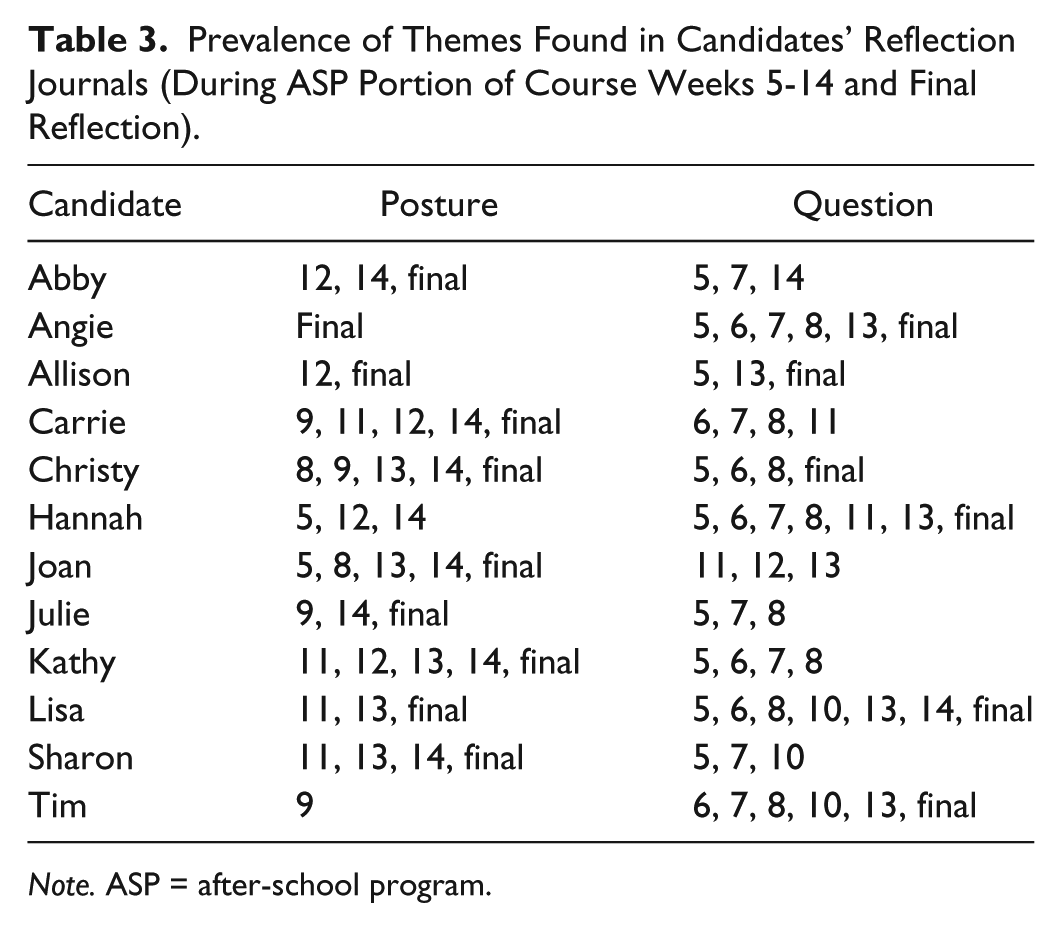
Note. ASP = after-school program.
Interpreting Teacher Reflections
Leont’ev (1978) suggested that there is a co-evolution of teachers’ practices and student learning through the development of tools. Specifically discussed in this section are the reinventions of some fundamental tools in developmental instruction such as working with students to empower them in the Zone of Proximal Development (ZPD; Vygotsky, 1978) and reorienting learners to the learning object-motive. The tools invented by candidates as solutions to their teaching and learning problems were new to the teachers, but will be familiar to readers. What we want to highlight is the fact that (a) the candidates reinvented these tools for themselves using TR, and (b) acquiring these tools was among the target learning objectives for the course. These two factors are also the main criteria typically used for assessing the effectiveness of developmental instruction (Karpov, 2014).
Posture as a Tool for Delegating Responsibility to Students
For this study, we defined teacher mediation as assisted performance during the teaching of cultural tools where “assistance is offered at points in the ZPD at which performance requires assistance” (Tharp & Gallimore, 1988, p. 21). Empowering students within the ZPD can occur through various forms of communication including re-directing attention, asking a question, or appropriately structuring learning activities (Bodrova & Leong, 2007). Teacher assistance provided when student performance does not require it can impede a student’s development. We argue that too much assistance also reinforces teachers as authoritative agents and limits students’ opportunities for learning. We show that when the amount and timing of assistance that candidates were providing students was the object of their reflection, candidates quickly began to see the importance of the ZPD and how to monitor their actions within it.
After watching the videos and noticing candidates doing parts of the science activities for the children, Professor Walsh addressed the candidates’ actions during a collective reflection session: The thing is that I want every single person to try on Thursday is to put your hands in your pocket{s}. So if a student wants you to help, there are two or three students at that table. You better bet that every single one of those students better be asked before you jump in. Put your hands in your pocket{s}. Just try it. It is really hard. . . .If it is a question about data, pull out the Socratic questions and throw a question right back at them. (Professor Walsh)
In the quote above, Professor Walsh offered a new tool for working with students to empower them within the ZPD (“keep your hands in your pockets”), which she then challenged the teachers to use—physically take a “hands-off” posture to position the students as agents in their learning and development and empower the students within their ZPD. She recommended additional tools candidates could use to support their new posture such as having students ask each other for help or using the list of open questions to re/orient student activity. She stressed that most teachers find it difficult to keep their hands in their pockets and tried to ease the difficulty by suggesting that they test a new tool that might be useful in supporting student learning. Teachers were learning to identify and work within students’ ZPD to support, rather than impede, student development and position students as agents in their own learning.
A week after the conversation above, Sharon posed and answered the following question in her journal entry: How could I be more effective without being too hands-on? Instead of doing things for the kids, I should try making helpful suggestions to guide them to find their own solutions. For the next session, I will keep my hands in my pocket{s} and see how that experience compares to my hands-on approach . . . in this class, I have definitely seen the value of letting go and giving the kids the freedom to explore on their own. A lot of my previous “wow” moments came from that type of approach. (Sharon, Journal entry 11)
Sharon’s intention for the pending ASP was to keep her hands in her pockets because she has “seen the value in letting go” and has experienced success in this class with that approach. As indicated in the following conversation excerpted from the collective reflection session (Excerpt 1, See Appendix for explanation of transcript notations), Sharon was not able to keep her hands in her pockets (note that all turns in all excerpts are between candidates):
I really need to ((motions zipping lips)) and take
a step back. Because I didn’t do the hand sitting
thing. The whole reflection ((journal)) all I kept
talking about was “Oh it is so cool that Hannah
and Tim were able to stick their hand in their
pockets.” Because the whole time I was staring.
at them, like, what are they doing? Then I realize.
((while watching the video)), ohhhh, I am all
grabby, all up in there.
((a student)) are holding up this
big tower and I am like, so much for not
touching things.
I was the only person who forgot that.
Although Sharon did not keep her hands in her pockets, she was able to critically think about her practice individually, through writing and with the aid of video, before participating in collective discussion with her peers (Lines 4-10). Angie’s response to Sharon’s comment (Lines 11-14) reveals how TR allowed shared experiences to be the basis for collective problematizing concerning teaching and learning theories and strategies. As the conversation continued, however, we learn that a hands-off posture is not enough to ensure that teachers will not interfere unnecessarily with students at work when Carrie explained how she talked instead of touching:
((reflection journal)). I measured the amount of
time I went without touching anything and there.
was one span where I went for 26 minutes,.
which is why I talked about it, but up until that
point I was touching things and then I realized
and then I stopped. I am literally like this at the
table ((crossing hands)). But I made up with that
by just speaking, like, adding everything I could say
I’m sure that is why I was even worse that time.
because I was like “I can’t touch.
this. I might as well just talk” ((class laughs)).
and talking so=
Carrie (Lines 17-23) shared with Sharon, and the rest of the class, that she also forgot in the beginning of the ASP to keep her hands in her pockets, but once she remembered the strategy she was able to keep her hands down for 26 min. Carrie used the video as a tool not only to measure the time she went without touching materials, but also to learn she increased her frequency of talk once she put her hands in her pockets (Lines 24-28). This was an example of a habit that would not have been realized without the video recording. Angie, through her use of the word we (Line 29), recognized her own, as well as others’, development. Angie states that the previous week, “we were both touching and talking” (Lines 29-30) and implies that, although Carrie talked a lot, she was able to keep her hands down, which was an improvement in teacher mediation practices.
Sharon successfully kept her hands in her pockets during the next ASP. In her journal she wrote, “Being a hands-off facilitator was a lot tougher than I thought. But it turned out to be a really valuable experience.” Through the use of video analysis, collective discussion, and practical experience working with students, the candidates were able to recognize specific practices that positioned students as passive learners (e.g., taking over students’ learning opportunities, increase in teacher talk).
Candidates’ beliefs and practices about how to position students as agents and empower student learning within ZPD were transforming. Through reflection, Joan became aware of her development: As I look back to my reflections, my concern and worries throughout the semester were sort of silly. On November 8th, I wrote that “The car activity may also be really loud and with a lot of motion with the kids moving around to test the cars and measuring the distance so it’s important for the teachers to help keep it under control.” However, if we expect the students to fully engage in the activity and to be motivated then it’s almost impossible to control the volume or physical movement. Rather than being a “controlling” teacher,
Joan documented the transformation in her beliefs related to teacher mediation practices when she explained how she originally wanted to “control” learning activities, which positioned students as submissive receivers. By the end of the course, she realized that children are capable of completing well-structured learning activities with minimal teacher intervention. Carrie echoed Joan’s transformation in her exit interview: “I definitely think I’ve taken a lot . . . into consideration in terms of . . . letting kids do things by themselves and . . . trusting them that they can do it was a big thing for me.” Joan and Carrie developed a view of students as agents in their learning and practiced empowering students within the ZPD as a result of their work in TR.
Open Questions as a Tool to Re/orient Learners
From a developmental instruction perspective, teachers’ questions are tools that can reorient learners to the object-motive by guiding students’ development and directing them to discover gaps in their understanding. We will show that during TR, candidates developed, shared, and refined the use of questions as a tool when reorienting learners to the learning object-motive.
During the first collective reflection session, Abby shared with the class that she and Hannah “felt forced” and “rehearsed” when asking children the open questions they had heard the instructors use earlier in the course. Abby asked the class, “To figure out ways to not sound that way.” Hannah explained her discomfort with implementing this strategy (using open questions), “It is not natural for us to do this.” She felt “really fake” and “weird” asking, “What wowed you?” She cited “insecurities” as a reason she was uncomfortable asking open questions. Carrie validated and supported insecurity as a reason for discomfort by stating, “I think as you teach more and more you sort of just learn what questions just kind of come next as you are asking questions. Like what they [the students] say leads you to the next and I think we all just need practice in doing that.”
Although Hannah expressed self-doubt and uneasiness with her questioning skills to the class, she was encouraged to practice this skill by her peers and instructors. Three weeks later in a journal entry, Hannah addressed her development with questioning children during science activities by asking and answering the following question, “How do you feel that your role evolves in the after school science program as each week passes?” I have grown to become much more comfortable asking the probing questions like why?, so what?, any surprises?, any big wow moments?. Initially, these questions seemed so rehearsed for me, I felt like I had been taught to ask these questions and needed to always ask these questions in order to teach successfully without truly understanding why I had to ask the children these questions. Through exploring the units with the children, I have now realized that these questions naturally arise for me and when I have discussions with the children, these questions come out without me consciously realizing it. It is through these discussions with the children that I learn where their thinking is coming from and where it may be going and helps me understand better what I can do to help facilitate their learning process. (Hannah, Journal entry 8, original italics)
Evidence of Hannah’s personal transformation lies in her comment: “I felt like I had been taught to ask these questions . . . without truly understanding why I had to ask the children these questions. . . . I have now realized these questions arise naturally for me.” Hannah’s statement illustrates what Bakhtin described as the struggle between authoritative and internally persuasive discourses. Operating under Smyth’s (1989) goal of having teachers question why they do what they do, Hannah engaged in that struggle and realized her role as a passive learner in the past and developed a purpose for questioning students that was meaningful to her and is likely to be more useful in her future. She explained how her learning gains were made possible through the process of reflecting on her work with children.
After reading Hannah’s journal entry and other entries from the candidates concerning the role of questioning and what questions to ask during science instruction, Professor Walsh addressed the issue with the class during a collective reflection session: So the handout that I just gave you is a list of Socratic-type questions because a lot of you have been asking ((in journal entries)), “Do I ask good questions or comments with the students?” . . . This is just one source of asking these types of questions, there are tons of different types of questions. (Professor Walsh)
Through the combined process of individual and collective reflection, the teaching tool of questioning children to reorient them to the learning object-motive was examined, probed, tested, and improved. For example, Lisa used video from her teaching experiences as a tool to alter and assess her ability to implement new types of open questions with children. She wrote about this process in her journal: I was able to see what I did last week and noticed things that I wanted to change about my interactions and questions. I knew that I wanted to ask more questions, since I found it really hard last time to not give the kids the answers, I figured asking Socratic questions to try to lead them in that direction would help keep me from giving away the answer, and letting the kids come up with the answer themselves. I think that I definitely improved in this from last week, even though I wasn’t perfect. (Lisa, Journal entry 8)
For Lisa, TR allowed her to change her practice by facilitating her recognition and implementation of asking questions to reorient learners to the learning object-motive. After the reflection process, she was able to more effectively mediate student learning by positioning students as agents in the learning activities instead of “giving away the answer.” Lisa’s willingness to change her practice is something users of TR are striving for to improve learning opportunities for students.
Next, we show how the role and importance of questions persisted. In the fourth collective reflection session, Sharon asked the class how she should address the children’s “obsession with tape” and the response was that rather than “address it” (an authoritative discourse that implies the students are using too much tape or are being wasteful), she might explore the students’ perspectives by asking them why they are using the tape (i.e., promoting internally persuasive discourses for her and the students by reorienting learners to the learning object-motive):
was also a good discussion point as he was like
“Let’s put tape on there,” this was with the half.
cardboard arch. And I was like, “Well, what does
that mean?” and I was trying to ask him to explain
his reasoning for wanting to put the tape. He
was cool. He started to talk about forces and
triangular effects, so it was kind of a learning tool
to use the tape
missed that opportunity.
why they are using the tape and how is it helping
their structures it is fine. Like when they were
building the arches at my table I was asking them
why they are using it and they said because it was
keeping them from flattening out and changing.
shape. And also they crumbled it up and put it
inside to support it from underneath, and that was
fine
on then, ask them why they are using tape. Because
at our table I was just like, “Wow Paula that is a
lot of tape!” That is all I said to her ((class laughs))
I will definitely ask her “Why?” next time.
when you ask “Why?” I think before we started
working with them you sort of underestimate.
think about the kind of questions you want to ask
because they really do give you a lot of good answers,
but you are only going to get as good of answers as
questions you ask them.
out of them what you put in
thinking I didn’t ask enough well thought out questions.
Sharon and her peers were able to share strategies on how and why to question children during learning activities. Angie voiced that the children provide great answers and insight in response to the question “Why?” (Lines 26-27) and admitted that before working with the children, she underestimated them (Lines 27-28). In other words, she had an unfounded authoritative discourse about children that was restricting her interaction possibilities (e.g., children cannot understand and use these science concepts we are teaching them because they are too young and the concepts are too difficult). Sharon revealed that during her individual reflections, she noticed that she struggled with asking students “well thought out questions” (Lines 36-37). Through her writing in weekly reflective journal entries, Sharon was able to describe and critically evaluate her teaching experiences before coming together with her peers to collectively pose problems and solutions related to shared teaching events, which is imperative to the development of a critically reflective practitioner (Smyth, 1989).
The study of questioning continued in the eighth collective reflection session, which was led by the “electricity and circuits” teacher team (Allison, Angie, and Tim). The teacher team shared a video clip of a teacher–student interaction they thought could be improved due to a lack of student response to the question they posed at the beginning of their session, “What is electricity?” Allison wanted her classmates to “watch how the kids react to that question and their answers or their non-answers” and revealed “it was not good being there and having all that dead air.” Angie agreed that “it was a pretty long minute.”
After Allison and Angie presented student silence as a teaching problem, Angie presented a possible explanation for the silence they experienced—the question was “such an open-ended question it was difficult {for students} to narrow it down to what they should have been answering.” Angie and Tim offered a few alternative questions they could have asked the children (“What are words you associate with electricity?” “How they used electricity in their everyday lives?”), which they proposed might have reoriented learners to discover how they experienced electricity in their everyday lives.
At the conclusion of this collective reflection session, Professor Walsh returned to the issue of questioning children that was brought up by the “electricity and circuits” teacher team: Be very careful about the questions you put out there, so I want to just, I have given you this ((a list of all of the questions candidates asked throughout the ASP)) and the exercise I wanted you to do today was to read the questions and think about what was the answer you expected when you asked that question. Think about if somebody just asked you that. What would you say? (Professor Walsh)
Professor Walsh challenged candidates to question, explore, and modify their own authoritative discourses in light of evidence and experience. Although the candidates were developing a new internally persuasive discourse on open questions as a tool for reorienting the students to the learning object-motive, Professor Walsh wanted to keep this discourse fluid and problematic. She recorded all of the questions asked by the candidates, both in small group and whole class discussions, to allow the teachers to closely examine the type and quality of questions they asked children. In this exercise, candidates were asked to critically confront their use of questions by having evidence-based discussions. To transform habits and practices, individuals must first become aware of them through description and informing (Smyth, 1989). TR led Allison to become aware of the use of questions in the classroom as indicated in her final reflective journal entry: This course has really brought to light the kind of questions I am asking and what kind of response I am anticipating. It is funny to watch other teachers ((at her field-observation site)) ask questions and wonder if someone could possibly answer. It doesn’t usually occur to teachers, which is crazy. (Allison, final journal entry)
Allison came to realize that questions function as a tool to mediate student learning and orient learners to the object-motive. In fact, Allison seemed surprised that inservice teachers at her field-observation site did not purposefully use productive forms of questioning (Jelly, 2001). Without TR, teachers like Allison may not become aware of how their use of questions in the classroom facilitates or inhibits student learning.
Discussion
We created TR by using principles from activity theory and related sociocultural concepts to understand and develop a process of reflection for teacher development. Through this exploratory ethnography, we attempted to identify teacher development possibilities by capturing what candidates using TR noticed, studied, and changed about their own teaching practices. In this way, we could see what practices candidates chose to explore and develop when making meaning of their experiences as professionals using TR. We found that candidates noticed, studied, and changed many of the same actions and attitudes targeted by education instructors including (a) posture and (b) questioning.
Reflection, Learning, and Transformation
Reflection is not typically viewed as a learning action necessary for the transformation of the self and the world, but learning is at the heart of the TR process. To change teachers’ assumptions and practices, we must acknowledge that they are learners and they are re/creating new forms of practice that do not exist for them when learning is initiated. As teacher educators, we must provide tools, structures, and relationships necessary for learning new forms of practice. At a minimum, these learners require mediation that frames the identification of problems, the development of multiple perspectives, and the negotiation of solutions (Loughran, 2002) and prompts the full range of reflection actions including retrospection (thinking back), self-evaluation (analysis), and re-orientation (future-oriented planning; Quinn, 1988/2000). When the learner’s object-motive is “reconceptualized to embrace a radically wider horizon of possibilities than in the previous mode of the activity,” an expansive transformation is accomplished (Engestrom, 2001, p. 137).
How TR Could Support the Development of Candidates
The three components for transformation embedded in TR (tools, structure, and relationships) address the lack of opportunity in teacher preparation for candidates to practice pedagogical strategies with students, and receive direct feedback from peers and professors on the implementation of their strategies (Grossman & McDonald, 2008). We also contribute to the paucity of research addressing how candidates use reflection on their own experiences in authentic teaching contexts to develop an understanding of teaching and learning and to monitor and hone their practices (Bloomberg, Sherin, Renkl, Glogger, & Seidel, 2014). Reflection, especially TR, is more relevant than ever before with the prospect of a national system of Teacher Performance Assessments (Darling-Hammond, 2010), which includes video reflection and analysis on teacher’s own practice. The increased focus on reflection in the teacher certification process brings to the forefront the importance of introducing and applying meaningful reflection experiences in education courses. The TR process provides candidates and teacher educators with a specific combination of tools, structures, and relationships in the preservice, on-campus setting where the classroom environment can be created entirely by the students, candidates, and instructor together in the absence of any other external influences.
Generalizability
TR provides a unique combination of tools, relationships, and structures to scaffold and support candidates’ development. However, the TR process will always depend on the context, including the teachers and the students, the interactions created in various settings, and the instructors’ abilities to help teachers develop a “new motive” (Karpov, 2005) to learn how to teach. Although the findings cannot be extrapolated to other contexts, we can generalize the theory-based reasoning for the component design. Additional research implementing TR in a variety of settings and disciplines is recommended to better understand candidates’ learning and development.
Conclusion
TR draws on Stetsenko’s (2010) rationale that all knowledge stems out of social practice (as its constituent tools), through social practice (where students rediscover these tools through their own inquiry) and for social practice (where knowledge is rendered meaningful in action). An example of knowledge revealed, rediscovered, and rendered meaningful occurred when Hannah came to understand and change the meaning of open questions for her work with children during the TR process. The social practice of teaching and learning science with elementary students and reflection on the experiences promoted learning motivation (Karpov, 2014), created problem situations for the candidates to explore (Davydov, 1998), and encouraged dialogic discourse (Bakhtin, 1981). The tools, relationships, and structures of TR allowed for the process of tool re/productions through individual learning and social interactions (Vygotsky, 1978), which contributed to the development of candidates’ mediation practices.
Footnotes
Appendix
Declaration of Conflicting Interests
The author(s) declared no potential conflicts of interest with respect to the research, authorship, and/or publication of this article.
Funding
The author(s) received no financial support for the research, authorship, and/or publication of this article.
Author Biographies
References
Supplementary Material
Please find the following supplemental material available below.
For Open Access articles published under a Creative Commons License, all supplemental material carries the same license as the article it is associated with.
For non-Open Access articles published, all supplemental material carries a non-exclusive license, and permission requests for re-use of supplemental material or any part of supplemental material shall be sent directly to the copyright owner as specified in the copyright notice associated with the article.
