







Abstract
During field experiences in teacher education, student teachers are generally placed individually with a mentor. Teacher education institutes search for alternative field experience models, inspired by collaborative learning such as team teaching. This study explores two team teaching models, parallel and sequential teaching, by investigating the student teachers’ perspective. Quantitative (survey) and qualitative (self-report) methods were used to map their attitudes toward both models, their perception on collaboration, advantages and disadvantages, and the conditions for implementation they consider critical. Student teachers adopt positive feelings toward both models. In sequential teaching, collaboration is experienced significantly higher than in parallel teaching. Both models have their own advantages and disadvantages, but advantages clearly outweigh disadvantages. In comparison with previous research, decreased workload and better management are new advantages, interdependence and complex management new disadvantages. “Preparation for new roles” is the most important condition in order to successfully implement both models.
Within teacher education, field experiences are crucial in preparing future teachers (Kyndt, Donche, Gijbels, & Van Petegem, 2014). During field experiences, student teachers are typically placed individually with a mentor (Sorensen, 2014). They start by observing their mentor and, afterward, get the responsibility to temporarily take over the class (Bacharach, Heck, & Dahlberg, 2010). Since collaboration within schools gains importance and is considered significant for teachers’ professional development (Meirink, Meijer, & Verloop, 2007), teacher education institutes show interest in field experiences inspired by collaborative learning (Bullough et al., 2002). By collaborating with peers, student teachers can come to higher levels of performance (Walsh & Elmslie, 2005). Moreover, it may help student teachers to be better prepared for the transition to practice (Murphy, Carlisle, & Beggs, 2009). A paired placement, during which two student teachers share a mentor, is suggested to be a good alternative for an individual placement (Nokes, Bullough, Egan, Birrell, & Hansen, 2008).
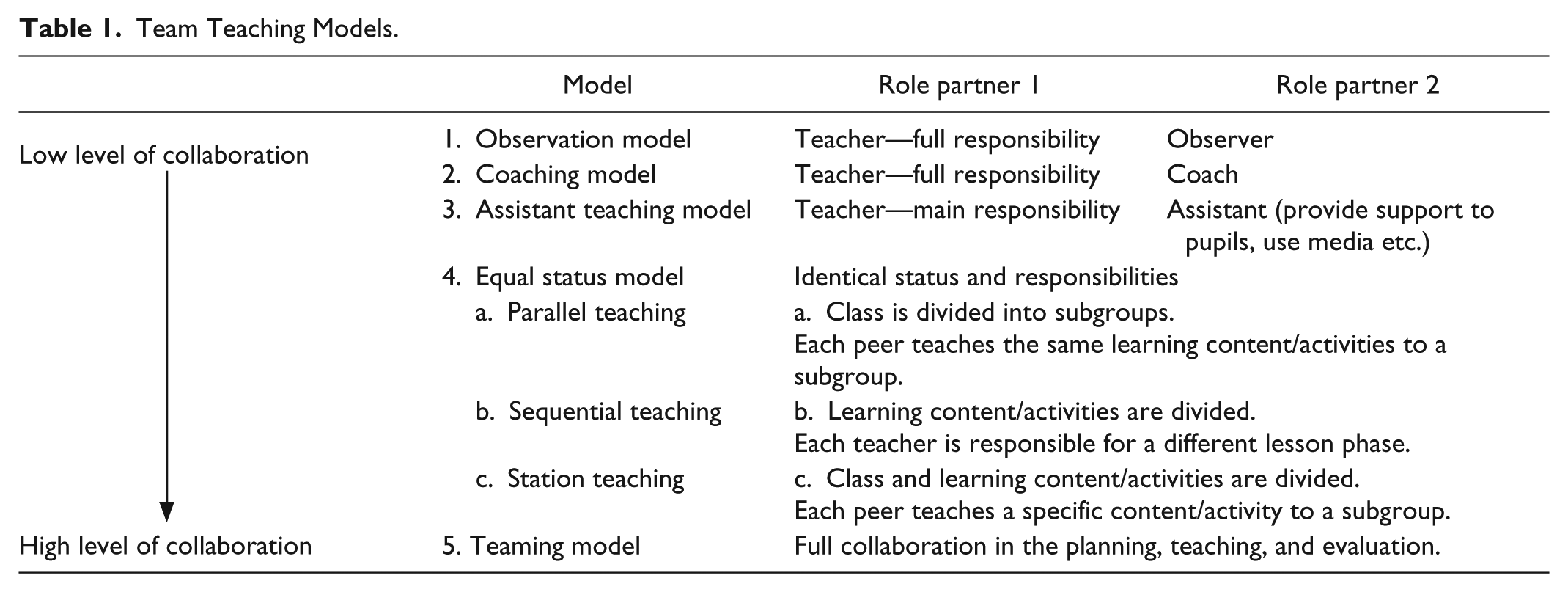
During paired placements, opportunities for team teaching arise. Team teaching refers to “two or more teachers in some level of collaboration in the planning, teaching, and/or evaluation of a course” (Baeten & Simons, 2014, p. 93). Based on the level of collaboration between the student teachers, five team teaching models can be distinguished (Baeten & Simons, 2014, p. 95). See Table 1 for an overview and a description of these models.
Team Teaching Models.
A literature review on student teachers’ team teaching (Baeten & Simons, 2014) shows important advantages for student teachers: emotional and professional support (Bullough et al., 2002; Goodnough, Osmond, Dibbon, Glassman, & Stevens, 2009), increased dialogue (King, 2006; Parsons & Stephenson, 2005), professional growth (pedagogical skills, reflection; Bashan & Holsblat, 2012; Goodnough et al., 2009), and personal growth (self-confidence, self-efficacy; Birrell & Bullough, 2005; King, 2006). Disadvantages for student teachers have been recognized as well: a possible lack of compatibility (Bashan & Holsblat, 2012; Stairs et al., 2009), comparison between peers (Goodnough et al., 2009; Stairs et al., 2009), difficulty of providing feedback (Parsons & Stephenson, 2005; Sorensen, 2004), increased workload (Nokes et al., 2008; Vacilotto & Cummings, 2007), and less individual teaching (Gardiner & Robinson, 2010). Nevertheless, previous studies emphasize the benefits of team teaching and encourage its implementation in teacher education as it can help offset some of the issues that affect the more traditional model of student teaching (for instance, lack of support, teaching in isolation) and because it maximizes resources in the classroom. With both student teachers actively engaged with pupils, positive results such as reduction of pupil-to-teacher ratio, consistent classroom management, increased differentiated instructional options for all pupils, and increased participation and engagement can occur (Bacharach et al., 2010).
In the field of education, team teaching has mainly been studied in the special education domain (Bacharach et al., 2010). The practice of team teaching by student teachers during field experiences is still in its infancy; even more so within the context of student teachers’ field experiences in secondary education (Bacharach et al., 2010; Stairs et al., 2009). Previous empirical research mainly focused on one specific team teaching model (e.g., Scantlebury, Gallo-Fox, & Wassell, 2008; Smith, 2004) or on team teaching in general, without specifying the model(s) (e.g., Birrell & Bullough, 2005; Goodnough et al., 2009). Nevertheless, several authors stress the need for more quasiexperimental research (Carpenter, Crawford, & Walden, 2007; Murawski & Swanson, 2001), for instance, by comparing team teaching models.
Our study compares two team teaching models, parallel and sequential teaching, and their application in secondary education. In parallel teaching, sometimes called “split class teaching” (Al-Saaideh, 2010), teachers divide the class into subgroups and they each teach the same contents to a subgroup of pupils (Cook & Friend, 1995; Graziano & Navarette, 2012). The instruction is generally planned by both teachers (Cook & Friend, 1995) and during the instruction they may rotate between the subgroups (Thousand, Villa, & Nevin, 2006). In sequential teaching, teachers divide the learning content. They teach the same lesson to the same pupils, but each teacher is responsible for different lesson phases (Carpenter et al., 2007). Synonyms of sequential teaching are “alternate teaching” (Dugan & Letterman, 2008), “serial arrangement” (Carpenter et al., 2007), and “rotational team-teaching model” (Helms, Alvis, & Willis, 2005).
We deliberately opt for two models with equal status as they are under-represented in empirical research (Baeten & Simons, 2014). We retrieved a few studies on parallel teaching in language and science teaching (Aliakbari & Bazyar, 2012; Forbes & Billet, 2012). However, studies on parallel teaching in teacher education are even scarcer. Conderman and McCarty (2003) included parallel teaching in an education course. Teacher educators implemented the model in a learning center for student teachers to experience how they might apply a differentiated instruction technique. Their study focused on the learning center, not on the parallel teaching model as such. Thousand et al. (2006) refer to a comprehensive national survey carried out by the National Center for Educational Restructuring and Inclusion (1995) in which parallel teaching was reported as appropriate for beginning co-teachers as it involves less structured coordination among the peers. Sequential teaching has been studied (to a limited extend) in higher education (Spafford, Honey, & Jordan, 2002). Dugan and Letterman (2008) compared student appraisals of sequential teaching, simultaneous team teaching and collaborative panel (classes with three or more instructors). Students’ appraisals for the three models were (very) positive. The least favored method was collaborative panel.
We can conclude that very few studies have investigated the application of parallel and sequential teaching in teacher education and to our knowledge, both models have never been compared as teaching models during field experiences. Therefore, the underlying research questions of this study are as follows:
Research Design
Based on the recommendations of the literature, we decided to answer the research questions through a quasiexperimental research design, comparing both models. Previous research on student teachers’ team teaching is mainly qualitative in nature (Baeten & Simons, 2014). Therefore, in this study a mixed method approach was adopted.
Context and Respondents
Totally, 14 student teachers participated in the study (see Table 2). They all had a bachelor’s and master’s degree and were taking a 1-year teacher education program (60 ECTS; including 60 hr of field experiences) for future secondary school teachers at the University of Antwerp. The experiment was applied during initial field experiences. The student teachers had no prior field experience. This decision was based on the recommendation for team teaching at the start of the field experiences as it lowers the threshold (Gardiner & Robinson, 2010; King, 2006).
Profile of the Participants.
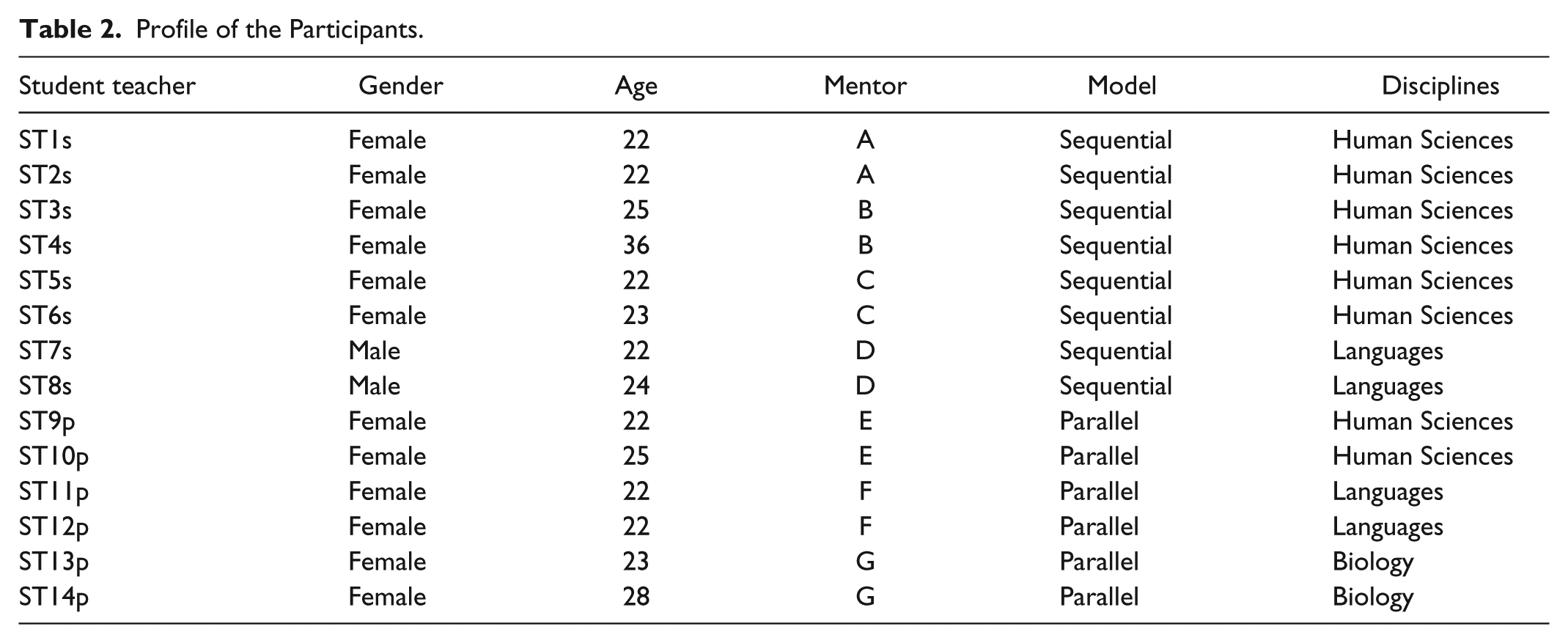
Students from different disciplines participated. They were between 22 and 36 years old (M = 24.1; SD = 3.84). Four student pairs applied sequential teaching; three others parallel teaching. Students were paired up based on geographical situation and subject. Peer selection was not allowed as prior research indicates that composing groups randomly is more closely related to a real professional setting and could, therefore, enrich the team teaching experience (Stairs et al., 2009). However, students were not entirely unknown to each other as they had collaborated before in several courses of the teacher education program.
Before the experiment, they were given two specific 2-hr training sessions by their faculty supervisor and one of the researchers on the application of both teaching models and on the ALACT model (Korthagen & Vasalos, 2005). The latter model facilitates a deep, yet efficient reflection on actions or lessons. Students were encouraged to reflect and apply new insights in five steps: Action, Looking back on the action, Analysis of essential aspects, Creating alternative methods, and Trial. Based on literature recommendations, ample time was hereby devoted to preparation for their new roles (Sorensen, 2004), the importance of co-generative dialogue (Tobin & Roth, 2005), and to relationship-building activities (Britton & Anderson, 2010). After the experiment, they met again in a supervision session. The mentors in the experiment (N = 7) discussed both teaching models and conditions for implementation (Baeten & Simons, 2014) with the researchers beforehand.
The student teachers were assigned to either parallel or sequential teaching and to a mentor they would observe during four lessons (1 lesson = 50’). Afterward, the teaching models were applied during four lessons. In both models, student teachers collaboratively planned their lessons. In parallel teaching, they divided the class so that each student taught a subgroup in a different classroom. In sequential teaching, they divided the learning content to alternatively teach within one lesson. Afterward, in both models, student teachers reflected together. The mentor observed and provided feedback after each lesson. In parallel teaching, the mentor partially observed each student’s lesson.
Instruments and Analyses
The following table shows the link between research questions, data collection instruments and the subsequent data analysis (see Table 3).
Research Questions, Data Collection, and Data Analysis.
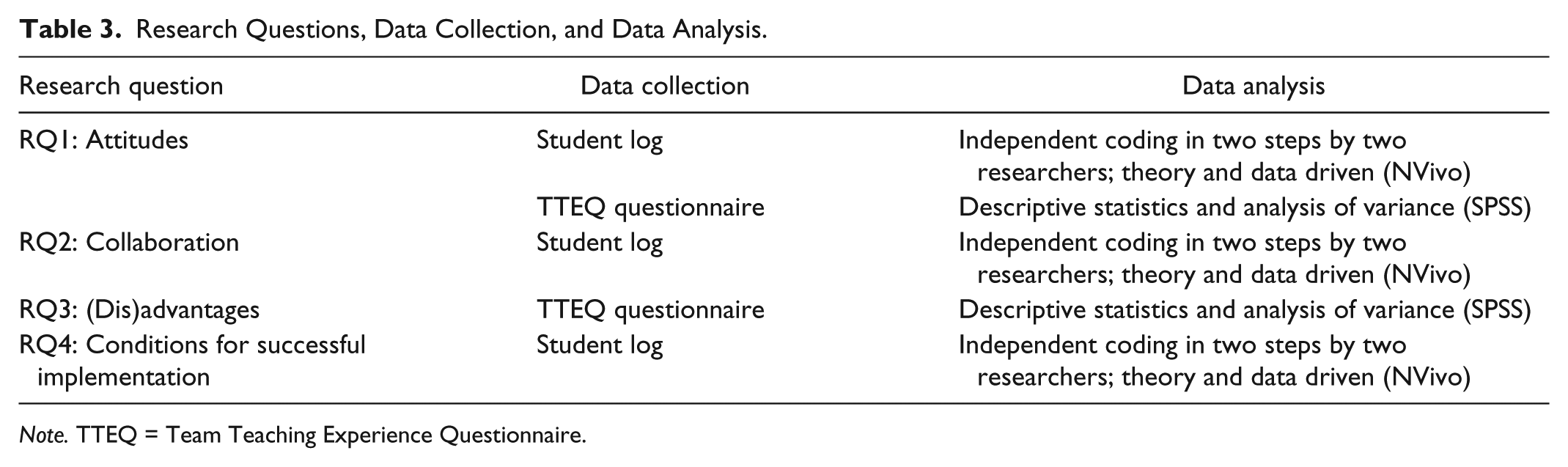
Note. TTEQ = Team Teaching Experience Questionnaire.
Data were collected with two instruments: student teachers were asked to keep a log on their experiences and a questionnaire was developed, focusing on the attitudes toward the teaching models and on the perceived advantages and disadvantages.
Self-reports: Logs
The log format (Appendix A) consisted of four sections. Next to personal and contextual information, students kept track of their activities and described them in detail. They provided information on lesson preparations, teaching activities, mentor conversations, peer reflections, and other possible activities. After each lesson and for each activity, they applied the ALACT model for lesson reflection (Korthagen & Vasalos, 2005). At the end of the field experiences, they completed the final section to globally evaluate the applied teaching model.
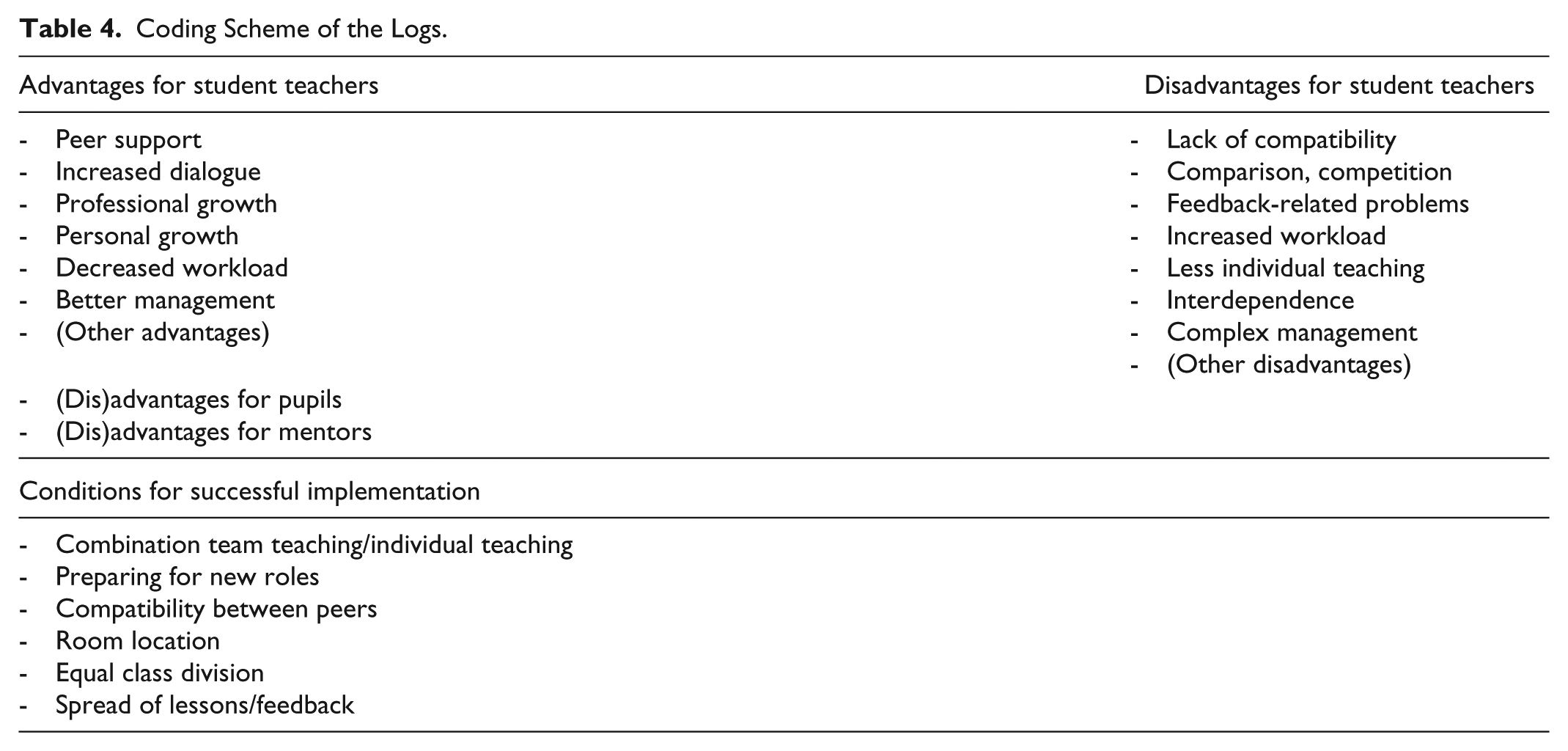
The first log coding phase constituted an explorative analysis. Data were classified with a coding scheme, both theory-driven—literature-based (Baeten & Simons, 2014)—and data driven. Next, the logs were recoded based on the extended framework and analyzed using NVivo10. Table 4 gives an overview. Data-driven codes are marked in italics. If a specific advantage or disadvantage was only identified by one respondent or difficult to characterize, it was assigned to the category “Other (dis)advantage.”
Coding Scheme of the Logs.
The validity structure of the qualitative research was assured through several strategies (Johnson, 1997). Descriptive validity was strengthened by investigator triangulation. Two researchers monitored data collection and analysis. The researchers independently coded the data in two steps (interrater reliability). First, author 1 analyzed Student Logs 1 to 7; author 2, Logs 8 to 14. Subsequently, the extended coding scheme was used and the order was inverted: author 1 analyzed Logs 8 to 14; author 2 Logs 1 to 7. Inconsistencies were then discussed.
Interpretive validity was met through the low inference descriptors strategy. The respondents’ actual language was used as noted in the logs. Theoretical validity was obtained by pattern matching. Advantages and disadvantages already described in the literature were systematically examined in the data. Internal validity was carried out by low inference descriptors (use of verbatims, direct quotations), peer review (discussion of the interpretations and conclusions not only with peers but also with the actual participants), and pattern matching (the prediction of results based on findings in the literature). In addition, data triangulation took place. Besides students, also mentors and pupils were questioned about advantages, disadvantages, and conditions for implementation (Baeten & Simons, 2016; Simons & Baeten, 2017).
Team Teaching Experience Questionnaire (TTEQ)
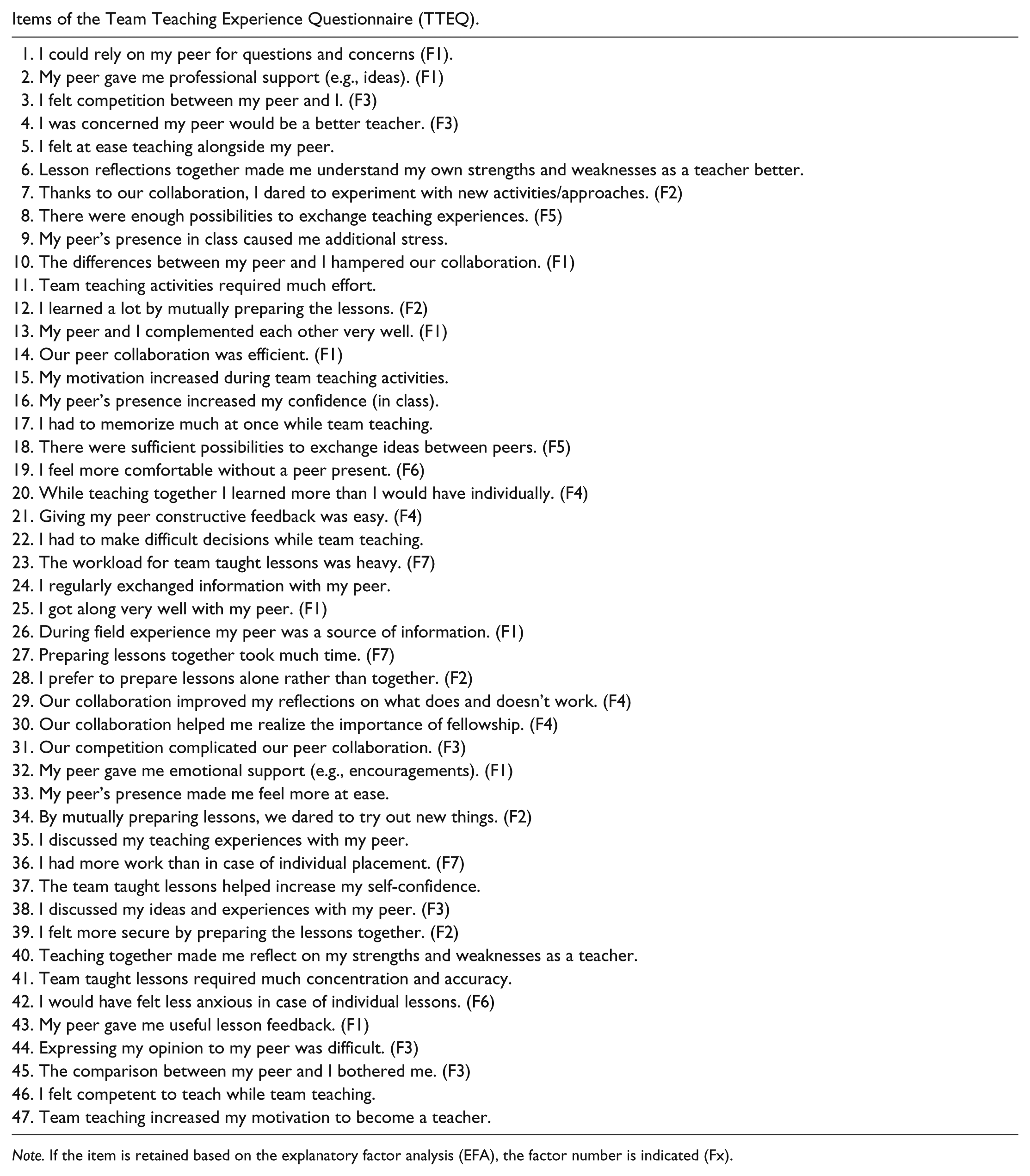
To collect quantitative data, a questionnaire on student teachers’ experiences was developed (Appendix B), with 47 items scored on a 5-point Likert-type scale, ranging from completely disagree to completely agree. Items were based on advantages and disadvantages of team teaching retrieved from the literature. Taking into account the limited number of participants (N = 14), it was impossible to conduct a factor analysis to reveal the constructs underlying the items (cf. the rule of 100, MacCallum, Widaman, Zhang, & Hong, 1999). The concerned teacher training program already used the observation model in field experiences. Therefore the TTEQ was tested in a larger sample of 134 student teachers taking the (same) 1-year teacher education program. Totally, 14 student teachers from this sample participated in the current study. The data were used to conduct an exploratory factor analysis (EFA), using the maximum likelihood method with varimax rotation. The discriminant (5.23 E-009), the Kaiser–Meyer–Olkin measure (.84) and Bartlett’s test of sphericity, χ²(435) = 1833.77, p < .001, verified that data were adequate to conduct factor analysis. The number of factors was determined by Kaiser’s eigenvalue-greater-than-one criterion. Only items that loaded significantly on a factor (⩾.40) were included. Significant cross-loading items were excluded if differences between the loadings were lower than .20. Seven factors were extracted (59.11% explained variance; see Table 5).
Results of the EFA.
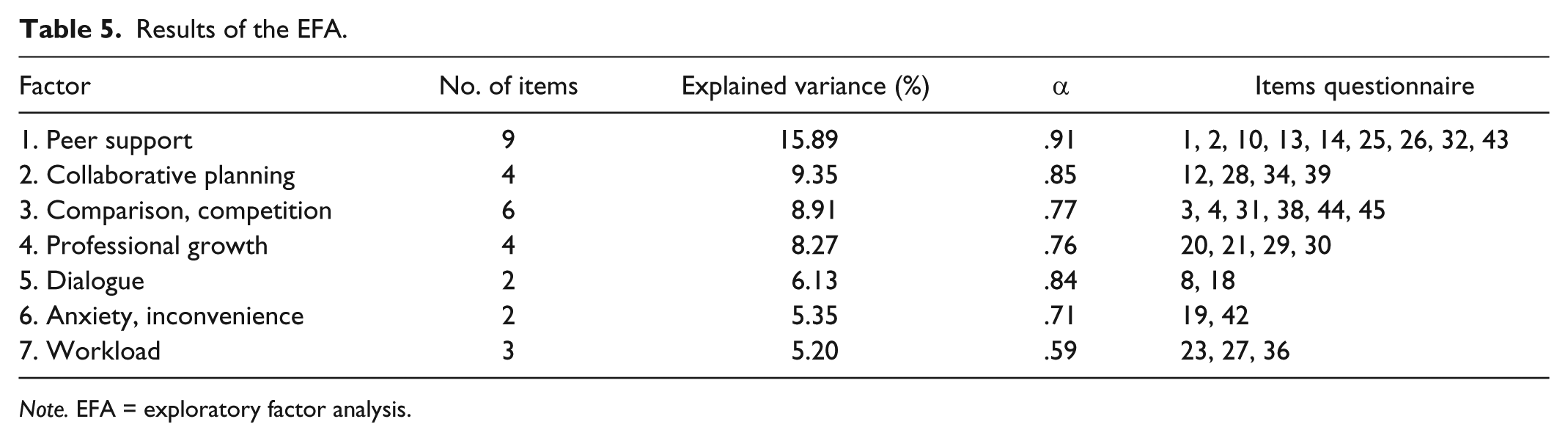
Note. EFA = exploratory factor analysis.
Although the internal consistency of the workload subscale was low (.59), we retained it as workload was considered an important team teaching related disadvantage. Moreover Cortina (1993) and Palant (2007) argue that a smaller amount of items can influence the Cronbach’s alpha, whereby occasionally a .60 cut-off can be considered acceptable. Even so, this subscale’s results need to be treated with caution. For each factor, scale scores were constructed by averaging the scores on the items. Differences between the teaching models on the scale scores were investigated descriptively and through analyses of variance.
Results
We successively answer the research questions underlying our study. First, we describe student teachers’ attitudes toward parallel and sequential teaching (RQ1). Next, we report on their experiences with teaching activities (RQ2). Subsequently, we outline the advantages and disadvantages they observed in each model and verify if findings from literature can be confirmed and/or enriched (RQ3). Finally, we report on the conditions they considered critical for successful implementation (RQ4).
To illustrate findings, we make use of citations. For each citation we refer to the student teacher and the model applied (for instance, ST1s = first student in Table 2; applied sequential teaching).
Attitudes Toward Parallel and Sequential Teaching (RQ1)
At the beginning of the experiment, 11 student teachers (out of 14) had positive feelings toward team teaching. All of them found it reassuring to share their first teaching experiences with a peer and thought field experiences would be less frightening and more fun. “It’s a pretty big step to teach for the first time. The thought of doing everything by yourself: prepare lessons, face a full classroom . . . It felt like a great relief that we could do everything together” (ST12p). Two student teachers hesitated as they didn’t know what to expect, whereas one had negative feelings. She was not convinced of the (parallel) teaching model and feared for additional work (ST9p).
After their team taught experiences, 10 respondents (out of the initial 11) still displayed positive feelings. They were convinced that team teaching lowered stress and enhanced confidence. It was instructive, more fun, and provided well thought-out lessons. Almost all respondents emphasized the good mutual understanding and the shared ideas on teaching. “We connected well on a personal and professional level” (ST5s). Four students showed mixed feelings (ST3s, ST4s, ST6s, ST9p). One of them (ST4s) had positive feelings toward sequential teaching at the start, but changed her mind afterward due to work pressure and peer differences in personality and teaching style. Another student (ST9p), with initial negative feelings, showed mixed feelings afterward. Two students with initial mixed feelings felt the same after the experiment. All four students appreciated peer support, different perspectives on learning content and increased possibilities for learning activities. However, they also encountered practical problems (increased workload, changing classrooms), partial mentor feedback and an unequal pupil repartition. They preferred individual teaching. The respondents’ attitudes toward team teaching were not directly influenced by the specific team teaching model they applied, nor by their peer.
These (globally) positive feelings are confirmed by the data of the Team Teaching Experience Questionnaire. Table 6 shows scores on the seven factors. Mean scores above 3.5 (on 5) are considered high, mean scores below 2.5, low.
Descriptive Analysis and Analyses of Variance.
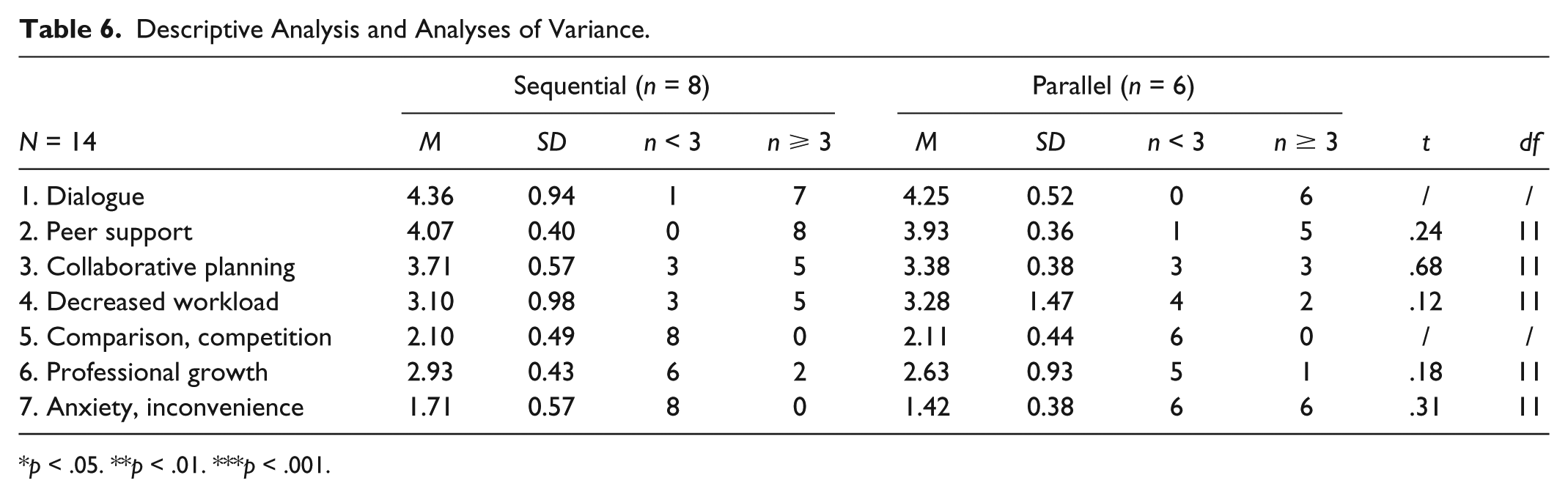
p < .05. **p < .01. ***p < .001.
Results show that student teachers adopt positive attitudes toward both models, as the mean scores of the advantages clearly outweigh the disadvantages. Both models scored relatively high on decreased workload, but feelings are mixed. In addition, the models did not encourage comparison and competition, nor cause anxiety and inconvenience.
Differences in team teaching experiences between the models were estimated. For dialogue and comparison and competition, the analysis of variance could not be conducted as the assumption of homogeneity of variances was not met. Nor the parametric Independent-samples t test, nor the nonparametric Mann–Whitney U test revealed any significant differences between the models, which could possibly be explained by the fact that the sample was too small (N = 14) for these types of statistical analysis.
Perception of Collaboration in Parallel and Sequential Teaching (RQ2)
Team teaching implies collaboration in the course preparation, teaching and reflection. The student teachers were asked to evaluate the actual and desired collaboration level (Logs, Section D) on a scale from 1 (no collaboration) to 4 (intense collaboration). Table 7 shows the global differences between the models and the detailed differences for specific activities.
Actual and Desired Collaboration Levels for the Models and the Teaching Components.
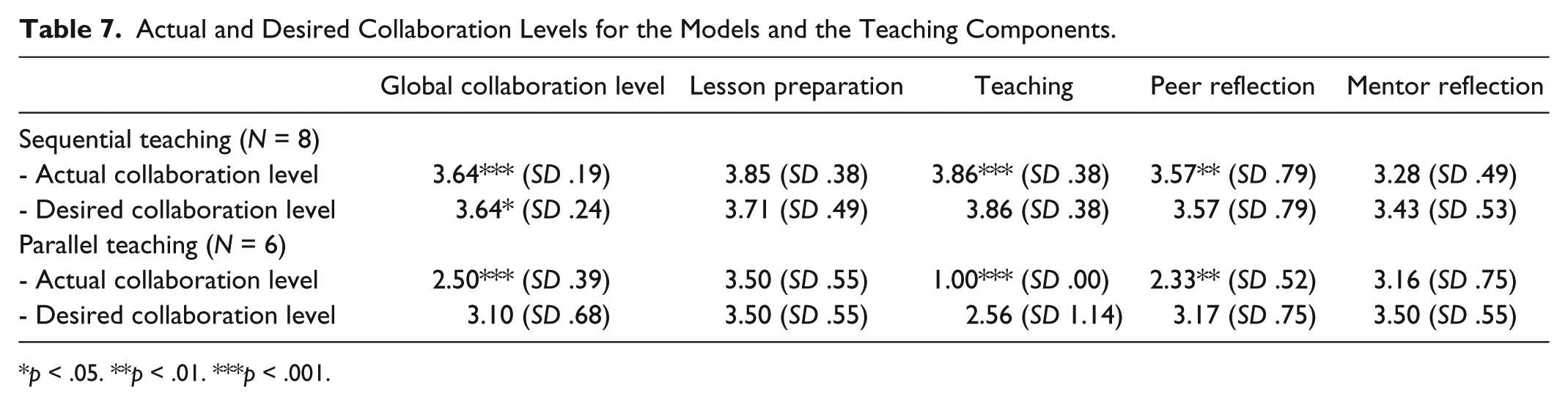
p < .05. **p < .01. ***p < .001.
The global (actual) collaboration level was (significantly) higher in sequential than in parallel teaching. The same goes for each activity (lesson preparation, teaching, peer reflection, and mentor reflection). Collaboration in sequential teaching is significantly higher for teaching and peer reflection.
For sequential teaching, we observe an important overlap between the actual and the desired collaboration level, which means this model’s realization, corresponded to student teachers’ expectations regarding collaboration. For parallel teaching, however, student teachers were quite satisfied with the collaboration level for lesson preparation, but would prefer more intense collaboration during teaching and for the peer and mentor reflection. The low collaboration level for teaching (M = 1.00), however, does not surprise. As both students teach in different classrooms, they perceive their collaboration as almost inexistent.
Advantages and Disadvantages of Parallel and Sequential Teaching (RQ3)
Quantitative content analysis of the answers in the logs revealed in-depth information on both models’ advantages and disadvantages. For each model, student teachers more frequently reported on advantages (N = 434) than on disadvantages (N = 255) for themselves. 34 references refer to advantages and disadvantages for mentors and pupils.
We will first discuss the advantages and disadvantages for student teachers. Next for mentors and pupils. New (dis)advantages, not previously mentioned in the literature, are marked in italics. To evaluate the importance of specific (dis)advantages, the number of respondents (reported as “N =”) and the number of times it was mentioned (reported as “refs”) is taken into account. The number of references were (relatively) equally spread out over the respondents. Whenever a respondent counts for more than one-third of the references, we consider it an unequal spread and report this separately in the column “Spread.” We also report whether (dis)advantages are experienced in a different way within the peer groups or whether the experiences between groups are (very) different. Finally, if trends for a specific element were clear (number of respondents equals or is more than three), we mention whether parallel teaching scored lower, the same, or higher than sequential teaching (p < S; P = S or P > S; in the column “Comparison”). Given the limited number of respondents, conclusions based on these observations can only be drawn with caution.
Advantages for student teachers
Table 8 gives an overview of the advantages. All the advantages previously mentioned in the literature were confirmed and two new advantages were found: decreased workload and better management. Decreased workload refers to the economy of time induced by collaborative planning or task partitioning. Better management implies better class or time management.
Advantages for Student Teachers.
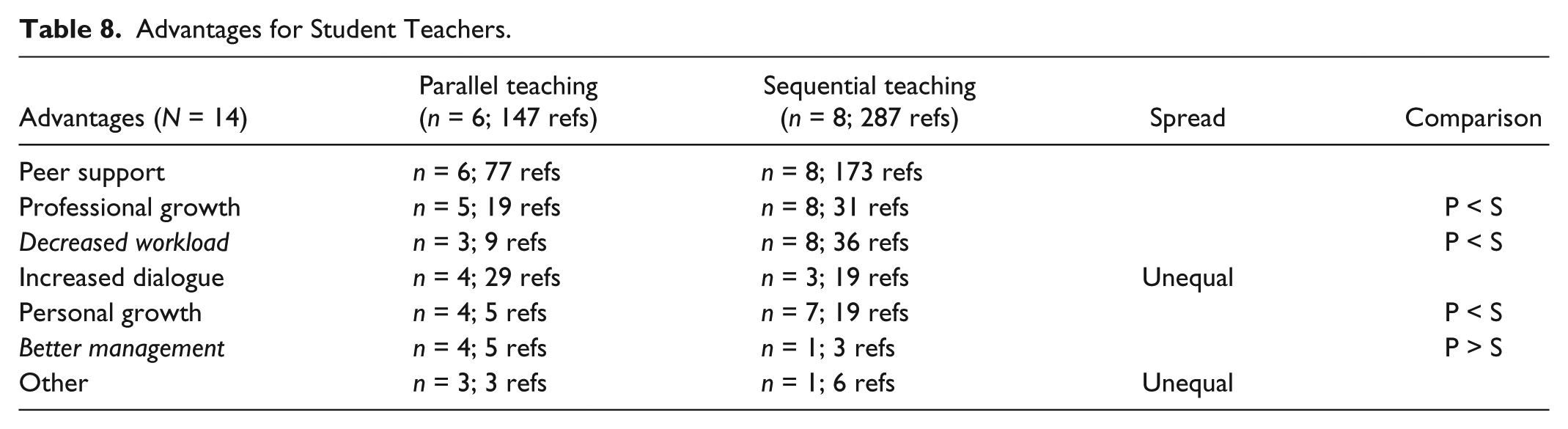
In both models, student teachers mainly reported on peer support, professional growth, decreased workload and increased dialogue. Personal growth was especially mentioned for sequential teaching, as opposed to better management for parallel teaching. Regarding peer support, this confirms the TTEQ results with both models scoring high (⩾3.93 on 5). Professional growth, mentioned by all student teachers in sequential and by all but one in parallel teaching, was scored relatively low in the TTEQ (<2.93). Decreased workload was partially confirmed by the TTEQ results. Collaborative planning, a more efficient working method, was scored relatively high for sequential (M = 3.71), and a bit lower for parallel teaching (M = 3.38). Personal growth was not identified as a factor in the TTEQ.
In regards to peer support, all student teachers indicated that paired placement provided support. For several respondents the first teaching experience was considered a critical event, described as “being thrown to the wolves” (ST7s). Therefore, both emotional and professional peer support was appreciated. Emotional support became clear through citations such as “A peer to rely on was a big mental support” (ST11p). Professional support implied receiving ideas and feedback: “It’s nice to create a lesson together, based on our separate input” (ST3s), support during the lesson: “When I didn’t know the answer to a question, my peer could help.”(ST5s), or practical issues: “I wasn’t familiar with the interactive whiteboard, but managed thanks to my peer” (ST4s).
Besides peer support, most respondents in both models referred to professional growth (n = 13). They learned from each other in various ways. During lesson preparation, they complemented each other in subject-specific content, pedagogical approaches, and so on, which improved lesson plans: “While planning, we had twice as many ideas. We complemented each other and developed better lessons.”(ST1s). In sequential teaching student teachers also learned by peer observation. Moreover, in both models peer feedback and the mentor’s feedback to their peer was instructive: “The mentor gave feedback on both our work, which was interesting” (ST11p). Student teachers also considered team teaching as a proper acquaintance with teaching, which could smoothen the transition to individual teaching. Finally, some respondents argued that it prepared them for their future careers, in which collaboration is required. Totally, 11 respondents (out of 14), including all sequential respondents, mentioned a decreased workload thanks to task partitioning: “As we divided the tasks, our collaboration was efficient” (ST1s). Nevertheless, several student teachers also mentioned a high workload.
In both models, a considerable number of respondents (nparallel = 4; nsequential = 3) valued the increased dialogue opportunities. They could share ideas, information and experiences, and discuss lessons: “There was room for discussion. We actively inquired about new ideas and agreement on things” (ST10p). This advantage is reported by four (out of the seven) student groups, and mainly by two students, one of sequential (ST5s), one of parallel teaching (ST10p), which indicates that the model in itself does not influence this advantage, but rather the group composition and/or the respondent’s personality.
Besides professional growth, especially sequential respondents experienced personal growth, mainly increased motivation and self-confidence (feeling at ease, proud, satisfied) in teaching: “Thanks to my peer, I felt more confident” (ST6s). The parallel respondents (N = 4) referred to their small pupil groups, which lowered pressure and increased self-confidence, but also led to better management, therefore, mentioned more often in parallel teaching (n parallel = 4; whereas n sequential = 1): “The limited number of pupils simplified class management” (ST10p). Furthermore, four respondents mention other advantages. One (sequential) respondent (ST6s) emphasized (6 refs) her view on team teaching as a good way to start the internship. In parallel teaching, three respondents considered the mentor’s regular absence in class advantageous, as it decreased feelings of evaluation (ST10p, ST11p).
Sequential respondents mention more advantages than their parallel counterparts. Parallel and sequential teaching mainly differ in terms of professional and personal growth and decreased workload (more sequential refs) on one hand, and better management (more parallel refs) on the other.
Disadvantages for student teachers
Table 9 lists disadvantages by and for student teachers. The disadvantages found in the literature are confirmed by the data. Two new disadvantages were observed: interdependence and complex management. Interdependence implies depending on your peer’s pace and methods, but also feelings. Complex management refers to class or time management related issues.
Disadvantages for Student Teachers.
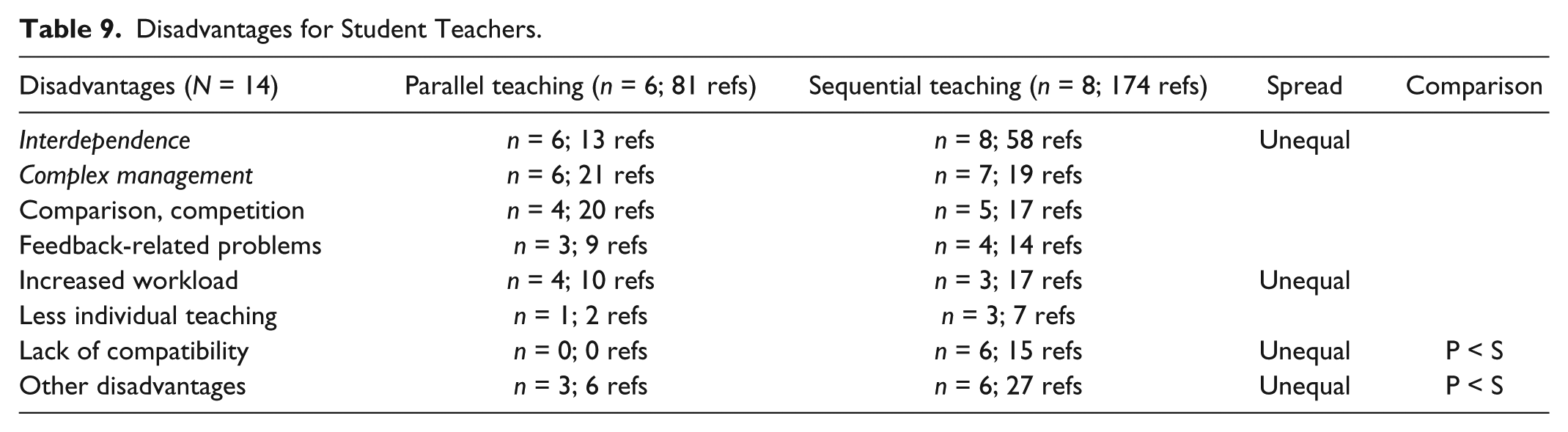
All respondents mentioned interdependence, with the highest number (58 refs) in sequential teaching. Student teachers could feel themselves at ease with their peer, but still be hindered by another pace or method. This sometimes led to frustrations: “I feel as if I’m in this alone. I want her to take more decisions” (ST4s), but also to explicit dependence on the peer’s input: “While working together everything went well, but individually it was laborious” (ST1s). Sometimes it also meant peers had to abandon their own ideas or felt limited in their freedom: “Sequential teaching does not leave much room for improvisation and flexibility” (ST3s). Interdependence could also have an emotional impact: “My peer was very worried, which made me feel insecure as well” (ST1s). One respondent (ST4s) accounts for 20 references on this disadvantage (unequal spread), as opposed to only five references from her peer. In the course of the trajectory ST4s turned out to have a perfectionist nature and had set very high standards for her peer.
Complex management was mentioned by all parallel and all but one sequential respondents, with the highest number (21 refs) for parallel teaching. In sequential teaching, standing together in front of the classroom sometimes created confusion: “Only class management remains difficult: it’s hard to determine who should intervene and when” (ST2s). Several respondents also mentioned time management issues: “We have to ensure we keep track of time to start our lesson timely” (ST7s).
Nine respondents experienced comparison and competition: “Despite our positive evaluation, it still felt like an intensive comparison” (ST5s). Nevertheless, the number of respondents with these feelings was low, as was confirmed by the results of the TTEQ (M = 2.10, SD = .45).
Feedback-related problems were mentioned by half of the parallel and sequential respondents. In the former group the partial mentor observations led to incomplete feedback: “It was very frustrating that large parts of my evaluation form had not been completed as the mentor was in the other classroom” (ST10p).Within the sequential group, only a general lack of mentor feedback was mentioned.
Seven respondents mentioned increased workload as they found it sometimes difficult to find common moments to meet and teach. In sequential teaching time-absorbing collaborative planning was the main cause: “The lesson preparation was much work. At each step, we inquired about the other’s thoughts.”(ST4s). As sequential respondents shared the teaching responsibility, they might have been more strongly involved in collaborative planning. ST4s, the same respondent who stressed interdependence as a disadvantage, also experienced remarkably more increased workload (10 refs, unequal spread). As opposed to interdependence, the increased workload was also clearly experienced (6 refs) by her peer (ST3s). In parallel teaching increased workload was mainly due to practical-organizational issues: division into subgroups or moving to another classroom.
Less individual teaching opportunities were mainly mentioned by sequential respondents (N = 3), who considered collaborative teaching remote from future teaching practice: “Sequential teaching does not feel like a real teaching practice” (ST6s).
Six out of eight, exclusively sequential, respondents mention a lack of compatibility due to the peer’s lack of motivation or opposing ideas and methods: “We work in very different ways” (ST4s). Again, the same peer group (ST3s and ST4s) shows a different response. It is important to note that this disadvantage wasn’t mentioned by parallel respondents at all (0 refs), which might be explained by their close collaboration in lesson preparation, but relative independence in class.
Six sequential and three parallel respondents mentioned other disadvantages. Five sequential respondents indicated that shared responsibility sometimes led to lower lesson quality as they were more easily satisfied. Furthermore, the shared responsibility (for instance, for class or time management) sometimes resulted in no action at all. One respondent mentioned the need for model diversification. While exclusively teaching within the sequential model, a certain mental fatigue might occur over time, especially in case of peer incompatibility. Two parallel respondents regretted the lack of peer observation.
The parallel and sequential models mainly differ in terms of two disadvantages: lack of compatibility and other disadvantages. Lack of compatibility is cited by six out of eight sequential respondents, but not mentioned at all in parallel teaching. Other disadvantages are mentioned in both models, but twice as often in sequential teaching.
Advantages and disadvantages for mentors and pupils
Although quite limited in number (n = 9), the student teachers also mentioned advantages and disadvantages for mentors and pupils (see Table 10).
Advantages and Disadvantages for Mentors and Pupils.
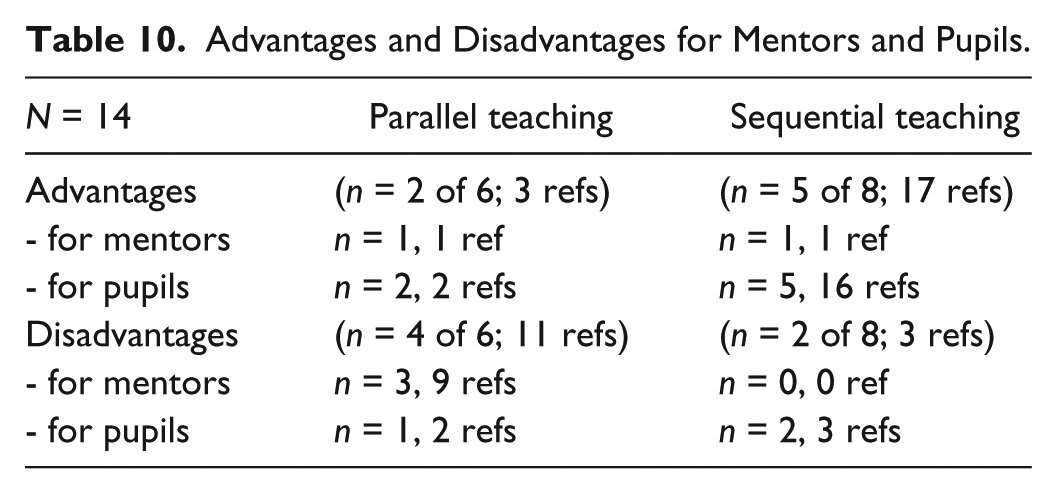
In regards to mentors, two student teachers report advantages. In sequential teaching mentors stated that the model had been interesting and offered learning gains (ST7s). In parallel teaching, it was considered advantageous that the mentor could compare both student teachers separately and give specific feedback (ST13p). No mentor disadvantages were mentioned for sequential teaching, whereas three parallel respondents reported a high workload and feedback issues: “The mentor told us that she regretted the incomplete evaluation as she could not be in two classrooms simultaneously” (ST10p).
Regarding pupils, both sequential (n = 5) and parallel (n = 2) respondents reported advantages. Sequential teaching provided pupils with a nice alternation and additional support: “If they don’t understand you, your peer can re-explain it” (ST3s). On the other hand, alternating between two sequential teachers might be confusing and tiresome: “There is no time to rest. When one pauses, the other takes over” (ST8s). Thanks to the small pupil group, parallel teaching made it possible to implement a variety of teaching methods. Moreover, it was a safe environment for pupils, in which they had more opportunities to ask questions. On the other hand, if a class is not divided equally, differences between both groups might increase: “I taught the weaker half, which still had to finish the previous lesson. We went through it quicker, which only enlarged the gap between both groups” (ST09p).
Conditions for Implementation (RQ4)
Table 11 gives an overview of the conditions and recommendations student teachers mention for the implementation of parallel and sequential teaching in teacher education.
Conditions for Implementation.
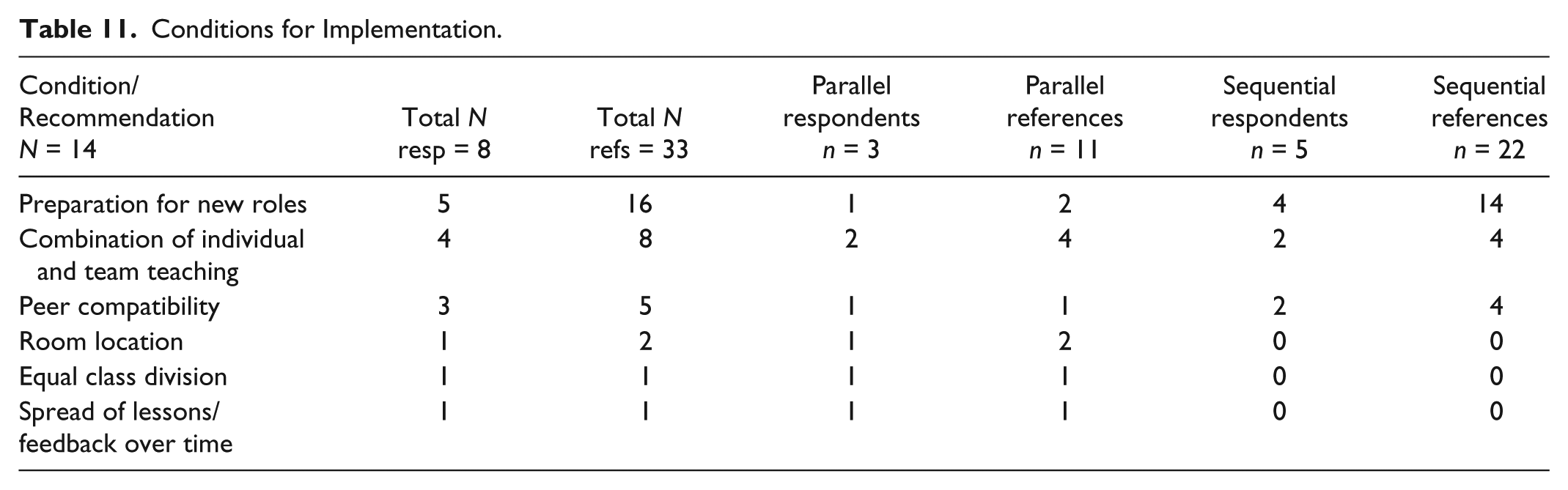
In total, eight students enumerated 33 conditions. Conditions previously found in the literature (Baeten & Simons, 2014), preparation for new roles (Sorensen, 2004), combination of individual and team teaching (Goodnough et al., 2009), and compatibility between peers (Smith, 2004; Walsh & Elmslie, 2005) are confirmed by the data. Three new conditions were found, exclusively mentioned by parallel students.
One condition, preparation for new roles, clearly outweighed the other, representing half of the references. Collaboration has to be learned and supported. Teacher educators can help. Student teachers generally know how to cooperate, but they do not know how to prepare, teach and evaluate a course together. Cooperating student teachers have to be aware of the importance of individual input and preparation. Collaboration does not imply the abandonment of individual work: “We have to find ways to focus on what we really need to discuss together, round up and then continue individually” (ST3s). The mentor also plays an important role in collaboration. Students mentioned that evaluation and/or feedback on lesson preparations beforehand could support peer collaboration. The mentor should also pay equal attention to both students. Some respondents felt as if they no longer counted as individuals. Furthermore, students need to learn to make good arrangements and besides cooperating by mail, actually meet up to avoid miscommunications and loss of time: “We should have met. By simply mailing back and forth, some things went wrong and unnecessary work was done” (ST6s).
A second condition is the request for an alternation between individual and team teaching (n = 4). The respondents experienced their teaching model as enriching, but underlined that other models should also be explored and alternated with individual teaching. A gradual advancement from different team teaching models toward a hybrid model with individual teaching is thereby considered the ideal scenario: “It would be interesting to teach various lessons sequentially and then gradually reduce the peer’s work, which ensures a gradual progression towards individual teaching” (ST7s). Parallel students regret the lack of peer observation, which explains the demand for alternation between models.
A third condition, mentioned explicitly by three and implicitly by other respondents, is the importance of compatibility with the peer. “I cannot imagine doing this with someone I am not compatible with” (ST3s). Compatibility implies getting along, but also to trust a peer. Students have to adopt an open attitude toward each other, and interpret comments as constructive feedback. Teacher educators can stimulate this process by organizing introductory activities and underlining the required attitude; as applied in this study. They should also evaluate the team process, for instance, after the first lesson preparation, to verify whether both are given an equal chance.
Three elements, mentioned exclusively for parallel teaching, entail organizational aspects, the first being room location: Two adjacent classrooms would help, to check up on the other group and adapt if needed” (ST09p); the second equal class division: “It’s important to have heterogeneous subgroups with both strong and weak pupils, so the global lesson pace remains equal” (ST10p), and the third spread of lessons and feedback: “Sometimes we lacked time for feedback as one lesson quickly followed the next and we were too far apart, which limited learning opportunities” (SP14p). When implementing parallel teaching it is therefore important to reflect on infrastructure, equal pupil repartition and global planning to maximize learning opportunities for student teachers, who should be able to reflect together and with their mentor.
Conclusions and Discussion
The present study gives a detailed view on two equal status models, parallel and sequential teaching, by investigating the student teachers’ perspective. Students display positive feelings toward both models. Students mainly underline positive elements (less frightening, more fun). Initial hesitation is mainly due to unfamiliarity with the model or a preference for individual teaching. After field experiences, hesitations are mainly situated within the parallel model: they are related to organizational challenges and to the workload it imposes on mentors. A mentor questionnaire (Simons & Baeten, 2017) confirms that mentors indeed experience more organizational problems in parallel teaching, but simultaneously consider both models useful for their own teaching practice and professional development. The results indicate that it might therefore be better not to impose just one model, but to let the students choose—alongside their mentors.
The collaboration level is significantly higher in sequential than in parallel teaching, for all activities involved (preparation, teaching, evaluation and reflection). The collaboration levels in sequential teaching almost entirely match the desired collaboration levels. This result was confirmed by the TTEQ with sequential teaching significantly outscoring parallel teaching on collaborative planning. A possible explanation might be that sequential students were more involved in collaborative planning, as they taught collaboratively and aided their peer at any time, whereas parallel students could not rely on each other in class. Therefore, for teacher education institutes willing to emphasize collaboration, the sequential model seems to offer more opportunities.
Students mention almost twice as many advantages as opposed to disadvantages for both models. Next to the advantages reported in the literature, two new advantages were found: decreased workload and better management. Peer support is the advantage most commonly shared, which confirms previous studies (Gardiner & Robinson, 2009; Goodnough et al., 2009; King, 2006; Smith, 2004). Next, professional growth, increased dialogue, and decreased workload are mentioned most often. Another frequently reported advantage in the literature is personal growth (a.o. King, 2006; Smith, 2004). However, this advantage did not come to the fore in the TTEQ, and although it was mentioned by several students (n = 11 out of 14), the number of references (24) was relatively small.
Sequential outscored parallel teaching on professional growth, decreased workload, and personal growth. A possible explanation might be that the higher collaboration level in the sequential model provided more opportunities to observe and learn from their peer, which helped them dare to try out new approaches and increased reflection. Furthermore, it facilitated a decreased workload, as they divided tasks more effectively. With a permanent peer presence in class, students also experienced more emotional support, which facilitated personal growth. Then again, parallel teaching outscored the sequential model on better management. As the class is divided, class management challenges are smaller and student teachers get more opportunities to build rapport with pupils, improvise, and develop self-reliance skills.
As far as disadvantages are concerned, the elements from the literature were confirmed, but two new elements, mentioned by nearly all respondents, were found: interdependence and complex management. Interdependence can be professional (another pace or method), or emotional (influence of peer motivation and/or anxiety). Complex management implies both class and time management. Lack of compatibility and other disadvantages (e.g., lower level of involvement) are mentioned more often in sequential than in parallel teaching. Even so, the perception of disadvantages occasionally turns out to be related to group composition. One respondent did not really connect with her peer, and as a result experienced disadvantages more profoundly. Consequently, it is important to sufficiently involve student teachers in joint decision making on group composition.
In regards to mentors and pupils, student teachers experienced more advantages and less disadvantages for sequential teaching. In general terms the picture is less clear. Both models show advantages and disadvantages, although the TTEQ confirms a slightly more positive result for sequential teaching.
The most important condition for successful implementation of sequential and parallel teaching is “preparation for the new roles.” Student teachers as well as their mentors have to be prepared for this new way of collaboration. This condition was also found in previous studies (Sorensen, 2004; Walsh & Elmslie, 2005). Teacher educators can help by ensuring students already collaborate during teacher training not only during the lesson preparation but also in the delivery and reflection. As they have to collaborate, a clear division of their roles and activities is important (Sorensen, 2004). They also have to be aware that conflicts may arise, but that this is normal and valued (Nokes et al., 2008). Moreover it is important to inform mentors that they need to pay equal attention to both students and may also expect an equal contribution from both.
The alternation between individual and team teaching is also mentioned as a condition. The importance of combining team teaching with individual teaching was confirmed by the mentors in this study, as this combination best suits teaching reality (Simons & Baeten, 2017). In later phases, individual teaching seems more suitable for preparing teachers (Gardiner & Robinson, 2010; King, 2006). The fact that the current study shows positive experiences with parallel as well as sequential teaching argues in favor of an alternation between team teaching models, whereby progression can be made from models demanding less collaboration (for instance, the coaching model) toward models with high levels of collaboration (for instance, the teaming model).
Peer compatibility is a third condition mentioned for both models. This condition was also identified by Smith (2004) and Walsh and Elmslie (2005). New conditions are room location, equal class division, and spread of lessons and feedback over time. These conditions were only mentioned for parallel teaching.
Notwithstanding the findings, the present study has some limitations. First, the number of students experiencing each model was different and, consequently, the design was unbalanced. The lack of random assignment is also a source of weakness. Replicating this study with a balanced design and random assignment would strengthen the results. Second, attempts should be made to revise the TTEQ, for example, broadening the factor professional growth and adding supplementary (dis)advantages coming to the fore through the quantitative content analysis. Furthermore, the TTEQ was tested in a sample of 134 respondents. The data allowed us to conduct an EFA. However, the sample of 134 respondents is rather small to make strong conclusions. Therefore, we suggest to replicate the implementation of TTEQ within a larger sample. Although the internal consistency of the workload subscale was low (.59) we decided to retain it. Subsequent research can strengthen this subscale. Third, this study only considered the application of team teaching during initial field experiences. Investigating whether the (dis)advantages hold later during their internship would be interesting. Fourth, comparing these models with other models, for example, the station teaching model or the assistant teaching model (Cook & Friend, 1995), may contribute to improve teacher education practice. We would like to conclude by giving three specific implications of this study for teacher education:
Teacher education institutes search for alternative field experience models, inspired by cooperative and collaborative learning. This study illustrates that the parallel and sequential teaching model, but particularly the latter have the potential to truly increase collaboration between student teachers, but, however, also shows that the application of those models should not entail the substitution of individual teaching.
The study reveals that both team teaching models can help offset some of the issues that typically affect the more traditional student teaching model, such as lack of support and teaching in isolation. In both models, the student teachers experienced ample support, both emotionally and professionally, which made them grow on a professional and personal level.
To ensure a successful implementation of these teaching models in teacher education, teacher educators should prepare student teachers (and their mentors) for their new roles. Teacher educators could not only inspire the latter by explaining and showing examples during their own lessons, but should also ensure peer compatibility, and vary individual and team teaching models. Particularly when implementing parallel teaching, they should not overlook specific practical issues (pupil repartition, room location).
The present study describes the potential of team teaching to support student teachers in their preparation to become classroom teachers. It provides useful insights into the experiences of student teachers with team teaching and contributes to our knowledge on different team teaching models, as it provides a detailed insight in two models that have almost not been studied, especially not in comparative research.
Supplemental Material
JTE789064 – Supplemental material for Team Teaching During Field Experiences in Teacher Education: Investigating Student Teachers’ Experiences With Parallel and Sequential Teaching
Supplemental material, JTE789064 for Team Teaching During Field Experiences in Teacher Education: Investigating Student Teachers’ Experiences With Parallel and Sequential Teaching by Mathea Simons, Marlies Baeten and Claudio Vanhees in Journal of Teacher Education
Supplemental Material
JTE789064m – Supplemental material for Team Teaching During Field Experiences in Teacher Education: Investigating Student Teachers’ Experiences With Parallel and Sequential Teaching
Supplemental material, JTE789064m for Team Teaching During Field Experiences in Teacher Education: Investigating Student Teachers’ Experiences With Parallel and Sequential Teaching by Mathea Simons, Marlies Baeten and Claudio Vanhees in Journal of Teacher Education
Footnotes
Appendix A
Appendix B
Items of the Team Teaching Experience Questionnaire (TTEQ).
| 1. I could rely on my peer for questions and concerns (F1). |
| 2. My peer gave me professional support (e.g., ideas). (F1) |
| 3. I felt competition between my peer and I. (F3) |
| 4. I was concerned my peer would be a better teacher. (F3) |
| 5. I felt at ease teaching alongside my peer. |
| 6. Lesson reflections together made me understand my own strengths and weaknesses as a teacher better. |
| 7. Thanks to our collaboration, I dared to experiment with new activities/approaches. (F2) |
| 8. There were enough possibilities to exchange teaching experiences. (F5) |
| 9. My peer’s presence in class caused me additional stress. |
| 10. The differences between my peer and I hampered our collaboration. (F1) |
| 11. Team teaching activities required much effort. |
| 12. I learned a lot by mutually preparing the lessons. (F2) |
| 13. My peer and I complemented each other very well. (F1) |
| 14. Our peer collaboration was efficient. (F1) |
| 15. My motivation increased during team teaching activities. |
| 16. My peer’s presence increased my confidence (in class). |
| 17. I had to memorize much at once while team teaching. |
| 18. There were sufficient possibilities to exchange ideas between peers. (F5) |
| 19. I feel more comfortable without a peer present. (F6) |
| 20. While teaching together I learned more than I would have individually. (F4) |
| 21. Giving my peer constructive feedback was easy. (F4) |
| 22. I had to make difficult decisions while team teaching. |
| 23. The workload for team taught lessons was heavy. (F7) |
| 24. I regularly exchanged information with my peer. |
| 25. I got along very well with my peer. (F1) |
| 26. During field experience my peer was a source of information. (F1) |
| 27. Preparing lessons together took much time. (F7) |
| 28. I prefer to prepare lessons alone rather than together. (F2) |
| 29. Our collaboration improved my reflections on what does and doesn’t work. (F4) |
| 30. Our collaboration helped me realize the importance of fellowship. (F4) |
| 31. Our competition complicated our peer collaboration. (F3) |
| 32. My peer gave me emotional support (e.g., encouragements). (F1) |
| 33. My peer’s presence made me feel more at ease. |
| 34. By mutually preparing lessons, we dared to try out new things. (F2) |
| 35. I discussed my teaching experiences with my peer. |
| 36. I had more work than in case of individual placement. (F7) |
| 37. The team taught lessons helped increase my self-confidence. |
| 38. I discussed my ideas and experiences with my peer. (F3) |
| 39. I felt more secure by preparing the lessons together. (F2) |
| 40. Teaching together made me reflect on my strengths and weaknesses as a teacher. |
| 41. Team taught lessons required much concentration and accuracy. |
| 42. I would have felt less anxious in case of individual lessons. (F6) |
| 43. My peer gave me useful lesson feedback. (F1) |
| 44. Expressing my opinion to my peer was difficult. (F3) |
| 45. The comparison between my peer and I bothered me. (F3) |
| 46. I felt competent to teach while team teaching. |
| 47. Team teaching increased my motivation to become a teacher. |
Note. If the item is retained based on the explanatory factor analysis (EFA), the factor number is indicated (Fx).
Declaration of Conflicting Interests
The author(s) declared no potential conflicts of interest with respect to the research, authorship, and/or publication of this article.
Funding
The author(s) received no financial support for the research, authorship, and/or publication of this article.

Author Biographies
References
Supplementary Material
Please find the following supplemental material available below.
For Open Access articles published under a Creative Commons License, all supplemental material carries the same license as the article it is associated with.
For non-Open Access articles published, all supplemental material carries a non-exclusive license, and permission requests for re-use of supplemental material or any part of supplemental material shall be sent directly to the copyright owner as specified in the copyright notice associated with the article.
