







Abstract
Classroom videos can make instructional practice public, cultivating collaborative, critical teacher discussions. However, video-based learning also involves a risk—the risk of hurting one’s own or a colleague’s public image, or face. In this study, we investigate the role of face threat and face management in teacher professional learning in 16 cases of video-based discussions in six school-based teacher teams. We present findings about the prevalence of face-work, which inhibits or mitigates face threat, as well as an account of various face-work strategies. We illuminate the role face-work plays in shaping opportunities for teacher learning, by analyzing in detail one video-based discussion. This linguistic ethnographic analysis suggests that face threat and face-work in video-based learning are inevitable and have the potential to both catalyze and constrain productive pedagogical discourse. The study demonstrates the critical role of face-work in video-based teacher learning, and the feasibility of investigating it.
Video-based professional development (PD) has generated much interest and enthusiasm in the past couple of decades (e.g., Beisiegel, Mitchell, & Hill, 2018; González, Deal, & Skultety, 2016; Hatch & Grossman, 2009). In particular, video-based learning has the potential to integrate key elements of effective teacher learning: exploring theory in relation to concrete problems of practice; cultivating collaborative critical discussions; and making classroom practice public (Darling-Hammond & Sykes, 1999; Stoll & Louis, 2007).
However, video-based learning also involves risk—the risk of hurting one’s own or a colleague’s public image, or face (Goffman, 1955). Face threat may undermine teachers’ willingness to share problems of practice. Moreover, extensive face-work, which mitigates such threat, may constrain critical discussion and impede learning. To what extent do teachers in video-based discussions orient toward face threats and engage in face-work? How do they manage face concerns, and what is the role of face-work in shaping professional learning opportunities? Although numerous studies have indirectly acknowledged the importance of face issues in video-based teacher learning (e.g., Borko, Jacobs, Eiteljorg, & Pittman, 2008; Zhang, Lundeberg, & Eberhardt, 2011), this article is the first to directly focus on the issue. We investigate the role of face threat and its management in 16 cases of video-based discussions in six school-based teacher teams. The investigation offers a nuanced account of the extent and forms of teacher face management in these discussions, highlighting the need to consider face-work, and both the potential contribution and methodological challenges of its investigation.
The article is organized as follows: First, we present the concept of face as discussed by Goffman (1955), shortly review the ways in which face has been addressed—and overlooked—in the literature on teacher video-based learning, and describe our framework for teacher learning. Second, we present the program from which the data have been taken and our methods of analysis. Next, we present findings about the prevalence of face-work in our data as well as accounts of various face-work strategies. We illuminate the role of face-work in shaping teacher learning opportunities by analyzing in detail one video-based discussion. Finally, we discuss this study’s implications for research and practice in video-based teacher professional learning.
Face Threat and Face-Work
Goffman’s (1955) theory of face and face-work is based on the premise that people care what others think about them—their public image or face—and that this overarching concern is one of the key building blocks structuring social interaction.
Goffman begins his analysis of face with the idea of a “line”: one’s expressed position on the situation at hand, including one’s “evaluation of the participants, especially himself” (p. 5). So, for example, in a teacher team meeting, a veteran teacher might take the line of the team’s resident expert, who has much to offer but little to learn from the conversation. Maintaining this line requires the cooperation of the other teachers and may be difficult to sustain if, for example, the team leader takes the line that all team members can and should learn from the discussion.
Goffman defines face as “the positive social value a person effectively claims for himself by the line others assume he has taken,” thereby emphasizing perceptions rather than intentions. Face involves unintentional as well as strategic action: “regardless of whether a person intends to take a line, he will find that he has done so in effect” (p. 5). Likewise, participants in the interaction interpret and monitor one another’s line (the line they assume has been taken) and collaborate to protect, repair, and otherwise preserve them. So, to continue the above example, other teachers on the team may act with deference to the veteran teacher, regardless of what they think of her, to prevent loss of face. Such actions are called face-work, defined by Goffman as “the actions taken by a person to make whatever he is doing consistent with face” (p. 12), both one’s own face and that of others. Thus, face-work involves positioning oneself and others in relation to available lines.
Being “in face” involves three conditions: one’s line presents an image of oneself that is internally consistent, that is upheld by others, and that is confirmed by external evidence. Thus, if the veteran teacher’s expert teacher line is consistent with the quality of the advice she dispenses, if that advice is met with approval by the others, and if the line is confirmed by evidence about the quality of her practice, then she is in face. On the contrary, if team members reject her ideas or a video-recording reveals problems in her practice, her face is threatened.
Being in face feels good and losing face is unpleasant; therefore, people usually act in ways that maximize the former and minimize the latter (Brown & Levinson, 1978). Interestingly, Goffman argues that we are not only invested in our own faces but also in others’ faces. Consequently, participants in interaction will generally seek to avoid situations that threaten their own or another’s face, to save face when it is threatened, and to work to repair the situation when face has been lost. Goffman distinguishes between a “defensive orientation towards saving his own face” and a “protective orientation towards saving the other’s face” (p. 14) as well as between “avoidance processes” and “corrective processes.” Avoidance processes include avoiding interactions in which face threat is likely to occur, eschewing sensitive topics, presenting a line only after assuring it will be well supported by the other participants, concealing information that may threaten others’ face, and ignoring face threat (“tactful blindness”). Corrective processes occur when face threat was not prevented and is difficult to overlook. They include disregarding the threat (by, for example, redefining it as a joke), compensating the injured or punishing the offender.
Face-work is not a special type of activity, but rather is a constant and inherent dimension of social interaction, sometimes conscious and strategic, but often “habitual and standardized practices…like traditional plays in a game or traditional steps in a dance” (p. 13). While Goffman refers to face as an overarching concern, what counts as a face threat, its severity, and the appropriate responses to it vary across social, cultural, and institutional contexts (Mao, 1994). Furthermore, the construction and maintenance of interlocuters’ lines and face is emergent in the dynamic unfolding of interaction, and should not be assumed a priori. This points to a key limitation of the face-work as an analytic construct: As interpretations of face threat and face-work are emergent and dynamic, the categories we develop to analyze face-work in one context may not necessarily hold in the same way in another context. We return to this issue in our discussion of limitations below.
We expect the activity of teachers discussing their practice, especially when the discussion is focused on video-recorded representations of one of the participants’ own practice, to be frequently face-threatening. Our expectation is supported by literature on teacher video-based learning, which indirectly suggests the significance of face but does not directly explore it.
Face in Video-Based Teacher Learning
The use of video in various teacher PD settings has gained momentum over the past decade, with accumulating evidence demonstrating its potential to advance teacher learning (e.g., Borko et al., 2008; Sherin & van Es, 2009). A video clip allows teachers to explore, probe, and reflect upon a classroom episode without the constraints of the real-time setting and with the ability to pause and rewind. It can afford exploration from different perspectives, is conducive to collaborative discussion and meaning-making, and offers a window into teaching practice and student thinking afforded by few other tools (Lieberman & Pointer-Mace, 2009; Santagata, 2009). But such deprivatization of classroom practice also entails exposure. With video, the teacher’s practice is on display, much more starkly so than with other representations of practice such as narratives or student work. Therefore, video, more than any other representation of practice, has the potential to threaten face.
The face threat inherent to video-based PD, with potential implications for teacher learning, is implicit in the scholarly literature. We performed a systematic review of the relevant literature in three leading journals in the field, Journal of Teacher Education, Teaching and Teacher Education, and Journal of the Learning Sciences, over a period of 12 years, from 2006 to 2017. The review yielded 84 articles, which investigated teachers’ viewing of video-recordings of classroom practice (see Supplemental Appendix A, available in the online version of this article, for the full list). Of the 84 articles, not a single one focuses on face-work. Face issues are indirectly discussed, however, in 28 articles.
For instance, the need for a supportive collegial environment to dispel the discomfort that teachers feel when viewing each other’s classroom practice and their objection to participate is noted in many studies (e.g., Borko et al., 2008; Finefter-Rosenbluh, 2016; van Es, Tunney, Goldsmith, & Seago, 2014; Zhang et al., 2011). Facilitators “reminded the teachers to be sensitive when watching and critiquing other teachers’ videos” (Zhang, Lundeberg, & Eberhardt, 2011, p. 363) and encouraged “appreciative feedback” (Kleinknecht & Gröschner, 2016, p. 49). Researchers also note participants’ reluctance to adopt a critical stance when discussing a colleague’s video (van Es et al., 2014), pointing to the potentially vexing relationship between a supportive community and the absence of a critical stance (Borko et al., 2008).
Van Es (2009) suggested that face concerns may explain her finding that while the role of “Critic” was significant for critical discussions of teaching and learning, nearly twice as many Critic remarks focused on students than on teachers. Lefstein and Snell (2011) found that teachers in a video-based workshop were more apt to engage critically in individual written reflection of a colleague’s video than in collaborative discussion of the same materials, and explicitly, though briefly, address face management. Studies comparing the affordances of own and others’ video (Beisiegel et al., 2018; Seidel et al., 2011; Zhang et al., 2011) found that in collaborative analysis of teachers’ own videos, colleagues were too polite and insufficiently critical to reap the full benefits of participation.
Thus, while face has frequently appeared as a concern in research on video-based PD, it has not yet received focused attention as a direct object of systematic inquiry.
Teacher Learning Through Productive Pedagogical Discourse
Teaching is a complex endeavor involving multiple momentary problems that call for immediate decisions. A teacher needs to identify such moments, to understand what is happening and why, to draw upon a wide repertoire of practices, and to wield the judgment necessary to determine which course of action is most appropriate. A critical aspect of teacher professional learning is thus the development of sensitivity, interpretation, repertoire, and judgment. Such development may be supported by collaborative reflective inquiry of problems of practice (Lefstein & Snell, 2014).
Productive pedagogical discourse—that is, discourse that offers opportunities for teachers to develop their sensitivity, interpretation, judgment, and repertoire—involves the following:
A focus on problems of practice, rather than on “best practice” (Horn, 2005; Horn & Little, 2010; Zhang et al., 2011), and actionable frames to discuss them (Horn & Kane, 2015; Vedder-Weiss, Ehrenfeld, Ram-Menashe, & Pollak, 2018)
Rich representations of instructional practice and students’ learning and thinking, such as classroom videos, students’ work or detailed stories (Little, 2003; van Es & Sherin, 2002)
Pedagogical reasoning, in which teachers explain their practice, share their considerations, and connect between teaching, learning, and the subject matter (Horn & Little, 2010; Wilson & Berne, 1999)
“Critical colleagueship” (Lord, 1994, p. 192) which entails critique, pressing for clarifications, questioning, challenging, and confronting disagreements over contrasting ideas and competing views (Grossman, Wineburg, & Woolworth, 2001; Wilson & Berne, 1999)
An inquiry stance, which drives the consideration of various antecedents, implications, and action possibilities (Sherin & Han, 2004; Wilson & Berne, 1999)
Productive pedagogical discourse runs counter to prevailing norms of teacher privacy, noninterference, and individualism (rather than collaboration; Hargreaves, 1994; Little, 1990; Lortie, 1975). Thus, teachers, typically working alone behind closed doors, are often reluctant to share problems of practice and to explore them, prioritizing planning, logistics, and “tips and tricks” (Horn, Garner, Kane, & Brasel, 2017). Such preferences also result from norms of “presentism” (i.e., short-term thinking) and conservatism (Hargreaves & Shirley, 2009; Lortie, 1975) as well as contrived collegiality, in which teachers maintain a safe and pleasant environment by avoiding critique, interrogation, and disagreements (Grossman et al., 2001; Hargreaves, 1994; Little, 1990; Lord, 1994). Many of these tensions are clearly related to face management.
Using the framework of productive discourse to explore the role of face-work in shaping video-based learning, we foreground social processes over individual ones, focusing on the learning opportunities provided within the discourse, that is, the ways in which professional knowledge and reasoning are made accessible to participants (Horn & Kane, 2015; Louie, 2016).
Research Questions
The research questions that guide this study are the following:
Method
Context and Data Collection
This study is part of a design-based implementation research project aiming to foster pedagogical discourse and leadership (Lefstein, Vedder-Weiss, Tabak, & Segal, 2018; Segal, Lefstein, & Vedder-Weiss, 2018; Vedder-Weiss et al., 2018). In this project, we collaborate with two Israeli school districts to develop teacher leadership and team discourse. Leading teachers in this program are team coordinators, responsible for facilitating weekly 90-min in-school meetings with their teams. They participate in a biweekly PD workshop in which they are introduced to tools to facilitate productive pedagogical discourse, such as a video discussion protocol (see Supplemental Appendix B, available in the online version of this article). Team coordinators are encouraged to use these tools in their team meetings, but are under no obligation to do so, and are autonomous in how they implement and adapt them to meet their teams’ needs (Segal et al., 2018).
The data for this extended case study (Burawoy, 1998) were collected during the first year of the project (2014-2015), in which four schools (10 teams) participated. We observed and audio-recorded 118 team meetings as well as all PD workshops (75 hr). We also interviewed 12 participating teachers twice (2 months after the beginning of the year and at its end), about their overall experience in the program, the PD workshops, and their in-school team meetings. Members of the research team led the development and facilitation of the PD workshops and visited each school weekly, observing team meetings and informally interacting with teachers. Although we did not select or evaluate participants, our position as researchers and developers undoubtedly affected our relationship with them. Nevertheless, teachers appeared to rapidly grow accustomed to our presence. Data collection was approved by ethics committees and conducted with participants’ informed consent.
We supported the coordinators in preparing video-based discussions: When requested, we video-recorded lessons and edited 3- to 8-min video clips, in dialogue with the recorded teachers. However, planning the team meetings was the responsibility of the team coordinators, with guidance from district coaches. We observed and audio-recorded all of the video-based meetings, but were typically not active participants in them. We documented video-based discussions in which the video-recorded teacher was present in seven teams. One of those teams communicated in Arabic and we lack the linguistic resources to analyze face-work in their meetings. We analyzed all the other six teams’ discussions (in Hebrew)—16 in total. Meetings were 43- to 100-min long, with video-based discussions lasting 29 to 95 min. Supplemental Appendix C (available online) summarizes for each case the school, team, participants, video, and main topics of discussion.
Data Analysis
We began our analysis by reviewing the entire data set, writing for each meeting a research memo summarizing the flow of events and prominent face-oriented episodes. Next, the first author systematically rescanned the data, searching for face-work moves and classifying them into broader categories that we have termed “strategies.” Strategies are not mutually exclusive (e.g., the same interaction could be coded as both dominating the floor and justifying). Through this analysis, we aimed to provide a broad and nuanced account of the various types of teacher face-work in video-based discussions.
Coding the entire corpus
In the third round of analysis, the first and second authors rescanned the data, listening to the audio-recordings of each discussion; pausing whenever detecting face threat, face-work, or avoidance of these; and marking start and end times. We coded three meetings together, and then completed these steps separately for the other 13 meetings. Participants attended to face concerns for an average of 31:03 min per meeting. The average difference in coded duration between the two coders was 3:14 min per meeting. We discussed disagreements until reaching consensus. In cases in which we did not reach agreement or were unsure whether to classify an event as face-work, we opted to err on the side of caution, and omitted the event from our analysis.
Finally, the first and second authors used the developed coding scheme to recode all of the data while recording the time “spent” on face-work, its discussion, and circumvention. Doing so, we distinguished between time devoted to (a) direct face-work, which serves to protect or defend the video-recorded teacher from the potential face threat (e.g., praising); (b) meta face-work, which is talk about face threats and ways to address them (e.g., rehearsing the ethical code for discussing video); and (c) circumventing potential face threats (e.g., engaging in appreciative inquiry). For each meeting, we calculated the portion of time devoted to direct face-work, meta face-work, and circumvention, from the time of audible video discussion (excluding video viewing time, follow-ups, administration, and small group discussions, which could not be analyzed due to the quality of the recording). In instances of direct face-work, we further coded for specific strategy subcategories (Figure 1 and Supplemental Appendix D, available in the online version of this article). Due to the inherent ambiguity of face-work, we used social moderation (Frederiksen, Sipusic, Sherin, & Wolfe, 1998) in which two researchers coded all the data independently and moderated decisions until reaching consensus, to ensure the reliability of our analysis (Herrenkohl & Cornelius, 2013; Shaffer, 2017).
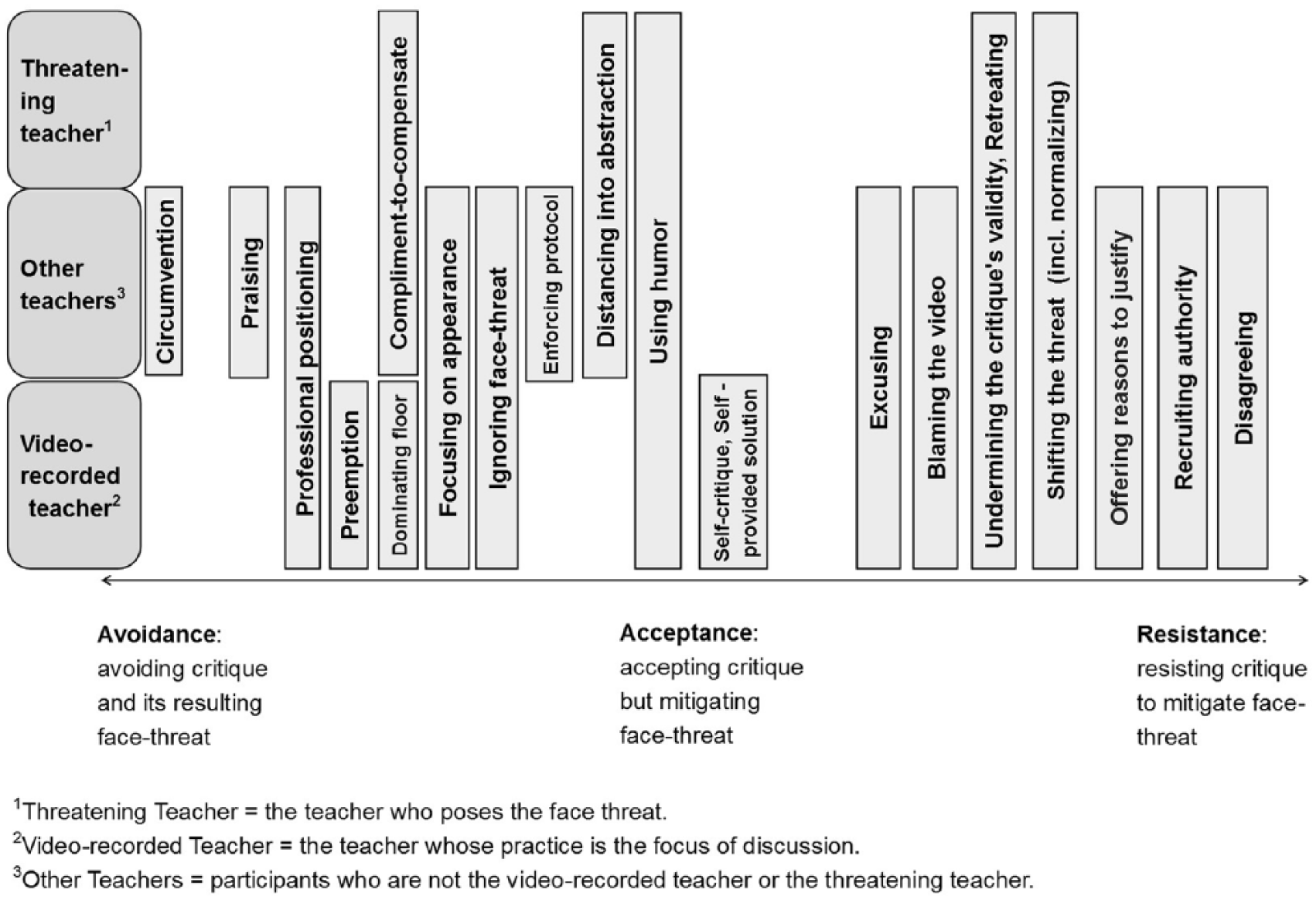
Face-work strategies.
Face threat and face-work are mostly implicit, and their identification involves interpreting intentionally ambiguous activity, which is often rendered in “the language of hint—the language of innuendo, ambiguities, well-placed pauses, carefully worded jokes, and so on” (Goffman, 1955, p. 30). When analyzing face threat and face-work, we focused on the publicly available projection of intentions and the consequences of that action. In addition, we integrated secondary ethnographic data collected via interviews and field notes. The interviews were systematically analyzed for key themes about teachers’ perceptions of the program, and we incorporated relevant findings into our analysis. For example, we classified “framing problems of practice as shared issues” as face-work because it resulted in saving face and because we knew from field notes and interviews that participants construed it this way.
Microanalysis of select cases
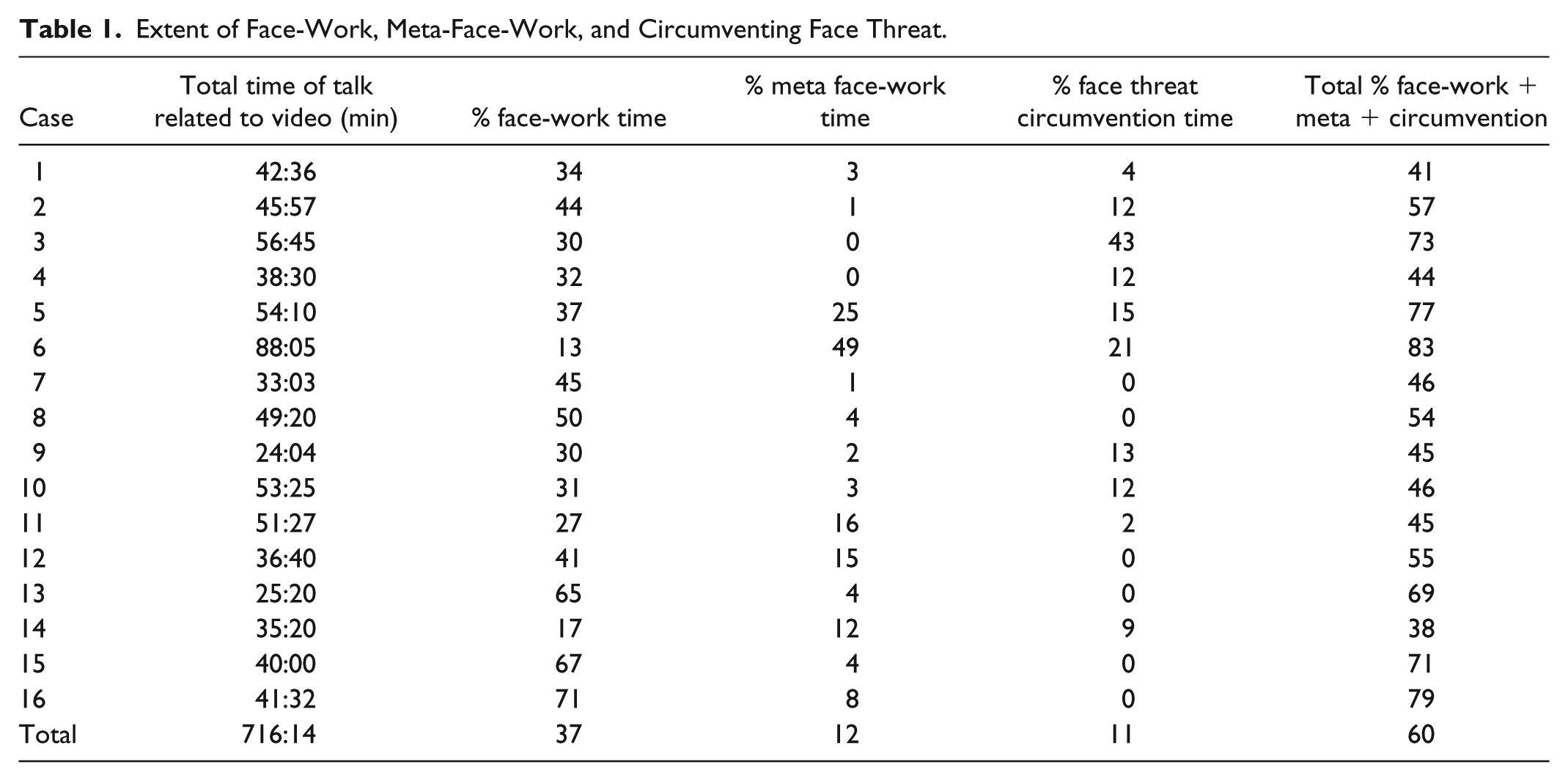
Our analysis was based on the assumption that engaging in face-work and related interaction is interwoven with other activities. That is, when teachers engage in face-work they may (or may not) be simultaneously engaged in inquiry and learning. To explore the role of face-work in shaping teacher learning opportunities, we scanned the data again, this time searching for connections between face-work and features of productive pedagogical discourse, such as attending to problems of practice, critically reasoning about the relationship between teaching and learning, anchoring claims in the video evidence, and weighing multiple perspectives and alternatives. We collaboratively discussed several of these events, using microanalytic methods, negotiated our understandings and developed an initial sense of the phenomenon. We then turned to more systematically examine our emerging understandings, by conducting a thorough microanalysis of one case. We selected Case 16 (Table 1) as an “information-rich case which manifests the phenomenon of interest intensely” (Patton, 2002, p. 234). Although the duration of the audible video discussion in this case (41 min) was close to the average of the discussions we documented (45 min), it had the highest percentage of direct face-work time (71%) and featured a wide variety of strategies: It included 15 out of the 20 face-work strategies in the coding system, each of which also appeared in five to 15 other meetings. The richness and sheer quantity of data made this episode particularly conducive to illustrative analysis, allowing us to demonstrate through a single case how face-work can both catalyze and constrain learning. Yet, the contours of the meeting, relationships among participants, and types of face-work moves are not unique within the data set.
Extent of Face-Work, Meta-Face-Work, and Circumventing Face Threat.
We used linguistic ethnographic micro-analytic methods to investigate the case, repeatedly listening to the data and rereading the detailed transcript, turning to field notes to complete missing information such as nonverbal activity. We collaboratively brainstormed about what was happening in terms of face-work and opportunities to learn, proceeding slowly through the text and asking at each line “What is the speaker doing?”; “Why now?”; “How does this turn of talk respond to what preceded it?”; “What else might have been done here but wasn’t?” and so on (Rampton, 2006). We shared an early version of this article with the video-recorded teacher, who found our interpretations credible and meaningful. The original language of the episode is Hebrew, and we have worked from the Hebrew recordings and transcripts throughout the analysis (see Supplemental Appendix E, available online, for transcription conventions).
Findings
In total, we estimate that participants attended to face concerns in about 60% of video discussion time, including direct face-work (37%), talking about face threat and face-work (12%), and circumventing face-work (11%; Table 1). While of course 60% of video discussion time was not devoted exclusively to face management (e.g., teachers were learning while also engaged in face-work), these findings do indicate that face is highly salient in video-based discussions of problems of practice.
Concerns about face were also expressed in the interviews, although interviewees were not directly asked about face. For instance, one coordinator said, “if the atmosphere is ‘God if I’ll ask this question’ or ‘what will they think of me,’ then no one will dare bring stuff, and then those hours won’t be effective.” Another ventured, “worrying about critique is so strong that it shuts people down, shuts teams, from the highest rank to the lowest rank, for everyone it’s a very shutting feeling.”
In what follows, we briefly review meta-face-work and face circumvention practices, and then focus on the teachers’ direct face-work strategies.
Meta Face-Work
In total, teachers spent about 12% of total video-based discussion time talking about face threats and face-work, including the following:
Reviewing ethical guidelines, such as “It’s forbidden to be critical” (Meeting 5 1 ), and “only productive critique” (Meeting 11).
Giving conversation instructions, such as “each one will say a positive sentence. Before we start going at her ((laughing))” (Meeting 15).
Reflecting on the discussion, such as “I can finally breathe. The longest six minutes of my life” (Meeting 5).
Circumventing Face-Work
In total, teachers spent about 11% of total video-based discussion time engaged in talk that appears at least partially motivated by an attempt to avoid or minimize face threat and face-work, including the following:
Appreciative inquiry, which orients toward identifying and “learning from success” rather than interrogating problems of practice. In this approach, criticism is expressly forbidden, thus preventing face threat and obviating the need for face-work.
Tasks related to the video yet removed from the recorded practice, such as “acting like students” prior to viewing the video, and working on the worksheet from the video-recorded lesson for 14 min with no reference to the video-recorded teacher or her practice (Meeting 3).
Discussion of remote issues or other teachers’ practice rather than the video-recorded practice. For example, when a video-recorded teacher asked whether the whole class discussion she led was too long, participants turned to discussing (for 9:30 min) remote issues such as the number of students in different classes, and the activity the team needs to prepare for an upcoming school staff meeting (Meeting 14). Throughout this entire time, there was no reference to the video-recorded teacher, her practice, or the video, thereby minimizing threat to her face.
Direct Face-Work Strategies
Our analysis indicates that teacher teams were engaged in direct face-work for an average of about 37% of their video-based discussion time. Figure 1 presents face-work strategies teachers used, classified according to the speaker, and organized on a continuum from avoiding critique to resisting critique. In what follows, we briefly discuss these strategies (see Supplemental Appendix D, available online, for code definitions, examples, and number of cases in which each strategy was evident).
Face-work strategies video-recorded teachers use to defend their own face
In eight meetings, we identified episodes of preemption, 2 in which the video-recorded teacher mitigated anticipated critique by justifying her practice, highlighting students’ characteristics, organizational constraints, the setting, curriculum, and so on. For example, in Meeting 5, the video-recorded teacher provided background to the video-recorded lesson, which showed a small group lesson focused on social skills. Many of the particulars the teacher described served to mitigate anticipated critique: it was her first year, only the second lesson, one student was absent from the first, students did not know each other previously, and as “it’s a social group kids are also allowed to unwind and sit on the floor.”
Another face-work strategy enacted exclusively by the video-recorded teachers was dominating the floor, speaking for longer than is customary, and presenting their professional philosophy, values, dilemmas, and so on in a way that excludes other voices and prevents others from raising doubts or critique. Similarly, face-work was evident when video-recorded teachers self-criticized their own practice and suggested solutions before others did. For example, in Meeting 12, the video-recorded teacher was asked about ignoring students’ mistakes and told a story about how she tried out a new teaching method, concluding that “so this was the dilemma, like, the lack of professionalism. I didn’t know the method deeply.” If the teacher experienced momentary face loss, it was immediately repaired by her explicit reference to the lesson she learned: If she were to do it now, of course she would address the wrong answers as well.
Face-work strategies used by both video-recorded teacher and other participants
In 15 of the analyzed cases, either the video-recorded teacher or her colleagues positioned her professionally as a competent practitioner, an expert in her unique field (e.g., art), and caring, motivated, thoughtful, and successful over and above the practice represented in the video. Such positioning typically bolsters the teacher’s face and mitigates future threat.
Teachers sometimes shifted the focus of discussion from instructional practice to physical appearance, such as in “I have a [fat] belly,” or other technicalities, such as how nice the classroom rug is. Occasionally, they tried to ignore threat, acting as if “it’s ok. Nothing happened” or using humor, such as, “I said I’m a genius and finally I contributed my part to mathematics.”
Other prominent strategies commonly used by both the video-recorded teacher and other teachers include excusing “malpractice” or problems of practice by attributing them to circumstances beyond the teacher’s control. Such circumstances were usually related to students, as in “we know this class’s history” or “they are too lazy.” The filming or editing of the video also became an object of critique, responsible for misinterpretations that led to face threat. For example, in Meeting 15, after being criticized for rushing with the subject too fast, the video-recorded teacher defended her judgment, arguing, “listen, I walked among the students. To my regret, again, you can’t see it [in the video].” The threatening teacher often mitigated the threat she posed by retreating and apologizing or by undermining the critique’s validity, as in “maybe because I’m teaching little ones, sweetheart, I was missing some illustrations.”
In 11 meetings, participants shifted the threat to their own face, protecting the video-recorded teacher’s face, as in “I have the same issue and I know it’s bad for some students,” or they normalized the problem, mitigating threat, for instance, “we all make mistakes when we talk” (cf. Horn & Little, 2010). Teachers often protected or defended face by offering reasons to justify the criticized practice, for example, arguing that using the word “piece” instead of “part” in a pizza slicing math activity is fine because it is better connected to students’ lives. They sometimes recruited authority to justify a practice (e.g., “I learned it in my PD”) or disagreed with the implied critique.
Face-work strategies other teachers use to protect the video-recorded teacher’s face
In 14 out of the 16 cases, teachers engaged in face-work through praising or complimenting, addressing both the video-recorded teacher’s practice and her willingness to share it, as in “you’re amazing,” “a role model,” or “inspiring.” Compliments often compensated for an apparent face threat.
In 10 of the meetings, teachers reacted to the potential threat by distancing the discussion from the video-recorded teacher to talk about abstract pedagogical issues or other teachers’ practice, or by framing problems of practice as shared issues. For example, in Meeting 1, after watching a teacher correcting a student’s reading aloud, one participant wished to “raise a general issue” about correcting students’ reading, elaborating on her dilemma: “something I do, I saw you also do it, I wonder if it’s the right way to go.” Teachers also used the protocol to delegitimize face threat, as in “no judging!”
We now turn to the analysis of one meeting through which we illustrate some of these strategies in context and discuss the role of face-work in both constraining and catalyzing opportunities for teacher learning.
The Role of Face-Work in Shaping Teacher Learning Opportunities—A Detailed Case Study
This analysis focuses on one elementary school literacy team meeting, which took place in December 2014. In addition to eight regular team members and the team coordinator, a district literacy coach and the school principal also attended. This meeting was the first in which the team viewed a video-recorded lesson taught by one of the team members. The video-recorded teacher, Orit, 3 was a literacy teacher and a sixth grade homeroom teacher with 9 years of experience, six of them in the current school. She participated in the PD workshop alongside Zehava, the acting team coordinator, as a potential future leading teacher. She also studied for a master’s degree in educational administration, aspiring to be a school principal. At the time of this meeting, Zehava opposed the use of video but agreed to allocate part of a meeting to its analysis, as long as she did not have to facilitate it. Thus, Pnina, a district coach, facilitated the discussion.
Presenting the lesson: Taking a line
Pnina thanks Orit for sharing her video-recorded lesson, describes and distributes the video analysis protocol (see Supplemental Appendix B, available online), and stresses the need to adhere to the ethical code and in particular to refrain from judgment: “We’re not here to skewer anyone” (meta face-work). She then invites Orit to introduce the lesson (see transcript in Supplemental Appendix F1, available online).
Orit presents her literacy aims (see Supplemental Appendix F2, available online)—“to use lots and lots of spoken language, meaning to have discussions”—thereby justifying why she “preferred not to stop” the whole class discussion and why “the page they were supposed to fill out in groups…we did it together in the whole group.” We know from our interviews with Orit and other teachers in the school that the school principal “is very much in favor of…differentiated learning” (interview with Orit, November 30, 2014), and in fact directed all teachers to arrange their classroom seating in groups. We therefore interpret Orit’s reasoning for not “run[ning] to stop and move on to differentiated work” as preemptive face-work addressing the potential threat entailed in exhibiting practice that goes against the principal’s agenda and offering reasons to justify it.
Interim summary
Although Orit could have mitigated the threat by presenting the video-recorded segment as exceptional, she essentially aggravates the threat by presenting it as representative of her teaching and even a model of good practice: “and this lesson, it was really an example of a lesson in which it flowed really nicely.” In doing so, Orit takes the line of a secure teacher, autonomous in her pedagogical judgment, undaunted by confrontation, and eager to champion her practice.
Discussing student behavior: Other teachers’ face-work
The team turns to view the 6-min video-recording. The video shows Orit discussing with the class the development of the plot in the story they have read, summarizing the answers they collaboratively develop, and dictating the correct answers to them, while attempting to manage the disruptive behavior of one boy (Gil). When the video ends, the teachers applaud and praise Orit: “thanks…well done.” Pnina invites them to “describe what you saw.” One teacher (Tamar) says with a slight laugh, “I’m dizzy,” referring to Gil’s turbulent behavior. Other teachers immediately delegitimize her comment saying “that’s already a sense…this is no longer what you saw.” Enforcing the protocol, they prevent the development of the threat implied in Tamar’s dizziness, reemphasizing, “What did you see? What did you see?” While Tamar tries to explain, “but one moment…,” she is silenced and others take the floor to describe the discussion Orit conducted, and to praise it (e.g., “it was very nice”). Tamar takes a second stab at the issue (see Supplemental Appendix F3, available online):
This time, Tamar starts by describing (“I see”) as requested, complimenting Orit (lines 619-621) which works to compensate for what she is about to say. She then switches back to Gil’s behavior, implying that just as she was distracted by it, other students in the class may also have been disturbed (623-624). Her description therefore includes an implicit criticism of the way Orit managed Gil. Tamar makes a point of being serious about it (622), yet she self-consciously giggles, suggesting that she is aware of the face threat she poses. She also checks whether others feel the same way (625), thereby mitigating the face threat by undermining the critique’s validity.
Our interpretation of Tamar’s implicit criticism and face threat is supported by Dan’s assertion that “the class isn’t distracted” (635). Dan (who is informally mentored by Orit) defends Orit by disagreeing with Tamar, explaining that the class is not distracted, thanks to Orit’s handling of Gil (636-639). Other teachers agree with Dan, suggesting that students have learned to ignore Gil’s behavior (640) and pointing out that this is a child “with needs” that Orit managed to address while continuing to teach the rest of the class (655-659). Gila even turns directly to Orit to praise her for her practice (660,662). Thus, everyone seems to disagree with Tamar, reframing her criticism as a compliment. This silencing of Tamar in effect serves to protect Orit’s face.
There is only one attempt to contradict this stance: Noya says, “yes, and with this method I think the kids in the class really benefit, but the kid himself, eventually he sat down, but practically most of the class he was…he missed out.” This line of inquiry is extinguished by Orit, who for the next minute and 25 s dominates the floor; she explains about her work with Gil, sharing with her colleagues “a tip I also gave our subject matter teachers” for working with this boy, which it took her a year to develop. While reasoning about and justifying her approach, she defends her face by professional positioning, and also reasserts the line she took at the beginning of the session, that of the professionally secure teacher. This time, she adds to this line the role of an expert teacher, who models her practice and shares her experience with her colleagues. No one questions her reasons (or line). Even Tamar retreats, laughing: “really, the second time [watching the video] he didn’t distract me like he did the first time.”
Interim summary
Although it was not Orit’s expressed intention to discuss Gil’s behavior, the face threat posed by Tamar (and Noya) led to an episode of pedagogical reasoning focused on a problem of practice—how to cope with the disruptive student. The teachers considered various interpretations of the represented interaction (is the class distracted by Gil or do they ignore him?), multiple points of view (the needs of the class vs. those of Gil), alternative practices (publicly paying attention to him vs. “continuing running the class”), as well as their advantages and shortcomings (stopping instruction to attend to him “could flow to the wrong place,” continuing teaching makes him “calm down” but he distracts other students and he “misses” much of the lesson). They offered explanations and reasons, connecting the teacher’s practice with students’ learning, based on what they saw in the video. Although this talk was productive in many respects, the consistent silencing of one voice in favor of team solidarity resulted not only in saving Orit’s face, in accordance with the line she presented, but also in missing several opportunities for further inquiry.
Discussing dictation: Orit’s face-work
Fifty-three minutes into the meeting, Pnina asks Orit which issue she wanted them to discuss and why she chose “to focus on this particular segment [of video]?” Consistent with her line of the expert, model teacher, Orit answers at length (1:10 min), dominating the floor, raising the controversial issue of teaching through dictation (see Supplemental Appendix F4, available online). She discloses that she shared the dictation segment in order “to show” her colleagues how it should be done. Note that she could have framed it as an issue of concern for her or as a matter for collaborative deliberation (as Pnina instructed). Her colleagues interrupt her mid-sentence, asking, “you always do that?” and raise the tension between dictation and “free expression.” Given the school atmosphere regarding differentiated instruction, we interpret their questions as critiquing this practice. Defending her face, Orit justifies her approach, elaborating its rationale (uninterrupted for a minute and 25 s) and disagreeing with her colleagues. She describes how she balances dictation with giving her students “space, to each write” in their “differentiated assignments,” which she then selectively checks, but as she knows “I won’t really have time to go over all of them, I make sure to do it together with them.” Explicitly addressing “differentiated assignments,” she demonstrates that she is well aware of the risk incurred by presenting an episode of teacher dictation. Thus, she potentially opens it up for discussion, but in effect, she does not allow the discussion to develop, in spite of Pnina’s efforts:
Pnina questions the practice of dictation, asking, “if it’s appropriate to operate this way.” The face threat this poses is mitigated by framing it as an “issue” (989,998) or a “wondering” (990, distancing into abstraction). Presenting dictation as an issue for discussion subverts the line Orit has taken, that of the expert teacher presenting best practice. However, Orit adheres to her line, answering the question as if it had been directed to her as expert, ignoring Pnina’s repeated requests to open the issue to others (993-1000).
Interim summary
In this episode, we see that while the face threat catalyzed some productive discussion about dictation and differentiated instruction, Orit’s line and her subsequent face-work stifled its development.
Discussing group work: Managing face while confronting the principal
Sixty-three minutes into the meeting, the principal, Efrat, who has been relatively quiet until this point, says students really were very much with Orit, this group. But along with this I say that there’s no doubt, listen, studies have also shown, that the proportion of concentration, or the amount of time that children can concentrate in a frontal lesson, is seven to ten minutes maximum, not more than that. (see Supplemental Appendix F5, available online)
Efrat speaks against whole class discussions, instead advocating for differentiated instruction and small group learning. She shifts between addressing Orit’s practice specifically (and talking to her in second person) and addressing instruction in general, as in the following: to be responsive to everyone, we, I mean
This works to mitigate the threat to Orit’s face by distancing into abstraction.
Orit responds to Efrat’s criticism by addressing not whether whole class discussions are good for students but whether they are good for teachers. Doing so, she lightly mocks Efrat’s research base: Also as a teacher, in my opinion, you’re not able to stand now and lecture for a whole day, 7 hours, 45 minutes every hour, like also in terms of the teacher even if he really wants to, even if they’d tell him that in research studies 45 minutes is OK.
In response, Efrat bluntly suggests that Orit is taking the easy route through heavy reliance on “frontal teaching” and playing “leading actress,” which is easier than managing group work.
Noya disagrees with Efrat’s interpretation, defending Orit: she wasn’t a lead actress; she conducted a discussion with the children. Efrat clarifies what she means by “leading actress”: Orit was the lead because she was the center of attention. Orit does not accept Efrat’s argument and insists that “it’s much easier for me to work with them in groups than to stand and be the lead actor.” Then, Efrat introduces the challenge of maintaining discipline and control in group work and establishing the necessary classroom norms. Without contradicting Efrat’s agenda of group work, Orit reestablishes her line: so possibly because today I’m already in group learning for the second year, I feel entirely in a different place…I don’t feel I waste energy when we work in groups. You [singular, addressing Efrat] can come in and see…we went through hell until we reached this.
She thereby implies that while it may be difficult for other teachers to do group work, she has already reached a level at which this is not the case. Here, she defends her face by justifying and professional positioning.
Concluding the meeting, the principal applauds the team for their good discussion and Orit for the way she handles Gil. She compliments to compensate for the face loss she may have caused Orit, upholding her line as an expert, model teacher: “anyway, I can tell you I learned, yes? And I really appreciated how you handle Gil, really really really. I think it can be taught to all teachers, I’m truly saying, not only in this school.” However, by adding, “and I’m convinced that Orit also took a few things from us,” she presumably refers to the problematization of Orit’s whole class instruction, undermining Orit’s model teacher line.
Interim summary
In this episode, the threat Orit preempted earlier was realized, escalating as the conversation proceeded. Both Orit and the principal directly criticized one another while delving deeper into the issue of differentiated teaching, and opening up new directions for consideration. In spite of the principal’s threats, Orit adhered to her line of the secure, expert teacher (who is not intimidated even by her principal).
Summary of analysis
As we cannot know what went on inside Orit and her colleagues’ heads, we can only relate to their presentations of self and thoughts in the discourse and to the ways in which professional knowledge was made accessible to them (Horn & Kane, 2015; Louie, 2016). We identify collaborative progression within the discussion, with numerous participants contributing various ideas and perspectives, deliberating about different aspects of the filmed interaction, focusing on problems of practice, connecting instruction and learning, reasoning, and at times effectively using the video to do so. This provided participants with access to related professional knowledge. We argue that many of these productive features resulted in or were triggered by face threats and were intertwined with face-work.
On the other hand, as we illustrated, we also identify instances of missed opportunities, in which face-work led to silenced voices and neglect of important issues. Significantly, the video-recorded teacher’s main line, which she developed and adhered to throughout the meeting, prevented her from publicly accepting criticism and scrutinizing her own practice and, at the same time, denied others access to professional knowledge.
Discussion and Conclusions
We have systematically analyzed 16 teacher video-based discussions and presented detailed analysis of one case. The analysis offers a nuanced account of various face-work strategies, affording a deeper understanding of the phenomenon, the recognition of its multiple variants, and an estimation of its scope. It demonstrates how critical it is to consider face-work, the potential contribution of detecting and examining it, and the feasibility of doing so.
In accordance with what others have previously argued (Borko et al., 2008; Sherin & van Es, 2009), we have found that video of classroom practice may facilitate productive pedagogical discourse. However, our analysis also shows that video-based discussions involve a great deal of face concern. In all of the cases we analyzed, teachers engaged (for a considerable amount of time) in (a) metapragmatic discourse vis-à-vis face concerns and ways to mitigate them or (b) circumventing face threats, thus obviating the need for face-work, and (c) face-work protecting the video-recorded teacher’s face when threatened. Not only was the video-recorded teacher invested in defending her own face, but so were her colleagues (cf. Goffman, 1955). At times, participants appeared to engage intentionally and strategically in face-work, while at other times, they seemed to stumble into it unawares. Either way, face-work was intertwined with other interactions, some of which opened up learning opportunities (e.g., leading to pedagogical investigation and reasoning) while others closed them down (e.g., discussions that avoided problems of practice).
Although the magnitude of face threat and face-work in video-based learning likely vary between groups (and cultures), we argue that they are inevitable and they have the potential to both afford and constrain productive pedagogical discourse. The analysis suggests that the need to protect face is conducive to opening learning opportunities when it drives the consideration of various interpretations of the represented interaction, arguing and reasoning, contrasting diverse perspectives, connecting instructional practice with learning, and weighing alternatives. However, face-work limits learning opportunities when it involves silencing critical voices, avoiding problematization and confrontation, and diverting attention away from practice. Thus, reminding teachers to be sensitive when critiquing other teacher’s videos (Zhang et al., 2011) or to avoid critique altogether (Dobie & Anderson, 2015) may help to establish a “supportive” collegial environment, which may in some respects be conducive for learning (van Es et al., 2014), but it may also impede critical colleagueship (Lord, 1994). We argue that moving past the usual peer support and sharing of practices to productive, critical discussion of teaching requires that participants acknowledge and accept face threat and face-work as an inherent aspect of their learning. Furthermore, we suggest that conducive management of face threat may more effectively construct face than avoiding face threats. Such an approach can lead to greater trust between participants, which may gradually help teachers overcome norms of privacy and fear of judgment.
The workings of face threat and face-work appear to be highly related to the lines adopted by the video-recorded teacher and the other participants. In our focal case, Orit’s dominant line was that of an expert teacher modeling best practice. Maintaining such a line requires intensive face-work, as every implied criticism undermines it. We suggest that lines that position the video-recorded teacher and her colleagues as both experts and learners are easier to maintain and are therefore more productive.
The role of face-work in shaping teacher learning opportunities appears to be intertwined with and perhaps even aggravated by issues of power relations, especially given the participation of an authority figure, such as a principal, a coach, or a researcher. Given the hierarchical nature of the school system, we expect micropolitics to influence face-work and learning in every case. Hence, we are not arguing for the exclusion of authority figures in video-based learning. Furthermore, as we have illustrated, their involvement can also advance learning opportunities. Rather, we contend that using classroom videos as a tool for teacher learning calls for a greater awareness of the social challenges involved in such learning processes, particularly when used within school-based teacher teams.
Some practical implications of this study for video-based teacher learning include the following:
The need to address face and face-work issues in the training of facilitators and team coordinators, highlighting the attendant complex role of face-work in learning as well as developing awareness and skills to harness face issues to promote learning. Previous work on facilitation of video has highlighted the efficacy of facilitation that is “focused and challenging” (Zhang et al., 2011, pp. 388-389), for instance, revoicing that is “negotiatory” rather than merely “affirmative” (Borko et al., 2008, p. 432). However, when it comes to identifying strategies and facilitation moves that address the social needs of the group, suggestions coalesce around distribution of participation rights and validation of ideas (van Es et al., 2014). Our study suggests that in addition to a general balance between support and critique, facilitators could benefit from a more nuanced understanding of face-work strategies, to recognize as face-work behaviors that they might have otherwise overlooked, and their potential risks and opportunities. Working with case studies such as that which we have detailed here can help develop facilitators’ awareness of face, appreciation of its complexity, and an understanding of the advantages and limitations of strategies for addressing it in their work.
The possible advantages of framing video-based discussion as a consultation, in which the video-recorded teacher exposes a problem of practice and seeks her colleagues’ assistance in deliberating about it (Vedder-Weiss et al., 2018). Such framing may better support a line of mutual learning and position the video-recorded teacher as the owner of the video. Although video allows teachers to identify problems of practice the video-recorded teacher does not (e.g., behavior management problems), this involves greater face threat. Framing video-based discussion as a consultation can help maintain the intended focus according to the video-recorded teacher’s preferences, affording the construction of a safe environment where teachers can gradually learn to more productively manage face.
The need to carefully consider the role of authority figures, such as mentors, coaches, principals, and university facilitators, in light of micropolitical concerns and their potential impact upon video-based learning.
Limitations and Future Research Directions
Highlighting the critical role that face-work plays in teacher video-based learning also suggests that face should be more broadly considered in research and practice related to other forms of teacher collaborative learning. Although video likely presents greater face threat than do other representations of practice, we assume that every pedagogical discussion focused on problems of practice poses some level of threat. Having demonstrated that face-work can be investigated and having offered a nuanced account of its variants, we advocate further investigation of the role face plays in teacher collaborative learning. This may include comparatively studying other video-based learning approaches, such as video clubs, lesson study, and problem-solving cycles (Borko et al., 2008); the functions of different types of representations of practice; various participant groupings; and different facilitation styles. Comparisons between different contexts in which video sessions are embedded and exploration of the broad meanings attached to video discussions are also important. For example, in Israel, videos are not used for high-stake teacher evaluation; we expect that in contexts in which they do serve this purpose, teachers will engage in more intensive and different face-work than described here. Also related are the motivations driving teachers to participate in video-based leaning, and the study of their relationship to face-work. Such investigations might use the classification system we developed, but would need to check its applicability across contexts and cultures, in light of the dynamic, emergent, and context-dependent nature of face-work.
Data collection and analysis in this study did not afford an examination of the outcomes of teacher video-based learning. Joining a line of existing scholarship (e.g., Horn & Kane, 2015), we have limited our scope to the examination of the sort of learning opportunities that are opened up or closed down because of concomitant face-work. While learning opportunities by themselves do not guarantee learning, they are indeed a prerequisite for learning (Louie, 2016). Future research might take a more developmental approach tracking the role face-work plays in learning processes, looking into how it affects knowledge construction, conceptual change, and improvement of practice. A developmental approach could also be used to explore the ways face threat and face-work change as facilitators gain experience in facilitating video-based discussions and teachers learn to better use this tool.
Supplemental Material
Appendix_A_JTE841895 – Supplemental material for Teacher Face-Work in Discussions of Video-Recorded Classroom Practice: Constraining or Catalyzing Opportunities to Learn?
Supplemental material, Appendix_A_JTE841895 for Teacher Face-Work in Discussions of Video-Recorded Classroom Practice: Constraining or Catalyzing Opportunities to Learn? by Dana Vedder-Weiss, Aliza Segal and Adam Lefstein in Journal of Teacher Education
Supplemental Material
Appendix_B_JTE841895 – Supplemental material for Teacher Face-Work in Discussions of Video-Recorded Classroom Practice: Constraining or Catalyzing Opportunities to Learn?
Supplemental material, Appendix_B_JTE841895 for Teacher Face-Work in Discussions of Video-Recorded Classroom Practice: Constraining or Catalyzing Opportunities to Learn? by Dana Vedder-Weiss, Aliza Segal and Adam Lefstein in Journal of Teacher Education
Supplemental Material
Appendix_C_JTE841895 – Supplemental material for Teacher Face-Work in Discussions of Video-Recorded Classroom Practice: Constraining or Catalyzing Opportunities to Learn?
Supplemental material, Appendix_C_JTE841895 for Teacher Face-Work in Discussions of Video-Recorded Classroom Practice: Constraining or Catalyzing Opportunities to Learn? by Dana Vedder-Weiss, Aliza Segal and Adam Lefstein in Journal of Teacher Education
Supplemental Material
Appendix_D_JTE841895 – Supplemental material for Teacher Face-Work in Discussions of Video-Recorded Classroom Practice: Constraining or Catalyzing Opportunities to Learn?
Supplemental material, Appendix_D_JTE841895 for Teacher Face-Work in Discussions of Video-Recorded Classroom Practice: Constraining or Catalyzing Opportunities to Learn? by Dana Vedder-Weiss, Aliza Segal and Adam Lefstein in Journal of Teacher Education
Supplemental Material
Appendix_E_JTE841895 – Supplemental material for Teacher Face-Work in Discussions of Video-Recorded Classroom Practice: Constraining or Catalyzing Opportunities to Learn?
Supplemental material, Appendix_E_JTE841895 for Teacher Face-Work in Discussions of Video-Recorded Classroom Practice: Constraining or Catalyzing Opportunities to Learn? by Dana Vedder-Weiss, Aliza Segal and Adam Lefstein in Journal of Teacher Education
Supplemental Material
Appendix_F_JTE841895 – Supplemental material for Teacher Face-Work in Discussions of Video-Recorded Classroom Practice: Constraining or Catalyzing Opportunities to Learn?
Supplemental material, Appendix_F_JTE841895 for Teacher Face-Work in Discussions of Video-Recorded Classroom Practice: Constraining or Catalyzing Opportunities to Learn? by Dana Vedder-Weiss, Aliza Segal and Adam Lefstein in Journal of Teacher Education
Footnotes
Declaration of Conflicting Interests
The author(s) declared no potential conflicts of interest with respect to the research, authorship, and/or publication of this article.
Funding
The author(s) disclosed receipt of the following financial support for the research, authorship, and/or publication of this article: This research was supported by the Israel Science Foundation (Grant No. 1180/18).
Notes
Supplemental Material
Supplemental material for this article is available online.
Author Biographies
 ).
).
References
Supplementary Material
Please find the following supplemental material available below.
For Open Access articles published under a Creative Commons License, all supplemental material carries the same license as the article it is associated with.
For non-Open Access articles published, all supplemental material carries a non-exclusive license, and permission requests for re-use of supplemental material or any part of supplemental material shall be sent directly to the copyright owner as specified in the copyright notice associated with the article.
