







Abstract
The purpose of this study was to investigate changes in a cohort of secondary preservice teachers’ (PSTs) vision of the role of a teacher within the context of a mathematics methods course designed around pedagogies of practice. We analyzed data collected in the first and last 2 weeks of the course, consisting of recordings of small- and whole-group discussions, PSTs’ written work, and individual interviews. We first coded using Munter’s Role of Teacher rubric and identified significant differences between beginning-of-semester data and end-of-semester data. We then conducted three rounds of constant comparative analysis resulting in four themes that describe the changes in visions of role of teacher. Findings indicate that engaging in pedagogies of practice in preservice education has the potential to influence PSTs’ visions of their role as mathematics teachers. This study extends both the literatures on pedagogies of practice and on teachers’ instructional vision.
Teacher candidates must . . . form visions of what is possible and desirable in teaching to inspire and guide their professional learning and practice. Such visions connect important values and goals to concrete classroom practices. They help teachers construct a normative basis for developing and assessing their teaching and their students’ learning. —Feiman-Nemser (2001, p. 1017).
Two decades ago, Feiman-Nemser (2001) identified “analyzing beliefs and forming new visions” (p. 1016) as the central tasks of teacher education. Preservice teachers (PSTs), she argued, conceptualize the work of teaching based on conscious and subconscious internalized observations, as students, of the work of teaching. Furthermore, she argued, visions of instruction are often ones in which knowledge is held by teachers and given to (and received by) students, which positions teaching as transmission of knowledge and learning as the receipt of that knowledge.
Teacher educators (TEs) anecdotally recognize that secondary mathematics PSTs enter professional education with instructional visions involving teachers delivering clear, concise explanations of mathematical procedures, monitoring the correctness of students’ work on practice problems, and testing students’ knowledge. In contrast, current professional literature suggests that an effective mathematics teacher’s role also includes planning for and implementing high-level tasks, eliciting and using evidence of student thinking, posing purposeful questions, orchestrating meaningful discourse, and supporting productive struggle (National Council of Teachers of Mathematics [NCTM], 2014).
Mathematics teachers’ instructional vision matters because it can influence the choices that teachers make about professional development (PD) opportunities (Appova & Arbaugh, 2017), the growth teachers experience within PD (Munter & Correnti, 2017), the nature of their teaching practices (Thompson et al., 2013), and the decisions they make about when to leave a current teaching position (Hammerness, 2008). Thus, as Feiman-Nemser (2001) argued, it is important to understand how professional coursework can support the development of PSTs’ visions of mathematics instruction to better align with the current recommendations for effective teaching.
Recent theoretical developments in pedagogies of teacher education provide a fertile context for examining mathematics PSTs’ instructional visions within professional coursework. In the past decade, TEs have begun to deliberately integrate the development of PSTs’ knowledge about effective teaching practices with the development of their capacity to enact such practices. This integration, referred to as pedagogies of practice (Lampert et al., 2010), uses specific decompositions of practice (Grossman, Compton, et al., 2009), which “[break] down practice into its constituent parts for the purposes of teaching and learning” (p. 2058). Learners interact with representations of practice (e.g., narrative or video cases) and engage in approximations of practice, which afford “opportunities for novices to engage in practices that are more or less proximal to the practices of a profession” (Grossman, Compton, et al., 2009, p. 2058). Researchers argue that engaging with pedagogies of practice helps novices learn to enact complex teaching practices (Grossman, Hammerness, & McDonald, 2009; Lampert et al., 2010).
At this time, few studies have examined outcomes for secondary mathematics PSTs who study in coursework designed around pedagogies of practice. In addition, no studies have examined how experiences within such coursework relate to developments in PSTs’ instructional vision. Therefore, this study addresses the question: How did secondary PSTs’ vision of the role of the teacher change from the beginning to end of a mathematics methods course, which was organized around pedagogies of practice and focused on instructional planning, posing purposeful questions, and eliciting and using evidence of student thinking?
Theoretical Considerations
We define instructional vision as a set of internal images that portray the work of teaching mathematics. Teachers can have instructional visions to which they aspire (Hammerness, 2001; Munter, 2014) and can hold visions of instruction that developed when they were students in mathematics courses. To operationalize instructional vision, we drew on Munter’s (2014) Visions of High-Quality Mathematics Instruction (VHQMI) framework. Using both literature on effective mathematics instruction and data collected in the Middle School Mathematics and the Institutional Setting of Teaching (MIST; Cobb & Smith, 2008) project, Munter developed a framework represented by four interrelated rubrics that describe instructional vision: Role of Teacher, Classroom Discourse, Mathematical Tasks, and Student Engagement in Classroom Activity. Each rubric contains levels indicating the extent to which teachers express an instructional vision consistent with current recommendations for effective mathematics instruction. For this study, we use the Role of Teacher (RoT) rubric (see Appendix) to describe the instructional vision of a cohort of PSTs and the ways that their vision changed during a secondary mathematics methods course designed around pedagogies of practice.
We also draw on Fullan (1993), who positioned personal vision-building as one of the “core capacities required as a generative foundation for building greater change capacity” (p. 12). Fullan argued that “teachers should be pursuing . . . purpose with greater and greater skill, conceptualizing their roles on a higher plane than they currently do” (p. 13). Although Fullan focused on inservice teachers, as we argued in the introduction this pursuit can and should begin in PST education. Furthermore, Fullan contended, visions are built from experiences: “Under conditions of dynamic complexity one needs a good deal of reflective experience before one can form a plausible vision. Vision emerges from, more than precedes, action” (p. 28, emphasis added).
Figure 1 illustrates our conception of how instructional vision and pedagogies of practice connect in PST education. We theorize that PSTs enter professional coursework with an instructional vision informed primarily by their experiences as mathematics students, which predominantly have occurred in lecture-style courses. When PSTs participate in pedagogies of practice in mathematics methods courses, they have opportunities to engage in approximations of practice (action) where they enact focal decompositions of practice. They then analyze resulting representations of practice (i.e., audio- or video-recordings) through lenses of decompositions of practice, thus reflecting on their actions. As visions change through action and reflection (Fullan, 1993), and pedagogies of practice conjoin action and reflection, we argue that as PSTs engage in pedagogies of practice, new visions of mathematics instruction have the potential to emerge. Specifically, we theorize that engaging in pedagogies of practice focused on learning about, and practicing the enactment of, effective teaching practices (NCTM, 2014) has the potential to impact PSTs’ visions of RoT, broadening their incoming instructional vision of the role that teachers take during instruction. This relationship is at the heart of this study.
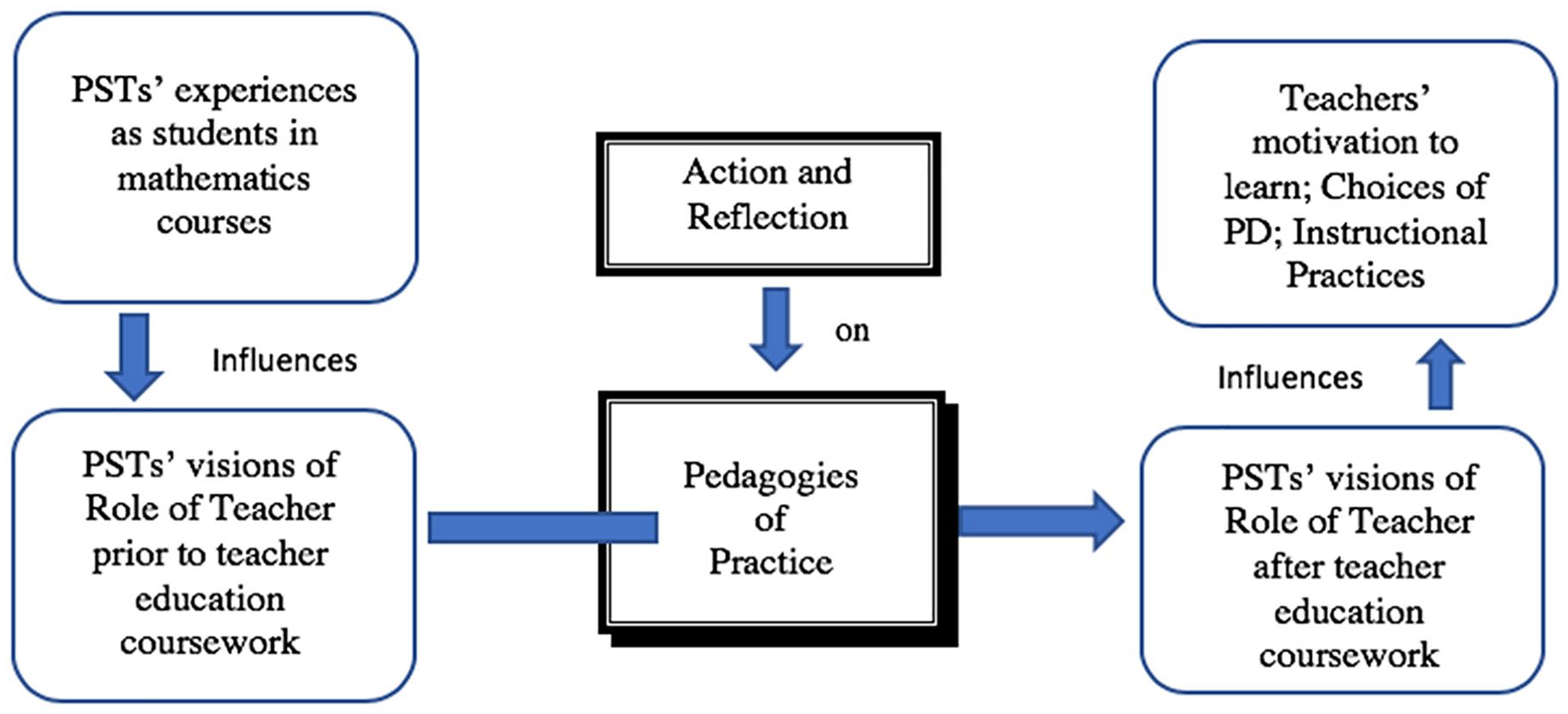
Theoretical connections among pedagogies of practice, PSTs’ vision of RoT, experiences, actions, and reflection.
Relevant Literature
Two bodies of literature are relevant to this study. In the following sections, we first review research in which VHQMI played a central role in study design and findings. We then review literature on pedagogies of practice in mathematics teacher education. To date, these two bodies of literature do not intersect.
VHQMI
The VHQMI rubrics have been primarily used to examine relationships between inservice professional development and teacher change. Munter (2014) and his team used the VHQMI rubrics to code yearly interviews with teachers involved in MIST. For the 44 teachers who participated in the 4-year project, Munter found an overall increase in average score from Year 1 (1.98) to Year 4 (2.66), including a statistically significant increase from Year 1 to Year 2. Munter’s conclusion was that participants’ instructional visions became more sophisticated over the duration of their participation in the project. Munter and Correnti (2017) conducted regression analyses to examine relationships among MIST participants’ RoT rubric score and changes in their instructional practices. Among other findings, they showed a statistically significant positive relationship between the sophistication of teachers’ VHQMI at the beginning of the project and their growth in instructional quality over the course of participation. Researchers from MIST have also used VHQMI rubrics as tools to investigate relationships between how teachers explained difficulties that students have in mathematics and their students’ opportunities to learn mathematics (Wilhelm et al., 2017), teachers’ enactment of cognitively demanding tasks (Wilhelm, 2014), and teachers’ opportunities to learn in two different MIST project teacher workgroups who met to interpret student assessment data (Horn et al., 2015). These studies imply that instructional vision is a useful construct for examining teacher growth and understanding teacher decision making.
VHQMI rubrics have also been used by researchers outside MIST to examine relationships between PST education and inservice teaching. Jansen et al. (2020) studied instructional visions of 81 graduates from two cohorts of a single elementary teacher education program who were in their second or third year of teaching by using VHQMI rubrics to analyze teachers’ written responses to a set of questions. They then developed three profiles, two of which (encompassing 89% of the participants) were consistent with the attributes of the teacher education program. From these results, Jansen and colleagues argued that the experiences that PSTs have in their teacher education programs impact their inservice visions in multiple ways, with aspects of the intended vision remaining as part of inservice teachers’ visions.
The studies of inservice teachers by Munter and colleagues and by Jansen et al. demonstrate that VHQMI rubrics are useful tools for understanding relationships among inservice teachers’ visions, practices, knowledge, and learning. Our goal is to extend this body of research by exploring relationships between PSTs’ instructional vision and their experiences in pedagogies of practice.
Pedagogies of Practice
To date, much of the scholarship regarding pedagogies of practice has focused on the use of learning cycles in mathematics methods courses. Such learning cycles involve stages in which PSTs examine/analyze representations of practice, plan for enacting a decomposition of practice, approximate practice by rehearsing for the enactment of the practice with students and reflect on or analyze a representation of the enacted practice. For example, Lampert et al. (2013) described a Cycle of Enactment and Investigation (CEI) with six stages: observation, collective analysis of the observation, preparation for teaching an instructional activity (IA), rehearsal of the IA, classroom enactment of the IA, and collective analysis of the classroom enactment. McDonald et al. (2013) described a similar learning cycle with four stages: introducing and learning about an activity, preparing for and rehearsing the teaching of the activity, enacting the activity with students, and analyzing enactment and moving forward. They further described the representations of practice (e.g., modeling, video analysis, and case analysis), approximations of practice (e.g., planning and rehearsing an IA), and decompositions of practice (e.g, core practices) that undergird the four stages. These learning cycles emphasize action in the form of rehearsals or enactments and reflection in the form of individual or collective analysis of representations of practice.
Research in this area suggests that methods course activities designed around pedagogies of practice offer opportunities for PSTs to learn about instructional practice, to develop instructional practices, and to begin noticing important aspects of instructional practice. For example, Lampert et al. (2013) found that exchanges between elementary PSTs and TEs during rehearsals created opportunities for PSTs to learn about eliciting and responding, representation, and student engagement. In a related study, Kazemi et al. (2016) found that temporal proximity between rehearsal and enactment affected the content of such exchanges. Tyminski et al. (2014) reported that engaging with pedagogies of practice supported elementary PSTs to develop instructional practices for orchestrating mathematical discussions. Similarly, Ghousseini and Herbst (2016) examined secondary mathematics PSTs’ opportunities to learn about aspects of leading mathematical discussions within pedagogies of practice, finding that opportunities were distributed across the focal decomposition, representation, and approximation of practice, with each contributing different opportunities to explore the practice of leading discussions. Furthermore, Baldinger et al. (2016) found that pedagogies of practice supported secondary mathematics PSTs’ capacities to notice factors related to steering discussions. Pedagogies of practice can also support inservice teachers to develop with respect to instructional moves related to implementing cognitively demanding tasks, though the effectiveness of their use of those moves is mediated by the focus of their attention while executing the moves (Webb et al., 2015).
Our study stems from a multi-year research effort to investigate outcomes of a methods course designed around pedagogies of practice using iterated learning cycles to focus on developing PSTs’ knowledge about and capacities to enact purposeful questioning and eliciting and using evidence of student thinking. In a different study from this project (Arbaugh et al., 2019), we describe what PSTs reported learning from engaging in one of the CEIs from this course. Using a modified version of Ghousseini and Herbst’s (2016) interpretation of the framework for learning to teach (FLT; Hammerness et al., 2005), we reported that engaging in the CEI supported PSTs in learning about mathematics content, about students and content, and about instructional strategies. We also established that different nodes of the CEI supported their learning in different dimensions of the FLT.
The knowledge base about outcomes for PSTs engaged in pedagogies of practice is in its early development and much is left to be investigated. With this study, we aim to extend and deepen the literature in this area.
Methods
Setting and Participants
We recruited 17 participants from one semester long offering of a methods course for undergraduate secondary (grades 7–12) mathematics education majors at a large public university in the eastern United States. The course met twice weekly for 15 weeks and was the PSTs’ first mathematics methods course, typically taken in year three of a 4-year program. Pedagogies of practice and learning cycles informed the design and sequence of course activities, which focused PSTs on learning core practices of planning for instruction, posing purposeful questions, and eliciting and building on student thinking (NCTM, 2014). We operationalized these core practices in two ways. First, PSTs used a modified Thinking Through the Lesson Protocol (TTLP; Smith et al., 2008) to support instructional planning. For other core practices, we used a decomposition consisting of asking assessing/advancing questions and using judicious telling (Freeburn & Arbaugh, 2017). The decomposition also framed PSTs’ analyses of representations and approximations of practice throughout the semester. Table 1 contains brief descriptions of our pedagogies of practice. See Arbaugh et al. (2019) for an illustration of one of the four learning cycles we enacted during this semester. Activities in the first 2 weeks (prior to engaging in learning cycles) included reading and discussing mathematics education literature (see Table 2), laying a foundation for the mathematics education community’s view of what it means to know, to learn, and to teach mathematics.
Specific Examples of Pedagogies of Practice Used in Methods Course.
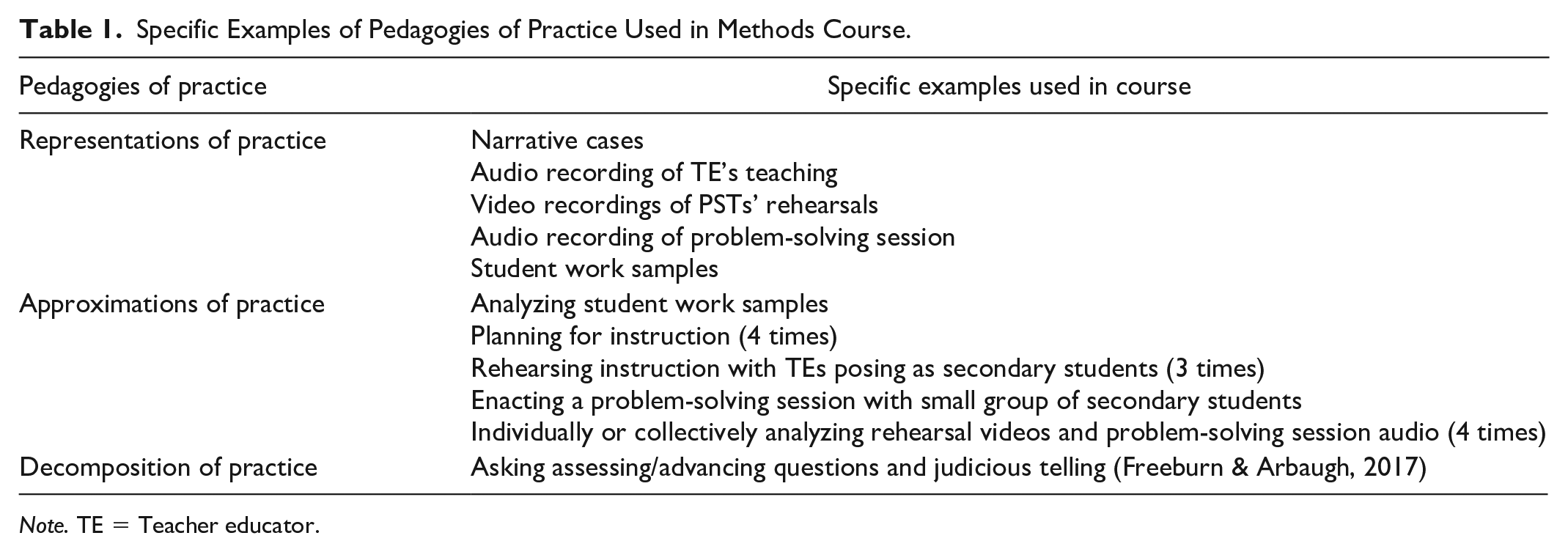
Note. TE = Teacher educator.
Data Sources.
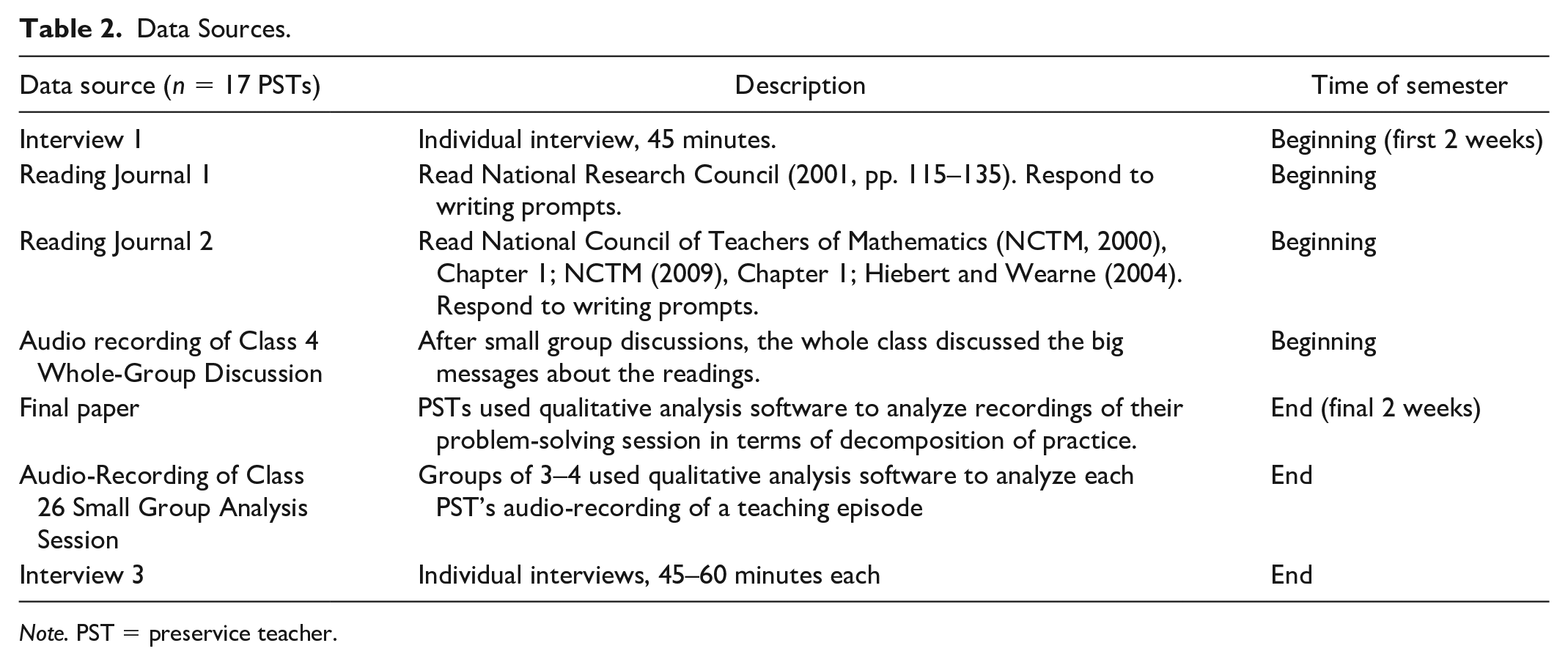
Note. PST = preservice teacher.
Data Collection
We collected data from course meetings, written assignments by PSTs, and individual interviews (Table 2). We focused on data from the first and last 2 weeks of the course to examine PSTs’ visions before and after their engagement in learning cycles.
Interview 1 questions focused on PSTs’ experiences as students in secondary mathematics classrooms and their visions of mathematics instruction. For instance, PSTs were asked to anticipate their best day of teaching mathematics and to describe what would make it their best day. Prompts for reading journals asked PSTs to reflect on their own mathematics education in light of the content of the reading and to comment on notable ideas from their readings. Day four discussions involved identifying important messages that they took from readings. In their final papers, PSTs reflected on their planning and instruction of a problem-solving session with a small group of secondary students. PSTs analyzed audio from their sessions using the focal decomposition of practice as a lens to reflect on their teaching practices in the session, described how their practices supported students’ learning, and characterized “good learning experiences.” In Interview 3, PSTs reflected on how course activities impacted their learning and described how they envisioned enacting effective instruction.
Data Analysis
This study was motivated by our work in the methods course, where we perceived differences across the course in how PSTs described the work of teaching. This perception prompted us to conduct systematic data analysis to question and examine those differences; we identified Munter’s (2014) RoT rubric as a relevant tool for that analysis. The RoT rubric contains five levels from 0 (low) to 4 (high), named respectively: teacher as motivator, teacher as deliverer of knowledge, teacher as monitor, teacher as facilitator, and teacher as more knowledgeable other. Each level above 0 has three subdimensions, which Munter presents as potential ways of characterizing teacher’s role: Influencing Classroom Discourse (ICD), Attribution of Mathematical Authority (AMA), and Conception of Typical Activity Structure (CTAS). 1
First-level qualitative coding
Our unit of analysis for coding was individual PST’s written or oral statements, identified as instances referring to a common focal idea. An instance could be as short as one sentence or could comprise a paragraph. We reduced data by coding instances as RoT or not; we then used Munter’s (2014) rubric (see Appendix) to assign first-level codes using the levels (0–4) of each RoT instance. For instances coded at levels 1, 2, 3, or 4, we coded subdimensions represented in the instance: ICD, AMA, and/or CTAS. We established reliability by individually coding all data sources from one PST, meeting to compare and to calibrate, and reaching consensus on instances that differed. Once we were satisfied with the level of interrater reliability, authors Freeburn and Konuk coded the remaining data and wrote low-inference analytic memos (Miles et al., 2014) including a summary of each instance and a coding rationale using descriptors from the RoT rubric. Further confirmation of reliability of coding occurred as we developed themes; as each researcher reviewed the coded instances, we raised and resolved questions that emerged regarding the initial coding.
We note that our use of the RoT rubric differs from Munter (2014), who relied on interview data designed to ask teachers explicit questions about their VHQMI. As the nature of our data is different from Munter’s, and some of our data consisted of statements made within small group and whole-group conversations, we decided that we were limited methodologically in being able to characterize each individual’s instructional vision. We chose instead to examine the collective vision of the cohort. Furthermore, rather than identifying sophistication of vision using the highest-level statements made by PSTs, we decided to characterize vision according to proportion of statements made at different levels. As such, we interpret changes in proportion of statements in different levels as evidence of PSTs broadening their vision to include new conceptualizations of RoT. Finally, we reasoned, as have others (e.g., Feiman-Nemser, 2001) that prior to professional coursework PSTs have few experiences from which they can build instructional vision, and therefore statements about experiences of mathematics instruction are important to understanding the instructional visions that PSTs hold. Therefore, we chose to code PSTs’ statements about the mathematics instruction that they had experienced as students as representing aspects of their instructional vision.
Quantitative analysis of change
Through this coding plan, we identified 505 RoT instances: 301 instances from beginning-of-semester data and 204 from end-of-semester data. Levels 3 and 4 of Munter’s rubric describe instruction organized in a launch-explore-summarize sequence and levels 0, 1, and 2 describe instruction that has a teacher demonstrate—students practice orientation. Therefore, we sorted the coded data into high-level (3 and 4) and low-level (0, 1, and 2) instances. To investigate whether the vision of the cohort changed across the semester, we treated level of instance and time of data collection as categorical variables, each with two possible values (High/Low and Beginning/End). We used chi-square statistical tests for independence (α = 0.001) to test the following hypotheses for each subdimension and for total RoT:
Second-, third-, and fourth-level analyses: Characterizing visions and changes
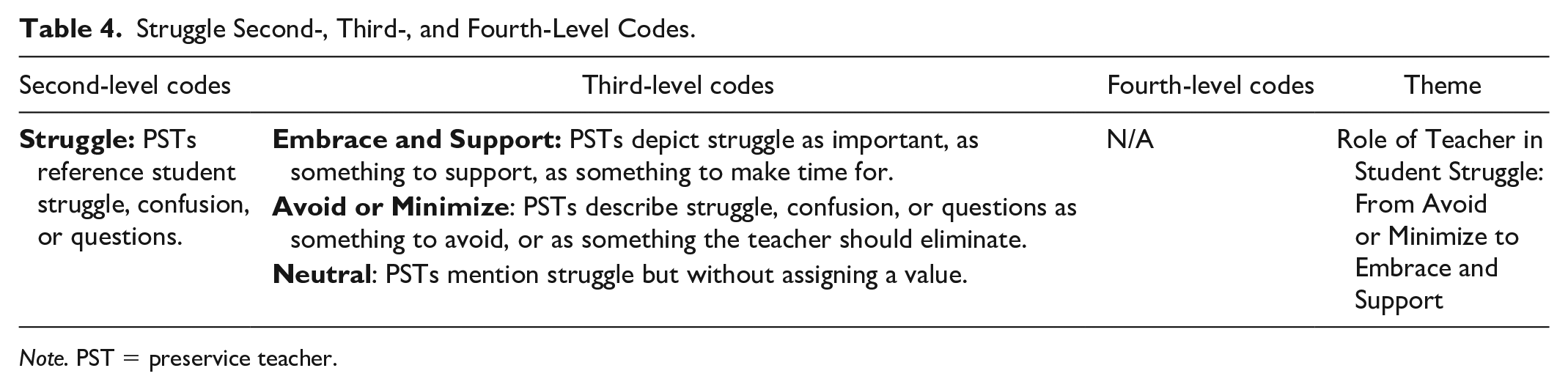
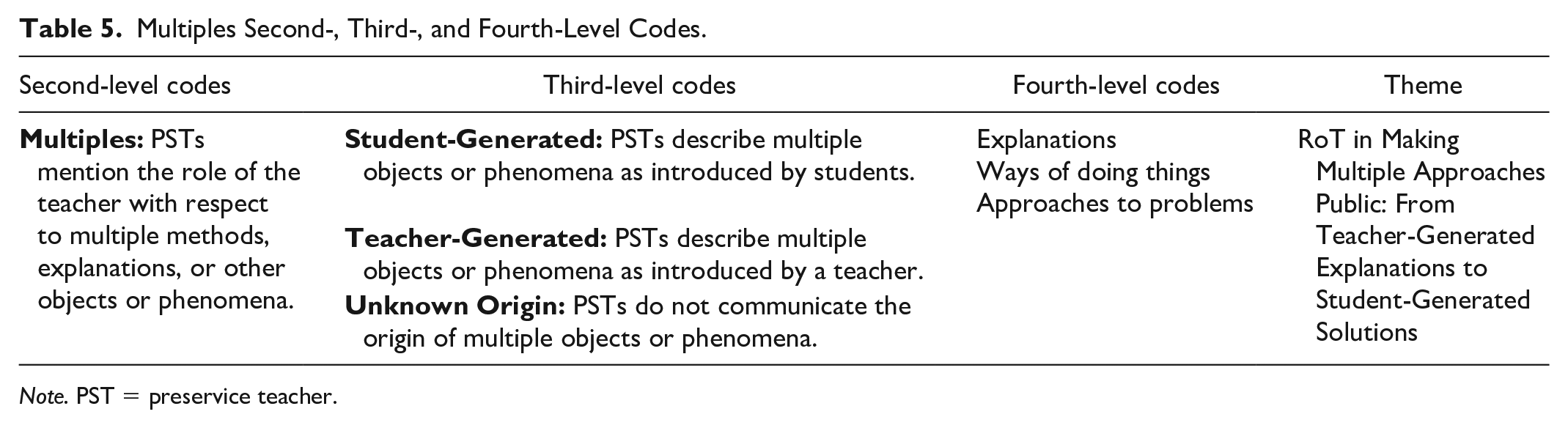
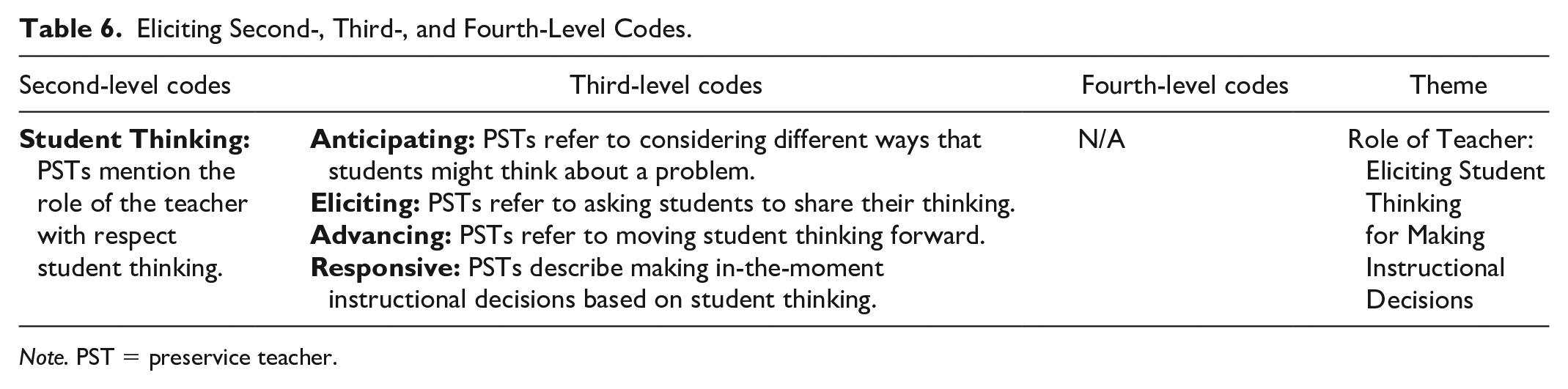
Based on the results of the first level of analysis, we sought to qualitatively characterize the cohort’s vision of RoT at the beginning and at the end of the course. Through constant comparative analysis (Miles et al., 2014), we grouped instances containing statements with similar features into second-level code categories (Communication, Multiples, Struggle, and Student Thinking) and assigned third-level codes that described content differences of instances within the second-level categories, such as Teacher-to-Student versus Student-to-Teacher in Communication (see Tables 3–6 for lists of codes from each level). For each second-level category, we used frequency counts of third-level codes in the low-level beginning (LLB) instances and in the high-level ending (HLE) instances to identify those codes that represented the majority of instances in each category and at each level. In the most frequent third-level codes from Communication and in Multiples, we analyzed the content of statements to develop fourth-level codes from the words PSTs used for the types of communication or the kinds of multiple objects that constituted their statements (e.g., Communication: Teacher-to-Student: Explaining or Multiple: Teacher-Generated: Explanations). We used frequency counts to identify the codes that appeared most commonly within each of the third-level categories. It is important to note that because instances could be as short as a sentence or as long as paragraph, some instances were multicoded.
Communication Second-, Third-, and Fourth-Level Codes.
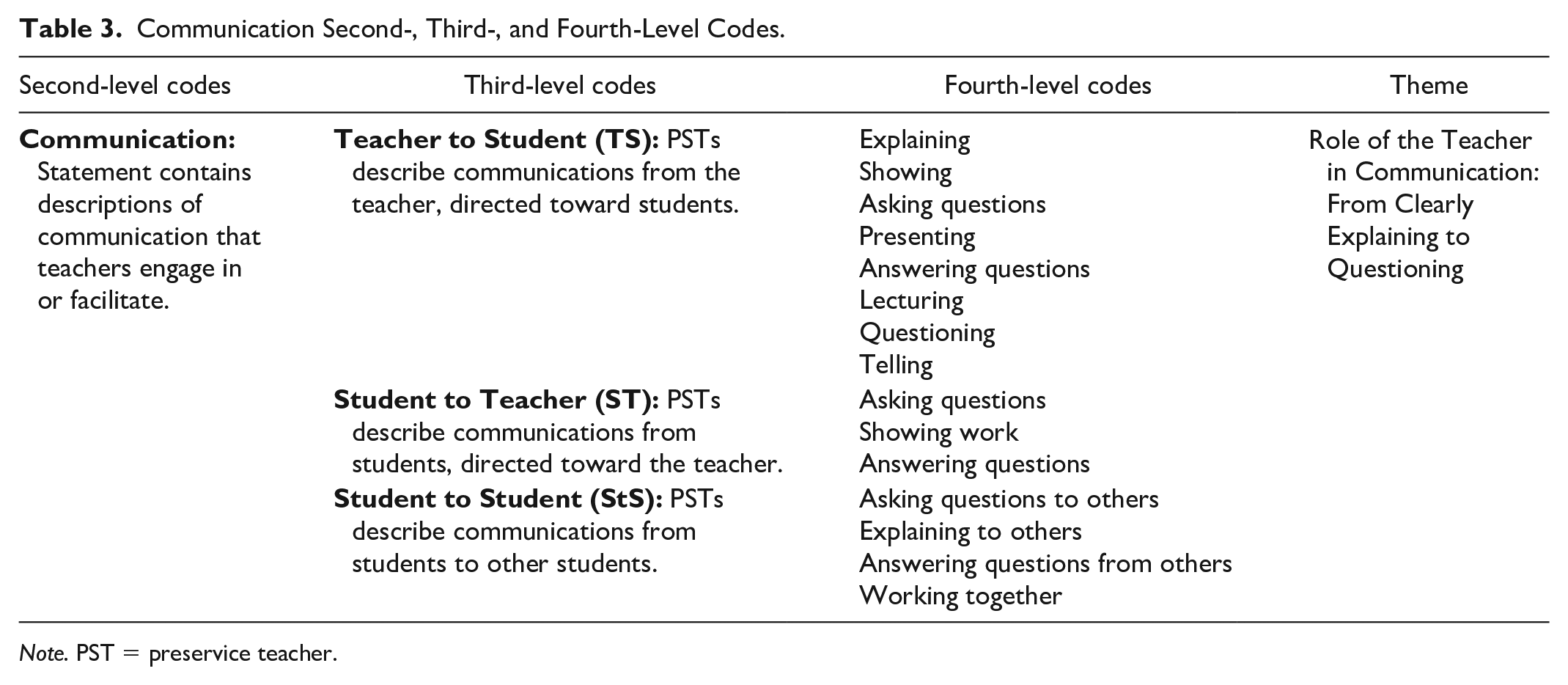
Note. PST = preservice teacher.
Struggle Second-, Third-, and Fourth-Level Codes.
Note. PST = preservice teacher.
Multiples Second-, Third-, and Fourth-Level Codes.
Note. PST = preservice teacher.
Eliciting Second-, Third-, and Fourth-Level Codes.
Note. PST = preservice teacher.
By comparing the frequency counts of third-level and fourth-level codes between LLB instances and HLE instances, we generated four themes that describe how the cohort’s vision of RoT broadened from beginning to end of the methods course: (a) RoT: From clearly explaining to questioning; (b) RoT in making multiple approaches to problems public; (c) RoT in supporting student struggle; and (d) RoT as focused on student thinking.
Findings
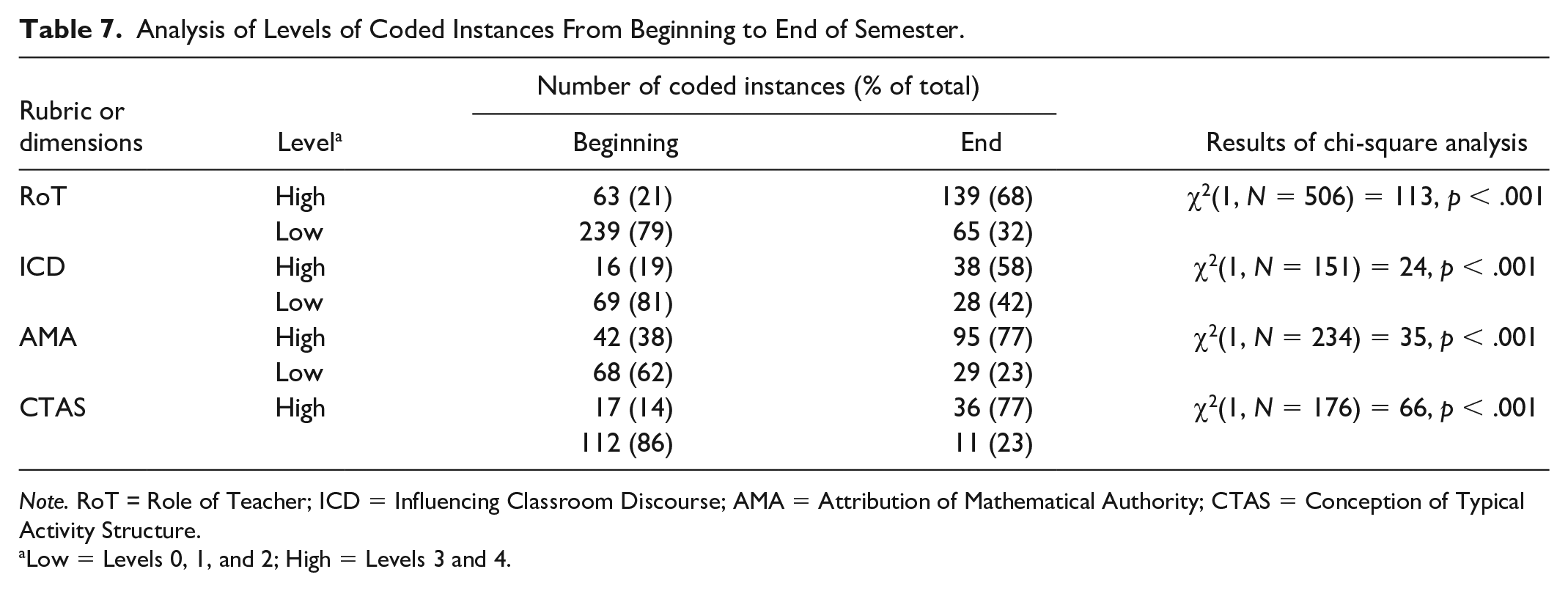
Overall, we found that the cohort’s vision of RoT broadened across the semester from characterizing the role primarily as motivator, deliverer of information, and monitor (Levels 0, 1, and 2) to include significantly more characteristics of teacher as facilitator and more knowledgeable other (Levels 3 and 4). Table 7 presents the total numbers of high and low instances from beginning and ending data and the chi-square statistics for total RoT and for each subdimension. We interpret the significance of results as evidence that the cohort’s instructional vision broadened to include more features of the field’s conceptions of effective mathematics instruction.
Analysis of Levels of Coded Instances From Beginning to End of Semester.
Note. RoT = Role of Teacher; ICD = Influencing Classroom Discourse; AMA = Attribution of Mathematical Authority; CTAS = Conception of Typical Activity Structure.
Low = Levels 0, 1, and 2; High = Levels 3 and 4.
Further inspection of the data allowed us to be confident that all PSTs were represented within the cohort’s vision—in other words, it is not the case that one or two verbose PSTs skewed our quantitative findings. For the beginning of the semester data, all 17 PSTs made low-level RoT statements (range 7–20, median = 14), with 16 making low-level ICD statements (range 0–9, median = 4), 15 making low-level AMA statements (range 0–10, median = 4), and 17 making CTAS statements (range 2–10, median = 7). At the end of the semester, all 17 PSTs made high-level RoT statements (range 2–15, median = 9), with 16 making ICD statements (range 0–6, median = 2), 16 making AMA statements (range 0–12, median = 5), and 16 making CTAS statements (range 0–4, median = 2).
Although the quantitative findings show that the cohort’s vision of RoT broadened over time, these findings do not illustrate the nature of the cohort’s vision of RoT at the beginning and end of the semester. Qualitative data analysis revealed four specific themes about how the PSTs’ vision of RoT changed over the semester. We expand on those themes next.
RoT in Communication: From Clearly Explaining to Questioning
The Communication code included 193 instances from LLB data and 121 instances from HLE data. PSTs’ visions at beginning and ending of the course were both heavily dependent on teacher-to-student communications (149 of 193 coded instances in LLB data [77%] and 94 of 121 coded instances HLE data (83%), respectively). At the beginning, the PSTs envisioned the teacher’s role as very teacher focused. Across the LLB teacher-to-student instances, we identified 183 statements coded at the fourth level. In 143 of those instances (78%), PSTs described the RoT as explaining, showing, presenting, asking questions, answering questions, lecturing, doing examples, or telling students things.
As an example, Dana wrote, “I had always envisioned teaching a math class by explaining and solving problems for the entire class.” (RJ 2). When asked what she felt like she needed to learn in the methods course, Lara also focused on being able to explain things clearly, One thing I definitely need to learn is how to explain things better. . . so someone else understands it. Because I know I can explain it, but when I explain it to someone it doesn’t necessarily make sense. (Interview 1)
Explaining clearly was also important for PSTs when working one-on-one with students, as Steve articulated: The best day for me, if I was teaching in a classroom setting, is to have the ability to work one-on-one with students. . . . I like being able to sit down one-on-one with people. “Hey, okay, this is what we are going to do step-by-step.” (Interview 1)
PSTs less frequently described their vision of RoT in student-to-teacher communication at the beginning of the semester (30 of 149 coded instances, 20%), yet the fourth-level analysis clearly indicated that a RoT is to encourage students to ask questions. We identified 35 statements that we coded at the fourth level across the 30 instances coded as student-to-teacher. In 17 (48%) of those statements, PSTs described the students asking questions to the teacher—all other fourth-level codes appeared fewer than four times each across the low-level beginning student-to-teacher instances. The PSTs’ vision of the RoT was to answer those questions, again through clear explanation. When asked to describe her best day of teaching, Nicole said: I think that in my classroom there will be people who do not feel like they should be embarrassed when asking questions because it might take a few different ways of explaining whatever I’m teaching for them to get it. (Interview 1)
Leslie also described the importance of students asking questions and the teacher answering them when describing her envisioned best day of teaching: “The students would be asking questions, showing involvement or some kind of interest. I’d hopefully be able to answer those questions” (Interview 1).
PSTs assigned importance to the teacher supporting student-to-student communication in only 14 (7%) of the LLB instances. To these PSTs, a RoT was to allow students to work in small groups and to talk to each other. We identified 18 occurrences of fourth-level codes across these instances. Most frequently, these instances described students asking each other questions (4 instances), answering each other’s questions (3 instances) or providing clear explanations when the teacher could not (3 instances). Lara described how this occurred in one of her high school math classes: We did a lot of independent work or group work to learn the material. It was a difficult thing for most of the class to realize the connections between topics, why they are important and how they can be used. I taught a lot of my friends in the class the material because I could see all the connections and really understood the material. They said I did a much better job at explaining things than our teacher. (Interview 1)
Telling, explaining, and showing how to do mathematics permeated the PSTs’ visions of classroom communication at the beginning of the semester, whether in teacher-to-student or student-to-student communications. And the purpose of student-to-teacher communication was to let the teacher know what needed to be told.
Although teacher-to-student communication remained the most frequent type coded in the HLE instances (109 of 131, or 83%), at the end of the semester PSTs held a more student-centered vision of the RoT in classroom communications. Fourth-level codes appeared 125 times across the 109 teacher-to-student high-level end instances. Of these, 56 (45%) characterized the RoT as questioning students to assess or advance their thinking (our focal decomposition of practice). Each of the 17 PSTs characterized the RoT as questioner and were able to describe with some detail how teachers ask students assessing questions to uncover student thinking and advancing questions to move students toward the mathematical goal of the lesson. This RoT as questioner also came with a decreased RoT as teller or explainer (35 of 125 fourth-level codes (28%). As Sarah described: Instead of telling too much information, having students recognize information with the help of advancing questions allows them to have a better understanding. These questions prompt students to do the thinking for themselves and identify certain conclusions on their own. Also, by asking advancing questions a teacher can extend a student’s understanding to new situations, which deepens their understanding even more. (Final Paper)
PSTs also saw asking questions as a way to support student-to-student communication, as in Sarah’s description of the RoT in orchestrating discussions: Asking questions in order to get students to make connections between what two different students are saying or asking broad questions that get students to start thinking about something and then discuss it with everyone else . . . [instead of] just standing there and telling them everything and . . . just telling them your ideas and what you want them to know and feeding them that knowledge. (Interview 3)
Instances where PSTs talked or wrote about the teacher providing clear explanations were virtually absent from the end-of-semester data. The findings presented in this section indicate that engaging in, and reflecting on, pedagogies of practice where effective teaching and learning are portrayed as described by NCTM (2014) broadened the PSTs’ RoT vision in the area of communication. Specifically, we contend that learning about effective questioning and appropriate telling and then having multiple opportunities to plan for and rehearse instruction based on this decomposition of practice, and then reflect on their teaching allowed them to build new RoT visions of communication.
RoT in Student Struggle: From Avoid or Minimize to Embrace and Support
Data analysis indicated that PSTs’ early vision favored teachers avoiding or minimizing student struggle. We noted 13 instances that mentioned struggle across the LLB data, nine of which (70%) positioned struggle as something to avoid, to minimize, or to eliminate by clear explanations and by answering questions. Nicole and Steve, respectively, provide representative statements of this vision: “When I tutored. . . I was surprised that they weren’t getting it. . . . I had to really break it down and show them an easier [way]” (Interview 1); and “One great example is providing examples in notes during class time; it serves as a step-by-step break down that allows students to follow later on when they are working on more problems” (RJ 1). Keith provided a metaphor for the RoT in minimizing struggle: “Students’ brains are like engines, and the teacher is the oil that keeps everything running smoothly” (Interview 1).
In contrast, at the end of the course, in 35 of the high-level instances, PSTs mentioned struggle as a positive part of student learning; in no instances in the end-of-semester data did the PSTs mention struggle as something to avoid. We interpret this as evidence that the vision of RoT was expanding to include supporting students to engage in challenging mathematics.
Furthermore, at the end of the semester, PSTs were talking and writing about their role in student struggle in a qualitatively different way. Eleven PSTs describe the RoT as supporting students to struggle, as represented by Nicole: I never thought of purposely making mathematics more difficult than it might already seem to students, but it is that small struggle that really allows students to explore and deepen their understanding, and maybe even motivate a liking toward mathematics. By doing this, students are provided a good learning experience because it helps push them to think for themselves and it ultimately will strengthen their mathematical proficiency because they won’t get answers handed to them and won’t be pre-taught mathematics that shouldn’t be. (Final Paper)
Even so, some PSTs worried about student frustration and envisioned the teacher stepping in to mediate (but not avoid or minimize) student struggle, as represented by Keith: Promoting a deeper understanding is something I plan to do, and using problem solving as a means to that end is ingenious. The idea of allowing mathematics to be problematic for students is a great way to get the students really learning. One flaw I can see. . . is that students may become frustrated with themselves if they cannot figure a problem out. Thus, the teacher must find a time when their assistance is necessary for the student to still have success. (RJ 2)
Over the semester, the PSTs developed new ways to think about student struggle and the RoT in supporting student struggle. The beginning of the semester RoT vision about struggle was likely formed by the PSTs’ own experiences in math classes where the RoT was to minimize struggle. We contend that the combination of reading about productive struggle, analyzing narrative cases that portrayed student struggle as useful, and engagement in approximations of practice in which the PSTs had to practice supporting student struggle allowed them to think about struggle in a different way. Our decomposition of practice (asking assessing/advancing questions and using judicious telling) provided pedagogical tools to use in supporting student struggle as well as the analytic tool for reflecting on approximations of practice.
RoT in Making Multiple Approaches Public: From Teacher-Generated Explanations to Student-Generated Solutions
Both at the beginning and end of the semester, PSTs thought it was important that multiple approaches to problems and multiple explanations be made public to the whole class. One aspect of this vision that changed, however, was the origin of multiple approaches. In the LLB data we identified 25 instances in the Multiples category. Sixteen of these (64%) described the RoT as generating and presenting: multiple explanations (6 instances), multiple approaches to problems (3 instances), and multiple ways of doing things (4 instances). As detailed in a previous section, at the beginning of semester, almost all of the PSTs held a vision of teachers clearly explaining mathematics. Part of this vision included showing multiple explanations in response to student confusion: “If students voice that they do not understand the material, it is our job as teachers to explain the material in a different way” (Jamie, Interview 1). Sarah also described this: If you have a topic that is usually difficult to understand and you explain it. . . two or three different ways that everyone can then understand it. Because a lot of times with math, you explain it one way, and some kids won’t really understand it. And then they get really frustrated if the teacher just keeps explaining it in the same way. So as long as you’re changing how you’re explaining things and getting more students to understand it, I think that’s good. (Interview 1)
At the end of the semester, however, PSTs described both how students should generate multiple explanations and/or solution pathways and how the RoT is to orchestrate discussions where the teacher asks questions to help students make connections across different approaches. In the HLE data, we found 27 instances in the multiples category, 23 of which (85%) described students generating and sharing multiple approaches, explanations, or other objects. Nineteen of these 23 instances (83%) involved multiple approaches to problems solving. Steve and Whitney, respectively, explained: When you bring it back to a class discussion and you can say, “Okay, does anyone want to share?” Or “What are some ways that we solve this problem?” And if [a student] gives [an] answer to the class and then, “Does anyone have anything that they did differently?” (Interview 3) And then for the summarize, I would . . . get students to share the different ways they approach the problem. . . to start generating discussion and get students to realize that there are different ways to approach a problem in different representations of the answer. (Interview 3)
Over the semester, PSTs shifted from talking about how teachers need to provide multiple approaches to students to envisioning the RoT as supporting students to create multiple approaches and designing ways for them to share those approaches in whole-class discussion. This finding suggests that when PSTs engage in and reflect on pedagogies of practice that portray the RoT as orchestrator of mathematical discussions grounded in student-generated solution paths and explanations, their vision of RoT can shift in the area of making multiple approaches to problems public.
RoT: Eliciting Student Thinking for Making Instructional Decisions
As previously described, PSTs’ visions at both the beginning and end were dominated by descriptions of teacher-to-student communications. However, content analysis of HLE instances evoked an aspect of vision of RoT that was outside of Munter’s (2014) rubric—that a RoT is to surface students’ thinking and then build on that thinking so that students progress toward a mathematical goal. This role was absent from instances in beginning-of-the-semester data. We coded 86 instances in HLE data in which PSTs described the RoT with respect to student thinking. In these instances, PSTs described the RoT in anticipating thinking (10 instances), eliciting thinking (32 instances), advancing thinking (10 instances), and building on student thinking (12 instances). Notably, there were 27 instances of PSTs commenting on the importance of allowing student thinking to drive in-the-moment decisions during instruction.
Take, for example, Steve’s comment about moving students forward with advancing questions: You could be trying to advance all the time, but if the student is unsure [where you are going] you have to retract. No matter what you want to do it’s about the student’s understanding and getting them towards the mathematical goal. (Interview 3, emphasis added)
Leslie also wrote about the importance of student thinking when she reflected on how planning assessing questions helped prepare her for keeping a focus on student thinking: My . . . plan [included] a lot of asking the student to explain his or her process and this came in handy when I noticed that his way of going about the problem was different than what I prepared for. By having him explain his thought process—sometimes more than once—I was able to figure out what to ask next in order for him to move on to the general formula and apply what he already did to what the question was asking. (Final Paper)
The PSTs developed a vision that the RoT included purposefully attending to student thinking to make decisions about how to help them make progress. We are not so surprised that the PSTs developed this vision of RoT, as our focal decomposition of practice for this course was asking assessing/advancing questions and using judicious telling. This finding suggests that explicitly engaging PSTs in pedagogies of practice about eliciting and building on student thinking can impact their vision of RoT to include the importance of making instructional decisions based on student thinking.
Discussion
Our quantitative findings established that at the beginning of their professional education program, this cohort’s vision of RoT was predominantly as motivator, deliverer of information, and monitor; thus, this study contributes to the knowledge base by empirically confirming the field’s anecdotally based and commonly held belief that secondary mathematics PSTs enter their professional education conceptualizing teaching as telling and envisioning effective instruction as providing clear and concise explanations. By the end of the semester, these PSTs had added visions of teacher as facilitator and more knowledgeable other. Our qualitative findings serve to illustrate how their visions broadened or shifted over the semester. This study also contributes to the field by establishing an outcome for secondary mathematics PSTs who engage in pedagogies of practice, extending the findings of Ghousseini and Herbst (2016) and Baldinger et al. (2016).
Our work also extends the scope of potential uses for Munter’s (2014) RoT rubric. Our use of the RoT rubric as an analytic tool supported analysis of methods course artifacts (i.e., reading journals, classroom discussions, and course assignments). This use of the rubric goes beyond Munter’s original use in analyzing interviews that contain questions specifically about VHQMI, which our interviews did not. In addition, our work demonstrates the potential of the rubric as a tool for characterizing vision by proportion of statements made at different levels rather than by the highest-level statements made within a data source. Finally, our findings suggest a new aspect of RoT vision (elicitor of student thinking for making instructional decisions) that enhances Munter’s conceptions as represented in the RoT rubric.
Our findings about PSTs’ broadening and shifting visions go beyond the intended learning goals for the methods course. Evidence exists that the PSTs learned what we intended them to learn during the course (Arbaugh et al., 2019; Freeburn, 2015), specifically with regard to planning for instruction, posing purposeful questions, and eliciting and building on student thinking (NCTM, 2014). Findings from these previous studies indicate that we were able to construct learning opportunities for the PSTs about these core teaching practices through taking a pedagogies of practice approach. This study extends our previous work in that it shows that broadening and shifting visions of RoT can occur when PSTs engage in pedagogies of practice focused on these core teaching practices. It is also interesting for us that we did not explicitly intend to broaden the PSTs’ vision of RoT in our planning and enactment of the course; we have come to think of this outcome as an unforeseen positive consequence of the design of the methods course. Thus, this study extends other researchers’ findings about outcomes of PSTs’ engagement in pedagogies of practice (e.g., Baldinger et al., 2016; Ghousseini & Herbst, 2016; Tyminski et al., 2014) to include ancillary changes in vision of RoT that are intertwined with changes in understanding of instructional practice.
Although we cannot make data-based claims about what exactly influenced the PSTs’ vision of RoT, we hypothesize likely connections between our use of pedagogies of practice and the cohort’s broadening visions of RoT. For example, our focal decomposition of practice (asking assessing/advancing questions and using judicious telling) targets student thinking as something to be elicited, considered, and advanced. Throughout the semester, PSTs used this decomposition of practice repeatedly as an analytic tool in their individual and collective analyses of representations of practice and as a focal teaching practice in their engagement in approximations of practice. We hypothesize that the broadening of vision to include RoT as facilitator and orchestrator of student activity was a natural consequence of analyzing representations of practice and engaging in approximations of practice through the lens of a decomposition of practice that positions student thinking as a focus of instruction. A vision of RoT as eliciting and connecting students’ mathematical ideas is more consistent with practices that place student thinking at the center of instruction than a vision of RoT that involves providing clear explanations would be. It is important to note that our findings do not imply that instructional visions cannot be broadened or shifted if PSTs do not engage in pedagogies of practice in their professional education. Further study is needed to establish how instructional visions change in the absence of pedagogies of practice. Another area to investigate is how a focus of assessing/advancing questions and judicious telling interacts with other pedagogies of practice to impact PSTs’ visions of RoT.
In spite of the encouraging findings regarding outcomes of engaging with pedagogies of practice on secondary PSTs’ instructional vision, questions also remain about the permanence of these changes, about whether these changes carry over to impact PSTs’ classroom instruction, and about how visions might impact early-career teachers’ dispositions. The PSTs who participated in this study did not have a concurrent field placement for this methods course, so further research is needed to study the role of field experiences in supporting, mitigating, or influencing changes in PSTs’ instructional vision. Longitudinal research is needed, along the lines of Jansen et al. (2020), to examine whether such changes in vision persist into teachers’ early careers, including whether and how PSTs’ instructional visions continue to change, stagnate, or revert in the early years of their career. Furthermore, we recognize significant questions about how identity variables related to aspects of PSTs’ identities—such as race, sex, gender, or socio-economic status—may influence how PSTs react to and respond to the kinds of activities that constituted this course. Although it is beyond the scope of this study, we encourage the pursuit of research on such questions.
Conclusion
The literature on pedagogies of practice in mathematics teacher education is small but growing as more researchers situate both their teacher education work and their research in pedagogies of practice. The field also has much to learn about how such professional educational experiences impact PSTs’ instructional visions. Although this study focused solely on Munter’s RoT rubric, the finding that aspects of RoT vision broadened and shifted as PSTs engaged in pedagogies of practice focused on developing their core practices is important to understanding the scope of the impact of pedagogies of practice. The findings of this study can encourage researchers to utilize the other three rubrics of Munter’s framework to investigate how pedagogies of practice influence PSTs’ instructional visions.
Footnotes
Appendix
Abbreviated Version of the Role of Teacher Rubric (Munter, 2014, pp. 625–633).
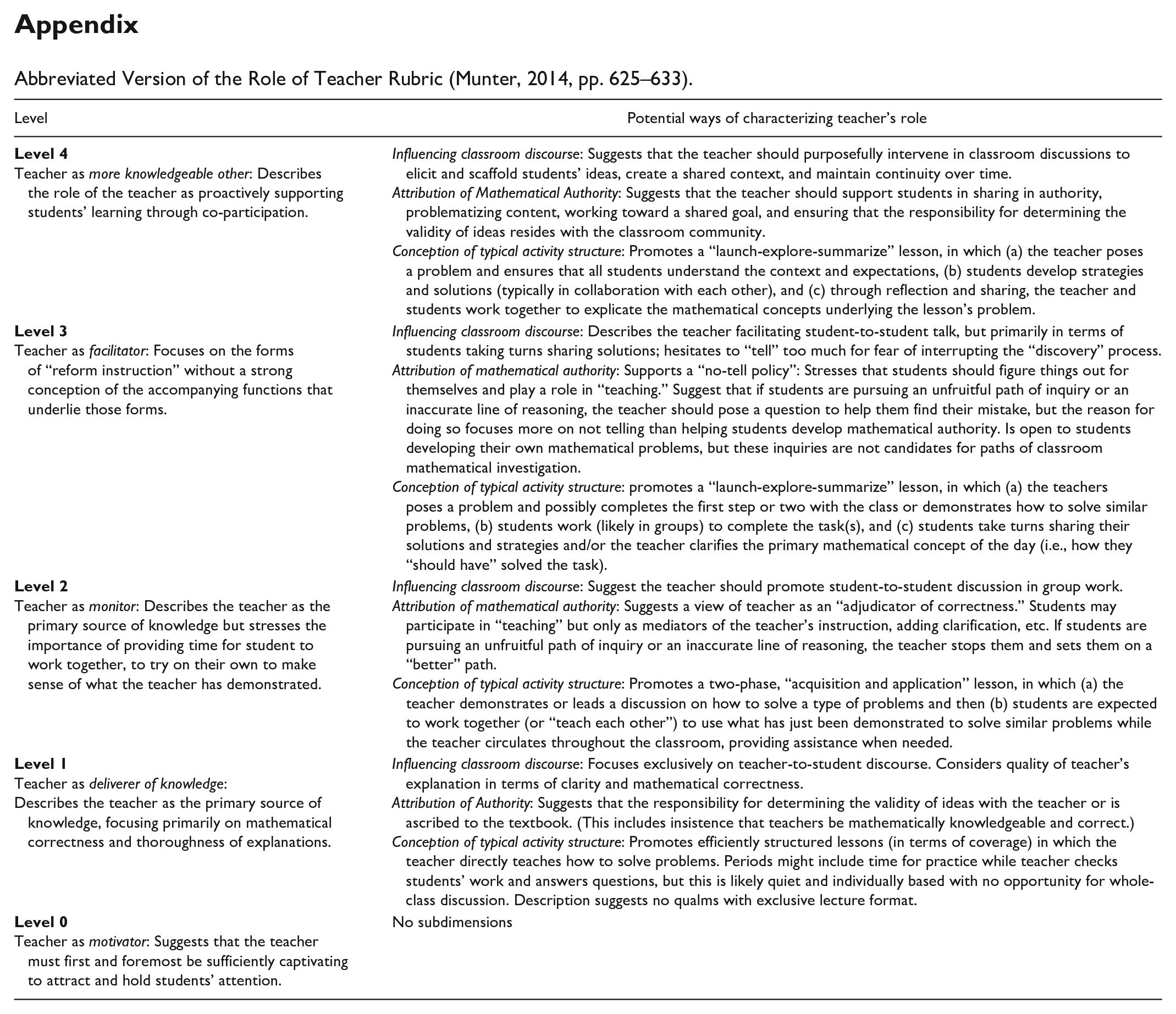
| Level | Potential ways of characterizing teacher’s role |
|---|---|
Teacher as more knowledgeable other: Describes the role of the teacher as proactively supporting students’ learning through co-participation. |
Influencing classroom discourse: Suggests that the teacher should purposefully intervene in classroom discussions to elicit and scaffold students’ ideas, create a shared context, and maintain continuity over time. Attribution of Mathematical Authority: Suggests that the teacher should support students in sharing in authority, problematizing content, working toward a shared goal, and ensuring that the responsibility for determining the validity of ideas resides with the classroom community. Conception of typical activity structure: Promotes a “launch-explore-summarize” lesson, in which (a) the teacher poses a problem and ensures that all students understand the context and expectations, (b) students develop strategies and solutions (typically in collaboration with each other), and (c) through reflection and sharing, the teacher and students work together to explicate the mathematical concepts underlying the lesson’s problem. |
Teacher as facilitator: Focuses on the forms of “reform instruction” without a strong conception of the accompanying functions that underlie those forms. |
Influencing classroom discourse: Describes the teacher facilitating student-to-student talk, but primarily in terms of students taking turns sharing solutions; hesitates to “tell” too much for fear of interrupting the “discovery” process. Attribution of mathematical authority: Supports a “no-tell policy”: Stresses that students should figure things out for themselves and play a role in “teaching.” Suggest that if students are pursuing an unfruitful path of inquiry or an inaccurate line of reasoning, the teacher should pose a question to help them find their mistake, but the reason for doing so focuses more on not telling than helping students develop mathematical authority. Is open to students developing their own mathematical problems, but these inquiries are not candidates for paths of classroom mathematical investigation. Conception of typical activity structure: promotes a “launch-explore-summarize” lesson, in which (a) the teachers poses a problem and possibly completes the first step or two with the class or demonstrates how to solve similar problems, (b) students work (likely in groups) to complete the task(s), and (c) students take turns sharing their solutions and strategies and/or the teacher clarifies the primary mathematical concept of the day (i.e., how they “should have” solved the task). |
Teacher as monitor: Describes the teacher as the primary source of knowledge but stresses the importance of providing time for student to work together, to try on their own to make sense of what the teacher has demonstrated. |
Influencing classroom discourse: Suggest the teacher should promote student-to-student discussion in group work. Attribution of mathematical authority: Suggests a view of teacher as an “adjudicator of correctness.” Students may participate in “teaching” but only as mediators of the teacher’s instruction, adding clarification, etc. If students are pursuing an unfruitful path of inquiry or an inaccurate line of reasoning, the teacher stops them and sets them on a “better” path. Conception of typical activity structure: Promotes a two-phase, “acquisition and application” lesson, in which (a) the teacher demonstrates or leads a discussion on how to solve a type of problems and then (b) students are expected to work together (or “teach each other”) to use what has just been demonstrated to solve similar problems while the teacher circulates throughout the classroom, providing assistance when needed. |
Teacher as deliverer of knowledge: Describes the teacher as the primary source of knowledge, focusing primarily on mathematical correctness and thoroughness of explanations. |
Influencing classroom discourse: Focuses exclusively on teacher-to-student discourse. Considers quality of teacher’s explanation in terms of clarity and mathematical correctness. Attribution of Authority: Suggests that the responsibility for determining the validity of ideas with the teacher or is ascribed to the textbook. (This includes insistence that teachers be mathematically knowledgeable and correct.) Conception of typical activity structure: Promotes efficiently structured lessons (in terms of coverage) in which the teacher directly teaches how to solve problems. Periods might include time for practice while teacher checks students’ work and answers questions, but this is likely quiet and individually based with no opportunity for whole-class discussion. Description suggests no qualms with exclusive lecture format. |
Teacher as motivator: Suggests that the teacher must first and foremost be sufficiently captivating to attract and hold students’ attention. |
No subdimensions |
Declaration of Conflicting Interests
The author(s) declared no potential conflicts of interest with respect to the research, authorship, and/or publication of this article.
Funding
The author(s) received no financial support for the research, authorship, and/or publication of this article.
