







Abstract
The important role of individual differences in affecting teachers’ involvement in and professional development through research has received little systematic attention in theoretical discussions and empirical studies on teacher research. Therefore, relying on the available literature and our proposed theoretical models, we investigated the possible links among language teachers’ Big Five personality traits, motivation to conduct research (through self-determination theory’s intrinsic and extrinsic motivations alongside the avoidance motivation construct), and teacher research involvement (TRI). Using a survey method, data were gathered from 253 Iranian school English teachers (SETs) and subjected to correlational and structural equation modeling (SEM) analyses. Notably, SEM results demonstrated that Openness to Experience, Conscientiousness, Agreeableness, and Neuroticism significantly predicted the motivational constructs which themselves predicted TRI. Moreover, the effects of these four traits on TRI were fully mediated through the motivational constructs. Implications for theory, policymaking, and professional development in the teacher research field are proposed.
Keywords
Introduction
Within global reform initiatives in education, the professional development (PD) of teachers beyond their initial training has been recognized as an important approach for improving the quality of teaching and learning (Groundwater-Smith et al., 2013; James & Augustine, 2018). Embedded in this broad movement, teacher research (i.e., research conducted by teachers themselves) is increasingly promoted as a key PD approach to the more successful implementation of such initiatives (e.g., Groundwater-Smith et al., 2013). This is because, as Somekh and Zeichner (2009) argue, teacher research could bring about a significant change in teachers’ roles from mere receivers of reform agendas to active participants in their implementation. Moreover, since it is situated in teachers’ own contexts, teacher research could target their specific needs better than other one-size-fits-all approaches to PD and therefore is regarded by some as “the epitome of customizable and meaningful professional development for educators” (Mertler, 2018, p. 21). In the theoretical literature as well, developments such as the transformative professional inquiry models (Kennedy, 2014) and the “transformational innovation” perspective (Mertler, 2018, p. 53) view teacher research as a core PD activity, enabling teachers to exercise agency as well as transform and renew their professional learning and practice.
Among different educational fields, such an emphasis on teacher research is especially evident in English language teaching (ELT) although here other distinct factors have also contributed to its prominence. One such factor is the failure of the global language teaching methods in the 1980s that paved the way for recognizing the value of classroom-based research and the essential role of language teachers in conducting it (see Burns, 2013). Furthermore, the high demand for English worldwide has led to a strong emphasis on language teacher quality and more effective pathways to their PD (Richards, 2008). Thus, a major trend toward teacher research could be observed within ELT in the ongoing theoretical debates/discussions on this topic (see Borg & Sanchez, 2015; Edwards, 2021; Rose, 2019) as well as ELT researchers’ persistent interest in investigating language teachers’ own involvement in research since at least the early 1990s. One of the most prevalent findings of such studies is the differences in the level of teachers’ involvement in research. For instance, Borg’s (2009) study of teacher researchers in 13 countries revealed that the frequency of their research involvement varied considerably from “rarely” to “often,” a finding also replicated in other national studies (e.g., Borg & Liu, 2013; Vu, 2020). Another recurrent finding has been the challenges and barriers teachers face when conducting research. A lack of time (e.g., Vu, 2020; Xu, 2014), limited access to resources and expert support (e.g., Gao et al., 2011; Nassaji, 2012), and not enough research knowledge/skills (e.g., Gao et al., 2011; Rainey, 2000) have been among the most frequently cited obstacles by teachers. Several comprehensive review studies (e.g., Borg, 2010) have also corroborated the prevalence of these results in ELT.
Despite its valuable findings, however, when attempting to understand the observed variability in teachers’ level of research involvement and address their research-related challenges, this body of literature has exceedingly relied on external explanations (e.g., time constraints, Nassaji, 2012) and offered contextual solutions (e.g., expert support, communities of inquiry; Borg & Sanchez, 2015; Vu, 2020). Yet, a closer look reveals counter-evidence in the form of teachers who report lower levels of participation even in contexts with relative external support (see Borg & Liu, 2013), and still others who report routine involvement in not very supportive contexts (see Gao et al., 2011). Therefore, the phenomenon of recurring variability in teachers’ research involvement brings to the fore theoretical models and perspectives proposing that differences in the level of participation in development activities (e.g., research) could very well stem from one’s underlying, relatively stable individual differences (e.g., Hezlett & McCauley, 2018; Murphy, 2002). It has been argued that these individual difference characteristics may have stronger effects on participation in PD than contextual ones (e.g., Major et al., 2006) as they represent broad patterns of behavior which show consistency across different situations (McCrae & Costa, 2013; Murphy, 2002).
In light of the above, we choose teachers’ personality traits, as one constellation of such stable individual differences, which have been surmised to relate to teacher research (e.g., Babione, 2015). This choice is also informed by the precedence personality traits generally take in research over other individual differences in terms of explanatory power, accounting for up to 40% of the variance in certain development outcomes in reviews of research (e.g., Furnham, 2005; Li et al., 2014). Such characteristics contribute to our principal aim of investigating a theoretically informed explanation of the recurring patterns of variability in teachers’ research involvement and evaluating contextual solutions offered to address this issue. This is because personality traits’ cross-situationally consistent, generally stable, and dispositionally determined nature (see Boyle et al., 2008), which engenders more enduring patterns of differentiation among individuals (see Noe et al., 2013), may help explain the mentioned variability. There are some postulations in the literature in this respect as well. For instance, Gilchrist (2018) assumes that personality characteristics such as being already “inquisitive” (p. 60) may lead to teachers’ more involvement in research. Furthermore, such traitedness could provide valuable insights into the extent to which contextual facilitation of teacher research, as advocated in the teacher research literature, can be effective for those with lower levels of involvement. This happens due to the relative stability of traits which may, to a certain extent, neutralize the effects of research-related PD interventions (see Murphy, 2002). In addition, distinct profiles of personality could lead teachers to engage more or less deeply in research activities and possibly learn from them differently (see Noe et al., 2013) as well as distinctively predispose them toward adopting research to transform their work environment so that they could better fit in it (see Deckers, 2018). These and similar possibilities further illustrate the potential of personality traits to contribute to a fuller picture of teacher PD through research.
In the empirical literature as well, personality traits have been prominent. Often studied through the Five-Factor model (Li et al., 2014; see below), personality has been the most widely focused upon, traited antecedent of participation in development activities in general meta-analyses (e.g., Cerasoli et al., 2018) as well as systematic reviews of teacher PD (Krille, 2020; Kyndt et al., 2016). In addition, studies on workplace populations (e.g., Major et al., 2006; Maurer et al., 2008; Watanabe et al., 2011) have related traits such as Openness to Experience, Conscientiousness, and Extraversion to participation in development activities. Similar results have been found among populations of teachers. For instance, in a survey of factors influencing 318 school teachers’ participation in PD activities, Lohman (2005) found nurturing (Agreeable) and outgoing (Extraverted) personality types to be influential. Another example is van Daal et al.’s (2014) study of 95 school teachers, where Openness to Experience and Conscientiousness positively predicted participation in different workplace PD activities. Based on this literature and the fact that teachers’ research involvement has been categorized as an instance of workplace PD (e.g., Hodkinson & Hodkinson, 2005), it is reasonable to assume that personality traits may affect this outcome as well. Yet, no prior study has attempted to relate personality traits to teachers’ research involvement.
Despite these results and the potential of personality traits to provide us with unique insights regarding our topic, traits often tend to indicate what individuals are inclined to do in general (Cortina & Ingerick, 2005) and “reflect action patterns that [hold across] tasks . . .” (Locke & Latham, 2004, p. 395). Yet, in order to gain information about teachers’ more task-specific drives for involvement in research, proximal motivational variables should also be investigated (see Barrick & Mount, 2005). Unlike traits, such variables are more prone to variability across tasks and situations since they do not stem from the stable dispositional characteristics of the teachers (see Deckers, 2018). Thus, there have been calls in the literature for the integration of personality traits with motivational variables as the main mechanism of these traits’ influence on participation in development activities (e.g., Barrick & Mount, 2005; Li et al., 2014). We, therefore, focus on teachers’ research motivation alongside their personality traits (see Theoretical Framework and the Proposed Models).
Empirically also, several studies have documented teachers’ differing motivational types as predicting uptake of PD (e.g., Richter et al., 2019) as well as more/less involvement in professionally beneficial PD activities and successful implementation of innovations (e.g., Gorozidis & Papaioannou, 2014). In addition, a small number of studies have found or discussed a role for teachers’ research motivation in influencing their research involvement. For instance, Gao et al.’s (2011) study of Chinese primary school English teachers’ research involvement revealed that factors representing intrinsic motivation (e.g., personal interest, improving teaching and learning, solving classroom problems) were the primary motivators for this activity. On the other hand, Xu (2014) found that extrinsic motivation was the main impetus behind involvement in research for Chinese university English teachers. Recognizing the potential of teachers’ research motivation, several researchers (e.g., Hosseini & Bahrami, 2022; Borg & Liu, 2013) have also called for its more systematic investigation in relation to teachers’ research involvement.
Overall, by taking into account language teachers’ personality traits and motivation to conduct research, we attempt to substantially broaden the current theoretical, empirical, and practical treatments of teacher research. From a theoretical perspective, this study could help us move toward a more nuanced understanding of the conceptual underpinning of teacher research in terms of its variability among teachers, presumed benefits, and facilitating conditions. Empirically, by virtue of identifying some of the antecedents of teachers’ involvement in research, the current study could serve as an important step in investigating these variables as the links among them have not previously been established, modeled, and systematically explored in mainstream education in general and ELT in particular. Finally, from a practical perspective, the present research could help with more comprehensively appraising the implementation of research-related policies and teachers’ research practices within contexts, schools, and/or educational organizations which are planning to use or are actively using teacher research as a PD approach for teachers.
Context of the Study
In line with the earlier-mentioned global reform policies, several reform initiatives have been adopted within the Iranian teacher education curriculum and structure. Among them, “teacher as researcher” programs, put into action on a nation-wide scale since 1997, have been supported and publicized by the Institute for Educational Research (IER; Gholami & Mehrmohammadi, 2014, p. 335). The major phases of these school-based programs involve introducing teachers to the various theoretical dimensions of teacher research (e.g., through inservice training); involvement in research by teachers themselves; submitting the final reports to the local branches of IER for evaluation; and the selection of high-quality reports for monetary support. In addition, as a result of their research record, teachers receive points on their yearly evaluation (Gholami & Mehrmohammadi, 2014) which can enhance their working conditions (e.g., gaining the opportunity to work in more prestigious schools, being transferred from rural to urban areas). Consequently, some teachers may also attend MA or, in some cases, PhD programs to further develop their research-related knowledge and skills.
These initiatives and programs are especially marked in the case of the field of ELT. Following the reformist policies beginning in 1997, remarkable attention has been paid by policymakers to the expansion of English education at all educational levels, mainly as a precondition for Iran’s modernization and participation in world trade and technology (e.g., Bahrami et al., 2019). In line with this growing importance, numerous trends of further professionalization have also begun to appear. These include research-related PD activities for language teachers, especially school English teachers (SETs); the establishment of ELT-specific organizations tasked with managing local conferences (e.g., focused on bridging the gaps between research, practice, and policy in ELT through teacher research); and journals that also publish teacher research reports (e.g., Mehrani, 2015). Therefore, language teachers are increasingly experiencing various opportunities, motivations, and pressures for involvement in research and sharing its results to a wider audience as this activity has been gradually turning into a high-profile PD approach in ELT over the past years in Iran (Dehghan & Sahragard, 2015).
Theoretical Framework and the Proposed Models
A classic approach to investigating the relationship between distal personality traits (e.g., the Big Five) and workplace outcomes is the source trait or the consequential outcomes perspective where traits are viewed as powerful, causal antecedents to such outcomes (see Boyle et al., 2008). This approach has been expanded upon and improved theoretically, in recent years, through the prominent mediational perspective whereby the main mechanism of the effects of distal personality traits on workplace outcomes is proposed to be proximal motivational factors (Barrick & Mount, 2005; Hezlett & McCauley, 2018; Li et al., 2014). Based on this perspective, traits should indirectly affect development behaviors (e.g., research) through motivation. However, it is additionally possible that their proposed predictive potency, according to the source trait/consequential outcomes perspective, could cause them to retain their direct effects on development behaviors, leading to partial mediation. There is a small number of empirical studies in the literature in favor of this perspective. For example, van Daal et al. (2014) retained a partial mediation model through goal orientation for the effects of Openness to Experience and Conscientiousness on participation in workplace PD activities. In one of their samples of employees, Watanabe et al. (2011) similarly observed that intrinsic motivation mediated the link between these same traits and participation in development activity.
While acknowledging the range and consistency of personality traits in successfully predicting a broad list of outcomes, other researchers have pointed to the variable validities of the observed relationships, which they attribute to the distal, general nature of these traits (e.g., Locke & Latham, 2004; see also Li et al., 2014). Under this view, proximal motivational mechanisms are very likely to fully transmit the effects of distal traits on development outcomes (e.g., research) as these traits may sometimes not be potent enough to retain their direct effects in the presence of such mediators (see Locke & Latham, 2004). Empirical support for this perspective is present in relevant studies where full mediation models have been retained (Major et al., 2006; Maurer et al., 2008). Similarly, van Daal et al.’s (2014) model of the effect of teachers’ Extraversion on their participation in workplace PD was one of full mediation, and Watanabe et al. (2011) confirmed a full mediation model in their second sampled population.
Overall, due to stronger evidence in favor of full mediation and methodological recommendations to use this model as the baseline for reasons of parsimony (e.g., James et al., 2006), we propose and test a full mediation model as our hypothesized model, where the effects of personality traits on teacher research involvement (TRI) are fully mediated by motivation to conduct research. Based on the above theory and evidence, we also investigate partial mediation. In the sections that follow, we elaborate on the conceptualization of our variables and the specific relationships that could exist among them in our models.
Teacher Research Involvement
There is a wealth of theoretical work on the nature of teacher research in terms of review studies which have defined it comprehensively (e.g., Borg, 2010; James & Augustin, 2018) and theoretical models/frameworks which have delineated its essential parameters (e.g., Kennedy, 2014; Mertler, 2018; Somekh & Zeichner, 2009). Within this literature, there is a strong emphasis on individual initiation of research by teachers (e.g., Kennedy, 2014) and/or collaboration with others (e.g., Groundwater-Smith et al., 2013). A recent development in this respect is Mertler’s (2018, p. 68) conceptualization of “action research communities” which situates teachers’ collaborative involvement in research within professional learning communities. This concept capitalizes on potentials for research-based shared goals/visions, mutual support, and large-scale innovations (see Mertler, 2018). Based on the definitional accounts (e.g., Borg, 2010; James & Augustine, 2018) and theoretical models (e.g., Somekh & Zeichner, 2009), the quality of systematicity (i.e., methodologically sound data collection and analysis) is also a requirement of the teacher research process. There is additionally a general consensus that teacher research can be characterized as a reflective tool (Gore & Zeichner, 1991; Mertler, 2018), utilized by teachers with a view to evaluating or improving one’s own practice (e.g., through responding to problems, dilemmas, or curiosities; Borg, 2010). Furthermore, dissemination of the research product in some way has been proposed to lead to opportunities for further learning by inviting external evaluation and feedback (Groundwater-Smith et al., 2013).
We drew on these potentialities for conceptualizing TRI, partly, due to their salience in the theoretical literature and also their importance in our and other policy contexts (e.g., Gao et al., 2011; Vu, 2020). Therefore, TRI in the present study refers to involvement in any systematic research project initiated and conducted individually or collaboratively by language teachers, mainly in response to their teaching/learning-related problems, issues, and dilemmas or curiosities, whose findings are disseminated to a wider audience although not necessarily through formal publication.
Teachers’ Motivation to Conduct Research
Drawing on Deemer et al.’s (2010) conceptualization of research motivation, Hosseini and Bahrami (2022) have conceptualized teachers’ motivation to conduct research as comprising three constituent components, revolving around self-determination theory’s (SDT) intrinsic and extrinsic motivations (Ryan & Deci, 2017) in addition to the avoidance motivation construct (Elliot & Thrash, 2002). A theme that has emerged from the available studies which have documented teachers’ research experiences (e.g., Borg & Liu, 2013; Gao et al., 2011; Xu, 2014) is that teachers report approaching this activity due to internal as well as external motivations. These findings, therefore, point to SDT as one of the most appropriate theoretical frameworks that could explain teachers’ motivation to conduct research. This is because SDT encompasses intrinsic motivation (i.e., engaging in a task because the activity itself is enjoyable and interesting and can generate feelings of competence in the individual) and extrinsic motivation (i.e., engaging in a task because it leads to external outcomes; Ryan & Deci, 2017). With regard to teachers’ motivation to conduct research, intrinsic motivation can capture teacher-internal while extrinsic motivation can represent teacher-external motivations for this activity.
Furthermore, a substantial number of studies on teacher research have also documented teachers’ research-related anxieties and insecurities (e.g., Borg, 2010). Borg’s (2010) fairly comprehensive list of such insecurities, for instance, includes teachers’ perceived lack of ability to conduct research and the belief that one’s research findings will not be important and useful. In view of these findings, research failure avoidance is another necessary construct appropriate for tapping into the negative, avoidance side of teachers’ research motivation. This construct is rooted in the fear individuals may have of failing (Elliot & Sheldon, 1997) and not being able to live up to expectations because of which they may engage in avoidant behaviors to prevent perceived impending failure (Deemer et al., 2010). Thus, teachers who are failure avoidant toward research may not start particular projects or may abandon them after a while due to the “challenges [they are] seen to present” (Borg, 2009, p. 375).
Teachers’ motivation to conduct research and TRI
The available studies which have documented the role of language teachers’ motivation in promoting teacher research can provide an empirical grounding for relating motivation to conduct research to TRI. As mentioned earlier, Gao et al. (2011) found that intrinsic motivation affected language teachers’ involvement in research while Xu (2014) found such a role for extrinsic motivation. Thus, higher levels of intrinsic and extrinsic motivations for research may lead to higher levels of TRI. In addition, reduced involvement in research has also been documented due to teachers’ research-related insecurities (see Borg, 2010). Consequently, higher levels of research failure avoidance could lead to lower levels of TRI. The likelihood of observing these relationships is further strengthened as Hosseini and Bahrami (2022) have documented significant bivariate correlations consistent with the proposed pattern.
Personality Traits
In the present study, we draw on the Five-Factor model of personality traits (John et al., 2009). The title of this model has been inspired by its incorporation of five overarching dimensions of personality (known as the Big Five traits), which John et al. (2009) and McCrae and Costa (2013) characterize as follows: Extraversion, referring to the extent to which an individual is sociable and prefers social interaction; Openness to Experience, referring to the degree of receptivity to different ideas and actions, being intellectually curious, and valuing knowledge and learning for its own sake; Conscientiousness, referring to the degree of an individual’s achievement-related behaviors, self-discipline, organization, and diligence; Agreeableness, referring to the degree of an individual’s altruism, trust, and cooperativeness; and finally Neuroticism, referring to the degree to which a person is susceptible to negative emotional experiences and unpleasant thoughts and actions. There is a consensus with regard to the role of the Five-Factor model in successfully influencing behavior cross-culturally and across various tasks (McCrae & Costa, 2013), including participation in development activities (e.g., Cortina & Ingerick, 2005).
The Big Five and teachers’ motivation to conduct research
When investigating the relationship between the Big Five traits and other variables in our model, drawing on the broader workplace development literature, which subsumes teacher PD (Hodkinson & Hodkinson, 2005), can be helpful. For instance, Watanabe et al. (2011) documented significant associations between Openness to Experience and Conscientiousness and intrinsic motivation for development. These relations probably exist because Openness to Experience gives rise to feelings of (intellectual) curiosity and interest in knowledge and learning for its own sake (John et al., 2009; McCrae & Costa, 2013), and Conscientiousness engenders competence and striving for achievement (Patterson, 2002); characteristics shared by intrinsic motivation as well (Ryan & Deci, 2017). Therefore, higher levels of Openness to Experience and Conscientiousness could also lead to higher intrinsic motivation for research. Furthermore, Agreeableness could negatively predict extrinsic motivation for research since lower levels of Agreeableness indicate competitiveness (McCrae & Costa, 2013), one of the most important characteristics of externally motivated individuals (Ryan & Deci, 2017).
In addition, Neuroticism predisposes individuals to negative emotions such as anxiety and worries about what may go wrong (McCrae & Costa, 2013), which are some of the characteristics of general avoidance of failure, and thus Neuroticism has also been empirically shown to associate positively with this construct (Elliot & Thrash, 2002). Similarly, it is likely that higher levels of Neuroticism could lead to higher levels of research failure avoidance. Yet, Openness to Experience, as a general tendency to approach novel and diverse sources of experience (McCrae & Costa, 2013), would probably predict research failure avoidance negatively. Conscientiousness could also negatively predict research failure avoidance as Conscientious people tend to be persevering and competence-oriented (Patterson, 2002), which stands in contrast to failure avoidant individuals’ tendency to either avoid or give up certain tasks (e.g., research projects that induce feelings of insecurity and incompetence; see Borg, 2010). Finally, regarding Extraversion, no specific relationships are postulated and discussed because there are no empirical studies, to our knowledge, that have established any relationship between Extraversion and motivation for PD activities, conceptualized from SDT or avoidance motivation perspectives. Possibly, Extraversion, as a trait that denotes a tendency toward sociability and social interaction (John et al., 2009), may not be immediately relevant to explaining the motivation behind starting or avoiding a research project.
The Big Five and TRI
A review of studies on the relationship between the Big Five traits and participation in PD activities reveals mixed results. While a number of these studies have found a role for some of the Big Five dimensions such as Openness to Experience and Conscientiousness (e.g., van Daal et al., 2014), others have failed to observe any direct relationships (e.g., Major et al., 2006). Drawing on and also extending this literature, we posit that Openness to Experience and Conscientiousness may influence TRI positively as the former inclines individuals toward intellectual pursuits and exploration while the latter predisposes them to being organized and disciplined (John et al., 2009); qualities necessary for problem solving and systematicity which are two of the building blocks of teacher research (Borg, 2010; Mertler, 2018). In addition, Lohman (2005) and Noe et al. (2013) found relations between Agreeableness and Extraversion and more participation in development activities. Since both individual and collaborative teacher research revolve around interpersonal relationships (Gilchrist, 2018), and Agreeableness gives rise to higher cooperativeness while Extraversion engenders higher sociability (McCrae & Costa, 2013), it is possible that higher Agreeableness and Extraversion may also move teachers toward more research involvement. Previous research has additionally found or argued for correlations between Neuroticism and participation in workplace development activities (e.g., van Daal et al., 2014). By extension, Neuroticism may be inversely related to TRI as neurotic individuals tend to feel anxious and less emotionally prepared to become involved in such activities. Figure 1 visualizes the above relationships.
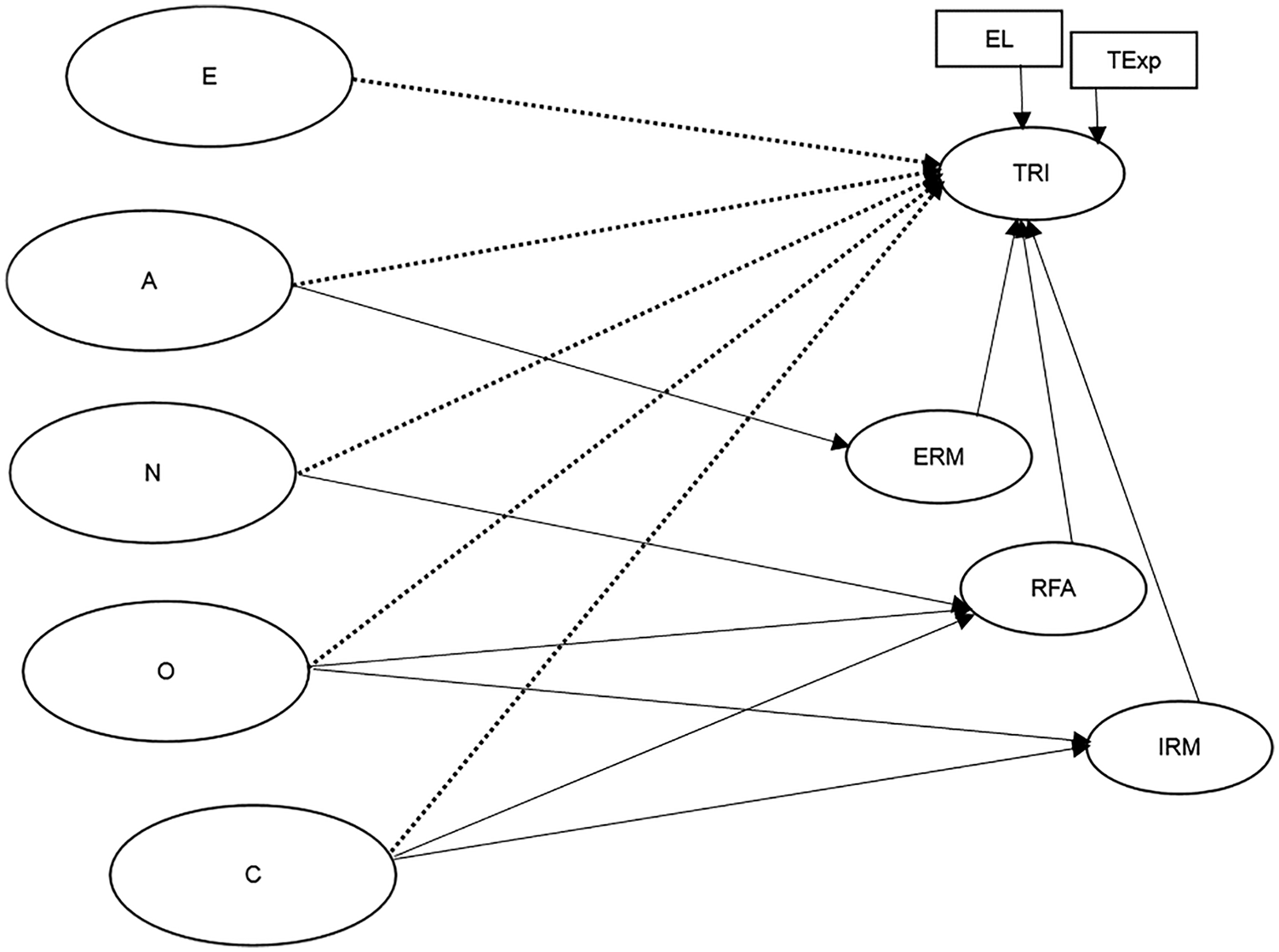
The theoretical models.
Aims
Based on the proposed models and the arguments presented earlier, we aim to answer the following research questions:
Design and Method
For the present research, we relied on a cross-sectional survey design which involves gathering quantitative data at one point in time through self-report measures (Cohen et al., 2018). The following sections elaborate on the nature of the sample, measures employed, and procedures followed for data collection and analysis.
Participants and Procedures
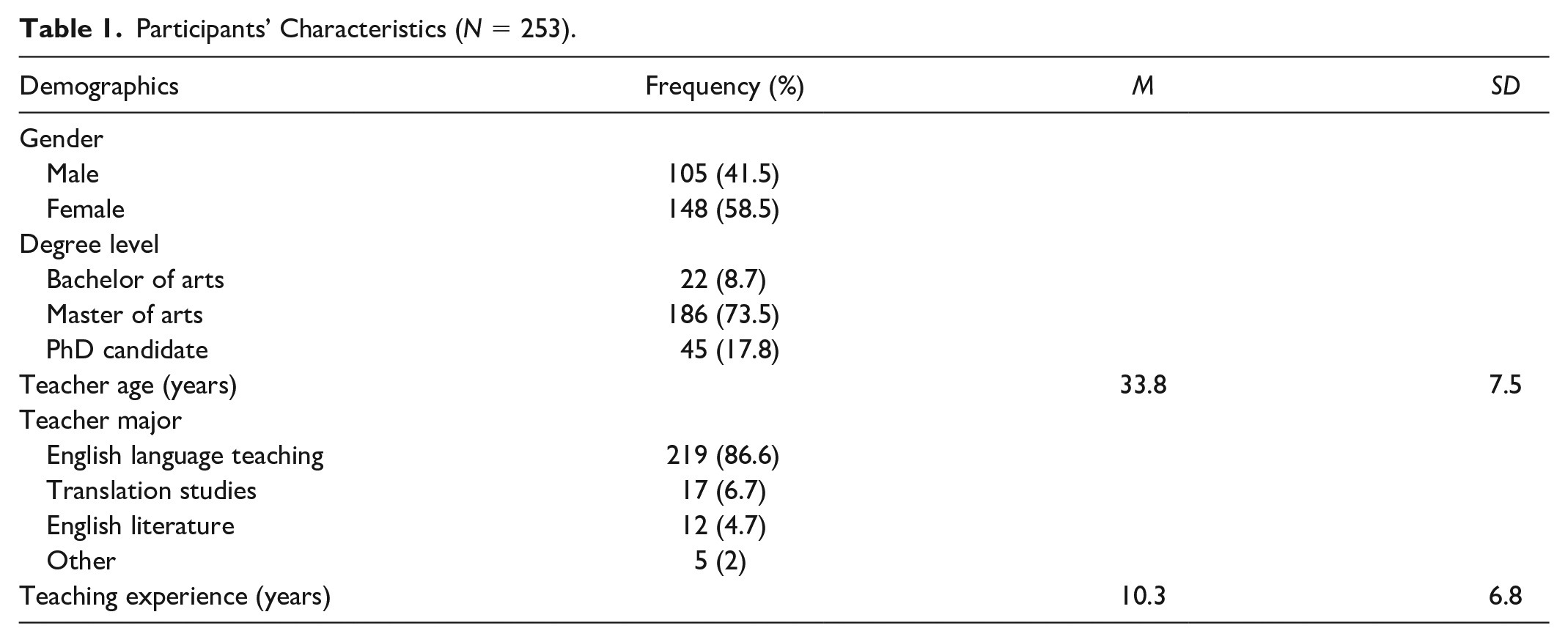
Annually in Iran, several ELT conferences are held by different universities or local ELT organizations, whose administrative affairs are managed through dedicated virtual groups in social media platforms. These groups generally include language teachers, researchers, and postgraduate students from all over the country. Due to the difficulty of access to SETs who possess research experience, the participants for this study were recruited through personal invitations to the members of these groups. The invitations briefly stated the purpose of the project and emphasized that only SETs whose research experience goes beyond simply an MA or PhD thesis should respond, if interested. This criterion was applied because academic requirements could supersede teachers’ concerns for doing meaningful research in their own contexts (Borg, 2010). The ethical codes of research, including assurance of anonymity, were observed during data collection. A total number of 253 SETs agreed to participate in this study (see Table 1 for teachers’ demographic characteristics).
Participants’ Characteristics (N = 253).
Measures
We included the definition of teacher research (see Teacher Research Involvement section above), where necessary, in the Instructions sections of the instruments. Also, the measurement models of the scales tapping the Big Five traits and motivation to conduct research were each evaluated through a confirmatory factor analysis (CFA) to ensure indicator score reliability and structural validity of the scale scores. Although the model chi-square statistic (χ2) is reported, we did not rely on it to evaluate model fit due to its sensitivity to sample size (Pituch & Stevens, 2016). Instead, the Tucker–Lewis index (TLI), the comparative fit index (CFI), the root mean square error of approximation (RMSEA) with its 90% confidence interval (CI), and standardized root mean square residual (SRMR) were utilized. Values of TLI ≥ .90, CFI ≥ .90, RMSEA ≤ .08, and SRMR ≤ .10 are regarded as criteria for adequate fit while values of TLI > .95, CFI > .95, RMSEA ≤ .05, and SRMR ≤ .05 are considered as criteria for excellent fit (Kline, 2016; Pituch & Stevens, 2016).
The Big Five traits
To measure the Big Five traits, the 44-item Big Five Inventory (BFI; John et al., 2009) was utilized. High test–retest reliability (r = .80–.90), external correlations with peer ratings, and good convergence with other measures of the Big Five (corrected r = .83–.99) have been previously reported for the BFI (John et al., 2009). The scale was translated from English into Persian (i.e., participants’ L1) by relying on a forward and backward translation method and step-wise reviewing by a translation team (i.e., a professor of psychology and two ELT graduates) who were highly proficient in both languages. This was to ensure conceptual and semantic equivalence (van De Vijver, 2016) and final revisions were made based on the suggestions. The participants rated a series of statements about their typical behaviors on a 5-point scale, ranging from 1 (strongly disagree) to 5 (strongly agree). We conducted a CFA to test a five-factor model for BFI, which showed adequate fit, χ2(892) = 1416.11, p < .001; TLI = .91; CFI = .92; RMSEA = .048 (90% CI [.04,.05]); SRMR = .072. However, the loadings of Extraversion Items 1 and 6 and Neuroticism Item 14 did not reach the minimum criterion of .4 (Pituch & Stevens, 2016) and as such they were removed from the inventory. This could be because, despite our best translation efforts, these items may have been interpreted differently. For example, Extraversion Item 6 (i.e., I see myself as someone who is reserved) could have been understood more positively than intended in our context due to cultural differences (see Gurven et al., 2013). These modifications resulted in improvement in model fit, χ2(769) = 1218.41, p < .001; TLI = .92; CFI = .93; RMSEA = .048 (90% CI [.04,.05]); SRMR = .068. All the remaining items had significant loadings (.47–.86) on their respective factors at p <.001 level. The sample size for the CFA is therefore adequate because, based on the simulation study by Jackson et al. (2013), models with loadings of at least .4 on three to six factors, each having five to 12 items do not require more than 200 participants to achieve good convergence and solution propriety. In the present sample, alpha values of .84, .85, .87, .82, and .82 were obtained for Extraversion, Openness to Experience, Conscientiousness, Agreeableness, and Neuroticism subscales, respectively (see Appendix A, available with the online version of this article for sample items and psychometric properties).
Teachers’ motivation to conduct research
To measure teachers’ motivation to conduct research, the Persian version of the 22-item Teacher Research Motivation Scale (TRMS; Hosseini & Bahrami, 2022) was employed. The TRMS scores have been shown to possess excellent psychometric properties in terms of reliability and validity. According to these results, this scale has three dimensions, namely Intrinsic Research Motivation (IRM), Extrinsic Research Motivation (ERM), and Research Failure Avoidance (RFA). Furthermore, the internal consistency of the scores on these dimensions was .93, .79, and .82, respectively. To gather data for this study, the participants were asked to indicate to what extent they believed each statement was true for them on a 5-point scale, ranging from 1 (strongly disagree) to 5 (strongly agree). A CFA was conducted to evaluate the three-factor solution, and the fit of the hypothesized model was close to good, χ2(206) = 510.67, p < .001; TLI = .94; CFI = .95; RMSEA = .074 (90% CI [.06,.08]); SRMR = 0.71. All factor loadings (.44–.90) were also significant at p <.001 level, indicating sampling adequacy based on Jackson et al.’s (2013) criteria. Furthermore, alphas of .89, .73, and .76 were obtained for IRM, ERM, and RFA subscales, respectively, in the present sample (see Appendix A, available with the online version of this article).
Teacher research involvement
To measure the extent of teachers’ TRI, we designed an overall question with six comprehensive choices around our conceptualization of TRI (i.e., which of the following research experiences apply to you as a language teacher? You can choose more than one; see Richter et al., 2019). The choices comprised (a) the experience of publishing in a local/international journal; (b) having a project in progress to be submitted to such journals; (c) presenting in a local/international conference; (d) having a project in progress to be presented in such conferences; (e) publishing in professional magazines or newsletters; and (f) having a project in progress to be submitted to these types of periodicals. The teachers could also write any other complementary research experiences in a separate dedicated space. They, for example, referred to sharing the results of their research projects within regional school-based consortiums; talking to their colleagues about their research results; participating in collaborative research projects shared in blogs; and conducting research to solve practical problems, which was shared in teacher discussion groups on social media platforms. In addition, each of these choices was followed by an empty space to indicate the frequency of each research activity during teachers’ careers irrespective of time range as teacher research has been documented to be quite time-consuming, with some projects even taking several years to complete (Gao et al., 2011; James & Augustine, 2018). The measurement tool was open-ended with the minimum possible score of 1 due to our sampling from among only teacher researchers (see Participants and Procedures section). In terms of reported frequencies, choice a scored the highest (62.8%), followed by choices c (48.7%), d (45.2%), b (38.3%), f (28.0%), e (24.9%), and other (18.2%). Afterward, we awarded a score of 1 to each research experience, but every time teachers reported frequencies higher than 1, we used those frequencies. For each participant, we summed all of these frequencies to calculate a total TRI score.
Control variables
In the hypothesized model (see Figure 1), the participants’ teaching experience and education level were included as control variables as they have been previously shown to be correlated with teachers’ involvement in research (e.g., Borg, 2009). Both variables were measured through the demographic questions.
Statistical Analysis
There were no missing data since our utilized online data collection software had the capability of alerting the participants if they left a field empty. For the preliminary analyses, we relied on descriptive statistics and conducted zero-order correlations. In addition, prior to conducting the main analysis through structural equation modeling (SEM), data were checked for the assumptions of normality, linearity, and lack of multicollinearity. We employed the weighted least squares mean and variance adjusted (WLSMV) estimation method for the CFAs. This method has been shown to be one of the most appropriate methods for handling Likert-type data in relatively small sample sizes and capable of improving the estimation of standard errors of parameters and their structural estimates (Li, 2016; see also Kline, 2016).
Due to the smaller population of language teachers with hands-on research experience both globally and in Iran (Borg, 2010; Gholami & Mehrmohammadi, 2014; Nassaji, 2012), our sample size did not meet the minimum criterion of five participants per free parameter for multiple-indicator SEM (Kline, 2016). We, therefore, relied on single-indicator SEM with correction for measurement error (e.g., Cole & Preacher, 2014), which increased the participant-per-parameter ratio above the minimum requirement. In this method, each construct is modeled as a latent variable with an observed indicator having a loading of 1 and an error term fixed to 1 minus the reliability of each indicator multiplied by its variance (i.e., [1 − rel x ] × σ2x). Methodological research (see Liang et al., 1990) has indicated that single-indicator SEM studies demonstrate comparable results to ones with multiple indicators. With a sample size above 200, the maximum likelihood estimator would yield reliable estimates (Kline, 2016) and thus it was utilized for the SEM analysis.
Furthermore, we tested the indirect effects of the Big Five traits on TRI through the bootstrap procedure which evaluates them directly by constructing CIs, and if zero does not fall within these CIs, the effect is considered significant (Hayes, 2018). We relied on 95% bias-corrected CIs, using 10000 bootstrap samples. We chose this approach over the traditional causal steps (CS) method, first, based on the “consensus . . . that a total effect of X on Y should not be a prerequisite to searching [directly] for evidence of indirect effects” (Hayes, 2018, p. 117). This stems from simulation studies (e.g., Rucker et al., 2011), showing that indirect effects may very well exist in the absence of total effects due to factors such as a stronger relationship between an independent variable and a mediator than an outcome and thus emphasizing reliance on what theory proposes in such situations. Moreover, utilizing the bootstrap procedure in SEM can ameliorate concerns about the heightened type I and II error rates and measurement error in CS as, unlike SEM, CS is a piecemeal regressional approach (Hayes, 2018). Overall, SPSS Version 25 was utilized for the descriptive and correlational analyses as well as for checking the SEM assumptions. The CFAs and the SEM were conducted in Mplus Version 8.3 (Muthén & Muthén, 2019).
Results
Preliminary Analyses
The means, standard deviations, and zero-order correlations among the variables are presented in Table 2.
Means, Standard Deviations, and Zero-Order Correlations (N = 253).
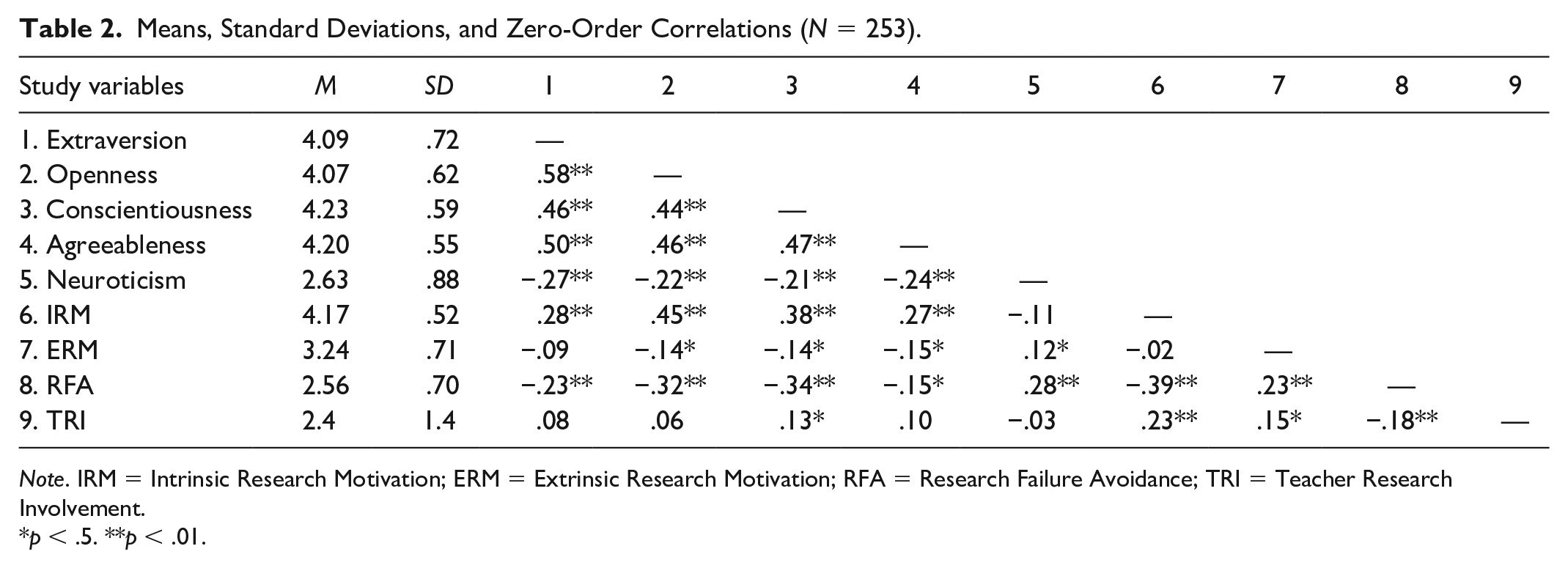
Note. IRM = Intrinsic Research Motivation; ERM = Extrinsic Research Motivation; RFA = Research Failure Avoidance; TRI = Teacher Research Involvement.
p < .5. **p < .01.
Teachers exhibited the lowest mean for Neuroticism (M = 2.63, SD = .88), which is consistent with some previous studies of school teachers (e.g., Jugović et al., 2012) and comparable means for Openness to Experience (M = 4.07, SD = .62), Extraversion (M = 4.09, SD = .72), Agreeableness (M = 4.20, SD = .55), and Conscientiousness (M = 4.23, SD = .59). Moreover, teachers demonstrated the highest mean for IRM (M = 4.17, SD = .52), followed by ERM (M = 3.24, SD = .71) and RFA (M = 2.56, SD = .70). The TRI scores ranged from 1 to 6 with the M of 2.4 and SD of 1.4, which indicates that teachers differ in their level of involvement in research.
The bivariate correlations showed several significant relationships among the study variables, the magnitude of which ranged from small to moderately large in our sample (Cohen et al., 2018). More specifically, all of the Big Five traits but Neuroticism yielded positive correlations with IRM. Openness to Experience, Agreeableness, and Conscientiousness demonstrated negative relationships with ERM, while Neuroticism yielded a positive relationship with this construct. All of the Big Five traits, except for Neuroticism which showed a positive relationship with RFA, were negatively correlated with it. Finally, Conscientiousness had a positive relationship with TRI. All the three dimensions of teachers’ motivation to conduct research also yielded significant relationships with TRI. Teachers’ age (SD = 7.5) and teaching experience (SD = 6.8) were found to have relatively high standard deviations, but prior literature only suggests a role for experience in influencing TRI (Borg, 2009). Therefore, by controlling its effect in our model, as mentioned earlier, we eliminated any source of bias.
SEM Analysis
Prior to conducting the SEM analysis, we inspected its main assumptions. Particularly, we checked the skewness and kurtosis results which were all below the <7 criterion, indicating no issues with the normality of the distribution (Kline, 2016). Similarly, inspection of the residual plot of predicted values against predicted errors did not reveal problems with linearity as no specific pattern was observable (Pituch & Stevens, 2016). Also, the largest variance inflation factor (VIF) value was 1.86 which is below the <10 criterion (Pituch & Stevens, 2016), demonstrating lack of multicollinearity and confirming convergent and discriminant validity of the study variables.
Afterward, the hypothesized full mediation model was evaluated for model fit and significance of path coefficients. The fit of this model was adequate on all the indices except marginally for TLI, χ2(41) = 85.79, p < .001; TLI = .87; CFI = .91; RMSEA = .066 (90% CI [.04,08]); SRMR = .055. Thus, the model was inspected for possible sources of misfit, revealing that the path from teaching experience to TRI was insignificant. This path was trimmed, which resulted in adequate model fit, χ2(33) = 54.56, p < .001; TLI = .93; CFI = .95; RMSEA = .051 (90% CI [.02,07]); SRMR = .046. All the other path coefficients in the model were significant.
Then, we tested the alternative partial mediation model which adds five direct paths from personality traits to TRI. However, not only were all of these paths insignificant, but a chi-square difference test indicated that this model did not improve upon the fit of the hypothesized one, ∆χ2(6) = 5.98, p = .42. In view of these results, the full mediation model (see Figure 2) was retained as the more parsimonious one (James et al., 2006). The R-squared value of this model for TRI amounted to .26, which means that it accounts for 26% of the variance in the outcome. In the social sciences, R-squared values from .04 to .16 are regarded as moderately weak while those above 0.25 are considered moderately strong (Ritchey, 2008; see Table 3).
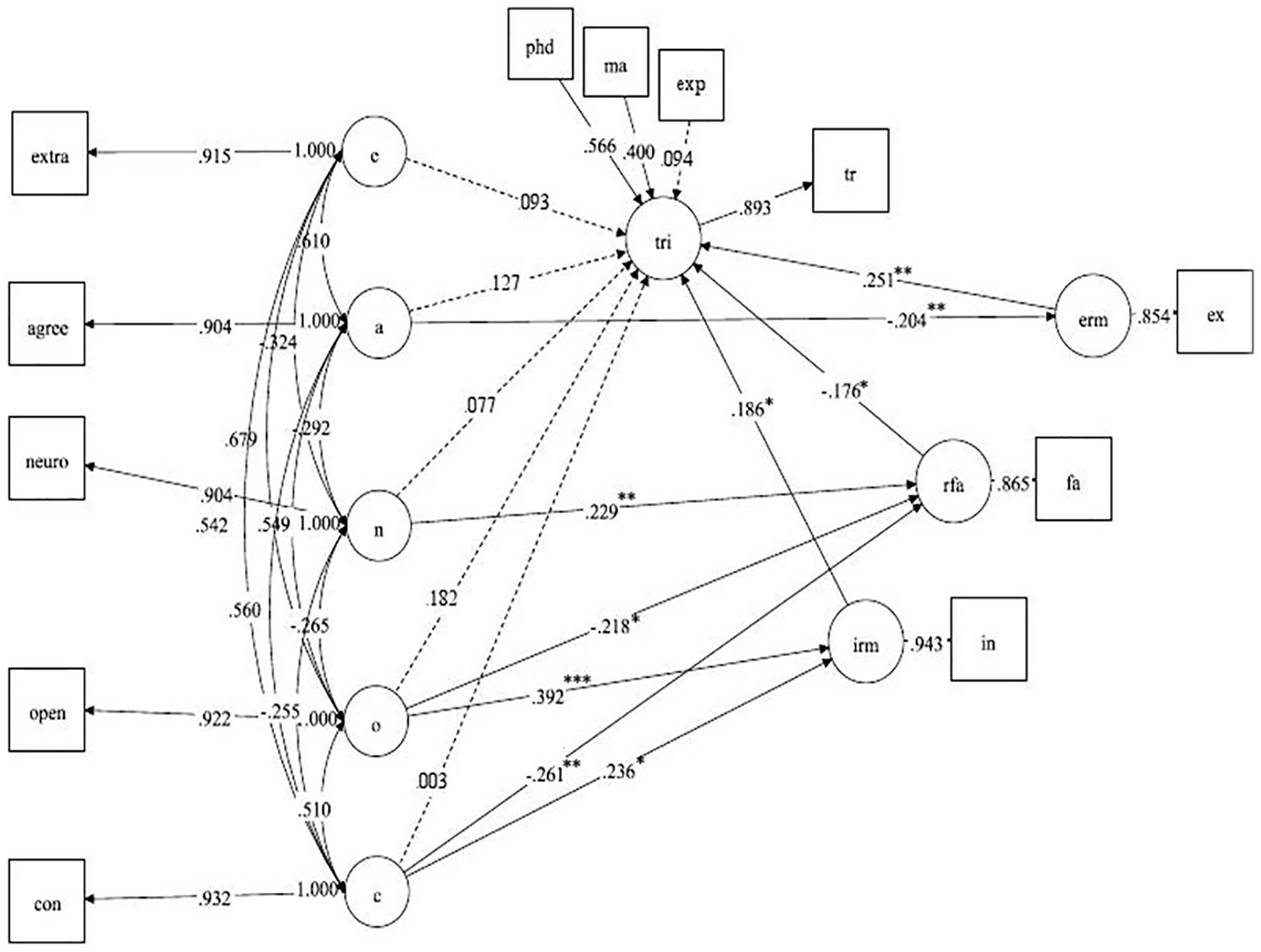
N = 253.
R-Squared Values of the Endogenous Variables (N = 253).
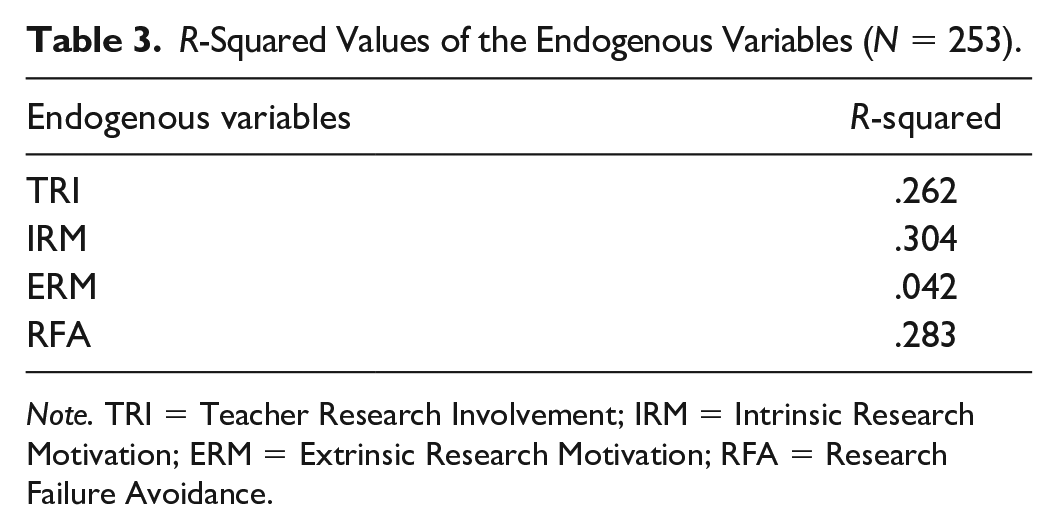
Note. TRI = Teacher Research Involvement; IRM = Intrinsic Research Motivation; ERM = Extrinsic Research Motivation; RFA = Research Failure Avoidance.
Research Questions 1 and 2 were addressed by relying on the results obtained from the path coefficients. For Research Question 1, while the Big Five traits did not show any direct influence on TRI, they significantly affected all of the motivational variables. Openness to Experience and Conscientiousness were the most influential of these traits, followed by Neuroticism and Agreeableness. More specifically, Openness to Experience significantly predicted IRM (β = .39, p < .001) and significantly but negatively predicted RFA (β = −.22, p = .03). The same pattern of relationships existed between Conscientiousness and IRM (β = .23, p = .02), on the one hand, and RFA (β = −.26, p = .007), on the other.
Furthermore, Neuroticism predicted RFA positively (β = .23, p =.001), and Agreeableness predicted ERM negatively (β = −.20, p = .006). With respect to Research Question 2, all the three dimensions of motivation to conduct research had significant effects on TRI. Particularly, ERM (β = .25, p = .001) was the strongest positive predictor of TRI, which was followed by IRM (β = .18, p = .01). RFA, too, had a significant but smaller negative effect (β = −.17, p = .03). Finally, Research Question 3 was answered based on analysis of the indirect effects through bootstrapping. All of the indirect effects were significant as zero did not fall within any of the 95% CIs (see Table 4).
Point Estimates and 95% Bias-Corrected Bootstrap CIs for the Indirect Effects (N = 253).
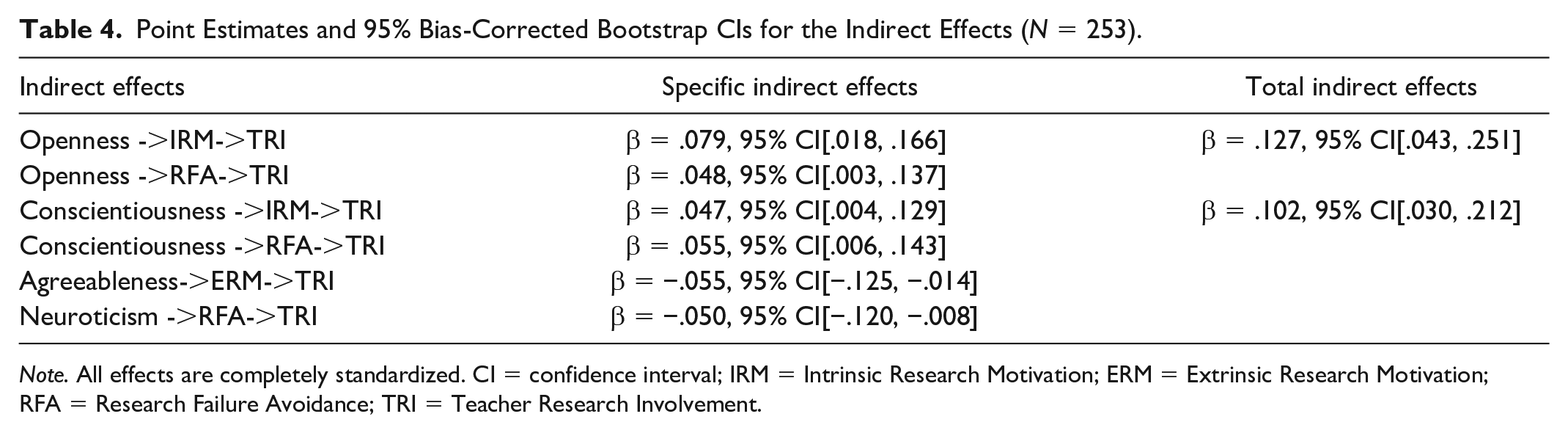
Note. All effects are completely standardized. CI = confidence interval; IRM = Intrinsic Research Motivation; ERM = Extrinsic Research Motivation; RFA = Research Failure Avoidance; TRI = Teacher Research Involvement.
Discussion
In the present study, we investigated the important role of individual difference variables (i.e., Big Five personality traits and motivation to conduct research) in relation to TRI. The combined evidence from the bivariate correlations and the SEM analysis (even after controlling for teachers’ work experience and education level) indicated significant relationships among the study variables. Specifically, we observed predictive relationships between the Big Five traits and approach-oriented motivational constructs (Elliot & Thrash, 2002) in terms of intrinsic and extrinsic research motivations as well as the avoidance-oriented (Elliot & Sheldon, 1997) research failure avoidance. These results expand previous research (e.g., Major et al., 2006; Maurer et al., 2008; Watanabe et al., 2011) which has predominantly used personality traits to predict unidimensional constructs tapping motivation for development and/or has not given enough attention to a fuller examination of SDT (see also Barrick & Mount, 2005). Thus, our findings provide some of the trait-based underpinnings of intrinsic and extrinsic research motivations whose counterparts in the general PD literature have been previously shown to, respectively, influence more or less optimal professional learning and growth (e.g., Gorozidis & Papaioannou, 2014; see also Ryan & Deci, 2017). Relatedly, the predictive relationship between research failure avoidance and TRI demonstrates that, alongside approach motivation (see Kyndt et al., 2016), avoidance motivation and its consequent behaviors impact teachers’ professional lives. Therefore, avoidance motivation could have a more prominent place in future studies on the broader category of teacher participation in PD, which have usually relied on approach-oriented constructs (Krille, 2020). As regards the Big Five traits and TRI, however, there were no predictive relationships. This somewhat unexpected finding could give support to the view that broadly defined Big Five dimensions may not always serve as effective predictors of more specific behavioral outcomes (e.g., TRI; Barrick & Mount, 2005; Locke & Latham, 2004) although future research needs to replicate this finding (see also Conclusion and Implications). Alongside replication, another possible route for future research is to explore whether and how narrowly defined facets of these traits may act as direct predictors of TRI (see Li et al., 2014).
In addition, our mediational results revealed that the Big Five traits predicted TRI only indirectly through teachers’ motivation to conduct research (see van Daal et al., 2014, for similar results in relation to workplace PD outcomes). Based on such a model, one fresh result of the present study is the tentative categories the teachers could be divided into. Teachers who were curious and open to new stimuli and challenges (i.e., high on Openness to Experience; McCrae & Costa, 2013) as well as hard-working and sensitive to achievement strivings (i.e., high on Conscientiousness; Patterson, 2002) were found to be intrinsically motivated to engage in research which, in turn, affected their research involvement positively. Furthermore, those who were competitive and uncooperative (i.e., low on Agreeableness; McCrae & Costa, 2013) were found to be driven by extrinsic motivation to conduct research which also affected their research involvement positively. However, those who were closed to diverse experiences (i.e., low on Openness to Experience), lacking in persistence/achievement striving (i.e., low on Conscientiousness), or susceptible to (achievement-related) anxiety and avoidance behaviors (i.e., high on Neuroticism; Elliot & Thrash, 2002) tended to feel avoidant toward research activities they thought could end in failure which, in turn, affected their research involvement negatively (see Appendix B, available with the online version of this article for a tabulation of these results).
These findings lend credence to the earlier-mentioned assumption that there could be underlying reasons for the observed variability in the level of teachers’ involvement in research. Thus, instead of viewing teachers who actually conduct research as a homogeneous group, presumed to possess more or less the same individual difference characteristics, as is implicit in the literature (e.g., Borg, 2009; Borg & Liu, 2013; Nassaji, 2012), there is a need for an individual differences-informed continuum of their different levels of research involvement. Thinking in terms of such a continuum, for example, could indicate that teachers with different personality characteristics may show different degrees of research sustainability which is a crucial issue in the discussions on teacher research (e.g., Groundwater-Smith et al., 2013; James & Augustine, 2018). As an instance, for teachers predisposed toward intrinsic research motivation, the mere existence of PD opportunities may be adequate to lead to more sustained involvement in research (see Major et al., 2006). In contrast, teachers predisposed to experiencing research failure avoidance may eventually abandon research involvement altogether or those predisposed to experiencing extrinsic research motivation may lose momentum, according to SDT principles (Ryan & Deci, 2017) and some relevant empirical findings (e.g., Borg & Liu, 2013), if external research-related motivations cease to exist.
In addition, the more enduring nature of personality traits could make it difficult to address such complexities through contextual support as exceedingly promoted in the literature (e.g., Borg & Sanchez, 2015; Groundwater-Smith et al., 2013). This is because intervening in personality–behavior relationships is complicated and, as Boyle et al. (2008) maintain, dependent upon the nature of the mediating mechanisms and their susceptibility to change. Thus, based on our results, it may not be very likely that by simply creating supportive research environments we can substantially help with the research avoidance behaviors of, say, Neurotic teachers. In the case of dispositionally competitive ones, extrinsic research motivation may be more sensitive to the situational milieu surrounding teacher research in terms of funded teacher research opportunities available in Iran and elsewhere (e.g., James & Augustine, 2018; Foster, 1999; Gholami & Mehrmohammadi, 2014) and in contexts where rewards accompany formal dissemination of research results. However, although such contextual affordances could lead to more involvement in research—this may be reflected in our finding that ERM was the strongest predictor of TRI compared to IRM and RFA—it may not be very easy to witness a collaborative, sustained research culture emerge despite this being one of the most important stepping stones for developing “research-engaged organizations” (Borg & Liu, 2013, p. 294). Thus, contexts, schools, and organizations seeking to utilize research as a viable PD approach for teachers may face some practical problems with research sustainability or creating a pervading research culture within themselves.
Our results also seem to lend further credence to the finding that mostly teachers who are already motivated to approach research will become more involved in it (Foster, 1999), corroborating an assumption going back at least to the 1970s in the field of teacher research (Stenhouse, 1975). This, however, may be problematic for experimental studies on teacher research with voluntary participation (e.g., Atay, 2008) since, if not controlled for, the preexisting individual difference characteristics of the volunteering teachers may enable them to engage more deeply in and/or gain greater benefits from the interventions and, therefore, act as a possible source of confound.
Another crucial issue is that although in the context of Iran teachers currently have no direct obligation to conduct research, there are indirect structures in place (e.g., rewards, promotion, salary raise) which may ultimately drive many of them toward this activity. However, based on our findings, some of these teachers will have a head start simply by virtue of their individual difference profile. Possessing such an advantage, however, could not be considered an equitable state of affairs for teacher PD since it could unfairly benefit certain groups of teachers over others, especially as teacher research is widely considered a gold standard for PD in Iran (Mehrani, 2015) and many parts of the world (Groundwater-Smith et al., 2013). For example, because teachers predisposed toward intrinsic research motivation are likely to be intellectually curious and/or more persistent in conducting research (John et al., 2009; Ryan & Deci, 2017), they may stand to gain more from research-based PD and could find job advancement easier. In contrast, if teachers who are vulnerable to failure avoidance decide to engage in research to gain rewards, they would inevitably have to face an inner struggle every time the possibility of failure seems real or the task of research seems insurmountable, and, even if they succeed, their emotional energy could be exhausted (see Thompson, 2004). These problems may arise more potently in contexts, including China (Gao et al., 2011) and Vietnam (Vu, 2020), where teacher research is already obligatory in certain educational institutions. In China, for instance, “. . . principals and other senior staff exert pressure on [language] teachers to become research active, even if they feel disinclined or unable to do so” (Gao et al., 2011, p. 74). Such suboptimal conditions could turn research for teachers in these contexts from a potentially useful tool for PD to a struggle for survival or “another ‘tick-box’ approach to professional development, and one which will make little, if any, difference to [teachers’] personal and professional . . . practice” (Gilchrist, 2018, p. 61). They may also result in higher rates of job dissatisfaction, burn out, or ultimately even attrition (see Barrick & Mount, 2005). Moreover, they may lead teachers who are under strain to producing low-quality research (see Borg & Liu, 2013) or even drive them to dishonest behavior (e.g., plagiarism, relying on third parties who provide illicit research services), both areas ripe for further future exploration.
Collectively, the identified issues highlight the need for a more nuanced evaluation and exploration of the emphasized benefits attributed to research for all teachers in the literature (e.g., Borg, 2010; Kincheloe, 2003; McKernan, 2008; Mertler, 2018). They could also bring under question the sometimes overoptimistic characterizations of teacher research, for instance, in terms of its capability to empower teachers (e.g., Kincheloe, 2003; McKernan, 2008; Rose, 2019) or its necessarily transformative nature for those who conduct it (e.g., Mertler, 2018). The present study’s results could, therefore, serve as first empirical evidence for the recently proposed arguments (e.g., Gilchrist, 2018) that teacher research (especially as it is currently practiced in some contexts) may not be a desirable or necessary PD approach for all teachers although those positively predisposed to this activity apparently still benefit from its many potentials.
Conclusion and Implications
The present study investigated the potential relationships among teachers’ Big Five traits, motivation to conduct research, and TRI. The correlational and SEM analyses revealed several significant relationships among these variables, and a full mediation model through motivation was retained. The implications of these results in terms of the differences in teachers’ actual level of research involvement, conditions necessary for its success, and research-related policies point to several important issues. First, they indicate that the treatment of teacher research should definitely be expanded beyond contextual factors in both the theoretical and empirical literatures. Awareness should also be raised in contexts where research is or becoming obligatory for teachers (e.g., Iran) in order to make the policymakers and PD coordinators realize that those who are more willing to conduct research are not necessarily better professionals. Moreover, receiving job-related benefits should not be primarily determined by whether a teacher is a researcher or not. Nevertheless, our results could also have implications for contexts in which there is interest in identifying teachers who are positively predisposed to research involvement.
Taken together, these considerations accentuate the need to move away from considering teacher research as a gold standard for PD toward a more level playing field where all the efforts by teachers for development are recognized and rewarded. Another fruitful direction could be to investigate teacher research conceptualized primarily as a reflective tool (Gore & Zeichner, 1991) and away from a predominant focus on formal dissemination. This may, to a large extent, disconnect extrinsically oriented teachers from external rewards associated with such dissemination, thereby providing opportunities for interventions that could transform extrinsic research motivation into more intrinsic types through internalization of the value of research (Ryan & Deci, 2017). Similarly, this shift may lead to less fear of failure for the failure avoidant teachers who can then be encouraged to participate in supportive collaborative research/action research communities (Mertler, 2018) to facilitate their (more) research involvement. If supported by empirical data, such interventions may positively transform research involvement for these groups of teachers.
While this study clearly adds to the existing scholarship on teacher research, it has some important limitations. First, more research is needed to confirm the validity of our results in different populations, including teachers in the higher education settings where research-related policies, practices, and experiences could be different (for an empirical example see Bahrami et al., 2019). In addition, as there is usually a smaller number of teacher researchers in each single context, we achieved adequate sampling based on rules of thumb. If possible, future research could gather data from a larger pool of participants to replicate our results, especially with regard to the lack of any direct predictive relationship between personality traits and TRI, which may be due to issues of statistical power (see Cohen et al., 2018). Moreover, retaining a full mediation model does not suggest that other potential mediators could not exist between personality traits and TRI (see Rucker et al., 2011) and therefore future research may look for these as well. We assessed TRI solely through self-report, but further research can combine self-report data with objective measures (e.g., official records) of TRI to obtain a more comprehensive indicator of this outcome. Finally, data elicited about the quality of TRI rather than solely its quantity may also help with providing deeper insights into the relationship between this outcome and individual differences.
Supplemental Material
sj-docx-1-jte-10.1177_00224871221105799 – Supplemental material for Individual Differences in Teacher Research Involvement? Factoring in Language Teachers’ Big Five Personality Traits and Motivation to Conduct Research
Supplemental material, sj-docx-1-jte-10.1177_00224871221105799 for Individual Differences in Teacher Research Involvement? Factoring in Language Teachers’ Big Five Personality Traits and Motivation to Conduct Research by Vahid Bahrami and Mehrdad Hosseini in Journal of Teacher Education
Footnotes
Acknowledgements
The authors would like to gratefully thank the anonymous reviewers and the editors of JTE for their constructive suggestions and insightful comments on the earlier drafts of this manuscript. We would also like to thank the participating EFL teachers for their time and dedication.
Declaration of Conflicting Interests
The author(s) declared no potential conflicts of interest with respect to the research, authorship, and/or publication of this article.
Funding
The author(s) received no financial support for the research, authorship, and/or publication of this article.

Supplemental Material
Supplemental material for this article is available online.
Author Biographies
References
Supplementary Material
Please find the following supplemental material available below.
For Open Access articles published under a Creative Commons License, all supplemental material carries the same license as the article it is associated with.
For non-Open Access articles published, all supplemental material carries a non-exclusive license, and permission requests for re-use of supplemental material or any part of supplemental material shall be sent directly to the copyright owner as specified in the copyright notice associated with the article.
