







Abstract
This article explores how preservice teachers (PSTs) are supported in translating their antiracist knowledge into practice within field supervision contexts. Grounded in a conceptual framework that foregrounds race, racism, and processes of learning and identity, this vignette-based analysis demonstrates how teacher educators (TEs) provide translational resources that help connect PSTs’ understandings of race and racism to their everyday decisions and actions in the classroom. Findings demonstrate that these translational resources are central to helping PSTs interpret and respond to acts of everyday racism within their classrooms and in relation to their teaching. The findings suggest that field supervision is a critical site for PSTs’ antiracist learning and highlight the need for more explicit attention to how TEs facilitate the translation of antiracist knowledge into practice.
“I know this, and I see it, but at some point, I was like, ‘How do I take this information and translate it to the classroom?’”
This sentiment, shared by a white preservice teacher (PST), reflects the uncertainties commonly voiced by PSTs as they move through teacher preparation experiences intended to develop their capacity for antiracist teaching. This PST had spent four semesters learning about race and racial inequity and was now attempting to connect what she had learned in the university classroom to her own classroom teaching. She is not alone; preservice and novice teachers alike report difficulty translating their understandings about race into practice (Maloney et al., 2024) and difficulty negotiating competing visions of “good teaching” across different teaching contexts (Williamson & Warrington, 2019). In addition, PSTs continue to demonstrate limited understandings of equitable teaching (Kwok et al., 2025) and difficulty engaging with issues of discrimination and racism (Martin-Beltrán et al., 2023). Even PSTs who express antiracist inclinations during teacher preparation tend to avoid issues of race in their classrooms (Maloney et al., 2024) and teach in ways that support the racial status quo (Behm Cross et al., 2019).
These realities are situated within a sociopolitical landscape marked by escalating threats toward the students and communities we serve, rampant xenophobia and anti-immigrant rhetoric, widespread anti-diveristy, equity and inclusion efforts, and politically motivated efforts to restrict the teaching of history in schools—making it both necessary and urgent for teachers to address racism in school policy and practice and ensure that their classrooms are safe and equitable places for learning. Hence, it is the duty of teacher educators (TEs) to build teachers’ capacity for antiracism, not only growing their awareness of racism and its material consequences but also developing their capacity to recognize racism within their own teaching practices and act steadfastly against it. TEs who supervise PSTs in their field placements are uniquely positioned to support PSTs in translating antiracist knowledge into practice; however, few investigations have empirically examined the relationship between TEs’ supervision practices and PSTs’ antiracist learning. This investigation responds by examining interactions between TEs and PSTs where translational resources (Oamek, 2024) for antiracist practice are made available to PSTs in field supervision contexts. The following research questions guide this investigation:
The decision to focus this investigation on the learning and development of white PSTs was made with both caution and intention. The U.S. teaching force remains overwhelmingly white, middle-class, and monolingual English-speaking, and the demographics of TEs continue to mirror this trend (U.S. Department of Education, 2020). This context begs urgency—both toward preparing and retaining teachers and TEs who represent the racial, ethnic, and linguistic diversity of the U.S. student population and toward our efforts to prepare white teachers and white TEs for antiracist work. White teachers have been the subject of much scholarship over the last several decades; however, we still know more about the challenges and complexities of preparing white teachers for antiracist work than we know about how to support their growth and development in this direction. As such, I conduct this investigation with the goal of generating knowledge needed to support white teachers’ movement toward antiracist practice, knowing that possibilities for racial and educational justice continue to rest largely on the degree to which people of Color 1 are enfranchised in civic and educational processes (Ladson-Billings, 2006).
Conceptual Framework
Understanding how racism and white supremacy shape teachers’ everyday decisions and actions is essential for recognizing the subtle yet powerful ways inequity is normalized and reproduced in classrooms. At the same time, supporting teachers’ capacity for antiracist practice requires attention to the learning and identity processes through which they come to recognize, interpret, and act upon these racialized dynamics. The following subsections outline how everyday racism (Kohli et al., 2017) manifests in teaching and introduce a learning and identity resources framework (Louie, 2017; Oamek, 2024) that helps explain how teachers make movement toward antiracist practice.
How Racism and White Supremacy Shape Teachers’ Everyday Actions
Racism is a structural system of power that employs the social construct of race to create, justify, and uphold unequal access to power, resources, and opportunities. Racism produces material consequences (e.g., disparities in wealth, education, safety, and health) and is sustained by discourses that uphold white supremacy—a system of power that normalizes whiteness, white privilege, and white dominance (Omi & Winant, 2015). Conversely, antiracism is the practice of identifying, challenging, and changing policies, practices, and ideas that uphold racism and white supremacy (Kendi, 2019). Hence, antiracist teaching is that which redresses racial and educational injustices by decentering white racial knowledge in the classroom and dismantling white supremacy in educational policy and practice (Dei, 2001; Leonardo, 2009).
Antiracist teaching requires a robust sociopolitical consciousness (Ladson-Billings, 1995) and the ability to leverage one’s understandings of racism and white supremacy in their everyday decisions and actions in the classroom (Madkins & McKinney de Royston, 2019; Pollock, 2008). This, however—bringing one’s understandings about racism to the level of their personal practice—remains elusive for many teachers, particularly as manifestations of racism become harder to recognize in schools and classrooms. As covert and more subtle beliefs and behaviors replace the more overt discriminatory policies and practices of the past, racially inequitable educational outcomes are increasingly normalized and accepted—a phenomenon identified by Kohli et al. (2017) as “new racism.” One dimension of “new racism” is what Kohli and colleagues describe as “everyday racism”: an often-unrecognizable type of racism operating as “interpersonal manifestations of institutionally driven racism” (p. 192). Racial microaggressions are a form of everyday racism; for example, a teacher might express surprise when a Black student performs exceptionally well on a test, implicitly communicating their lowered expectations and subtly reinforcing stereotypes about intelligence.
When unrecognized and unquestioned by teachers, acts of everyday racism marginalize students of Color and reproduce inequitable experiences and outcomes. For this reason, antiracist teaching requires conscious disavowing of such injustices and immediate action to redress them, distinguishing it from teaching that may be culturally responsive, in some respects, but fails to directly counter everyday manifestations of racism. As such, teachers must learn to recognize subtle acts of racism within the daily activity and interactional patterns of classrooms and learn how to resist and redress such injustices in and through their teaching. However, such learning has proven to be a complicated and thorny process (Shim, 2020) and has been appropriately framed as a “process of becoming” (Shah & Coles, 2020). The learning and identity resources framework described below accounts for the complexity of this process and offers utility for both theorizing this process and examining PSTs’ trajectories of learning and identity with respect to antiracist teaching.
Learning and Identity Resources for Antiracist Practice
Like any kind of learning, developing the capacity to teach in a specific way is a dynamic process wherein one grows increasingly invested in a particular pursuit and able to make use of the repertoire of meanings and practices associated with it. As one makes use of this new repertoire, their sense of who they are in relation to this pursuit begins to take shape and informs their future investment and participation. In response, one’s degree of investment and participation continues to shape their sense of who they are becoming. In this way, learning (i.e., what you know and can do) and identity (i.e., who you are in relation to what you know and can do) are mutually constitutive (Wenger, 1998). That is, learning and identity are continually developing in relation to each other. What results is a trajectory of learning and identity: an inbound path that moves an individual closer to particular ways of knowing, being, and doing, or alternately, a path that keeps them at a distance or leads them in a different direction entirely.
Such trajectories are shaped by the kinds of resources available to learners and how learners engage with these resources. Nasir and Cooks (2009) term these resources identity resources and explicate how they shape an individual’s connection to a particular pursuit. Extending this frame, Louie (2017) found that when mathematics teachers had access to certain learning and identity resources, they maintained close engagement with equity-oriented instructional practices (see Table 1). She identified these as orienting resources (i.e., visions of what “good teaching” is), technical resources (i.e., tools for enacting particular visions of teaching), relational resources (i.e., interpersonal connections that afford a sense of belonging and identification), and positional resources (i.e., those which support one’s sense of worth and competency).
Resource Types and Functions.
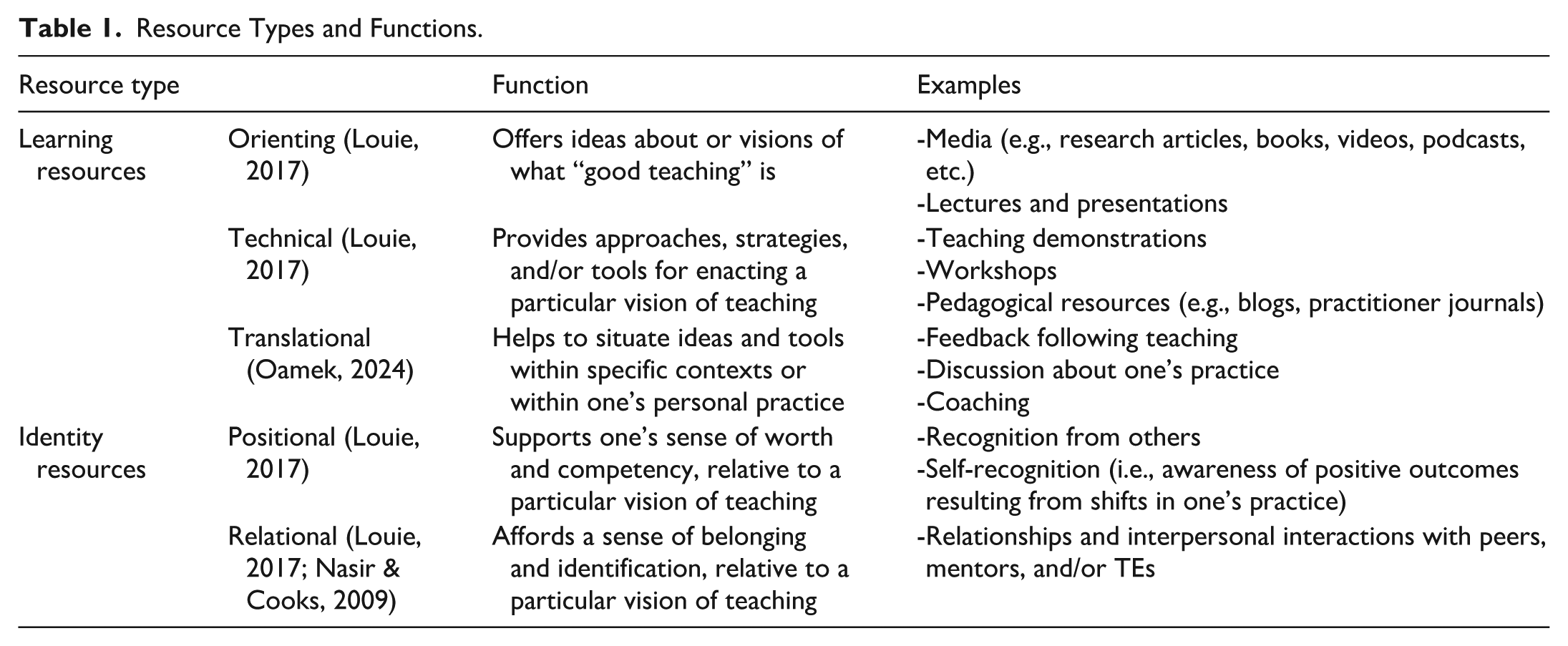
Similarly, I found that when PSTs had access to particular visions of antiracist teaching (i.e., orienting resources) along with tools and strategies for enacting this vision (i.e., technical resources), they began moving along an inbound trajectory of learning relative to antiracist teaching (Oamek, 2024). Their movement in this direction was further enabled by messages of their potential (i.e., positional resources) and interactions affording them a sense of belonging within antiracist practice (i.e., relational resources). At times, however, PSTs found it difficult to translate what they were learning to their early teaching experiences, and they remained uncertain about how and when particular tools and strategies might be useful. In some of these instances, their field supervisors provided additional support that enabled them to begin situating their antiracist knowledge within their practice. Unique from the resource types previously identified in the literature (i.e., orienting, technical, relational, positional), this support was not aimed at providing additional ideas, tools, or even encouragement. Rather, the TEs’ support was aimed specifically at connecting the ideas and tools that PSTs had already been exposed to in their coursework and seminars to specific moments of PSTs’ teaching. These types of support—which I term translational resources—were key to helping PSTs connect their growing antiracist knowledge to their teaching. PSTs with access to these translational resources began to make shifts in their teaching, and as they did, their sense of belonging and identification with antiracist teaching also grew. In the absence of such support, PSTs may remain limited in their ability to act—despite their interest in doing so—and, as a result, move along a more peripheral or outbound trajectory relative to antiracist practice.
Faculty instructors, school-based mentors, and university-based supervisors are all positioned to make a range of learning and identity resources for antiracist practice available to PSTs, and those who directly supervise and mentor PSTs are uniquely positioned to provide translational resources (Oamek, 2024). Such possibilities do exist in empirical accounts: for example, in the ways that PSTs can be supported in reexamining deficit-framings of their students (Philip, 2011) and in recognizing and addressing racial phenomena in their own classrooms (Shah & Coles, 2020). However, such possibilities are not yet the norm within teacher preparation (Maloney et al., 2024), prompting an urgent need to both better understand PSTs’ processes of learning and identity, with respect to antiracist teaching, and leverage these understandings within field supervision contexts.
Literature Review
Central to understanding PSTs’ development as antiracist teachers is identifying the factors that make it difficult for them to translate antiracist knowledge into practice. In the sections that follow, I examine features of teacher education contexts that can impede white PSTs’ movement from awareness to action. I situate these challenges within scholarship on white racial identity development and race-evasion, highlighting how whiteness, fragility, and silence can function to uphold white supremacy and, in turn, constrain PSTs’ engagement with race and limit possibilities for antiracist action. I then consider the role of university field supervisors in PSTs’ learning and draw on the small but growing body of research that examines how TEs attempt to foreground race and equity within their supervision practices. Finally, I address the significant yet underexamined influence of cooperating teachers (CTs) on PSTs’ antiracist learning. Taken together, these strands of scholarship are important for understanding TEs’ supervision practices in relation to PSTs’ trajectories of learning and identity, relative to antiracist teaching.
The Challenge of Antiracist Teaching for White PSTs
Despite the antiracist aims of many teacher preparation programs, PSTs can find it difficult to translate their antiracist knowledge into practice. In many university courses, PSTs have opportunities to learn about race and racism and consider how race and racism operate in schools and society to produce racially inequitable school experiences and outcomes. Yet in the absence of sufficient opportunity to grapple with issues of racism in relation to their own practice, PSTs can learn to avoid—rather than address—issues of race in their field experience classrooms. For example, PSTs have demonstrated discomfort engaging in conversations about race and discrimination in the context of their placement schools (Maloney et al., 2024) and a reluctance to grapple with and confront racial phenomena within their placement classrooms (Behm Cross et al., 2019; Martin-Beltrán et al., 2023).
Such difficulties have been attributed to the tendency of teacher education programs to prioritize helping PSTs understand racism over providing real-time support and guidance in helping PSTs act upon their understandings and begin to practice antiracist teaching. Preparation programs often provide insufficient time for PSTs to work with diverse groups of students, leaving them with little opportunity to develop cultural competence and understand the pedagogical implications of student diversity (Maloney et al., 2024; Martin-Beltrán et al., 2023). In addition, PSTs can encounter competing ideologies between their preparation program and their placement schools, which can limit opportunities for PSTs to translate antiracist knowledge into action. Failure to support PSTs in negotiating these conflicting values and competing visions of “good teaching” can leave PSTs uncertain about how and when to leverage their antiracist knowledge within their developing practice (Williamson & Warrington, 2019).
Studies documenting PSTs’ difficulties with antiracist practice often point to the importance of racial identity development and argue the need for preparation programs to more intentionally support white PSTs’ racial identity development. In the absence of such support, white PSTs have difficulty confronting their own complicity in systemic inequalities (Martin-Beltrán et al., 2023) and struggle to understand how their whiteness shapes their actions, reactions, and decision-making within the classroom (Behm Cross et al., 2019). As a result, white PSTs can demonstrate fragility in moments where their whiteness is implicated and tendencies to blame students and families when they encounter difficulties translating antiracist knowledge into practice. As such, white PSTs need ongoing support for their racial identity development, along with opportunities to grapple with issues of racism within classrooms and support navigating ideological and pedagogical differences across preparation contexts.
White Teacher Identity Development and Race-Evasion
Critical race theorists argue that because racism is “. . . so enmeshed in the fabric of our social order, it appears both normal and natural to people in this culture” (Ladson-Billings, 1998). This means that we can expect teachers in the United States, particularly those who are white, to have been socialized to think about race in uncritical ways and to accept the “normalcy” of racism and white privilege. It is necessary, then, for white teachers to come to recognize themselves as racial beings, become critically conscious of their own positions within a racial hierarchy, and develop positive white racial identities (Milner, 2010).
White racial identity development (Helms, 1990) is understood as a process by which an individual comes to accept their own whiteness, the implications of being white, and a notion of oneself as a racial being that is not predicated on the perceived superiority of one racial group over another. Importantly, white racial identity development is not about forming new ideas about “raced” others; rather, it is a process of forming new ideas about oneself as a white racial being and understanding one’s own relationship to white supremacy (Tatum, 1992). White PSTs must come to understand the implications of their whiteness and their relationship to white supremacy if they are to develop robust antiracist knowledge and effectively translate this knowledge into practice (Maloney et al., 2024).
The process of developing a positive white racial identity is often marked by fragility, which manifests as defensive behaviors such as resistance, withdrawal, silence, and avoidance (Diangelo, 2011). In particular, silence and race-evasion—both in school settings and teacher education contexts—have been documented in the research literature. Scholars have noted the ways in which white PSTs weaponize silence (e.g., Ladson-Billings, 1996), how silence about race serves to protect and further entrench whiteness (e.g., Castagno, 2008), and how race-evasion makes racial hierarchies difficult to disrupt (e.g., Chang-Bacon, 2022). As such, TEs who work directly with PSTs throughout their preparation program (e.g., field supervisors, CTs) must intentionally support white PSTs’ racial identity development, understand the difficulty of this (un)learning, and respond pedagogically to the uncertainties, evasions, and silences that so often characterize this process.
Field Supervision: Roles, Structures, and Limitations
School-based mentors, university-based field supervisors, and faculty instructors all play instrumental roles in helping PSTs connect theory to practice. Recognized as the primary link between the university and preK-12 field sites, university field supervisors also play a crucial role in linking program goals to PSTs’ field experiences (Burns et al., 2016) and supporting program coherence (Richmond et al., 2019). This is of particular importance when PSTs encounter ideological differences between pedagogical approaches foregrounded in their university coursework and those that predominate in their field placement sites (Behm Cross et al., 2019; Hood, 2024).
However, the work of field supervision is often delegated to adjunct instructors and graduate students, who may be former teachers and experienced TEs but may not have the same job security, protections, or resources as tenured faculty. Field supervision has thus garnered less scholarly attention despite its perceived importance (Hood, 2024). Consequently, field supervision remains under-researched and undertheorized (Haberlin & Burns, 2024), especially in relation to antiracism, thus limiting our understandings about the relationship between TEs’ supervision practices and PSTs’ antiracist learning.
Antiracist Supervision: What We Know
While field supervision remains undertheorized in general, a small body of scholarship offers guidance for integrating ideas about culture, race, and equity more fully into PSTs’ fieldwork experiences. This scholarship advances frameworks, practices, and tools intended to support the learning and development of PSTs in this direction (e.g., Jacobs & Casciola, 2016; Lynch, 2018). To locate studies that empirically examined TEs’ supervision practices with respect to antiracism, I conducted a search using terms such as field supervision, coaching, mentoring, teacher preparation, race, antiracism, and social justice. The search produced nine studies published between 2011 and 2025, with most employing self-study methodologies.
Findings of these studies reveal several common themes. The first is that TEs’ supervisory practices (e.g., guided observations, video observations/debriefs) can support PSTs in developing reflective stances (Price-Dennis & Colmenares, 2021), a greater awareness of educational inequities (Dismuke & Snow-Gerono, 2024), and deeper understandings of how race operates in schools and classrooms (Oamek, 2024). However, findings also indicate that supporting PSTs’ movement from awareness to antiracist action is a persistent challenge for field supervisors and is often recognized as a shortcoming of programs with antiracist aims (Maloney et al., 2024).
The difficulty in supporting PSTs’ movement from awareness to action is associated with several factors. Consistent with the broader literature on race and teacher education, persistent silences and race-evasion preclude opportunities for PSTs to grapple with racial phenomena in their placement classrooms and in relation to their teaching (Price-Dennis & Colmenares, 2021; Wetzel et al., 2021). Similarly, ideological and pedagogical differences between university programs and schools add a layer of complexity for TEs to navigate as they attempt to support PSTs in leveraging their antiracist knowledge in their teaching and classroom management (Baker et al., 2022). Movement to action may also be stymied by TEs’ tendencies to celebrate PSTs’ recognitions of injustice but stop short of calling on PSTs to challenge dominant systems and act upon their knowledge and awareness (Dismuke & Snow-Gerono, 2024). Finally, an increase in virtual and hybrid field experiences has presented additional complexity for TEs as well. A study by Dismuke and Snow-Gerono (2024) identified ways that virtual teaching and supervision contexts influence TEs’ supervision practices. The authors found that challenges surrounding online, remote, and hybrid instruction often predominate TEs’ conversations with PSTs. As a result, TEs’ feedback for PSTs is often directed at problem-solving individual episodes of teaching in this format, leaving little opportunity for dialogue with PSTs about larger issues of race and inequity.
This small body of work has also identified opportunities for TEs to better address these challenges. These include building communities of trust with PSTs and providing PSTs with opportunities to engage in low-stakes dialogue prior to engaging them in critical dialogue about their own practices (Domke et al., 2025; Wetzel et al., 2021). PSTs also need space to grapple with the tensions between what they are learning in their university courses and experiencing in placements (Baker et al., 2022) and support from university supervisors to reflect on how their own identities are implicated in these tensions (Domke et al., 2025). Wetzel and colleagues (2021) suggest that TEs be more intentional in their attempts to discuss race with PSTs and move them to action by holding pre-conferences focused on the actions that PSTs are intending to take in their lessons. Finally, Domke and colleagues (2025) argue that TEs themselves must engage in reflective work, noting the potential for autoethnographic study and collaborative reflection to strengthen supervision practices.
The Role of CTs in Antiracist Learning
While not the specific focus of this investigation, it is important to account for the role that CTs play in the learning and development of PSTs. The role of CTs has been theorized and well-documented in the extant literature; however, little research has specifically addressed CTs’ influence on PSTs’ development of antiracist knowledge and skill. Some studies have positioned CTs as obstacles to the antiracist aims of teacher preparation programs, noting that they are sometimes ill-prepared to offer specific knowledge about antiracist teaching and model antiracist practice themselves (Maloney et al., 2024) and, at times, less supportive of pedagogical practices that are seen as a departure from district priorities (Williamson & Warrington, 2019). Such conditions, authors argue, leave little room for PSTs to consider new possibilities for practice and leverage their antiracist knowledge within their practice. Yet other studies highlight the ways that CTs help candidates understand the historical, racial, and sociopolitical factors that shape the local school context and develop teaching practices that are well-suited to these specific contexts and responsive to their students’ needs (Matsko & Hammerness, 2014). Despite the lack of research in this area, it is important and necessary to consider how TEs’ supervision practices intersect with the mentoring of CTs with respect to furthering PSTs’ antiracist learning.
Method
The analysis presented here draws on data that I collected as part of a larger investigation examining PST learning at a large, public university in the Midwestern United States. Overall, the full investigation sought to identify specific learning arrangements that support PSTs in developing the capacity for antiracist teaching. The vignette-based analysis that I present here focuses specifically on how resources for antiracist teaching were made available to PSTs in contexts associated with field supervision and how these resources influenced the learning and development of white PSTs.
Vignette-Based Analysis
In qualitative research, vignettes can function as a methodology (i.e., as a way to collect data and generate participant responses) and as an analytic tool (i.e., as a way of interpreting and theorizing data). In this investigation, I employ vignettes as an analytic tool for capturing and conveying scenes that I encountered in the field, allowing such moments to be represented in a narrative form that is closely tied to participants’ own experiences (Miles, 1990). Drawn from ethnographic field notes, vignettes aim to re‑evoke the thoughts, feelings, and interactions that shape participants’ actions and experiences, thereby illuminating the complexity of such moments and making them available to others for analysis, interpretation, and reflection. As demonstrated by Madkins and McKinney de Royston (2019), vignettes can offer vivid insights into pedagogical practices—in their case, by illuminating the ways a science teacher’s sociopolitical consciousness is enacted in and through his teaching. Vignettes can also reveal the contradictions and negotiations present in everyday moments of teaching. For example, Philip and colleagues (2024) used a vignette to demonstrate how teachers’ decisions and actions in the classroom can conflict with their stated pedagogical commitments. In this way, vignette-based analysis holds potential to deepen our understandings of pedagogy and invite readers to grapple with the tensions and realities that shape educators’ work.
Existing literature clearly documents the challenges of antiracist teacher education and delineates competencies that TEs should possess; however, there is far less understanding of what TEs actually do in real time to support PSTs’ antiracist learning and development. Vignette-based analysis helps to address this gap by capturing and conveying the field-based experiences of TEs and PSTs. As such, I employ a vignette-based analysis in this investigation to provide concrete representations of TEs’ real-time supervision practices, making these experiences visible to others and available for further analysis. I construct vignettes from ethnographic field notes that are thick with description and include participants’ physical reactions, verbal exchanges, and the contextual features that shape these interactions. Doing so invites readers to experience the moment in a way that is closely tied to participants’ own experiences and allows readers to consider phenomenon that might not surface through other methods alone (e.g., interview studies, self-study).
Research Sites and Contexts
The full investigation was conducted within an elementary education degree program with a publicly stated social justice mission. At the time of the study, the degree program used a cohort model, allowing TEs to work with a group of PSTs over a four-semester sequence of fieldwork. The PSTs completed fieldwork requirements in local schools serving racially, linguistically, and socioeconomically diverse communities. These schools were situated throughout Oakdale, a mid-size city grappling with stark racial and economic inequities.
At the start of the full investigation, I purposively selected three cohorts as critical cases due to the TEs’ expressed commitments to antiracism and their intentions to structure weekly seminars around social justice and antiracism. To gain access to these cohorts, I recruited the TEs responsible for teaching weekly seminars and supervising PSTs in their fieldwork experiences. These TEs recommended PSTs for greater participation in the study based on their perceived willingness to engage in meaningful reflection. I recruited approximately one-third of the PSTs in each of the three cohorts as focal participants at the start of their second semester in the program.
Participants
The data I have chosen for this analysis feature two TEs: Rachel and Whitney. Rachel, a white female, had worked in teacher education for several years, having guided multiple cohorts of PSTs through their fieldwork requirements. Her commitment to antiracist teaching was well-developed and steadfast, and in her work with PSTs, she drew upon her prior experiences as an early childhood educator in urban areas of the southwestern and northeastern U.S. In interviews, Rachel expressed intentions for the PSTs’ learning to go beyond neutral and race-evasive exploration of problems in education and toward “honing a critical understanding” of social and educational injustices. In addition, she aimed for PSTs to become skilled in examining dominant narratives and recognizing teachers’ accountability relative to social and educational injustices.
Whitney, also a white female, was new to teacher education, having recently left her position as an early childhood educator to pursue graduate study. In years prior, Whitney had taught in a racially and socioeconomically diverse area of the western U.S., a background she drew upon as she worked with PSTs. Like Rachel, Whitney brought an antiracist lens to her work with PSTs, facilitating seminar discussions aimed at understanding bias and exploring racial dynamics in schools and classrooms. For example, at the start of semester three, Whitney shared an article with PSTs that highlighted racial tensions between white teachers and communities of Color, and while discussing this reading, Whitney encouraged PSTs to consider their own racial identities and how race operates in their placement classrooms.
The data presented here also feature Emily and Sarah, two PSTs who were members of the cohort supervised by Rachel and Whitney. Emily and Sarah both identified as white, monolingual, English-speaking females raised in middle-income homes in small, predominantly white cities. During interviews, they each described having had positive schooling experiences and reported strong desires to become teachers from an early age. Like many of their white peers, Emily and Sarah reported learning little about race prior to their degree program and admitted uncertainty about addressing race in the context of their teaching.
Researcher Positionality
My identities as a former teacher in the Oakdale School District, a former TE in the university’s degree program, and a white educational researcher all play a significant role in this investigation. For more than a decade, I (white, monolingual, middle-class female) taught in racially, linguistically, and socioeconomically diverse U.S. public schools, both on the West Coast and in the Midwest. In the Oakdale School District, I primarily worked as a reading teacher, spending my time with elementary students identified by their classroom teachers as “at-risk” or “struggling.” During my time in schools and classrooms, I witnessed the material consequences of racism and the resulting disparities for multiply minoritized students.
Because I had taught in Oakdale schools and then worked as a methods instructor and a field supervisor within the university’s degree program, I understood a great deal about the contexts in which my participants were learning and working. These understandings often aided my interpretation of the data but also required me to be reflexive about my own experiences, preconceptions, and biases. Like me, the study participants largely reflect the current demographics of TEs and PSTs: white, female, middle-class, and monolingual English-speaking. Our shared social identities may have created a context where participants felt comfortable inviting me into their classrooms and post-observation conferences and speaking about race and racism with me, thereby yielding a rich data set from which to glean insights about PSTs’ antiracist learning and TEs’ practices.
However, contending with white racial knowledge (Leonardo, 2009)—my own and others’—as I interacted with participants, collected and interpreted the data, and developed this manuscript, required me to also remain reflexive about whether and how my analysis responds to the calls for rigorous, race-central analyses in teacher education research (Milner, 2007). I am grateful to the many peers and mentors who generously shared their experiences with racism and their insights on antiracism, helping to deepen my understandings of how race, racism, and white supremacy shape students’ school experiences and outcomes. They (and others) continue to offer support and challenge as I develop the criticality that antiracist work requires and as I grow as a white, antiracist TE and researcher.
Data Collection
Throughout the full 18-month investigation, I observed each of the three cohorts’ weekly seminars and many of the post-lesson conferences facilitated by TEs at PSTs’ field placement sites. During these observations, I attended both broadly to what participants were saying and doing and more specifically to how they were engaging with issues and dilemmas related to race, racism, or antiracist teaching and how they were interacting with one another in these moments, both verbally and nonverbally (e.g., gestures and facial expressions). Following each observation, I produced detailed ethnographic field notes to capture the activity, communication, sensory details, and feeling tones that I had observed and experienced (Emerson et al., 2011).
Over the course of the full investigation, I also conducted four semi-structured interviews with each of the TEs and PSTs, once at the beginning of the study and again at the end of each semester. The interviews with TEs focused on their goals for PSTs, their approaches to leading seminars and conducting observations, and their perspectives on preparing teachers for racially diverse classrooms. Because I had directly observed the TEs’ practices, follow-up interviews became a space for TEs to revisit meaningful exchanges and offer their insights and perspectives on that which I had observed. The same was true for the PSTs: during interviews, they also returned to exchanges that had occurred either in weekly seminars or in their post-lesson conferences and offered their own perspectives. This allowed me to situate member reflection within the data collection process. Throughout the 18-month investigation, I also collected documents, such as PSTs’ lesson plans, lesson reflections, and written assignments associated with seminars.
Data Analysis
The analysis I present here is a secondary, vignette-based analysis using a subset of the data collected in the full investigation. When conducting the initial analysis, I used a constructivist grounded theory approach (Charmaz, 2006) to analyze the full data set. I employed line-by-line coding and in vivo coding, along with iterative rounds of comparison to arrive at a set of focused codes representing the activity occurring within observation contexts and the meanings, feelings, and experiences voiced by participants. I applied these focused codes to the full data set and generated analytic memos exploring relationships between segments of data. Through this process, I identified “translation” as a distinct form of support that enabled PSTs to bring ideas about antiracism to the level of their personal practice (see Oamek, 2024). From here, I raised “translational resources” to a conceptual category and moved analytically toward trying to understand how this form of support both enabled learning and interacted with other types of learning and identity resources already documented in the research literature (i.e., orienting, technical, relational, positional).
To conduct the secondary, vignette-based analysis presented here, I returned to the full data set and identified instances where TEs made translational resources available to PSTs. I selected several of these instances for closer examination, and I leveraged the learning and identity resources framework to code for the types of resources available to PSTs in each instance (i.e., orienting, technical, relational, positional, translational). To understand the significance of the resources available in these moments, their accumulative nature across time and space, and their influence of PSTs’ trajectories of learning, I widened my analysis to also include relevant data collected prior to each moment and following each moment. Doing so allowed me to better understand each moment, connect the presence of resources over time and across contexts (i.e., seminars, post-lesson conferences), and consider whether and how PSTs leveraged these resources in their clinical teaching.
I chose two of these instances to feature as vignettes in this analysis. These moments were chosen for several reasons. First, my field notes and jottings around these two moments were well-suited for the creation of what Graue and Walsh (1998) refer to as “close-to-the-field vignettes.” With each of these moments, I had captured a series of short, direct quotes (e.g., “kids who look like that can’t be from here”), forms of nonverbal communication (e.g., nodding, shrugging), types of activity (e.g., squatting next to, clapping in rhythm), and feeling tones (e.g., a look of unease, nervous laughter) that allowed me to attend to the possible meanings held within these interactions and retell these interactions in a narrative form. Second, both moments were ones that participants returned to and recounted in interviews at the end of the semester, allowing me to add depth and detail to these vignettes. Third, these moments represented the “typical work” of TEs across the three cohorts, with Rachel and Whitney demonstrating antiracist dispositions and actions comparable to the other TEs in the study. Finally, these moments differed in their context—one occurred in a university-based seminar associated with PSTs’ field requirements, and the other occurred in a post-lesson conference in a PST’s field placement classroom. This presented opportunities to consider how translational resources operate within and across different field supervision contexts.
Results
In this section, I present two moments of practice (i.e., vignettes) where translational resources were made available to PSTs. The first moment features Rachel (TE) and Emily (PST). It is drawn from an observation that I conducted in a weekly seminar in March 2020, and it is a moment that Emily returned to in an interview when asked to share how she was making sense of antiracist teaching. The second moment features Whitney (TE) and Sarah (PST). It is drawn from an observation that I conducted in a post-lesson conference at Sarah’s field placement site in February 2021, and it is one that Sarah also revisited in an interview when asked to talk about shifts in her teaching. After unpacking each moment, I highlight the translational resources at work, and I consider the possibilities these moments held for PSTs’ antiracist learning. I draw on interview data and documents to provide additional context and commentary related to these moments and highlight the ways that translational resources interact with other learning and identity resources to support PSTs’ movement toward antiracist practice.
Moment of Practice #1: “I Just Didn’t Know What to Say”
This moment features Rachel, a TE facilitating a weekly seminar for a cohort of PSTs, and Emily, a PST enrolled in this weekly seminar. The PSTs, including Emily, were in the second semester of their program and placed in local elementary classrooms for their second practicum experience. In the seminar prior, Rachel had introduced the topic of microaggressions and had given PSTs a chance to share microaggressions that they had either witnessed or experienced themselves. Together, the group examined the raced, classed, sexed, and gendered nature of these assaults. During this activity, two of Emily’s Asian peers shared specific instances in which they had experienced racial microaggressions. Following these intimate disclosures, Rachel made explicit the messages that these assaults can carry: “You don’t belong. This isn’t for you. You don’t have power here.”
On this day (1 week later), Rachel returned to the topic of microaggressions—this time, explicitly focusing on action PSTs can take to redress harm in classroom settings. She led PSTs through a series of prompts aimed at responding to microaggressions, offering three contexts for them to consider: “How do you respond when you are the person who experienced the microaggression? When you witness a microaggression? When you are responsible for a microaggression?” It was while the group was responding to the second prompt that Emily recounted a situation in her kindergarten placement where a white male student made a statement about a Hmong peer. In the vignette that follows, Rachel provides support aimed at helping Emily move from awareness and recognition toward possibilities for future antiracist action.
Vignette #1: Weekly Seminar
Emily tentatively raises her hand, indicating that she wants to share. Rachel invites her to respond, and Emily explains to the group: “We have a Hmong student in our kindergarten class and he’s in my math group. I was getting ready to start the math lesson when one of the students in my group noticed that the Hmong student was missing and asked where he was.” She continues, “I said that he must be at home today and suggested that maybe he wasn’t feeling well. But then one of my white students said, ‘No, I think he went to China.’” Emily pauses. Rachel scans the room for reactions, a knowing—yet troubled—look on her face. Emily continues, “I told the white student that the Hmong student is from Oakdale—that he was born here, that he lives here.” She adds, “But the student is five, so he just didn’t understand.” Rachel tips her head to the side, nodding slowly and encouraging Emily to continue. Emily continues, “I wanted to explain to the white student that, ‘No, just because he doesn’t look like you, doesn’t mean he’s not from here.’” Emily then admits to the group that she hesitated in the moment and did not know how to respond. A nervous laugh escapes her lips, and she offers, “If anyone has some tips, let me know.” Some join in the uncomfortable laughter; others look expectantly toward Rachel. A red flush rises to Emily’s cheeks, and she adds, “He didn’t know what he was saying, though. I doubt he understood the impact of what he was saying.” She explains, “I was really stressed. I just didn’t know what to say to him.” Rachel looks to Emily and offers, “We can talk more about that in a minute,” motioning with one finger between herself and Emily, indicating that they will connect. A look of relief crosses Emily’s face. She nods at Rachel, exhales audibly, and responds, “Cool.” Rachel then invites the PSTs to talk in their small groups about strategies for responding to microaggressions—the second of the three prompts on the slide. Voices fill the room, and Rachel makes her way to where Emily is sitting with four of her fellow PSTs. She squats next to the table, looks to Emily, and asks, “Do you want to talk more about your situation?” Emily briefly recounts the incident. She explains, “I didn’t know what more to say, other than, ‘He doesn’t look like you, but he was born here, and he lives in Oakdale.’” Emily continues, “It’s not even that the Hmong student speaks another language which would give the white student the impression that he’s from somewhere else.” She adds, “But that’s not okay either.” A short silence follows. Rachel says, “I wonder if the white student knows the word Asian?” Another short silence follows before Rachel continues: “Maybe you could say something like, ‘I wonder if you’re noticing that he’s Asian. Many people who live in Oakdale have Asian heritage and Asian ancestors.’” Emily responds, “I just wasn’t prepared.” A peer to her left chimes in, “But you can’t ever prepare for these moments.” Rachel pauses and then responds, “Sometimes it’s helpful, especially with young children, to follow up with a question. Like, ‘Oh, tell me what you mean?’” She explains, “It’s important to try to get an understanding of what he just said. He may have meant that kids who look like that can’t be from here.” She adds, “In any case, the child’s current understanding is a good place to start.” Emily responds, “I didn’t think to ask, ‘Oh, why would you say that?’” She explains, “I was just, like shocked, I guess.” Rachel nods and adds, “Getting at the layers of understanding that the child is bringing to the moment is really important.” Emily nods in agreement. Rachel looks to the clock and rises from her position next to the table. She claps in rhythm, and the PSTs clap in response. When the room grows quiet, Rachel thanks them for their engagement with the topic and expresses a desire to continue these discussions next week.
Unpacking the Moment
Based on Emily’s contribution to the seminar discussion, she seems to have engaged with the antiracist understandings offered by Rachel the week prior (i.e., orienting resources) and then leveraged these understandings toward noticing racial phenomena (Shah & Coles, 2020) in her kindergarten placement classroom. She recognized the racial narrative present in the white kindergartener’s statement and likened it to the types of racial microaggressions they had analyzed the week prior. However, Emily remained uncertain as to whether it counted as such due to the child’s age and his presumed inability to recognize the impact of his words. She appeared to vacillate between wanting to address the “everyday racism” (Kohli et al., 2017) present in the child’s statement and wanting to excuse the child’s words as an innocent assumption.
When Rachel joined Emily’s small group, she offered Emily additional time to talk about the situation. Here, Emily considered factors that might prompt a child to assume that a peer “is not from here.” She considered how both appearance and language might factor into a child’s assumptions, seemingly arriving at the conclusion that assumptions based on either are inexcusable. When Rachel entered the discussion, she offered a simple wondering about what the white child knows about race (i.e., “I wonder if the white student knows the word Asian?”). She then modeled a curiosity (i.e., “Oh, tell me what you mean?”) toward understanding how young children are making sense of racial difference and belonging. She suggested language that Emily might use to get at the “layers of understanding” that children bring with them to classroom interactions and relationships. When Emily’s peer suggested that it is impossible to prepare for such situations, Rachel did not provide a direct counter. Instead, she offered Emily and her peers one way of responding when discourses that uphold white supremacy surface in young children’s everyday classroom interactions. Her suggestion—to get at the layers of understanding that the child brings—seems developmentally appropriate; it acknowledges that even young children bring understandings about race into classrooms, and it creates space for a teacher to gently, but directly, address a child’s misconceptions and potentially challenge the supremacist discourses that shape such misconceptions.
Translational Resources at Work
As noted above, during the seminar the week prior, Emily’s peers had opportunities to share microaggressions that they had witnessed or experienced themselves. Yet, Emily remained uncertain about how to address such instances of everyday racism—and specifically, how to address it with young children. Here, Rachel’s support served as a translational resource for Emily, helping her situate larger ideas about antiracism (i.e., protecting children from racial harm, disrupting racial narratives and xenophobia) within her personal practice and current teaching context. Responding to discourses that uphold white supremacy in any educational context is challenging work, and certainly, responding to racial narratives in a kindergarten classroom requires a level of care, intentionality, and adroitness that does not come without thoughtful preparation. To this point, Rachel refused the notion that one simply cannot prepare for such moments in their practice, and she offered Emily a meaningful and contextualized approach to addressing racial narratives that is developmentally appropriate for young children. Emily’s reaction (e.g., “I didn’t think to ask”) suggests that Rachel’s offering seemed like a reasonable approach—a way of positioning herself and the child that she had not previously considered. In this way, Rachel’s timely support played a role in helping Emily situate her growing antiracist knowledge within her current teaching context and consider new possibilities for dismantling white supremacy in her personal practice.
In an interview at the end of the semester, I invited Emily to share how she was making sense of antiracist teaching. Emily immediately returned to the moment featured here. She recounted the moment again for me and then expressed doubt whether she would have noticed the microaggression in her placement classroom without having had the earlier seminar discussions about microaggressions. She admitted that even if she had noticed it, she would have likely “just let it go” because she would have assumed that the child “didn’t mean it.” She then expressed gratitude that she had been able to think through this moment with others. She explained, Having that space—, being able to talk and get—, like, knowing how to address that. Because he didn’t know it was wrong. Like, he didn’t know what he was saying was bad. And so, there’s no reason to punish him or get upset. It was a teaching moment. (Interview 2, 5/19/20)
What Emily has taken from this moment is that there is opportunity for her—even as a clinical student in a kindergarten classroom—to respond to “everyday racism” (Kohli et al., 2017) in ways that hold potential to move young children toward new understandings about race and racial difference. Without Rachel’s support, it seems unlikely that Emily would have come to see such instances as “teaching moments,” let alone begin to consider new possibilities for her own practice. Whether she can notice and effectively respond to other forms of racism (whether presently or in the future) is beyond the scope of this investigation. However, Rachel’s support seems to serve as a powerful connector, helping Emily situate her growing antiracist knowledge within her current teaching context and potentially increasing her capacity for antiracist action in the future. Yet, without continued access to translational resources for antiracist practice (e.g., feedback, coaching, demonstration), it is unlikely that Emily’s current desires and tentative actions will result in the kind of sustained antiracist action needed to decenter white racial knowledge in classrooms and dismantle white supremacy in educational practice (Dei, 2001; Leonardo, 2009).
Moment of Practice #2: “Falling Into Social Patterns”
This moment features Whitney (TE) facilitating a post-lesson conference with Sarah (PST) and Sarah’s CT. Sarah was in her final semester of the program and completing her student teaching in a predominantly white kindergarten classroom. A small number of low-income students (many identifying as students of Color and/or multilingual students) were bussed to Sarah’s placement school as part of a long-standing desegregation arrangement in the Oakdale school district.
During a seminar the semester prior, Sarah and her peers had discussed white supremacy and considered the ways that normative whiteness shapes teachers’ interactions with and responses to their students. They problematized this in relation to a lesson that Rachel (Whitney’s co-facilitator) and some of the PSTs had recently observed in an Oakdale classroom. In this lesson, the teacher structured participation in a way that seemed to center the white, monolingual English-speaking students and marginalize the linguistically diverse students in the classroom. For Sarah and her peers, such discussions offered a vision of antiracist teaching (i.e., an orienting resource) that rejects normative whiteness and creates space for all students’ voices to be heard, their contributions valued, and their capabilities recognized.
Sarah approached her student teaching placement as an opportunity to put this growing antiracist knowledge into practice, and she regularly sought feedback from Whitney, one of the university-based supervisors who had been working with Sarah’s cohort from the beginning. Prior to teaching a virtual lesson, Sarah asked Whitney to attend to her language use and interactions with students. In her lesson plan, she expressed a desire “to make sure everyone’s voice is heard,” and she asked Whitney to observe for moments when she might be inadvertently giving more attention to students who contribute in normative ways (i.e., “raising hands,” “voluntarily coming off mute”). The following vignette captures both the content and tenor of Sarah’s post-lesson conference and features Whitney drawing Sarah’s attention to a moment where she showed disproportionate pleasure to one student as compared to others.
Vignette #2: Post-Lesson Conference
Whitney greets Sarah and her CT and thanks them for taking the time to meet and discuss Sarah’s lesson. After pleasantries are exchanged, Whitney turns to Sarah and asks, “How do you think it went?” Sarah responds, “Ughh, it felt kinda rushed. But overall, I think it went really well.” She adds, “I’m glad students had a chance to share and learn more about each other.” Whitney nods, responding, “You also did a great job bringing literacy into the lesson. Like how you introduced the new word ‘play.’ And how you reviewed the sight words ‘like’ and ‘to’.” Sarah responds, “I wanted to provide challenge and support during the writing portion. That’s why I gave students two sentence starters to choose from—one using ‘play’ and one using sight words they are more familiar with.” Whitney responds, “Yeah, from what I could tell, all of your students were able to write a sentence about themselves and share it with the group.” Whitney then turns to Sarah’s CT and asks, “What did you think? Do you have feedback for Sarah?” Sarah’s CT commends Sarah for situating the lesson within students’ prior knowledge and creating a community-building experience for students. She says, “We’ve done things like this a couple of times, but they definitely need more of it.” She adds, “You explained new vocabulary words while you were reading aloud, and you gave students a chance to share their ideas with the whole group before having them write in their small groups. That’s so important.” Whitney adds, “Yeah, you did a nice job engaging students and modeling your thinking.” Sarah nods, seemingly satisfied with her efforts. Whitney then casts a quick glance at her notes and says to Sarah, “But there are a couple of things I want you think more about.” Sarah nods, waiting for Whitney to continue. Whitney asks Sarah if she recalls a point during the small group portion of the lesson where one student combined multiple sentence frames (e.g., I like . . ., I play with . . ., etc.) to write a sentence of greater complexity. Sarah smiles and nods. Whitney says, “You got very excited. You were like, ‘Claire, oh my gosh, that’s great!’” She adds, “You just seemed more pleased with Claire’s work.” Sarah nods again, her expression shifting from satisfaction to unease. Whitney adds, “And I was just wondering—, I’d like you to think about how you can show excitement and encouragement to all students, no matter—.” Whitney falters briefly before continuing, “. . . because I think one student just wrote, ‘I like Legos.’ And I think you were pleased that they were writing something, but when Claire went above and beyond, you showed more excitement.” She adds, “Just being aware that if you show more pleasure or approval to one student, you could be alienating other students.” Sarah nods slowly. Whitney adds, “So just being more aware of how you are responding to students.” Serious in tone, Sarah responds, “For sure, yeah. I can see that.” Whitney then turns attention to Sarah’s attempts to incorporate the “Learning for Justice” standards into her lesson, and the three begin to discuss how Sarah’s lesson supported the teaching of these standards.
Unpacking the Moment
In this instance, Whitney carefully observed Sarah’s interactions with her students and then called attention to an exchange where Sarah had valued one white student’s contribution over those of the other students in the racially and linguistically diverse small group. Doing so provided an opportunity for Whitney to connect a larger idea about racism (i.e., marginalization) to a specific moment of Sarah’s teaching. She supported Sarah in understanding how a teacher’s language and interactions with students can be marginalizing despite their aims to be inclusive. Sarah appeared to immediately understand what Whitney was getting at, and in a follow-up interview, Sarah reflected on this moment. She expressed gratitude that Whitney had noticed her “falling into social patterns” and explained that this exchange had prompted her to seek additional feedback from Whitney in future observations related to how she was responding to students. Whitney, it seems, had helped Sarah recognize the “normalcy” of racism (Ladson-Billings, 1998) in her teaching and supported her in acting to disrupt these “social patterns.”
In advance of her next lesson, Sarah asked Whitney to again provide feedback related to her “attention to each student.” She explained in her lesson planning commentary, “I want to make every student feel valued and heard and smart.” When asked to elaborate on her personal goals for the lesson, she wrote: My goal for this lesson is to acknowledge what every student has to bring and offer. I want to ensure that I am not dismissive to any student, even if they do not accomplish what I intend for this lesson. I also want to be adaptive. With social-emotional learning, things may come up that I didn’t plan for, but I want to incorporate what the students bring into the lesson. (Sarah, Lesson Plan, 3/1/21)
While Sarah does not talk specifically about race in her lesson planning commentary, we can understand the racialized nature of her classroom, where white, middle-class kindergarteners might bring with them ways of participating that are culturally congruent (Milner, 2010) with the expectations of their white teachers and, as a result, be treated as more “engaged” or “capable” than their peers who are bussed in from an economically disadvantaged area of Oakdale. Sarah’s desire to “acknowledge what every student has to bring and offer” and not be “dismissive to any student” can be understood as a desire to resist subconscious preferences for the ways of knowing, being, and performing that white, middle-class kindergarteners might bring to her classroom—the issue the group had discussed in a seminar the semester prior. Importantly, Sarah desired to be held accountable for resisting these tendencies, and she was willing to request continued support from Whitney to keep her accountable to these intentions. In the post-lesson conference that followed Sarah’s next observed lesson, Whitney drew Sarah’s attention to another moment—a moment where one of her students likely felt as she intended (i.e., “valued and heard and smart”)—and Whitney affirmed Sarah’s role in making this happen.
Translational Resources at Work
Based on Sarah’s goals for her teaching, she seems to have taken up the orienting resources available to her and was aiming to resist marginalization in her own teaching. Yet, as knowledgeable as Sarah had become and as committed to antiracist teaching as she claimed to be, she still needed additional layers of support (i.e., translational resources) to help her situate this knowledge within her personal practice and current teaching context. In this instance, Whitney was able to connect the concept of marginalization—a phenomenon that Sarah was aware of—to a specific moment of her teaching, helping Sarah recognize how her interactions with students can uphold white supremacy, despite her aims to be inclusive and value what all students are bringing. In addition, Whitney’s translational support yielded Sarah access to additional resources in the days and weeks to come—specifically messages of her worth and potential (i.e., positional resources) as she worked to alter her teaching to align more closely with her antiracist intentions and goals.
However powerful Whitney’s support was, we must also acknowledge the silence around race during Sarah’s post-lesson conference and in her lesson planning commentary. Despite in-depth discussion of race, racism, and white supremacy being common in the university seminar, Sarah and Whitney both remained silent about race in the presence of Sarah’s CT, and Sarah omitted any specific mention of race in her lesson planning commentary. Sarah seemed to understand Whitney’s feedback as antiracist; yet, staying silent on race works against antiracism by further normalizing such silences, protecting white supremacy, and ultimately limiting the learning and development of PSTs (Wetzel et al., 2021).
Discussion and Implications
In the foregoing analysis, I presented two moments where translational resources for antiracist practice were available to white PSTs. Both moments helped the PSTs situate their understandings of racism within their everyday decisions and actions in the classroom, and each held potential to increase their capacity to recognize and redress “everyday racism” (Kohli et al., 2017) in classrooms. These moments did not occur in a vacuum—they were both shaped and enabled by the availability and uptake of many other learning and identity resources (Louie, 2017; Oamek, 2024) available to Emily and Sarah throughout their time in the program. From the very beginning, identity resources (i.e., relational, positional; see Table 1) were readily available to them, offering each a sense of belonging and competency within antiracist practice, despite their missteps and uncertainties (see Oamek, 2024). As Louie (2017) has noted, these identity resources serve as powerful vehicles for additional learning resources. To this point, early messages of their worth and potential as antiracist teachers likely buoyed Emily’s and Sarah’s sense of belonging within antiracist practice, enabling their continued engagement with specific orienting and technical resources and creating contexts where translational resources (i.e., support in addressing racism) could assist them in moving from awareness to action. In turn, their active engagement with these translational resources then afforded Emily and Sarah access to additional positional resources (i.e., messages of their worth and competence), further buoying their commitments to antiracism (see Figure 1). In this way, learning and identity resources work to enable each other, steadily accumulating to move one’s learning, identity, and practice further along an inbound trajectory (Oamek, 2024).
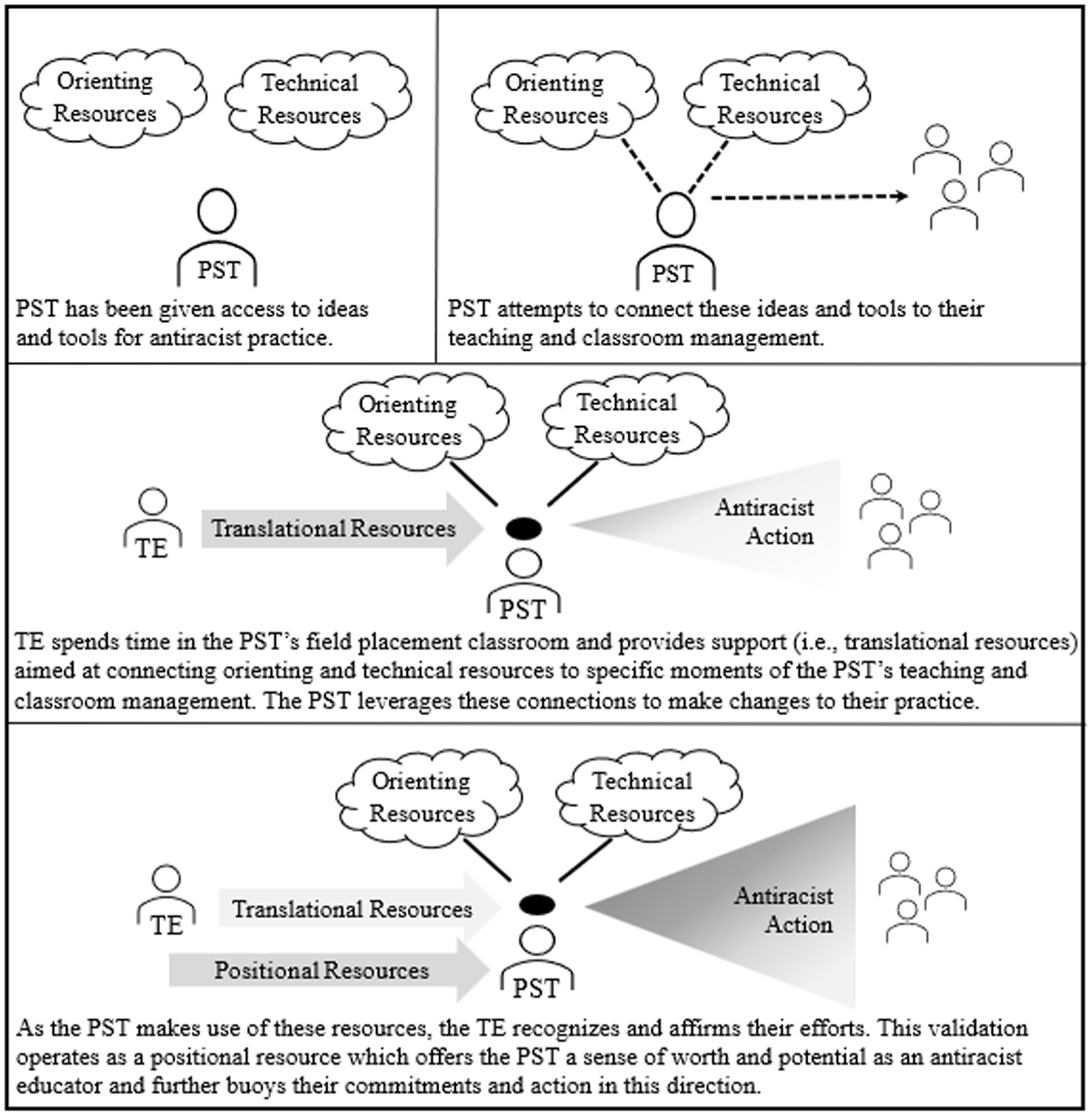
The role of translational resources.
These findings highlight the potential for TEs’ field supervision practices to deepen and accelerate PSTs’ antiracist learning, and they have implications for teacher education. Those who design and direct programs of teacher education should recognize field experiences and their associated seminars as powerful sites of learning and allocate resources accordingly. Quite often, PSTs are supervised by someone previously unknown to them (e.g., a graduate student needing funding, a retired teacher on a limited-term appointment)—someone who might know very little about PSTs’ prior learning and has little chance of helping them connect their growing antiracist knowledge to their early teaching experiences. Such arrangements are commonplace and accepted as the norm, due to well-established funding structures and hierarchies in academia that position clinical work as inferior to teaching and research. However, such arrangements are more likely to perpetuate the status quo than they are to move PSTs closer to antiracist practice. Rather than delegating supervision, programs must ensure that knowledgeable supervisors are both integral to the program and a consistent presence throughout PSTs’ field experiences. Doing so increases the likelihood that supervisors will establish communities of trust with PSTs (Domke et al., 2025) and create space for PSTs to grapple with the everyday racism and the discourses that uphold white supremacy in their placement classrooms and in relation to their teaching (Wetzel et al., 2021). Without intentionality in design, PSTs may express burgeoning commitments to antiracism but fall short of decentering white racial knowledge in their teaching and dismantling white supremacy in their everyday decisions and actions (Behm Cross et al., 2019; Kendi, 2019; Leonardo, 2009).
These findings also have implications for TEs’ supervision practices. As demonstrated in the analysis, the resources that PSTs engage with matter. Orienting resources—like those that helped Sarah and Emily understand antiracist teaching as teaching that dismantles white supremacy in policy and practice (Leonardo, 2009)—are necessary yet insufficient for moving PSTs from places of awareness and recognition to sustained antiracist action. TEs must explicitly bridge coursework to specific moments of classroom instruction and support PSTs in connecting antiracist knowledge with classroom practice. As such, TEs must be directly involved in PSTs’ field experiences, both inviting field-based dilemmas into their weekly seminars and conducting guided observations in preK-12 classrooms alongside the PSTs they supervise (Price-Dennis & Colmenares, 2021). In addition, TEs must nurture a culture of noticing, questioning, and vulnerability, as Rachel and Whitney did for Emily and Sarah. If not for this, Emily may not have admitted her uncertainties to the group, and Sarah may not have requested critical feedback from Whitney—conditions that ultimately enabled their access to translational resources. Perhaps most importantly, TE must refuse any notions that educators cannot prepare to address classroom discourses that uphold white supremacy, and like Rachel, they must equip themselves with the knowledge and tools to respond to such moments themselves. This means that TEs must commit to disrupting silences about race (Wetzel et al., 2021) and be willing to critically interrogate their own practices (Domke et al., 2025; Turner et al., 2024).
Of course, there are ever-present challenges in this work. As shown in the analysis, Rachel created a community in which Emily’s Asian peers were willing to share their everyday experiences of racism, and doing so had a profound impact on Emily’s antiracist learning. Yet TEs must remain cautious about how racially marginalized students are positioned in the service of this learning and seek alternative ways to make such learning available. Like Rachel, TEs who spend time in field placement classrooms can observe for instances of “everyday racism” to bring back to their seminars as general cases for PSTs to grapple with and rehearse responses to. Likewise, TEs can make use of published cases and vignettes that highlight manifestations of racism in schools and classrooms, draw PSTs’ attention to such phenomena within their placement schools and classrooms, and demonstrate approaches that PSTs might themselves use to resist and redress everyday racism in their own practice (Kohli et al., 2017).
TEs, depending on geographic region, are also under increased scrutiny and subject to politically motivated divisive concepts and laws. Such conditions require TEs to move carefully within their teaching contexts but not lose sight of the fundamental responsibility of educators. Pollock (2019) reminds us that protecting students from harm and ensuring their right to learn is not partisan; it is the basic work of education, a fundamental responsibility of educators, and well-established in our civil rights laws. TEs cannot turn away from this responsibility themselves; instead, we must find space within and among these contradictions to help PSTs understand their fundamental responsibilities as educators and nurture their continued movement toward antiracist practice.
Limitations
Although this study provides rich insights into how field supervision can support white PSTs’ movement toward antiracist practice, several limitations should be noted. This study drew on a small sample of white PSTs from one teacher education program, limiting the transferability of the results to broader or more diverse PST populations. In addition, my insider positionality may have shaped participants’ responses as well as my own interpretation of the data, despite my efforts to engage in reflexivity and mitigate bias. Finally, while some white PSTs in the study demonstrated shifts in awareness and action during the study period, the study design does not allow me to confirm whether these observed shifts led to sustained antiracist practice.
Future Studies
Future research is needed to trace how translational resources are made available and taken up both over time and across diverse teacher education contexts. Longitudinal studies would help determine whether such resources support PSTs in translating their antiracist knowledge into practice as they move throughout their preparation programs and into their early years of teaching. In addition, future investigations should examine how translational resources are made available to PSTs of Color and investigate whether the effects of translational resources differ for PSTs of Color. In addition, future studies might explore how structures for online or hybrid supervision alter the availability and uptake of translational resources. Together, these future endeavors might deepen our understanding of how translational resources function across contexts and over time, and how they might more effectively support and sustain PSTs’ movement toward antiracist practice.
Conclusion
This investigation examined how white PSTs are supported in translating antiracist knowledge into practice through TEs’ field supervision practices. Grounded in a conceptual framework that attends to everyday racism (Kohli et al., 2017) and processes of learning and identity (Louie, 2017; Oamek, 2024), I used vignette-based analysis to demonstrate how translational resources function within moments of TE practice. The findings demonstrate that while orienting, technical, relational, and positional resources are necessary for PSTs’ antiracist learning, on their own, they are insufficient to move PSTs from awareness to action. Rather, it is through translational resources—those that explicitly connect ideas about race and racism to PSTs’ immediate teaching contexts—that white PSTs begin to situate their growing antiracist knowledge within their everyday decisions and actions in the classroom. The vignettes of Emily and Sarah illustrate how such resources can support white PSTs in recognizing and responding to everyday racism and, in doing so, move along an inbound trajectory of learning and identity relative to antiracist teaching.
At the same time, this investigation highlights both the promise and complexity of this work. Translational resources do not operate in isolation. Rather, they are made possible through the accumulation and interaction of other learning and identity resources across time and contexts. Moreover, their effectiveness depends on TEs’ willingness and ability to disrupt persistent silences, engage explicitly with race, and position field supervision as a central site of antiracist learning. As teacher education programs strive to prepare educators capable of dismantling white supremacy in educational policy and practice, this study underscores the importance of equipping TEs with the knowledge, skills, and resources needed to enact pedagogies of translation in their supervision practices. Doing so holds potential for both supporting PSTs’ immediate instructional decisions and for sustaining their investments in antiracist practice.
Footnotes

Funding
The author received no financial support for the research, authorship, and/or publication of this article.
Declaration of Conflicting Interests
The author declared no potential conflicts of interest with respect to the research, authorship, and/or publication of this article.