







Abstract
This paper proposes some anthropological notes on aviation and national imaginaries, taking Varig, an important Brazilian airline with international projection and recognition, as a starting point. The analysis is based on an explorative perspective, which included fieldwork among Varig’s former employees, especially female flight attendants who joined the carrier in the 1970s and 1980s and remained until the closure of its activities. Alongside the testimonies of these employees, it analyses magazine and television advertisements from Varig and other Brazilian airlines, in order to throw some light on the pertinence of gender, class and race as social markers that structured the aviation field in the second half of the twentieth century. Through a critical perspective, this work launches heterodox interpretative challenges on the nation-building process, hoping thus to contribute to a better understanding of the political and ideological games that characterised the formation of the nation.
Introduction
This paper speaks of an era of Brazilian commercial aviation that no longer exists. Varig, the main airline analysed, closed due to bankruptcy. Panair, Cruzeiro do Sul, Vasp and Transbrasil, other airlines mentioned in the text, are also defunct. However, that era is ardently present in the testimonies and memories of former Varig employees that today live in the city of Rio de Janeiro, one of the main hubs of the carrier. In spite of migrations and deaths, they are still many, as it is possible to verify in the meetings and protests that still take place to claim the labour and retirement rights neglected as a result of the bankruptcy of the company, in August 2006 – they often talk about eleven thousand labour lawsuits waiting for a favourable decision of the court. But it is not of this tragedy that I will talk about in this paper, but of the “good times”, a contrast often mentioned by these workers as if their life was split in half. “There is a before and after Varig”, they usually say. And it is about that “before” that I will concentrate on these lines, always taking as reference the point of view of the protagonists of that drama. 1
This analysis is based on an exploratory research, carried out from an anthropological perspective, which included fieldwork among former Varig employees affected by the bankruptcy, especially female flight attendants that were still “flying” when the company ceased its activities. They are today between 55 and 65 years old (having entered aviation in the 1970s and 1980s), some of them are retired and few still work on newer Brazilian airlines. Throughout 2015 and 2016 I conducted more than 20 in-depth interviews, some carried out in more than one session, as well as an ethnography of the current sociabilities of these former colleagues, in meetings, parties and protests.
From this material, I recover in the present text some dimensions about the strategies of the airline as a social actor with a relevant role in the nation-building process. The historical perspective will be deepened with the analysis of specialists in the field of sociology of organisations and historians of Brazilian commercial aviation. 2 In addition to the testimonies, I incorporate magazine and television advertisements of Varig and other Brazilian airlines from the 1960s, 1970s and 1980s. This empirical information grounds observations about the pertinence of gender, class and race as social differences markers that structured the commercial aviation champions in the second half of the twentieth century. Far from limiting itself to a circumscribed exercise of Brazilian aviation history, through a critical perspective this work seeks to launch heterodox interpretative challenges on the nation-building 3 process, hoping thus to contribute to a better understanding of the political and ideological games that characterised the formation of the nation.
The first Brazilian airline
Remembered as the first Brazilian airline, Varig SA – Empresa de Viação Aérea Rio-Grandense – was founded by the German immigrant Otto Ernst Meyer, being officially registered as a private company on 7 May 1927. In a similar way throughout the region, these first commercial impulses were influenced by the between the interwar context, when aviation could be considered an open field of struggle between nations that had technology, such as Germany, the United States and France. 4 Otto Meyer had been mobilising political and economic support since 1925, winning the encouragement of the government of Rio Grande do Sul and counting on the participation of the German group Condor Syndikat, in addition to the support of industrialists and traders, many of Germanic origin like him.
This situation was stirred during the Second World War, when the position of the Brazilian government in favour of the Allies gave rise to an anti-German sentiment. The Condor Syndikat was nationalised, having its name changed to Cruzeiro do Sul, and its German directors were replaced by Brazilians. Likewise, in Varig, Otto Meyer retired from the presidency giving way to Ruben Martin Berta. Berta was then responsible for the creation of the Varig’s Employees Foundation, renamed Ruben Berta Foundation after his dead.
Taking advantage of the opportunities created by the expansion of Brazilian aviation after WW2, with the creation of agencies, regulations and airports, Varig began its expansion to the north and northeast of Brazil. Shortly after, the carrier managed to negotiate, with the federal government, a route to New York (inaugurated in 1955), which allowed it to ascend to the group of large national companies. Monteiro quotes the testimony of the Aeronautics minister in the second Getúlio Vargas government, Brigadier Nero Moura, as evidence of the benefit that Ruben Berta obtained from being a contributor to the Vargas campaign to get the route: the episode of the concession of this route would again be emblematic of the centrality of the strategy of approximation with the government, and how much investment in this political game would be decisive so that the gaucho company would occupy a prominent place in the scenario of aviation commercial.
5
Still in 1960 Varig was not dominant: Real Aerovias held 27 per cent of Brazilian market and Varig 23 per cent, followed by Panair 17 per cent and the Cruzeiro/TAC/SAVAG consortium with a 14 per cent (Vasp and Loid 8 per cent each; and 3 per cent adding up the other companies). 6 However, in 1961, Varig gained a new boost with the acquisition of the consortium Real Aerovias, which allowed the company to expand to several important routes, such as Los Angeles and Japan.
Discussion about the regulation of the sector started during the two first Brazilian Civil Aviation National Conferences (CONACs), which took place in 1961 and 1963. Representatives of the airlines, the Civil Aviation Department, and economic authorities participated in these meetings, which helped strengthen the ties between business leaders and aeronautical authorities. The milestone for the consolidation of this pattern was the military coup of 1964, when a restrictive regulatory model started being adopted as a response to the crisis that had been affecting air transport since the end of the 1950s. 7
The next year, the military government suspended Panair concessions – in unclear and controversial conditions to this day – and its routes were distributed to Varig and Cruzeiro do Sul, marking the beginning of Varig’s activities in Europe. 8 Three years later, in 1968, during the third CONAC meeting, two important regulatory principles were established. The first was the “fare realism”, that is users of the service were supposed to cover all the costs of the air transport service, putting an end on the state subsidies. The second was “controlled competition”, aiming to reduce excessive costs, generated by the duplication of routes by different companies, and thus predatory competition.
It was in that context that Varig inaugurated the flights to Japan, on 26 June 1968, with the Boeing 707-341C PP-VJS. Leaving Rio de Janeiro, the first transpacific stretch made a technical stopover in Honolulu heading west, returning nonstop due to prevailing favourable winds. In organising also tailored flight for the political elite, Varig built its trajectory, from a small company to a market leader, 9 through strategies of partnership with the government.
Ruben Berta, counting on the esteem of his employees due to his unconditional dedication to the company, had also the ability to build important links with Getulio Vargas and later with the military governments. In that way, throughout those years, Varig sought to build an image of “company at service” of the country, articulating especially to the development model of “Great Brazil” of the military governments. 10
The advertisements of that time illustrate the carrier’s effort to identify itself with the impulses for the integration of the national territory, the modernisation and development of the country, as a genuine server of the nation. The running of the route to New York in 1955, followed by the international expansion to America, Europe, Africa and Asia, was explored ichnographically in order to identify Varig as a fundamental agent of this progress. “Linking Brazil to the Lebanese capital, Varig opens its international travellers to the Middle East” is part of the text that accompanies a 1966 advertisement published in the magazine O Cruzeiro, promoting a new “vibrant destination of economic life and business activities” (see Figure 1). Frankfurt, Paris, Rome, London, Lisbon, Madrid, Milan, Tokyo, Beirut, and later also Johannesburg, Hong Kong, Bangkok, Toronto, Chicago, Atlanta: the airline’s map expanded around the world until the late 1980s. Terms such as “development” and “progress”, key to the design of Brazilian economic policy in this decade, appear in several of the advertisements for these flights. Japan’s own capital was promoted as the ideal destination for business, cultural and commercial exchange in a 1968 advertisement in the same magazine. The phrase “Varig opens a new horizon for Brazilian development. The sun-rising horizon. The progress of the country has called for this initiative and Varig assumes the undertaking to once again serve the nation” accompanies the circular cut-out of the image of a Buddha in the centre of a red frame, as observed in Figure 2.
“Beirute”. “Tóquio”.

In the following years, the leadership of Varig in the international segment was reproduced in the domestic scenario, reaching increasing share of the market. With the incorporation of Cruzeiro do Sul in the mid-1970s, its share reached 50 per cent of the domestic market, a position that would remain until the early 1990s. Just as the promotion of commercial and tourist activities around the world was displayed as a symbol of the development of the country, in the national route advertisements the diversity of colours, aromas and flavours was highlighted to emphasise the integrating role of a large airline in the country. “Go with Varig. It goes to 64 cities in Brazil with the best on-board service”: we can see how the penetration of the carrier in the immense national territory was promoted with the same quality standards for international flights (Figure 3).
Brazilian flavours.
Varig offered a “service of excellence” as it was clear to users and attendants, to whom we will turn our attention in the following section. Women who worked as flight attendants in Cruzeiro do Sul and were absorbed by Varig in the mid-1970s often mention this during our interviews. The change of company was seen as an opportunity to overcome Cruzeiro’s “growth limitations”, which was limited to cover South America and the Caribbean. In Varig, the possibilities of promotions and the quality of training were proportional to the exigent standards of the passengers, as Ellen
11
puts it: Varig was famous for offering an excellent service, you know? Varig’s own advertisings emphasized this. So, the passenger, when he arrived on board, he expected all this too, you know. Even because Varig sold its service as a differential compared to other airlines: the excellence in service. (Ellen, 57 years old, flight attendant at Varig between 1981 and 2006)
This “differential” appears in most of the advertisements as the trademark of Varig’s flights inside and outside the country and throughout its history, even when the transformations of the commercial aviation market forced it to orient the competition in other directions (as punctuality, ticket prices or safety). “Sophistication”, “excellence”, “glamour” and “luxury” function as indexers of the social class markers that structured that commercial space for this Brazilian airline, as another advertisement from 1966 makes clear, promoting the flights to Rome, with images of some of the buildings and squares of the city, with the message “during the flight, those delicious drinks, those menus of high category, prepared with the Varig class for those who enjoy traveling well”. 12
Notes for an intersectional perspective in Brazilian commercial aviation
Although the feminisation of the cabin crew, centred on performing a commercialised version of the caring and service activities carried out in the domestic sphere, has been widely documented, 13 a critical analysis of the racial and class contours of that process remains as a pending matter. Regarding airline advertisements between 1930 and 1980 in the United States, Lyth 14 explains that by the end of WW2, airline managements gave way to the more prosaic issues of running a service industry: the emphasis in airline advertising shifted from the speed, size and range of airliners to the comfort of the passenger cabin and the price of the ticket. In that period, the almost absolute feminisation of the airline cabin staff profession laid, at large part, in the recognition by the airlines that women were simply better than men at performing the new “hostess” role. 15 For airline marketing departments, the ability of those women to be constantly smiling and pleasant in her demeanour, what Hochschild named “emotional labour”, was to prove invaluable as the defining quality of the stewardesses as they moved from the “cabin pacifier” to the service industry professional roll. Thus, they were constantly showed in airline publicity, consolidating a distinct image which was no longer merely a representative of the airline but an exact reflection of all those attributes that the airline liked to think of itself.
In Brazil, images of exotic but modern landscapes, with an exuberant nature and a captivating culture, permeate the advertisements of the airlines of the time. At the rhythm of a bossa nova or samba, these commercials made crystal clear social markers of difference – race, ethnicity, class, gender and sexuality – that used to structure this social space, at least until the late 1990s. A clear sexual division is overall observed in most of them: the pilots are always men and the stewardesses female; passengers with an “executive look” are also men, while the female passengers are usually in the company of children; the care of the flight attendants with makeup and the uniform is more emphasised than their safety functions, which are practically absent from any publicity.
We can take as an example a 1976 Viação Aérea São Paulo S/A or VASP 16 television advertisement, awarded the Grand Prix of the Brazilian Advertising Festival. 17 It begins with an opening tune that accompanies the movement of an aeroplane stamped with the company’s logo coming out of the hangar, and then we are taken to the image of a woman combing herself in front of a round mirror. A vase with flowers on the dresser and a huge teddy bear above another chair makes up the scene of the girl’s room, while we listen the first phrases of a bossa nova song sung by a male voice: “there she comes, with a beautiful smile”. While the song goes on – “she asks what I need, how I’m going” – we are taken back to a foreground of the outside of the plane, and then we see the same woman coming out of a building with the first rays of a sunny day, taking a taxi and arriving at the airport, where she greets her colleagues (all uniformed, young, white and smiling).
The lyrics continue: “she serves a snack and still asks if I’m satisfied. I am, but I want everything I have a right to. How much grace, how much art. This is a mirage! Too bad it’s not part of the ticket”, while we see the plane taking off and, already inside it, a young man quite nervous, shaking. The melody is coming to an end – “with this flower on board I agree then … what a silly thing to be afraid of flying” – the man observes curiously the flight attendant serving and smiling, and, now that he is quieter, smiles too. On the loudspeaker, a female voice performs the landing speech, and finally the advertisement ends with the VASP symbol followed by the message “where you fly with whom you like”.
In addition to the social class indicators observed – symbolised in this advertisement by accessories such as the whisky glass in a passenger’s hand and the champagne in his wife’s hand, elements that represent the “refinement” and sophistication of the on-board service of that time – publicities like this make clear the racial hierarchy prevailing in this space: among passengers and crew it is hard to find a black person. Explaining that during the publicity boom the image that airlines chose, among many possible ones, “was that of a beautiful and smartly dressed Southern Brazilian white woman, the supposed epitome of gracious manners and warm personal service”, 18 Hochschild quotes the case of a black flight attendant intrigued by the absence of blacks in local Georgia advertising. Hired by Delta Airlines in the early 1970s in response to an affirmative action suit, the woman herself concluded that these advertisements pointed to the market in Georgia, a market that “doesn’t include blacks”.
It was similar in Brazil, although the statements of the flight attendants themselves about the racial issue in the commercial aviation services have an ambiguous character. On the one hand, I had the opportunity to meet black men and women who joined the sector in the 1980s and confirm the difficulties they had due to the prevailing racial prejudices. Ana Beatriz, whom I interviewed in November 2016, had to apply ten times to the selection process of different Brazilian airlines, before being accepted in Varig. When I asked her about the reasons for those failures, she looked at me with an ironic expression, going on to enumerate the justifications received in each attempt. She always tended to be a bit fat, so first it was the weight. Then, it was the absence of a tooth; but when she was able to put a prosthesis, she failed the English language test. But foremost, Ana Beatriz has no doubts that the real reason was racial discrimination.
In her words: It was not easy for me to enter. Only in Rio Sul and Varig I tried ten times. Because, you know, twenty years ago, thirty years ago, a black trying to become flight attendant was a scandal … not to say, until today it is, but today there are more black flight attendants than in the past. (Ana Beatriz, 54 years old, flight attendant at Varig between 1984 and 2006)
After finally being admitted, Ana Beatriz still had to go through some episodes of discrimination at work, such as when a business class passenger refused to be served by “a black person”. The measure taken by the person of the crew in charge was to make her change aisle, with what she agreed. “Who lost was him”, she concludes peacefully. “You have to respect others, if he does not like black people, he will not like black people! I will not tear my hair out for this. I am very well resolved with my colour.”
On the other hand, the awareness of certain segregation mechanisms was accompanied by the belief that the company handled, diplomatically, indisputable inequality: Varig had, for instance, clear inclination to hire people from the South of the country (white and blond, of German ascendance). The “gaucho” identity (derived from the Argentinian name for skilled horseman, and applicable also to the South of Brazil) was frequently mentioned in this way, to explain Varig’s preference on people from the South and vice versa. Claudia Vasconcelos, an old Varig flight attendant who wrote a book about her trajectory in the airline, explains that the “German disciplinary origin” guided the parameters reached, leading the carrier to select, more systematically, people from Rio Grande do Sul, where the number of German colonies is greater. 19
Regarding gender hierarchies, besides the predominant maternal attributes frequently ascribed to the female passengers in the advertising, it is possible to observe that the role of the flight attendant represents a tension, if not a flirt, between two attributions of the feminine. Like Hochschild observes: More than female accountants, bus drivers, or gardeners, female flight attendants mingle with people who expect them to enact two leading roles of Womanhood: the loving wife and mother (serving food, tending the needs of others) and the glamorous “career woman” (dressed to be seen, in contact with strange men, professional and controlled in manner, and literally very far from home). They do their job of symbolizing the transfer of homespun femininity into the impersonal marketplace, announcing, in effect, “I work in the public eye, but I’m still a woman at heart.”
20
And the airlines did not measure efforts when it comes to inflating the expectations of potential consumers. As Whitelegg also insists, in the airline industry, emotional labour is vital to the success of the product. Customer perceptions of a flight are overwhelmingly shaped by their dealings with airline staff and face-to-face contact. When “women’s virtues” are paraded as part of the package of flying with a particular airline, the withdrawal of those virtues – through the absence of the smile – can be perceived by the customer as a faulty commodity. He – and it is specifically a “he” – may well take his business elsewhere.
21
Accordingly, during the fieldwork for my doctoral thesis, talking to women who have worked as flight attendants at Varig between the late 1970s and the early 2000s, I found that one of the most important learnings of that career was precisely to become a good “hostess”. From body language and the ability to be communicative, to precise knowledge about food and types of wines, all this involves the performance of the “good hostess”. As another Varig worker put it: I think that, before you become a flight attendant, before you pass by all those Varig trainings, you are like, sloppier, so to speak, less concerned about the, the appearance, the food, even of receiving people in your house, I think, a series of things that involve being the hostess. In fact, Varig trains you, you know, used to train, to be a good hostess. So, your personal presentation, your languages, your posture, to know how to receive someone in your house and make he want to come back. The pleasure of, like, ‘you matter to me and I want you to return’. I think that is very important. And you carry that all your life, so you become a more sociable person, educated, polite, for everything, to receive, to go to a restaurant, more refined in the knowledge of food, wines, and nicer with people too. Maybe, I think so, I wouldn’t be as communicative as I had to learn to be in Varig. (Alice, 53 years old, flight attendant at Varig between 1986 and 2006)
The analogy between the passenger cabin and the house, or more specifically the living room, was thus used by companies themselves, encouraging their cabin crew to treat passengers as if they were important guests for dinner. “This lady has graduated in courtesy”, announced a male voice commenting on the foreground of a smiling and uniformed stewardess, in a Varig advertise of the 1960s, and then closed “Varig prepares their stewardesses and flight attendants to serve you always better”. 22 As Lyth notes, in practical terms this meant that stewardesses should be able to show kindness and a constant smile, even when confronted with rudeness or passenger abuses.
As it was already mentioned, in Brazilian companies’ advertisements, this “hostess iconography”
23
was often tempered with attributes that would be specific to Brazilian landscapes and culture, such as music, tropical beauty, kindness, components of the popularly known “jeitinho brasileiro” (“Brazilian way”). A good illustration of this is another Vasp advertisement from 1980 (Figure 4), with a big picture of tree smiling stewardesses preceded by the inscription “quem gosta de voos internacionais vai adorar o jeito desta brasileira” (“who likes international flights will love the way of this Brazilian”). Reallocated in the female body of the stewardess, those Brazilian attributes acquired a specific erotic appeal, consistent with the perception of a sexualised exoticism that propelled the colonising process of the tropics.
Vasp and the “Brazilian way”.
The anthropologist Mariza Corrêa wrote in 1996 a seminar paper about the symbolic status of the mulatta, approaching medical discourses, nineteenth-century descriptions and the use of television networks make today of her as a trademark in Brazil. 24 According to Corrêa, in racial classifications, the mulatta occupies the definitive place of the “racial encounter” of Brazilian society; in classifications of gender, she became a social object, symbol of a society (allegedly) mestiza. Almost ten years later, Adriana Piscitelli proposed a complexification of this idea, taking as reference the insertion of Brazilian girls in the sex industry of Spain, and seeking to unravel the way in which an erotic appeal anchored in the “ethnic” and “racial” diversity of those female bodies function in this industry. According to Piscitelli, this complexification emerges from studies on the circulation of Brazilian images across borders; there, the images tend to be eroticised through a gendered construction of nationality that is racialised and sexualised, but not necessarily associated with dark-skinned “colours”. 25
Let me mention another relevant research to develop this argument. Analysing the discourses about Brazil activated in advertising catalogues of one of the largest and most traditional circus in the United States, as well as the recruitment practices carried out during an audition in Rio de Janeiro, Rangel observes how the “energy” of Brazilians girls refers to a productive, economically profitable national femininity, since the temperament associated with the performance of the dancers on the scene is taken as capable of infecting those who pay tickets and wait for fun. From an incisive intersectional perspective, the author points out: If, on the one hand, the infantilization of the audience produces restrictions on the possibility of verbal appeal to eroticism, on the other, national femininity is made ethnic by the invocation of samba, folklore, energy and their correlates. Thus, the recurrent racialization of Brazilian women as mestizas in the flows to the North ends up being directed by the catalogues to a notion of temperament overly emphasized. (…) I mean, as a symbol of the encounter between “races” in Brazil and object of desire, the mulatta inhabits the imaginary related to the samba, the carnival and the country as a whole and, therefore, surrounds the catalogues.
26
This seems to be also the norm in the advertisements of the Brazilian airlines analysed here. There too the erotic appeal is rarely explicit (in fact, Vasp’s advertisement reproduced in Figure 4 is one of the few where the focus of attention is directed to the female figure), but the feminisation is evident when it comes to display the qualities of the on-board service, always provided by a woman. The racial outlines, on the other hand, leave no doubt: throughout my research in Brazilian magazines of the second half of the twentieth century, I could not find one publicity carried out by a black woman. The same result was found on the research in television advertisements. Whiteness is thus invariably triggered by its association with class, elegance and excellence (“international standard”), and race is avoided, even though it is imbued in the celebration of the “joy” and “easiness” of the Brazilian “way”.
We thus observe how notions, such as care, comfort or joy, are never neutral or objective. The protagonists and the public of the ads, and also the music, objects, smiles and words, respond to classifications interpreted and reactivated by the airlines, according to commercial strategies that seek to build a moral image of the company itself. They are addressed to a specific audience, whom those airlines seek to conquer by means of qualities that are understood as attractive to this segment. If the public is understood as masculine, the service will be, besides feminine, strongly feminised: the body figure, its movements and expressions, its “grace”, will be more beautiful, delicate and expressive than those of any other woman. Adjusting to the ways, perceptions and expectations of this audience, the service should be warm, but polite, attentive, without being inconvenient, inviting, but modest. If these attributes may have been common to all commercial aviation at that time, the particular or “special” character of each airline would eventually be constructed by a mixture of aspects understood as typically national or regional, incorporated in the commercial advantages (best price, punctuality, faster routes, less scales, etc.) that this company has managed to conquer for its image. After this exercise of intersectionality as a critical analysis of Brazilian airlines ads of the 1970s and 1980s, in the last section of this article I turn my attention to the role and status of Varig in the Brazilian social memory.
A “magical kingdom” for export
Scholarship on the advent of airline travel has illuminated links among aviation, nation building and national identity. 27 Communication between distant territories, strengthening of commercial relations and transportation of refugees are some of the actions that these airlines have carried out since its inception, seeking to exhibit themselves as fundamental for national development. Quoted by the commercial aviation historian Aldo Pereira, the journalist Assis Chateaubriand wrote in 1943 about Cruzeiro do Sul airline: “It is the great pioneer. It is the magnificent pathfinder. It makes the less desirable lines. It helped creating an aeronautical spirit in our land, and for this effort of nationalism we will never be enough grateful to it.” 28 Notions of national belonging and pride like those were often deployed on the advertisements of those airlines, accompanied by slogans such as “Brazil is with us”, “Brazil became smaller”, “It is part of Christmas, it is part of Brazil”.
At the same time, the idea that “Varig used to put the different faces of Brazil in their planes” – frequently mentioned in meetings – is consistent with the conception of a “Brazilian racial democracy”, based on a positive view of the miscegenation and cultural mixture of the Brazilian people. Developed at the beginning of the twentieth century by intellectuals such as Gilberto Freyre, this notion is based on other assumptions such as hospitality to foreigners, intercommunication between different parts of the country, dispersion of inheritance, ease of job change, moral tolerance, etc.– specific conditions to the Brazilian nation, which would allow the cultural and economic antagonisms of this society to coexist harmoniously.
29
Although nowadays the “racial democracy” concept is criticised for having solidified a mechanism for the racialisation of the relations masked by tolerance and assimilation which, precisely because it was not evident, crystallised a solid pattern of exclusion and production of racial inequality, it long worked as an asset. As the anthropologist Roberto DaMatta explains, In our national ideology, we have a myth of three formative races. One cannot deny the myth. But what can be said is that the myth is precisely this: a subtle way of hiding a society that still does not think of itself as hierarchized and divided among multiple possibilities of classification. Thus, “Brazilian racism”, paradoxically, makes injustice something tolerable, and difference, a matter of time and love.
30
According to this, tolerance and miscegenation are part of those qualities that only Brazilian airlines could offer. The “Brazilian way”, the “gentileza” (gentleness), “diplomacy”, were thus attributes often exalted in the advertisements, which projected such values as a singularity of the Brazilian nation or culture. “More caring treatment, proving the traditional Brazilian kindness”, expressed an advertisement of Panair, in 1965, 31 “Brazilian way, international standard”, reaffirms the caption in Figure 4.
It was in this context, commented at the beginning of this paper, that Varig took off and consolidated itself in the commercial aviation market, in the domestic market – leaving behind important national airlines, as Panair, Cruzeiro do Sul, Transbrasil and Vasp. Expanding internationally with stops in Zurich, Copenhagen, Johannesburg and Lagos, among others, the international projection of the airline was strengthened. According to Aldo Pereira, Varig was entitled to these inheritances because it was the most daring and which enjoyed the greatest prestige with the federal government, something it never lacked and knew how to explore. Very significant of these political investments were the trips abroad of the elected Presidents of the Republic Juscelino Kubitschek and Jânio Quadros.
32
The flight to Tokyo mentioned at the beginning of this text was inaugurated in 1968 and followed this tradition (Kubitschek was elected in 1956 and Quadros in 1961). With its consolidation as the largest Brazilian airline abroad, Varig was able to position itself as the company responsible for the communications between the Brazilian nation and the rest of the world. The advertising of the carrier offers many examples of how Varig exploited that image. One of the greatest successes of Brazilian advertising of all time was a classic Varig jingle inspired by the legend of Urashima Taro, which incorporated Japanese folklore in the launch of the company’s flights to Japan.
33
In the initial and most famous chapter, Urashima – the cartoon’s main character, “a poor Japanese fisherman” depicted as a very small man – arrives at Rio de Janeiro mounted on a turtle, where he is received by smiling mermaids lying on the sand. The jingle that accompanies the pictures says: Urashima Taro/A poor fisherman/He saved a turtle/And she, as a prize, to Brazil took him/For the Enchanted Kingdom/He felt in love/And here it was/Many years passed/Suddenly, nostalgia (“saudade”) arrived/And a mysterious ark/From this, he won/By opening it, how much joy/Vibrated his heart/He found a Varig ticket/And flew happily to Japan.
34
The story ends with the image of an aeroplane passing in front of the sun and the phrase “from Brazil to Japan via Varig”. In the adaptation of the Japanese legend, Brazil, “the enchanted kingdom” – represented by some of its main tourist attractions (the Pão de Açucar, the Iguazu Falls and a large river that could be the Amazon) and, again, its seductive women, replaces the mythical role of the seabed, to where Urashima is taken in the original version.
Although targeted to the business and political elites, Varig’s advertising and mainly its jingles impregnated the collective memory of much of the Brazilian society, at least a fraction larger than the one actually able to afford a trip to Japan in the 1970s and 1980s. In agreement with what Abu-Lughod observes in Egypt, the aesthetics of development and the values of social welfare and national progress are promoted by television advertisements announcing fast-moving consumer goods, celebrating the joys of comfort, pleasure, consumption and modernity. Retrieving studies which challenges the dichotomy between citizenship and consumption, Abu-Lughod argues that the capitalist market and mass consumption as elements of globalisation are not necessarily antithetical to the process of national identity formation. 35
Identifying itself as part of an effort to integrate, modernise and develop the country, advertisements such as the saga of Urashima Taro did not have the only purpose of offering a service; they sought, above all, to emphasise Varig’s role in spreading a positive image of the country abroad. Represented by a successful national commercial aviation company with exigent standards of excellence (always compared to those of the well-known Lufthansa, Swissair and Pan Am), Brazil, an enchanted kingdom but also a modern nation, could only benefit.
In the memoirs and testimonies of the company’s former employees, this performance maintains its appeal to this day. Flight attendants’ testimonies reflect how being part of a company that projected itself as representative of the country “outside” defined their professional “vocation”, understood in an almost “missionary” way.
36
In this sense, in addition to specific flight situations, each of them holds in a special place of memory the care they have rendered to some important politician (or some athlete, musician, actor, and even Pope John Paul II); and they often refer to Varig’s presence in several cities around the world through its agencies or stores as a service that in fact materialised the importance of the company abroad. As Raissa warned me, everyone would say the same thing: Varig represented the country outside: Varig, it represented the country out there, so everybody will say the same thing to you. You will hear several repetitions of it. I was for a short time on national routes, so I only made international flights. Thus, I’ve seen several things happen that showed what the company, what Brazil lost when Varig ended. Brazil lost an embassy outside. Because it was like this, for example, I had to go to Milan many times, and there were a lot of travecas (travesties) going to Milan, lots of them. When something happened with them, it was at Varig that they went; something with their passport, for example. Someone who got lost, searched a Varig store, because now we talk of Internet and it is simpler than before, right? We didn’t have this facility. So, you went to Varig and had … I lived that, I went through this whole period, of Brazilians outside the country, finding Varig as if they were in Brazil. Varig represented the country. In all senses. And it was strong! Okay, you could go to Denmark, Copenhagen, get there and the agency would not have a huge balcony as it was in Rio. Okay, it was a South American country. But everybody knew it, you know? And Brazilians, when they went, even if it was, in the sense of having Varig ‘Oh, I found! I’m going to speak Portuguese, someone’s going to give me some coffee, so I’m not lost. Someone will explain to me how I get a taxi.’ So, that never again. (Raissa, 53 years old, flight attendant at Varig between 1985 and 2006)
Varig’s agencies functioned effectively as an extension of the company abroad, a presence that materialised the international impetus that the company achieved in that period. In the press of the time, reference is made to the Varig stores placing them in a position similar to that of the Brazilian embassies abroad (and often with the government bank Banco do Brasil branches). Embassies, agencies and stores were indistinctly places where one could go in case of losing their passport,
37
to read Brazilian newspapers and magazines, and as a fundamental actor in Brazil’s bilateral relations with other countries. In Figure 5, illustrating this point, we can see a note from the year 1982, about the visit to the country of a group of important Swiss journalists, “sponsored by the offices of Varig and Embratur [Brazilian tourist office] in Frankfurt”.
“Swiss interested in tourism in Brazil”.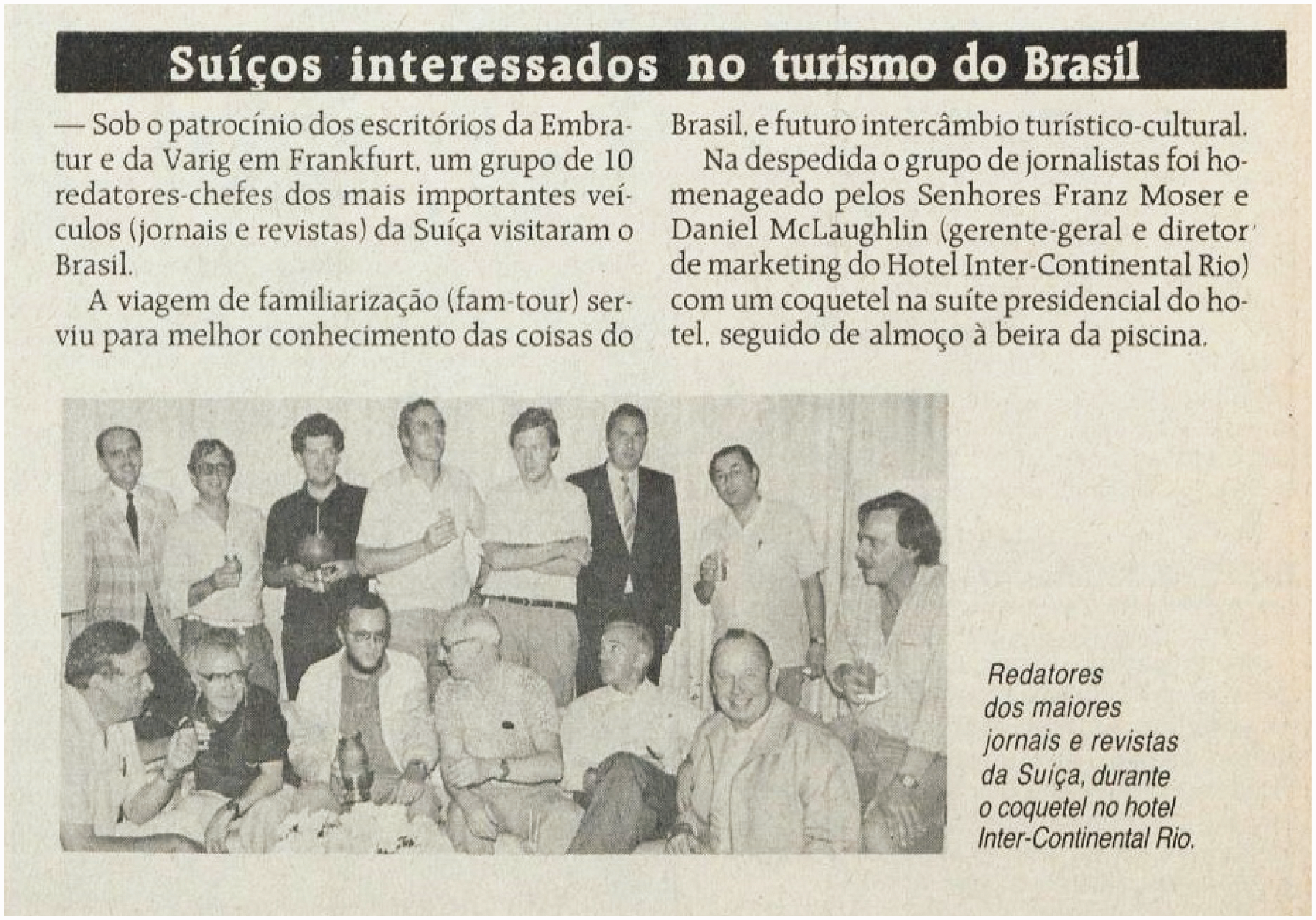
Located in strategic areas of major tourist attraction, such as the Rockefeller Center in New York, Avenue Champs Elysées in Paris or Florida Street in Buenos Aires, and decorated with panels of renowned Brazilian artists such as Carlos Vergara, the agencies offered “tourists and businessmen assistance in 128 cities in 64 countries”. 38 Truly extensions of the company abroad, the agencies also participated in the airline mission, “taking the Brazilian style, the human warmth and the kindness that characterizes our people, to the four corners of the world”. 39 Quoted frequently and explicitly as scenarios of international commercial relations, through their agencies, Varig acted as an agent of the Brazilian presence abroad, “expanding its commercial borders beyond the Atlantic and promoting social approximation, with the cooperation of other national companies”. 40
The memories of the prestige won by Varig, and the sense of belonging and pride for having contributed to a positive image of Brazil projected internationally, are part of the identity of the company’s flight attendants. This pride was constantly encouraged by the company, through paternalistic work relationships, in which the commitment and dedication of workers was recognised and rewarded with good salaries and stability. Those values, as well as the success achieved by the airline in associating itself with a national identity, led many to believe that Varig was “like a public company”, even though it was not: When I signed up for Varig, there were three good companies, three big companies, which were Vasp, Transbrasil and Varig. I remember that, when I started to think about becoming a flight attendant, I joined Varig because I was a gaucha, of course, because it was a gaucha airline, and later in Rio de Janeiro, flying, I got to know Transbrasil and Vasp, and the impression that I had was that the pride was to fly in Varig. Even the staff at Vasp, Transbrasil, was something else. They were great, I made good friends, but the glamor, the pride and the encouragement by the company itself, that incentive made all the difference. […] So, I mean, it was a pride; it became a pride. […] So it was the famous public carrier, who actually never was, of dreams, right? Because no one was dismissed, job stability was immense within the company, and it gave you all the support that a foundation gives its employees. (Alice, 53 years old, flight attendant at Varig between 1986 and 2006)
Bifurcations are social processes, which present an important part of unpredictability and can have consequences in dimensions considered stable or regular – “structural” – of the social world. 41 Among Varig’s employees, the bankruptcy of the company was not completely unpredictable (many interviewees mention having perceived the seriousness of the crisis a year before its height), but had radical financial and identity effects. In order to make visible those effects, they often insist on the number of colleagues who had to face diseases such as depression and cancer caused by the bankruptcy, and how many of them did not resist. If as Pollak observes, memory is a phenomenon built on the political and personal concerns of the moment, 42 it is not a minor fact that many of these workers are still struggling to recognise the labour and social security rights neglected as a consequence of the bankruptcy of the airline, in August 2006. Certainly, to remember the importance of the airline for the Brazilian nation can also be a strategy to emphasise the seriousness of the lack of responsibility by the state. And here we cannot understand strategy as an action consciously directed to an end, but as a constituent of memory’s framing work, 43 which is never arbitrary because it must meet certain requirements of justification.
Final considerations
From a critical perspective, this article explored some episodes of the history of a Brazilian airline and, through them, representations of a nation with specific social outlines. As we have seen, since the last years of the 1950s Varig built a successful trajectory in order to position itself as a company in the service of Brazil: a country in process of development and modernisation, vast and diverse, but united by common goals and advancing in one direction, settled by the occupants of the government, democratically elected or not. In such framework, the airlines constituted metaphorical and material stages of the narrowing of political and commercial ties between executives and government. Public and private interests seemed harmonisable in terms of a single purpose, which consisted of guiding the country in similar trends from those of the so-called First World. The role played by an airline, which, although private, was dedicated to the best representation of the country abroad, was fundamental in this growth process. This role could be direct, by transporting leading figures to the four corners of the planet, side by side with the executives of important Brazilian companies, or indirect, through the manipulation of symbols understood as constitutive of the national culture, such as the football selection – systematically transported by Varig to the World Cups, the bossa nova and the samba, and the beauty and kindness of the Brazilian girls, of course.
Thus, allowing this opening of Brazil to the world, Varig also participated in the construction of a nationality crossed by more or less subtle hierarchies of gender, class and race. Benedict Anderson has already said that communities should not be distinguished by their truthfulness or falsity, but by the style as they are imagined. 44 Gentleness, beauty, ethnic and racial diversity and development were qualities of the imagined community of the Brazilian nation that Varig helped to strengthen. If it was a development fraught with deep social disruptions, unequal distribution of income and endemic racism, these were issues that ran away from the interests of the commercial aviation services, thought as exclusive, oriented to specific and restricted population profiles, composed predominantly of white men of high purchasing power. In this way, the airline also participated and contributed to strengthen the aforementioned founding myth of the Brazilian national ideology.
Participating in this founding myth, an ambiguity was pointed out between the imaginary of an inclusive airline, truly Brazilian and, therefore, diverse, and another vision of a traditional company, with strong regional appeal and, therefore, identified with an immigrant, European and white Brazil. If I had to choose one of the two, I would say that the second image was more repeated in the discourses, gaining a more powerful sense when explaining institutional and business practices of “the pioneer”. However, such a statement seems less valuable to me heuristically (and scientifically responsible) than to show the relevance of the ambiguity itself, its modalities and consequences, not only within the company, but outwardly, in commercial aviation and national identity. After all, affirming the differences and, at the same time, hiding certain privileges is a hallmark of Brazilian nationalism even today.
This representation has undergone transformations, and today everyone recognises that commercial aviation has changed, becoming a means of transport like others, of more popular and broad access. “The airport became a bus station” – as those former employees often declare – is the deprecating realisation of those who feel they have lost privileges as a result of such social transformation. 45 However, the Varig symbol persists as an agent of an idyllic past of prestige and modernity. With each court decision, the “Variguian” community rekindles this imagination, bumping into the path with others who also claim their place in the nation. In this plot full of holes and patches the national memory is disputed and rebuilt every day.
Footnotes
Author’s Note
Carolina Castellitti is now affiliated to Departamento de Sociologia e Metodologia das Ciências Sociais (GSO), Universidade Federal Fluminense, Brazil.
Declaration of conflicting interests
The author(s) declared no potential conflicts of interest with respect to the research, authorship, and/or publication of this article.
Funding
The author(s) disclosed receipt of the following financial support for the research, authorship, and/or publication of this article: The author(s) received financial support for the research, from de Coordenação de Aperfeiçoamento de Pessoal de Nível Superior (CAPES) and Fundação Carlos Chagas Filho de Amparo à Pesquisa do Estado do Rio de Janeiro (FAPERJ).
1
The use of inverted commas in this passage, as well as throughout the text, will be restricted to indicating ideas and expressions of my interlocutors, extracted from interviews or recorded in field diary throughout the research. The use of quotation marks will be reserved for the bibliographical references included in the text and expressions extracted from those same references, as well as from other audio-visual resources mentioned in the article.
2
It has already been pointed out that the marginal position of studies devoted to the history of aeromobility is an acute feature of Latin American historiography. In Brazil, see Aldo Pereira, Breve História da Aviação Comercial Brasileira (Rio de Janeiro: Europa, 1987). More contemporary: Claudia M. Fay, Crise nas Alturas: A Questão da Aviação Civil (1927–1975) (Porto Alegre: UFRGS, 2001); Henrique Helms, O Panorama da Aviação Nacional de 1986 a 2006 e a Quebra da Varig (Porto Alegre: UFRGS, 2010); Geneci G. de Oliveira, Varig de 1986 a 2006: Reflexões Sobre a Ascensão e a Queda da Empresa Símbolo do Transporte Aéreo Nacional (Porto Alegre: PUCRS, 2011); Elones F. Ribeiro, A Formação do Piloto de Linha Aérea: Caso Varig – O Ensino Aeronáutico Acompanhando a Evolução Tecnológica (Porto Alegre: PUCRS, 2008). Other important productions are those of Cristiano Fonseca Monteiro, cited throughout this article, from the field of economic sociology. On the other hand, it is necessary to observe that, since Varig was such a popular company and its bankruptcy is so significant, there are many journalistic and divulgation works, more or less specialised. We recommend: Gianfranco Beting and Joelmir Beting, Varig a Eterna Pioneira (Porto Alegre: EDIPUCRS; São Paulo: Beting Books, 2009); Marcelo D. Lins, Caso Varig. A História da Maior Tragédia da Aviação Brasileira (Rio de Janeiro: Jaguatirica, 2015).
3
João Pacheco de Oliveira. O Nascimento do Brasil e Outros Ensaios. “Pacificação”, Regime Tutelar e Formação de Alteridades (Rio de Janeiro: Contra Capa, 2016), here 8.
4
Something similar was pointed out by Piglia, observing that, due to the scarce development of surface communications in a large part of the territories, Latin America appeared as a market with enormous potential. In fact, the establishment of the first airline in Argentina had as a precedent, in 1924, the sending by a French company of a mission to Brazil in order to study the establishment of a service airmail with Europe, with head in Buenos Aires and stopover in Natal. After obtaining an exclusivity agreement with the Argentine postal company, those capitals constituted Aeroposta Argentina S.A., the first local airline, at the end of 1927. Melina Piglia, “En Torno al Viaje en Avión en la Argentina: Representaciones y Experiencias, 1929–1958”, Avances del Cesor 12:13 (2015), 133–58.
5
Cristiano Fonseca Monteiro, “A Varig e o Brasil, Entre o Desenvolvimento Nacional e a Competitividade Global”, Civitas – Revista de Ciências Sociais 7:1 (2007), 35–58, here 42. (All the translations from de original in Portuguese are mine).
6
Beting and Beting, Varig a Eterna Pioneira.
7
Cristiano Fonseca Monteiro, “Political Dynamics and Liberalization in the Brazilian Air Transport Industry: 1990–2002”, BPSR 5:1 (2011), 35–53, here 38.
8
This arrangement lasted for over a decade, challenged only by the end of the military dictatorship in 1985, with the gradual abandonment of nationalistic-developmentalist policies, and greater room given to stabilisation and pro-market policies. Within the executive branch, taming inflation by means of strict control of prices became a top priority.
9
According to data obtained by Pereira (Breve História da Aviação Comercial Brasileira) from the Commercial Aviation Department (DAC), from 1964 to 1965 the total number of kilometres flown by Varig increased from 34,815,156 to 38,936,499, with international traffic being the main tendency. The total number of passengers transported by the company grew steadily in the period 1964–85 (last available measurement of 4,807,913 passengers transported), with the exception of the transition from 1982 to 1983, when there was a decrease from 4,729,674 to 4,451,938 passengers. The number of employees was doubled over the same period, ranging from 9936 officials and aeronauts in 1964 to 19,383 in 1985. In relation to the fleet, Varig started operations in 1927 with two aircraft, with a strong expansion in 1948 (with 24 aircraft, the company was still restricted to the national territory and some countries of South America); from 1961 to 1962 the fleet was almost doubled, mainly due to the arrival of 14 Convair 340/440, 10 Curtiss C-46, 30 DC-3, 3 CD-6 and 4 L Super H aircraft. During the following two decades, the fleet was significantly reduced, until the 1990s when a period of new acquisitions began. 2001 is the year in which the company’s fleet reaches its largest size with 155 aircraft (with 12 B737-200, 33 B737-300, 4 B737-400, 4 B737-700, 2 B737-800, 6 767-200, 6 767-300, 2 B777-200 and 16 MD-11, plus 10 other cargo aircraft). In 2006, the year of closure of its activities, Varig had 65 aircraft, of which 13 were cargo.
10
Monteiro, “Political Dynamics and Liberalization”, here 46.
11
The names of the interviewees correspond to pseudonyms with the objective of maintaining anonymity.
12
“Roma via Varig”, [Revista] O Cruzeiro, 30 (April 1966).
13
Kathleen Barry, Femininity in Flight: A History of Flight Attendants (London: Duke University Press, 2007). Drew Whitelegg, “Cabin Pressure. The Dialectics of Emotional Labour in the Airline Industry”, The Journal of Transport History 23:1 (2002), 73–86.
14
Peter Lyth, “‘Think of Her as Your Mother.’ Airline Advertising and the Stewardess in America, 1930–1980”, The Journal of Transport History 30:1 (2009), 1–21.
15
Although the analysis by the author about the changes in the feminine figure in these advertisements is pertinent, we do not agree with his interpretation of Hochschild’s “emotional labour” concept like being a “female nature” (Lyth, “‘Think of Her as Your Mother’”, here 6). On the contrary, the whole argument of the American sociologist rests on the idea that emotional labour is unevenly distributed between men and women from social bases, or, in her words, “a consequence of the power differences between the sexes”. See Arlie R. Hochschild, The Managed Heart (Berkeley: University of California Press, 1983), here 163.
16
Viação Aérea São Paulo S/A or VASP was an airline with its head office at Congonhas Airport in São Paulo, Brazil. It started its operations in 1933. Although it had been remarkably well run for most of its life as a state-owned company (the state of São Paulo), by the 1980s VASP was being plagued by inefficiency, losses covered by state capital injections and a bloated payroll for political reasons. Under the Brazilian government’s neoliberal policies newly introduced at the time, VASP was privatised in 1990. The company then faced its worst crisis in 2004 and declared bankruptcy in 2008.
17
Propagandas Históricas, “Vasp aeromoça”.
18
Hochschild, The Managed Heart, here 93.
19
Claudia Vasconcelos, Estrela Brasileira (Petrópolis: KindleBookBr, 2011), here 22.
20
Hochschild, The Managed Heart, here 175.
21
Whitelegg, “Cabin Pressure”, here 75.
22
TV Tupi.
23
Lyth, “‘Think of Her as Your Mother’”, here 7.
24
Mariza Corrêa, “Sobre a Invenção da Mulata”, Cadernos Pagu 6:7 (1996), 35–50, here 40.
25
Adriana Piscitelli. “Corporalidade em Confronto. Brasileiras na Indústria do Sexo na Espanha”, Revista Brasileira de Ciências Sociais 22:64 (2007), 17–32, here 18.
26
Everton Rangel, “Brazilian Dancers: Corpos Exibíveis em um Circo Norte-Americano”, Cadernos Pagu 52 (2018), 5–32, here 15.
27
Chandra Bhimull, “Caribbean Airways, 1930–32. A Notable Failure”, The Journal of Transport History 23:1 (2002), 228–42.
28
Pereira, Breve História da Aviação Comercial Brasileira, here 129.
29
Peter Fry, “Politics, Nationality and the Meanings of ‘race’ in Brazil”, Daedalus 129:2 (2000), 83–118, here 88–9.
30
Roberto DaMatta, O que faz o brasil, Brasil? (Rio de Janeiro: Rocco, 1986), here 48.
31
TV Excelsior, “Panair do Brasil”.
32
Pereira, Breve História da Aviação Comercial Brasileira, here 65.
33
O Estado de São Paulo, “Jingle inspirado em lenda de Urashima Taro marcou época”, 29 December 2007.
34
Varig, “The saga of Urashima Taro”.
35
Lila Abu-Lughod. Dramas of Nationhood: The Politics of the Television in Egypt (Chicago: The University of Chicago Press, 2001).
36
Carolina Castellitti, “A Carreira de Comissária de Bordo na Varig. Processos de Individualização Feminina em Contextos Urbanos”, PhD dissertation, Rio de Janeiro (Brazil), 2018, here 96.
37
“Sem lenço, sem documento e sem passaporte. O que fazer para conseguir outro passaporte no exterior?”, Jornal do Brasil, 265 (30 December 1987).
38
“A Varig não foi feita só para vender passagens”, Aviação Comercial.
39
“Nostalgia, anos 80”, Aviação Comercial.
40
Arguing about “the potentialities of the region fixed below the Sahara to the equator”, a report mentions the Brazilian presence in the Economic Community of West Africa, and refers to the Embassy and Varig’s agencies, enabling the “increase in bilateral relations”. Vasconcelos Costa, “O futuro da África”, Jornal do Commercio, 25 September 1985.
41
Marc Bessin, Claire Bidart and Michel Grossetti (eds), Bifurcations: Les Sciences Sociales face aux Ruptures et a l’événement (Paris: Éditions La Découverte, 2010).
42
Michael Pollak, Memoria, Olvido, Silencio. La Producción Social de Identidades frente a Situaciones Límites (Buenos Aires: Ediciones Al Margen, 2006), here 37.
43
Michael Pollak, Memoria, Olvido, Silencio, here 26.
44
Benedict Anderson, Comunidades Imaginadas. Reflexiones sobre el Origen y la Difusión del Nacionalismo (México, D. F.: Fondo de Cultura Económica, 1993).
45
These changes in the commercial aviation market, in Brazil and around the world, had direct consequences on the types of professional reinsertion of my interlocutors, both for those who continued in aviation, and for those who did not. Both of them repudiate the current working conditions, and many of those that did not remain in aviation, it was precisely because they did not support these conditions. They do not repudiate (at least explicitly) the most popular access to the service achieved in our days, but the consequences that the tariff war caused in their working conditions (synthetically: lower salaries, less rest time, more frequent and rigorous controls, less international flights).