







Abstract
This article examines how the Berlin Transport Authority's (BVG) employee periodical Die Fahrt, published between 1929 and 1945, shaped discussions and representations of urban mobility and the BVG's company identity around the historical shift of 1932/33. Specifically, the essay looks at how the new National Socialist editorial board appropriated one of the most significant technological transformations of the German Empire and Weimar Republic, namely Berlin's public transit network, into broader discussions that reinforced both their vision of modernisation and ideological agenda. The close readings trace how the periodical's representations of mobility, labour, and leisure supported competing mobility regimes across the Weimar and National Socialist eras. Rather than passively documenting political and ideological shifts, I argue, Die Fahrt actively contributed to the reframing of public transit as a site of ideological performance under National Socialism.
Berlin's public transit system has long been central not only to people living there or visiting, but also the city's identity as a modern, well-networked metropolis. Despite the network's long and well-documented history, significant gaps remain in our knowledge of its governing body, the Berliner Verkehrsbetriebe (Berlin Transport Company, hereafter, BVG), as almost all the company's internal documentation was destroyed in a fire in November 1943. In this context, the BVG's employee periodical Die Fahrt (henceforth DF), published between 1929 and 1945, remains one of few surviving sources that offers insight into how the BVG mediated between institutional self-representation and everyday concerns of its employees in this tumultuous period of Berlin's history. Where earlier studies have shown administrative decisions and the structural re-organisation of the BVG against the backdrop of the Nazi-Party's Gleichschaltung (coordination), this article takes a culturalist perspective to show how ideological messaging both in the Weimar and Nazi years reached the broader workforce. 1
In this article, I analyse DF as a site where the BVG reconfigured representations of public transit and of its own institutional identity conceptually and symbolically across two markedly different mobility regimes. This approach builds on Tim Cresswell's assertion that mobility as “a fundamental geographical facet of existence […] provides a rich terrain from which narratives—and, indeed, ideologies—can be, and have been, constructed”. 2 Cresswell's triadic model of mobility, comprised of physical movement, representational practice, and embodied experience, likewise frames the parameters of this analysis, as the article does not aim to address operational or technical mobility, but to foreground the representational sphere of public transit in late Weimar and National Socialist Berlin.
The qualitative close-reading approach focuses on how narratives of mobility were rearticulated through enduring themes in DF, namely via discussions regarding Berlin's status as a Weltstadt (Metropolis, literally “world city”) and BVG's connection to the city's thriving leisure and sport culture. While the periodical underwent extensive changes to formatting, rhetoric, and scope, DF consistently framed the BVG as central to Berlin's metropolitan identity and to Berlin's access to recreation throughout these years of tumultuous shifts. These motifs, rooted in the Weimar-era, persisted into the National Socialist period and were then mobilised to drive ideological influence within the BVG community. The use of institutional and state-adjacent media to foster worker loyalty was not unique to the BVG by any means. Nazi social policy relied on propaganda and organisational culture to bind workers into the regime. 3 These thematic strands, due to their popularity in both Weimar and Nazi Germany, reveal that the BVG's shift from social-democratic red to fascist brown encompassed a rearticulation of symbolic and discursive continuities rooted in the Weimar years. In tracing this shift from social-democratically charged idioms toward an increasingly hierarchical rhetoric, the close readings align with Jeffrey Herf's notion of “reactionary modernism” to underline the periodical's negotiation and mediation of pastoral imagery with urban modernity. 4 This perspective begets a closer examination not only of what the BVG represented in these years, but how DF re-narrated public transit and the company itself as carriers of ideological and völkisch (nationalist) renewal.
The analysis in this article is rooted in a close-reading approach, thus engaging with several interrelated categories, including propaganda, modernity, ideology, discourse, and narrative. I discuss the selected contents from the periodical against these broader categories to showcase and discuss how DF employed persuasive communication to shape readers’ perception of their role within the BVG and the city. Part and parcel of the argument is that the periodical goes beyond informing. It tells a story of the role of both transit companies and infrastructure for a cohesive urban, and later national, community.
Berlin's transit system and the BVG have been documented from economic, technological, and political perspectives, yet cultural approaches remain scarce. 5 A notable exception is Samuel Merrill's monograph Networked Remembrance, which deal with Berlin and London's underground transit networks beyond technical and operational terms, persuasively arguing for their function as cultural and mnemonic networks in urban space. In terms of the cultural and historical significance of employee periodicals in the BVG, Merrill mentions the role of Signal, DF's successor, in re-branding and unifying what had been two separate authorities for transit in divided Berlin, the BVG and the BVB, which merged in 1992. 6 Moreover, as Merrill notes in his research, key periods in Berlin's public transportation history, “despite the existence of tempting archival sources”, remain understudied. 7 Other existing scholarship that focuses on BVG in the specific time period, such as Aus Rot wird Braun: die BVG 1929–1945, foregrounds structural and administrative changes, relying on top-down sources like leadership correspondence. This article's approach aims to shift the focus from institutional structures to the representational sphere by examining DF as a cultural text. Comparable staff periodicals have existed elsewhere, such as the T.O.T Staff Magazine, published by the Underground Electric Railway Company of London (1922–1933) and Transit: A Monthly Magazine for the Men and Women of the New York City Transit Authority (1954–1957). In Paris, the SNCF launched Notre Métier in 1938, which later evolved into La Vie du Rail in 1952, a broader trade weekly. In comparison to these, DF's sustained focus on urban public transit workers during the volatile years between Weimar and National Socialism marks it as a valuable cultural artifact of Berlin's modernity and transportation history.
Much scholarship on Berlin focused in this time period foregrounds visual culture and print journals as key mediators of deeper cultural transformations and the formation of a Weimar modernity and its rearticulation under National Socialism. 8 This paradox of an abundance of scholarship on voice and culture on the one hand, yet meagre attention to staff periodicals on the other, especially in terms of cultural subtexts in their contents, makes a discursive-analytical approach relevant and valuable, as it highlights how institutional self-representation and communications operated alongside broader cultural transformations. By tracing how DF crafted narratives about mobility, labour, and urban identity alongside broader historical shifts in Berlin and Germany, we can also recognise that although employee periodicals are not conventionally approached as cultural texts for close-reading purposes, previous scholarship on employee periodicals has shown how these texts have been used to regulate and shape desired corporate image and worker performance. One useful lens for understanding internal company publications is the notion of “imagined communities”. 9 Drawing on Benedict Anderson's formulation, Michael Heller and Michael Rowlinson have shown how employee magazines in the UK served to construct a sense of shared community, asking “when and how the employees of corporations were imagined as communities with a shared consciousness”. 10 This approach resonates with the aims of this article, as it similarly puts the textual media in through which the company community was imagined front and centre. Along similar lines, in his case study on The Great Western Railway Magazine, Mike Esbester argues that managers used the magazine as a medium to bridge physical and hierarchical distance and to increase control of the workforce through definitions of safety and safe work behaviour. 11 Other notable approaches focus on the construction of internal and external corporate images. Roland Marchand posits in-house magazines within a wider project of regulating how employees perceive their company, while D.J. Griffiths extends this argument by suggesting that employees, as salespersons, might circulate this image beyond the immediate workplace. 12
It is necessary to clarify that although DF might have achieved some degree of circulation outside the company's workforce, it was first and foremost addressed to its employees. As a staff periodical for an institution charged with providing and improving mobility, I suggest that we can view DF as a lens through which we can examine what Colin Divall and George Revill have referred to as the dual dimension of transport history: the symbolic, expressed through imagined world orders and civic identity, and the material, tied to the functionality of the infrastructure as the city's, and, by extension its economy's, circulatory organ. Divall and Revill point out that a major challenge for transport historiography is to move beyond treating culture as text alone and instead specify how “symbolic-expressive and material-functional dimensions are articulated or even mutually constituted”. 13
This article is based on digitised copies of DF which were made available to me in conjunction with a research visit at the BVG-Archiv in Berlin. 14 My research, in consultation with the archivists, confirms that knowledge about the authors and the composition of the editorial board remains fragmentary, apart from the prominent roles of the main editors: Ernst Reuter and later Johannes Engel. Once yearly, or in some cases, each volume, would include a table of contents listing contributors, though often only by their initials; the same practice appears in individual articles themselves. Where full names are given at the end of individual articles, this likely indicates external contributors rather than members of the editorial staff. While this latter point cannot be established with certainty due to the lack of archival sources, a fuller investigation of the contributors’ identities and affiliations would enrich our understanding of DF's production. At the same time, I believe it is worth noting that the anonymity of authorship in DF is itself significant as it reflects the journal's function as a vehicle for BVG's collective and institutional voice. After DF ceased publication in 1945, the publication history of internal journals and communications in the immediate post-war years is fragmentary. The best-known successor is Signal, which preceded BVG-Profil (BVG Profile), published between 1998 and 2003, which in turn continued from 2004 onward as Profil.
From service to symbol: Public transit across regimes in Weimar and National Socialist Berlin
Before 1928, the public transport network in Berlin had been highly fragmented, with smaller independent companies operating the subways, trams, and busses. This inevitably led to inefficiencies and fare discrepancies, especially against the backdrop of Berlin's explosive administrative growth following the Greater Berlin Act in 1920. Against this backdrop, the Berlin city administration consolidated the existing transport companies under a publicly owned, municipal authority, the BVG. Shortly after the official foundation of the BVG on December 10, 1928, the first issue of DF was published on January 25, 1929. The BVG continued to publish the periodical at regular intervals up until the end of World War II in 1945, thus spanning the social and economic instability of the Weimar Republic, as well as Hitler's rise to power in 1933 and World War II. The publication frequency and content followed a relatively predictable pattern: comprehensive and frequent volumes in the early years, followed by a sharp reduction to near-pamphlet length editions during the transition into National Socialist editorship. Content then expanded again leading up to the war, only to contract once more as paper shortages became increasingly evident in the later years of the war, with this shrinkage culminating in a four-page issue published in 1945 before Germany's capitulation.
A key figure in shaping DF's early voice was Ernst Reuter, social democratic local politician and chair of the BVG's supervisory board, and thus also the city official for municipal transport. Apart from the articles and editorial addresses authored by him, summaries of his public speeches regularly featured in the periodical. In the inaugural 1929 issue, Reuter expressed his vision of the periodical as a forum for fostering shared purpose and dialogue among BVG employees: “In it [DF], we will speak of Berlin's traffic, its technology, its economy, the developments in our giant city, of its buildings and institutions. Everyone who wants to contribute will have the opportunity to do so”. 15 In the same article, the BVG's dual mission to provide both speed and safety in transit is underscored: “The public expects us, through our work, to meet the two main demands that the new era places on transportation: speed and safety”. 16 The two themes of increased mobility through progressive technology and infrastructure, combined with the more affective side of parading Berlin's now centralised public transit system as a shared ground for public debate, shaped the journal's editorial framework in its early years. Subsequent issues, published monthly, offered a vibrant mix of educational articles, cultural engagement, and international perspectives. Content encompassed articles on traffic safety education, humorous poems, coverage of international transit systems, sports, and a short section toward the end “für die Hausfrau” (for housewives). This breadth in content underscores DF's role not only as a tool to spread information and give directions, but also as cultural mediator.
Reuter's vision for the BVG intrinsically ties to the transformative urban development of the 1920s which included the annexation of previously independent townships, such as Charlottenburg, Wilmersdorf, Schöneberg, Lichtenberg, Neukölln, Köpenick, and Spandau. As a result of this annexation and the consolidation of public transit under one municipally owned company, the BVG became a major centralised public transit company on a global scale. By comparison, London's and New York's public transit systems were not consolidated until 1933 through the London Passenger Transport Act and 1940, as the Interborough Rapid Transit Company and the Brooklyn-Manhattan Transit Corporation came under public operation, respectively. In this newly integrated structure in Berlin, DF played a key role in articulating a shared institutional identity and image. As part of such ongoing modernisation and urbanisation processes, Reuter not only focused on the company's pivotal role in the city's infrastructure but also framed public transit as an indispensable tool of urban planning. This perspective is evident in his assertion that, unlike in most cities where transportation followed existing demand, Berlin's transit system aimed to anticipate and shape urban development: While in most cities traffic infrastructure is only implemented once an existing demand guarantees profitability, in Berlin we are able to influence urban growth and steer it in specific directions by striving to anticipate future traffic needs. Instead of the often-haphazard approach that characterises the architectural development of a metropolis [Weltstadt], we can employ systematic foresight and conscious planning.
17
Here, Reuter posits the BVG as an active force in shaping the city's social and economic landscape, rather than merely responding to existing transportation demands. Further emphasised is that this approach replaces the haphazardness often associated with organic urban growth with deliberate foresight and conscious design. This language aligns with broader rationalist and modernist discourses of the early twentieth century that sought to impose order on the urban environment, linking transportation policy with social welfare and economic progress. The implication is that transit is not just a reactive service but a tool of governance, structuring mobility in a way that actively determines the future of the city and, by implication, its inhabitants.
Reuter's vision for Berlin's transit system as both a technological innovation and a force for social cohesion aligns with a broader Weimar-era commitment to urban modernisation and public welfare. In this regard, several important milestones were reached in the late 1920s. In spite of the economic crises of 1928–1929, the BVG finalised the construction of the Alexanderplatz subway station in 1930, and in the following year, Reuter participated in a press tour to celebrate the inauguration of a new subway line connecting Alexanderplatz to Friedrichsfelde. DF framed this event not only as a technical milestone but also as a key step in integrating previously underserved areas into Berlin's transit network. As noted in a report of Reuter's speech at the inauguration: “The rapid transit network, which before the war existed only in fragmentary form, covering primarily the west of the city, has now been extended to the north, south, and east, particularly into the densely populated working-class districts”.
18
Moreover, Reuter informs us that the significance of these new lines extended beyond profitability, echoing his previous statements that public transit serves essential economic as well as social functions: When assessing the economic viability of these railways, one must not forget that they are not only parts of a company that must balance its profits and losses, but that they also fulfil important functions for the national economy. For large segments of our population, they represent a significant saving of time and energy.
19
Rather than being assessed solely in terms of profitability, transit is framed here as an essential public good that provides tangible benefits to the population, particularly through time and energy savings. This sentiment suggests that the value of the BVG extends beyond financial metrics, encompassing broader contributions to economic efficiency and public welfare.
The BVG's operations under Reuter was firmly rooted in a social democratic framework, drawing to the foreground collective welfare, accessibility, and the integration of mobility into a broader vision of societal progress. However, at the time Reuter served as editor for DF, the Social Democratic Party and its proponents faced growing opposition from both ends of the political spectrum: the Communist Party (KPD) accused social democracy of betraying true revolutionary socialism, while the National Socialists (NSDAP) denounced its weak leadership and their incapability of addressing the economic crisis. This shared hostility occasionally led to tactical collaborations, as seen in the autumn of 1932, when Walter Ulbricht (KPD) and Joseph Goebbels (NSDAP) both called for a wildcat strike at the BVG. 20 Following the NSDAP's rise to power in 1933, the journal underwent profound transformations. Early in 1933, Reuter was replaced by Johannes Engel, an NSDAP member with ties to the German Ku Klux Klan, as State Commissioner for Transport. Leadership changes, along with new regulations targeting communists, social democrats, and Jewish employees, fundamentally altered the BVG workforce and the journal's priorities. After Reuter was dismissed from office in 1933, he went into exile in Turkey, where he taught and advised on urban planning. After the war, he returned to Germany and served as mayor of West Berlin from 1948 to his death in 1953, becoming a central figure in the city's cold war politics. 21
A few of the subtle, yet evident changes made to the appearance of the periodical and the BVG workers’ uniforms include the adoption of the Fraktur/Tannenberg font in 1933, the Gothic-style typeface favoured by the National Socialists, signalling DF's alignment with the visual and cultural aesthetics of the new regime. This change first appeared in volume 7/8 (April 1933), a seemingly minor design choice that reflected the broader ideological shift occurring within the BVG and its official communications, marked a departure from earlier, more neutral, design conventions, and visually aligned the journal with National Socialist propaganda. 22 The same year, new brown transit passes were issued to district and council members and a couple of years later, in 1937, the Berlin city emblem that up to that point had adorned the BVG workers’ hats was exchanged for the Hoheitszeichen, a Nazi symbol featuring a stylised eagle clutching a swastika within a wreath. 23 Workplace terminology was restructured to reflect the ideological shift, introducing terminology that carried a much stronger hierarchical tone that suggests obedience and control: the title of Direktor was replaced with Betriebsführer (Operations Manager), Belegschaft (workforce) became Gefolgschaft (followers), and the BVG as a whole was now envisioned as a unified Betriebsgemeinschaft (operating community) in accordance with loyalist rhetoric of the NSDAP.
In one of his first contributions to the periodical, the newly appointed editor, Engel, shares his vision for DF: “‘Die Fahrt’ is intended to be the spiritual bond that unites all BVG employees and their families; it aims to awaken and deepen a sense of belonging to the company community of this largest European public transport company”. 24 His emphasis on Gemeinschaft (community), both within the BVG workforce and between employees and their families, signals a shift from the previous editorial leadership. The journal's content increasingly foregrounds themes of collective identity and hierarchical order, laying the groundwork by framing the BVG as a microcosm of the National Socialist state: one in which unity, loyalty, and ideological alignment take precedence over professional identity alone. This transformation culminates in articles and special issues that fully embrace the regime's racial ideology, such as a 1934 issue on eugenics and culture. 25 A similar article exploited negative connotations associated with the colour black, to construct yet another racialised discourse of exclusion. 26
Themes of exclusion were mirrored in the BVG's embrace of militarised rituals. In December 1933, the BVG, which had its own music corps, became the first private organisation to receive a Schellenbaum (bell tree), a ceremonial emblem and standard traditionally associated with the military. The ceremony was a grand display of Nazi public-facing aesthetics, as DF reports: A giant swastika flag on the Berlin City Hall, portrait of our Führer adorned with fir branches, and green laurel on either side of the main staircase of the “Red City Hall” provided a festive atmosphere to the small ceremony held on December 9 to mark the presentation of the Schellenbaum. The small square in front of city hall quickly filled up, and the crowd continues to grow along Königstraße. Curious passengers on the slowly moving trams and omnibuses craned their necks to catch a glimpse of the event.
27
The description above illustrates how the ceremony for the Schellenbaum's handover was carefully orchestrated to align with the visual and ideological aesthetics of the Nazi regime. The “swastika flag”, the “the fir-decorated portrait of the Führer”, and the “laurel” flanking the steps of the Red City Hall reinforced the connection between the BVG and the broader state apparatus. The account also foregrounds the public engagement with the event. The description of the crowd filling the Königstraße and people craning their necks from trams and buses further underscores the performative and collective nature expected of the German people around such ceremonies. The Schellenbaum itself continues to feature as a fixture at BVG-organised public events, symbolising the integration of civilian institutions into the militarised ethos of the Nazi state. Such company events—notably the yearly BVG Christmas and Maypole celebrations (spring festivals) which DF reports on annually—attended by workers, their families, and high-ranking officials, were more than just celebrations. They functioned as ritualistic affirmations of loyalty and strength, showing the BVG workforce and DF articulating and shaping National Socialist values by using family and community as key rhetorical frames. Their alignment is further made explicit as the BVG is imagined at the forefront of Germany's labour front: “At the forefront German companies committed to realising the National Socialist ideal of labour and striving for the highest goal in the competition of German workplaces—the ‘National Socialist Model Company’ award bestowed by the Führer—is our BVG”. 28
Intrinsic to the nationalist socialist agenda is also to contrast their alleged grand successes with the failures of the previous Social Democratic leadership, in national politics at large, as well as more specifically regarding the BVG. A telling example is provided in a 1934 article, depicting the inflation's catastrophic effects on the city's transportation infrastructure: the inflation unchecked and rail yards reduced to “wagon cemeteries”. Against this image of despair, the article presents the Nazi rise to power as a moment of economic and infrastructural resurrection, framing the transformation of the BVG as emblematic of national renewal. The same article proclaims: In contrast to this deterioration of public transportation […], after Führer and Reich Chancellor Adolf Hitler took over leadership of the German Reich, we experienced, thanks to his decisiveness, the German economy being saved from further decline and […] from 1933 onward, a gratifying and steady increase in the number of passengers using public transportation.
29
Yet the claim that public transit was more than an isolated economic sector was not new. Under Reuter's editorship, DF had articulated similar arguments, foregrounding the BVG's role in stabilising employment, facilitating economic productivity, and fostering a sense of collective welfare. This continuity in thinking across the Social Democratic and National Socialist divide is evident in assertions such as: “Although the transportation industry in which we work represents only one of many production factors, it is, as a service-oriented sector, inextricably linked to the overall economy and cannot be imagined without it”. 30 By appropriating this discourse, DF functioned as a mouthpiece to legitimise Nazi economic policies while simultaneously aiming to erase the role and institutional memory of earlier Social Democratic transit planning.
Addressed to tens of thousands of transit workers and their families, the magazine carried weight in an urban environment where Nazi support had historically had weaker traction than in rural areas. Unlike an internal newsletter for a small factory, the contents of DF reflected an institution that governed the circulatory system of Berlin itself. Its contents and framing of the BVG thus cannot be separated from the larger discourses of mobility, modernity, and urban identity in which their messaging was embedded. This makes the magazine a crucial site where local and national visions of movement converged, and where boundaries between work, civic duty, and private life were rapidly dissolved. At the same time, DF offers a lens through which we can trace how certain trends in mobility discourse were not only reshaped but, in some cases, directly co-opted from the social democratic framework into the National Socialist agenda. While continuities in themes across the shift in editorship, such as the role of public transit in fostering social cohesion and collective welfare remain visible, they are rearticulated within a much more deliberate rhetoric of national unity and duty.
Becoming a Weltstadt: Where transit and urban fantasy meet
DF did more than foreground the service function of transit: it attached narratives of movement to the very identity of Berlin. Scholars such as Cresswell and Mimi Sheller foreground in their work that mobility is not only about physical movement through space. The meanings and narratives that are attached to movement are equally important to understand the role of mobility in any given context. 31 By examining more thoroughly how DF used transit to spin a narrative of Berlin as a Weltstadt, a concept that emerged in the 1800s but gained traction with remarkable speed in the early 1900s, we see that the periodical emphasised not only Berlin's expansive transit infrastructure, but also staged Berlin's global status and Weltgeltung (global reputation) through the discourse of public transit.
On a semantic level, a Weltstadt is a world city. Beyond pure semantics the term implies a city that contains the world within it. You might even imagine a Weltstadt as a collection of multiple worlds, bound together into a single entity, marked by both global interconnectedness and internal complexity. Or, as the infographic in Figure 1 suggests, Berlin's role as a Weltstadt was also defined by a transit network whose sheer scale mirrored the population of the entire globe.
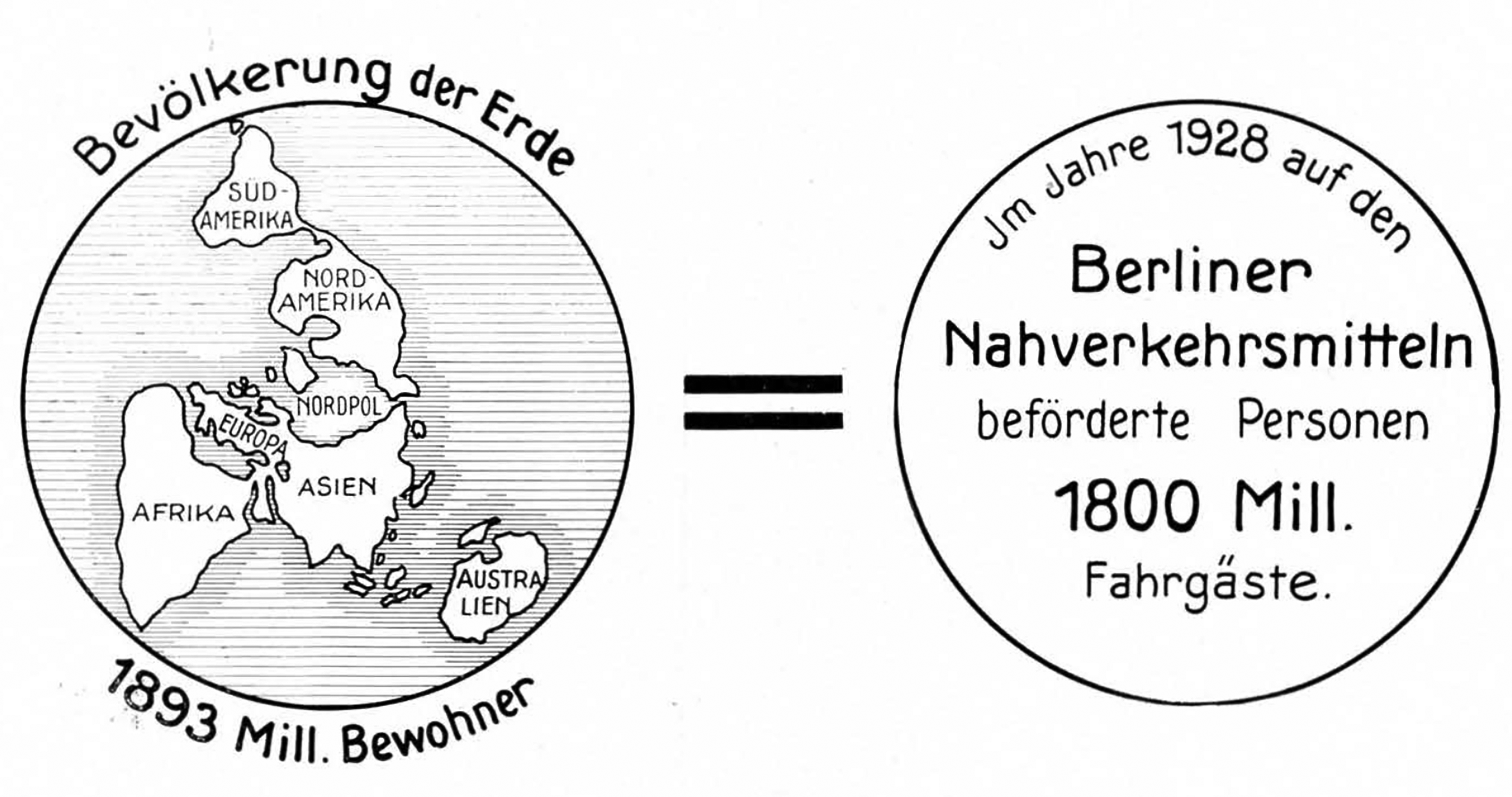
Comparison of global population and annual BVG ridership.
Though the term Weltstadt quickly became a defining descriptor for 1920s Berlin, its meaning remained fluid and multifaceted. For the artistically minded who called Berlin home in the late nineteenth and early twentieth centuries, this idea of Berlin as a Weltstadt was synonymous with modernity itself. It was not just a description of scale or international importance, but a recognition of the ways in which Berlin embodied the forces of rapid change, such as technological acceleration, mass communication, ephemeral modes of perception, and the disorienting pace of urban life. The city's cultural scene increasingly saw itself as on par with its older European siblings, London and Paris, cultivating an artistic and intellectual sphere that reflected Berlin's growing ambitions.
In its early years, DF actively informed its readership about developments in public transit across the world, positioning Berlin within an international network of urban modernisation. A 1929 article set London as a model to aspire to, acknowledging that “London is two decades ahead of us with their subway tunnel construction”. 32 The journal's interest in London's transit system extended beyond infrastructure, also covering innovations in public transport advertising. An article about traffic advertisement in London describes how visual advertising had become an integral feature of the London Underground, playing an educational as well as commercial role: “The posters are very popular with the London public and are especially sought after by schools in order to foster children's understanding of famous historical buildings”. 33 At the time, advertising in Berlin's public transit system was a relatively new phenomenon, introduced only in 1929. Prior to this, the city's transit spaces had remained largely free of commercial imagery, reflecting different approaches to public space and visual culture in Berlin and London. The implementation of advertising in the Berlin U-Bahn and S-Bahn marked a shift toward a more commercially integrated transit environment, aligning Berlin with other global metropoles.
Beyond London, DF frequently reported on transit advancements worldwide, publishing updates on traffic development in the US and electric traction in European trains. 34 These articles reinforced an outward-looking perspective, emphasising Berlin's place in a larger, transnational exchange of technological progress and urban mobility. Even into the late 1930s, such reporting continued, although by this time, the journal's international scope had narrowed considerably. 35
To understand the evolving connotations of Weltstadt, we must frame this within the larger question of the Nazis’ ambivalent relationship with modernity and big cities. Industrial quarters, grey concrete, and commercial display windows stood in stark contrast to the idyllic German potato fields commonly featured in Nazi propaganda, yet Berlin's self-declared status as a Weltstadt that had been cultivated and circulating for decades could not simply be erased. DF's rhetoric and visual identity under National Socialism resonates with what Jeffrey Herf has described as “reactionary modernism”, the reconciliation of antimodernist, romantic, and irrational ideas within German nationalism with its pronounced rationality and technical modernity—right-wing politician and engineer Peter Schwerber had argued already in 1930 that National Socialism was not antitechnological but sought to liberate technology from the “domination of money” and “fetters of Jewish materialism”. 36 Herf's account of reactionary modernism is helpful to understand how DF employs the Weltstadt-discourse, as it showcases how the National Socialist ideology sought to celebrate pastoral imagery with the notion of a modern urban centre. Of course, the BVG as a transport company not only linked these two registers conceptually in DF, but also quite literally, connecting the metropolitan Berlin core with various green spaces—parks, lakes, forests—in and around the city.
The Weltstadt concept, perhaps due to its rich connotative field, was particularly susceptible to reappropriation. While the term initially embodied Berlin's competitive drive to assert itself alongside London and Paris, it also carried ideological undercurrents that could be leveraged for expansionist ambitions. Just as technological progress could be mobilised in service of empire, so too could the rhetoric of Berlin's ascendance to Weltstadt-status legitimise the broader project of Lebensraum (habitat). Some articles frame the Tempelhof airport not simply as an architectural or logistical achievement but as a gateway to Germany's growing global presence. 37 Similarly, Berlin's role as the infrastructural and ideological nucleus of the Nazi state is forcefully touted to DF's readership. 38 Such narratives did not reject Berlin's status as a metropolis but redefined it in explicitly nationalistic and expansionist terms, positioning it as both the administrative heart of the Reich and the launchpad for further technological innovation and global territorial ambition.
A striking example of this shift toward internal comparison and territorial ambition is the spike in attention to Vienna's transit system following der Anschluss (the annexation) in 1938. The periodical's coverage of Vienna's integration into the German Reich framed the event less as an external report on a foreign city's infrastructure but as an extension of Berlin's own transit network, reflecting the nationalist-imperialistic claim that this was a “Reunification” and that Austria had always been an integral part of the German nation and Volk (people). The BVG also played a logistical role in the Anschluss, facilitating the transport of the Wehrmacht (armed forces), the Schutzstaffel (SS), and police forces from Berlin to Vienna. Central to this effort were BVG's special busses, specially designated buses that carried troops across the border, effectively transforming Berlin's public transit vehicles into instruments of expansionist policy. Images from the time show BVG buses adorned with anti-Semitic slurs and caricatures—“the Jew is out”. 39 At the same time, celebratory slogans proclaiming German-Austria and emphasising the Vienna-Berlin connection appeared next to such imagery on the busses’ exterior, creating a striking juxtaposition between celebratory nationalism, unity, and violent exclusion (Figure 2).
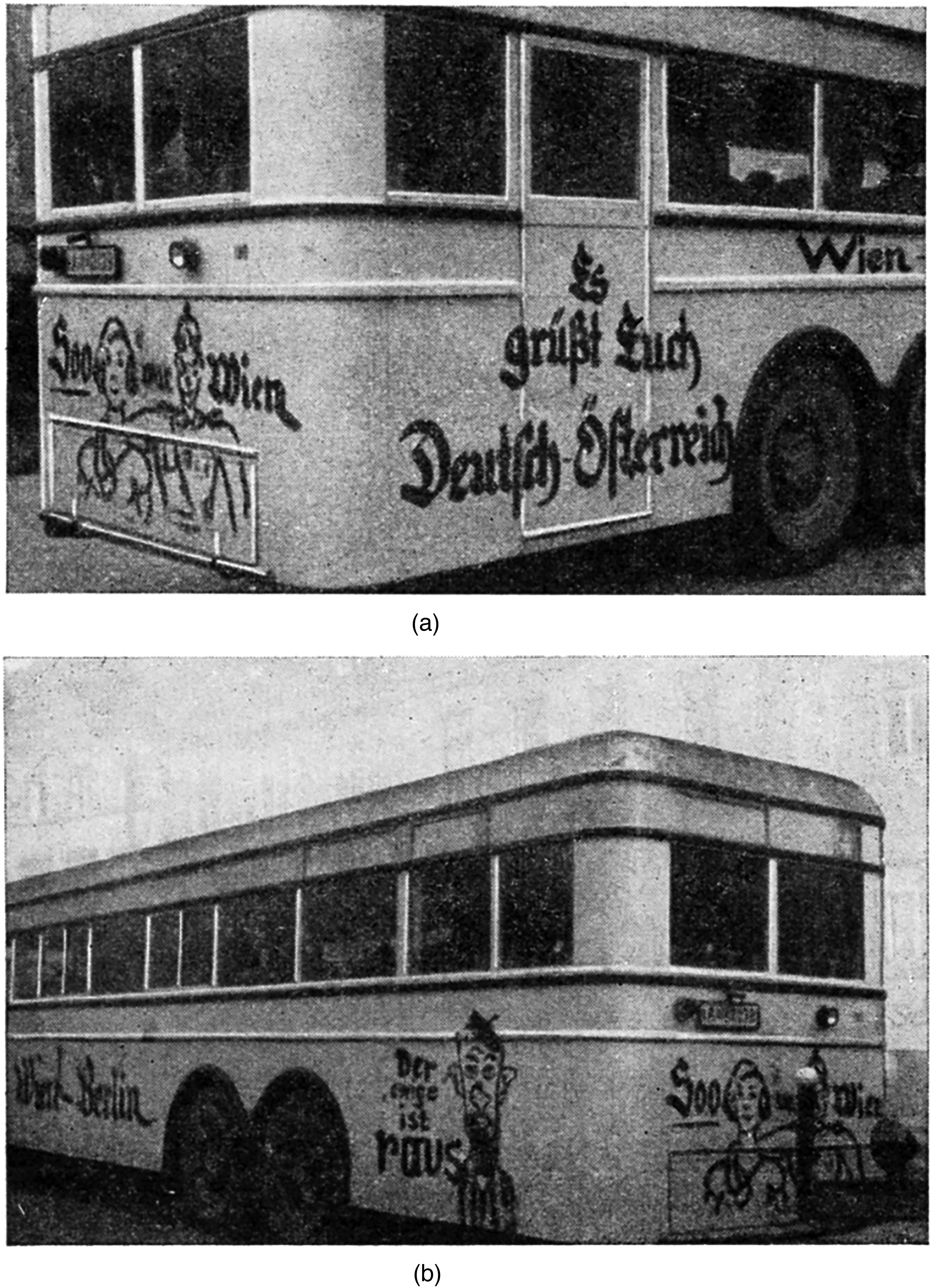
a–c: BVG buses decorated with nationalistic slogans and anti-Semitic caricatures.
The annexation of Austria did not merely entail a political and territorial expansion from DF's standpoint but also constituted urban transformation for Großdeutschland (Greater Germany), with Vienna now positioned within the Reich's growing network of Weltstädte (world cities). A 1938 article explicitly declares: “Through the union of Austria with our fatherland, the greater German national state has also gained one more Weltstadt”. 40 The expansionist vision of Weltstadt was not merely about Vienna being subsumed into the Reich, it also foregrounded a mutual mobility between the two cities, touting Austria's full integration into the Nazi state. One particularly striking example of this is the four-week visit of the group Kinder der Wiener Straßenbahnkameraden (Children of the Vienna Streetcar Comrades) who arrived at Anhalter Bahnhof on April 10, 1938—the very day of the referendum for the annexation of Austria. The article frames this visit as a joyous occasion, presenting the children as enthusiastic participants in their new national reality. One article describes the children's excitement and relief to finally be able to say Heil Hitler as a greeting, and their relief of “no longer hav[ing] to worry that their fathers could be imprisoned”. 41 DF's reporting thus framed the annexation of Austria less as the imposition of a regime, but rather as a fulfilment of a long-suppressed natural affinity, suggesting that these children could now openly embrace a Nationalist Socialist identity that had been off limits to their parents’ generation due to the Austrofascist ban (1933–1938) on the Nazi party.
As DF evolved under National Socialist control, its scope expanded beyond merely connecting Berliners to excursion destinations in and around the city. The journal likewise changed its visual focus away from Berlin to show Greater Germany, from the northern lowlands to the southern Alps, protected, headlines stressed, by the Wehrmacht “on land, on water, in the air”. 42 Around the same time, particularly following the Anschluss, DF advocated strongly for Germany's colonial ambitions. Regular advertisements and articles encouraged readers to join the Reichskolonialbund (Reich Colonial League), while defending the push for colonial reclamation. Titles such as “Our Demand: Resurrection of the German Colonial Empire”, 43 “Lazy Excuses in the Colonial Debate”, 44 “German Colonial History”, 45 and, perhaps most notably for the direct appeal to its workers, “The BVG's Colonial Party” 46 demonstrate how the journal encouraged its readership to see themselves as participants in these contemporary colonial debates.
One of the most striking shifts in DF's trajectory is its reframing of progress through the Weltstadt concept; and not just in terms of public transit, but of urban modernity itself. While earlier issues had celebrated technological advancements and the accelerating forces of modernity, later editions increasingly redirected attention toward the workforce, emphasising discipline, dedication, and collective labour over innovation. This shift reflects a broader ideological repositioning, in which the destabilising effects of modernity at the forefront of artistic production at the time, such as acceleration, the loss of individual agency, and the restructuring of spatial and temporal perception, are recast as being firmly “under control” under National Socialist rule. In this context, public transit was no longer depicted as a disruptive force of modern life, but as a symbol of order and national stability. This recoding of not only political meaning, but also the discursive understanding of mobility as a potentially disorienting force of modernity, is crucial for understanding DF's strategies in positioning Berlin as a growing metropolis. The term Weltstadt in the Weimar era did not imply stability but rather embraced the transient, fluid, and potentially disorienting nature of urban modernity—celebrating ephemerality as central to the city's dynamism. Under Nazi rule, however, this very concept was recast to serve expansionist aims, stripping Weltstadt of its associations with unpredictability and instead mobilising it to justify colonial ambitions and imperialist discourse. The once-celebrated openness of the metropolis, inextricably tied to the discourse of mobility and public transit, was now reconfigured as a hierarchical vision of global dominance.
Public transit and the staging of leisure and sports
Through DF, the BVG emphasis on sport and leisure can be seen as part of the regime's wider strategy to win over the working class. Just as vehicles and the built transportation infrastructure were mobilised by DF to posit Berlin as a Weltstadt, the journal's emphasis on sport and leisure extended this logic to the moving human body through thematic strands connecting transportation, discipline, and recreation. As Detlev Peukert has shown in his seminal study, the working class remained one of the groups least receptive to National Socialism. He argues that “the lack of enthusiasm for the character and policies of the regime, and the lack of zeal in the workplace, went along with a wary retreat into privacy and into the atmosphere of solidarity in small, intimate groups within the working-class social environment”. 47 By contrast, Peter Fritzsche has shown how, in spite of the limits implied by Peukert, National Socialism eventually crept into everyday life through language and shared practices. 48 Within this tension, we can trace how DF employed sport and leisure to align everyday routines and interests within broader ideological projects.
By the 1920s, escapism had become more than just a response to the demands of modern urban life; it transformed into an industry. The rise of a modern leisure culture in the late 1920s reflects a growing awareness of leisure as an economic force, deeply embedded in patterns of consumption, mobility, and social aspiration (by “modern leisure” I refer to a broad category of cultural practices that were popularised in 1920s Germany, and especially Berlin, including but not limited to cinema, cabaret, and sports, as well as to the expanding culture of advertising and consumption). 49 With expanded access to paid time off and a public transit network that made lakes, forests, and resort towns accessible, Berliners embraced the idea that escaping the city, even if only momentarily, was essential to navigating the strains of salaried work and hectic city life. Magazines, advertisements, and travel brochures promoted das Weekend (the weekend) as a structured break from urban routine. In the 1920s, it was common to use the Anglicism, das Weekend (the German original term is das Wochenende), to describe leisure time spanning Saturday afternoon and Sunday. The term evoked cosmopolitanism and was associated with new forms of recreation, consumption, and mobility. The weekend relied on the same commercial impulses that defined city life: the purchase of proper attire, the use of cameras and gramophones, the selection of trendy destinations. 50
The Nazi regime did not eliminate the structures of modern leisure—it reframed them, turning escapist mobility into a regulated component of collective discipline, as exemplified by the evolving rhetoric of DF. Engel held dual roles in 1933 as both Treuhänder der Arbeit (Trustee of Labour) for the Brandenburg economic region and chairman of the supervisory board of the BVG (The role of Treuhänder der Arbeit was created by the Nazi regime to oversee and regulate labour relations, replacing independent trade unions with state-controlled structures that dictated wages and working conditions). However, in 1934, Engel was relieved of his position as trustee of labour. Rather than marking a setback, this shift allowed him to refocus his rhetoric on the importance of leisure and recreation, particularly through the newly established Kraft durch Freude (KdF, Strength through Joy), an organisation stressing that “work and leisure were complementary and mutually reinforcing aspects of life”, affirming that “after work activities’ amounted not to the escape from work but its affirmation”. 51 Reflecting on his dismissal, Engel framed his departure as an expected consequence of the intense demands of his position yet he also takes the opportunity to stress a broader lesson: “Things in Germany surely would not have turned out this way if, before 1914, more attention had been paid to the emotional and spiritual life of the German people”, reflecting the common Nazi argument that the political and social instability of the early twentieth century could have been prevented if the state had earlier addressed the psychological and recreational needs of its people. 52
As the 1930s progressed, DF increasingly blurred the lines between the BVG's internal workforce and the nation at large. Although the company organised its own sporting events and associations, DF's heavy promotion of KdF further eroded the boundaries between company and regime initiatives. Leisure mobility, in particular leisure travel organised by KdF, thus became a tool not just for recreation, but for ideological alignment, reinforcing collective identity within the BVG. Importantly, this mobilisation of leisure was not a Nazi invention; rather, it drew on earlier discussions about the social value of recreation and movement that had already taken shape during the Weimar Republic and late imperial Germany. Earlier examples of this legacy include: the Lebensreform (Life Reform) Movement of the late nineteenth and early twentieth centuries promoting natural living, vegetarianism, and nudism; the rise of Turnen (gymnastics) under Friedrich Ludwig Hahn; the Wandervogel between 1896 and 1933; and the Arbeiter-Turn und Sportbund (Workers’ Gymnastics and Sports Federation) from 1893 to 1933 that linked leftist political views and fought for the representation of the working class in established sports clubs. 53
Throughout the Weimar years, the BVG positioned itself as an institution facilitating not just urban transit but also recreational mobility, as evidenced by the long-running article series “Mit der BVG in die Mark” (Take the BVG to the Mark [Brandenburg]) and their Ausflugführer (excursion guide), both of which encourage city residents to travel into Brandenburg's natural landscapes (Figure 3). 54 The BVG continues to participate in similar exhibits also in later years. 55
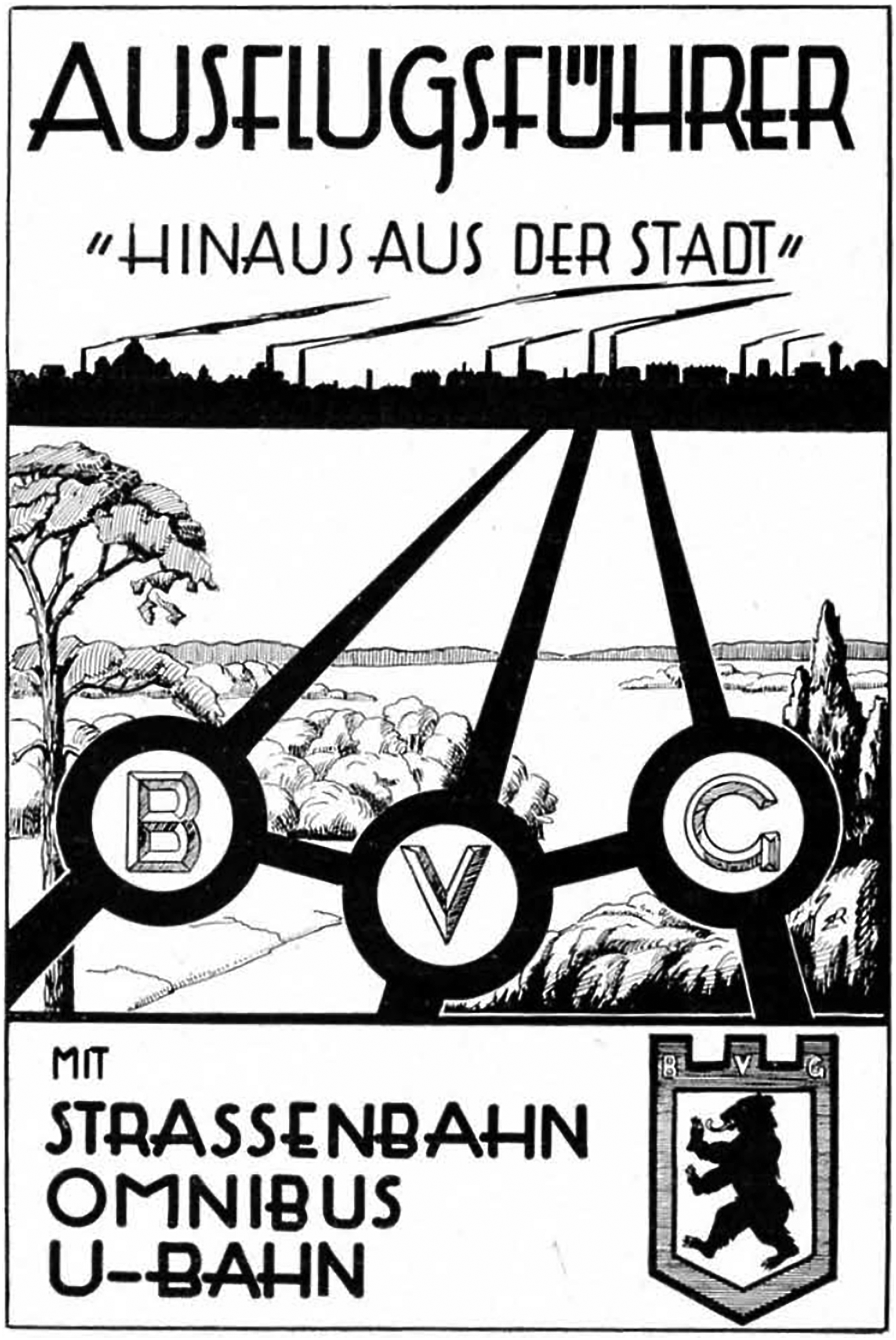
Cover of an excursion guide.
The company also took part in high-profile exhibitions, including the 1931 Travel and Traffic Exhibition at Wertheim, the 1932 Sun, Air, and House for All exhibition at Kaiserdamm, as well as the 1932 Winter Sport Exhibition at the KaDeWe, reinforcing its role in shaping access to fresh air, open space, and physical well-being. Already in their first issue, they provide a list of the various sports clubs organised by the BVG, from bowling to football, boxing, and motor sports.
56
Another article underscores the alignment between mobility and physical vitality, asserting that sport and transit should run parallel: Is there anything more beautiful than traveling into God's lovely countryside in a modern BVG passenger train, whether to the beautiful forests and lakes of Mecklenburg, to admire the unique beauty of the Spreewald, unmatched anywhere else in the world or to any other destination? Here, sports clubs have an excellent opportunity to organise enjoyable outings at a reasonable price.
57
The BVG's investment in sport continued to operate on both symbolic and practical levels under National Socialist editorship. Internally, BVG employees were deeply embedded in organised athletics, holding their Generalappell (general assembly) in the Berlin Sports Palace, a venue synonymous with mass spectacle and political mobilisation.
58
Two of their key leaders, Otto Schönrock (Chairman of the BVG Sports Club) and Fritz Treubrodt (Head of the BVG Athletics Department), were inducted as honorary as members of the Leichtathletik-Abteilung für nationalen Sport (Athletics Division for Nationalist Sport), “In recognition of [their] selfless, long-standing service dedicated to German sport, and in particular to the Berlin Public Transit Company Sports Club”.
59
Externally, the BVG expanded its athletic infrastructure, opening a new outdoor swimming pool in 1939 and through collaboration with KdF to provide workers with access to sports medicine advisory centres ensuring their physical readiness.
60
The journal further reinforced the ideological function of sport, celebrating winter athletics with “Ski Heil!”
61
and insisting on the necessity of continued physical training, especially after the outbreak of war: In National Socialist Germany, sport is no longer a private matter! Every young German has the duty and obligation—now more than ever—to maintain mental and physical readiness through athletic activity, so that when called upon for Germany, whether at home or at the front, he will be able to stand his ground. That is why our motto is: “Sport will continue!”
62
This rhetoric makes clear how physical exercise was redefined as both civic duty and military preparation, fusing the discourses of sport and leisure with the regime's demand for wartime readiness (Figure 4).
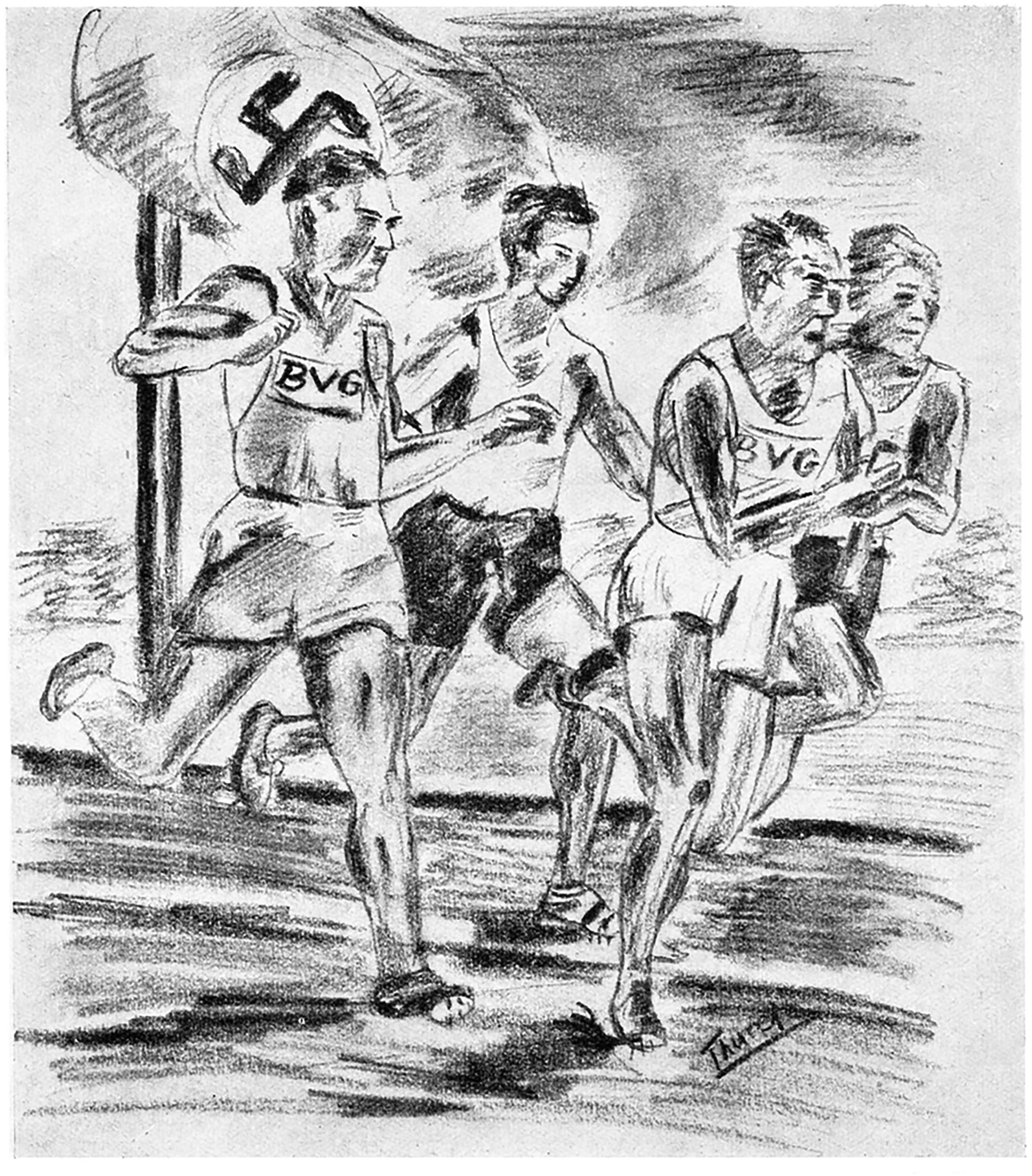
Illustration of BVG athletes running under the swastika flag, announcing their third workplace sport festival.
DF recast public transit and the BVG workforce as not merely a connector of people and spaces but as an ideological infrastructure for shaping a national community. Public transit's unifying potential was thus co-opted to enforce division, turning an integrative system into a tool of control. Such instrumentalisation diverged from the connective logic inherent to public transit itself. By design, transit links home and workplace, city and periphery, and as cultural artefacts of the Weimar era such as Ruttmann's 1927 Sinfonie der Großstadt (Symphony of a Great City), Döblin's 1929 Berlin Alexanderplatz, and the photography of Sasha Stone and László Moholy-Nagy illustrating individual passenger and collective urban movement. In DF, this connective tissue was recalibrated so that mobility symbolised inclusion only within the regime's imagined Volkskörper (national body).
Conclusion
The focus on mobility through the BVG's internal employee periodical brings a different dimension to a familiar question of propaganda. More specifically, this helps us see why movement of vehicles and bodies as a collective, was a medium through which propaganda could easily be spread. Rather than inventing whole new practices, the BVG under National Socialism used their staff periodical DF to reframe existing narratives of mobility. In contrast to the Weltstadt rhetoric that may have appeared somewhat remote from daily life, the blending of work and leisure, coupled with the emphasis of sport and bodily vitality hit much closer to home; the appeals were no longer abstract slogans. In other words, while the abstractness of the vision of a Weltstadt stood in tension with the concrete, embodied dimensions of movement, DF employed these elements side by side both in the Weimar and National Socialist eras.
Further work might examine additional areas outside the present scope, such as the periodical's depiction of women in the workforce or its extensive attention to accidents and accident prevention. The former becomes increasingly prominent as the workforce was reshaped by wartime mobilisation, while a more concentrated focus on the latter might yield insights into how the BVG navigated shifting operational conditions during this period. A closer examination of DF's successors in more recent memory may also reveal interesting intersections of BVG's self-envisioned role against the backdrop of contemporary political debates regarding questions of belonging and urban cohesion.
Approached through the lens of mobility, DF makes visible how everyday practices of transit were discursively rearticulated to naturalise competing ideology projects across the rupture of 1933. This is revealing in the ways that Weimar-era visions of urban modernism, grounded in civic cohesion and technological progress, were recalibrated under National Socialism. The paradox is telling: the Nazis needed the city and its networks—its workers, visibility, and rhythms—even as it sought to redirect them. By appropriating and instrumentalising familiar representational forms of mobility and transit via themes such as Weltstadt and leisure culture, DF embedded first Weimar-era ideals and, later, their National Socialist reinterpretations into a discourse already familiar to a working, urban public. Ultimately, these continuities reveal a narrative intent behind the periodical's content, namely, to craft a story in which the BVG was not merely an urban service provider, but a formative agent in shaping the future of Berlin as a modern metropolis, and by extension, the nation itself. In this sense, we see how transit workers were implicated into broader regimes of mobility while public transit itself remained central to the cultural imagination of Berlin as a metropolis.
Footnotes
Acknowledgements
I would like to thank the BVG historical archive in Berlin for giving me access to the materials examined in this article.
Declaration of conflicting interests
The author(s) declared no potential conflicts of interest with respect to the research, authorship, and/or publication of this article.
Funding
The author received no financial support for the research, authorship, and/or publication of this article.
