







Abstract
Women's involvement in the transport business in the early eighteenth-century is considered through a case study of the barge trade of Surrey's Wey Navigation. Around one in 10 of the bargemasters, those running the trade, were women. Their backgrounds varied. Aged between their 20 s and 50 s, the bargemistresses appear in the records after the death of their husband, father or brother. Often trading for several years, the nature of their trade and its scale generally reflected that of their deceased male relative, commonly at a lower level, but still comparable to that of some male bargemasters. Some traded concurrently with but separately from another male relative. A range of evidence suggests the bargemistresses were an accepted part of the community of bargemasters and their recorded involvement in the business strongly supports their previous close (but usually invisible in the records) earlier involvement as not only as wives but also as daughters.
Introduction
In April 1710, Henry Johnson, a bargemaster based in Guildford, England, had a problem. He was unwell and feared – rightly – that he was dying. 1 His particular difficulty was that he was a widower with a young family. His wife Ann had died the previous year and his six surviving children were all young, aged between 2 and 17. Such a situation was not uncommon at the time and the provisions he made in his will were, for the most part, also not uncommon. His main beneficiary was the older of his two surviving sons, John (aged 9) who was also to make provision for his siblings when they turned 21. Less common was that Henry chose to leave his barge business to his 17-year-old daughter Mary. Describing her as “being my Eldest Daughter and Capable of Manadgement”, he left her “My Stock & out Doore goods Barge Barges boates horses Cattle & Implements of Trade & Stock Bargeing & husbandry”, besides making her his sole executrix (named to carry out the instructions of the will and manage the deceased person's estate). 2 Henry, whose business involved the carriage of freight on the Wey Navigation and the Thames, clearly believed that it was possible for a woman to be involved in running a barge trade such as his. 3
The barge trade in the eighteenth century might have been expected to be an overwhelmingly male business. But the will of Mary's father suggests otherwise. Unfortunately, there is no evidence of what Mary did following her father's death.
This article provides a contribution to understanding women's economic activity in transport in the period by considering a group of women running barge businesses on the Wey Navigation, the waterway worked by Henry Johnson. The Navigation was a managed river running for about 15 miles between Guildford and the Thames in south-eastern England. The key source which enables this exploration dates from 14 years after Henry Johnson's death. It is the fortuitous survival of the Account Book of the Proprietors of the Wey Navigation 1724–1758. This contains a detailed list of the Navigation Proprietors’ incomings and outgoings. 4 The Proprietors' main source of income was “riverage” payments – tolls paid by bargemasters for using the Navigation. The information of the Account Book is supplemented by parish records, wills and other local sources to flesh out the biographies of those recorded.
Following a brief historiography, the article outlines the Wey Navigation, its barge trade and the bargemasters who ran the trade between 1724 and 1758. It then considers its bargemistresses, the dozen or so women who traded on the Navigation in this period. To do this, it firstly takes a numeric approach, comparing the level and nature of their involvement with those of men. Secondly, it provides brief biographies of the bargemistresses, illuminating their trade and the context through which they came to be trading. Thirdly, it considers evidence of women as part of the bargemaster community.
Historiography
Getting a sense of women's working lives in the eighteenth century is difficult. Women's occupations were much less frequently reported in the historical records than men's. A woman, for example, was almost never identified by her occupation in probate documents in early modern England. 5 One insight is available from a study of London court records which showed that around 1700 nearly all single and widowed women were in employment, as were at least two-thirds of married women sometimes but far from always in the same occupation as their husbands. 6 Although most married women did work – the economic survival of many eighteenth-century households required their involvement – they are often invisible in the records; being mostly regarded as feme covert (under the legal doctrine of coverture, through which a woman's legal persona was subsumed into that of her husband upon marriage), their property and economic activity was treated as that of their husband. 7 Useful summaries of relevant literature are given in Doe and, more recently, in Erickson. 8
Entrepreneurship was an attractive option for women. Erickson wrote that “[g]iven sufficient capital, running one's own business was infinitely preferable for women, whose wages stuck at the biblical ratio of one half to two-thirds of men's wages for over 500 years”. 9 In the early modern period, the inability of most women to be accepted as freemen of a town hampered their ability to run a business successfully and makes those that did less visible in the records. Wallis wrote that there were “only a few guilds in which women were present in very large numbers”. 10 In some towns, for example late seventeenth-century Oxford, the city admitted no women as freemen. 11 In London and in some other towns, including seventeenth-century Reading and eighteenth-century York, some women were accepted as freemen. 12 In the eighteenth century, women's businesses remain less visible in newer types of historical records: trade directories and insurance policies, for example, were less likely to include businesses run by women. 13
Although there was a tendency for businesswomen, as other women, to work in so-called “feminine trades” (petty retail, food, drink, and textiles) or in occupations such as workshop-based trades or innkeeping, which provided a domestic context, they were not solely in such trades. 14 Women in the first half of the eighteenth century worked in a much wider range of trades, some that were later to become the monopoly of men. 15 Simonton wrote that in eighteenth and nineteenth century Scotland women were “present and active in business as wives, widows and singletons, not always ‘holding the fort’ until a suitable male arrived on the scene” and that “Scottish women were not only involved in business but also dominated certain sectors and that they did not necessarily withdraw from business on marriage and motherhood”. 16 Similarly, Hafter and Kushner wrote that in eighteenth-century France: “[m]istress craftswomen and master's widows ran their own workshops, taking on the training of apprentices as well as the manufacture of goods, the management of their businesses, and sometimes that of a guild”. 17
A range of studies have looked at businesswomen in sectors which do not fit the idea of “feminine trades”. There are many examples of individual businesswomen in such sectors in the eighteenth and early nineteenth centuries including Barbara Ford, a maltster, Anne Turton, initially an ironmonger and subsequently a vintner, Eleanor Coade, a manufacturer of artificial stone, and Charlotte Matthews, a Lloyds member and a financier of the industrialists Boulton and Watt. 18 Other studies have considered not individuals but groups of women involved in particular businesses and have demonstrated women's considerable involvement in trades often regarded as “masculine”. One example is that of the Newcastle coal trade in the sixteenth century. Women were extensively involved in the business of Newcastle's hostmen, a guild of freemen trading in coal. 19 Overs showed that widows “were involved in the running of family coal businesses, were as active in trade as their male counterparts and continued to trade in their own names even though they had adult sons”. They “owned and controlled family and business capital, trained apprentices […] and were central to the property networks and inheritance of mining land”. Overs concluded that there was no bar to women trading in a heavy industry traditionally seen as a male enterprise. 20 In a study of shipowners around England in the nineteenth century, Doe described how “women were shipowners, they managed men, dealt with customers, handled the logistics of complex businesses and were not limited to ‘feminine’ trades”. The role involved being familiar with maritime law and insurance and maintaining good contacts and the need to work with a wide range of people. Doe also found women in related businesses such as shipbuilders, managers of foundry business and marine store dealers. 21
Women running transport businesses
The inland transport trade has not been a trade commonly associated with women. Women were not, though, despite the suggestion of some earlier historians, wholly absent. 22 Women recorded in the transport trade included, for example the widowed Ann Nelson, a nineteenth century, innkeeper and coachmaster, who “effectively ran the business before her husband's death and continued to do so for many years afterwards before one of her sons took over”. 23 Studies mentioning women working either as carriers (land transport of freight) or bargemasters (water transport of freight) are often limited and anecdotal, simply noting the presence of some women's names in contemporary records. The most thorough study of the carrier trade is by Gerhold who explored carriers and coachmasters serving London in the late seventeenth century using two contemporary lists compiled by Delaune in 1681 and 1690. 24 Of the 645 carriers listed, about 2 per cent were women. A larger proportion, 5 per cent of the 212 coachmasters listed, were women. 25 Almost all were widows and, beyond their names and the routes they worked, very few details of them are available.
The barge trade might thus seem an unlikely occupation for women to play a significant role in. It was not a “feminine trade”; it did not have the domestic focus of workshop-based trades; it did not (unlike coachmasters) generally have an association with innkeeping; it required involvement with people from some distance away; and it probably needed the ability to acquire credit, something women were less able to access than men. Little detailed insight into women's involvement in river trades is available. The most thorough is probably Prior's study of the Fisher Row area in Oxford which identified women as central to the river-based communities of fishermen, bargemen, river boatmen and canal boatmen who worked the upper Thames between 1500 and 1900. 26 But it did not consider those based at nearby Folly Bridge in Oxford, the bargemasters trading down the Thames towards London with whom the bargemasters of the Wey Navigation would have had more in common. 27
There is some limited evidence elsewhere of women's involvement in the barge trade. Agnes Hellous of Walton-on-Thames, not far from the mouth of the Wey, was running a barge on the Thames in the mid-sixteenth century: in her will of 1558, Agnes, a widow, included the instruction to her executors to pay 10 s “each to my daughters out of the profit of my barge for five years”. 28 Further upstream, in Henley-on Thames, Townley found that in the eighteenth century (and probably for much longer) barge families continued for several generations. A few records identify individual women's involvement, including Sarah Jackson, a widow, described as a bargemaster and publican in 1774. 29 Similarly, working on the Upper Severn (1660–1900) was described by Trinder as “famously a hereditary occupation, and the operation of a vessel or set of vessels was a family concern that involved women as well as men. There is no evidence that women worked on boats, but they commonly managed their operations”. Such women included Margery Peakes of Bewdley who “took responsibility for more than 60 voyages undertaken by her family's tows between 1720 and 1725” and Ann Andrews of Bridgnorth who told a court in 1706 she had carried on her husband's trade after his death. 30
The Wey Navigation and its barge trade
The Wey Navigation was a managed river, running from the mid-seventeenth to the mid-eighteenth centuries between Guildford in western Surrey and the Thames upstream from London at Weybridge. 31 It was about 15 miles long, of which 9 miles were new cuts bypassing the natural river, and it contained 12 locks. The Navigation's main cargoes were timber (mainly to London, much bought by the Navy), grain (to London and elsewhere along the Wey and the Thames) and coal (from London), the heavy, bulky, non-perishable cargoes well suited to water transport. Its barges, somewhat smaller than those on the Thames due to the dimensions of the Navigation's locks, tended to be manned by a crew of three and were propelled by oars, sail, poles and horses, or possibly sometimes man-hauled. 32 Trips to London might take 3 days, two on the Navigation and one on the Thames. 33 Crews had the benefit of a fabric covering at the stern of the boat to shelter in overnight (see Figure 1), but this was only for the duration of the voyage; they did not, unlike later canal boatmen, live on the barges.
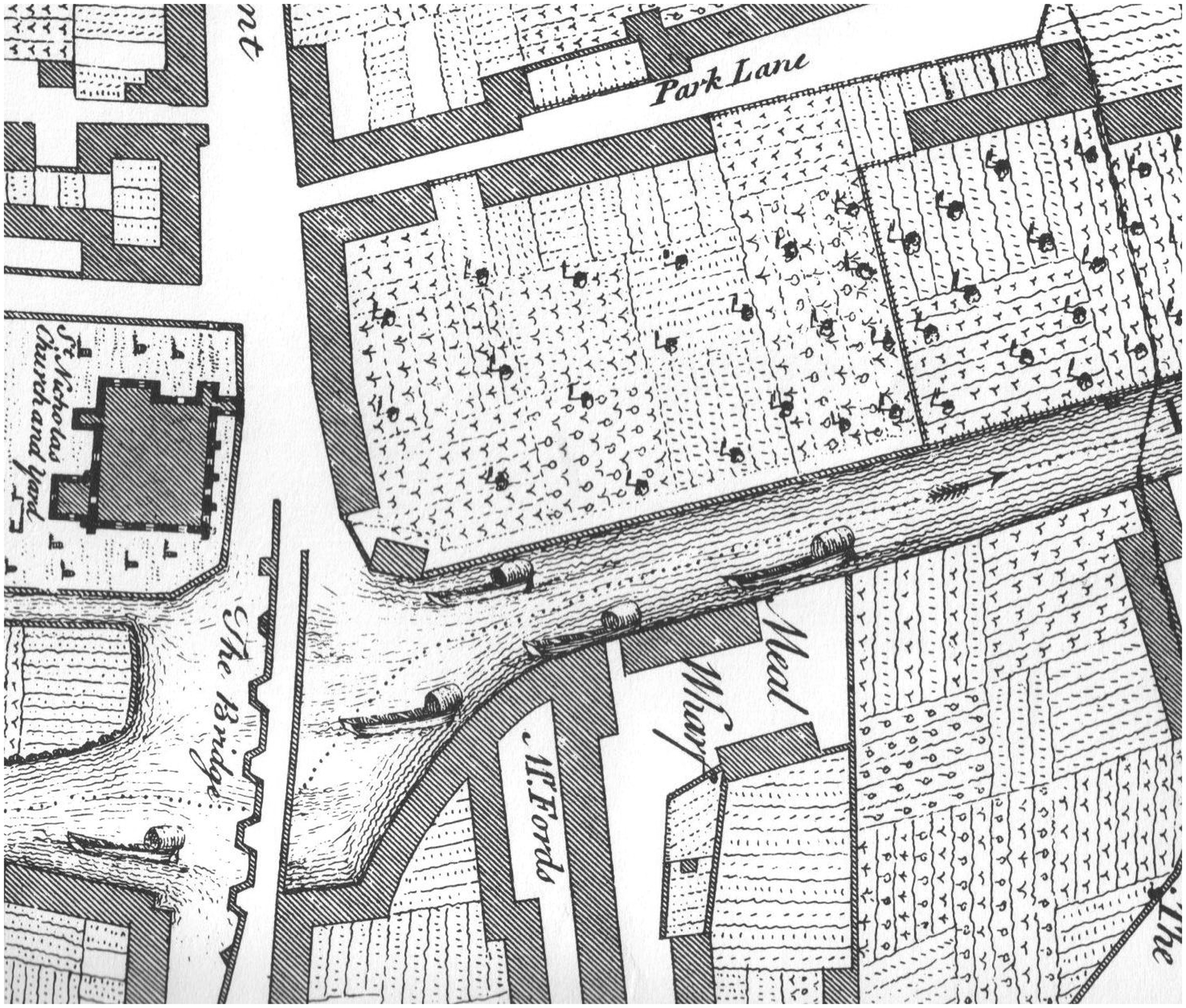
Barges on the Wey Navigation at Guildford. Source: SHC, 8363/1/33/15, 1739 Guildford Ichnography (detail).
Willan and Rolt distinguished three categories of people who worked river barges – bargemasters, relatively affluent business people who ran the trade; bargemen who crewed barges; and (where they operated) bow-halers, men who pulled the barges. 34 Such distinctions were true of those who worked on the Wey Navigation. This article is concerned with the first group, those who ran the business, the bargemasters and bargemistresses of the Wey Navigation. They have been only lightly touched on by other authors, and the women not at all. 35
The demands on bargemasters would have been considerable, both financially and practically. The barge trade was capital intensive. Bargemaster Hugh Moth, for example, bought a barge in 1724 for £105 (comparisons between monetary values over time are problematic but one estimate suggests this might be equivalent to about £23,000 today) and re-sold it to another Guildford bargemaster in 1733 for £150. 36 The trade could also involve the movement of considerable amounts of money. For example, a newspaper report of 1789 recorded the theft of £78 15 s in London from a Guildford bargemaster. 37 Barges were also physically vulnerable. For example, a newspaper report of 1743 recorded: “On Wednesday last two barges from Guildford, with Timber, were sunk at London-Bridge, occasion’d by being too deeply laden and the Water being very rough, the Bargemen with Difficulty sav’d themselves by the Assistance of a Boat from Pepper-Alley Stairs”. 38
A bargeman from the first part of the twentieth century described vividly the difficulties for a horse-hauled barge on the Navigation itself: “When you was going up to Bowers Lock in a flood, you used to have a pony on the stern. And the horses used to go hell for leather […] and you’re going, I can tell you! […] You’ve only got to make one miss and you’ll sink the barge”. 39
A further challenge for the business owners was the management of the men crewing the barges. Bargemen had a reputation for being unruly. Contemporaries saw them as troublesome, their semi-itinerant lifestyle positioning them outside the mainstream of society making them less easily controlled by the social and legal structures the rest of society operated under. 40 A 1695 Act made Thames barge owners liable for any damaged caused by the “rude and disorderly persons […] managing the said barges”. 41 The nature of bargemen's reputation is illustrated in a 1776 newspaper report of a coach robbery near London by three teenage boys: “There were seven outside Passengers, and it is remarkable that five of them were Hertford Bargemen, who are deemed the most fighting Fellows in the Kingdom, yet they submitted to be robbed by three Boys”. 42
In Guildford, the Wey Navigation bargemen sometimes challenged the authorities. In 1730, for example, a newspaper report recorded that in Guildford: This day Five of the Malefactors condemned here at the late Assizes for this County, were executed […]. Money was collected yesterday in our Churches for Coffins to bury them in, and notwithstanding their bodies had been begg’d by Surgeons, our Bargemen brought them off and saw them interred.
43
Wey Navigation bargemasters
Wey Navigation bargemasters varied in the nature of their trade, in their level of usage of the Navigation and in where they were based. Some were carriers offering their services to others. Others owned a barge for the purposes of transporting their own goods. Some appear in the Account Book (1724–1758) in only one or two quarters, making a small payment of £1 or so. A few appear in every quarter for years, sometimes for a couple of decades or more, a couple making annual payments approaching £1000. Some Wey Navigation bargemasters were based in Guildford at the Navigation's southern end while others were based on the Thames, at or near the mouth of the Wey. A few were from places on the Navigation between the two.
Wey Navigation bargemistresses
Not all the bargemasters were men and the remainder of this article focusses on the bargemistresses, businesswomen running their barge trade. No instance of a woman working as crew on a barge on the Navigation has been identified. A couple of women were recorded in the Account Book working as lockkeepers, both at New Haw towards the north of the Navigation, probably managing the barges’ riverage payments. Both were paid the same rate as the men who preceded and followed them.
Numbers
Following the acquisition of the Wey Navigation by new Proprietors in 1724, its record keeping, at least in as much as what has survived, improved greatly. Their Account Book records, for every quarter between 1724 and 1758, the names of all those paying the Proprietors riverage, the fee for barges using the Navigation, and the amount of their payment. 44
In total, the Account Book contains about 126 different names of people paying riverage. The exact number is slightly uncertain, depending on a few assumptions when names vary slightly in the recording – are J. Smith, John Smith and Mr Smith one, two or three people? And is Jeremiah Smith another person or included in one or more of these descriptions? Sometimes other evidence supports such a linkage but occasionally it remains unclear. In all but 3 years at least one of those paying riverage was a woman, it was not uncommon for there to be two in the same year and, on a few occasions, there were three. In total, 15 women are recorded. Two more, both daughters of bargemasters, are almost, but not quite, visible in the records and they too are discussed here. Of the 15 bargemistresses explicitly recorded, 12 were clearly working as bargemistresses, a tenth of all those trading. The remaining three appear only fleetingly and the reason for their payment is uncertain. The scant evidence available suggests one was possibly a member of a Thames-based barge family, another's payment may not have been for riverage and the third was a gentry widow probably paying the riverage on a barge transporting goods to or from her family's estate near the Wey Navigation. Given their minimal involvement in the Navigation and the lack of securely based evidence of their backgrounds, they are not discussed here further.
The trade undertaken by these 12 bargemistresses formed, based on riverage payments, about 8 per cent of the Navigation's total trade between 1724 and 1758, so slightly less than their numbers would suggest if they traded at the same level as their male counterparts. Women's total payments over the course of their trading lives ranged from a little under £1 to over £1,500; men's from a few pence to over £12,000. These comparisons highlight two key differences between men's and women's trade. One is the presence of a few very substantial male bargemasters. Nehemiah Wilkins who traded for about two decades had annual riverage payments increasing to over £900 and his total payments over the whole period of his trading was £12,100. The two Lockwoods, William (senior) and William (junior) traded throughout the period of the Account Book. At their peak, their annual payments approached £900 and their total payments were £11,300. Together they accounted for over a quarter of all riverage payments recorded in the period of the Account Book. Excluding these three men, the Lockwoods and Nehemiah Wilkins, the mean total riverage payments by male bargemasters in the period of the Account Book were £477, close to the women's figure of £440. The other difference was that men and women differed in the extent to which they made only very occasional use of the Navigation. Such men (presumably Thames bargemasters) were very much more common than women. Eighteen men made payments of under £1 and 22 between £1 and £6 compared to only one woman paying under £1 and the next lowest woman's payment being over £6. As a result, bargemistresses’ median total payment recorded in the Account Book (£126) was considerably higher than that of the bargemasters (£38).
Biographical sketches
This article is concerned next with identifying something of the lives of the individual bargemistresses. The bargemistresses were a varied group and their biographies illustrate the range of women's involvement in the Navigation barge trade, their links with male bargemasters and something of men's attitudes to women being involved in the barge trade.
Most of the bargemistresses recorded were widows. But, perhaps surprisingly, only about a half of them seem to have been involved in the trade solely through being the widow of a bargemaster; for several, there is evidence that it was their involvement in the barge trade as the daughter of a bargemaster from which they gained much of their expertise. One widow whose husband was clearly expecting his wife to trade after his death, and moreover to do so at the same time as, but separately from, their son, was Mary Field of Chertsey (on the Thames). Her husband, John Field, appears briefly in the Account Book, paying only a very few pounds of riverage from 1750 until his death in 1753. The Fields were a longstanding family of bargemasters based at Chertsey (see also below, Ann Delver) and John was presumably trading mostly on the Thames, the Navigation forming a small part of his wider trade. In his will, he made provision for his daughter, his son and his wife. His daughter Ann was left £20. Bequests to his son John included “my largest Barge with all manner of Tackle thereunto belonging” and also the lease of his wharf from Sir William Perkins (a wealthy local merchant). Bequests to his wife Mary included “all my Boats and Tackle (not herein before given)”. He made clear in a codicil that he expected both his wife and his son to trade. His concern was that his wife, Mary, be able to make use of the wharf: my Will is that my Loving Wife Mary Field shall during the term of her natural life have free liberty to Load and unload all manner of boats and work Carriages for that purpose to and from my said Wharf free from all Expenses or Impositions charged by my said son John Field or any other person claiming under him.
45
Another widow whose husband's will shows he expected her to continue in the trade was Mary Powell, based in Guildford. In her husband Andrew Powell's will of 1729, he left her “use of my barge and goods for life then to her son Thomas Martin and to her grandson Henry Edwards between them”. 46 Mary too was made sole executrix. Andrew Powell was probably a carrier (transporting goods for others) as there is a record of a payment to him by Thomas Coram (best known as founder of the Foundling Hospital in London but earlier, for a short time, involved in the manufacture of gunpowder in Surrey). In April 1729, Coram “paid men of Deptford launch for bringing 200 empty barrels to Powells barge at Queenhith”. 47 Andrew and Mary had married a decade earlier, in Guildford in 1720. Mary had been married before, in 1701, to Thomas Martin by whom she had had at least three children of which their son Thomas (mentioned in the will) was born in 1708. One of their daughters, Mary, married George Edwards in 1726 and they had a son, Henry in 1727 (also mentioned in the will). It seems likely Mary had extensive links with the barge trade before her marriage to Andrew Powell for both her maiden name, Petoe (Peyto, see also below, Mary Peyto, nee Westbrook), and the surname of her first husband, Martin, were those of bargemasters on the Navigation in the early eighteenth century. Based on the date of her first marriage, she was probably in her 50 s when her second husband died and she took over the trade, her son Thomas about 20 and her grandson Henry a baby. Her husband had paid moderate levels (£20–50) of Navigation riverage for only a couple of years, 1728–1729, until his death. Following her widowhood, Mary traded on the Navigation for a few years, 1729–1732, at a similar rate to her late husband. She did not hand on the trade either to her son or to her daughter's family for there is no mention of Thomas Martin or anyone with the surname Edwards trading, either in her lifetime or subsequently during the period of the Account Book.
In contrast to the Powells, some bargemasters and bargemistresses were not carriers but instead used their barges to carry the goods which were their main business. One such was Ruth Gallop, the widow of Thomas Gallop, a Guildford-based timber merchant and bargemaster who died in 1733.
48
Timber was a major product traded on the Navigation, as Defoe described in 1722: by this navigation a very great quantity of timber is brought down to London, not from the neighbourhood of this town [Guildford] only, but even from the woody parts of Sussex and Hampshire above thirty miles from it, the country carriages bringing it hither in the summer by land.
49
Bargemistress Ann Delver, too, was the widow of a timber merchant, William Delver of Walton-on-Thames, but she was very much younger than her husband. He traded on the Navigation for 30 years, almost all of the Account Book period, from 1725 until his death in 1754. He made only small payments in the early years, presumably trading more on the Thames, but over time his trade on the Navigation increased to between £50 and £200 a year. Ann (nee Tyrrell) was William's second wife and had been only 18 at their marriage in 1751 so was about 22 when widowed, by which time she had a very young child, Mary, born 1754. Ann, despite her youth, probably had experience of the barge trade for she was from a bargemaster family: her father, Henry Tyrrell, traded intermittently on the Navigation between 1728 and 1745 until his death and her mother's maiden name was Field, another Thames-based bargemaster family. Given the shortness of her marriage, it seems most likely it was her experience as a daughter of a bargemaster, along presumably with family support, which enabled her to take over the trade. She continued the business, at a lower level than her husband for a couple of years after her husband's death. She then remarried in 1756, marrying William, another member of the Field family. He paid the balance of her account that year and he continues to be recorded in the Account Book until it ends in 1758. Ann may well have continued to be involved in the trade after her marriage but her involvement is no longer visible in the records.
Anne Burchett was a bargemistress involved in another of the major trades of the Navigation, the grain trade. Defoe wrote in about 1722: this navigation is also a mighty support to the great corn-market at Farnham, which I have mentioned so often: For as the meal-men and other dealers buy the corn at that market, much of it is brought to the mills on this river; which is not above seven miles distant, and being first ground and dress’d, is then sent down in the meal by barges to London.
54
Three families had more than one woman recorded as trading. One was a prominent Guildford family, the Wilkins. They had been involved with the Navigation since its early days, and their status had risen over time. The family contained two bargemistresses in the period of the Account Book, Jane and her granddaughter Ann. Bargemistress Jane Wilkins was the widow of John Wilkins. Her father-in-law, also John, had described himself in his 1684 will as a bargemaster and in his lifetime had been a churchwarden and an overseer of the poor, both in Guildford. 56 His son John, husband of Jane, described himself as a gentleman in his will of 1725–1726 as did his grandson, Nehemiah in 1743. Jane's husband John had been mayor of Guildford on three occasions and her son, Nehemiah, was also to become mayor. She was the sole executrix of her husband's will and his main beneficiary, inheriting various properties in Guildford. She traded from shortly after her husband's death for 7 years until her own death in 1733 making quite substantial annual riverage payments of about £150, about half her late husband's. She traded at the same time as her son Nehemiah.
The Wilkins family's second bargemistress, Ann Wilkins, Jane Wilkins's granddaughter, was Nehemiah Wilkin's daughter. Nehemiah had traded between at the latest 1724, until his death in 1743. His trade, initially around £300 per annum rose substantially, paying at its peak an annual riverage of £913 in 1735–1736, the most substantial payment made at the time. Baptised in St Mary Guildford in 1715, Ann would have been in her late 20 s when her father died. Her mother Elizabeth, Nehemiah's wife, had died many years previously when Ann was just 3 years’ old. So it seems likely, especially given her grandmother's involvement (Jane lived until Ann was a teenager), that Ann had, from a young age, been closely involved in the barge trade. Although the younger of the two daughters mentioned in her father's will, Ann was its major beneficiary and was also made sole executrix. Bequests to her included “Timber Plank Ship Pins Stock in Trade Goods Chattels Credits and Personal Estate”. The bequest suggests her father expected her to trade, and she did
Another family in which more than one woman (this time two sisters-in-law) was involved in the barge trade was the Pauley family, though in this case the story is complicated by one being married and hence almost invisible. Confusion is added by the overlap of the names of those involved: bargemaster John Pauley (senior) had at least two children, Elizabeth (who married Thomas Bax) and John (junior), also a bargemaster, who married another Elizabeth, nee Beale, in 1732 in Guildford. Elizabeth Pauley, nee Beale, the widow of John (junior), was recorded as trading on the Navigation for several years in the 1750s at an annual rate of around £150. Her husband had died in 1749 having traded for about a decade at a similar rate. Elizabeth Pauley's father-in-law, John Pauley (senior), traded initially at the same time as his son, John (junior, Elizabeth's husband) and subsequently, after his son's death, at the same time as his daughter-in-law (John junior's widow), providing another example of both male and female members of a family trading concurrently. The trade of John (senior) was slightly more than that of his son and then of his daughter-in-law, with annual riverage payments of about £200. Elizabeth traded until her death in 1756. Elizabeth's final payment was paid by William Drury, another bargemaster.
The family also contained another woman who was almost certainly a bargemistress, Elizabeth Bax (nee Pauley), the daughter of John Pauley (senior). She is not one of the bargemistresses recorded explicitly in the Account Book but the evidence of her involvement in the barge trade is sufficiently strong as to justify her inclusion here. On her father's death in 1755 he left his daughter Elizabeth, wife of Henry Bax (or Box), and her son James Denyer “all my barges and their trappings”. 59 She was his younger daughter and would have been in her mid-40 s at the time. Elizabeth Bax had been married twice. First, she married James Denyer in 1735 and her son, also James Denyer, was born the following year. She was widowed in 1741, marrying Henry Bax in 1750. Hence her surname (Bax) and that of her son (Denyer) at the time of her father's will. Elizabeth Bax was joint executor of the will with her son James Denyer who would have been about 19 at the time. Following the death of John (senior) death, his son-in-law Henry Bax (Elizabeth's husband) traded jointly with Messrs Richardson, an arrangement John Pauley (senior) had started shortly before his death. He would have been in his 70 s, his son had died and his daughter-in-law Elizabeth Pauley was probably unwell. It seems likely his daughter Elizabeth Bax continued this arrangement when she and her husband took over her father's business but that due to her married status the surviving records are in her husband's name only. Contributing to the likelihood that it was Elizabeth, not her husband, who ran their barge business is that her husband Henry Bax was not recorded as a bargemaster until after his father-in-law's death.
The third family to contain two women involved in the barge trade was that of Jeremiah Westbrook, specifically his daughters Catherine Bowyer and Mary Peyto. Catherine Bowyer was the bargemistress who traded for the longest period of time. Her father, Jeremiah Westbrook, had traded on the Navigation since at least 1724 (possibly earlier) until his death in 1737 making annual riverage payments of between about £100 and £150. 60 On his death he bequeathed property in the area of Guildford's town wharf to his surviving children, his three daughters Catherine, Mary, and Sarah. His three sons had pre-deceased him. The last to die, John, died only shortly before his father and had appeared briefly in the Account Book paying small riverage payments a few years before his father's death. Jeremiah's daughter Catherine was married to George Bowyer and his daughter Mary to Thomas Peyto. 61 Neither George Bowyer nor Thomas Peyto was recorded in the Account Book before the death of their father-in-law but both were recorded as trading following his death. Mary's husband Thomas Peyto traded between 1738 and 1740 at a modest level, £40 a year. He was almost certainly from a barge family as his surname was that of a family who did trade on the Navigations (see above, Mary Powell). But there is no record of Thomas himself trading previously. Catherine's husband George Bowyer traded from 1737 until his own death in 1743. George Bowyer's trade was initially modest, similar to Peyto's, but increased to about £150 a year in his final year. When he died in 1743, his widow, Catherine, then aged 50, took over the trade, continuing for a decade until 1753. 62 She had a regular, quite substantial trade, paying riverage of around £150 a year, similar to that of her father (Figure 2). It seems likely both Catherine and her sister Mary had been involved in the barge trade with their father and their brother John until the two men's deaths. Then, both sisters carried on trading at a temporarily much lower level but, since they were married, they were under couverture and invisible in the records. Instead, their husbands were recorded as trading. Mary and her husband then disappear from the record for reasons that are unclear. The death of Catherine's husband enables us to see her trade for the first time. She traded for a decade, making in total the largest riverage payments of all the women, £1,581. Following Catherine's retirement from the barge trade, another member of the family, John, possibly her son, took over. His confidence in the stability of the trade is suggested by his decision, aged 28, to marry in 1753, the same year as he took over the business. Catherine lived locally for another 26 years, her death being recorded in St Nicholas parish in 1779. This is the only example identified of a bargemistress possibly retiring and handing over her trade to a younger male relative.
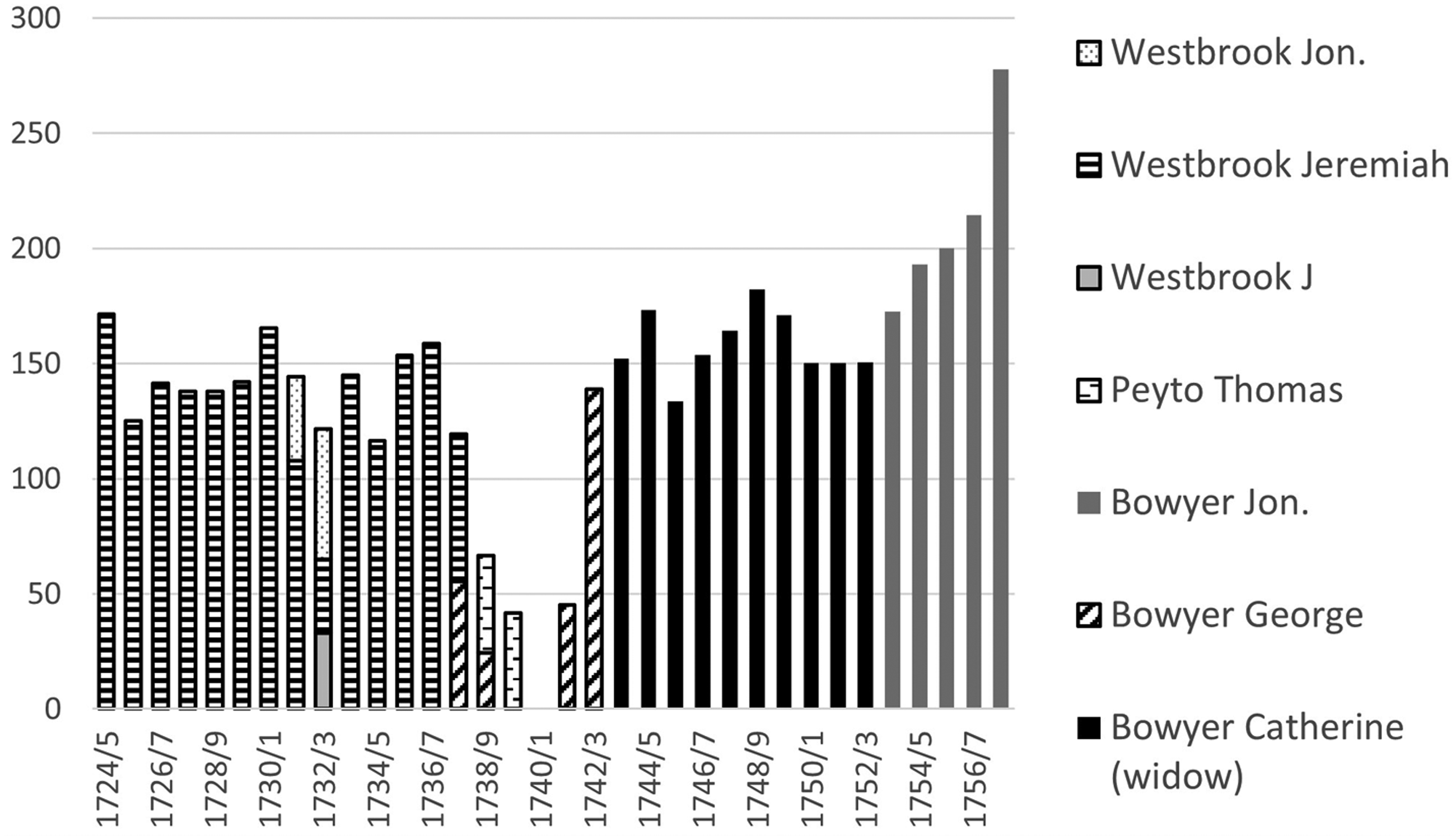
Westbrook, Peyto, Bowyer annual riverage payments 1724–1758 (£). Source: Wey Navigation Account Book.
The bargemistresses considered so far were the widows or daughters of bargemasters but one may have had a different relationship with a bargemaster, probably being the widowed sister of a bargemaster, taking over his trade on his death. Widow Stephenson (later recorded as Elizabeth) was first recorded in the Account Book in 1740 (she was recorded variously as Widow, E., Elizabeth). Unique amongst the bargemistresses recorded, there was no-one of the same surname trading previously. She was plausibly the widowed sister of a deceased bargemaster, John Sink. He had traded regularly since 1725 (small quarterly payments between £2 and £15) until the first quarter of 1740–1741, that is April–June 1740. Elizabeth made her first payment immediately after his death in the next quarter, July–September 1740. She continued to trade for a couple of years until 1742 making small payments, similar in size to John Sink's. Elizabeth was probably his younger sister. A John Sinke of Great Bookham was the father of three children: John (1694), Elizabeth (1695) and Mary (1699). In 1719, an Elizabeth Sanke married a John Stephenson in Send and Ripley. It has, though, not been possible to identify the death of John Stevenson. All these parishes – Ockham, Great Bookham, Send and Ripley – are within a few miles of each other and one, Send and Ripley, lies on the Navigation. If the identification is correct then Elizabeth would have been in her mid-forties when she took over her brother John's trade. Further details have, unfortunately, proved elusive.
Finally, much more limited information is available about another two women recorded as making riverage payments in the Account Book, Mrs Brown and Mrs Mildred, but they both seem to fit into a similar pattern to those already discussed. Mrs Brown is recorded in 1752, shortly after the last payment by John Brown (junior,) probably her husband. Her payment, like his, was small. He and his father John Brown (senior), were timber merchants and bargemasters based on the Thames who had both traded occasionally on the Navigation between 1730 and 1751. 63 Mrs Mildred made riverage payments between 1748 and 1750. She was probably related to John Mildred, a mealman of Guildford, and Robert Mildred, a miller of Newark Mill to the south of Guildford so likely to have been using the Navigation to transport grain or flour.
Integral part of the trade
The biographical details of the bargemistresses outlined above point strongly to women's close involvement in the barge trade of the Wey Navigation, several features of their biographies suggesting that they were very much seen by contemporaries as an integral part of the trade. Of those bargemasters whose wills have been identified, it was common for the wife or daughter to be made sole executrix: this was the case in six of the eight Navigation bargemaster wills described. Most of these women were also explicitly left a barge or barges in the will. In doing so, some husbands made clear their expectation that their widows would continue their trade.
The name by which widows were recorded in the Account Book provides a further sense of their being regarded as an intrinsic part of the trade, as independent businesswomen not simply as widows or daughters. It was far from uncommon for widows to be recorded with their first names also given, especially after they had been trading for a period of time. And for several, Ann Delver, Catherine Bowyer, Mary Powell, Jane Wilkins, simply their first name and surname were used at times. Doubtless, the extent to which some of the women carried on trading at a level comparable to that of some male bargemasters and for periods of years rather than simply a few months while they wound up the trade was a key part of their acceptance.
The acceptance that women were capable of running a barge trade is exemplified further by the several women who are recorded as trading at the same time but separately from a male relative: Mary Field traded at the same time as her son John; Jane Wilkins at the same time as her son Nehemiah; Elizabeth Pauley at the same time as her father-in-law John. Moreover, bargemistresses do not, for the most part, seem to have been carrying on their trade only temporarily, doing so until a male relative was able to take over. Occasionally a male relative may have taken over the bargemistress's trade on her death, such as Ruth Gallop, but only one example has been identified (Catherine Bowyer) of a male relative apparently taking over on a bargemistress's retirement.
The bargemistresses were part of an extensive network of relationships by marriage which existed between bargemaster families including those, on the Thames, between the Delver, Tyrrel, and Field families and, in Guildford, between the Powell, Petoe, Martin, Bowyer, and Westbrook families. The scale of women's connections with the barge trade is exemplified further by considering how many of the bargemasters families had at some stage a female relative working as a bargemistress. In the Account Book, out of the total of 111 men, there were 27 men who were from a family which also contained a bargemistress (based on surnames) or a quarter of all the male bargemasters. If the most infrequent users are removed, those paying in total less than £5 riverage, it leaves 75 bargemasters. Thus, about a third of the bargemaster men making at least modest use of the Navigation were from families which included bargemistresses.
Conclusions
This article provides a new perspective on a less researched topic, the role of women in running a transport business, specifically the barge trade, in early eighteenth-century England. As such it contributes to the understanding both of the barge trade and more generally of the economic involvement of women in eighteenth-century businesses. The barge trade might be expected to have been a trade dominated by men. But this study suggests otherwise. Rather than the more usual brief mention of the names of a few women recorded in a mainly male trade it offers a view of a group of businesswomen, suggesting who they were, how their involvement came about and where they fitted into the wider business. It shows the Wey Navigation's barge trade should be viewed not as a “male” trade but as a trade in which both men and women were closely involved.
It shows women made up around one in 10 of those recorded as bargemasters in the Wey Navigation Account Book 1724–1758 and that in almost every year covered by the Account Book at least one woman was trading. The bargemistresses were all close relations of bargemasters but in other ways they were a relatively heterogeneous group. They were the widows or daughters of bargemasters, or in one case probably a sister. Aged between their 20 s and their 50 s, some took over the trade from their deceased male relative for only a few months but most continued to trade for a number of years, their pattern of trade being similar to that of their deceased male relative though generally at a somewhat lower level. Several traded at the same time as, but independently from, another male relative. There is evidence of the relevance of women's experience in the barge business as daughters, not solely as wives: in one example a daughter explicitly traded on her own account for a couple of years before marriage; in several others, while couverture sometimes conceals the details, it seems very likely that it was the bargemistress's position as the daughter of a bargemaster that provided her with much of the expertise to take on the trade. The women's acceptance as an integral part of the trade is suggested by their often being bequeathed one or more barges and related equipment, by being made sole executrix of the husband's or father's will and by some widows being referred to by their forename, not as widow, in the Account Book. Around a third of the male bargemasters making more than occasional use of the Navigation were from a family which also contained, at some stage, a bargemistress. In addition to the bargemistresses’ close involvement within the immediate family, their expertise would have also been through being part of a network of relationships by marriage which existed between bargemaster families.
Taken together there is thus strong evidence that women were closely involved in England's eighteenth-century barge trade. Sometimes, as in the Wey Navigation, some of that involvement is visible but even there, with its unusually complete financial records, much of that involvement is not directly apparent from surviving records. Women's involvement in the barge trade was thus a key aspect of the trade which should not be overlooked.
Footnotes
Acknowledgements
The author is grateful to Adrienne Rosen for supervision of the Master's dissertation from which this article developed, to two anonymous reviewers and to Amy Erickson for valuable comments on earlier drafts of this paper.
Declaration of conflicting interests
The author declared no potential conflicts of interest with respect to the research, authorship, and/or publication of this article.
Funding
The author received no financial support for the research, authorship, and/or publication of this article.
