






Abstract
The use of animals as a model for humans has a long history. This paper describes in a bird’s eye view the main developments from the ancient period until recent times. Although animal models have been used since the early Greek and Roman civilizations, the main increase in their use dates from the end of the Second World War. Not only did the number of animals used in experiments increase dramatically in this period, but also the variety of species, as well as the purposes for which animals were used. However, from the 1970s onwards, the number of animal experiments has decreased. The reasons for this decrease are briefly explored.
Early developments of animal use
The development of the use of animals as a model for man runs, to a great extent, parallel to the development of medical science. The basis of Western medicine stems from Greece, where philosophers were among the first to practice vivisection (literally: cutting into living organisms) for scientific purposes.1–3 Although it is most likely that the traditional Chinese medicine and herbal remedies that developed in the 21st century
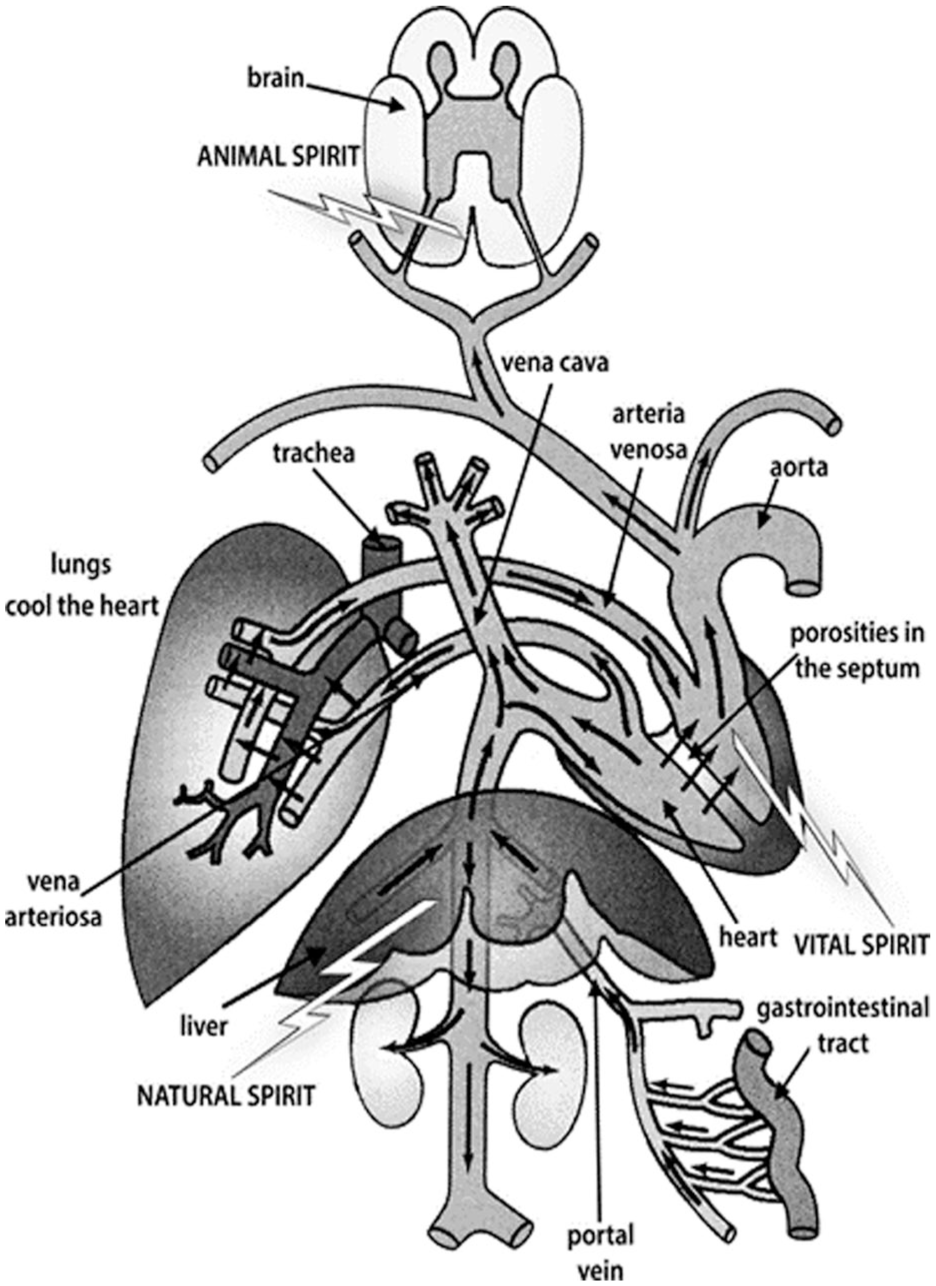
Blood flow according to Galen.
The first era of Western medical research ended with Galen. Roman culture did not provide a conducive environment for the further development of medicine and biology. After the increase of Christianity, experimental science ceased almost completely. Empirical studies were banned for more than a millennium, and no animal experiments worth mentioning were carried out. This situation lasted until the 15th century, the beginning of the Renaissance period. 6
Most of the work of the Greek philosophers would have been lost had they not been rescued through initiatives in the Eastern world. Arab scholars like Joannitius (Ibn Ishaq, 809–873
Developments in the Western world
In the Western world, the revival of experimental medicine and biology was part of the total revival of learning. Philippus Aureolus Theophrastus Bombastus von Hohenheim (1493–1541), better known as Paracelsus, was the first to once again use medical experiments as a means to gain understanding, rather than affirming prior beliefs. He rejected the work of his predecessors and claimed that knowledge could only be gained through experience, careful observation, and experimentation. At the same time, Leonardo da Vinci’s (1452–1519) insight into the human body was also partly based on experiments with animals. The empirical approach rapidly gained ground. Initially, the emphasis that prevailed in medicine and biology was mainly on anatomy (Vesalius, De Humani Corporis Fabrica, 1543), but from the 17th century, physiological processes (Harvey, Exercitatio Anatomica de Motu Cordis et Sanguinis in Animalibus, 1628) were also subjects of study.11,12
At this time, animals were not regarded as sentient creatures. This view was promoted by the publications of French philosopher René Descartes (1596–1650), who proposed that living systems could be understood on purely mechanical principles. The main difference between humans and animals was believed to be that animals had no soul and, therefore, no consciousness. He expressed that, “man is able to think and to feel pain but the animal acts as an insensate machine.” German philosopher Immanuel Kant (1724–1804) partially embraced Descartes’ ideas. In his view, humans had intrinsic value, whereas animals had only instrumental value, although he judged that torturing animals without reason was unacceptable.
From the 18th century onwards, it was gradually accepted that the results of experimental medicine contributed to man’s welfare and living conditions. It also became evident that the further development of medicine depended on the results of animal experiments. 6
However, this does not mean that, in those days, everyone was applauding the use of animals for this purpose. In 1789, Jeremy Bentham made an impressive contribution to the debate on the justification of animal experimentation. In his famous Introduction to the Principles of Morals and Legislation, he rejected the Cartesian view that animals had no capacity to feel pain. His view on the moral states of animals cannot be expressed more concisely than in the frequently quoted sentence, “The question is not, Can they reason? nor, Can they talk? but, Can they suffer?”—referring to infants, people with neurodevelopmental disorders, and animals. 6
In the 19th century, a major movement against animal experimentation began, first in Victorian England and later in France, where physiologists such as Francois Magendie and Claude Bernard were targets of criticism by the anti-vivisectionists. The first anti-vivisection organization, “The Victoria Street Society,” was established in 1875 in England. It was also in England that the first law on the protection of experimental animals (Cruelty to animals Act, 1876) was introduced. 6
However, the viewpoint of some extremists, demanding the total abolition of animal experiments, was not generally supported in society. On the contrary, from the end of the 19th century animal experimentation increased, becoming an integral part of biomedical research.
Several points can be considered as contributory factors to this increase 6 :
- The discovery of anesthetics, such as ether and chloroform in the first half of the 19th century, enabled scientists to anesthetize animals before exposure to painful experiments. However, initially, this was more to immobilize the animals than for pain relief.
- In 1859, Charles Darwin published The Origin of Species, in which he gave a scientific basis for the concept of evolution. The evidence that the similarity between humans and animals was based on homology, provided a rational basis for the use of animals as models for man.
- In 1865, Claude Bernard’s Introduction à l’étude de la médecine expérimentale was published. In this book, Bernard introduced methodology as a tool for the design of physiological experiments. He strongly emphasized the need for animal models to further the development of experimental medicine.
- Developments in the field of microbiology also greatly influenced the increase in animal use. In 1884, Koch’s postulates were published (a set of criteria established to demonstrate the causative relationship between a micro-organism and a disease), wherein it states that, among other things, evidence for the pathogenicity of a micro-organism can be obtained after successfully infecting healthy susceptible animals with material of a diseased individual. Thus, the experimental animal became an indispensable substitute for man in microbiology. The need for experimental animals in microbiology was further increased when the production of antisera and vaccines began, and their potency and safety were tested in animals.
- The development of several biomedical disciplines (pharmacology, toxicology, virology, immunology), and in particular the development of the pharmaceutical industry, caused a rapid increase in animal usage in the 20th century.
Animal use: numbers, species, and purposes
The first data on the number of animals used in biomedical research came from the UK, the first country in the world to introduce legislation on the protection of animals used for research purposes. In 1940, fewer than 1 million laboratory animals were used in the UK; in 1960, this had risen to 3.5 million, and in 1970, to 5.5 million (Figure 2). More than 90% of these animals were rodents. No reliable figures on animal use in other countries are available for that period. According to a rough estimate, in 1960 about 30 million vertebrates worldwide were used, increasing to between 150 and 200 million in 1970. The sharp increase in animal use after World War II can be explained by the explosive development of biomedical sciences (e.g. pharmacology, toxicology, immunology). Moreover, the Declaration of Helsinki, developed by the World Medical Association in 1964, requires that research involving human subjects must be based on adequate laboratory and, as appropriate, animal experimentation to ensure human safety. 13 In Europe and the US, biomedical research also received massive governmental funding during that period. For example, the budget of the US National Institutes of Health increased from approximately $8 million in 1947 to more than $900 million in 1966.
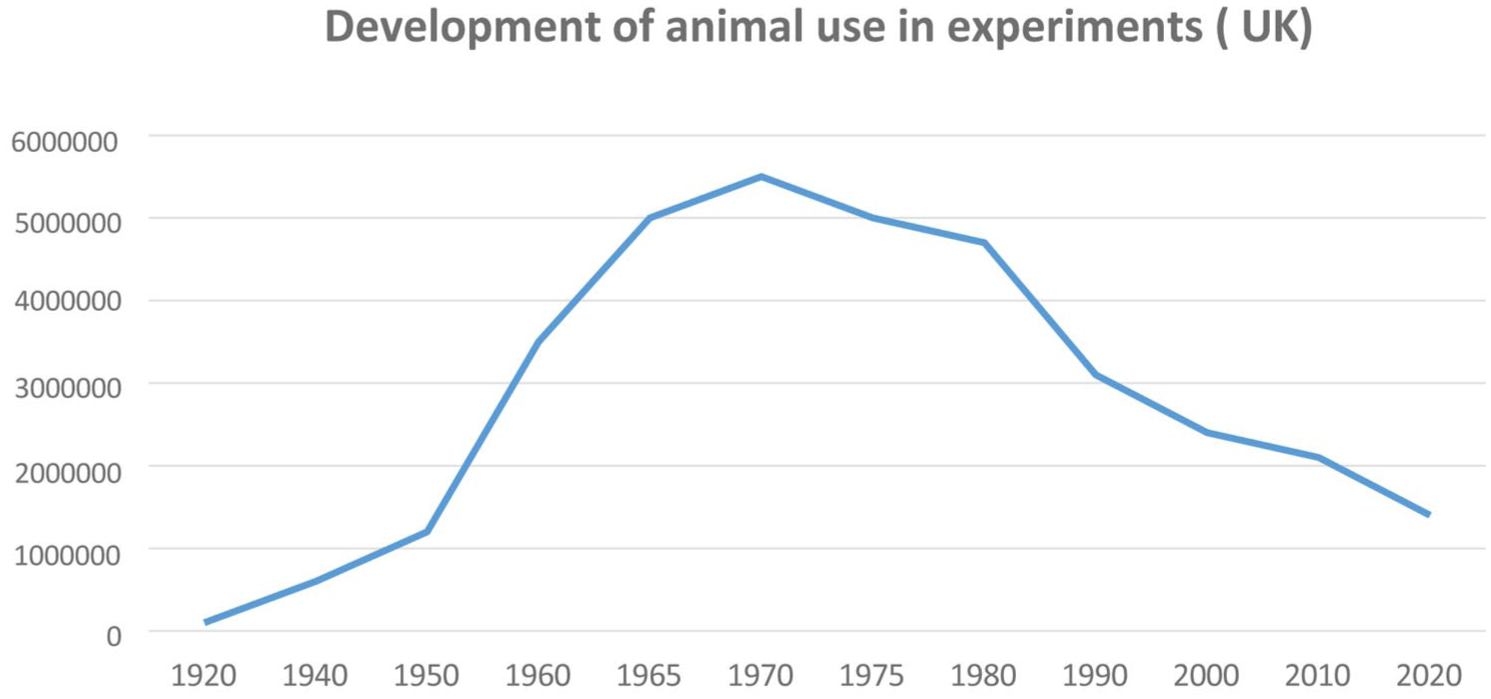
This graph illustrates the development of animal use in experimental procedures in the past century. It is mainly based on data from the UK, but data collected since the 1970s by the EU (and presented in the ALURES EU statistical database) for most EU countries illustrate a similar trend. As can be seen, after World War II, the use of animals increased dramatically, up until the 1970s. Thereafter, the number decreased and is still gradually decreasing.
In the 1970s, several countries other than the UK also started to collect data on animal experimentation and the numbers involved. Animal use seemed to stabilize during the late 1970s, then started to decrease from the early 1980s due to the development of alternatives to animal experiments, greater awareness of the use of animals in experiments, and the establishment of animal ethics committees. In the UK, the number of animals decreased from 5.5 million in 1980 to about 1.5 million in 2023 (2.7 million procedures when including the creation and breeding of genetically altered animals). 11 However, as comprehensive animal data were not available for all countries, Figure 2 should be considered indicative only; it cannot be regarded as an exact representation of the worldwide use of laboratory animals.
Until the end of the 19th century, domestic animals were mainly used in experiments; however, from the beginning of 20th century, researchers took advantage of the availability of inbred strains of mice and rats. More recently, several other vertebrate species have been used (Figure 3).
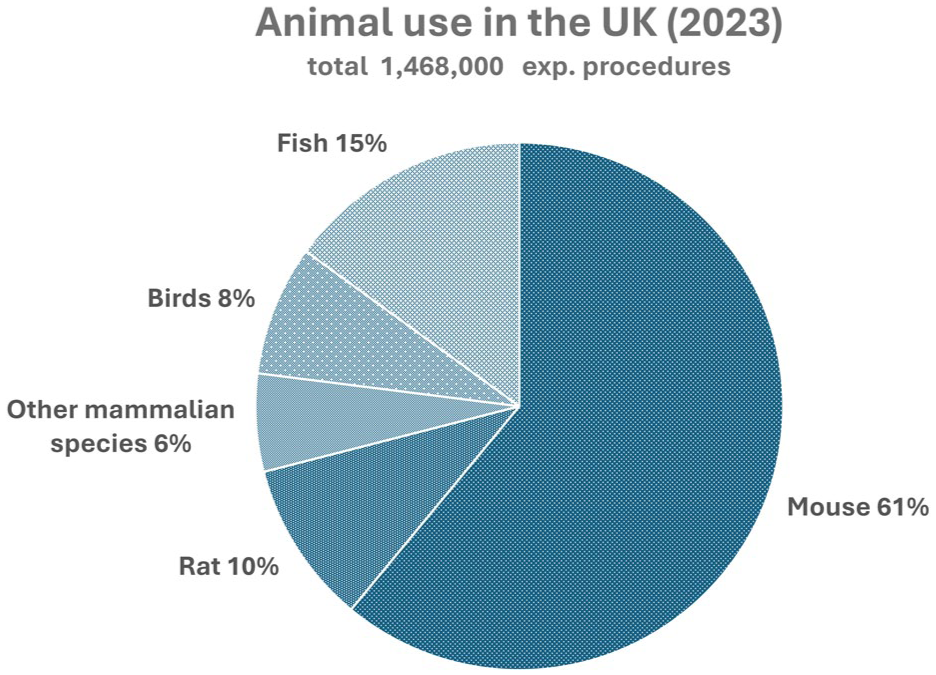
Distribution of vertebrate animal species used in experimental procedures in the UK in 2023. (https://www.understandinganimalresearch.org.uk/news/animal-research-statistics-for-great-britain-2023)
The mouse is by far the most frequently used experimental animal in the EU, including the UK (Figure 3). The category “other mammalian species” encompasses rabbits, guinea pigs, hamsters, dogs, cats, pigs, goats, and horses.
Within the EU, almost 7 million vertebrate animals were used in 2022, including 0.03% invertebrates such as cephalopods. 12 Although Directive 2010/63/EU was originally aimed at vertebrate species (including cyclostomes: a class of jawless fish), it was later believed that cephalopods should also be included in the scope of the directive, as there was scientific evidence of their ability to experience pain, suffering, distress and lasting harm. 12 This was implemented in 2013.
The registration of animal experiments has not only provided insights into the numbers of animals involved, but also into the variability of species and into the purposes of animal usage.
A breakdown of UK statistics for 2023 shows that animals were used for basic research (52%), applied research (24%), safety and regulatory research (22%), and research for the protection of the natural environment, preservation of species, and higher education or training (2%). 11
Regulations
Legislative regulations on the protection of animals used in experimental research have taken effect during the last decades. As mentioned, the first law was issued in England in 1876 (Cruelty to Animals Act). In the US, the Animal Welfare Act (1966) was amended in 1985 to include the Improved Standards for Laboratory Animal Welfare Act, whereas in 2010, after several European countries had already implemented legislation at the national level, Directive 2010/63/EU on the protection of vertebrate animals used for experimental and other scientific purposes came into effect.6,14
The term “animal experiment” can be applied to any scientific procedure involving animals, irrespective of whether the animal used is a vertebrate or invertebrate. However, in most legislative regulations on the protection of experimental animals, the term is restricted to experiments with vertebrates used for scientific or regulatory purposes that cause pain, fear, distress or lasting harm. 15
Legislative regulations have considerably influenced the development of laboratory animal science, but it is not only governments that have to deal with the question of regulating animal use. The International Council for Laboratory Animal Science (ICLAS) is an organization dedicated to the worldwide advancement of human and animal health and well-being by promoting ethical care and use of laboratory animals in research.
Scientific societies like the Federation of European Laboratory Animal Science Associations (FELASA), and national and local animal ethics committees, are also preparing their own guidelines. In this respect, it is worth mentioning that the guidelines adopted in 2001 by the European Science Foundation (ESF), an association of major national European science-funding organizations, set out its views on the use of animals in research. These can be summarized as follows:
- ESF recognizes that laboratory animals not only have an instrumental value, but also an intrinsic value that must be respected.
- While accepting the need for animal use for the advancement of scientific knowledge and for human and animal health and well-being, ESF strongly endorses the “3R” principles. Research aimed at improving the welfare of animals should be encouraged and actively supported.
- Prior to embarking on a program of research, animal use should be subjected to independent expert review, for both scientific and animal welfare considerations. The assessment and weighing of the potential benefit and likely animal suffering should be an essential part of the review process.
- Investigators should assume that any procedure that would cause pain in humans will also cause pain in other vertebrates, unless there is evidence to the contrary (principle of analogy).
- The best practical living conditions should be maintained for animals kept for research purposes. Monitoring of the care and health of the animals should be under the supervision of veterinarians or specialists in the field of laboratory animal science.
- Investigators and other personnel involved in the design and undertaking of animal-based experiments should be appropriately educated and trained. ESF member organizations should encourage the development of accredited courses on laboratory animal science, including information on animal alternatives, welfare, and ethics.
- ESF encourages the editorial boards of journals publishing the results of animal-based research to include in the “Instructions to Authors,” a statement on the ethical use of animals.
These guidelines clearly illustrate ESF’s position on the use of animals. Much emphasis is put on the requirements for animal welfare, alternatives, and ethics and on the responsibility of the researcher to meet these requirements.
Nowadays, several international journals require researcher submissions to the comply with the ARRIVE guidelines (Animal Research: Reporting of In Vivo Experiments): a checklist of information to include in publications describing animal research (https://arriveguidelines.org/). 16
Implementation of legislation and guidelines of (inter)national and local animal ethics committees and animal welfare bodies has had a major impact on the use of animals for experimental purposes. It has stimulated the search for animal alternatives and measures for improving animal welfare: notwithstanding the increase in biomedical research (including the use of genetically modified animals), the total number of animals used has substantially decreased (as illustrated in Figure 2).
Laboratory animal science
The growth of biomedical sciences and, as a consequence, the increasing use of animals, has been the impetus for the development of laboratory animal science. This is a multidisciplinary branch of science that contributes to the humane use of animals in biomedical research and to the collection of informative, unbiased, and reproducible data. Its main objectives are to contribute to the welfare of the animals and to improve the quality of animal experimentation.
Laboratory animal science encompasses the study of the biology of laboratory animals, their husbandry and environmental requirements, genetic and microbiological standardization procedures, the prevention and treatment of diseases, the optimization of experimental techniques, and improvements in anesthesia, analgesia, and euthanasia. Ethical aspects of animal experimentation, together with the search for alternatives, are an increasingly important domain of laboratory animal science. Russell and Burch’s approach, as elaborated in their 1959 book, The Principles of Humane Experimental Technique, has become a central theme in laboratory animal science. This book deals with the question of how the inhumane aspects of animal experimentation can be diminished or removed. The authors introduced the “3R concept” (Replacement, Reduction, Refinement) as a main guideline for the responsible use of animals in experiments. 17
Replacement
Replacement refers to the substitution of living animals by, for example, in vitro techniques, computerized models, mannequins, videos, film, and genomics. The animal model is replaced by an alternative procedure that yields the same results without the use of live animals.
New approach methodologies (NAMs), including advanced in vitro systems such as organoids and organ-on-chip platforms, together with artificial intelligence–driven in silico approaches, have promoted substantial progress in non-animal research methodologies.18,19 These approaches generate more human-relevant data, particularly in toxicity testing and early stage drug development, and support a significant reduction in laboratory animal use.18,20 Importantly, increasing regulatory recognition and promotion of NAMs by international authorities, including the EU Reference Laboratory for Alternatives to Animal Testing (EURL ECVAM), further facilitate their implementation in biomedical research.20,21 Nevertheless, current NAMs remain limited in their capacity to fully capture complex multi-organ interactions, long-term systemic toxicity, and immune responses.19,22 Consequently, scientific consensus emphasizes that non-animal and animal-based methods should still be applied as complementary, integrated strategies, ensuring scientific robustness while minimizing animal use whenever scientifically feasible.20,22
Reduction
Reduction refers to a decrease in the number of animals required for a given experiment. This can be achieved by choosing suitable experimental procedures, by improvements in the design and statistical analysis (e.g. power analysis) of animal experiments, by controlling environmental factors, and by standardizing the animal population—standardization reduces variation in the results. During recent decades, significant developments in health monitoring and standardization of genotype and environmental conditions, including nutrition, have contributed to a further reduction in variance. In particular, the improved organization within and between animal research institutes has contributed to the reduction of animal use.
Refinement
Refinement refers to any decrease in the incidence or severity of painful or distressing procedures applied to animals. Refinement can be realized prior to experimentation on the animal, for instance, by a better “reading” of the biological needs of the animal and translating them into adequate husbandry and environmental conditions. Adjustment of the environment to suit the behavioral and physiological needs of the animal is a prerequisite for animal homeostasis, whereas prolonged deviation from homeostasis may result in abnormal behavior and disease. Refinement can also be realized during the course of the experiment, for example, by improving experimental procedures or methods of anesthesia and analgesia, which may reduce distress.
The researcher should be aware that refinement not only contributes to the welfare of animals but also to the quality of the animal experiment. The 3Rs thus provide a concept for animal alternatives, and the search for such alternatives has met with increasing interest: specific journals are being published and major congresses organized to that end.
In 1993 the first World Congress on Animal Alternatives was organized in Baltimore, and the second in Utrecht (1996). Similar meetings have been held since then, every 2 to 3 years, in different parts of the world. At each of these meetings, Russell and Burch’s 3Rs concept is a central theme. 17
Education and training
Competence, originating from adequate education and training, is a main condition for the quality of research and for the careful and responsible use of animals. In many countries, completion of specific educational topics is required by law for persons responsible for the design of animal experiments, for animal caretakers, technicians, and anyone who is otherwise involved in the use and care of laboratory animals. Usually, the laboratory animal specialist/animal welfare officer is a veterinarian who has specialized in laboratory animal science; they may also be the person authorized to supervise the welfare of laboratory animals at the institutional level. Some countries are developing a post-graduate course in laboratory animal science for this group. This course may take between 6 months and 4 years to complete, depending on the graduate training program and previous experience of the trainee.
In various countries, veterinary colleges (e.g. the European College of Laboratory Animal Medicine) offer training leading to appropriate qualifications for laboratory animal veterinarians. Today, five laboratory animal medicine colleges (in America, Europe, Japan, Korea, and India) and one associate college (in the Philippines) are members of the International Association of Colleges of Laboratory Animal Medicine. 23
The scientist, as the designer of the animal experiment, has ultimate responsibility for the humane treatment of the animals. The welfare of the animals and the quality of animal research depends on an understanding of animals. As stated by Sir Peter Medawar in The Hope of Progress (1972), “one does not come by this understanding intuitively; it must be learned.” 24
Education in the field of laboratory animal science is not only needed for animal welfare officers and for persons who are charged with the daily care of animals, but is also a conditio sine qua non for the researcher. FELASA has addressed the question of how the competence of the scientist must be defined: a scientist may be considered competent for the design or performance of animal experiments after having completed graduate training in one of the biomedical disciplines (e.g. biology, medicine, veterinary medicine) and, in addition, having taken a course in laboratory animal science. In addition to the scientific and technical information necessary for the design of an animal experiment, the course should also deal with welfare issues and ethical aspects of animal experimentation. It must provide the tools for improving the quality of research, as well as for the careful, responsible use of animals. Replacement, reduction, and refinement should be the guiding principles for the course. Courses are also offered (partially) online in several countries: the species-specific training (handling, procedures with animals) must be completed in person. 25
Education and training, though essential, do not equate to a free permit to carry out animal experimentation.
It should be noted that an animal experiment is acceptable and justified only if
- it is necessary (no alternatives available),
- the benefit outweighs the animal’s suffering (according to the judgment of an ethical committee),
- it is carefully designed and performed by persons who are fully competent, with maximum attention on the welfare of the animals.
Laboratory animal science associations
Scientific associations in the field of laboratory animal science have been founded in various countries. In the USA, the American Association for Laboratory Animal Science is most prominent, whereas in Europe, several national associations have established FELASA. Laboratory animal science associations in 11 Asian countries are members of the regional association, Asian Federation of Laboratory Animal Science Associations.
ICLAS is a worldwide organization in the field of laboratory animal science, comprising national and scientific members from over 40 countries. The aim of ICLAS is to promote international collaboration in the field of laboratory animal science and, in particular, to support developing countries in achieving the standard required for both high-quality research and the humane use of animals.
Conclusion
The increase of the use of laboratory animals during the last century parallels the rapid development of biomedical medicine. However, although the field of biomedical medicine is still expanding, the number of animal experiments has gradually decreased since the 1970s. There are several factors that have contributed to this decrease. Legislative regulations to protect the welfare of animals are important, as is the organization of specialized education, the establishment of animal ethics committees, and developments regarding animal alternatives. These advancements have not only contributed to a decrease in animal use, but also to improvements in animal welfare.
Footnotes
Declaration of conflicting interests
The authors declared no potential conflicts of interest with respect to the research, authorship, and/or publication of this article.
Funding
The authors received no financial support for the research, authorship, and/or publication of this article.
