






Abstract
Successfully implementing the 3R principles relies on a range of interdependent factors operating across multiple levels. As such, any effort to advance the 3Rs must engage with this complexity and incorporate the lived experiences of stakeholders to inform policy advancements. In an interview-based study, we gathered insights from 35 Swiss researchers on the implementation of the 3Rs in Switzerland. Using reflexive thematic analysis, we identified two overarching categories of facilitation: originative facilitation, referring to the collective meaning-making of the 3Rs, and executive facilitation, encompassing politico-institutional conditions that support their implementation. The present paper focusses on the latter domain, in which key themes include political support fostering a pro-3R research environment, the cultivation of a 3R culture within research institutions, clearer 3R guidance from cantonal commissions on animal experimentation, and strategic use of the Swiss 3R Competence Centre as a leading national 3R intermediary. These themes detail major institutional stakeholders that could further promote the implementation of the 3Rs from the perspective of researchers. Accordingly, the results showed that advancing the 3Rs is not just a matter of niche innovations but should also be orchestrated from a broader institutional perspective and with specific objectives to achieve. While these findings are specific to the Swiss context, they provide valuable information for countries with similar regulations on animal experimentation or a similar political structure.
Introduction
Over the past decades, the 3Rs of animal experimentation (Replace, Reduce, Refine) have been embedded within regulatory standards, such as European Union Directive 2010/63/EU and the Swiss Animal Welfare Act. Beyond these legal considerations, the principles are often branded as moral imperatives for researchers to minimise their use of animals and actively pursue scientifically validated methods to either find alternatives or to lessen animal suffering. However, despite this normative and regulatory commitment, the practical implementation of 3R practices remains inconsistent, fragmented, poorly funded, and slow.1–4 A growing body of literature has documented the epistemic and technical barriers that hinder the uptake of 3R methods, including the slow pace of validation processes,2,5 limited translational relevance of some alternative models, 6 cultural inertia within scientific communities, 7 as well as a preference bias for animal models in the peer review process.8,9 But the implementation of the 3Rs is not merely a matter of scientific innovation; it should also encompass social sciences, governance, and political aspects.10–13 Indeed, while natural sciences help to better grasp our biomedical understanding and develop 3R methods, social sciences and humanities decipher the societal, economic, political, and cultural drivers that open the path to change. 10
Comprehensive frameworks are therefore needed to integrate technical advancements with the governance of biomedical research. Some authors have suggested a multilevel perspective for the regulatory acceptance of the 3Rs. 14 In this framework, adapted from previous work in the field of socio-technical transition,15–17 three levels are defined to describe the transformational change of a system: a micro level (niche level where new models are developed), a meso level (socio-technical regimes including all institutions, accepted practices, and current regulations revolving around biomedical research), and a macro level (socio-technical landscape at the societal level). These three levels interact in complex, non-linear ways: niche innovations gradually building up internal momentum, while changes in the socio-technical landscape create pressure on socio-technical regimes, allowing niche innovations to diffuse. 18
Such an interplay of factors is crucial to a good understanding of 3R implementation, as this shows a more complex picture of animal experimentation, where multiple variables can incentivise the use of animal-based models even though there is a shared commitment to the 3R principles.
In 2022, Switzerland launched the National Research Programme 79 ‘Advancing 3R’ 19 with one of the objectives being to investigate these aspects. Switzerland is a federal country; each canton organises the validation and conduct of experiments, which adds a supplemental layer of institutional complexity. The case of Switzerland can thus help to better understand how 3R implementation can be advanced in other national contexts. As part of the aforementioned research programme, we conducted an explorative qualitative study of researchers’ perceptions of the 3Rs implementation in Switzerland. The objective of this study was to better understand potential barriers and facilitators to this implementation from the perspective of these stakeholders. The socio-technical regimes level from the multilevel perspective was especially relevant to the context of this study, as we wanted to understand the practical application of the 3Rs and how these practices are experienced by researchers in relation to the broader context of animal experimentation in Switzerland. Indeed, these regimes refer to the praxis and institutional structuring of a given socio-technical system, 18 which in the context of this article is biomedical research and animal experimentation. An interesting characteristic of socio-technical regimes is that they operate within a form of duality between shared beliefs and concrete actions taken by stakeholders. 20 To capture this duality in this context, we define two concepts: originative facilitation, which reflects the influence of socio-technical regimes on the discursive framing and collective meaning given to the 3Rs, and executive facilitation, which reflects the influence of socio-technical regimes on the concrete application of the principles. To comprehensively report on our study, the findings have been divided into two complementary publications following this duality: Part 1, focussing on originative facilitation, and Part 2 on executive facilitation. In this second article (Part 2), we focus our attention on institutions that concretely influence 3R implementation.
Methods
This section is written following the standards for reporting qualitative research (SRQR). 21 A completed SRQR checklist with all reporting criteria is provided in Supplementary information 1.
Qualitative approach and research paradigm
The study was conducted within an interpretivist and constructivist epistemological paradigm. Given the exploratory aim of our research, namely, to generate novel insights from the perspectives of researchers, an inductive analytic strategy was used to develop relevant patterns and interpretations from the qualitative data. We analysed the interview transcripts through a reflexive thematic analysis 22 to account for the depth and nuances of participants’ experiences regarding the implementation of the 3Rs in Switzerland.
Researcher characteristics and reflexivity
The research team included one PhD candidate in biomedical ethics (ELM), one postdoctoral researcher (LDG), the principal investigator (BSE), and two additional collaborators (CB and LH). ELM holds a doctorate in veterinary medicine as well as undergraduate and graduate degrees in applied ethics. He therefore has some knowledge of the scientific and ethical aspects related to biomedicine and animal experimentation. Before starting the study, ELM undertook extensive training in qualitative research methodology with a particular emphasis on conducting semi-structured interviews. LDG is trained in medicine and global health, holds a PhD in biomedical ethics, and has more than 6 years of experience conducting qualitative research. LH is a PhD researcher focussing on socio-technical transitions in the field of New Approach Methodologies and contributed to this study with theoretical inputs to the interpretation of findings. CB is a professor of administrative and environmental law with expertise in animal law and the governance of animal experimentation. She also serves on the Swiss Ethics Committee for Animal Experimentation (ECAE). Her contributions to this study were strictly made in her academic capacity. BSE is a physician and professor of bioethics with longstanding experience in empirical bioethics research in clinical and research ethics contexts.
Sampling strategy
Researchers were recruited using purposive and snowball sampling. 23 Based on publicly available information (e.g. university websites, publication records), we identified researchers based in Switzerland with a direct engagement either with the development of 3R methods or with in vivo animal research. This purposive sampling ensured that the study included participants capable of providing informed perspectives on the implementation of the 3Rs in Switzerland. We also sought variation in gender, scientific background, career stage, and linguistic region (see section ‘Units of study’ for details). In addition, snowball sampling was carried out by asking participants to suggest other researchers who met the inclusion criteria and who might be willing to share their experience. From February to December 2024, 103 researchers were invited via email to participate in the study. Individuals who did not respond to the initial invitation received one reminder approximately 2 weeks later. Of those contacted, 18 declined participation and 50 did not respond. Thirty-five researchers agreed to participate, resulting in a response rate of 34% (35/103). No participants dropped out from the study after completing their interview.
Interview context
Most interviews (28/35) were conducted in person. The remaining seven interviews took place online via the Zoom conference software, using its end-to-end encryption functionality. All interviews were conducted in English, except for one conducted in French at the participant’s request.
Ethical issues pertaining to human subjects
Ethical approval for the study was granted by the Ethics Commission of the University of Basel (reference number UEK_137). Prospective participants received written information via email about the purpose of the study, the voluntary nature of participation, and measures taken to ensure confidentiality and anonymity during the management of their data. These aspects were reiterated verbally at the beginning of each interview. Written informed consent was obtained from all participants prior to their inclusion in the study.
Data collection methods
Interview data were collected between February and December 2024. Each participant took part in a single interview. Interviews lasted on average 68 min (range: 39–96 min). ELM conducted interviews until the dataset was rich and diverse enough to support meaningful interpretation.
Data collection instruments and technologies
The semi-structured interview guide (see Supplementary information 2) was developed by ELM, LDG and BSE. Prior to formal data collection, the guide was pilot-tested in January 2024 with three researchers who met the inclusion criteria for this study. Feedback from these pilot interviews informed refinements to the guide. Interviews conducted face-to-face were audio-recorded using an offline portable recording device. Online interviews were recorded using the built-in recording functionality of the Zoom software.
Units of study
To ensure representation of diverse perspectives on the implementation of the 3Rs in Switzerland, we included two categories of researchers: those actively engaged in developing strategies for replacement, reduction, or refinement (labelled as ‘3R’, 19/35), and those conducting in vivo animal research without a specific 3R focus (labelled as ‘AX’, 16/35). All participants were affiliated with public research institutions and some of them (4/35) also reported having a current or former role in their cantonal commission for animal experimentation. In terms of academic seniority, a minority of participants were in junior positions (PhD candidates (5/35) or postdoctoral researchers (3/35)). All other participants held senior roles, including full professors (12/35), an emeritus professor (1/35) and other senior positions (e.g. assistant/associate professors, 14/35). Fourteen participants were female researchers. Participants were recruited from two of the three linguistic regions of Switzerland: German-speaking cantons (20/35: 6 from Basel-Stadt, 7 from Bern, and 7 from Zürich) and French-speaking cantons (15/35: 5 from Fribourg, 5 from Geneva, and 5 from Vaud). Figure 1 presents the scientific fields with which participants identified their research activities.
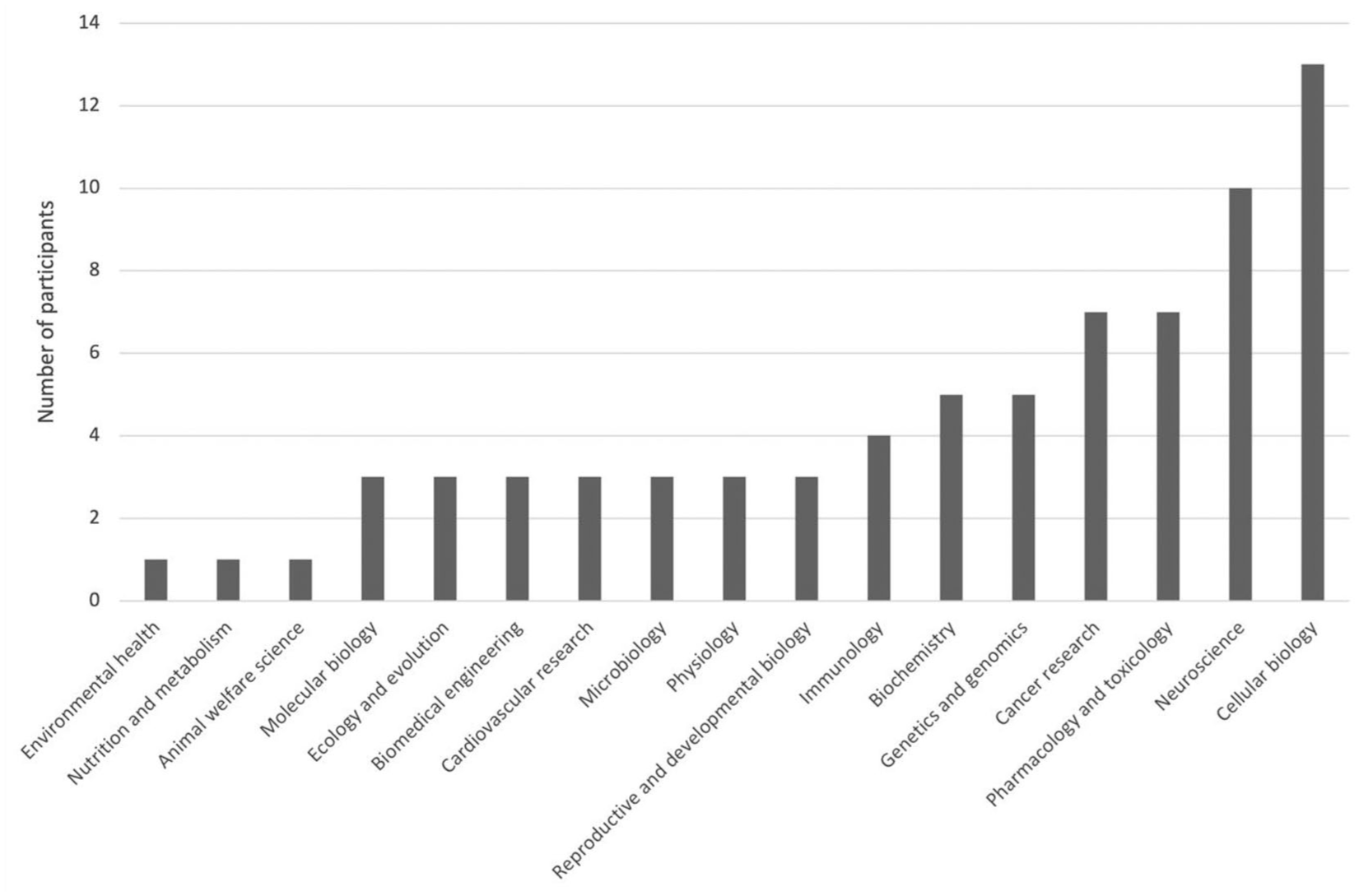
Scientific fields of interview participants.
Data processing
All interviews were transcribed verbatim by ELM. Identifying information was removed during transcription to preserve anonymity. Participants were offered the opportunity to review their transcripts and provide comments prior to analysis. Audio files and transcripts were stored on secure servers at the University of Basel, within a restricted-access folder available only to authorised members of the research team.
Data analysis and strategies to enhance trustworthiness
Data analysis was conducted using the MAXQDA software (version 24.1.0) and followed the six phases of reflexive thematic analysis. 22 The first phase involved familiarisation with the data through repeated reading of the transcripts. Then, ELM coded the entire dataset, identifying features relevant to factors influencing the implementation of the 3Rs, with guidance from experienced researchers in the team (LDG and BSE). Codes were then organised into initial themes by identifying broader interpretative patterns. The themes were then reviewed and refined to ensure coherence, internal consistency, and alignment with both individual coded excerpts and the dataset as a whole. The final phase involved producing a narrative report of the findings, supported by illustrative quotations. BSE and LDG regularly reviewed interview quality, transcription accuracy, coding practices, and thematic development. Analytical interpretations were further discussed among all co-authors of this article.
Results
General presentation
The perspectives on the implementation of the 3Rs shared by participants could be categorised within different socio-technical regimes of the multilevel perspective. Figure 2 details the six themes that we built from the interview data as well as the relationships between them. This article further details four of these themes that illustrate the notion of executive facilitation: a political impulse supporting the development and adoption of the 3Rs, a 3R culture at research institutions, better 3R guidance from cantonal commissions on animal experimentation, and the 3RCC (the Swiss 3R Competence Centre) as a leading national intermediary.
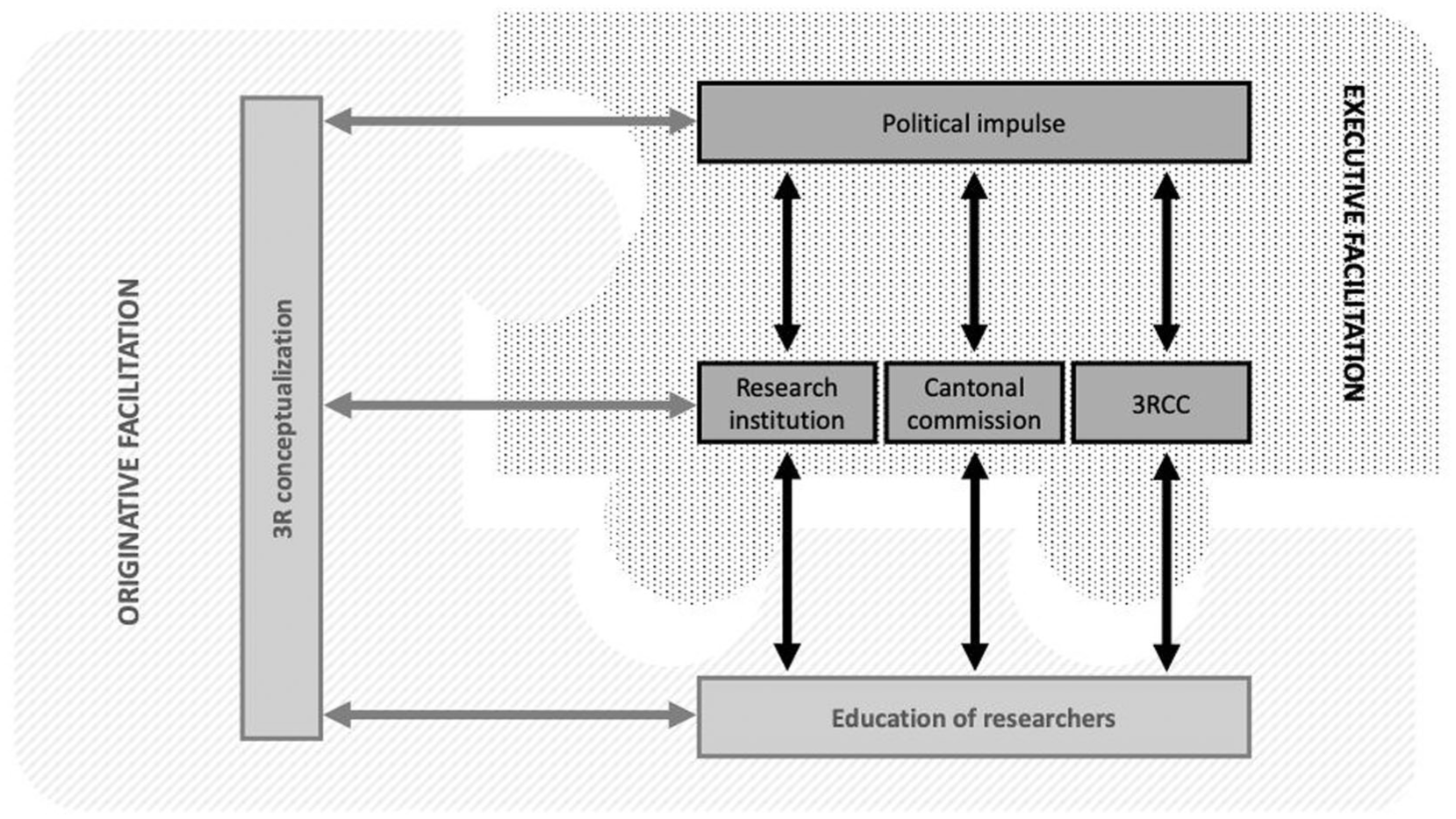
Thematic map of the different levels of facilitation identified.
A political impulse supporting the development and adoption of the 3Rs
Participants described how organisational narratives concerning the 3Rs are mobilised to align with public expectations. However, this emphasis was sometimes seen by participants as merely idle, performative, and missing the point for meaningful change in research practices. Such dynamics can obscure deeper discussions about the necessity and justification of animal use in some contexts, which reinforces a status quo environment with only an appearance of ethical progress rather than substantive political action. As a result, two main facilitators were brought forward: concrete political measures and resources dedicated to advancing the 3Rs.
Concrete political measures
Participants shared the need for a clear ambition for the use of animals in research and the development and implementation of replacement methods, with actionable measures, continuous monitoring and improvement. This would require a targeted plan and a tiered approach for each specific area of research, as exemplified by the UK’s Royal Society for the Prevention of Cruelty to Animals (RSPCA) plan to reduce severe suffering. This plan specifically targets severe procedures and aims to find innovative and practical ways to refine them so that they are no longer severe or at least less severe. 24 A clear plan such as this one would allow the allocation of resources and research efforts to the most promising options, thereby taking concrete steps towards implementation of the 3Rs. Moreover, such measures would break the feeling of powerlessness towards 3R events, which were sometimes perceived as very limited in opportunities for outreach or actual improvements in practice.
Participants called for sector-specific analyses, asking what the actual goal of animal use is, whether alternative means could achieve the same result, and what prevents their adoption – enabling targeted investments rather than generic 3R promotion. One senior researcher acknowledged that such decisions carry real political weight: [Y]ou would tell the people who have been doing this type of research for fifty years that this is not bringing us anywhere. But this is already becoming a political decision because those people would want to continue the way they do it. (Participant 3R-09 – Senior researcher)
Setting up resources to implement the 3Rs
A common ground of agreement among participants was that funding seemed a key facilitator for 3R development and implementation: ‘Like everything, money talks, right?’, (Participant 3R-01 – Senior researcher). More generally, setting high goals for 3R implementation demands having enough resources to actualise them, not only funding, but also infrastructure, workforce, and adequate skills. Making these resources and research grants more targeted to achieve 3R goals may incentivise researchers to work on these topics and create a momentum for more niche innovations. The case of the Swiss National Research Programme 79 ‘Advancing 3R’ is noteworthy in that regard, as participants found this initiative very positive, but were seemingly sceptical about its actual significance if funding is not sustained in the long run.
The fact that there is funding for the 3Rs, I think that is a very good thing. And that is a well-known thing in science: everyone follows the money. So I think, if as a country, as a nation, you say for us in Switzerland it is important that we do the highest level for animal welfare, then just put a lot of money in it and give a lot of grants to people. (Participant AX-15 – Senior researcher)
This dynamic was not merely theoretical. Participants described concrete moments where funding availability directly shaped research decisions.
[W]e had opportunities to get funding for projects through the 3Rs, right. So that was exactly the time when we had to make the decision to go to the mouse model. [. . .] Because we thought ‘Okay, could we maybe prevent going to the mouse? Could we use a similar system?’. And then we saw this opportunity with the 3Rs. And we said ‘Okay, we take a new eukaryotic system, which is not animal’. (Participant 3R-05 – Full professor)
Cultivating a 3R culture at research institutions
While some participants noted the presence of a supportive environment that encourages critical reflection in line with the 3Rs, in particular through the work of local animal welfare officers, others reported a more conservative institutional environment where implementing innovative advancements is perceived as more difficult. The interpretation of the 3Rs varied significantly among participants, so much so that it could be seen as a so-called 3R culture, 25 whereby research institution certainly project adherence to the principles but with unclear and inconsistent measures. From the participants’ perspective, ‘3R culture’ was not viewed as dependent on formal policies but rather on university leadership in promoting best practices and the possibility for peer engagement to actively pursue a value shift. For instance, career prospects for researchers such as developing new laboratories or having access to professorship positions play a central role in their ability to change their research practices and the existing scientific paradigms in their research community.
General support from the hierarchy
Research institutions were perceived as an important stakeholder in easing 3R implementation. Although general support for the principles and some initiatives such as 3R prizes exist, some participants emphasised that they do not always translate to a genuine value shift or change in the material conditions of researchers. The gap between symbolic endorsement and substantive commitment was described bluntly by one senior researcher: There are the 3Rs in all the universities, but it is a little bit of a joke. It is like one person trying to do something with little support just to show that the university has the 3Rs. [. . .] So the university could be supporting these types of things and saying that these are the important things for society. (Participant 3R-03 – Senior researcher)
Best practices across research institutions
A recurrent opinion from participants was that facilitating the implementation of the 3Rs requires fostering collaborations between laboratories and different skillsets, including social sciences, when it comes to striking a balance between public expectations and the reality of research work. The right scale to facilitate interdisciplinary collaborations seemed to be at the university level: research clusters could be organised in such a way to allow some level of permeability between disciplines, while providing new opportunities for innovation. However, participants noted that differences in disciplinary reasoning, not merely vocabulary, would require deliberate efforts to bridge existing gaps. These collaborations could extend to other institutions like hospitals, where researchers might gain access to relevant human tissues and health data, with appropriate ethical clearance.
But what could definitely be the case is to have one cluster in the big cities, and then we have a Swiss-wide network of these facilities that exchange knowledge, exchange ideas, and that also would be a discussion partner for politicians, for the lay public. So this would definitely be a big plus. (Participant 3R-02 – Full professor)
Career prospects
A final aspect brought up by participants in relation to developing a ‘3R culture’ was career prospects. The availability of university positions and research funding dedicated to 3R advancement, and support in publishing 3R-dedicated papers were reported to be the most important incentives for researchers. For instance, at the time of writing, there is only one university chair of animal welfare in Switzerland, which limits the possibility of research on refinements for laboratory animals.
I think for sure it is a benefit if a young scientist is confronted with the 3Rs and actually also actively learns how to think about that, how to find novel solutions to implement it. Because as I said, it is a very actual topic at the moment and also if you go to industry it is probably good . . . if you have that background and if you already have experience with some of the classical methods used to implement the 3Rs. (Participant 3R-19 – Full professor)
Better 3R guidance from cantonal commissions on animal experimentation
In Switzerland, cantonal commissions on animal experimentation have a consultative role on the evaluation of licences to perform animal experimentation (art. 34, para. 2 Animal Protection Ordinance) and work in concert with cantonal veterinary offices, which have the administrative power of granting the licence. Unsurprisingly, this evaluative stage, which reviews the study rationale, justifications, weighing of interests, and the 3R methods to be implemented, was often reported as a frustrating experience by participants. Most notably, differences in cantonal practices and procedures, and a general sense of bureaucracy were two key aspects mentioned. Nevertheless, these commissions were also seen by study participants as a critical safeguard for scientific integrity and animal welfare, whose role could be further bolstered.
Making the licencing assessment more systematic and concordant
Despite recommendations made by the federal ECAE,
26
the licencing process was experienced as a subjective, bureaucratic black box, where the final decision does not seem to rely entirely on objective parameters but rather on the small details of research design and the individuals evaluating the application. This seemed to spark participant concerns about unfairness, specifically in relation to outcomes (e.g. similar projects being evaluated differently) and procedures (e.g. biased decision-making). They considered the licencing procedure tedious, sometimes unnecessary, and even showed some form of defiance as they revised their applications. Participants believed these issues called for a more consistent and streamlined procedure across Swiss cantons, a sentiment captured plainly by one senior researcher: [T]here still seems to be some subjectivity in what they are looking for. [. . .] You never quite know what to expect when you are going into the process, which I think could be simpler and harmonised. I don’t know how, but it seems as though you don’t always get the same answer from everyone. (Participant 3R-01 – Senior researcher)
Empowering commissions
As mentioned, cantonal commissions have a consultative role. But due to their composition – a mix of researchers (in the majority), veterinarians, lawyers, ethicists, members of the civil society, and so forth, which varies among cantons – each has a unique voice, representing more than just the interests of science. Some participants believed that commission members should be able to challenge scientists on the substance and relevance of the application they are evaluating, in particular regarding the justification of implementing a replacement method or not. Moreover, in the interests of researchers, participants recommended that commissions perform more on-site visits with a mindset of continuous improvement and refinement of procedures. However, participants emphasised that these aspects should go hand in hand with objectivity and scientific rigour; this would require some form of professionalisation of commission members. The typical example mentioned by participants was having a dedicated biostatistician reviewing the study design and possibilities for reduction. Participants argued that this level of responsibility demands commensurate institutional autonomy: It is important for the commission to remain autonomous, to be free from outside pressure, and to be able to make its own decision, whether it is a yes or no decision. This is the case in some cantons. In other cantons, it is clear that commissions are not necessarily autonomous due to large institutions that have so much power that you cannot really say no to them anyway. And that is not fair. (Participant AX-06 – Senior researcher)
Beyond autonomy, participants also pointed to the quality-control function that more regular oversight could serve: [I]t does not have to be like a police, but still it is a quality control. If you control the quality more often, you will slowly but constantly improve the level. But of course, you need people to do that. If you do more checks, you will bring up the level. (Participant AX-08 – Senior researcher)
3RCC as a leading national 3R intermediary
The participants generally acknowledged the role of the 3RCC in providing resources, training, and platforms for knowledge exchange on the 3Rs. However, a few comments were critical on the actual influence the 3RCC has regarding its capacity to make substantive change for researchers, among their other missions. Indeed, there is a perceived disconnect between the centre’s strategic objectives and the operational realities of research environments, where the efforts seemed to be insufficient to meet the diverse needs of researchers and achieve significant practical advancements for the 3Rs. This highlights the dual role that the 3RCC should play, according to participants: being both a key implementation hub and a promotion platform.
Pushing for an implementation hub
Some participants emphasised the ideal position the 3RCC is in for facilitating 3R implementation and coordinating advancements at the federal level. Since the 3RCC is an independent national centre and is linked to all Swiss public research institutions, it has the ability to centralise initiatives that have meaningful impacts on the 3Rs. Participants suggested that it may be able to do so by having, for instance, a dedicated laboratory for developing non-animal media for cellular cultures or other kinds of reagents, or by setting harmonised guidelines and standard operating procedures for the implementation of refinement techniques. Some participants, however, questioned whether the centre’s current balance between developing new methods and implementing existing ones was well-calibrated: I mean, what is the point of developing new technologies if you don’t apply those that are available today? [. . .] We should select a few subjects on which we really implement replacement . . . [pause]. And do it. That should be the mission. And we get to all the other missions of the 3RCC and I would give this mission to the 3RCC, because the 3RCC is the place where everybody comes together. (Participant 3R-17 – Full professor)
Sustaining promotional activities
A more concordant perception of the 3RCC among participants was its role as an educational and promotional platform for the 3Rs. Both during its annual 3Rs Day or in day-to-day communications with scientists, the 3RCC seemed to play a key role in raising awareness of the latest developments and actual possibilities for 3R implementation. Participants recognised this promotional role while also highlighting that there was still room for the 3RCC to make a greater impact, particularly in connecting researchers with relevant expertise: I think probably one of the challenges is really connecting people with the expertise to do such experiments with the scientists who are in need of the tools. I think that is probably one of the things that can be a bit challenging. I think the 3RCC is probably doing a good job in that sense, that they are kind of establishing a platform where this exchange should happen. But maybe this could be further intensified . . ., that people are more easily connected to each other. (Participant 3R-19 – Full professor)
Discussion
The second part of our qualitative study has revealed important policy-making considerations in the implementation of the 3Rs in Switzerland. It has shown that the factors facilitating originative implementation (addressed in our complementary publication) are necessary, but not sufficient in themselves to work decisively toward better implementation. Factors influencing implementation on the macro and meso levels must be also considered. Socio-epistemic contexts 7 and governance bodies of animal experimentation 6 tend to stabilise existing practices rather than disrupt them. The current framing of the 3Rs as a regulatory requirement only, hiding its concurrent transformative nature, creates a research environment where symbolic compliance takes over meaningful implementation efforts. As a result, the 3Rs are drained of their conceptual content and become mere ‘rituals of verification’ 27 with a performative function. This function may give the appearance of meeting public expectations but falls short in bringing about concrete improvement. To work effectively toward fuller implementation of the 3Rs, our participants called for more specific actions, such as strategic funding, infrastructure development, and specific roadmaps for different research fields. In practice, given the differentiated maturity of the 3R methods across disciplines, the same level of attention and effort may not be required uniformly. This aligns with other proposals for tiered implementation approaches and phase-out plans.6,28,29
This leads to another critique highlighted by the participants, namely that serendipity in science, or grassroots efforts from individual research groups, will seldom advance the implementation of the 3Rs. This echoes other perspectives from the philosophy of science30,31 and from scholars in laboratory animal science, 10 showing that serendipitous discoveries depend on the socio-political structures in which science is made. While it may be thought that individual 3R initiatives alone can change the socio-technical landscape, our findings support the argument that institutional change must be orchestrated to work more decisively toward full 3R implementation and change individual research practices. Overall, this highlights the need for a bi-directional approach to 3R implementation – one that acknowledges both the top-down influence of political and institutional decisions on scientific practice, and the bottom-up contribution of researchers, whose engagement and groundwork should inform policy development. 32
One major aspect is the need for harmonised and consistent actions across cantons. This is particularly true concerning cantonal commissions for animal experimentation, whose variability between cantons contributes to a perceived lack of legitimacy. This suggests a need for standardisation, but also the professionalisation of commission members, and transparency in the review process, as argued by some authors two decades ago, 33 and recently reviewed in a scoping review. 34 In this process, it may be suggested that commissions build a collaborative relationship with researchers that goes beyond their regulatory role and includes more objective, systematic, and evidence-based assessments of protocols.
At the local scale, Swiss universities hold a significant position from which to coordinate transdisciplinary collaborations and offer support and new chairs dedicated to 3R research. 35 This would include structures and positions that support researchers in, for example, finding replacement methods, conducting systematic reviews of the literature, improving experimental design, or refining procedures to meet the welfare requirements of their experimental models. On a national scale, the Swiss 3RCC, due to its unique position, may be transformed to operate as a key actor overseeing the systemic change and building federal initiatives for 3R advancements, for example, with reference laboratories, centralised expertise, education and training initiatives, or national network building. 36
Several limitations of this study need to be discussed. First, the very nature of our qualitative study means that the results are not generalisable from a positivist standpoint. The data reflect participants’ self-reported experiences and perceptions, which are further interpreted through the analytic judgement of the investigators of this article. Nevertheless, these findings are relevant for hypothesis generation in other national or supra-national contexts to support fit-for-purpose, cross-border evolutions. Careful evaluation of the applicability of the findings in light of the contextual information about the conduct of animal experimentation, institutional setting, and sociocultural background is therefore warranted. Second, even though our sample is diverse, it included researchers only from public institutions and does not represent all scientific disciplines in biomedical research. Triangulation with a more diverse pool of participants, including, for instance, laboratory veterinarians, animal caretakers, and regulators, would strengthen the interpretation of these findings. Third, both cultural factors and social desirability are important considerations to bear in mind when interpreting our results. Participants may have underreported certain aspects or attitudes in relation to 3R implementation and presented themselves in ways consistent with expected professional norms. Further studies could explore other federal contexts in an interdisciplinary fashion to better understand the intricacies of factors at the macro and meso levels.
Supplemental Material
sj-pdf-1-lan-10.1177_00236772261447418 – Supplemental material for Advancing the 3Rs? Researchers’ perspectives on institutional facilitation in Switzerland – Part 2: executive facilitation
Supplemental material, sj-pdf-1-lan-10.1177_00236772261447418 for Advancing the 3Rs? Researchers’ perspectives on institutional facilitation in Switzerland – Part 2: executive facilitation by Edwin Louis-Maerten, Love Hansell, Charlotte E. Blattner, Bernice S. Elger and Lester D. Geneviève in Laboratory Animals
Supplemental Material
sj-pdf-2-lan-10.1177_00236772261447418 – Supplemental material for Advancing the 3Rs? Researchers’ perspectives on institutional facilitation in Switzerland – Part 2: executive facilitation
Supplemental material, sj-pdf-2-lan-10.1177_00236772261447418 for Advancing the 3Rs? Researchers’ perspectives on institutional facilitation in Switzerland – Part 2: executive facilitation by Edwin Louis-Maerten, Love Hansell, Charlotte E. Blattner, Bernice S. Elger and Lester D. Geneviève in Laboratory Animals
Footnotes
Declaration of conflicting interests
The authors declared no potential conflicts of interest with respect to the research, authorship, and/or publication of this article.
Funding
The authors disclosed receipt of the following financial support for the research, authorship, and/or publication of this article: This work was supported by the Swiss National Science Foundation, as part of the National Research Programme 79 ‘Advancing 3R’ (grant number: 407940_206432). The funder played no role in data collection and interpretation nor in the study design and reporting.

Data availability statement
Supplemental material
Supplemental material for this article is available online.
References
Supplementary Material
Please find the following supplemental material available below.
For Open Access articles published under a Creative Commons License, all supplemental material carries the same license as the article it is associated with.
For non-Open Access articles published, all supplemental material carries a non-exclusive license, and permission requests for re-use of supplemental material or any part of supplemental material shall be sent directly to the copyright owner as specified in the copyright notice associated with the article.
