







Abstract
A common feature of public speech in Catalan is the placement of prominence on lexically unstressed syllables (“emphatic stress”). This paper presents an acoustic study of radio speech data. Instances of emphatic stress were perceptually identified. Within-word comparison between vowels with emphatic stress and vowels with primary lexical stress reveals that the former are characterized by having a high tone, higher F0 scaling, and greater intensity, but shorter duration with respect to lexically stressed vowels. Emphatic stress can thus be characterized as anchoring an intonational pitch accent on a lexically unstressed syllable. When this phenomenon occurs, primary lexical stress is still cued by duration. Compared with other lexically unstressed vowels, vowels with emphatic stress have greater duration and intensity, and less vowel centralization. Thus, vowels are hyperarticulated when bearing emphatic stress. In particular, schwa is more open, without merging with /a/. Regarding the distribution of emphatic stresses, the most common pattern observed is binary or rhythmic (le̱s instituc
1 Introduction
Catalan is a language with contrastive stress. Word-stress in Catalan may fall on different syllables in the word in a not completely predictable manner. Primary stress is thus part of the lexical information of the word (Prieto, 2002; Recasens, 1993). Freedom of placement is nevertheless restricted to the last three syllables of a word (
Studies on Catalan stress (Bonet & Lloret, 1998; Coromines, 1974; Oliva, 1977, 1992; Recasens, 1993) often mention the existence of (non-contrastive) secondary stress (accent secundari), an umbrella term that encompasses different phenomena, including putative rhythmic prominence or “rhythmic stress” (e.g., picar
Previous experimental studies have examined the acoustic correlates of “rhythmic stress” (Recasens, 1991) and “morphological stress” in compounds (Mascaró, 1983; Prieto, 2003), without finding robust acoustic correlates for either of these two types of secondary stress. In this article we examine, instead, the phenomenon of “emphatic stress”. This is a phenomenon that primarily characterizes public speech, such as the speech of politicians, lecturers and radio announcers, although it is also occasionally found in conversational speech as a rhetorical device.
An acoustic study was carried out using corpus data obtained from ten different speakers of Central Catalan presenting radio news programs. Instances of emphatic stress were perceptually identified by a native speaker of Catalan, and 20% of the data were transcribed by two other native speakers of the language, with over 90% agreement with the first transcriber. The results show that it is possible to obtain acoustic evidence (in terms of duration, intensity, F0, and vowel quality) for emphatic stress. This phenomenon can be located in a larger context which concerns the relation between stress and vowel quality in Central Catalan. We argue that the phenomenon of emphatic stress represents a deviation from the normal interaction between stress and vowel reduction in this variety, insofar as lexically unstressed syllables with reduced vowels are perceived to be stressed.
1.1 The interaction between stress and vowel quality in Catalan
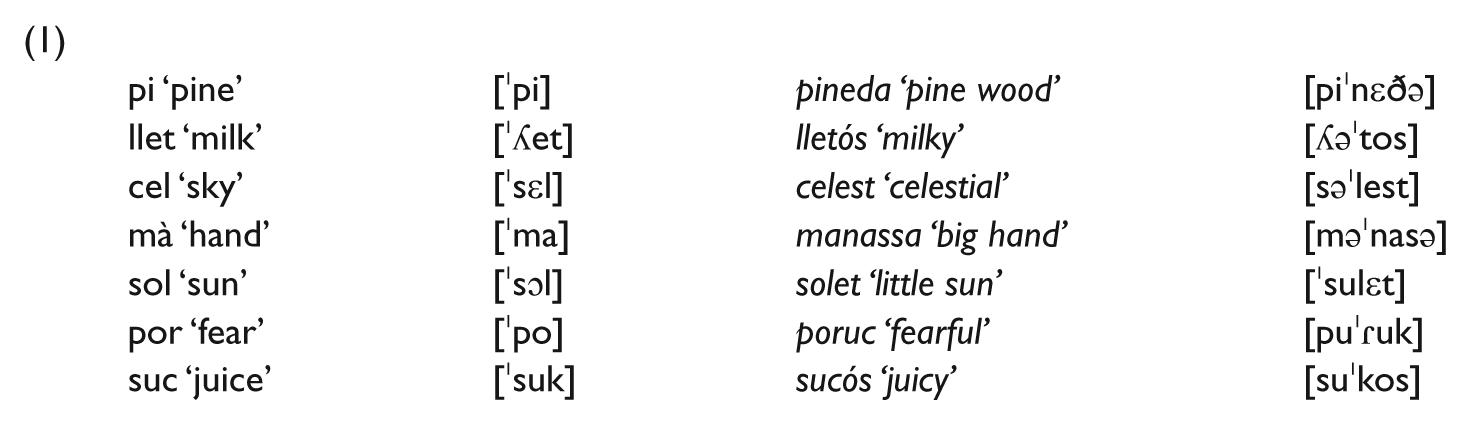
A well-known characteristic of Central Catalan is its correlation between vowel quality and stress. In this variety, the stressed vowel system comprises seven vowels (/i, e, ϵ, a, ɔ, o, u/), which alternate with only three vowels in unstressed position ([i, ə, u]), as shown in Figure 1. Thus, the stressed mid front vowels (/e, ϵ/) and low vowel (/a/) alternate with schwa in unstressed position. The stressed mid back vowels (/o, ɔ/) merge with /u/ in unstressed positions. The high vowels /i, u/ are both present in the stressed and unstressed vowel systems of Central Catalan. The examples in (1) show the alternations described in morphologically related pairs of words: The column on the left contains a monosyllabic word with a full vowel, which becomes unstressed when a stress-bearing derivative suffix is added to the stem (right column).

Central Catalan stressed (left) and unstressed (right) vowel system
Full vowels are expected to appear in stress-bearing syllables, whereas they should not be present in unstressed syllables, except for the high vowels /i, u/, which belong to both the stressed and the unstressed inventories. Conversely, reduced vowels indicate the lack of stress of those syllables where they appear. However, this correspondence between vowel reduction and stress is sometimes lost, either because certain unstressed syllables present full vowels or because reduced vowels occur in stressed syllables (Mascaró, 2002; Oliva, 1992).
1.1.1 Full vowels in unstressed position
Unstressed syllables are expected to present only one of the three vowels [i, u, ə], but there are a few cases in which this relationship does not hold. That is, the vowels (/e, ϵ, a, ɔ, o/), typically restricted to stressed syllables, are exceptionally found in unstressed syllables in certain contexts. Two such sets of exceptions are provided by unreduced prepositions and unreduced prefixes (for more details, see Sancho Cremades, 2002, and Gràcia, 2002, respectively). 2 The examples in (2) show a prosodic contrast between an unreduced preposition plus a noun phrase and a verb phrase. The preposition cap ‘towards’ and the verb cap ‘it fits’ are homophonous at the segmental level, and are pronounced identically in isolation. However, the two examples differ in their prosody. The difference is in the number of stresses in the phrase. The preposition cap lacks stress, even though it has a full vowel.

On the other hand, (3), taken from Mascaró (2002), exemplifies the fact that words derived with unreduced prefixes have the same stress pattern as homophonous sequences with a single stressed syllable. That is, these prefixes are also unstressed.

Most compounds (especially of the type verb + noun) retain the full vowel of the first root, which may be any of the seven vowels of the stressed set. These compounds are homophonous at the segmental level with verb phrases, but contrast in the number of stresses (4). Empirical evidence of the stresslessness of the full vowel in unreduced prefixes and in compounds is reviewed in Section 1.2.

Lastly, borrowings (5a), cultisms (5b), technicisms (5c), and clippings (5d) constitute other instances of lack of correspondence between stress and vowel quality (Cabré, 2002, 2010). In these instances, exceptionally we may find the vowels /e, o, a/ in an unstressed syllable.

1.1.2 Reduced vowels in stressed position
Instances of reduced vowels appearing in stressed syllables are also attested. 3 Traditionally called “unstressed” prepositions and prefixes are unstressed in their normal usage and so contain a reduced vowel. In particular, they may contain a schwa. However, they can receive prominence when used in citation form for metalinguistic purposes or in narrow focus. In spite of that, no full vowel is recovered (Mascaró, 2002, p. 94). Hence, they constitute examples of reduced vowels in stressed positions. Examples are shown in (6).

We hypothesize that there is another case in which lexically unstressed syllables can receive prominence in the discourse without recovering a full vowel. Vowels which receive emphatic stress are, by definition, lexically unstressed and contain an unstressed vowel. Our hypothesis is that vowels with emphatic stress will still be reduced vowels, although they may be more hyperarticulated with respect to their fully unstressed counterparts, due to enhanced prominence (Lindblom, 1963, 1990).
1.2 “Secondary stress” phenomena in Catalan and other Romance languages
As already mentioned, in Catalan only primary stress is lexically-contrastive. The term “secondary stress” has been used in the literature on Catalan and other Romance languages to refer to a number of phenomena where prominence is postulated on syllables other than the one bearing primary lexical stress.
In a classic paper on theater elocution and recitation, Coromines (1974, pp. 96–97) claims that the stress system of Catalan is binary: Long words are claimed to have a secondary stress placed in every other syllable counting from that with primary stress and moving leftwards (a̱fecti̱vit
According to Oliva (1977, p. 89), the combination of unstressed and stressed syllables is one of the factors that constitute the rhythm of a language. In a sequence of several unstressed vowels, one of them can receive greater intensity for eurhythmic purposes. In his view, both binary (mo̱noton
In a similar vein, Bonet and Lloret (1998, p. 212) claim that unstressed syllables can sometimes receive additional, purely rhythmic stresses in order to avoid long stretches of unstressed syllables. Recasens (1993, pp. 66–67) states that the assignment of secondary prominences may be inevitable when the lexically stressed syllable is preceded by a large number of unstressed syllables (his example: el convalidar
Prieto (2002, p. 57) distinguishes between two types of secondary stress: rhythmic stress (with a binary or ternary pattern) and morphologically-conditioned stress. The latter type would be found in compounds and derived words with unreduced prefixes (re̱ntapl
In spite of the descriptive statements we have presented, which are based on intuitions and tradition, experimental research has failed to find acoustic evidence for secondary stress.
5
Mascaró (1983) and Prieto (2003) offer empirical evidence of the stresslessness of the full vowel in unreduced prefixes and of the full vowel in the first member of compounds such as that in (4). Mascaró (1983) tests whether compounds and derived words with unreduced prefixes display a single prominence, like morphologically simple words, or two prominences, like a two-word sequence (e.g., whether there is prominence on the first syllable of the compound mitjan
Prieto (2003) compares segmentally identical syllables (e.g., /pi/) with varying putative stress levels: primary (p
For another closely-related Romance language, Spanish, Hualde (2007, p. 79) describes secondary stress as an optional and variable phenomenon, which does not seem to be a feature of colloquial, unplanned speech, but rather a very recurrent feature in the language of the media, lectures, recitation and public speech in general (see also Kimura, 2006, p. 146). Hualde (2007, 2009) claims that secondary stress exists in Spanish as “an optional discourse-level phenomenon related to special emphasis or ‘didactic’ style” (Hualde, 2007, p. 79). This is the phenomenon we are calling “emphatic stress” in this paper. He describes two patterns of secondary stress differing in terms of their pattern and pragmatic meaning. The first type consists in placing prominence two syllables to the left of the syllable with primary stress (e.g., dificult
In a controlled production experiment, Hualde (2010) obtained examples of secondary stress in Spanish. Participants were asked to read sentences that contained lists of nouns by imitating a given intonation (which could follow the lexical stress list pattern, the rhythmic pattern, or the emphatic pattern). In his data, the most common pattern of secondary stress involved placing a high tone two syllables before the one with lexical stress. This is in line with Belda and de-la-Mota’s (2010) findings for radio speech (also for Spanish). Unstressed syllables that are perceived to be accented (they call this phenomenon “secondary stress” or “overaccentuation”) show an F0 peak aligned early in the vowel. Contrary to traditional descriptions, Hualde’s (2010) data included examples in which this high tone had been placed on the syllable immediately preceding the primarily-stressed one, giving rise to a stress clash.
Stress clash is not tolerated in many languages, which prefer configurations where stresses are distributed more regularly (Hayes, 1995; Nespor & Vogel, 1989; Selkirk, 1984, among others). When a stress clash occurs, repair mechanisms are used in different languages, such as lengthening (part of) the first stressed syllable (as in Greek, Arvaniti, 1994) or inserting a pause to create distance, or removing or weakening one of the stresses. The latter repair strategy has been impressionistically described for languages such as Catalan (Oliva, 1992), Italian (Nespor & Vogel, 1989), Modern Hebrew (Bolozky, 1982), and Brazilian Portuguese (Gayer & Collischonn, 2007). Empirical evidence for the removal or weakening of one of the stresses in a clash in Catalan is presented in Prieto et al. (2001). Their perception study revealed that there is a high degree (40%) of error in distinguishing stressed syllables in a stress clash (e.g., el dur
Hualde (2010) also analyzed duration, F0, and intensity, and found that the pretonic syllable with secondary stress had higher F0 and higher intensity, but shorter duration, than the syllable with primary stress in the same word. Hualde noted that secondary stress is different from primary stress in that the former anchors an F0 movement (a pitch accent), whereas the latter is cued durationally in words with secondary stress. That is, Hualde’s rhythmic and emphatic secondary stresses involve anchoring a pitch accent in a lexically unstressed syllable in certain types of public speech. This is the type of secondary stress that we are interested in investigating for Catalan. As mentioned, we will call this type of prominence “emphatic stress”.
In Brazilian Portuguese, acoustic prominence on non-primary stressed syllables is a much more frequent phenomenon than in Spanish or Catalan, not limited to the emphatic style we analyze in this paper. In Abaurre and Fernandes (2008), where 17 speakers of Brazilian Portuguese were asked to read a magazine article, 97% of the prosodic words with one or two pretonic syllables were perceived (by three judges) to have secondary stress. Binary feet were the most common pattern in their data, although ternary feet were also found. Regarding the acoustic cues of this prominence, they found that the presence of a secondary stress was marked by a high tone. In another production study with Brazilian Portuguese data, Arantes (2010) observed initial F0 prominence (a peak or rising movement associated with the first or second syllable of the prosodic word), but no evidence for binary alternation was found. Similarly, Ferreira (2009, 2010) found that 78.5% of utterances read by four Brazilian Portuguese speakers contained what she calls “high initial tones”. These high initial tones were absent in the Spanish read data she collected for comparison. This phenomenon in Brazilian Portuguese may be more in line with “initial accent” in French (Astésano, Bard, & Turk, 2007; Welby, 2006), which marks the beginning of prosodic phrases. Nevertheless, we may expect certain commonalities in the cueing of non-lexical prominence. In this respect, we may note that initial syllables are not durationally enhanced in Brazilian Portuguese (Arantes, 2010; see also Gama Rossi, 1998), so that pitch would appear to be the main correlate of initial prominence (as well as perhaps vowel quality, Arantes, 2010).
1.3 Acoustic study of emphatic stress
In order to shed light on the nature of emphatic stress in Central Catalan (in terms of its patterns of distribution as well as its acoustic manifestation), an acoustic study was carried out using a corpus of radio news programs. Instances of emphatic stress were perceptually identified and manually labeled, together with vowels with primary stress and lexically unstressed vowels not bearing emphatic prominence. Four acoustic correlates (namely, duration, intensity, F0, and vowel quality) were analyzed to identify which of these may indicate the presence of emphatic stress. We also examined the distributional patterns that emerge when emphatic stress appears (i.e., which syllables in the prosodic word may receive emphatic stress).
1.3.1 Hypotheses
Our first hypothesis concerns the distribution of emphatic stress. As mentioned in Section 1.2, the most commonly cited pattern in the literature for rhythmic stress in Catalan is a binary pattern, but different authors disagree on whether ternary patterns are also possible and on what determines which pattern will be used. We hypothesize that, when emphatic stress appears, it will typically result in a binary pattern, although other possibilities (such as ternary patterns and even stress clash) are expected to occur in the data. That is, the hypothesis is that emphatic stress will be typically assigned to syllables that are rhythmically prominent.
Regarding the acoustic correlates of emphatic stress, findings similar to those described for Spanish are expected (see Section 1.2). More specifically, we expect emphatic stress to be cued by the presence of high or rising F0 and higher intensity. As far as duration is concerned, the hypothesis is that vowels with emphatic stress will be shorter than primarily-stressed vowels, but they may or may not differ from unstressed vowels. When comparing vowels with emphatic stress with vowels with primary stress in the same word, the latter are expected to be longer than the former, as in Hualde (2010).
Finally, vowels with emphatic stress are expected to show less vowel reduction than unstressed vowels, but also to differ from primarily-stressed vowels. The hypothesis is that vowels with emphatic stress will show intermediate formant values between unstressed and primarily-stressed vowels. The added level of prominence will result in the three vowels from the unstressed set [i, ə, u] being more hyperarticulated with respect to their fully unstressed counterparts (de Jong, 1995; Lindblom, 1963, 1990). In particular, expansion of the vowel space should result in [ə] being realized as a somewhat lower vowel, closer to /a/.
2 Methods
In order to test the hypotheses described in Section 1.3.1, a radio news corpus was used. To compile the corpus, data from ten different speakers (five females, five males), all between 30 and 50 years of age, were used. For each speaker, two one-hour-long news programs were selected and analyzed. Only the voice of the main newscaster was used (discarding advertising, parts with sound effects or correspondent interventions). The total number of minutes analyzed was 283.31.
To collect the data, the first author listened to the sound files and selected those words in which prominence was perceived on a syllable that did not carry lexical stress. 654 prosodic words 7 with emphatic stress were identified in this manner, with a total number of 705 instances of emphatic stress. The latter number is larger because some prosodic words were perceived to bear emphatic stress on more than one syllable.
Interrater reliability was assessed by asking two other transcribers to independently code 20% of the data. This is in line with other studies where instances of a phonological phenomenon are perceptually identified by the researcher, regarding both the number of judges and the amount of data that were rechecked (see, for instance, Bürki, Fougeron, Gendrot, & Frauenfelder, 2011; Davidson, 2006; Guion, Post, & Payne, 2004; Haley, Seelinger, Callahan Mandulak, & Zajac, 2010). 8 For each speaker, we randomly picked 20% of the selected files that contained at least one emphatic stress as determined by the first labeler. In total, the two transcribers were given 98 sound files (with a mean length of 4.59 seconds, and a total length of 7 minutes and 24.9 seconds). The files contained a total of 137 prosodic words with emphatic stress as identified by the first coder. The other transcribers were also native speakers of Catalan, one of them with training in linguistics. They were asked to indicate the words containing unstressed syllables that they perceived to have prominence simply by listening to the sound files. Table 1 shows the percent agreement between the first transcriber (who coded all the data) and each of the other transcribers (around 92% for both transcribers), as well as the results of the interrater reliability Fleiss’ Kappa statistic.
Degree of agreement between transcribers

Regarding the acoustic analysis of the data, the beginning and end of each vowel with emphatic stress and primary stress in the same words were manually marked using Praat (Boersma & Weenink, 2009). Boundaries were established by using both the waveform and the spectrogram, as shown in Figure 2. Tokens were coded by vowel identity and stress level (unstressed, primary, emphatic, primary in word with emphatic stress(es)).
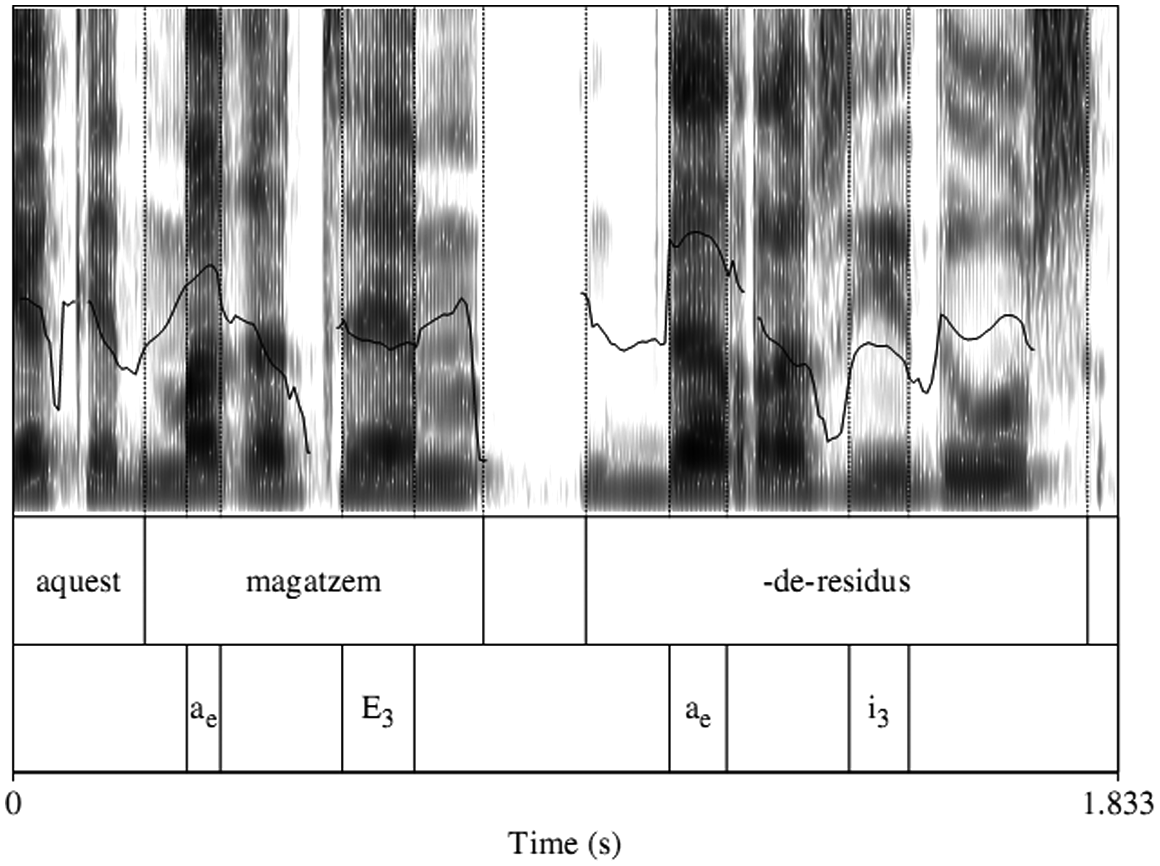
Annotation example for the phrase aquest magatzem de residus (radioactius) ‘this repository for radioactive waste’. Subscript characters indicate stress level (e = emphatic stress, 3 = primary stress in a word with emphatic stress). Ordinary characters represent vowel type (a = [ə], E = /ϵ/, i = /i/). The black line shows the F0 curve
Because emphatic stress occurs in lexically unstressed syllables, and Central Catalan has a restricted vowel inventory in these syllables, the only vowels that could occur in those positions were [i, ə, u]. To be able to determine the acoustic correlates of emphatic stress, unstressed [i, ə, u] and primarily-stressed [i, u] were also segmented. Since [ə] cannot occur in stressed position, we also included /a/ in the analysis. Although [ə] is involved in morphophonological alternations with all of /a/, /e/ and /ϵ/, it is phonetically closest to /a/, as it is a central vowel and is lower than /e/. Some evidence that Central Catalan speakers tend to equate unstressed [ə] with /a/ is an ongoing sound change in some sociolects of Barcelona Catalan, where [ə] is in fact very close or identical to /a/ (Ballart, 2002; Pla Fulquet, 1995).
In addition, unstressed and primarily-stressed vowels were extracted from words which were not perceived to carry emphatic stress. Neither posttonic unstressed vowels nor word-final stressed vowels were considered, since they may be subject to word-final lengthening, and all cases of emphatic stress are by definition pretonic. Primarily-stressed vowels which received nuclear accent were not included in the analysis by vowel. No vowels coming from compound words or words with unreduced prefixes were used either. Each vowel token was coded for vowel identity (/i/, /u/, [ə]~/a/) and degree of stress (primary, emphatic, unstressed, primary in words with emphatic stress). For each vowel, total duration, mean intensity, mean and maximum F0, and F1 and F2 values were extracted using a Praat script written for that purpose.
Words were coded for total length (in number of syllables), lexical category, position of the primary stress, number of emphatic stresses, position of the emphatic stress(es), and distance (in number of syllables) between one stressed syllable and the next. When computing the number of syllables, sequences of a high vowel and a non-high vowel, which traditionally are said to constitute a hiatus, were computed as one single syllable, since they are typically realized as rising diphthongs (Cabré & Prieto, 2004, 2008), as shown in (7).

Two types of statistical analyses were performed. Raw intensity, duration, and F0 values of vowels with emphatic stress were compared with those of the primarily-stressed vowel in the same word, using paired t-tests (within-word pairwise comparisons). Pairwise comparisons were performed separately for words in nuclear vs. non-nuclear position. Only prosodic words with one emphatic stress were included in the within-word pairwise comparisons.
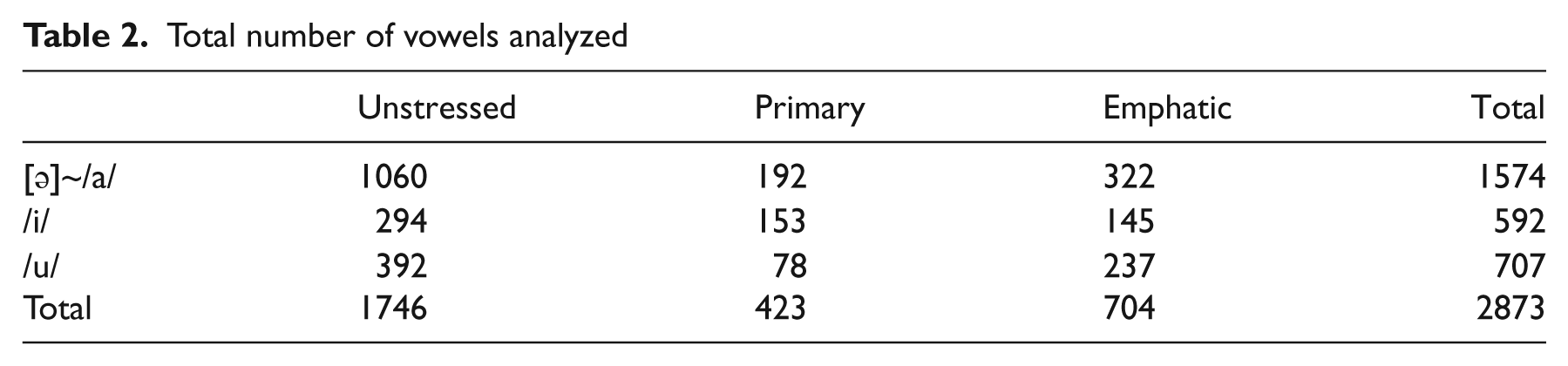
Normalized intensity, duration, and formant values of vowels with emphatic stress, unstressed vowels and non-nuclear primarily-stressed vowels were also compared using mixed-effects regression models. The raw measurements of duration, intensity, and formants were z-normalized for each speaker separately (Lobanov, 1971; Wang, 2007, Ch.5). This type of normalization is speaker-intrinsic and vowel-extrinsic. For example, for each speaker, mean duration of all vowels was calculated and it was subtracted from each data point of that speaker. The result was divided by the standard deviation to allow for comparison across words and across speakers. The same type of normalization was performed for mean intensity, F1 and F2. Table 2 shows the total number of vowels used in these analyses.
Total number of vowels analyzed
Statistical analyses were carried out in R (R Development Core Team, 2009) using the lme4 (Bates & Maechler, 2009) and languageR (Baayen, 2009) packages.
3 Results
3.1 Emphatic stress distribution and tonal manifestation
A total of 654 prosodic words with emphatic stress were found in the data. Of these, 596 (91.13%) contained one syllable with emphatic stress and 51 (7.80%) included two emphatic-stress-bearing syllables. The remaining seven prosodic words (1.07%) contained two lexical stresses 9 and one syllable with emphatic stress.
These values suggest that in the vast majority of instances a prosodic word will have at most one syllable bearing emphatic stress. It is the case, however, that most prosodic words could, in fact, contain only one due to the number of pretonic syllables. Table 3 presents the distribution of words with emphatic stress according to their length (in number of syllables).
Length of prosodic words (in number of syllables) with emphatic stress(es)
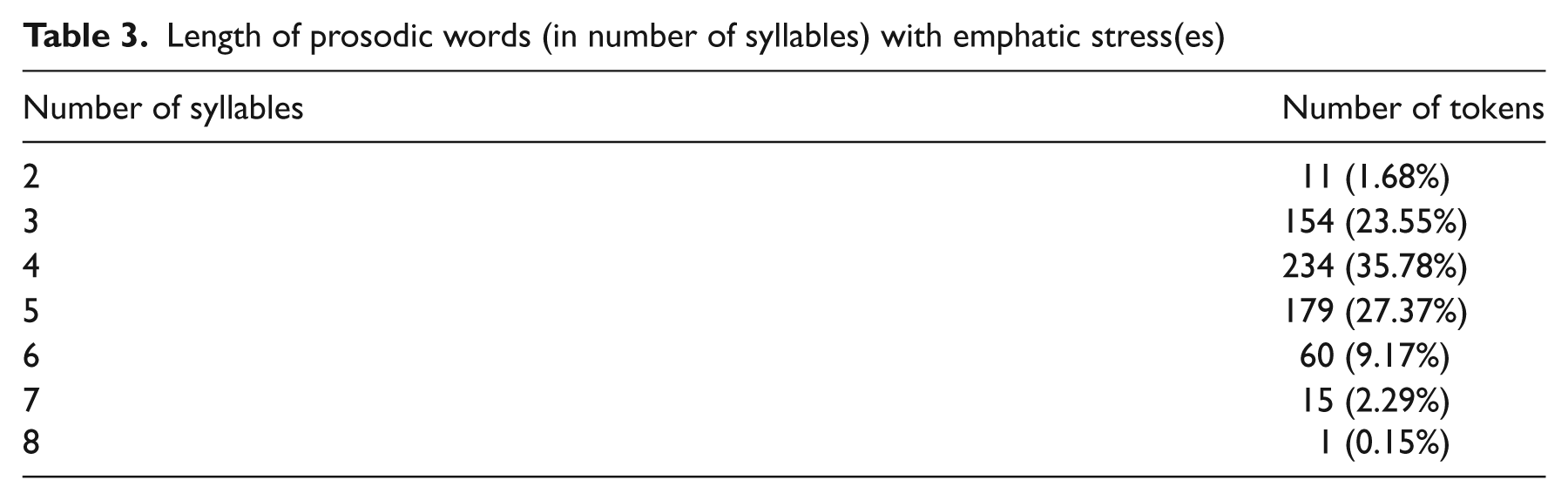
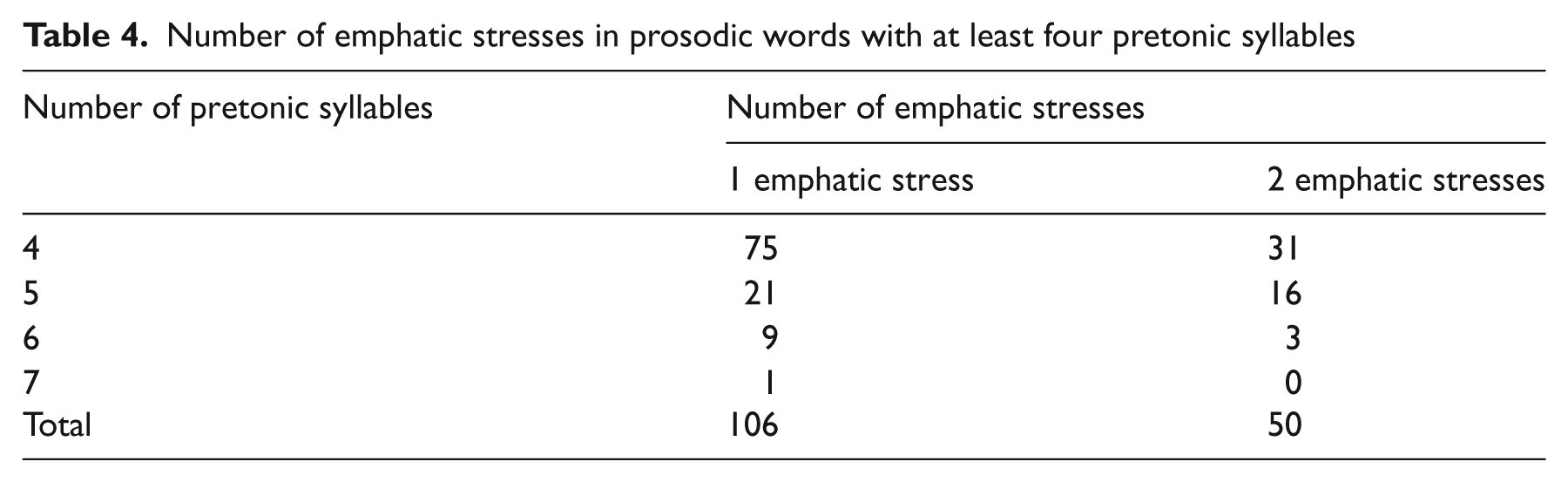
Table 4 shows the number of emphatic stresses present in words that are long enough to permit an alternating binary pattern (i.e., prosodic words which have four pretonic syllables or more). Nevertheless, when examining only words that could potentially contain two emphatic stresses, it is still more frequent for only one to appear (106 cases of words with one vs. 50 cases of words with two emphatic stresses). This is in agreement with Hualde’s (2007) findings for Spanish.
Number of emphatic stresses in prosodic words with at least four pretonic syllables
Hypothesis one concerned the distributional patterns of emphatic stress. Of the 647 prosodic words with one or two emphatic stresses and only one lexical stress, 519 (80.22%) displayed a binary pattern created by the presence of emphatic stress(es). In those where no binary pattern was created, a tendency was found for emphatic stress to occur on the first syllable of the word (in 77.34% of the cases, 99 tokens). Assignment of emphatic stress to the initial syllable resulted in stress clash in 26 cases (4.02% of the data). Figures 3, 4, 5, and 6 show F0 patterns of words with emphatic stress. Syllables with emphatic stress are shaded. Primarily-stressed syllables are indicated in the caption. Figure 3 exemplifies the most common pattern in the data: the binary pattern. Figure 4 shows a token displaying a non-binary pattern. Finally, Figures 5 and 6 display examples of stress clash (the emphatic stress occurs in a VC syllable in Figure 5 and in a V syllable in Figure 6).
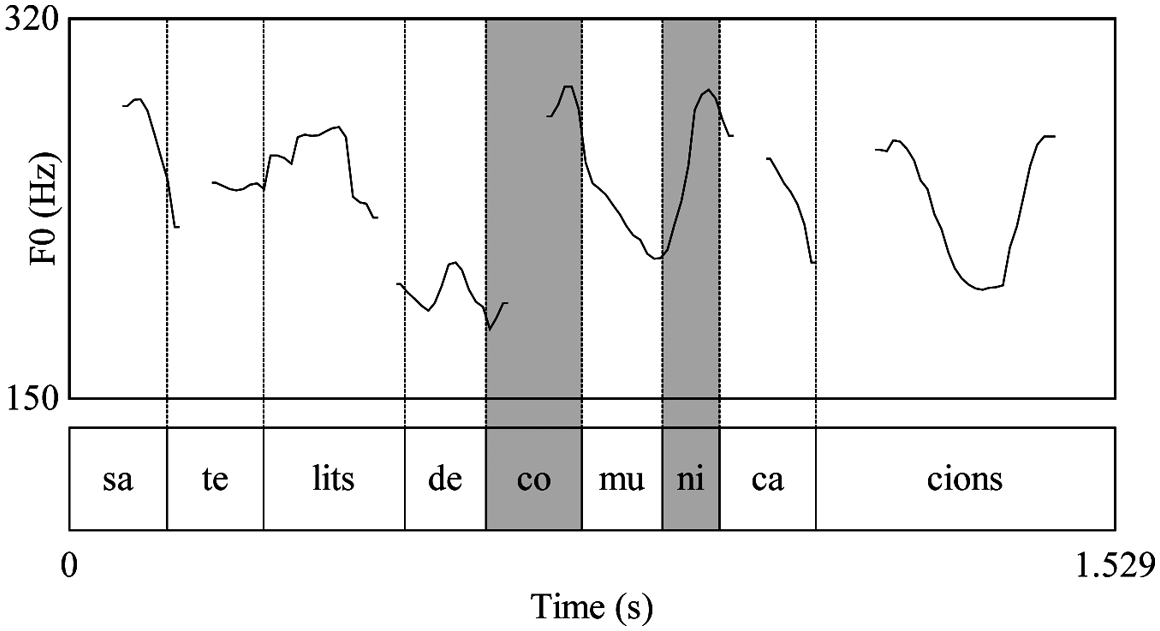
Two prosodic words (satèl·lits de co̱muni̱cacions ‘communication satellites’), the second of which contains two emphatic stresses, creating an alternating binary pattern
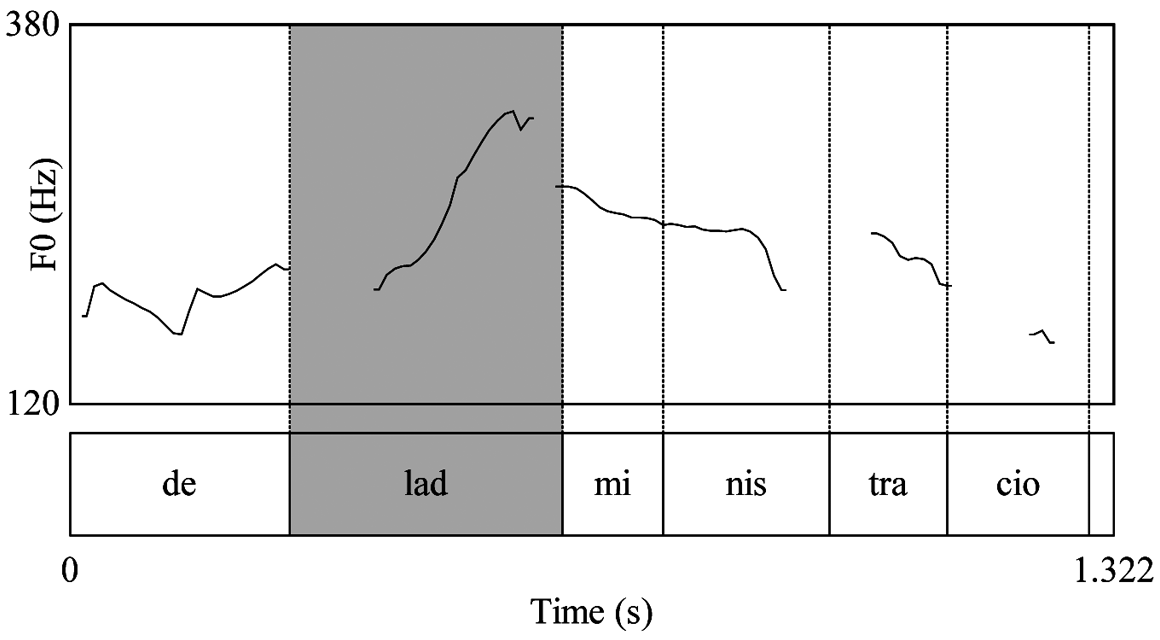
The prosodic word de l’a̱dministració ‘of the administration’ with one emphatic stress on the initial syllable of the morphological word
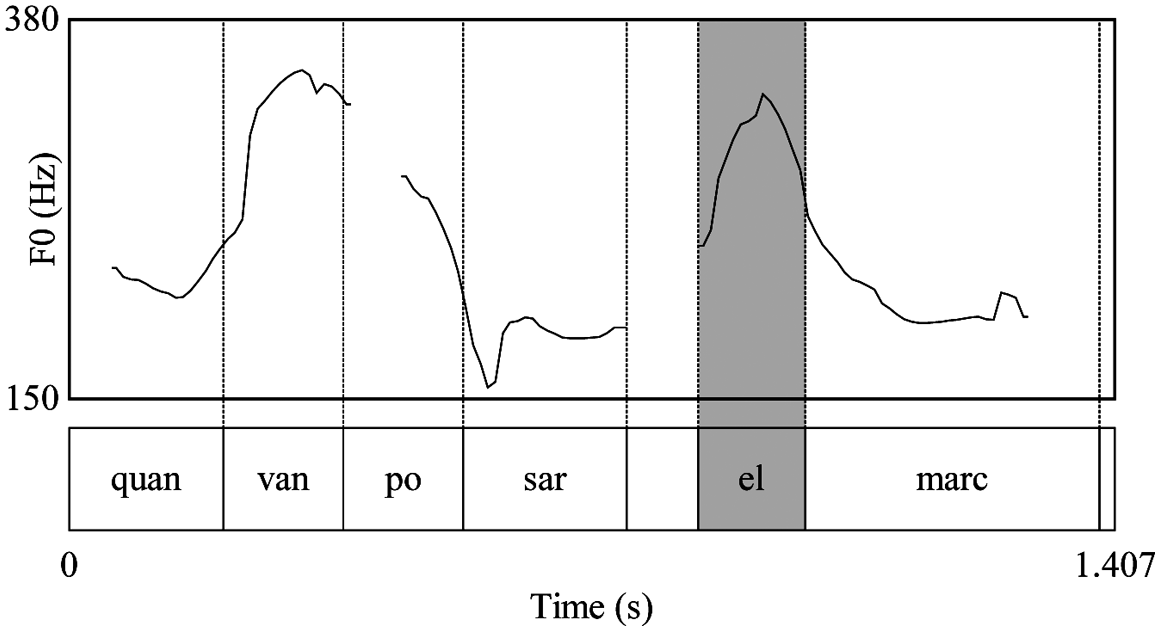
The prosodic word e̱l marc ‘the framework’ with one emphatic stress creating a stress clash
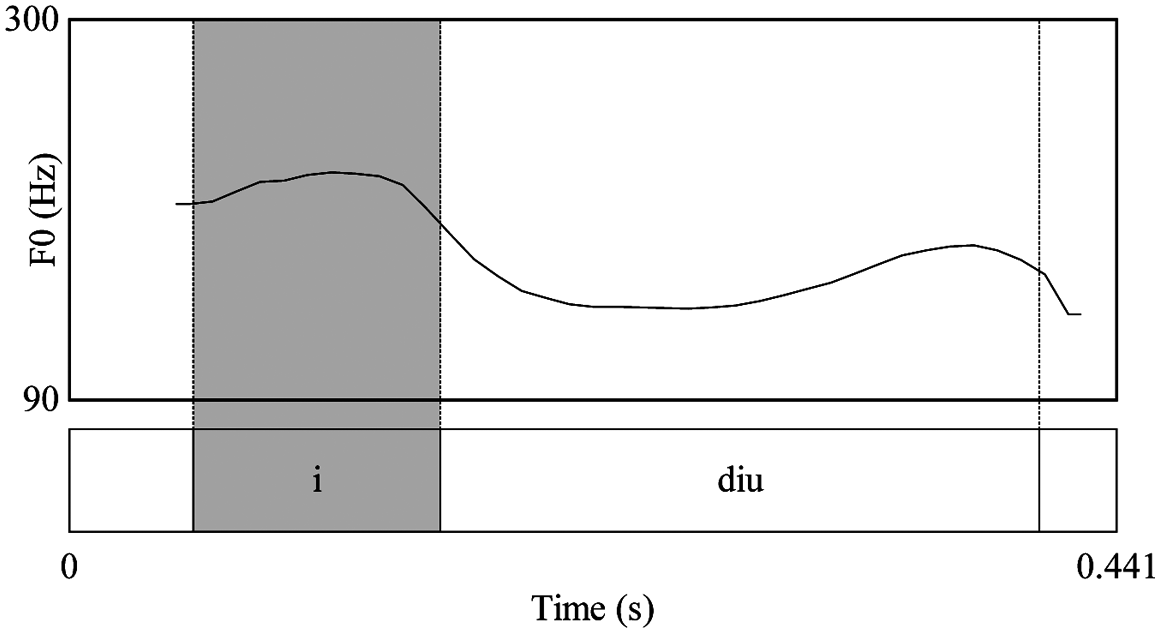
The prosodic word i̱ diu ‘and (s/he) says’ with one emphatic stress creating a stress clash
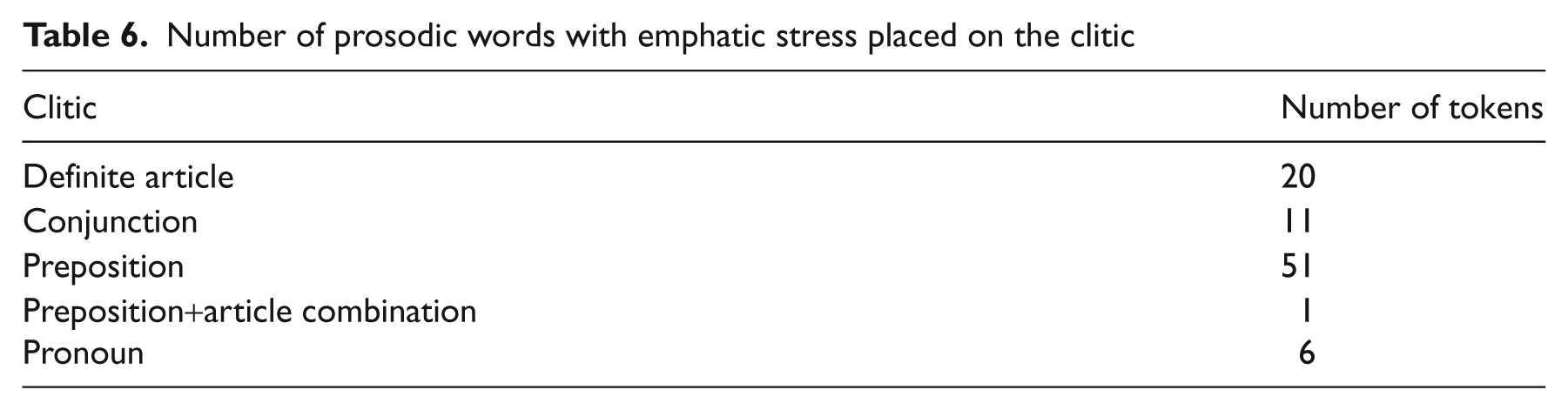
Table 5 shows the lexical category of words which receive emphatic stress(es) in our data. We distinguish between prosodic words formed by one morphological word alone and those that contain clitics. In fact, emphatic stress was placed on a clitic in 89 prosodic words, as shown in Table 6.
Lexical category of prosodic words which receive emphatic stress
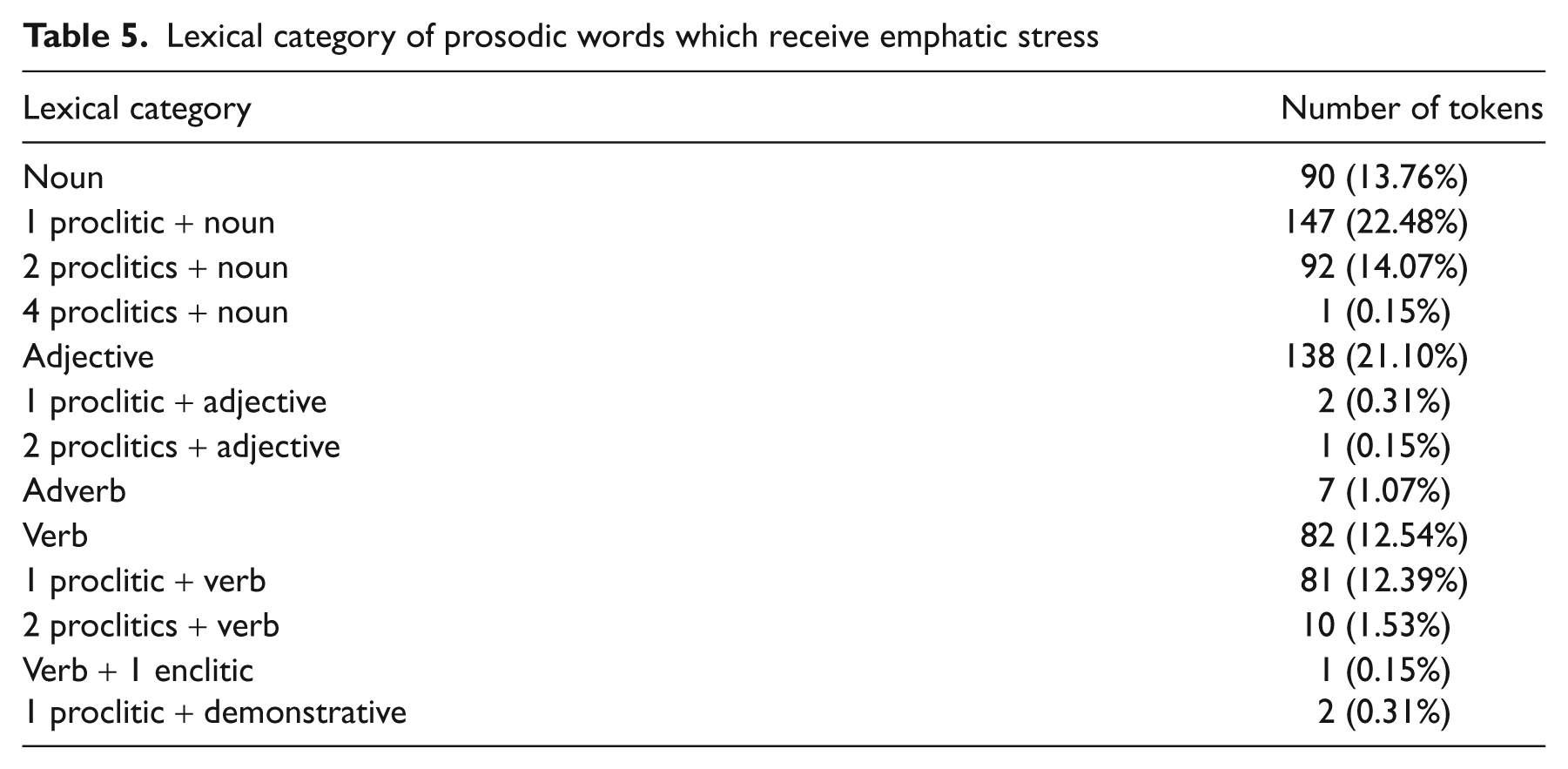
Number of prosodic words with emphatic stress placed on the clitic
Regarding the tonal manifestation of emphatic stress, the most common realization by far (96.73% of the cases) involves an F0 rise during the syllable with emphatic stress. The peak is typically aligned early in the vowel (as found for Spanish in Belda & de-la-Mota, 2010). This high F0 is most frequently maintained up to the end of the syllable, as shown in Figures 3 and 4 and in the schematic realization in Figure 7. The F0 starts falling immediately after the syllable with emphatic stress. This is the pattern found in 63.55% of the data. In terms of Autosegmental-Metrical labeling (e.g., Ladd, 2009), this tonal contour may be characterized as L+H*. Occasionally (24.11% of the cases), the emphatic-stress-bearing syllable anchors a complete rising and falling F0 movement, as Figure 6 displays. Only in a few rare cases (6.95%), there is a displaced F0 peak, with the F0 maximum found in the following syllable.
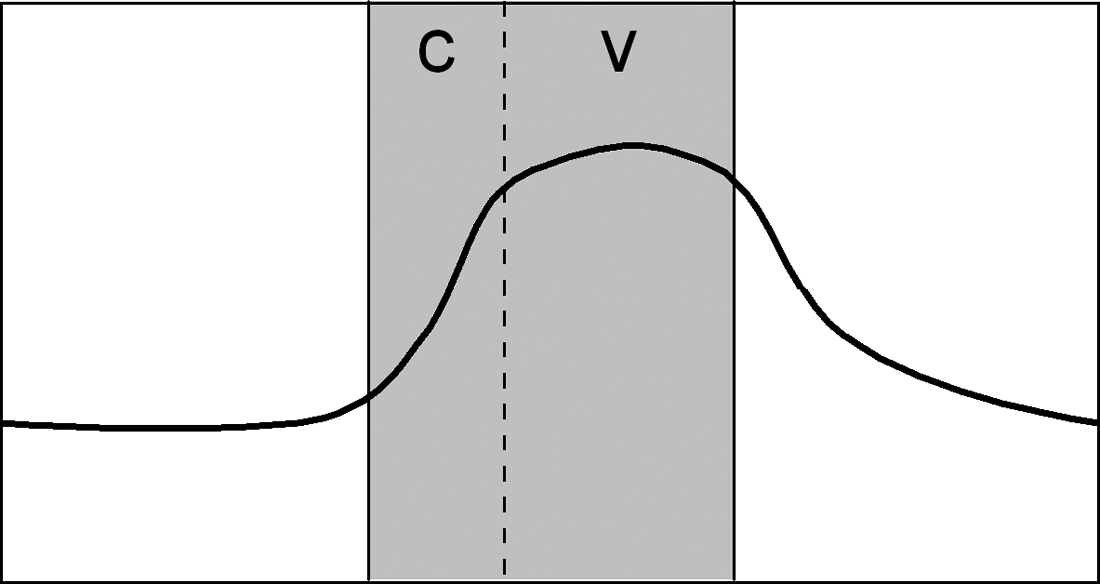
Schematic representation of the F0 movements most commonly associated with emphatic stress. The shaded cell represents the syllable with emphatic stress (C = consonant, V = vowel)
3.2 Within-word comparisons
In the within-word comparisons, vowels with emphatic stress are compared to vowels with primary stress in the same prosodic word by means of paired t-tests. Therefore, prosodic words with only one emphatic stress were included in these comparisons. In addition, the analyses were performed separately for prosodic words in nuclear and in non-nuclear (pre-nuclear) position. In Catalan, as in other Romance languages, the nuclear accent is generally placed on the last content word in the intonational phrase and it is immediately followed by a boundary tone. The total number of tokens included in the analyses of F0 (534 in non-nuclear position, 41 in nuclear position), duration (455 in non-nuclear position, 32 in nuclear position), and intensity (536 in non-nuclear position, 43 in nuclear position) is different. For the analysis of F0, some tokens had to be discarded due to F0 tracking problems. For the analysis of duration, those prosodic words whose primarily-stressed syllable contained a diphthong were discarded.
The within-word comparisons allow us to compare our results with those found for Spanish (Hualde, 2010) and Brazilian Portuguese (Abaurre & Fernandes, 2008).
3.2.1 Duration
Two paired t-tests revealed statistically significant differences in duration between vowels with emphatic and primary stress in non-nuclear, t(454) = −18.01, p < 0.001, as well as in nuclear positions, t(31) = −3.67, p < 0.001. Vowels with primary stress (non-nuclear = 96.13 ms, nuclear = 91.86 ms) are longer than those with emphatic stress (non-nuclear = 64.81 ms, nuclear = 72.96 ms) in both positions, as shown in Figure 8 (row 1).
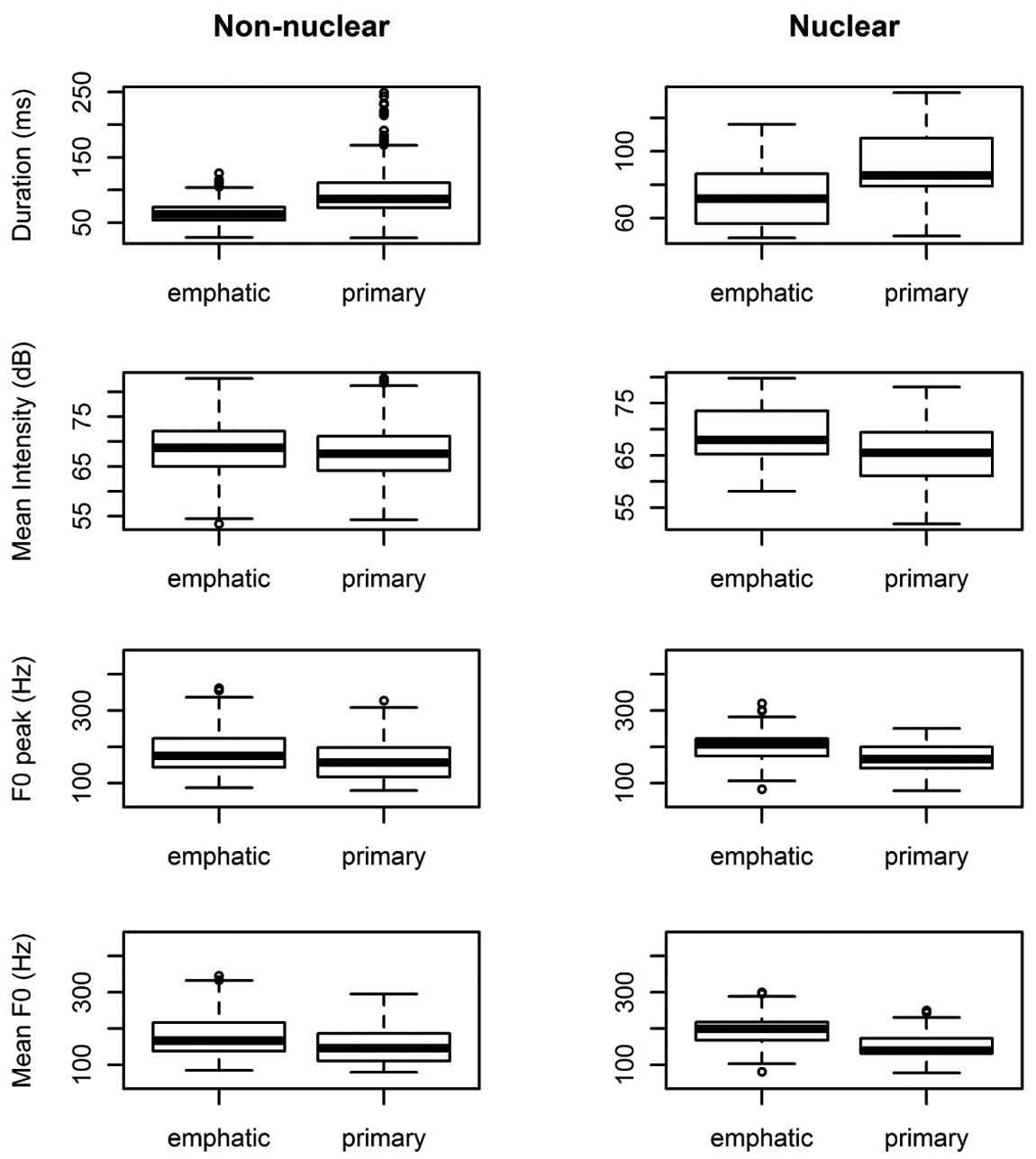
Duration (row 1), mean intensity (row 2), F0 peak (row 3), and mean F0 (row 4) of vowels with emphatic vs. primary stress in non-nuclear (column 1) and nuclear (column 2) position
3.2.2 Intensity
Two paired t-tests revealed statistically significant differences in mean intensity between vowels with emphatic and primary stress in non-nuclear, t(535) = 8.92, p < 0.001, as well as in nuclear positions, t(42) = 4.26, p < 0.001. Mean intensity is higher for vowels with emphatic stress (non-nuclear = 68.67 dB, nuclear = 68.74 dB) than for those with primary stress (non-nuclear = 67.74 dB, nuclear = 64.99 dB) in both positions, as illustrated in Figure 8 (row 2).
3.2.3 F0
Figure 8 shows the maximum F0 value (row 3) and mean F0 value (row 4) of vowels with emphatic vs. primary stress. Vowels with emphatic stress present a higher F0 peak (non-nuclear = 186.9 Hz, nuclear = 203.9 Hz) than primarily-stressed vowels (non-nuclear = 162 Hz, nuclear = 169.4 Hz) in the same word. Two paired t-tests revealed statistically significant differences in peak F0 between vowels with emphatic and primary stress both in non-nuclear, t(533) = 16.33, p < 0.001, and in nuclear position, t(40) = 5.95, p < 0.001. Another two paired t-tests testing differences between mean F0 of vowels with emphatic stress (non-nuclear = 179.6 Hz, nuclear = 194.9 Hz) and those with primary stress (non-nuclear = 151.9 Hz, nuclear = 152.8 Hz) showed the difference to be significant both in non-nuclear, t(533) = 20.6, p < 0.001, and in nuclear position, t(40) = 7.53, p < 0.001.
3.3 By vowel
3.3.1 Duration
Duration values (Figure 9) show the same tendency for each vowel: Vowels with primary stress are the longest, followed by vowels with emphatic stress. Unstressed vowels are shorter than the other two types. Means and standard deviations for this and subsequent measurements can be found in the appendix. Duration data were analyzed by submitting them to a mixed-effects regression model with normalized duration as response, individual speaker and word item as random intercepts, and stress level (primary, emphatic, unstressed) and vowel (/i/, [ə]~/a/, and /u/) as fixed factors (Baayen, 2008, Ch.7). The model was followed by an ANOVA, which revealed significant effects of stress, F(2, 2864) = 166.26, p < 0.001; vowel, F(2, 2864) = 53.67, p < 0.001; as well as a significant interaction, F(4, 2864) = 3.05, p < 0.05, between the two factors. Two regression models with the single fixed effect of stress were carried out to explore the effects of this factor. Each regression model used a different intercept, which allows testing for the three pairwise comparisons. Markov Chain Monte Carlo sampling, calculated on the t-statistic, was used to obtain the p-values for the pairwise comparisons (Baayen, 2008). In order to explore the interaction between vowel and stress, the dataset was divided by vowel identity and, again, two regression analyses (each with a different intercept) were performed for each subset in order to investigate the three pairwise comparisons. The results are presented in Table 7.
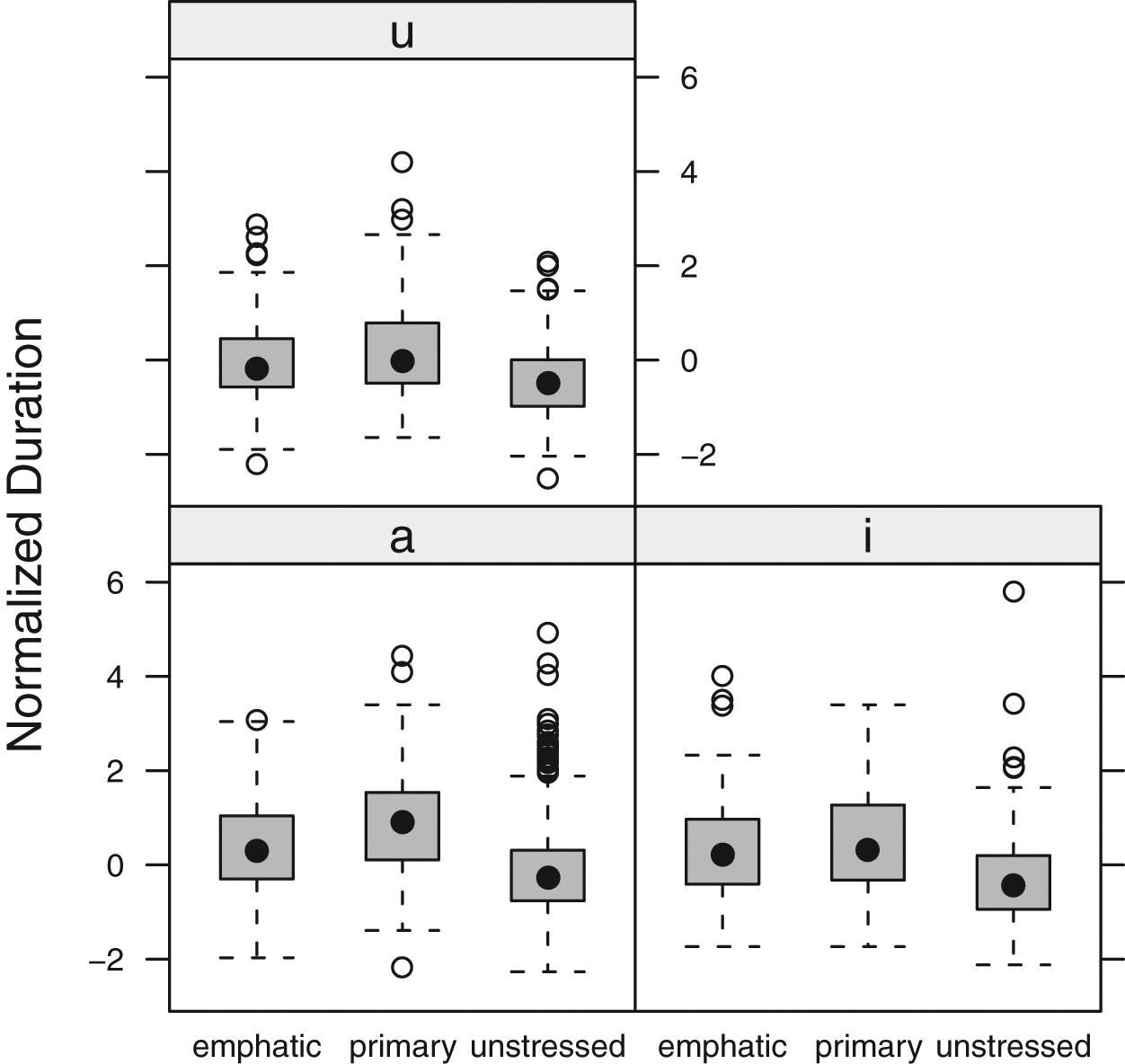
Normalized duration of /u/, [ə]~/a/, and /i/ by stress level
Mixed-effects regression analyses of duration as a function of stress with speaker and word as random intercepts
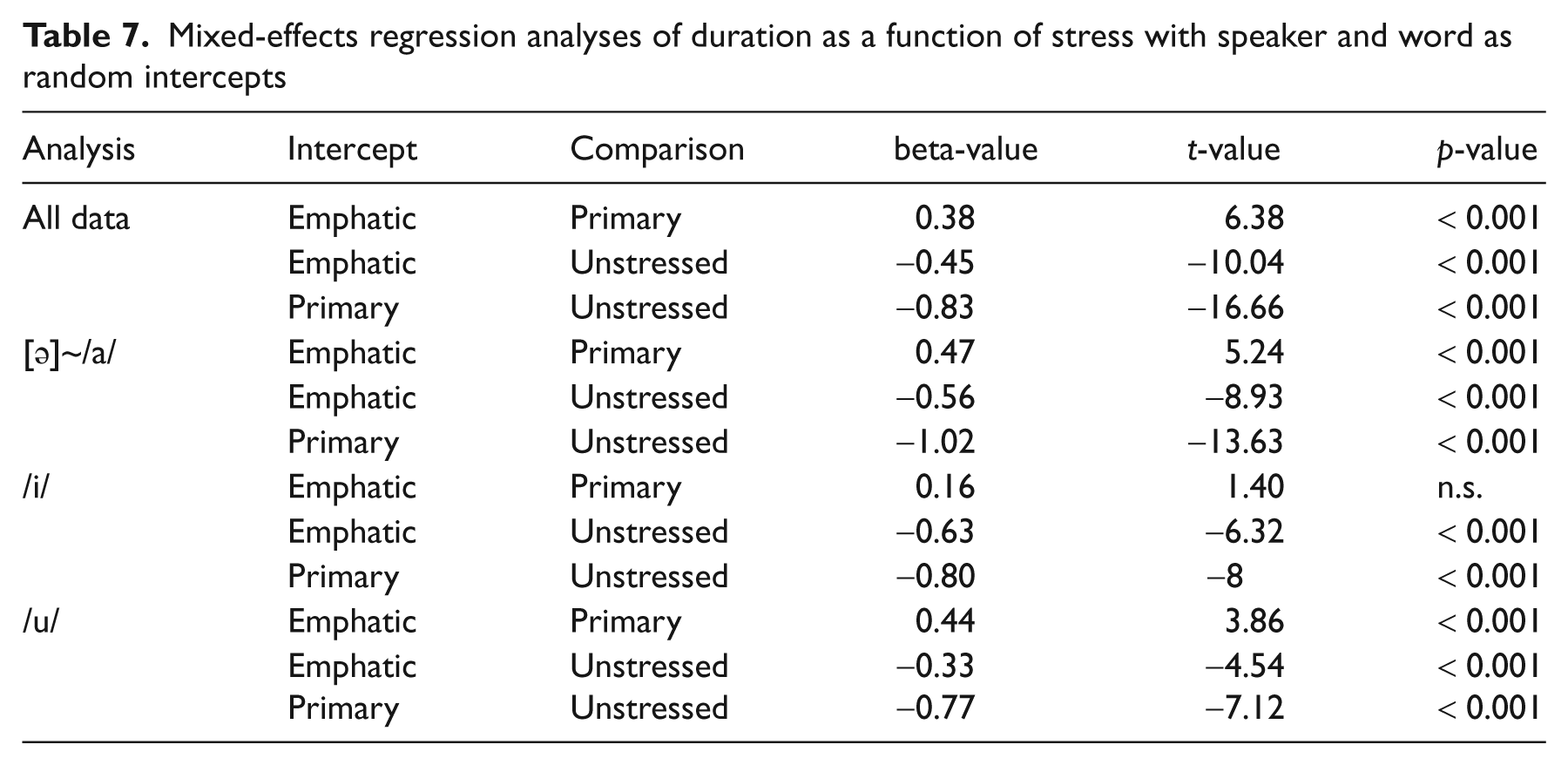
The three pairwise comparisons reach significance when all the vowels are pooled together. The regression models for the subsets of data show that all three pairwise comparisons are also significant for [ə]~/a/ and /u/, although for /i/, vowels with emphatic stress do not differ from those with primary stress.
3.3.2 Intensity
Figure 10 shows lower intensity values for unstressed vowels when compared to vowels with primary or emphatic stress. Regarding these two categories, emphatic /i/ and /u/ display higher intensity values than corresponding primarily-stressed vowels, whereas for [ə]~/a/ there does not seem to be a difference.
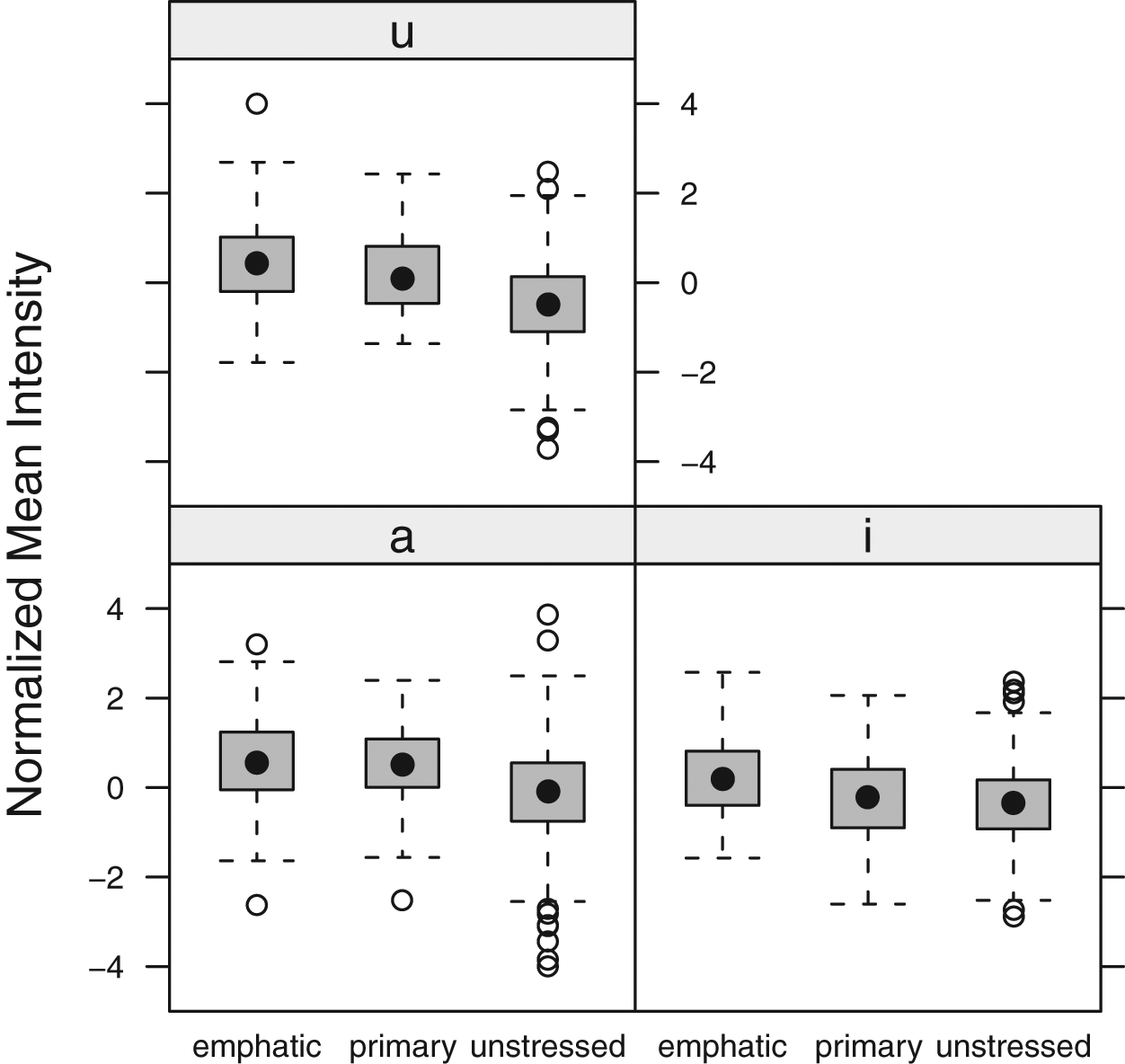
Normalized mean intensity values of /u/, [ə]~/a/, and /i/ by stress level
A mixed-effects regression model with normalized mean intensity as response, individual speaker and word item as random intercepts, and stress level (primary, emphatic, unstressed) and vowel (/i/, [ə]~/a/, and /u/) as fixed factors was followed by an ANOVA, yielding significant effects of stress, F(2, 2864) = 138.63, p < 0.001; vowel, F(2, 2864) = 75.40, p < 0.001; as well as a significant interaction between the two factors, F(4, 2864) = 4.84, p < 0.001. Two regression models with different intercepts and stress as the only fixed factor were carried out to explore the effects of stress. As for the analysis of duration and in order to explore the interaction between the two factors, the data were divided into three subsets by vowel identity and each subset was submitted to two regression models with the fixed factor of stress. Table 8 summarizes the results of the various regression models.
Mixed-effects regression analyses of mean intensity as a function of stress with speaker and word as random intercepts
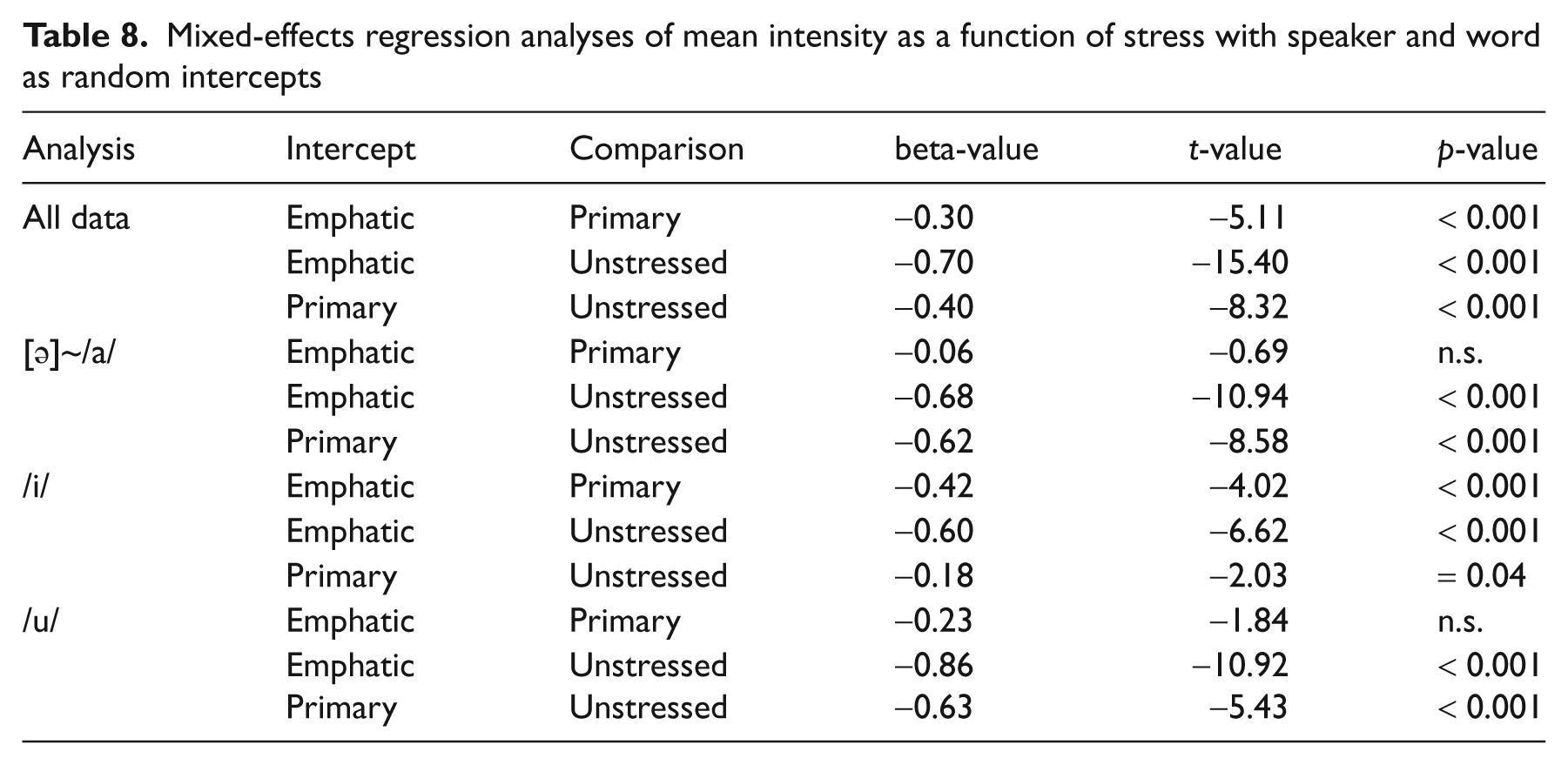
All pairwise comparisons for all models are significant except for the emphatic vs. primary comparison for [ə]~/a/ and /u/.
3.3.3 Vowel quality
Figure 11 shows a vowel plot with the three vowels, each with three stress levels. For all three vowels, tokens with emphatic stress display intermediate values in F1 between primarily-stressed and unstressed tokens, suggesting that emphatic stress results in realizations that are more centralized than stressed tokens, but less than unstressed tokens. The data were submitted to statistical analysis to verify whether these differences were statistically significant.
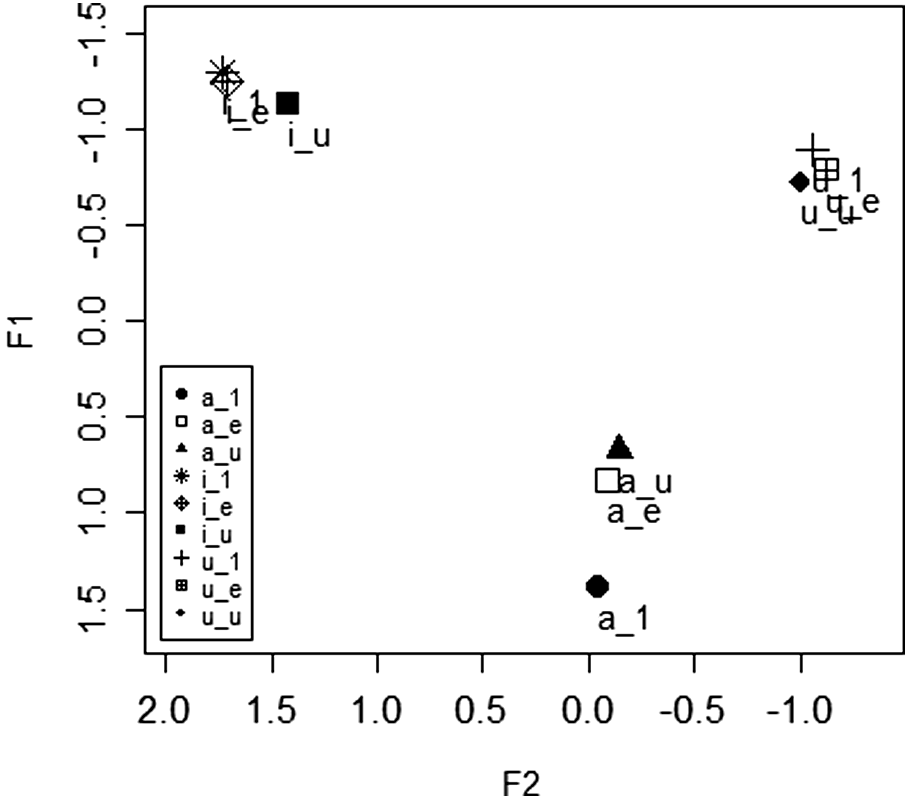
Mean vowel formant values (1 = primary stress, e = emphatic stress, u = unstressed, a = [ə]~/a/)
A mixed-effects regression model with normalized F1 as response, speaker and word as random intercepts, and stress level (primary, emphatic, unstressed) and vowel (/i/, [ə]~/a/, and /u/) as fixed factors, followed by an ANOVA of the model, yielded significant effects of stress, F(2, 2864) = 58.34, p < 0.001; vowel, F(2, 2864) = 6150.74, p < 0.001; and a significant interaction between these two factors, F(4, 2864) = 77.49, p < 0.001. The fixed effect of stress and the interaction between stress and vowel were explored as before. Table 9 provides the results of the two regression models with all the data pooled together, as well as those of the models carried out with subsets of data divided by vowel type.
Mixed-effects regression analyses of F1 as a function of stress with speaker and word as random intercepts
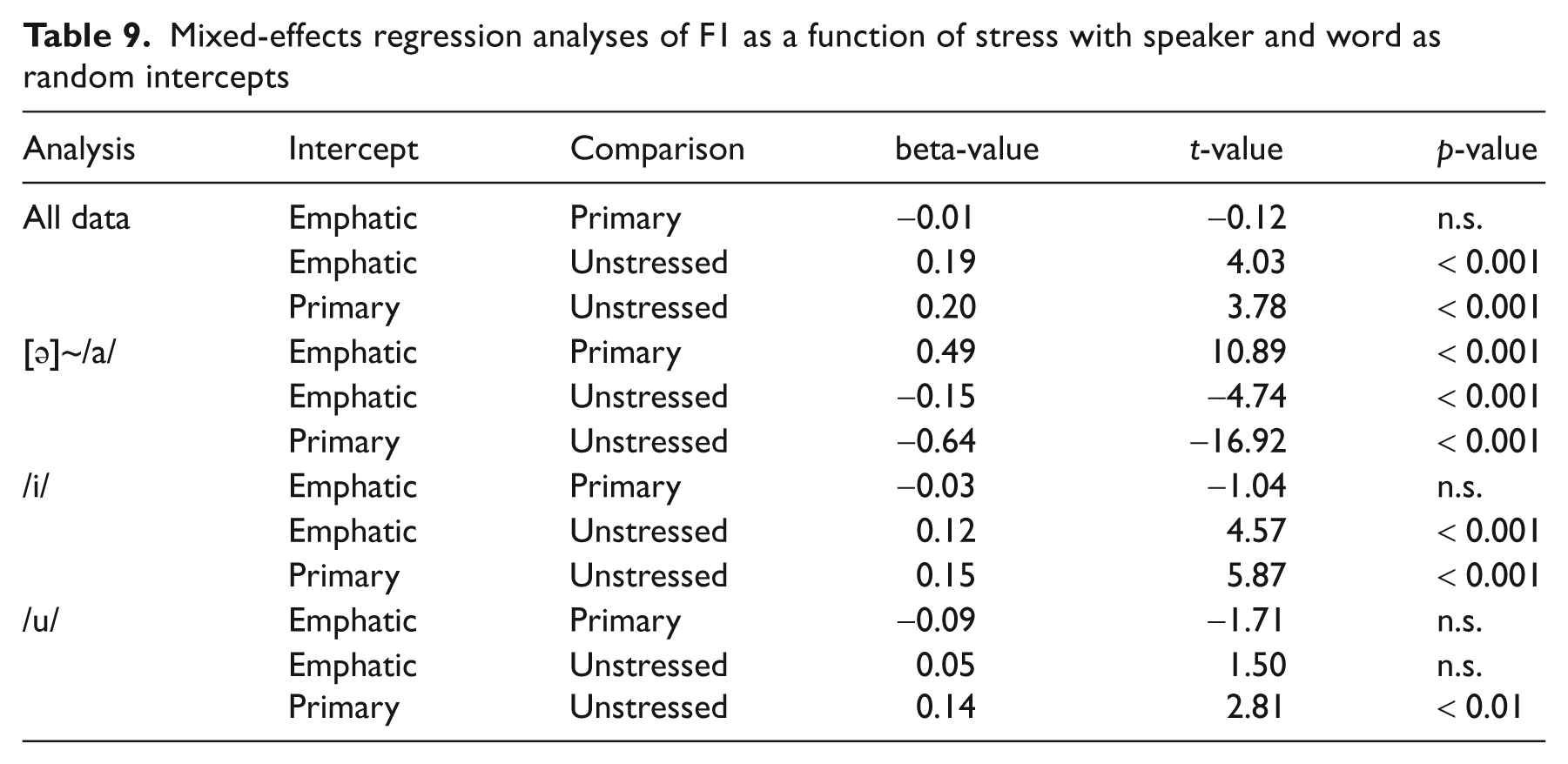
With all the data considered together, the analyses show significant differences between unstressed vowels and vowels with emphatic stress, as well as between unstressed vowels and primarily-stressed vowels. This is the same pattern found for vowel /i/. As shown in Figure 12, vowels with emphatic or primary stress are higher than unstressed vowels. For /u/, the only significant comparison is between primarily-stressed and unstressed vowels (the former being significantly higher than the latter). Finally, for [ə]~/a/, all three pairwise comparisons are significant. Schwa is lower when it receives emphatic stress, but it still differs statistically from primarily-stressed /a/.
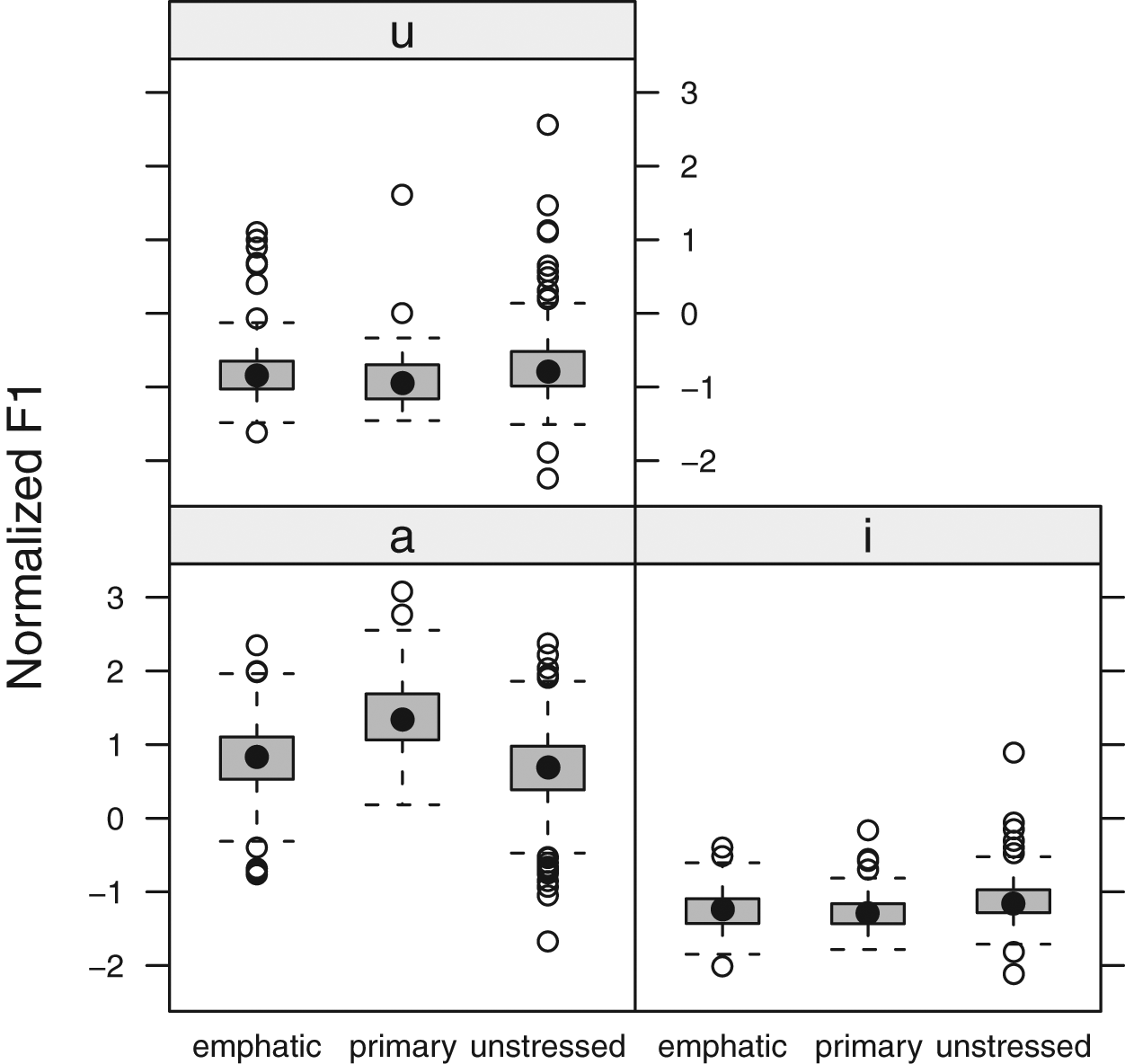
Normalized F1 values of /u/, [ə]~/a/, and /i/ by stress level
Figure 13 shows boxplots of normalized F2 by vowel and stress level. The data were analyzed as before. The mixed-effects regression model with normalized F2 as response, speaker and word as random intercepts, and stress level (primary, emphatic, unstressed) and vowel (/i/, [ə]~/a/, and /u/) as fixed factors was followed by an ANOVA, which returned significant main effects of stress, F(2, 2864) = 227.76, p < 0.001, and vowel F(2, 2864) = 5292.84, p < 0.001. The interaction between the vowel and stress factors was also significant, F(4, 2864) = 20.07, p < 0.001. The same follow-up analyses were performed and the results are reported in Table 10.
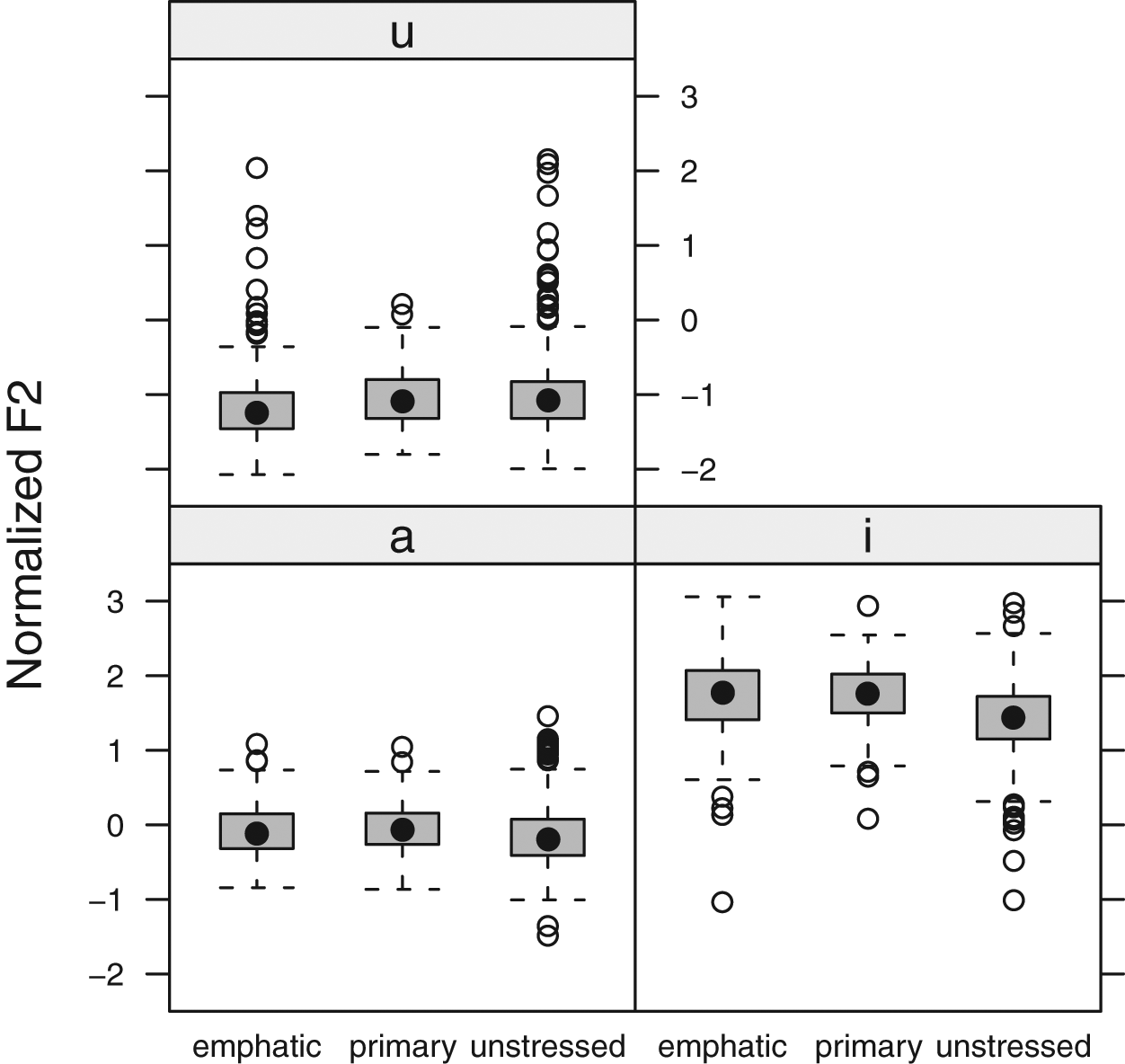
Normalized F2 values of /u/, [ə]~/a/, and /i/ by stress level
Mixed-effects regression analyses of F2 as a function of stress with speaker and word as random intercepts
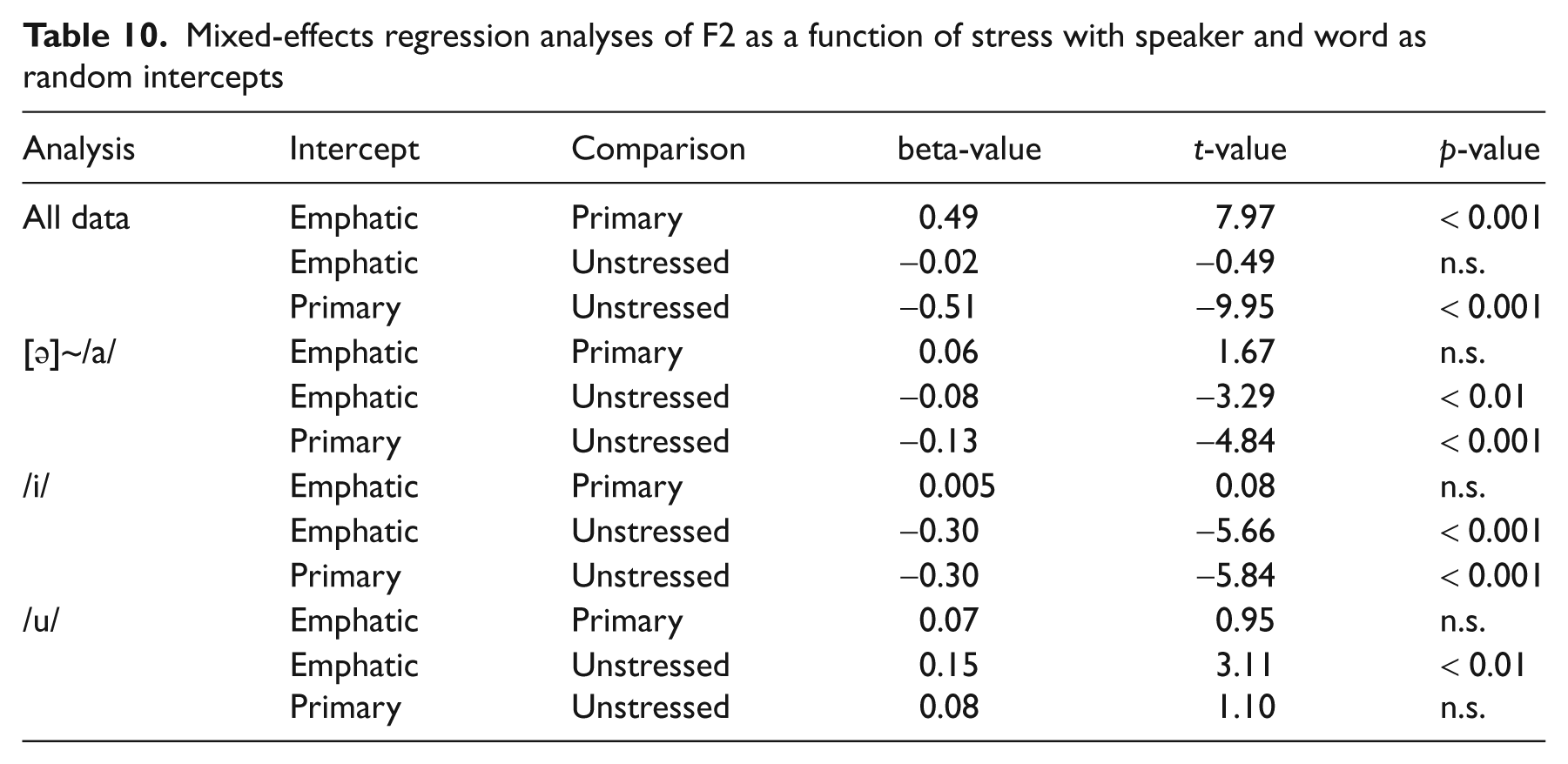
As shown in Table 10, the general model shows differences between vowels with primary vs. emphatic stress, as well as between primarily-stressed vs. unstressed vowels. For [ə]~/a/, all pairwise comparisons are significant except for that between vowels with emphatic vs. primary stress. Vowels with emphatic or primary stress are more fronted than unstressed vowels. The same results are found for /i/ and again vowels are more anterior when they receive primary or emphatic stress than when they are unstressed. Regarding /u/, the only significant comparison is between vowels with emphatic stress and unstressed vowels (the former are more posterior than the latter).
4 Discussion and conclusions
The analysis of the patterns that result from the assignment of emphatic stress to lexically unstressed syllables in radio speech shows that emphatic stresses usually appear two syllables to the left of the syllable with primary stress or, in fewer cases, of another syllable with emphatic stress. That is, most commonly, the presence of emphatic stress results in a binary pattern.
However, the data show that other patterns are also possible, including ternary and mixed (binary and ternary) patterns, among others. In addition, in a few cases (4% of the data), emphatic stress was assigned to a syllable immediately to the left of the lexical stress, thus giving rise to a stress clash, which is otherwise disfavored in the language (Prieto et al., 2001). The findings in terms of the patterns that emphatic stress creates confirm the first hypothesis. The binary pattern was found to be the most frequent pattern, coinciding with Coromines’s (1974) intuitions for rhythmic stress, but other patterns were also observed (as pointed out by Oliva, 1977, 1992, and Recasens, 1993, again for rhythmic stress), including stress clash and mixed patterns. It was shown that, when the resulting pattern is not binary, emphatic stress is typically anchored on the first syllable of the prosodic word. It may well be the case that, in fact, the different distributional patterns observed correspond to different pragmatic meanings, but the present experiment does not allow us to draw any conclusions on this matter. Perception experiments, as well as a study of the context of utterance of the different patterns, would be needed in order to be able to establish whether the two main patterns (alternating vs. initial stress) have different pragmatic meanings (as Hualde, 2007, 2009, proposes for Spanish).
The relative scarcity of emphatic stresses compared to the amount of data analyzed indicates that this is not an obligatory phenomenon, but an optional one that is favored by speech style. The present study shows that it is possible to find acoustic evidence of this phenomenon. However, the location of stress may not be entirely predictable, as demonstrated by the various patterns found. Unlike primary stress, emphatic stress is not a lexical property of words.
We have found that syllables that are perceived to carry emphatic stress anchor a rising F0 movement that culminates early in the vowel portion. Generally a high F0 is maintained throughout the syllable and a fall initiates in the following syllable. This contour may be labeled as L+H*. In a few cases, a complex, rising-falling movement is associated with the syllable with emphatic stress. This may be considered a tritonal contour L+H*+L.
It was also hypothesized that duration would distinguish at least between primarily-stressed vowels and those with emphatic stress, and that the latter would have higher intensity than vowels with primary stress in the same word. Regarding duration, the within-word comparison reveals that primarily-stressed vowels are somewhat longer than those with emphatic stress. This is consistent with the results reported in Hualde (2010) for Spanish emphatic stress and also with the Brazilian Portuguese facts reviewed in the introduction. Even though pitch prominence is shifted to a different syllable, the position of the lexical stress is still cued by duration. In the comparison across the three stress categories, duration turned out to be a reliable correlate of emphatic stress, since vowels bearing emphatic stress are intermediate in their duration between primarily-stressed and unstressed vowels. For /u/ and [ə]~/a/, primarily-stressed vowels were found to be significantly longer than both unstressed vowels and vowels with emphatic stress. In addition, for all vowels (/i/, [ə]~/a/, and /u/), vowels with emphatic stress were significantly longer than unstressed vowels. That is, the effect of emphatic stress on duration is to create an intermediate length for these vowels, which are shorter than primarily-stressed vowels, but longer than unstressed vowels. The within-word analysis of intensity reveals that vowels with emphatic stress have higher intensity than vowels with primary stress in the same word. The comparison of the three stress categories reveals that vowels with emphatic or primary stress have higher intensity than unstressed vowels, as expected. For /i/, differences were also found between vowels with emphatic vs. primary stress, in that the former had higher mean intensity than the latter.
Regarding the third hypothesis, the results show that we can at least distinguish between emphatic-stress-bearing and unstressed vowels in terms of vowel height. When schwa receives emphatic stress, it becomes different (less centralized) than its corresponding unstressed segment, but it does not become a full vowel (it is still higher than /a/). For /i/, the analyses show that, when this vowel is realized with emphatic stress, it becomes less centralized than its unstressed counterpart and indistinguishable from the primarily-stressed one. That is, vowels which received emphatic prominence were found to be realized indistinguishably from primarily-stressed vowels in terms of vowel height (/i, u/) or to result in an intermediate category between the corresponding unstressed and full vowels ([ə]). To sum up, the effects of emphatic stress include the assignment of a high tone on a lexically unstressed syllable, longer duration (with respect to unstressed vowels), higher intensity, and less vowel centralization.
This corpus study offers empirical evidence of an atypical relation between stress and pitch accent assignment in Central Catalan, since it shows that lexically unstressed syllables can anchor a pitch accent, thus functioning like lexically stressed syllables. It also offers evidence of an atypical relation between stress and vowel reduction: Lexically unstressed, phonologically reduced vowels receive prominence and, as a result, the reduced quality of these vowels is affected, yielding intermediate categories between primarily-stressed and unstressed vowels. In fact, these results may be taken to indicate the existence of a stressed schwa in this variety of Catalan. Analysis of the formant structure of this vowel revealed that schwa is statistically less centralized (lower) when it receives emphatic stress, but it does not merge with stressed /a/. More generally, these findings allow us to distinguish between two reduction processes affecting vowels at different linguistic levels: phonological reduction (as exemplified by the morphophonemic alternations shown in (1)) and phonetic reduction (instantiated in the differences obtained among the three different levels of stress).
Footnotes
Appendix
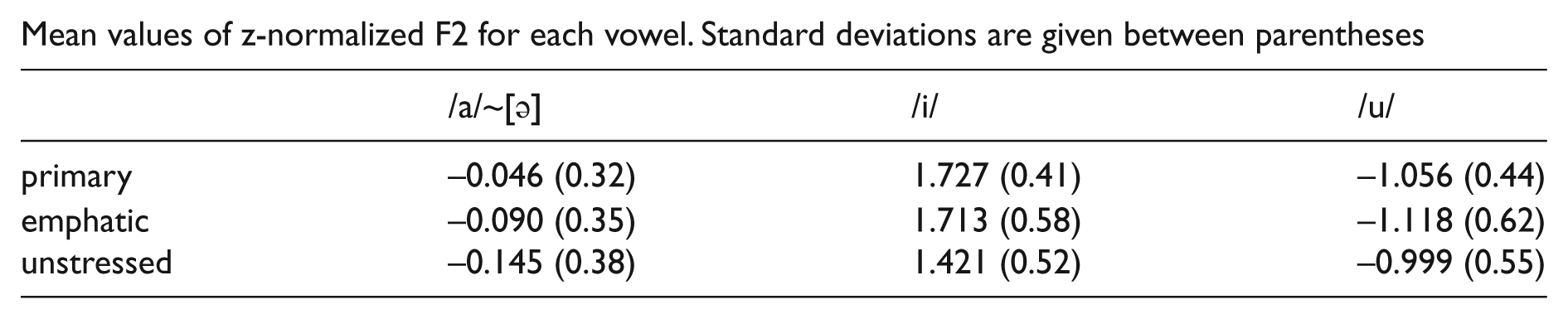
Mean values of z-normalized F2 for each vowel. Standard deviations are given between parentheses
| /a/~[ə] | /i/ | /u/ | |
|---|---|---|---|
| primary | –0.046 (0.32) | 1.727 (0.41) | –1.056 (0.44) |
| emphatic | –0.090 (0.35) | 1.713 (0.58) | –1.118 (0.62) |
| unstressed | –0.145 (0.38) | 1.421 (0.52) | –0.999 (0.55) |
Acknowledgements
We are very thankful to Oriol Camps and Catalunya Ràdio for providing us with the data. We would also like to thank the audience at the 15th Hispanic Linguistics Symposium and the 2nd Workshop on Intonation and Cat_ToBI for their comments, Maria del Mar Vanrell and Romà Rofes for transcribing part of the data, and the two reviewers for very useful feedback that helped greatly improve the article. All errors are ours.