







Abstract
Although intonation has been traditionally associated with the expression of attitudes and intentions on the part of the speaker, little is known about whether sociopragmatic factors, such as power or social distance, or situational ones, like physical distance or insistence, can constrain the use and felicity of pitch contours. This article investigates the felicity conditions underlying the choice of three vocative pitch contours in Central Catalan by means of two experiments, namely a production experiment based on the Discourse Completion Task (320 vocative contours produced by 20 speakers), and an acceptability judgment task in which 72 listeners were asked to rate the appropriateness match between a set of vocative contours and a previous discourse context (3,456 responses). The results from the two experiments show that both situational and social politeness factors govern the choice of vocative intonation. Finally, the results are discussed in line with the traditional classification of politeness strategies defined by Brown and Levinson, in the sense that the three intonation contours can be linked to negative, positive, and bald on-record politeness strategies.
1 Introduction
Vocatives are addressee-oriented linguistic units that can be used in a variety of speech acts such as greetings, calls, commands, or requests (Parrott, 2010; Poynton, 1990, and others). Research on their pragmatic function has shown that they can fulfill three main functions: attracting someone’s attention, identifying someone as an addressee, and maintaining and reinforcing a social relationship (Biber, Johansson, Leech, Conrad, & Finegan, 1999; Leech, 1999; McCarthy & O’Keeffe, 2003; Norrick & Chiaro, 2009). Zwicky (1974, p. 796) claimed that vocatives express “attitude, politeness, formality, status, intimacy, or a role relationship, and most of them mark the speaker […] as belonging to a subculture, social class, or geographical dialect” (see also Axelson, 2007, pp. 95–122). Thus, one of the main discourse functions of vocatives is to identify participants’ roles and characterize the speaker in relation to the addressee, as they are especially relevant as markers of power and solidarity (Ahmed, 2007; Brown & Levinson, 1987; Hook, 1984; Osterman, 2000; Wood & Kroger, 1991; cf. French toi vs. vous ‘you’). 1
Languages can use a variety of strategies to mark vocatives, such as morphological case or particles, as well as prosodic mechanisms such as specific intonation patterns, stress shifts, or truncation patterns (see Daniel & Spencer, 2009, for a review). Crosslinguistic research on vocative intonation has documented a specific pitch contour known as vocative chant (Liberman, 1979), stylized fall (Ladd, 1978), or chanted call (Hayes & Lahiri, 1991). 2 This tune consists of a rising pitch accent, typically associated with the stressed syllable, followed by a sustained mid-boundary tone – labeled (L+)H* !H% after Ladd (1996). In fact, some authors have stated that politeness-related factors such as age and social status constrain the use of the vocative chant across languages. The chanted form has been found to be characteristic of children’s speech across languages. Abe (1998) reported that the vocative chant in Japanese is likely to be used by a group of children for calling their friend out of his or her house to join them – and Sadat-Tehrani (2008) explained that Persian speakers will usually not call somebody of a higher social rank (e.g., their boss, or an elderly person) in chanted form. The main goal of the present study is to investigate the influence of social politeness factors (i.e., power and social distance) as well as two situational factors (the physical distance between participants and insistence) on vocative pitch contour selection and felicity.
Frota and Prieto (to appear, 2015) report that almost all Romance languages (Catalan, French, Friulian, Italian, Portuguese, Romanian, Sardinian, and Spanish) use a form of the vocative chant (three language-specific types differentiated by the tune-text association of the !H target), as well as a final-falling calling contour characterized by a high pitch on the nuclear syllable (H* or L+H*) followed by a low (L%) or a falling (HL%) boundary tone. Situational factors, such as insistence and physical distance, have been highlighted as playing a role in the selection of vocative intonation (see Prieto et al., to appear, 2015, for Catalan, and Frota et al., to appear, 2015, for European Portuguese), though these claims have been based on a handful of examples and there is a need for further empirical and quantitative investigation.
In addition to the limited knowledge of the role of situational factors, little is known about the potential role of social politeness in vocative pitch contour selection and felicity. Researchers have pointed out that the speaker’s choice of vocative forms acts as a marker of power and solidarity across languages (Brown & Levinson, 1987; Hook, 1984; Ostermann, 2000), but to our knowledge no previous studies have been carried out on the effects of these factors in empirical terms. Following Astruc, Vanrell, and Prieto’s (in press) work on the intonation of request and offering questions, we took as a starting point Brown and Levinson’s (1987) classical version of politeness theory for the control of the social variables, which remains the most influential model.
Brown and Levinson (1987, p. 61) based their theory around the concept of face, defined as: […] the public self-image that every member wants to claim for himself, consisting in two related aspects: (a) negative face, the basic claim to territories, personal preserves, rights to non-distraction (i.e., to freedom of action and freedom from imposition), and (b) positive face, the positive consistent self-image or ‘personality’ (crucially including the desire that this self-image be appreciated and approved of) claimed by interactants.
The authors then state that every speech act (e.g., a vocative) has the potential to be a face-threatening act (FTA), and that the assessment of the seriousness of any FTA depends on the relationship between the speaker and the hearer, which generally involves three factors (1987, p. 74): the social distance (or solidarity) between them, their relative power (or social status), and the absolute ranking of impositions in that particular culture. The politeness strategy to be followed in doing the FTA will crucially depend on these factors (and thus very importantly on the personal relationship between the interactants), and it can be of four types: bald on-record (e.g., “Shut the window”), positive (e.g., “Hey, how about shutting the window, man?”), negative (e.g., “Would you mind shutting the window, please?”), or off-record (e.g., “I think I’m cold …”). In the studies presented here, we will control for and test the potential effects of power and social distance, in addition to physical distance and insistence.
In Central Catalan, vocatives are mainly identified through the lack of the personal article (Maria, menja una mandarina! ‘Mary, have a tangerine!’ vs. La Maria menja una mandarina ‘Mary is eating a tangerine’). Interestingly, a variety of intonation contours can be used with vocatives (see, e.g., Prieto et al., to appear, 2015). The Interactive Atlas of Catalan Intonation (Prieto & Cabré, 2007–2012) documented that the most frequent pitch contours used for vocatives in Central Catalan are L* H%, L+H* HL%, and L+H* !H%, whereas the rising-falling pitch contour L+H* L% is more rarely found. Figure 1 illustrates the three most frequent intonational contours found for Catalan vocatives, namely L* H% (left), L+H* HL% (center), and L+H* !H% (right), applied to the proper name Marina [mǝˈɾinǝ].
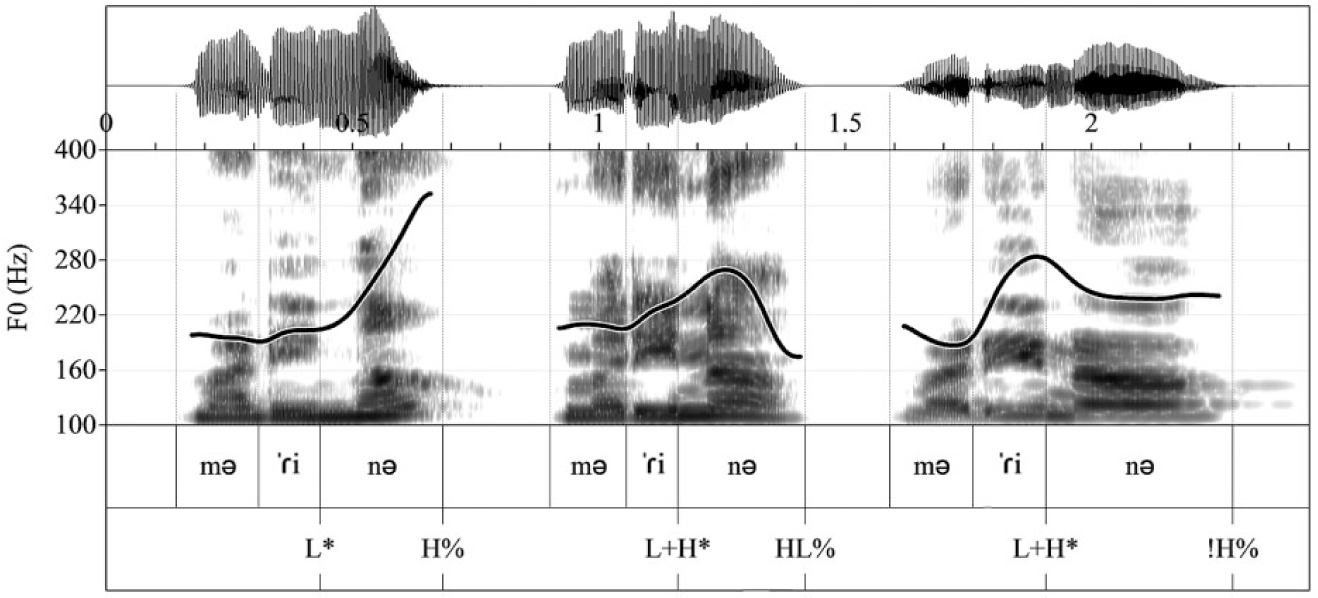
The three main intonational contours found in Catalan vocatives, from left to right: L* H%, L+H* HL%, and L+H* !H%. The contours illustrated are taken from three speakers (MD, NA, MR) who participated in the subsequent production experiment.
Our general research question is to assess the felicity conditions that constrain vocative intonation preferences in Catalan. This language provides a good test case for this question, as it frequently uses three different intonational contours for vocatives. This research question will be investigated by means of two complementary experiments, namely a production experiment using a Discourse Completion Task methodology (Section 2), and an acceptability judgment task in which speakers are asked to rate the appropriateness of these three intonation patterns in relation to the preceding pragmatic context (Section 3). The following two sections describe the methods and results for these two experiments.
2 Production experiment (DCT)
2.1 Methodology
2.1.1 Participants
Twenty speakers of Central Catalan (17 female and 3 male), aged between 18 and 55 (mean = 27.05 years), volunteered to participate in the production experiment. All participants were native speakers of Catalan and, when asked to rate their own linguistic dominance, said that they used it as their main language. On average, they reported using Catalan (as opposed to Spanish) during more than 80% of their daily activities.
2.1.2 Materials and procedure
In order to elicit vocative intonation patterns in Central Catalan across a set of contextual or pragmatic conditions, we designed the target discourse contexts for a Discourse Completion Task (henceforth DCT; Billmyer & Varghese, 2000; Blum-Kulka, House, & Kasper, 1989; Félix-Brasdefer, 2010) aimed at eliciting vocative utterances. In a DCT, the speakers are presented with specific discourse contexts that constrain their productions, so this enables the researcher to obtain semi-spontaneous productions while controlling for specific pragmatic factors.
Following Brown and Levinson’s (1987) politeness theory, two sociopragmatic features were controlled for in the target discourse contexts, namely Social Distance (henceforth
(1) Discourse context: You’re a project manager in a big company. The vice-president is Mrs Marina Smith. She holds a position of authority and you don’t know her very well. You need her to sign some documents. She’s in front of you. Call out her name so that she will come over.
[
(2) Discourse context: Your little sister Marina is very good at math and you want her to help you with your homework. You are the older sister and you have a lot of influence over her. She’s now in the next room, so she may not hear you very well. You have already called her once. Call out to her again.
[
Importantly, the target discourse contexts were controlled for the potential confounding effects of other pragmatic factors. For example, in order to control for potential gender effects, female participants were asked to call another woman (Marina [məˈɾinə]) and male participants were asked to call another man (Emili [əˈmili]). In addition, to avoid potential syntactic influences on prosodic patterns, the DCT was designed to elicit isolated vocative forms. Finally, the cost of the petition to the interlocutor was also taken into consideration. The ultimate will of the speaker is in the one case to get some documents signed and in the other to get some help with math homework from a close relative who is very good at it. Though both situations involve a low cost request, participants were told to call their interlocutor with the aim of getting them to do the same single action, that is, to come closer to them, with no additional information contained in the utterance. Thus, participants were told to focus on their interlocutor’s name only and to specify the reason for their calling only after this first action was accomplished.
The experiment took place in a quiet room at the Universitat Pompeu Fabra in Barcelona. The 16 target contexts were described orally by the experimenter to each of the 20 participants. The participants’ responses were digitally recorded using a Marantz 660 or a Zoom H4n handheld digital recorder. The total number of vocatives obtained was 320 (16 contexts × 20 speakers). The mean duration of the experiment was 5 minutes.
2.1.3 Analysis
The 320 vocatives obtained were prosodically labeled using the Cat_ToBI system (Prieto et al., to appear, 2015) by the first two authors of the article, both proficient speakers of Catalan and experts in the labeling system. The labels were then submitted to an inter-transcriber agreement test. The inter-transcriber agreement between the two labelers’ coding was quantified by means of the Cohen’s kappa coefficient (Cohen, 1960), which gave an overall coefficient of .92. Disagreements were resolved by the coding of the third author, whose labels always coincided with one of the two previous candidates in conflict for each production.
2.2 Results
2.2.1 Contour selection
Table 1 shows the absolute number (N) and frequency of appearance (%) of the intonational contours obtained. These results confirm the previous findings reported by Prieto et al. (to appear, 2015; see also Prieto & Cabré, 2007–2012), namely that Central Catalan speakers use three main intonational contours for vocatives (L+H* HL%, L+H* !H%, L* H%), and less frequently L+H* L% (which represented around 4% of the data). The analysis presented in this section will only take into consideration the three most frequent patterns.
Absolute number (N) and frequency of appearance (%) of each intonational contour in the DCT experiment.
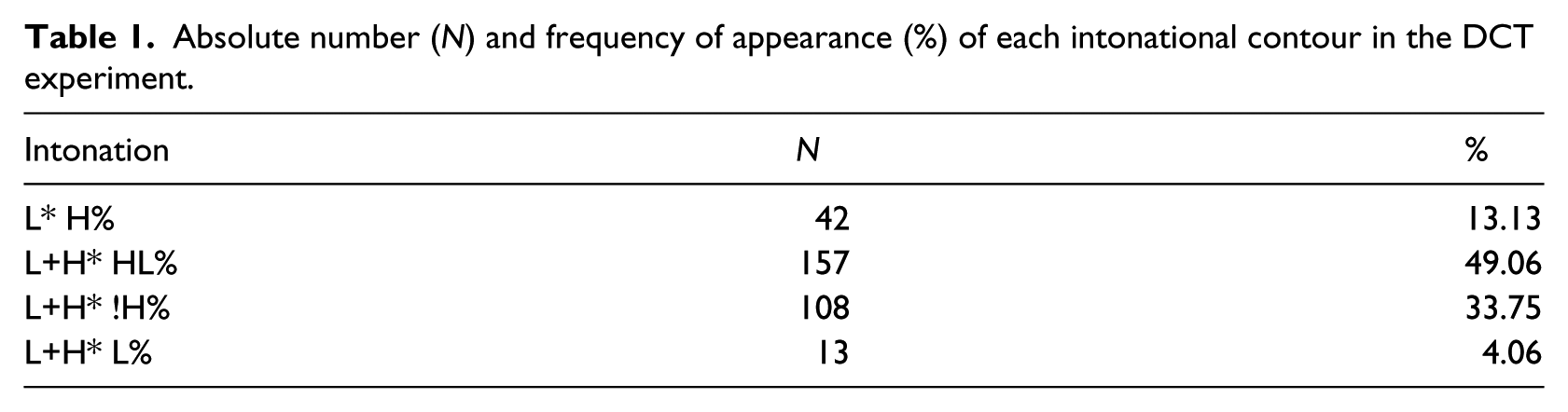
Figure 2 shows the number of times that each contour (different panels, from left to right: L* H%, L+H* HL%, L+H* !H%) was produced across the possible combination of pragmatic factors.
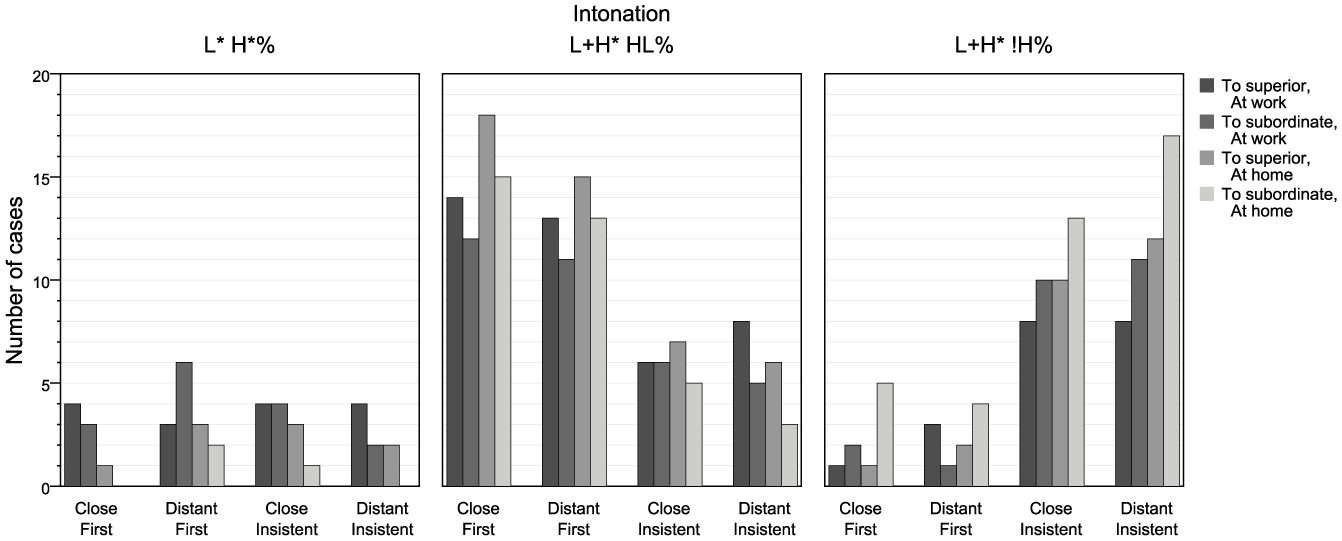
Number of productions of the three target vocative contours (different panels: L* H%, L+H* HL%, L+H* !H%) across the different pragmatic conditions (the combinations of
To determine whether there were significant differences in the proportion of each pitch contour used across conditions, a General Linear Mixed Model (GLMM) was conducted with the mean produced proportion as the dependent variable (binomial distribution, logit link).
3
GLMM effects related to
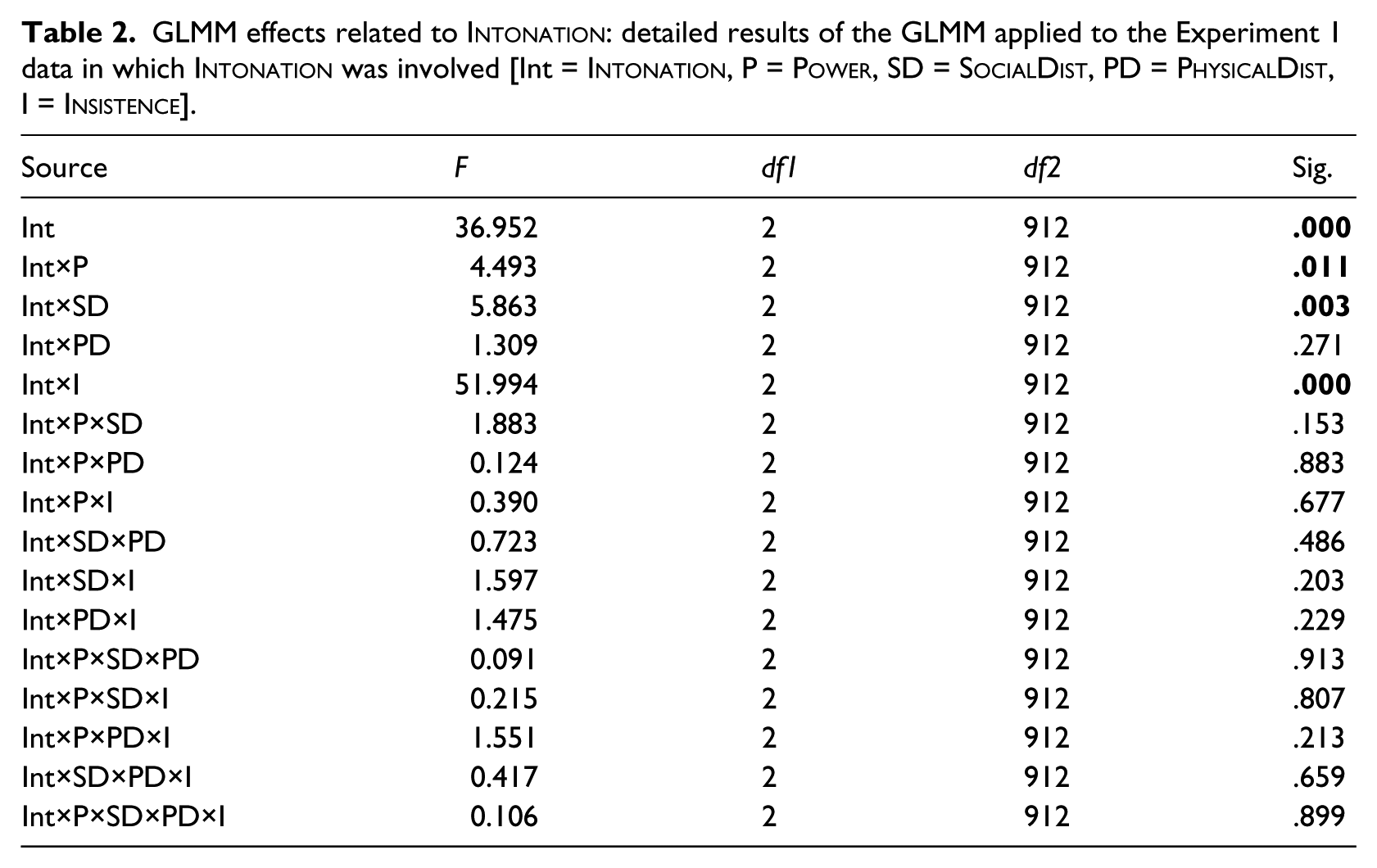
Bonferroni pairwise contrasts were conducted in order to determine the direction of the significant effects. The results of the pairwise comparisons showed that the main effect of
2.2.2 Gradient acoustic properties
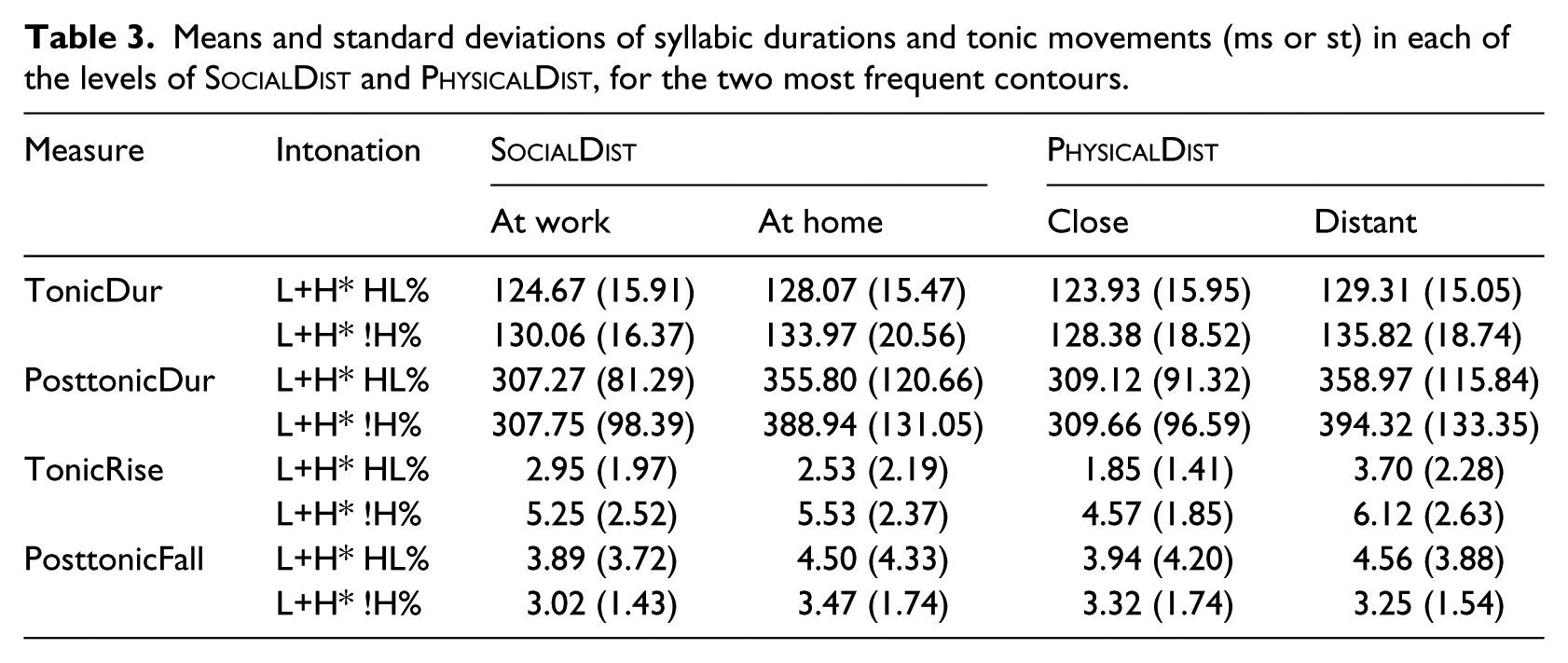
The acoustic properties of the two most frequent contours (L+H* HL% and L+H* !H%) were further examined in order to find out whether they vary consistently according to the four contextual factors. For each sentence, four measures were extracted: the duration of the stressed and post-stressed syllables (in ms), the pitch range of the rising movement within the stressed syllable (in st), and the range of the posttonic final fall (also in st). Eight GLMMs were then conducted (2 contours × 4 measures), in which these four acoustic measures were set as dependent variables (TonicDur, PosttonicDur, TonicRise, PosttonicFall), the four pragmatic factors and all their possible interactions were set as fixed factors, and Subject as a random factor.
For L+H* HL%, all measures but TonicDur provided significant effects; for L+H* !H%, all measures except PosttonicFall showed signficance. This second fact indicates that, in vocative chants, the distance in semitones between the target tones associated with the stressed and post-stressed syllables is found to be consistent independently of the four factors that have been shown to govern contour selection (M = 3.28 st, SD = 1.63 st).
In general, duration variation (in both stressed and post-stressed syllables) is related to
Variation in the range of pitch rises and falls is generally due to a main effect of
Table 3 shows the mean values and standard deviations of the syllable durations (ms) and pitch range measures (st) in each of the two levels of
Means and standard deviations of syllabic durations and tonic movements (ms or st) in each of the levels of
Due to the production task constraints, each participant could only produce one contour for a given communicative context, meaning that this methodology does not allow us to adequately assess how felicitous other possibilities would be in that specific context. In order to investigate this issue, we then conducted a perception experiment in which all participants had to rate the degree of acceptability of the target vocative contours L* H%, L+H* HL%, and L+H* !H% in all 16 contexts.
3 Acceptability judgment task
In order to assess the felicity conditions on which Catalan listeners rely for their preferences among vocative pitch contours, we designed an acceptability judgment task in which listeners were asked to rate the perceived degree of adequacy between a given prosodic rendition of a vocative (i.e., uttered with a particular intonational contour) and its preceding discourse context.
3.1 Methodology
3.1.1 Participants
Seventy-two speakers of Central Catalan (44 women and 28 men; mean age = 34.00, s.d. = 10.84; mean self-estimated daily usage of Catalan = 86.15%, s.d. = 21.18) participated in the acceptability judgment task. None of them had participated in the preceding production experiment.
3.1.2 Materials and procedure
The discourse contexts presented to the participants of the acceptability judgment task were exactly the 16 contexts previously used in the production experiment (2
From the production experiment data, four speakers (MD, MR, NA, NE) were selected to provide one representative utterance for each of the three intonational contours (L* H%, L+H* HL%, and L+H* !H%). The selection criteria were that the same speaker should have produced all three contours and that the utterances only included the proper noun Marina, without any preceding personal term of address (like senyora ‘Mrs’, senyoreta ‘Miss’ or tieta ‘Aunty’). The three authors of the study plus three more members of the research group in Barcelona checked that the 12 utterances were representative of the target intonational contours, showing similar acoustic properties of duration and pitch range across speakers. The four sets of three utterances were then assigned pseudo-randomly to the different pragmatic contexts, and the resulting 16 test trials were randomly presented to the listeners for judgment.
Participants were asked to rate the acceptability of each vocative in the specific contexts using a 0 to 100 scale. The experiment was run through the online survey platform SurveyGizmo (http://www.surveygizmo.com/). The mean duration of the experiment was 25 minutes, and the total number of acceptability ratings obtained was 3,456 (72 listeners × 16 discourse contexts × 3 intonation contours).
3.2 Acceptability judgment results
Figure 3 shows the mean acceptability rates for each intonational contour as a function of the two situational factors
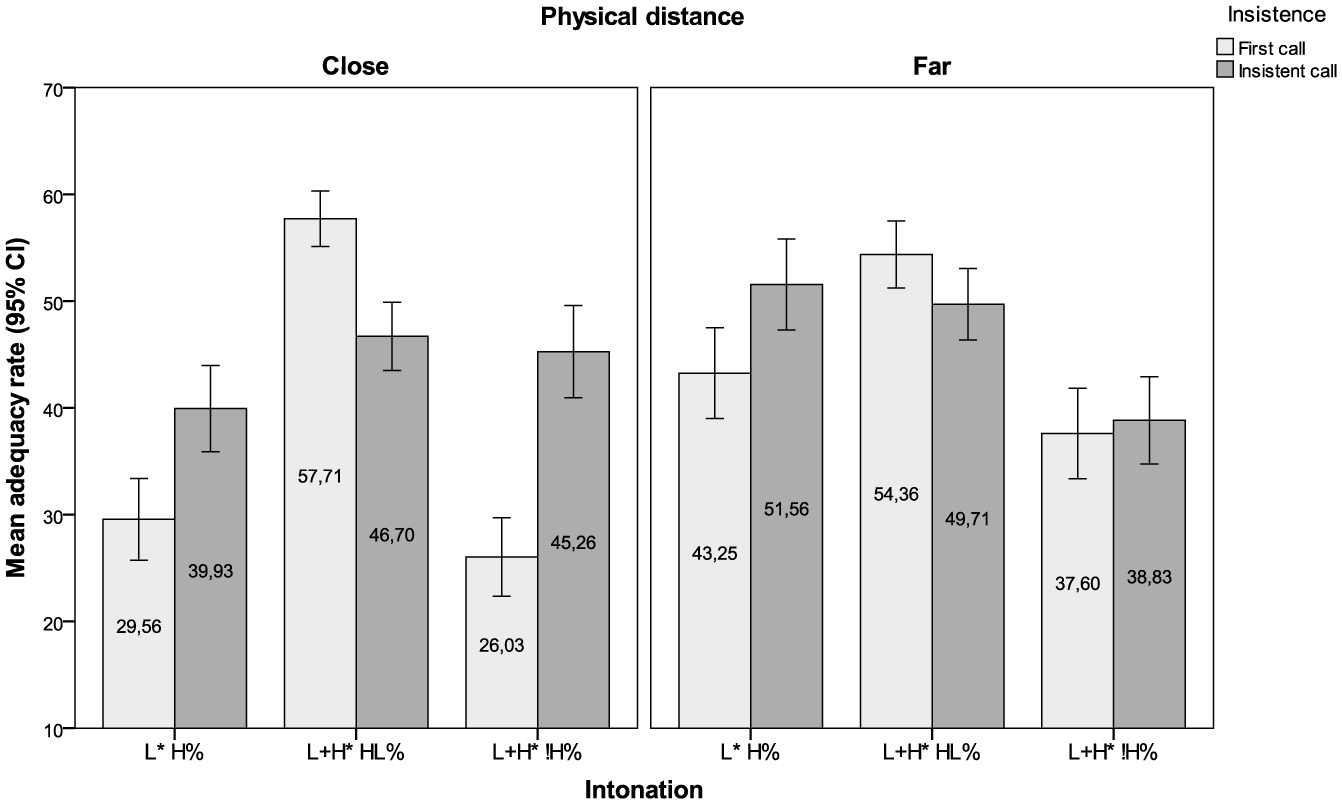
Mean acceptability rates for each intonational contour as a function of the contextual factors
Figure 4 shows the mean acceptability rates for each intonational contour as a function of the two sociopragmatic factors
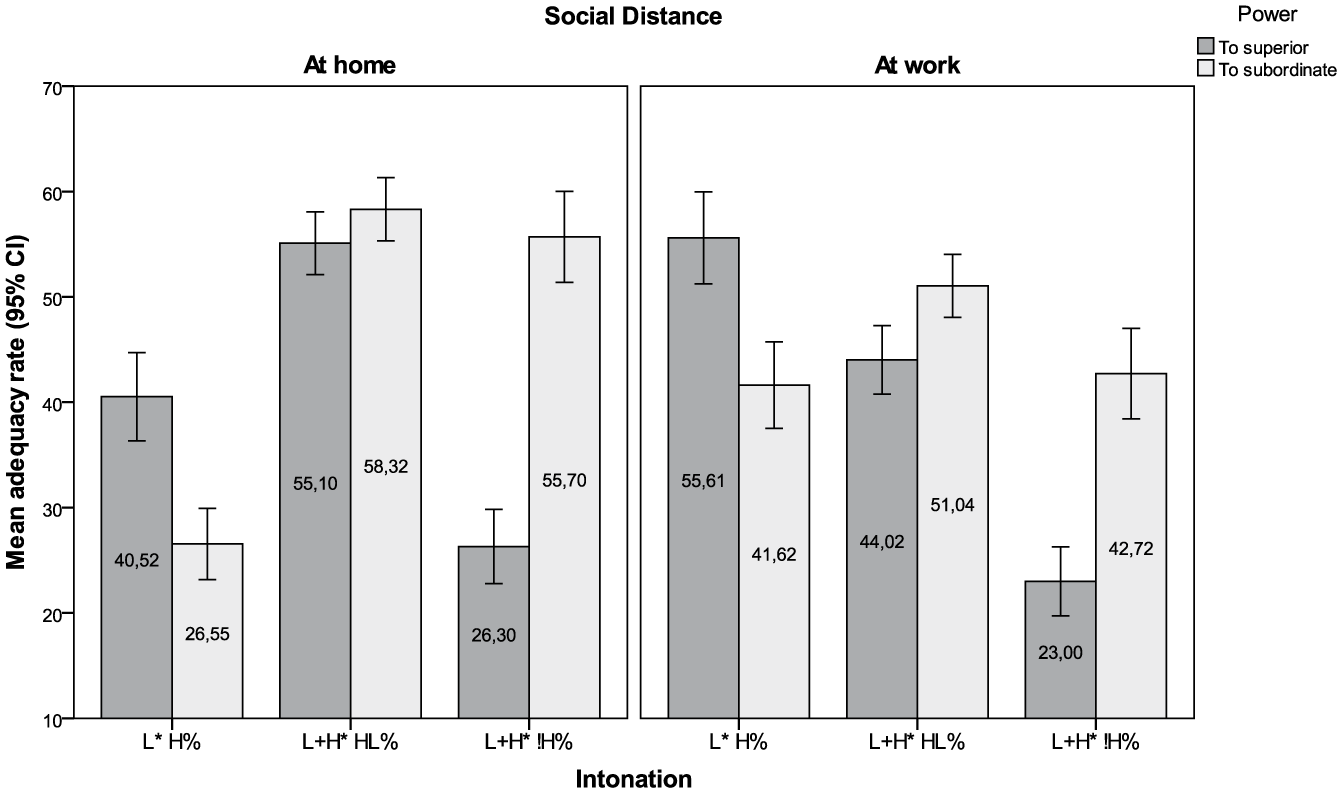
Mean acceptability rate for each intonational contour as a function of the sociopragmatic factors
A GLMM was conducted with the acceptability rate as the dependent variable.
GLMM effects related to
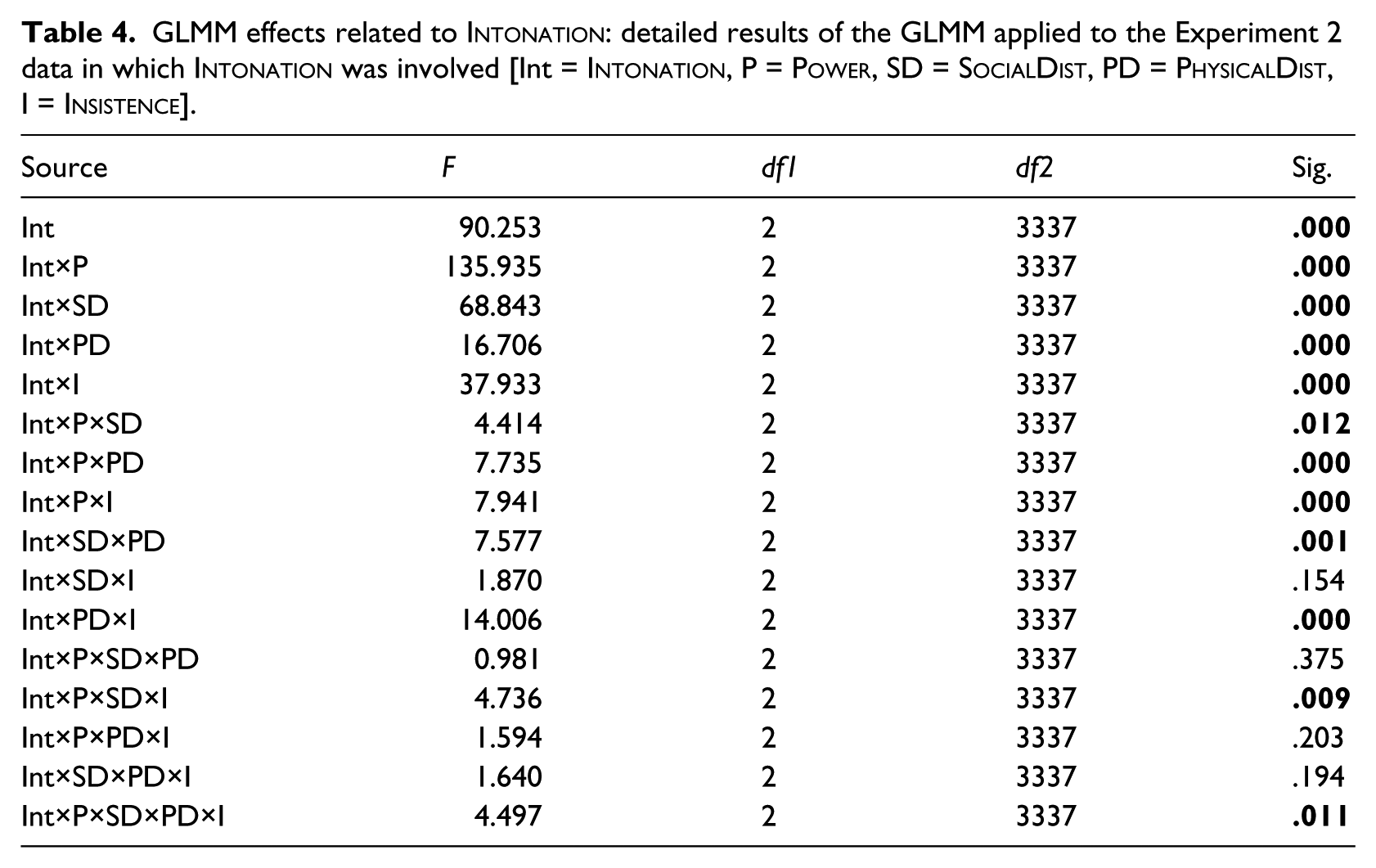
The direction of the significant effects was determined by Bonferroni pairwise contrasts, which showed that the main effect of
As for paired interactions, the interaction
4 Discussion and conclusions
The two experiments reported in this article have addressed the role that four pragmatic factors play in vocative intonation preferences in Catalan. First, we ran a DCT production experiment in order to elicit a variety of vocative contours in a controlled set of communicative situations. The analysis of 320 vocative contours (20 speakers × 16 contexts) showed that Central Catalan speakers used mainly three contours for vocatives, namely the rising interrogative contour (L* H%), a contour ending in a rising-falling boundary tone (L+H* HL%), and the vocative chant (L+H* !H%). These results were consistent with Prieto et al. (to appear, 2015) and Prieto and Cabré (2007–2012) and revealed that the four contextual factors were statistically significant for this pitch contour selection. L+H* HL% was more frequently used for first calls, and the vocative chant L+H* !H% for insistent calls. Moreover, L+H* HL% was used more frequently when calling a superior than a subordinate, and L* H% was most usually produced in situations where the speaker had no close relationship with the hearer (i.e., in work situations).
The analysis of the phonetic patterns of the utterances obtained in the DCT experiment (i.e., duration and pitch range of the stressed and post-stressed syllables) also revealed some interesting findings. On the one hand, longer syllable durations were obtained in closer social distances, farther physical distances, and insistent calls (especially when calling a subordinate). On the other hand, farther physical distances led to larger rises in the stressed syllable (in both L+H* HL% and L+H* !H%) and larger falls in the post-stressed syllable (only in L+H* HL%, since the pitch difference between the H and !H tones in vocative chants was fairly consistent).
Second, we ran an acceptability judgment task in which listeners were asked to rate the perceived acceptability of vocatives (uttered with three different intonational contours) in a target discourse context. This task allowed us to investigate in a more systematic fashion the perceived acceptability rates of each of the three intonational contours in the 16 communicative contexts used in the DCT. The analysis of 3,456 responses (72 listeners × 16 discourse contexts × 3 intonation contours) revealed a set of results that were essentially consistent with the production task, that is, the results summarized two paragraphs above for production were also borne out by the perception task. 8 However, a great number of additional results were obtained, which are discussed below in terms of the two types of pragmatic factors analyzed here, namely situational factors and sociopragmatic factors.
To summarize the effects of the situational factors (Physical Distance and Insistence), L* H% was found to be more appropriate for more distant communication, and also to some extent for insistent calls. One notes that these two situations may involve an implicit interrogation, since such calls may connote questions such as ‘Can you hear me?’ or ‘Are you paying attention to me?’, typically previous to an actual request for action. L+H* HL% vocatives were linked to first calls (also found in the production study) and shorter physical distances, contexts in which their specific function seems to be to open the communication channel. Finally, L+H* !H% was preferred for insistent calls (also found in production) in short distances, so they seem to be related to those cases in which the communication channel is already open (i.e., when it is not necessary to ask ourselves whether our interlocutor can hear us or not). In sum, the patterns obtained when looking at the influence of the situational factors suggest three different stages in the establishment of the communication channel (which correspond to the use of three particular intonation contours): first, a check for the listener’s availability when the channel has not been opened yet (L* H%); second, the opening of a communication channel itself (L+H* HL%); and third, an optional calling when the communication is considered to be already established, as happens with insistent calls (L+H* !H%). Therefore, when the speaker uses a particular vocative contour, he or she is also expressing a particular degree of imposition over the listener.
The results found for the sociopragmatic factors (Power and Social Distance) are summarized in Table 5.
Summary of the acceptability results related to Power and Social Distance.
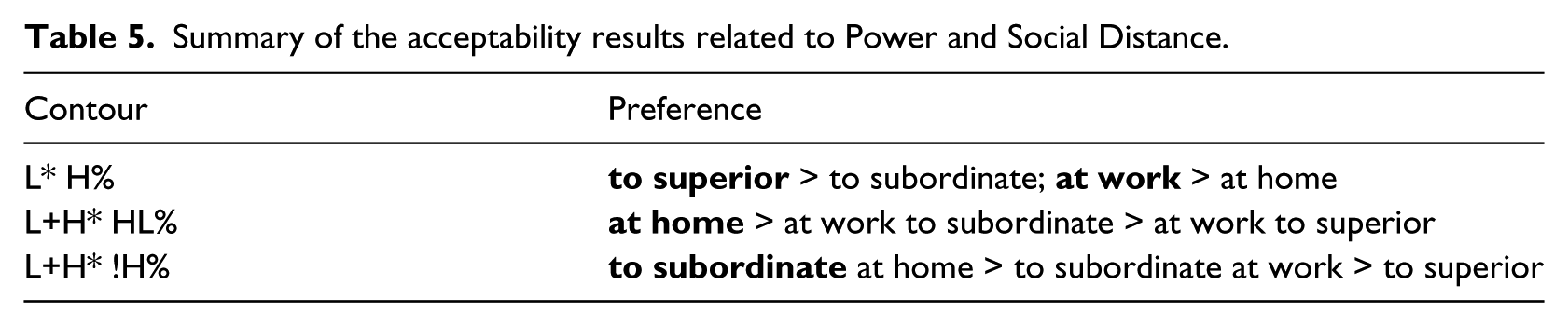
In line with the DCT results, we found that the L* H% contour was mainly preferred in work situations and with superiors. Calling a superior at work with an interrogative contour may indicate that the speaker is trying to minimize the imposition of requiring something from his/her addressee, interrupting them in what they are doing. This can be directly related to what Brown and Levinson (1987) call negative politeness strategies: not wishing to run the risk of showing offense, the speaker uses a strategy that shows deference and avoids causing the impression of imposing on the hearer. As Leech and Svartvik (1975, p. 147) state, “it is often more tactful to use a request than a command: that is, to ask your hearer whether he or she is willing or able to do something.”
The calling contour L+H* !H% was found to be most felicitous for calling subordinates, especially at home, which is consistent with the literature on vocative chants in other languages (Abe, 1998; Di Cristo, 1998; Fónagy, Bérard, & Fónagy, 1983; Sadat-Tehrani, 2008 ). In general, Catalan speakers will usually not call somebody of a higher social rank (in the case of our experiment, their boss) in chanted form unless they want to express insistence. These results are in line with what Brown and Levinson (1987) described for positive politeness strategies: the speaker may try to avoid giving offense by highlighting friendliness, which can be expected in those cases where listener and speaker are socially close and power distinctions are small.
The L+H* HL% pitch contour received high acceptability ratings across all contexts – it was never regarded as the least felicitous contour in any context. We might argue that speakers tend to use this contour as an unmarked, multi-purpose contour for Central Catalan vocatives. In terms of Brown and Levinson’s politeness theory, this seems to correspond to the absence of both positive and negative politeness strategies. In fact, this pitch contour is especially felicitous in home situations, where power distinctions are not very important – at least in contemporary Catalan society – so that there is no need to resort to explicit (i.e., positive or negative) politeness strategies to save face.
9
This would link L+H* HL% contours to Brown and Levinson’s (1987, p. 69) bald on-record politeness strategies, used by speakers in three main circumstances (see also Bousfield, 2008): (a) S[peaker] and H[earer] both tacitly agree that the relevance of face demands may be suspended in the interests of urgency or efficiency; (b) where danger to H’s face is very small, as in offers, requests, suggestions that are clearly in H’s interest and do not require great sacrifices of S (e.g., ‘Come in’ or ‘Sit down’); and (c) where S is vastly superior in power to H, or can enlist audience support to destroy H’s face without losing his own.
The greater acceptability of L+H* HL% across all contexts, and especially at home (and, to a lesser extent, with subordinates at work), can thus be related to the appropriateness of the use of bald on-record politeness strategies in the specific contextual situations of our experiments, where the Speaker is simply requesting something which requires almost no sacrifice on the part of the hearer.
To summarize the effects of politeness on vocative contours, the patterns obtained when looking at the influence of the sociopragmatic factors suggest a three-way classification of Central Catalan vocative contours into three different types of politeness strategy: negative politeness (L* H%), bald on-record politeness (L+H* HL%), and positive politeness (L+H* !H%). Thus, both situational and sociopragmatic factors lead to two tripartite and linkable classifications of Catalan vocative contours. Whereas in the case of situational factors these contours can be classified into three different degrees of imposition, our analysis of the sociopragmatic factors within politeness theory allows us to analyze these degrees in terms of the social relationship between the speaker and the hearer, as well as in terms of the three different types of politeness strategy.
In fact, if the L+H* !H% is linked to an implicit idea of total availability of the hearer to pay attention to the speaker (which is obtained through its properties of insistence), the use of this contour might be regarded as polite only in cases where the interlocutors are socially very close and in contexts where the loss of the hearer’s face is more difficult to trigger. Otherwise, if such a positive politeness strategy is used in a context that prioritizes negative politeness, that behavior would be regarded as impolite. Such a relationship between politeness theory and intonation has also been noted in the realm of yes/no questions, though it is not always explicitly stated in similar terms. Astruc et al. (in press) analyzed the intonation of request and offering questions in Central Catalan. In this variety, the most frequently used intonation patterns for polar questions are either rising (L* H%) or falling (H+L* L%), and the use of falling intonation is generally linked to confirmation-seeking questions, that is, questions where the speaker presupposes that his/her uttered proposition will be accepted by his/her interlocutor. Astruc et al.’s (in press) results revealed that falling contours were preferred for low-cost requests and rising contours for high-cost requests. These results make sense in the light of the semantic properties of both contours. Using a falling question can be regarded as impolite (and convey a high degree of imposition) in requests which entail an important cost on the part of the hearer (i.e., borrowing his/her car), because this contour is conveying the presupposition of a positive belief on the part of the speaker (the assumption that he/she will lend him the car). By contrast, using the default L* H% is regarded as more polite in this context because this tune does not convey this positive presupposition.
In conclusion, the two experiments reported here demonstrate that both sociopragmatic and situational factors (such as relative power, social distance, physical proximity, and the degree of insistence) play an important role in determining vocative pitch contour preferences in Catalan. These factors define a number of contextual situations involving Face Threatening Acts (Brown & Levinson, 1987) that require different politeness strategies. We have proposed that Catalan vocatives, with their three possible intonational contours, appear to be linked to different politeness strategies: first, an interrogative L* H% vocative is used as a negative politeness strategy; second, the rising-falling contour L+H* HL% is linked to bald on-record politeness strategies; and third, the L+H* !H% vocative chant is adopted as a positive politeness strategy. In sum, the analysis of the interplay between sociopragmatic and situational factors and Catalan vocative intonation in the light of politeness theory has broadened our understanding of how politeness inferential meaning controls the intonational variation in this language. This investigation also opens a door to exploring the role of politeness factors in intonational meaning in other types of speech acts.
Footnotes
Acknowledgements
Preliminary versions of this work were presented at the 2013 session of the ‘Phonetics and Phonology in Iberia’ conference in Lisbon, as well as at the 2nd and 5th workshops on ‘Catalan intonation and Cat_ToBI’ (2010, 2013). We are grateful to Amalia Arvaniti, Ramon Cerdà, Aoju Chen, Barbara Gili-Fivela, Aditi Lahiri, Ignasi Mascaró, and Trudel Meisenburg for their comments. We are also grateful to the participants in all the experiments for voluntarily taking part in them. Special thanks go to Maria del Mar Vanrell, Paolo Roseano, and Santiago González-Fuente for recording part of the production data.
Funding
This research has been funded by a research grant awarded by the Spanish Ministry of Science and Innovation (FFI2012-31995 “Gestures, prosody and linguistic structure”), and by a grant awarded by the Generalitat de Catalunya (2014 SGR-925) to the Prosodic Studies Group.