






Abstract
This study examines how expectations for prosodic prominence, as related to information structure, influence speech perception in line with how segmental cues are modulated by prosodic prominence in so-called “prominence strengthening” in production. Following the general methodology of a previous study, which elicited listeners’ explicit judgements of prominence, listeners heard target sentences that were preceded by contexts that set up the critical utterance-final word to be relatively prominent or not, based on the information-structural relation it held with the preceding context. We first replicated that listeners shift explicit prominence ratings (of identical speech stimuli) on the basis of preceding context. We then show that these effects translate to the perception of vowel duration as a cue to voicing: listeners appear to effectively compensate for expected vowel lengthening under prominence, in line with previous studies that have sought to manipulate prosodic prominence within the speech signal itself. Finally, we find that explicit judgements for length are influenced by actual/veridical vowel duration, but not by preceding context. Results are discussed in terms of how they inform our understanding of prosody, and more specifically prominence, in speech perception.
1. Introduction
In speech production, lexical and phrasal prominence are known to modulate how segmental articulations are realised, and their acoustics. For example, English stops in phrasally prominent positions show more separation in voice onset time (VOT) values between voiced and voiceless categories (Cole et al., 2007; Kim et al., 2018). Vowels can be peripheralised in the vowel space (hyperarticulation; e.g., Cho, 2005) or lowered (sonority expansion; e.g., Garellek & White, 2015). Broadly speaking, we can consider these patterns (and those related to prosodic phrasing) as a part of the “phonetic encoding of prosodic structure” as described by Keating (2006). These effects are now quite well documented and understood to be pervasive in spoken language (e.g., Cho, 2005, 2016; De Jong, 1995, 2004; Georgeton et al., 2016; Keating et al., 2004; Roessig et al., 2019).
As a sort of reflection of these production patterns, listeners have been shown to be sensitive to phrasal prosodic factors in their perception of segmental cues, for example, requiring more peripheralised first- and second-formant values to categorise a vowel as /i/ when that vowel is prominent, effectively compensating for the acoustic consequences of hyperarticulation under prominence (e.g., Steffman & Zhang, 2023). In a general sense, this suggests that information about prominence and perhaps phrase-level prosodic organisation more generally is processed in parallel with segmental information (see, for general discussion along these lines, Cho et al., 2007; McQueen & Dilley, 2020; Mitterer et al., 2019; Steffman, 2020).
This study builds on these speech perception findings to connect them to an important observation in the prominence perception literature: that prominence perception can be “hallucinatory” based on expectations derived from context. In particular, when the informational structural context in which a stimulus is presented sets up particular words in that stimulus to be prominent based on how a typical response to that context would be produced, listeners tend to perceive them as such (Bishop, 2012). This occurs, notably, when the actual stimulus is unchanged across conditions. This influence of contextual expectations related to information structure can be considered interesting in several regards: first it shows, broadly speaking, that speech-signal-external factors lead listeners to process speech differently, which fits into a larger picture of a fundamentally multimodal speech comprehension system (e.g., integrating visual information; Bosker & Peeters, 2020; Bujok et al., 2025; Rosenblum, 2019; Tuomainen et al., 2005) and one in which the perception of speech is flexibly influenced by a variety of factors such as word frequency, the broader context in which speech is perceived, and so on (e.g., Baumann & Winter, 2018; Maslowski et al., 2020; Röhr et al., 2022).
Second, this result tells us something about prosody and information structure. The mapping of prosodic prominence to information-structural factors can be complex and probabilistic (e.g., Chodroff & Cole, 2019), and listeners’ decoding of this mapping is also complex and context-dependent (Röhr et al., 2021). By showing that specific information-structural conditions can modulate prominence perception, however, Bishop (2012) evidences that listeners are aware of information structure in their perception of prominence and processing of speech in a way that derives from the relationship between prosodic structure and information structure. This is an insight into how this structure is relevant in spoken communication.
In the present study, we examine how signal-external expectations of this sort may affect perception of segmental detail in light of the “phonetic encoding of prosodic structure” mentioned above. In other words, if listeners expect a portion of the speech signal to be prominent based on information structure, do they project these expectations to the level of acoustic cues to segmental contrasts? Or put differently: does “hallucinatory” prominence (implied by means external to the speech signal) translate to segmental cue perception, aligning with what has previously been observed with signal-based prominence effects? In answering this question, we hope to build towards a fuller understanding of prominence perception and the influence of prosody in speech perception and processing.
1.1. Information Structure and Prominence
Various aspects of prosodic realisation can be related to information structure, though, as described in the recent review in Cole (2025), these patterns are complex, and evidence for some patterns is mixed. Here, we focus on two elements that are most directly relevant to the present study and that receive fairly clear support from a synthesis of the literature. These are the properties of given-ness and the concepts of contrastive focus.
Following Baumann and Riester (2012), a relevant distinction can be made between lexical given-ness (i.e., a prior mention of a lexical item) and referential given-ness (a prior mention of the referent, without lexical given-ness). Broadly speaking, new information, as compared with given information of both types, is realised with more prosodic prominence. This may be in the form of the presence/absence of pitch accentuation (Burdin et al., 2015; Kim & Arnhold, 2024; Turnbull, 2017), though, as highlighted by Chodroff and Cole (2019), this pattern is clearly probabilistic. It has also been documented that given items are less prominent in their acoustics, showing, for example, lower F0 means and maxima values (Kim & Arnhold, 2024). Given these patterns, we can predict that items which are given in a discourse context may be expected to be less prominent than new items by listeners.
The concept of focus, as relevant to the present study, can be framed as a part of the information structure of an utterance. Focus can be conceptualised as enhancing the meaning of the focused item through evoking salient alternatives (Rooth, 1992; see also reviews in Cole, 2025; Krifka, 2006), where contrastive focus evokes a contrast with a salient contextual alternative. In English, contrastive focus increases prosodic prominence in the sense that it is marked by pitch accentuation, more likely to be marked with prominent pitch accent types, and manifested in higher degrees of phonetic prominence in comparison to a broad focus utterance (e.g., Ito et al., 2004; Katz & Selkirk, 2011; Kim & Arnhold, 2024). On this basis, we can hypothesise that items that are set up as contrastive with a context might be expected to be prominent by listeners, that is, contrastively focused.
We can illustrate these concepts jointly with the following set of question-answer pairs, which are directly relevant to the set-up of the present study. Consider the following as two dialogues between an asker and an answerer.
Q1: Did Jordan hear a sound? A1:
Q2: Did Taylor hear a scream? A2: Taylor heard a
In A1, we could expect the word bolded “Taylor” to be prosodically prominent, as it is new information and also contrasts with “Jordan” in the question. This could also potentially be referred to as corrective focus, if we consider that the answerer is correcting the misapprehension in Q1 that Jordan is the relevant person in the discourse. Next, consider the word “buzz” in A1. It is lexically new; however, it could possibly be considered to be linked to Q1 in what is sometimes described as a bridging relationship. Bridging is described by Baumann and Riester (2012) as “discourse-new but at the same time inferentially related to some expression introduced earlier,” that is, in this case, the “sound” which was referenced in Q1 (p. 128). The word “buzz,” thus, potentially could be considered referentially given in this light. In this regard, we might expect relatively less prominence for the word “buzz” (especially in relation to “buzz” in A2). “Taylor” in A2 is both lexically and referentially given and hence likely to be less prominent (e.g., produced as unaccented). In contrast, the word “buzz” could be expected to be produced with contrastive focus, in relation to “scream” in the question.
In summary, in 1, we expect “Taylor” to be more prominent and “buzz” to be less prominent. The opposite is true in 2. Most importantly for the present study, the relative prominence of “buzz” across 1 and 2 is expected to vary, being more prominent in A2 than in A1. This phrase-final word is what we will investigate listeners’ perception of.
1.1.1. Bishop (2012): Information Structure and Explicit Prominence Judgements
We can now turn to Bishop (2012), the study which served as the inspiration for this one. That study manipulated information structure in relation to the size of the focused constituent, as illustrated in the example below.
3. Q1: What happened? Q2: What did you do? Q3: What did you buy? A: I bought a motorcycle.
Here, the size of the focused constituent can be said to be the sentence in response to Q1 and the verb phrase in response to Q2, both of which Bishop describes as analogous to “broad focus” (Ladd, 1980). However, in response to Q3, the object “motorcycle” can be considered as subject to a narrow focus. Narrowly focused words are generally expected to be realised with greater acoustic prominence (Ito et al., 2004; Kim & Arnhold, 2024). To examine how expectations derived from preceding contexts of the sort in 3 above influence prominence perception, Bishop carried out a prominence rating task in which auditory stimuli were rated for prominence on a five-point Likert-type scale. Both the verb and the object (“bought” and “motorcycle” in “I bought a motorcycle”) were rated by listeners. Across trials, listeners rated the prominence of these words after hearing an auditorily presented preceding question, as if hearing a short dialogue between two people. Each participant heard each context paired with each auditory stimulus (with a pseudo-randomised presentation, separating the same auditory stimulus by at least six trials).
Bishop found that prominence ratings shifted as a function of preceding context. The most salient result was obtained in an object-focused context (e.g., “What did you buy?”) in relation to the others. In this context, the object (e.g., “motorcycle”) was rated as more prominent than the verb (e.g., “bought”). In addition, it was rated as more prominent than the (acoustically identical) object in the other two contexts. In other words, it appears that listeners projected an expectation of prominence on the stimuli based on the preceding context and the information-structural relationships that were present between the context and the target.
These findings are perhaps especially interesting in the sense that ratings shifted even when there was no change in the stimuli, only the preceding context in which (identical) acoustic information was perceived. They are, as Bishop says, illusory (see also Akker & Cutler, 2003). To our knowledge, very little subsequent work has examined these types of effects, which was in part the inspiration for the present study.
There is, however, one additional study that we are aware of which followed on this line of research: Bishop (2016). That study was very similar to its predecessor in how contextual prominence was manipulated and in sharing the goal of assessing how that preceding context influenced prominence judgements. However, it differed in that it additionally manipulated the duration of the verb in subject-verb-object (SVO) sentences along a continuum. This allowed for examination of the role of verb duration itself in influencing prominence judgements, where longer durations may be judged as more prominent (e.g., Cole et al., 2010, 2019). Second, it allowed for examination of how the context-induced prominence manipulation, when the verb is relatively prominent (as in the case of verb phrase focus), might lead to greater attention to that portion of the speech signal. Increased attention could yield a greater influence of the durational manipulation in affecting prominence judgements, which would be evident in a duration-by-prominence interaction. The results showed that there was some effect of vowel duration on prominence judgements, though it was modulated by individual differences, which were another focus of that study. In particular, only participants who were measured to have better pragmatic skill 1 showed an influence of the durational manipulation, where longer durations lead to judgements of increased prominence. Second, the possible interaction between prominence and listeners’ sensitivity to the durational manipulation was notably not observed: it seemed that contextual prominence did not lead to increased sensitivity to duration in the prominence rating task. Both of these points will become relevant in consideration of the present study’s results.
2. Prominence in Segmental Perception
In the foregoing section, we briefly overviewed some relationships between prosodic prominence and information structure and the way that this was manipulated in Bishop (2012, 2016). In this section, we will consider several relevant studies that evidence the influence of signal-based prominence in leading listeners to adjust perception of segmental cues, in line with how those cues are modulated under prominence, that is, “prominence strengthening.” This will lead us to tie together the methods from Bishop with the question of prosodic influences on the perception of segmental cues.
The general idea that has been explored in the literature is that listeners effectively compensate for prosodic context. When a particular segment is signalled to be prominent, listeners consider, and perceptually adjust for, how segmental cues are modulated by prominence. This is evident in the patterns for American English /i/, mentioned above, where listeners require more peripheralised formant values to categorise a vowel as /i/ (vs. /ɪ/) when it is signalled to be prominent (Steffman, 2020; Steffman & Zhang, 2023). Steffman and Zhang (2023) furthermore showed that these effects evidence a sensitivity to how specific vowel contrasts are modulated by prominence strengthening. 2 Overall, it appears that listeners’ perceptual patterns reflect something about the joint encoding of prominence information and contrastive segmental information in a single acoustic parameter (here, vowel formants), an idea which is echoed for prosody more broadly in the recent literature (McQueen & Dilley, 2020; Mitterer et al., 2019; Steffman et al., 2022). The manipulation of prominence in these previous studies has been achieved by means of the speech signal, both in terms of variation in the context preceding a target and the F0 contour of the target itself. 3
A conceptually similar prominence strengthening pattern, which is relevant to this study, is vowel duration as a cue to coda obstruent voicing. In American English (and many, but not all, varieties of English), it has been shown that this constitutes a robust correlate of the voicing distinction: vowels are longer when preceding voiced obstruents (Chen, 1970; De Jong, 2004; Tanner et al., 2020). Broadly speaking, vowels are also lengthened when produced as phrasally prominent, for example, when pitch-accented, as compared with being unaccented. De Jong (2004) offers a clear examination of both of these effects together, where speakers produced words with both voiced and voiceless obstruents with and without phrase-level prominence. In evidencing joint encoding of prominence and contrastive segmental information in this single cue, an influence of both the prominence manipulations and coda voicing was evident on the acoustic measurement of vowel duration: both contributed to lengthening vowel duration such that voiced obstruents showed longer preceding vowels, and prominent renditions also entailed longer vowel duration.
How then should listeners be influenced by such a joint encoding of prominence and voicing in vowel duration? Steffman and Jun (2019) examined this question and considered the possibility that listeners would effectively compensate for expected prominence-based lengthening when categorising coda voicing distinctions. In a perception experiment, listeners categorised a vowel duration continuum as one of two English words: “coat” or “code.” The prominence of those target words was manipulated by resynthesis of the F0 contour, with the assumption that higher F0 values would lead to a perceived-to-be-more-prominent vowel. The authors reasoned that if listeners perceived the target to be more prominent, they might effectively expect prominence-induced lengthening of the vowel and compensatorily adjust their perception of vowel duration as a cue to coda obstruent voicing. In other words, if a vowel duration is relatively ambiguous in distinguishing “coat” from “code,” listeners may reason that, if prominent, it is “coat” which has undergone prominence-based lengthening. Conversely, the same vowel duration when non-prominent may be perceived as “code,” because prominence-based lengthening cannot account for a relatively longer duration. This compensatory pattern was indeed observed for one part of that study: listeners decreased “code” responses under prominence, compatible with the compensatory view. This, in line with the other perception studies mentioned in this section, suggests that prosodic prominence guides listeners’ interpretation of segmental cues in line with prominence strengthening. 4
2.1. The Present Study
As a sort of extension of the question asked in Steffman and Jun (2019), this study tests whether expectations for prominence, external to the speech signal itself, can exert a comparable influence on vowel duration perception. Will a vowel that is expected to be prominent show a relative decrease in voiced obstruent responses, comporting with the idea that listeners compensate for expected prominence-based vowel lengthening? If yes, this would line up with those findings in Steffman and Jun (2019), where prominence was manipulated by means of the speech signal itself, and would show that the effect found in Bishop (2012) plays out in listeners’ perception of segmental cues. This question strikes us as timely in providing a conceptual replication of Bishop (2012) and in further extending the current state of knowledge regarding prosody perception, specifically prominence perception, and the processing of segmental cues in speech.
Three experiments are presented here, which are aimed at addressing the following research questions:
Do information-structural contexts which vary expectations for contrastive focus and given-ness yield shifts in explicit prominence judgements? This is a conceptual replication of the findings in Bishop (2012), using the same five-point Likert-type response scale as in that study.
Do the same contexts and stimuli yield shifts in perception of vowel duration that are commensurate with an expectation of prominence? If compensatory, like the signal-based effect in Steffman and Jun (2019), then this would be perceived as a shorter vowel duration (as a cue to coda voicing) when the target word is contextually prominent.
Do the same contexts and stimuli yield changes in explicit judgements of vowel duration?
The final question of explicit judgements for duration is aimed at examining how different types of perceptual judgements may be influenced by information-structural expectations. This can be linked to a related question in the literature dealing with rate-dependent speech perception. In this literature, listeners’ categorisation of durational cues as relating to phonemic contrasts (e.g., voice onset time [VOT] as a cue to /b/ vs. /p/) can be considered an implicit judgement of speech rate (Bosker & Reinisch, 2017; Reinisch, 2016), whereby changes in contextual speech rate exert contrastive effects on VOT perception (among other temporal cues). Reinisch (2016) examined how the presence of fast speech processes affects implicit judgements in this sense, as well as explicit judgements of duration. Fast speech processes, like segmental reductions, led listeners to perceive speech as faster, as indexed by phonetic categorisation in the implicit sense, even when the actual/veridical rate was the same. However, when participants were asked to explicitly compare and judge which stimulus sounded faster, Reinisch found that fast speech processes did not contribute to rate judgements: listeners relied on actual/veridical rate alone (see also Koreman, 2006). An analogous finding in Steffman and Jun (2021) was that F0-based cues to a prosodic boundary influenced rate-dependent perception of vowel duration as a cue to coda voicing in implicit (phonetic categorisation) but not explicit judgements.
The present study presents an interesting opportunity to extend these ideas. With it, we will examine if information structure-induced shifts in phonetic categorisation (if observed) also translate to explicit judgements of duration, or if, like the studies mentioned above, listeners rely only on actual/veridical duration when providing explicit judgements.
3. Method
The study received ethical approval from the University of Edinburgh PPLS Ethics Review Board (reference number 305-2425/4). All data, stimuli, analysis code, and saved statistical models are included in an open-access repository on the OSF: https://osf.io/haezg.
As outlined above, the general method was inspired by Bishop (2012), with some variations adopted that were thought to be helpful in translating the premise of that study to a phonetic categorisation paradigm. One other notable difference between this study and Bishop (2012) is that we presented preceding contexts visually, to be read silently by participants, whereas in that previous study, they were presented auditorily prior to the context sentence. We made this choice to eliminate any possible effects of preceding auditory context, for example, if speech rate in the preceding context, or contexts throughout the experiment, influenced duration perception in the target sentences (e.g., Maslowski et al., 2019, 2020). Although these sorts of influences seem unlikely to us given the materials, we can definitively rule them out by having the contexts be only visually presented (and read silently by participants).
Prior to showing how precisely the trials were set up (detailed in Section 3.2), we can now consider the contexts and target sentences and how they were intended to manipulate expectations for prominence, which follows closely on the example given in Section 1.1.
The premise of the study from the participants’ perspective was a dialogue between two individuals named Olivia and Jim. Participants were instructed that they would read and listen to a conversation between two people, where Olivia asks questions and is corrected by Jim.
We can illustrate the prominence manipulation with the actual items from the study, which are given in Table 1 and which show the question–answer pairs from this contrived dialogue. The critical word from a vowel-duration continuum, which listeners categorised and evaluated in three tasks, is the final word. In what we call the “prominent” contexts, this final word stood in a contrastive relationship with the preceding question, and the subject of the SVO sentence in that context was lexically and referentially given, as with the example given in Section 1.1. In the “non-prominent” contexts, the target word could be considered accessible via a bridging relationship with the context, whereas the subject of the sentence was in contrast with the context.
Context Sentences for the Four Items Used in the Experiments.
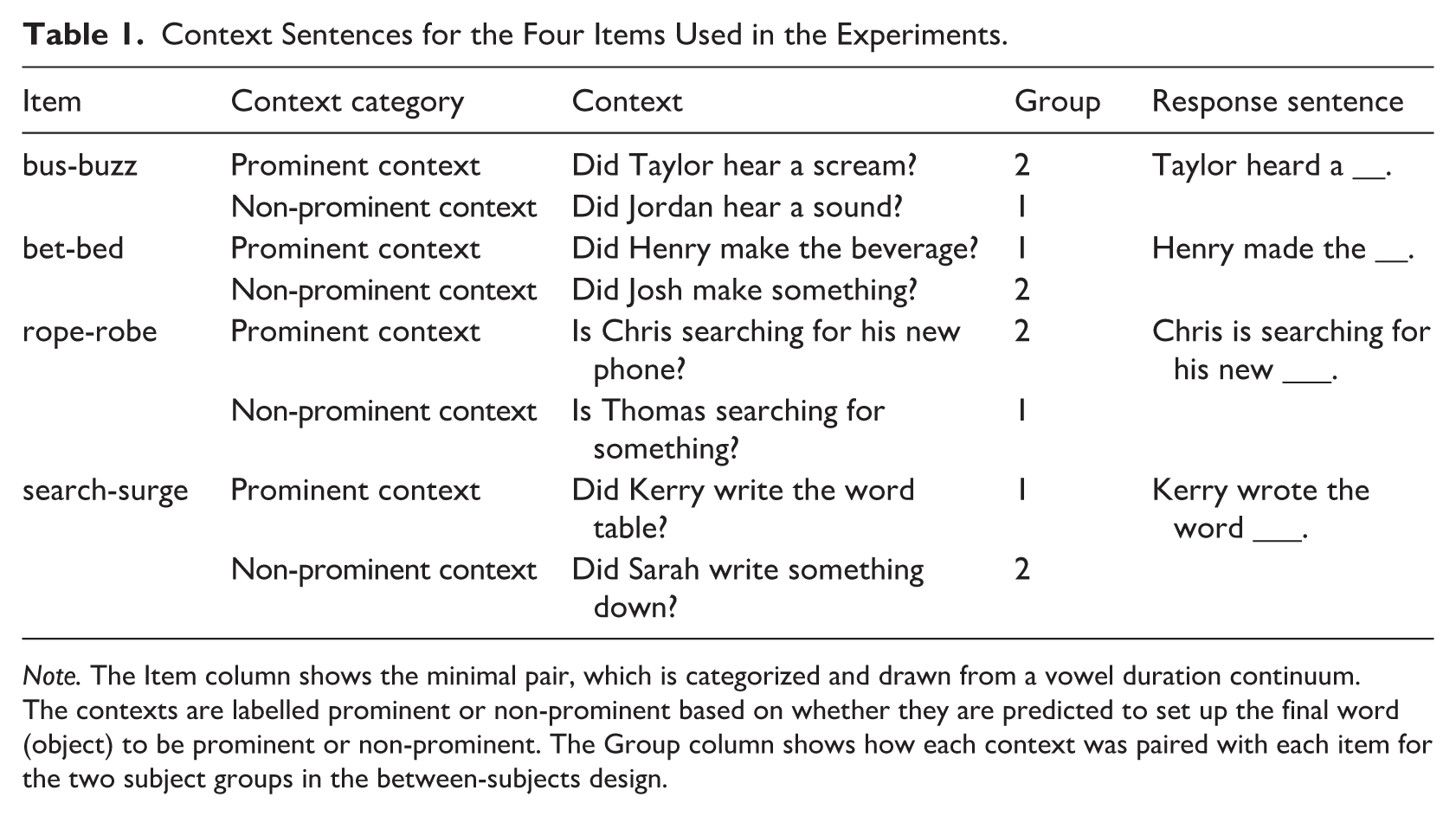
Note. The Item column shows the minimal pair, which is categorized and drawn from a vowel duration continuum. The contexts are labelled prominent or non-prominent based on whether they are predicted to set up the final word (object) to be prominent or non-prominent. The Group column shows how each context was paired with each item for the two subject groups in the between-subjects design.
Here, it is important to mention the aspect of the design and its adaptation to a task that will include phonetic categorisation. A critical constraint is that the target word, which listeners will categorise, for example, “buzz” or “bus,” should not be present in the preceding context at all. This presents a particular challenge in the non-prominent context, where the target item must not be lexically given but where we want it to be expected to lack prominence. The approach we took, therefore, also subject to the constraint of finding suitable minimal pairs and sentences, was one of a plausible bridging relationship as described above. This was, however, different in nature across the four items in the study. For example, in the non-prominent context for “bus”-“buzz,” the context “Did Jordan hear a sound?” contextualises the target as being a sound, that is, the sound of a bus or the sound of a buzz, hence plausibly accessible via bridging. However, for “rope”-“robe,” the bridging relationship is more general. Here, the context “Is Thomas searching for something?” sets up the target item as connected referentially to the context only as something that could be searched for. This is a more tenuous bridging relationship, which might make the target item “more new.” However, importantly, even in this case, there is a critical relative difference with the prominent context (“Is Chris searching for his new phone?”) in which the subject of the target sentence is given, and the (final) target word is clearly in contrast with the object in the context, hence expected to be more prominent in comparison to the non-prominent condition. This critical aspect holds true across all four items. In the prominent context, the target item is always saliently in contrast with the object in the context, and the subject and verb are given information. In that sense, the object is clearly expected to be prominent in all cases. Although the expectations for the prominence of the object are less clear-cut in what we call the non-prominent condition, it is always the case that the subject of this sentence is in contrast with the subject in the context, and the object is plausibly therefore postfocus. In that regard, across items, we can suppose that the object will be expected to be more prominent in the prominent condition than in the non-prominent one. It is this critical within-item variation that manipulates the intended effect.
3.1. Stimuli
The stimuli were created from naturally produced utterances. These were recorded in a sound-attenuated room using an AKG CK 98 unidirectional hypercardioid pattern condenser microphone capsule with a windscreen attached to minimise pops. The recording was made using PreSonus Studio One Prime software with a sampling rate of 48 kHz and a bit depth of 16. The speaker was the first author, an L1 speaker of American English. 5 The prosody of the speech in the stimuli merits some consideration, as the signal-internal aspects of the stimuli are also expected to influence perception of prominence and, of course, of the relevant cue (vowel duration). The intended prosody was “neutral,” with broad focus, as an utterance that could plausibly be produced in response to the question “What happened?” The idea was that this sort of “default” production would be perceived more flexibly by participants, or rather, subject more readily to the influence of expectations derived from the preceding context. Regardless of the success of intended “neutral” or “default” production, it should be reiterated here that participants always heard the same auditory stimuli. Therefore, differences based on this contextual influence cannot be attributed to the auditory stimuli (which were invariant and identical across contextual conditions).
The recordings were subsequently manipulated to create phonetic continua. We used a total of eight different items, four of which were vowel duration items, which we consider target items here; they are the focus of this study. The other four items differed in initial stop voicing. These were included for variety and with the intent of (hopefully) obscuring the focus of the study on coda voicing, that is, as fillers. For parity with the target items, fillers were also manipulated to vary along a VOT continuum.6,7
Vowel duration continua were created using a Praat script (Winn, 2014). The base file for the vowel duration manipulation was chosen based on its naturalness and the degree to which it was perceived by the authors as changing voicing when vowel duration was manipulated. The only part of the file which was manipulated was the duration of the phrase-final vowel. For two items, “search”-“surge” and “bet”-“bed,” the base file was a voiced token, which was phonetically devoiced/voiceless. The vowel duration for these two items was accordingly compressed in seven linearly spaced steps, which yielded what was judged to sound most natural (as compared with expanding a prevoiceless vowel). For the other two items, “rope”–“robe” and “bus”–“buzz,” the voiceless token was used as a base file and the vowel was lengthened to generate what were judged to be decent renditions of a prevoiced-obstruent vowel. Given the constraints which were operating under in terms of plausible contexts and suitable voicing minimal pairs, we did not attempt to control or match for lexical frequency. We did, however, pilot each of the used continua to confirm relatively well-anchored categorisation and no strong bias towards either endpoint, which could be a manifestation of a frequency effect (Connine et al., 1993). 8 Notably, even if such biases do persist to some extent, they are orthogonal to the contextual manipulation of interest in the present study. The ranges used for each target item were slightly different, based on the authors’ perception of naturalness and being a clear rendition of a voiced versus voiceless coda at the continuum endpoints: “search”–“surge” was 80–220 ms, “bet”–“bed” was 100–200 ms, “rope”–“robe” was 90–220 ms, and “bus”–“buzz” was 80–180 ms.
To limit the number of trials in the experiment, we subset all continua to be Steps 1, 3, 4, 5 and 7. In this way, we hoped to retain clear endpoints and the relatively more ambiguous intermediate continuum steps. There were thus a total of five stimulus tokens for each item, 40 in total for the 4 target items and 4 filler items. These were repeated twice, in fully randomised order, for a total of 80 trials in the experiment. All stimuli files are available on the OSF repository.
3.2. Trial Structure and Responses
As stated above, each item, whether a filler (VOT) or target (vowel duration) item, was preceded by one of two contexts, shown for the target items in Table 1 and for the filler items in the appendix of the article. That context pairing was manipulated between subjects so that one individual participant only ever saw the prominent or non-prominent context for a given item. For example, Group 1 always saw the non-prominent context for the “bus”-“buzz” item, whereas Group 2 always saw the prominent context. The context–group pairing was the same for “rope”–“robe” and reversed for the other two items. This was implemented for two reasons. First, to (hopefully) obscure the contextual manipulation to participants in terms of its intent, which we reasoned might be too obvious if participants saw both contexts presented for the same item, given the relatively limited number of total items. Second, this pairing helped to reduce the number of trials in the experiment (as compared with showing both contexts to each participant).
The premise of the study, which participants were provided with prior to the experiment, was designed to make clear that something akin to corrective focus was to be expected. This was implemented in a contrived dialogue between two individuals, Olivia and Jim, as described above. The two characters were represented with blue and orange avatars visible in Figure 1. The full set of instructions for the phonetic categorisation task is provided below: In this study you will read and hear a conversation between two people. Olivia and Jim are discussing people in their neighborhood and what they are up to. Olivia is asking Jim questions, but she is confused about some of the details, for example being confused about who did something, or what someone did. In response to each question, Jim corrects her and provides the correct details. [Here a visual example of a practice trial was given.] In each trial you will READ what Olivia says silently in your head. Then you will click LISTEN to hear Jim’s response. Your task is simply to choose the last word that you hear Jim say, which will be represented by a blank ( __ ). You will have two choices, and both options may be heard throughout the experiment.
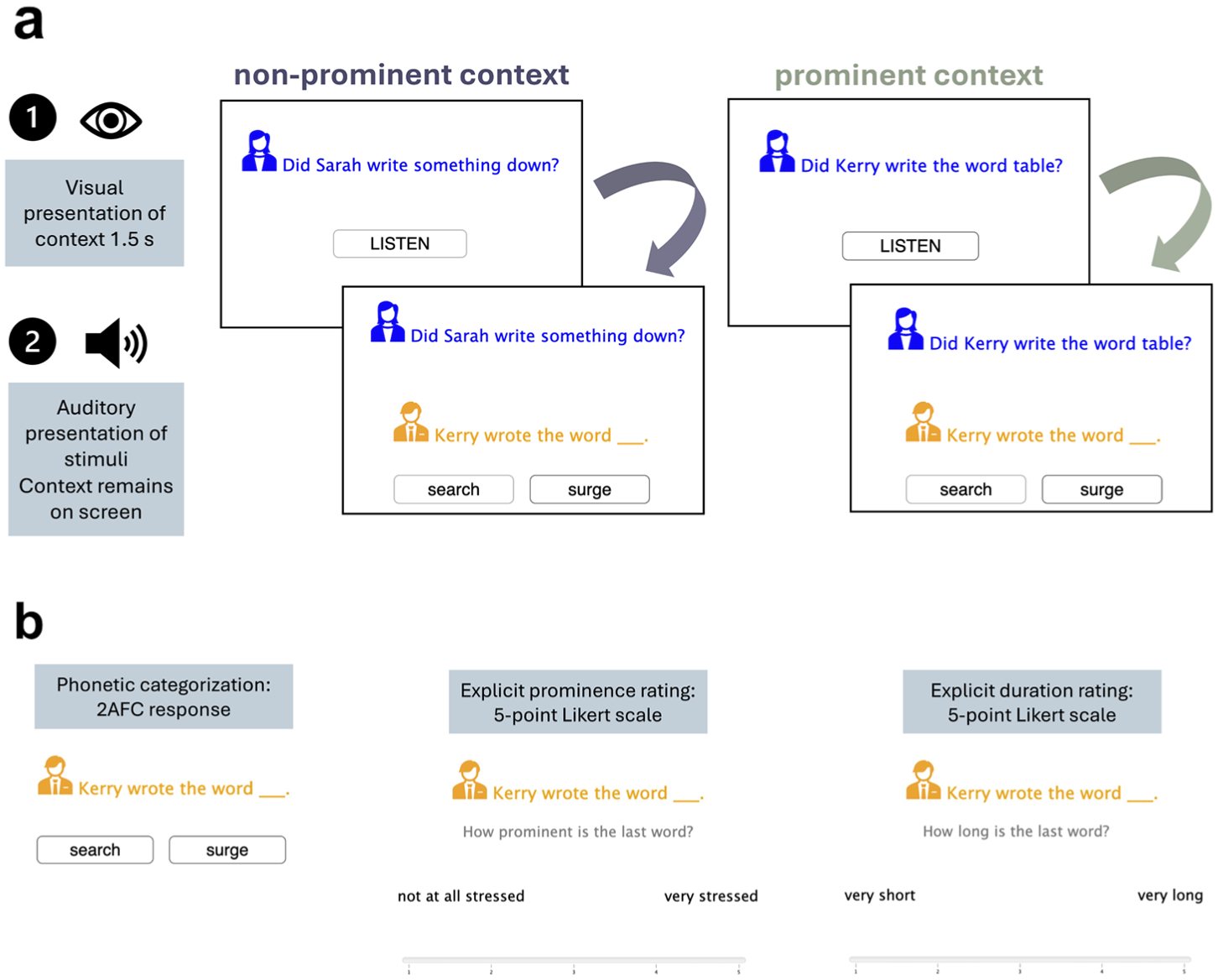
Schema for the trial and responses in the study.
An example of a trial is given for both contexts for one item in Figure 1A. The trial began with the visual presentation of the context (Olivia’s question). After 1.5 s, a button labelled LISTEN appeared. After participants clicked this button, Jim’s response to the question, with the final word represented as a blank, appeared as well as the response options and with simultaneous playing of the stimulus. Participants could not register a response until the end of the stimulus. After a response was given, an 800 ms intertrial interval elapsed before the presentation of the context for the next trial. Here, it can be reiterated that the auditory stimulus is always identical accross conditions; only the preceding context (which was presented orthographically and read silently by participants) varies.
In the three experiments we present in this article, the trial structure was the same, with the same context-item pairings and the same presentation of stimuli. The critical difference across experiments was only the task participants were asked to perform and the responses which were collected from them. The example in Figure 1A shows the phonetic categorisation task, a 2AFC task where two orthographic word response options are provided. These were balanced in terms of which side of the screen they appeared on, with each response appearing on each side an equal number of times (on one side for one repetition of the 40 unique stimuli, and on the other for the second repetition, with all stimuli fully randomised).
Figure 1B shows the additional response types which were collected in two additional experiments: an explicit prominence judgement task and an explicit duration judgement task. In these tasks, a slider was placed and could be dragged around a five-point scale, as was also used in Bishop (2012) and the explicit duration judgement task in Steffman and Jun (2021). The slider did not begin on the scale and had to be placed by participants. After it was placed, a button labelled NEXT appeared, which participants had to click to proceed to the next trial (not shown in Figure 1).
In the explicit prominence judgement task, we used similar language to Bishop (2012) to describe the task, following the same presentation of the two characters, that is, starting where it says “Your task is” in the phonetic categorisation task instructions above. The instructions for prominence judgements were provided as follows: The last word Jim says will be represented by a blank ( __ ). Your task is to tell us as accurately as possible how stressed/prominent this last word you hear is, relative to other words in the sentence. By “stressed” we mean “how much did the speaker use his voice to make the word stand out?” You will rate this using a slider which ranges from not at all stressed to very stressed. You can click then move the slider around, and you can use this scale however you would like.
Finally, for the explicit duration judgement task, the instructions were as follows: The last word Jim says will be represented by a blank ( __ ). Your task is to tell us as accurately as possible how long or short this last word you hear is, relative to other words in the sentence. By this we just mean whether that last word is spoken quickly (short) or slowly (long). You will rate this using a slider which ranges from very short to very long. You can click then move the slider around, and you can use this scale however you would like.
One critical aspect of the design is that the contexts should, ideally, not exert an inherently biasing influence on the lexical choice that participants make in the phonetic categorisation task. To assess this, we ran a norming study in which participants, without hearing auditory stimuli, provided what they thought was the best-fitting response as the final word in the dialogue, set up and presented as in the actual phonetic categorisation task. This experiment, included in Appendix B of the article, found no biasing effect of contexts on word choice for the critical vowel duration items (which could possibly confound or work against the hypothesised prominence effect).
In the procedure for each of the three experiments, following the instructions, there were 2 practice trials, and then all 80 trials were presented in a fully randomised order. The experiments took approximately 15–20 min to complete in total.
3.3. Participants
All participants were recruited via Prolific (2024), subject to the following Prolific filters: self-reporting no hearing deficits, indicating yes to “I only speak English,” being a resident and born in the United States, and having an approval rating of 99 or higher on Prolific. We recruited 64 participants for each of the three above-described experiments, 32 allocated to each subject group, which counterbalanced context-target pairings as described in Section 3.2. No participant took part in more than one of the experiments. Participants were instructed that they should take the experiment in a quiet location and use headphones. All responses from participants were analysed, a total of 2,560 for each experiment (20 target trials × 2 repetitions × 64 participants).
3.4. Statistical Analysis
We analysed participants’ responses for all experiments using Bayesian mixed-effects regression models, implemented using brms (Bürkner, 2017). For two experiments described in this article, the dependent variable was a five-point Likert-type scale, which we modelled using an ordinal model (Bürkner & Vuorre, 2019; Liddell & Kruschke, 2018), specifying the family as cumulative with the probit link function. The model for phonetic categorisation has a binary voiced/voiceless dependent variable, modelled with a logistic regression model (specifying the family as Bernoulli with logit link function). In this case, a voiced response was mapped to 1 and a voiceless response was mapped to 0. 9 We specified (very) weakly informative priors for the intercept and fixed effects using the student family with three degrees of freedom: student_t(3,0,2.5) in all models, in the log-odds space. Besides these, default prior specifications from brms were used.
The fixed and random effects in each of the three models were the same. They included a continuum step (centred and Gelman scaled, divided by 2 as compared with 1 SD; Gelman, 2008) and the prominence variable of interest (treatment-coded with non-prominent mapped to 0 and prominent mapped to 1). The interaction between the two fixed effects was included as well. Random intercepts for participant and item were included, with by-participant random slopes for both fixed effects and their interaction. In presenting the results, we focus on the effect of context, with the estimate being the log-odds of a change in response in the prominent relative to the non-prominent condition. We will also discuss the effect of the continuum step in some cases.
4. Results
Results are presented in this section for each experiment in sequence.
4.1. Explicit Prominence Judgements
Recall that the first question we attempted to address was whether we could carry out a conceptual replication of Bishop (2012). This would be evident in a shift in listeners’ Likert-type-scale ratings for the target word, as a function of context.
The results from this experiment are shown in Figure 2. Panels A and B in the figure focus on the overall effect of prominence-manipulating context. The empirical data are shown in Figure 2A as the overall proportion of ratings assigned to the target word from the Likert-type scale for each context. As can be seen, the distribution of ratings shifts as a function of prominence. When the target word follows the prominent context (i.e., the context that sets that word up to be prominent), ratings shift to higher numerical values. There is a relatively larger proportion of 5, 4, and 3 ratings in the prominent context as compared with the non-prominent context and a smaller proportion of 1 and 2 ratings. In other words, it appears listeners numerically rate the target as more prominent following the prominent context, lining up with Bishop (2012).
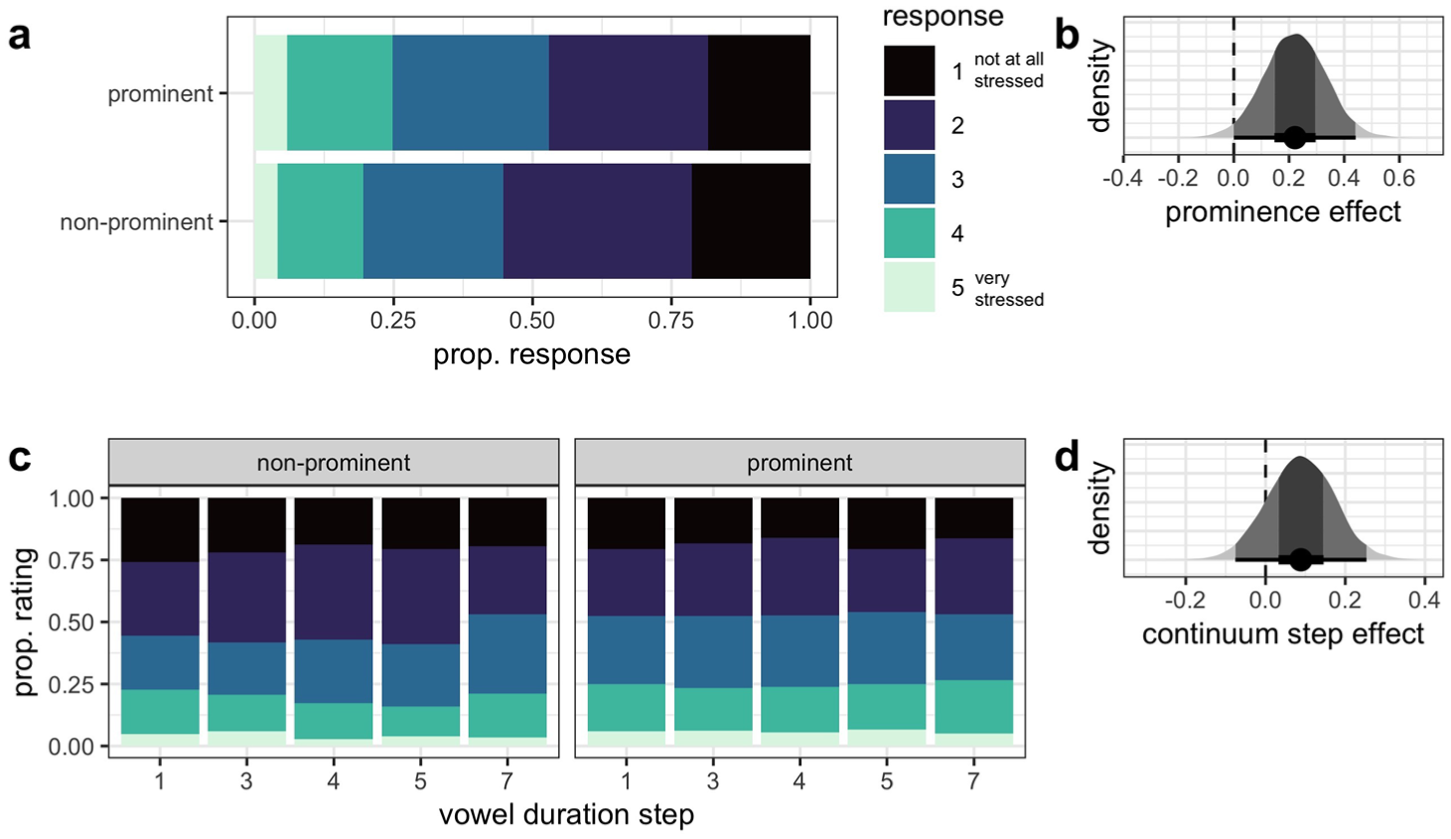
Results from the explicit prominence rating task. Panel A shows the proportion of each rating given in each overall prominence condition, with the rating scale’s endpoints labelled in the same way they were for participants. Panel B shows the posterior estimate for the prominence effect. Panel C shows ratings split by continuum step. Panel D shows the posterior estimate for the continuum step variable. Intervals indicated by colour in Panels B and D show 50% and 95% CrI.
The model’s estimate for the effect of prominence was found to be credibly non-zero, with 95% CrI narrowly excluding that value: (βˆ = 0.22, 95 CrI = [0.00, 0.44], pd = 98); the full posterior distribution for the effect is shown in Figure 2B. Overall, this serves as a conceptual replication of Bishop (2012, 2016): preceding contexts influence listeners’ explicit judgements of the prominence of spoken stimuli (using, notably, a different method of contextual prominence manipulation than that of the original study and presenting the contexts visually instead of auditorily).
The effect of the continuum step, which we considered might lead to an increased perceived prominence at longer vowel durations, is shown in Figure 2C. There was no credible evidence for this effect (pd = 85), though this value indicates some weaker evidence for a positive effect, whereby increasing duration leads to increased numerical ratings of prominence, with the distribution shown in Figure 2D. This estimate is notably for the reference level for prominence (non-prominent), though no evidence for a step-by-prominence interaction was observed (pd = 62), as was also confirmed by estimating the step effect for each prominence condition using emtrends() from the emmeans package (Lenth et al., 2018). 10 Therefore, it seems listeners’ prominence judgements overall were not very sensitive to vowel duration in these phonetic continua. This result mirrors the aforementioned findings of Bishop (2016) in several regards. Recall that the study also manipulated the duration of a word along a continuum (similarly to how we manipulated vowel duration in our stimuli) and crossed that manipulation with a contextual prominence manipulation. Bishop (2016) found some evidence for an influence of vowel duration on explicit prominence judgements, which varied as a function of listeners’ pragmatic skill, suggesting that it is neither uniform nor robust across listeners. This is conceptually not unlike the weaker evidence we find here for such an effect: although we do not examine individual differences, we see in our data that such an effect is not clear, though estimates do lean in the expected direction. Also, like Bishop (2016), we find no evidence for a duration by prominence interaction, which could have (hypothetically) shown a greater sensitivity to durational differences when the relevant word is contextually prominent. This result and its alignment with Bishop (2016) are taken to suggest that listeners are not very sensitive to duration (as manipulated along a continuum) in this task, nor does their processing of this durational information, when rendering explicit prominence judgements, interact with contextually conveyed prominence. This point is returned to in the general discussion of the results in Section 5.1.
4.2. Phonetic Categorisation Task
The findings from the first experiment serve to show that our prominence-manipulating contexts do effectively elicit changes in explicit prominence judgements. We now address the central question of this study: does this translate to listeners’ expectations about the realisation of vowel duration as a cue to coda obstruent voicing? The results are shown in Figure 3. A plot of model estimates is included online on the OSF, titled: vdur.phon.cat.fit.jpeg.
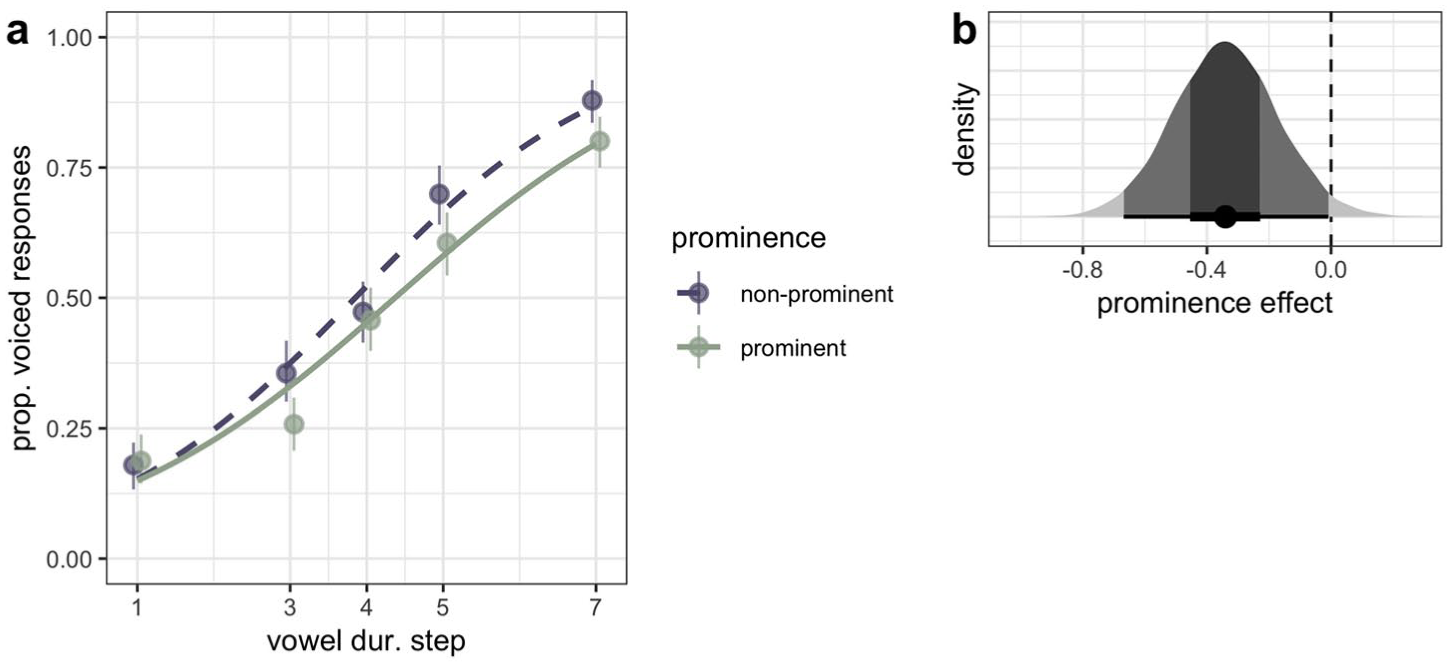
Results from the phonetic categorisation experiment. Panel A shows the proportion of voiceless responses given at each of the continuum steps. Points show means with bootstrapped 95% CI computed from the empirical data. The fit lines show a logistic function fit to the data to represent a smoothed categorisation function. Panel B shows the model’s posterior estimate for the prominence effect. Intervals indicated by colour in Panel B show 50% and 95% CrI.
Looking first at Figure 3A, we can make two observations. First, as vowel duration increases from left to right, the overall proportion of voiced responses increases, indicating that listeners are indeed using the cue as expected (though notably, categorisation is not fully anchored at the endpoints, reflecting some uncertainty). Second, we can note a shift in categorisation as a function of prominence-lending context: the prominent context effectively reduces the overall proportion of voiced responses, shifting the categorisation function rightwards to longer required vowel duration values for a voiced response.
The model’s estimates confirm these observations. First, there was a clear effect of continuum step (pd = 100), both as estimated at the model’s reference level (non-prominent) and also for the prominent condition (pd = 100), as computed with emtrends. Addressing the critical question of context, there was clear evidence for an effect whereby the log-odds of a voiced response are reduced in the prominent condition (βˆ = 0.34, 95 CrI = [−0.67, −0.01], pd = 98). In other words, listeners effectively required longer vowel duration for a voiced percept in that condition, comporting with the compensatory predictions laid out above and the relevant result from Steffman and Jun (2019). There was also some evidence (though 95% CrI narrowly included zero) for the interaction between prominence and continuum step (βˆ = −0.45, 95 CrI = [−1.02, 0.11], pd = 94). One lens through which to view the interaction is as an effective increase in the size of the prominence effect (i.e., a more negative effect) as vowel duration increases, which can be seen roughly in the fit lines in Figure 3A. It thus appears that longer vowel durations in these stimuli were more susceptible to the prominence effect.
At this point in the article, it can be reiterated that the stimuli themselves were identical across prominence conditions, which only varied the pairing of an orthographically presented context with the subsequent auditory stimulus. In this sense, we have evidence for a signal-external influence on listeners’ apparent expectations of vowel duration, evidencing sensitivity to the intricate relation between prosodic prominence and durational cues in speech production (e.g., De Jong, 2004).
4.3. Explicit Duration Judgement
In the final experiment in this study, we sought to examine if an analogous effect of context would appear in listeners’ explicit judgements of the duration of the final word, elicited using a five-point Likert-type scale as in Steffman and Jun (2021). The results are shown in Figure 4. As can be seen in Figure 4A, the distribution of ratings remains quite stable across contexts, with no clear evidence for a shift in ratings, also confirmed by the model’s estimates for the prominence effect, shown in Figure 4B (βˆ = 0.04, 95 CrI = [−0.15, 0.22], pd = 65).
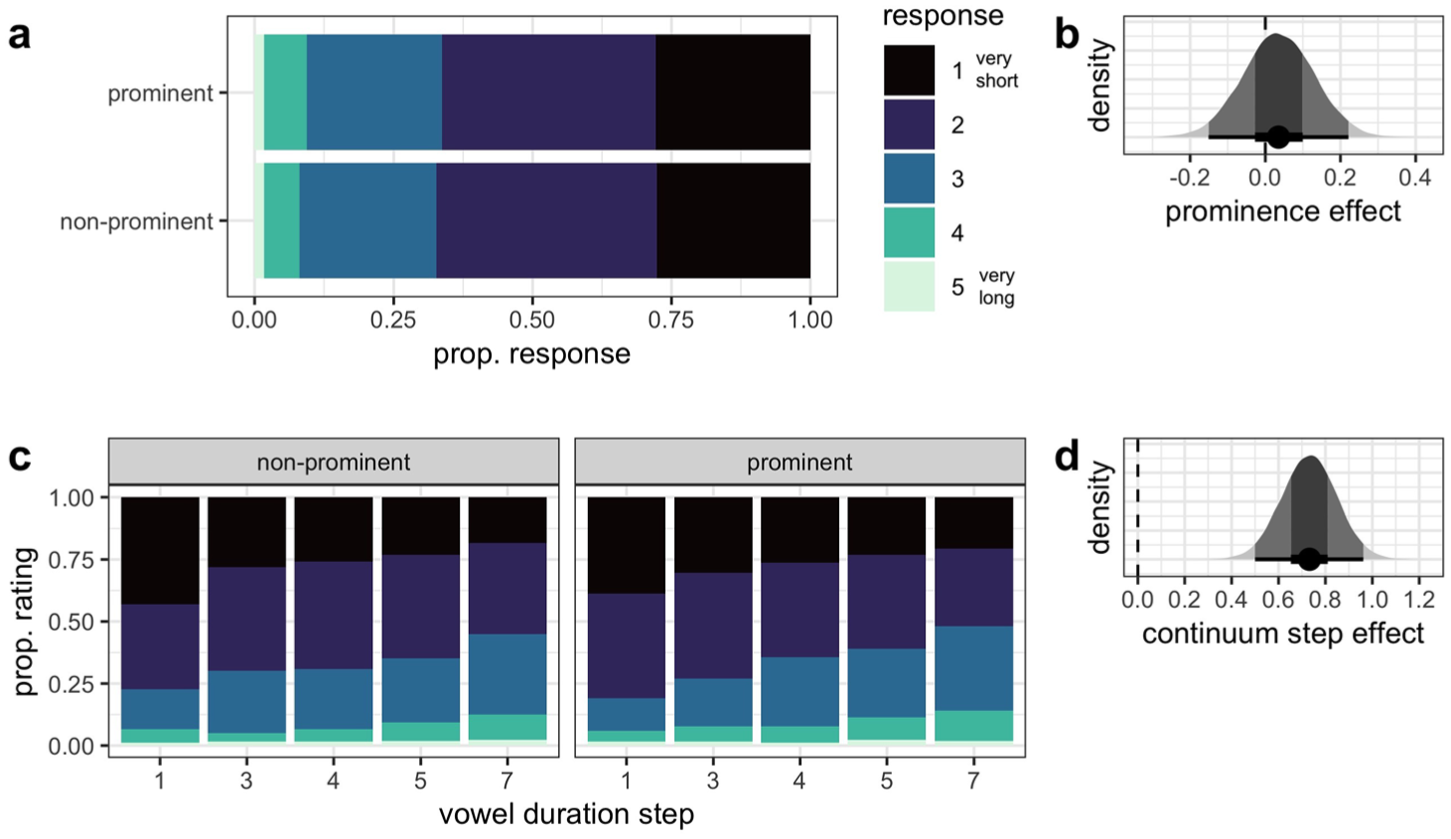
Results from the explicit duration rating task. Panel A shows the proportion of each rating given in each prominence condition, with the rating scale’s endpoints labelled in the same way they were for participants. Panel B shows the posterior estimate for this prominence effect. Panel C shows ratings split by continuum step. Panel D shows the posterior estimate for the continuum step variable. Intervals indicated by colour in Panels B and D show 50% and 95% CrI.
As would be expected (and unlike the explicit prominence judgement task), increasing vowel duration robustly increased numerical ratings of duration on the Likert-type scale (βˆ = 0.73, 95 CrI = [0.50, 0.96], pd = 100). These effects are shown in Figure 4C and D. In both prominence conditions, the longer vowel durations from the continuum lead to higher numerical responses on the Likert-type scale. There was no evidence for an interaction between continuum step and prominence condition (pd = 65), suggesting the effect of duration on ratings is comparable in both prominence conditions.
Taking this result with the lack of a prominence effect, we can conclude that, based on this experiment, listeners are attending to actual/veridical duration when making these explicit judgements, and in that sense, they are not influenced by prominence context (which we might have supposed would generate compensatory effects in explicit judgements of duration). These results are further discussed in relation to other studies comparing implicit/explicit judgements in Section 5.1.
5. Discussion and Conclusion
In this section, the results from the foregoing experiments are summarised and discussed in terms of their broader implications and future directions.
Recall that three basic questions were pursued in the above experiments. First, we asked if we could elicit changes in prominence judgements (for the same speech sample) as a function of changing the context that preceded it, which was orthographically displayed and did not have any auditory presentation. This preceding context was intended to change the status of the last word, to be expected to be produced with corrective focus (as well as being lexically and referentially new) or postfocus (being, possibly, referentially given or subject to a bridging relationship). In a conceptual replication of Bishop (2012), we found that listeners did indeed judge the target word to be more prominent in the first case, apparently projecting expectations derived from the preceding context. This was taken to show that the manipulations were suitable for eliciting changes in prominence perception.
The core contribution of this study was in the second experiment: here, we found that listeners adjusted their categorisation of a vowel duration continuum in a way that was compatible with the idea that they expected vowel duration to be longer in a word that was expected to be prominent. In other words, the previously documented influence of prosodic prominence in the processing of segmental cues can apparently be elicited by changing prominence expectations (without changing the speech signal). This lines up rather directly with the aforementioned finding in Steffman and Jun (2019), where prominence, as conveyed by overall raised F0 over the course of a vowel, elicited a comparable effect.
Finally, in the third experiment, we found that although actual vowel duration was a strong influence in listeners’ explicit duration judgements, there was no influence of the contextual manipulation: it thus appears that in explicit judgements, unlike the implicit ones from the phonetic categorisation experiment, listeners rely only on actual/veridical duration in the speech signal.
Most fundamentally, this study has provided evidence that listeners’ interpretation of speech is linked to prominence-based expectations. These modulate both explicit judgements (as already shown in Bishop, 2012) and perception of cues to segmental contrasts. The picture that emerges is one in which listeners are sensitive to the relation between prosodic prominence and segmental acoustics. The novel finding is that these expectations can be based on context alone, and therefore, the present study provides a new angle to consider how these sorts of effects relate to speech signal-external information and how the perceptual system is sensitive to information structure, as manipulated in the present study.
In rapid prosody transcription (RPT) studies, it is well documented that signal-external factors influence or mediate prominence perception, for example, the case of lexical frequency (e.g., Baumann & Winter, 2018; Cole et al., 2019). In this sense, the observed effects are commensurate with the idea that listeners integrate various sources of information in prominence perception. The inference we can make from the alignment of this explicit task and the “implicit” one in which listeners categorised the vowel duration continuum is that similar types of information are relevant, and in this sense, the perception of segmental cues entails processing expectations derived from information-structural context.
This general premise of expectation in speech perception has been framed in various lights throughout the literature (e.g., Babel & Russell, 2015; McMurray & Jongman, 2011). Most relevant here, we can consider the Prosody Analyser model, proposed in Cho et al. (2007) and more recently examined in the literature (Kim et al., 2018; Mitterer et al., 2019; Steffman, 2020). This model, in an activation-competition view of spoken word recognition, proposes that lexical items are activated in parallel with a representation of prosodic phrasing, and that word boundaries are assessed in terms of their alignment with phrasal boundaries (see also Christophe et al., 2004). The same idea has fruitfully been applied to other cases besides the word segmentation problem, with the general idea being that lexical candidates are evaluated with respect to a prosodic structure, in light of the influence of that prosodic structure on cue realisation (Kim et al., 2018; Mitterer et al., 2019). The evidence from the present study suggests that this prosodic structure can be elicited from, or parsed from, context alone, with apparent differences in perceived prominence as a consequence.
The additional suggestion from these results is that context-based prosodic structure, as with prosodic structures that listeners parse from the actual speech signal, exerts a mediating influence in spoken word processing. In this sense, the present results have also reaffirmed that listeners evidence sensitivity to information structure and its manifestation in patterns of prosodic prominence, using a new sort of index for this sensitivity.
5.1. Implicit and Explicit Judgements
The results also allow us to consider how different types of listener judgements are influenced by the contextual manipulation we employed. Recall that the methods across experiments were highly similar and differed only in the response that participants gave. Thus, the differences across experiments presumably allow us to examine how these different tasks influence listeners’ processing of the contexts we manipulated.
First, the explicit and “implicit” (i.e., phonetic categorisation) prominence judgements are in alignment, in the sense that both exhibit the predicted effect. As noted above, the integration of various pieces of information in explicit prominence judgements is well established. From this perspective, it is perhaps surprising that the explicit duration judgements do not align with the first two experiments. It was considered possible that the contextual manipulations would have an influence on these judgements, evidencing overall shorter judged durations in the prominent conditions, that is, the final word “sounds short” for being prominent if prominence-based lengthening is expected.
The absence of such an effect, where (only) the vowel duration continuum exerted an influence on explicit duration judgements, does, however, comport with several other studies, which in aggregate suggest that explicit judgements of duration tend to be largely signal-based, that is, based on actual/veridical duration. These studies, Reinisch (2016) and Steffman and Jun (2021), both find that explicit duration judgements do not integrate information outside of actual durations/rates. Both of the aforementioned studies also find, however, that information is integrated in duration-dependent “implicit” judgements of rate/duration (i.e., phonetic categorisation), which are influenced by fast-speech processes and F0 cues in Reinisch (2016) and Steffman and Jun (2021), respectively. The present findings are broadly consistent with this idea and allow us to draw two inferences. First, the task of recognising speech, including durational cues, appears to draw on a wider set of contextual and non-durational information, whereas the task of judging duration taps into a mode of processing which is based more on actual durations in the speech signal. This divergence is perhaps not surprising, but nevertheless informative for future research which examines the processing of durational and rate-dependent information. This also notably differs from explicit prominence judgements, which appear to be fundamentally broader in terms of the types of information which inform them. It is also worth noting here that the nature of the task and instructions themselves may be relevant. In the final experiment in this article, participants were told explicitly to focus on and judge the durations in the target words. This might have led participants to disregard the context and focus only on the speech signal in the target sentence. Exploring other ways of making the context more salient or relevant in the duration judgement task (e.g., auditory presentation of the context, as in Bishop, 2012, 2016) would constitute a valuable extension from a methodological perspective.
Finally, one other outcome was that explicit prominence ratings were not robustly affected by duration, as was also observed in Bishop (2016), where those effects were present, but only for individuals who were indexed as having greater pragmatic skill. This outcome stands in contrast with a somewhat analogous experiment in Turk and Sawusch (1996), where listeners judged the relative stress of the two-syllable word [mama], and intensity and duration were varied on each syllable (their Experiment 2). Variation in duration was indeed impactful for explicit prominence ratings. Notably, in that study, the target was presented in isolation and did not vary across numerous items, as was the case in this study and Bishop (2016). One possible inference then is that when variation is minimised, as it was in Turk and Sawusch (1996), listeners’ attentiveness to duration when rendering explicit judgements of prominence is heightened. At the same time, RPT studies (e.g., Cole et al., 2019) also document a role for duration in prominence judgements. Typical RPT set-ups differ from ours in various ways: targets are not manipulated but natural speech samples, responses are a binary classification of prominent/non-prominent, and multiple words in an utterance are evaluated. The by-item variability and in-context targets in RPT thus suggest that highly controlled stimuli like Turk and Sawusch (1996) are not necessary for finding an influence of duration. One other possibility, therefore, for the limited role observed in the present study’s explicit prominence rating task is that duration variation is also saliently a segmental contrast cue (evidently used by listeners in the phonetic categorisation experiment). Thus, it is perhaps less-saliently a cue to prominence in that task, even though listeners are providing explicit prominence judgements. However, this, of course, does not explain what was observed in (Bishop, 2016). At this stage, given the various parameters that differed across Turk and Sawusch (1996), the present study, Bishop (2016), and typical RPT studies, we can only speculate on this discrepancy, but it certainly is notable and merits further attention. Investigating when and how, across methods, duration is incorporated into prominence perception becomes a pertinent avenue for future research.
5.2. Some Future Directions
Various directions for future research and extensions of these results can be considered in light of the present findings.
At a basic level, a handful of methodological considerations might fruitfully be pursued. As we detailed above, our design was constrained by the choice to convey a clear corrective aspect in the dialogue to participants, and, by virtue of the phonetic categorisation task, to have the target word be lexically new in both contexts. This led to the use of a plausible bridging relationship for the target in the non-prominent condition, which might be improved upon in future studies. For example, manipulating focus domain size, as a more direct replication of the approach taken in Bishop (2012, 2016), would be informative. Using auditory contexts like those in previous studies in lieu of only-read ones would also be a useful extension methodologically. In addition, testing other prosodically modulated cues, such as vowel formants (cf. Steffman & Zhang, 2023), would help to extend these results and see if they replicate across different variants of the same general experimental task.
Another aspect of the present findings which merits further work is to consider the relationship between phonetic categorisation responses and perceived prominence; that is, does a listener’s perception of the target word (e.g., “bus” vs. “buzz”) have a consequence for their explicit prominence judgements or vice versa? If, for example, a token at an ambiguous continuum step is categorised as voiceless, this could correlate with increased prominence judgements by virtue of attributing vowel length to prominence instead of coda voicing. This is indeed the type of processing we assume listeners are engaging in when they compensate for contextual prominence in phonetic categorisation. However, directly examining the consequences of that categorisation decision itself would allow another interesting lens on the interrelation of segmental and prominence information as intertwined in listeners’ perception of speech. This would furthermore help validate our current understanding of these effects. This sort of question could relatively easily be addressed in the present case by collecting multiple responses per trial (phonetic categorisation and explicit prominence rating), with a structure otherwise mirroring that in the present study.
The present results also merit contextualisation within the current understanding of prominence in speech perception, and especially segmental and lexical processing. One relatively straightforward extension along these lines is fitting together these results with previously documented signal-based effects. The question of the relative importance of both signal-based and signal-external prominence effects, and possible additive or interactive influences between the two, will better inform how each plays out in naturalistic speech perception, where both influences occur jointly on a regular basis. This also opens up the possibility of asking more direct questions pertaining to the role of prominence in speech recognition. Perhaps especially interesting is the question of how listeners will process signal-internal and -external information when they conflict (e.g., the implied-to-be-prominent word is actually not prominent in the speech signal). Which type of information takes precedence, if either? And how does such a conflict influence the speed of word recognition?
From a related perspective, Zhang and Steffman (2025) examined how F0-based prominence influenced listeners’ perception of speech in adverse listening conditions, finding that the presence of prominence yielded an effective up-weighting of formant cues to vowel contrasts. This was the case in an ideal (quiet) listening condition, in line with the concept of prosodic prominence as attention orienting (Akker & Cutler, 2003; Cole & Jakimik, 1980; De Jong, 1995; Lialiou et al., 2024). It was also the case when the target speech was presented in multitalker babble noise: prominence effectively mitigated the negative effects of copresented noise on cue weighting. Notably, Akker and Cutler (2003) found that the implied location of focus (based on a preceding context), in addition to prosodic prominence in the speech signal, benefitted listeners in a phoneme monitoring task by speeding up their reaction times. The same question holds for the present study’s results: Is there a benefit in recognition speed and accuracy on the basis of these manipulations? How these effects relate to those now shown for signal-based prominence, as well as potentially benefitting perception of speech in noise, will be another interesting angle to consider when extending the findings.
It may also be the case that this type of prosodic processing, one that involves maintaining and integrating contextual expectations, could be disrupted by adverse listening environments, such that the effect could potentially disappear in noise or other task-demand-induced challenging conditions. Testing the fragility of the effect in that respect, and in comparison to signal-based prominence effects which were shown to persist in noise (Zhang & Steffman, 2025), may also help us better understand the effect’s robustness and how it influences perception in more naturalistic conditions (cf. Bosker et al., 2017; Kong & Lee, 2018).
The Prosody Analyzer account, described briefly above, also allows us to consider an interesting prediction regarding the time course of the effect. In that model, the integration of lexical and prosodic information involves mapping activated word forms to parsed prosodic structures after lexical access has occurred. In that sense, the influence of phrasal prosody could be considered a later-stage influence and a postlexical one. This later time course is supported by eyetracking studies, which examined the timing of the influence of prosodic structure (Kim et al., 2018; Mitterer et al., 2019), which supports the idea that prosodic phrasing (in particular), parsed out of the speech signal itself, shows a later influence. The picture for prosodic prominence is slightly more complicated, where near-immediate influences were observed for localised cues to prominence such as vowel-initial glottalisation. However, prominence as conveyed by the overall melody of an utterance has shown a relatively delayed influence Steffman (2020), in line with Cho et al. (2007). How then should the present results enter into this picture? One critical difference from the preceding studies is that all of the relevant prominence-manipulating information precedes any auditory stimulus: It is purely expectational. Testing the time course of the effects shown here in terms of listeners’ phonetic categorisation thus allows an interesting opportunity to test if the influence is delayed. Even if all relevant contextual information is received by listeners at a very early time in processing the stimulus, it is still the case that this information must be integrated with the target speech itself to arrive at a categorisation decision; if that process remains a delayed one, it suggests that the postlexical model proposed in Cho et al. (2007) remains a valid one for these types of effects.
The present study was also focused on prosodic prominence, and the observed result begs the question of whether a similar sort of illusory prosodic parse can be elicited for prosodic boundaries. If one could convey a likely prosodic boundary contextually, for example, eliciting a particular syntactic parse for globally ambiguous attachment contexts (e.g., “I saw the man with the binoculars”), it would be possible to examine if this sort of implied boundary influenced perception of segmental detail, in line with boundary-induced modulation of segmental cues such as VOT (see, e.g., Kim & Cho, 2013). As discussed in Mitterer et al. (2016) and Steffman et al. (2022), this particular question can be a very difficult one to answer, in light of other contextual influences like speech rate. Therefore, manipulating perceived phrasing in a signal-external fashion may offer an interesting avenue to circumvent these challenges (if a suitable design with the right contexts and items could be devised).
Finally, this study has examined just one side of the coin of prosodic-segmental interactions in perception: the influence of prosody in segmental/lexical processing. It has become increasingly clear that the influence goes both ways, that is, that segmental information can influence prosodic parses and interpretation of prosodically conveyed meanings in speech (Mitterer et al., 2021, 2024). As a broader goal in extending the present enterprise, the role of segmental cues (e.g., vowel duration here, even when relevant to segmental contrast) in contributing to listeners’ parsing of prosodic structure and the information it conveys is another important future step.
Together, it is hoped that extensions along these lines will help us learn more about the processing of prominence and prosody more globally, and their impact on spoken word recognition.
Footnotes
Appendix A: Filler (VOT) Items and Contexts
Contexts and Target Sentences for the VOT (Filler) Items.
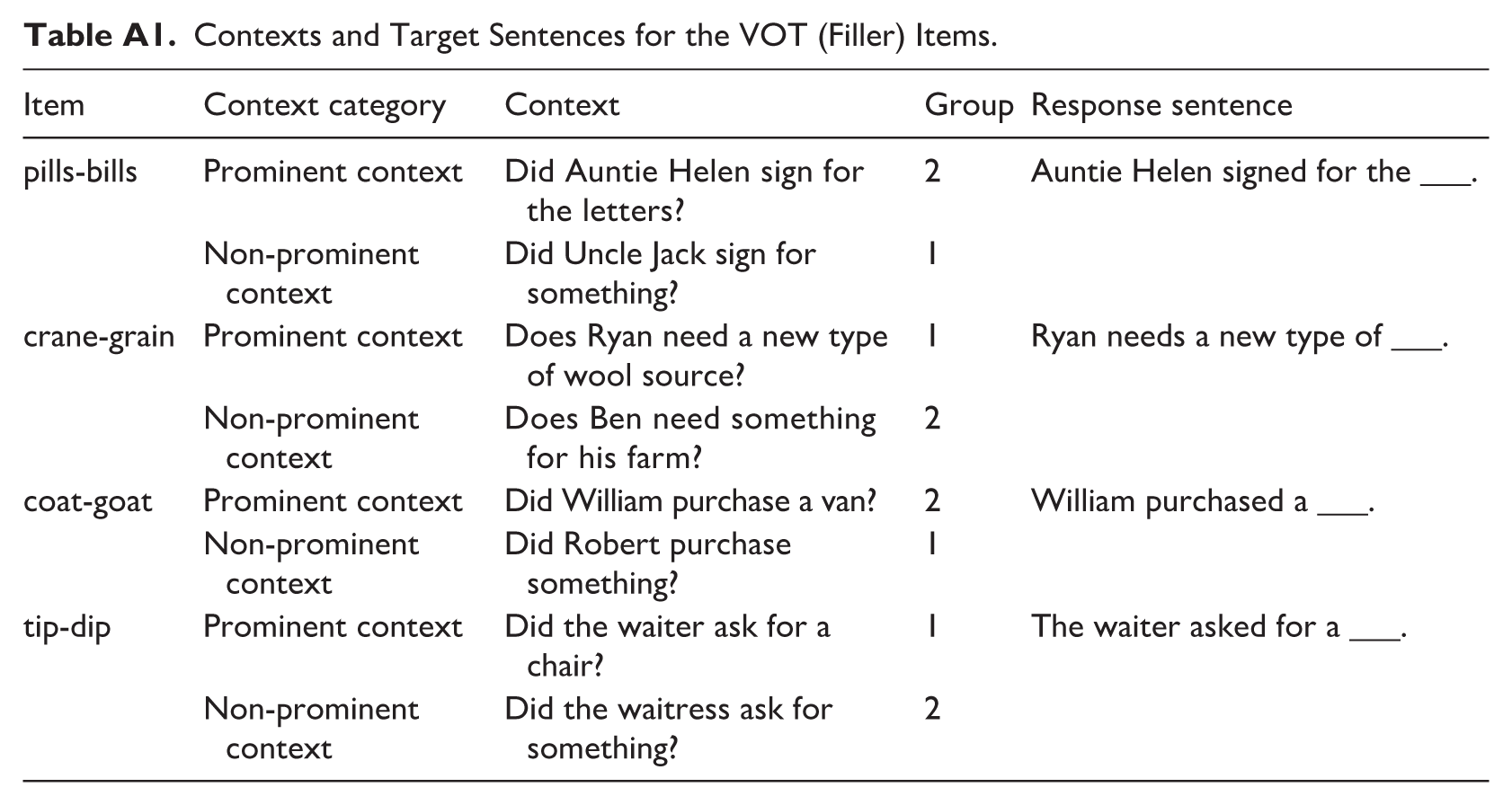
| Item | Context category | Context | Group | Response sentence |
|---|---|---|---|---|
| pills-bills | Prominent context | Did Auntie Helen sign for the letters? | 2 | Auntie Helen signed for the ___. |
| Non-prominent context | Did Uncle Jack sign for something? | 1 | ||
| crane-grain | Prominent context | Does Ryan need a new type of wool source? | 1 | Ryan needs a new type of ___. |
| Non-prominent context | Does Ben need something for his farm? | 2 | ||
| coat-goat | Prominent context | Did William purchase a van? | 2 | William purchased a ___. |
| Non-prominent context | Did Robert purchase something? | 1 | ||
| tip-dip | Prominent context | Did the waiter ask for a chair? | 1 | The waiter asked for a ___. |
| Non-prominent context | Did the waitress ask for something? | 2 |
Appendix B: Norming Experiment for Contexts
Acknowledgements
The authors are grateful for the two anonymous reviewers’ helpful feedback and for the feedback provided by attendees of the Phonetics Colloquium at the University of Cologne. This study was supported by a Small Research Project Grant from the University of Edinburgh, School of Philosophy, Psychology and Language Sciences.

Funding
The authors disclosed receipt of the following financial support for the research, authorship, and/or publication of this article: This research was supported by a University of Edinburgh PPLS Small Research Project Grant.
Declaration of Conflicting Interests
The authors declared no potential conflicts of interest with respect to the research, authorship, and/or publication of this article.