






Abstract
Theoretical models of second language speech acquisition generally propose that a learner’s ability to produce speech is closely linked to their perceptual representations. Although some studies have explored this phenomenon among learners from typologically distant backgrounds, empirical research on the acquisition of closely related, yet distinct, tonal systems remains limited. Addressing this gap, this study investigates Mandarin tone acquisition by late middle-aged native speakers of Puxian Min, a Southern Chinese dialect. This demographic is characterized by delayed, naturalistic Mandarin exposure and deeply entrenched native tonal habits. Specifically, the study investigates the production–perception relationship across different prosodic contexts, including monosyllabic words, the initial syllables of disyllabic words, and the final syllables of disyllabic words, by assessing tone production through a reading task and tone perception through a discrimination task. Results demonstrated that tonal realization was highly sensitive to prosodic structures, with targets in disyllabic words, especially in word-initial positions, yielding greater accuracy than isolated monosyllables. At the tonal categorical level, T1 and T4 proved robust, whereas T3 emerged as the most vulnerable category, frequently merging with T2. Crucially, overall statistical analyses confirmed a moderate positive alignment between learners’ tone production and perception. These findings highlight the interaction between tone production and perception, suggesting that long-term exposure to Chinese dialects may shape the cognitive representation of Mandarin tonal categories. This study offers valuable insights into tone acquisition in language contact situations and has implications for future research on second language phonological development.
1. Introduction
A central question in speech science concerns the relationship between speech production and perception. A range of theoretical frameworks propose that the two domains are closely related. For instance, according to the Motor Theory of Speech Perception, both processes rely on shared phonetic gestures within a specialized neural system, indicating an innate link rather than a learned one (Liberman & Mattingly, 1985; Liberman & Whalen, 2000). Neurocognitive evidence supports this view, showing that motor control systems are activated during both production and perception (Fowler, 1986; Perani & Abutalebi, 2005; Zhang & Peng, 2017). In contrast, auditory models of speech perception propose that production and perception are independent subsystems, with a connection developing through repeated exposure to a language (Blumstein & Stevens, 1979; Guenther, 1994, 1995; Kuhl et al., 2008). Despite these differences, most models converge on the prediction that production and perception are closely linked. However, this relationship may be less straightforward in second language (L2) acquisition. The Speech Learning Model (SLM) proposes that perception precedes production, with production guided by perceptual representations stored in long-term memory, implying shared mental representations for both processes (Flege, 1995). At the very least, perceptual learning is necessary to establish these representations. In addition, the SLM acknowledges that L2 production and perception may not always be perfectly aligned (Flege, 1995; Flege & Bohn, 2021). This link between production and perception is especially important in tonal languages, where lexical tones carry a high functional load in distinguishing meaning. Even subtle perceptual biases can lead to noticeable production errors (Hyman, 2011; Surendran & Levow, 2004). Moreover, lexical tones are particularly challenging for adult learners, as novel tonal patterns in L2 are often assimilated into existing first language (L1) categories based on acoustic similarity. This assimilation can delay the formation of independent tonal representations, resulting in persistent cross-linguistic interference and accented speech (Gao et al., 2020; Liu et al., 2020). Given their functional significance and acquisition difficulty, lexical tones provide a particularly informative case for investigating the productive and perceptual challenges faced by L2 learners (Flege, 1995; Yang, 2015).
Motivated by these persistent cross-linguistic challenges, the current study aims to further elucidate the complex relationship between L2 tone production and perception. To frame this study within existing research, we specifically focus on the acquisition of Mandarin. As the world’s most widely spoken tonal language with over one billion native speakers, Mandarin has attracted considerable research attention (Xie & Zhong, 2023). Reflecting this importance, numerous studies have provided important insights into the production and perception of Mandarin tones by L2 learners. For instance, Ding (2012) found that German learners of Mandarin exhibited differing patterns in production and perception, particularly in their ability to produce and perceive different types of tones. Similarly, Hao (2012), through production-based and perception-based tasks on Mandarin tones among English-speaking learners, reported only a moderate correlation between their tonal production and perception abilities. Likewise, Liu and Meng (2016) noted that while Kazakh learners showed some correlation between Mandarin tone production and perception, notable differences remained between the two. Building on these early behavioral observations, more recent studies have moved beyond broad accuracy scores and increasingly employed quantitative measurements of learners’ phonetic parameters including F0 contours, duration patterns, and tonal trajectory characteristics, to establish empirical links between learners’ production and perception (Leung & Wang, 2020, 2024; Yu et al., 2021). These studies indicate that the relationship between Mandarin tone production and perception in L2 learners is complex and does not follow a simple one-to-one correspondence.
Despite these valuable insights, empirical research explicitly examining this production–perception relationship has predominantly focused on typologically distant language pairs. Consequently, it is still unclear whether L2 tone production and perception are correlated, and if so, to what degree, when the L1 and L2 are closely related but distinct tonal systems. To address this important gap and further advance frameworks of L2 speech acquisition, the present study investigates the link between production and perception by examining Mandarin tone acquisition among speakers of Puxian Min, a dialect sharing a historical lineage with Mandarin but possessing a highly complex and unique tonal inventory. To empirically evaluate this link, we assess learners’ tone production through a reading task and their tone perception through a discrimination task. Specifically, by assessing the degree of confusion for all tone pairs across three prosodic contexts, including monosyllabic words, word-initial syllables of disyllabic words, and word-final syllables of disyllabic words, we aim to quantify the correlation between learners’ tone production and perception performance. To establish a robust framework for this study, the remainder of this introduction first presents the Mandarin tone acquisition profile of Puxian Min speakers and the evaluative baseline for assessing their L2 acquisition. It then compares the tonal systems of Puxian Min and Mandarin, highlighting the factors that influence how L2 learners perceive and produce Mandarin tones. Building on these theoretical foundations, we conclude by presenting the specific research questions and hypotheses that guide this study.
1.1. L2 Mandarin Acquisition Among Puxian Min Speakers
To better understand the acquisition of Mandarin by regional speakers, it is necessary to first consider the substantial linguistic diversity within the Chinese language family. From a genealogical perspective, “Chinese” does not denote a single language but rather a collection of distinct languages spoken across China. Broadly, these can be classified into eight major groups, further divided into the Mandarin and the Southern (non-Mandarin) branches (Xie & Zhong, 2023). While varieties within the Mandarin branch share considerable similarities, those within the Southern branch differ so substantially in pronunciation, vocabulary, and grammar that they are mutually unintelligible both among themselves and with Mandarin (Chappell, 2001; Tang & Van Heuven, 2015; Zhang & Zhang, 2010). Although these varieties are officially classified as dialects to support a unified national language, from a linguistic standpoint, they are more accurately regarded as separate languages (Bruche-Schulz, 1997; Francis, 2016; Li, 2006; Xie & Zhong, 2023). Consequently, when speakers of a Southern variety learn Mandarin, the process is essentially equivalent to L2 acquisition (Chen, 1999). However, most studies on Mandarin phonological acquisition among speakers of Southern Chinese dialects have focused on the major dialect groups, such as Cantonese (Li et al., 2017b; Yang, 2024; Zhang et al., 2012), Wu (Faytak et al., 2020; Gao et al., 2020; Wu et al., 2023), and Southern Min (Chen et al., 2014; Weng et al., 2023; Wu et al., 2016), which have large speaker populations and have attracted extensive research attention. In contrast, smaller dialect communities, although exhibiting substantial phonological divergence from Mandarin, have received comparatively little attention. In this regard, Puxian Min exemplifies such neglect. Spoken by over 3 million people across approximately 4,000 square kilometers in the Puxian region of Fujian Province, including Putian and Xianyou, it has remained largely unexplored in systematic research. To our knowledge, the present study is likely the first systematic investigation of Mandarin tone acquisition among this population.
The present study targets Puxian Min speakers aged 50–60, representing a late middle-aged generation (Franssen et al., 2020; Park & Kim, 2015). This population is particularly well suited for this investigation for three primary reasons. First, from a sociolinguistic perspective, this cohort is particularly significant as it represents a transitional generation in the history of Mandarin promotion in China. Born before the 2000 policy that established Mandarin as the official medium of education, these speakers lived during a period of historical resistance to its promotion in Fujian (Chen, 1999; Erbaugh, 1995), and thus did not receive the systematic phonetic training provided to younger, highly proficient generations (Tong et al., 2021; Zhou & Sun, 2004). Consequently, their acquisition of Mandarin was typically delayed until adolescence or later, occurring primarily through naturalistic exposure. As predicted by Critical Period Hypothesis (Asher & Garcia, 1969), this delayed exposure would result in strong accent retention when L2 learning begins in adolescence. Second, phonetically, their speech exhibits prominent regional features (Yan et al., 2024) and reflects the systematic fossilization typical of intermediate-to-advanced learners rather than the unstable errors of beginners, thereby offering reliable evidence for persistent L1 transfer (Yang et al., 2015). Preliminary fieldwork further confirms that their native tonal habits remain resistant to passive assimilation (Li et al., 2020). Third, methodologically, focusing on the 50–60 age group helps minimize potential age-related cognitive factors. Compared to speakers over 60, who face a 42% prevalence of mild cognitive impairment (Hu et al., 2017) and associated deterioration in general language processing (Burke & Shafto, 2004; Caplan & Waters, 2005; Salthouse, 2010), this late middle-aged group remains cognitively healthy. Thus, this cohort represents a well-suited group, preserving intact language functions while providing rich phonological data for examining the long-term influence of Chinese dialects.
To accurately assess the extent of long-term dialectal influence, the target variety of acquisition must be clearly defined. In this study, the target language is Standard Mandarin, which is the official national language and the main source of linguistic input through mass media and government communication (Li, 2006; Li et al., 2020). Crucially, the participants’ speech should be characterized as a regionally accented L2 interlanguage rather than a stable localized Mandarin variety (Chen, 1999; Flege, 1995). In contexts where a true localized variety exists, learners typically receive that specific variety as their primary ambient input (Siegel, 2010). For these late middle-aged Puxian Min speakers, however, their primary Mandarin input comes from official broadcasting and media, which strictly adhere to Standard Mandarin norms (Li, 2006). Since their target input is Standard Mandarin, the systematic deviations in their speech cannot be taken as evidence of successful learning of a local dialectal variety. Instead, these deviations reflect an incomplete L2 approximation (Flege, 1995), with learners striving to produce Standard Mandarin but still shaped by the phonological characteristics of their native Puxian Min (Li, 2006). Consequently, Standard Mandarin is adopted as the baseline norm for evaluating both production and perception, with deviations generally interpreted as reflecting the influence of L1 and related factors.
1.2. Tonal Systems in Mandarin and Puxian Min
Fundamental frequency (F0) is the primary acoustic cue for lexical tones in Chinese, with tonal categories distinguished by pitch height and contour (Chen et al., 2018; Liu & Samuel, 2004; Zhang & Hirose, 2004). To normalize F0 for analysis, this study adopts Chao’s five-level tone number system (Chao, 1930; Wang et al., 2003), which scales pitch from 1 (lowest) to 5 (highest). The T-value is calculated as follows:

Here, Xmin and Xmax represent the minimum and maximum values of the average F0 at each measurement point, respectively, while Xi refers to the average F0 at each individual measurement point. This method converts F0 in Hertz into T-values, allowing for a relative and normalized representation of pitch for tonal analysis (Chao, 1968; Deng et al., 2006).
Drawing on the T-value framework outlined above, we interpret the tonal relationship between Mandarin and Puxian Min within the historical context of Middle Chinese. Middle Chinese distinguished eight tonal categories: Yin Ping, Yang Ping, Yin Shang, Yang Shang, Yin Qu, Yang Qu, Yin Ru, and Yang Ru (Chen et al., 2013; Liang, 2018). The Ru tone (also called checked tone) was characterized by syllables ending in a stop coda (-p, -t, -k) and was typically shorter in duration. Mandarin retains four lexical tones (T): T1 [55] (high level, from Yin Ping), T2 [35] (high rising, from Yang Ping), T3 [214] (dipping, from Shang), and T4 [51] (high falling, from Qu), as shown in Figure 1 (Chao, 1930, 1968). In contrast, Puxian Min preserves seven distinct categories: T1 [533] (high falling, from Yin Ping), T2 [334] (high rising, from Yang Ping), T3 [453] (peaking, from Shang), T4 [51] (high falling, from Yin Qu), T5 [31] (low falling, from Yang Qu), T6 [41] (high falling, from Yin Ru), and T7 [3] (mid-level, from Yang Ru) (Cai, 2016; Chen et al., 2013). Figure 2 illustrates the tonal categories of Puxian Min (Cai, 2016; Jiang, 2021). At the macro-phonological level, the cognate tonal categories between the two varieties, derived from their shared Middle Chinese lineage, can be mapped as follows: In the Ping category, Mandarin T1 and T2 share a direct cognate origin with Puxian Min T1 and T2, respectively. Within the Shang category, Mandarin T3 is the historical cognate of Puxian Min T3. In the Qu category, Mandarin T4 aligns with a split category in Puxian Min, encompassing both T4 and T5. Finally, for the Ru category, Mandarin does not have a direct tonal equivalent; characters historically marked as Ru are distributed across various Mandarin tones, whereas they consistently correspond to Puxian Min T6 and T7. It should be noted that while these tonal categories share clear historical cognate relationships, the diachronic mapping of individual lexical items between the two modern varieties exhibits natural complexity and lacks a strict one-to-one correspondence (Cai, 2016; Huang & Liao, 2002). For instance, a specific lexical item carrying Mandarin T2 may correspond to T2, T7, or other tonal categories in modern Puxian Min.
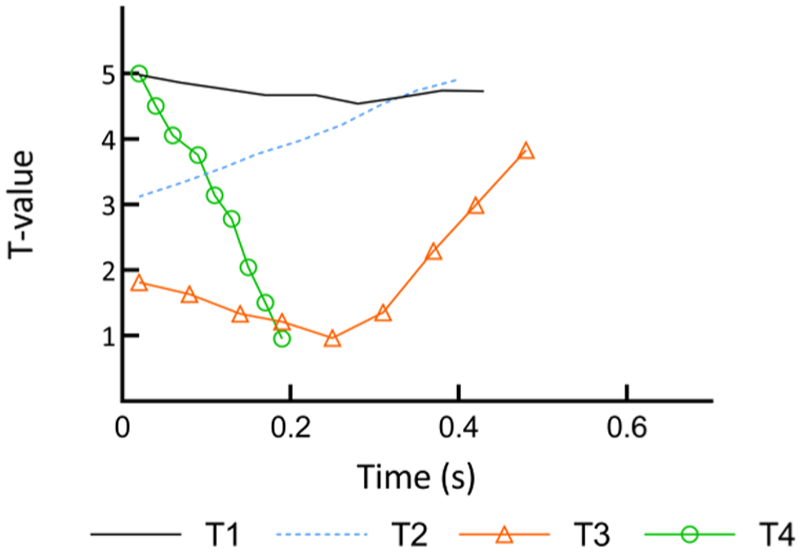
Standard Mandarin tonal contours.
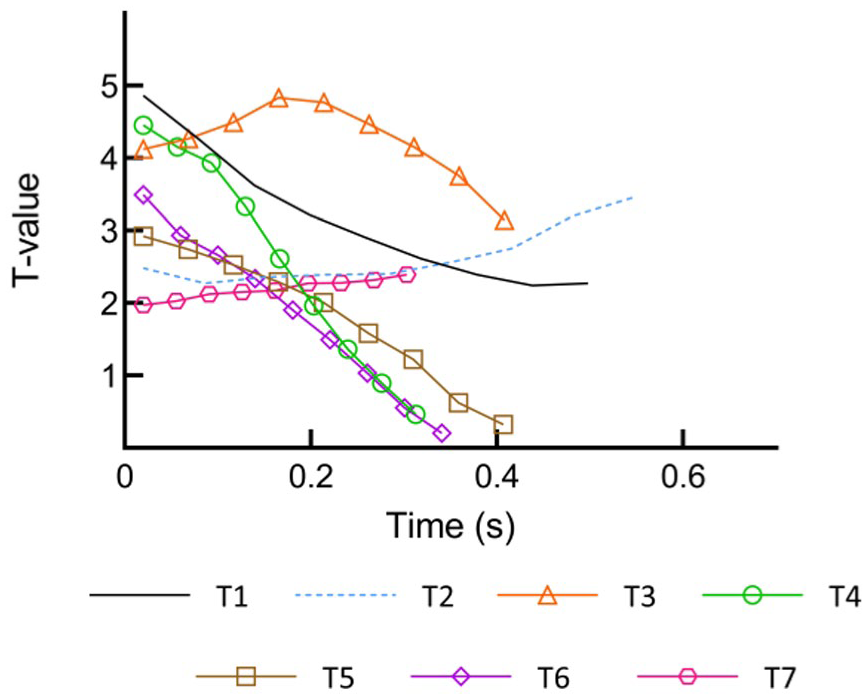
Puxian Min tonal contours.
Beyond these historical category mismatches, a systematic comparison of the two tonal inventories reveals profound structural asymmetries in their acoustic realizations. Mandarin includes a high-level tone (T1 [55]) that is absent in Puxian Min, while Puxian Min exhibits a greater variety of falling tones, such as T1 [533], T4 [51], T5 [31], and T6 [41], whereas Mandarin has only one falling tone, T4 [51]. In addition, Mandarin has a dipping tone, T3 [214], whereas Puxian Min features a peaking tone, T3 [453], and a mid-level tone, T7 [3], both of which diverge substantially from Mandarin tonal categories. Puxian Min also retains entering tones (T6 [41] and T7 [3]), a feature common to many Min dialects, which Mandarin has entirely lost. The two systems further differ in their use of phonation cues: while Mandarin frequently employs creaky voice as an important cue for T3, Puxian Min restricts glottalized or creaky phonation to the short, checked Ru tones (T6 and T7) and does not use it for long contour tones (Cai, 2016; Kuang, 2017; Yang, 2011). These structural disparities indicate that learners must not only resolve historical category conflicts but also overcome acoustic interference between similar yet non-identical contours and distinct phonation patterns.
In addition, both Mandarin and Puxian Min exhibit distinctive tone sandhi patterns in disyllabic words. In Mandarin, the primary sandhi involves T3. When two T3 tones occur consecutively, the first one changes to a rising contour [35], resulting in a T2 + T3 surface form. This is commonly referred to as the full T3 sandhi. In other contexts, when T3 precedes any non-T3 tone, it undergoes half T3 sandhi, in which the contour [214] simplifies to a low falling [21]. At phrase-final or prepausal positions, however, T3 typically retains its citation contour [214] (Duanmu, 2007). Puxian Min, by contrast, has a considerably more complex sandhi system. When two monosyllabic words combine, the tone of the word-initial syllable changes according to that of the word-final syllable, while the tone of the latter generally remains unchanged (Wu, 2010). Disyllabic tone sandhi in Puxian Min yields six surface tonal realizations, corresponding to the citation tones T1, T2, T4, T5, T6, and T7. T3 rarely occurs in the word-initial position after sandhi. The detailed sandhi rules are presented in Table 1 (Cai, 2016). Given these profound differences in tonal and sandhi complexity, Puxian Min and Mandarin function more as distinct languages than mere dialectal variants. Consequently, investigating how native speakers of such an intricate system acquire Mandarin tones provides crucial insights into cross-linguistic tonal interference.
Tone Sandhi Rules of Puxian Min Disyllabic Words (Initial = Word-Initial Syllable, Final = Word-Final Syllable).
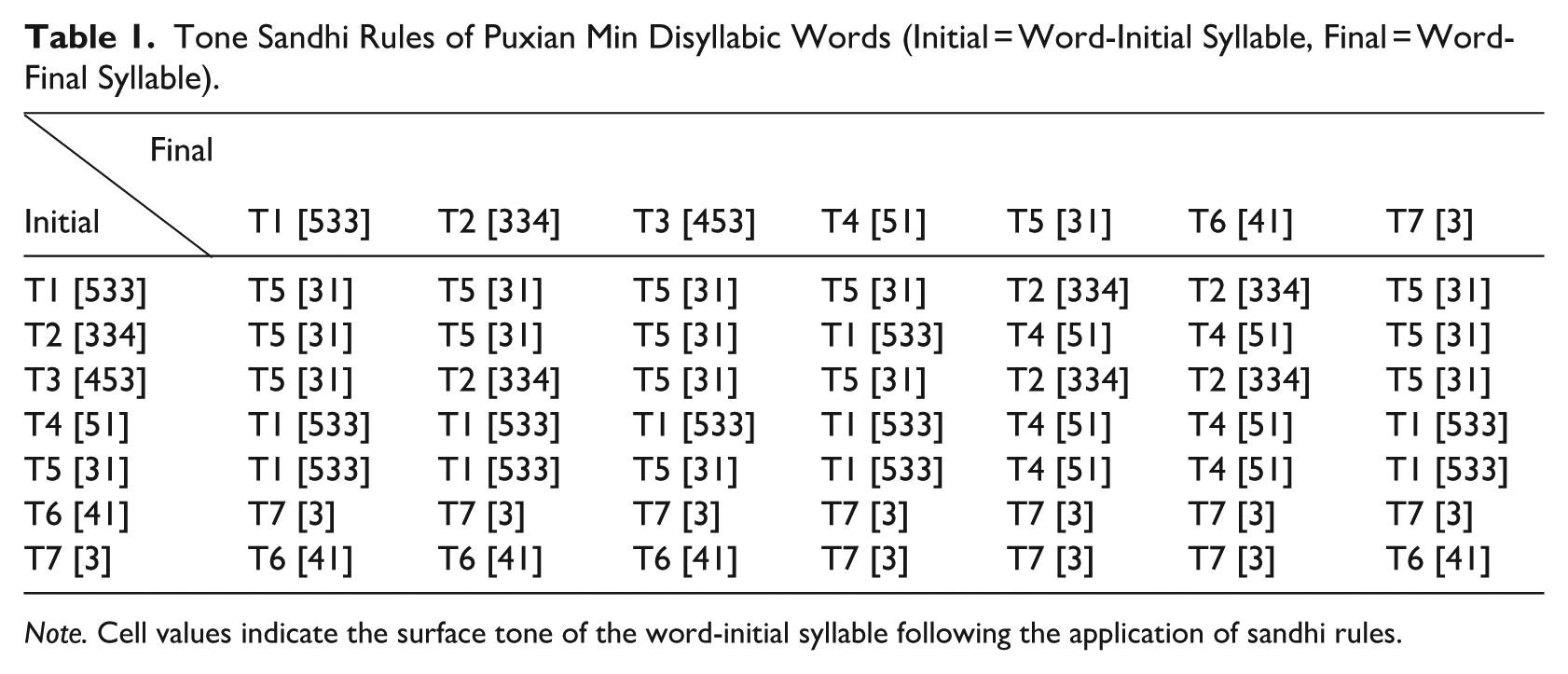
Note. Cell values indicate the surface tone of the word-initial syllable following the application of sandhi rules.
1.3. Challenges in L2 Mandarin Tone Acquisition
Building on the comparison between Puxian Min and Mandarin, the acquisition of L2 Mandarin tones is a complex process shaped by multiple linguistic factors. We will discuss two primary types of challenges related to this process. One important challenge in L2 Mandarin tone acquisition is that the difficulty of learning tones is not uniform across all tonal categories. For instance, tones with clearly distinct pitch contours, such as the high level T1 and the falling T4, are generally easier for learners to perceive and produce (Hao, 2012; Wang et al., 1999). Conversely, previous studies consistently identify the contrast between T2 and T3 as particularly challenging for non-native learners (So & Best, 2010; Tsukada & Idemaru, 2022). This may be due to two reasons. The first reason is that T2 and T3 are acoustically similar. Especially when the initial fall of T3 is reduced or unclear, its rising portion closely resembles the contour of T2, leading to frequent merging in both production and perception. This similarity can cause learners to perceive distinct tones as equivalent, a phenomenon known as equivalence classification, which hinders the formation of independent L2 phonetic boundaries and contributes to persistent negative transfer (Liu et al., 2020). The second reason is that both T2 and T3 do not easily correspond to L1-specific categorical mappings. Specifically, this refers to the process by which learners automatically interpret incoming L2 sounds through their native phonological framework, often leading to substantial category-matching inconsistencies. For many learners, especially native speakers of Chinese dialects, their L1 categories do not provide a direct one-to-one correspondence for Mandarin tones (Peng et al., 2010; Xu, 1994). For example, studies on Cantonese-speaking learners demonstrate that Mandarin T2 is ambiguously assimilated into multiple native rising categories, including Cantonese T5 and T2, whereas Mandarin T3 is primarily mapped onto the low falling Cantonese T4. Crucially, because these native Cantonese categories share an identical low starting pitch and dipping-like or dynamic phonetic contours, this complex perceptual mapping further increases category confusion and strongly interferes with both phonetic perception and lexical encoding (Li et al., 2017b). Similarly, examining the phonetic structure of Puxian Min reveals a conflict between historical cognate relationships and current acoustic realizations, which provides a basis for understanding L1 influence. Due to historical tonal evolution, Mandarin T3 does not map neatly onto a single Puxian Min tone. Instead, Mandarin T3 words correspond to multiple tonal categories in the native dialect, such as Puxian T3 or T5, depending on the lexical item. Importantly, the Puxian Min tonal inventory lacks a true low-dipping equivalent to Mandarin T3. According to the Perceptual Assimilation Model (PAM), this structural gap in the L1 inventory, together with the complex non-one-to-one historical mappings, limits learners’ ability to apply top-down lexical cognate knowledge during real-time speech processing (So & Best, 2010, 2014). Without a phonetically compatible Puxian counterpart for Mandarin T3, Puxian Min speakers may rely more heavily on bottom-up acoustic cues during perception. Because the rising terminal phase of Mandarin T3 closely resembles the rising trajectory of Mandarin T2, learners may be prone to equivalence classification, perceptually assimilating the unfamiliar dipping T3 into the acoustically similar and more familiar rising domain of T2 (Liu et al., 2020). Consequently, the combination of acoustic overlap and the absence of a closely corresponding L1 category may render the Mandarin T2–T3 contrast particularly challenging for Puxian Min speakers.
Another key challenge arises from the influence of prosodic context, as learners’ production and perception of Mandarin tones can vary depending on the position of the syllable within a word or phrase, such as in isolated monosyllables, word-initial syllables, or word-final syllables. It is generally found that learners achieve higher performance in disyllabic words compared to monosyllabic words. For instance, Pelzl et al. (2022) found that Vietnamese learners distinguished highly confusable tones such as T3 more accurately in disyllabic words than in isolated monosyllables. This improvement is thought to result from the richer acoustic cues in connected speech, where adjacent syllables provide additional prosodic information and relative pitch references (Huang & Holt, 2009; Moore & Jongman, 1997). Within disyllabic contexts, performance can vary between word-initial and word-final syllables. Yang (2019) reported that Thai- and Yoruba-speaking learners often show increased difficulty on word-initial syllables, which may reflect universal prosodic tendencies, as learners naturally place narrow focus on initial positions, sometimes resulting in pitch distortions and categorical errors. However, this pattern is not consistent across studies or learner groups. In contrast to Yang (2019), some studies observe that learners perform relatively better on word-final syllables (Braun & Johnson, 2011; Hao, 2024). This discrepancy is often influenced by learners’ native intonational patterns. For example, Hao (2024) found that English-speaking learners tended to transfer intonation habits from their L1 language to Mandarin, resulting in higher accuracy on word-final syllables than on word-initial syllables. Building on these cross-linguistic findings, we propose that Puxian Min speakers may process tones more accurately in disyllabic contexts than in isolated monosyllables by benefiting from the additional acoustic cues and relative pitch information available in connected speech. Within disyllabic words, because both Puxian Min and Mandarin lack the strong phrase-final intonational interference commonly observed in non-tonal languages, Puxian Min speakers are not expected to exhibit a clear final-syllable advantage. Instead, due to a natural tendency to allocate greater attention to word onsets, they may demonstrate higher accuracy for initial syllables than for final syllables in both production and perception.
1.4. Research Questions and Hypotheses
The primary objective of this study is to investigate the production and perception of Mandarin tones among late middle-aged native speakers of Puxian Min, with particular emphasis on the relationship between these two aspects. To systematically examine the effects of L1 background and age, this study recruited three distinct participant groups: (1) Late Middle-Aged Puxian Min speakers (PM-LMA) as the experimental group; (2) Young Adult Puxian Min speakers (PM-YA) as a comparison group to evaluate the impact of systematic formal education and generational language exposure; and (3) Late Middle-Aged Standard Mandarin speakers (SM-LMA) as a native baseline to isolate the effect of L1 background. The study also examines how different prosodic contexts, including monosyllabic words, word-initial syllables in disyllabic words, and word-final syllables in disyllabic words, influence tone production and perception. These objectives are addressed through two experimental tasks: a reading task assessing production and a discrimination task assessing perception. Because the PM-LMA participants had not received systematic education in Standard Mandarin, discrimination tasks were used instead of identification tasks to provide a more appropriate measure of their perceptual abilities.
The research questions that the current study aims to address are as follows:
RQ1. How do PM-LMA speakers perform in Mandarin tone production and perception across different prosodic positions?
RQ2. Which Mandarin tone pairs are most frequently confused by PM-LMA speakers in production and perception, and what factors contribute to this L2 tone confusion?
RQ3. What is the overall relationship between tone production and perception in Mandarin for PM-LMA speakers?
Based on previous research (see references below), the following hypotheses are proposed:
H1. PM-LMA speakers are expected to perform better on Mandarin tones in disyllabic than in monosyllabic contexts, with higher accuracy on initial than on final syllables. This pattern is expected to occur in both Mandarin tone production and perception (Hao, 2012, 2024; Pelzl et al., 2022).
H2. PM-LMA speakers are expected to have the greatest difficulty with the T2–T3 contrast, while distinctions among other Mandarin tones are not anticipated to present major challenges. This difficulty is thought to arise from both the acoustic similarity of the tones and the influence of the native Puxian Min tonal system (Hao, 2024; Peng et al., 2010; Tsukada & Idemaru, 2022; Yang, 2019).
H3. For PM-LMA speakers, Mandarin tone production and perception are expected to show a moderate positive correlation (Hao, 2012; Yang et al., 2015; Yu et al., 2021).
2. Methods
2.1. Participants
The study participants were divided into three groups based on their age and linguistic background. The experimental group (PM-LMA speakers) consisted of 20 late middle-aged adults (10 males and 10 females) aged between 50 and 60 years, with a mean age of 57.2 years (SD = 4.1). All participants in this group were from the Putian and Xianyou regions and spoke Puxian Min as their L1. They had not received systematic Mandarin education, defined here as no formal schooling in Mandarin or workplace-based Mandarin training, with exposure limited mainly to passive media consumption. Having lived in the Putian and Xianyou region for most of their lives, they primarily used Puxian Min in daily communication and had limited exposure to Standard Mandarin. To verify the participants’ linguistic background, we used a reading script in the style of a weather report designed by the researchers and provided in Supplementary File 1. The passage was constructed specifically for this study to include all Mandarin tone combinations. It was used to confirm participants’ ability to read coherent modern written Mandarin and to provide material for the evaluation of salient regional accent features. The use of news-style or short reading passages to elicit connected speech for phonetic and acoustic analyses is a common practice in speech science, as shown in previous studies (Nakamura et al., 2008). The present study follows this convention while making explicit the material’s role as a fluency and accent check rather than as a formal perceptual test. All participants completed the task fluently, and two independent native speakers confirmed that each participant’s Mandarin speech displayed distinct Puxian-accented features.
To evaluate the effects of systematic formal education and generational language exposure, a second group of PM-YA speakers (control group 1) was recruited. This group consisted of 20 young adults (10 males and 10 females) aged 20 to 28 years, with a mean age of 25 years (SD = 4.7). Like the experimental group, these participants were born and raised in the Putian and Xianyou regions and spoke Puxian Min as their L1. However, unlike the older group, they had received systematic formal education in Standard Mandarin from primary school through university. As a result, they became bilinguals fluent in both their dialect and Standard Mandarin, using the dialect for family communication and Mandarin in academic and social contexts. They read the same weather report passage fluently, and their speech was evaluated as having high proficiency in Standard Mandarin with no perceptible regional accent. The third group, SM-LMA speakers (control group 2), served as a baseline control for L1 background. This group consisted of 20 late middle-aged adults (10 males and 10 females) aged 50 to 60 years, with a mean age of 56.6 years (SD = 3.4). These participants were from Beijing and its surrounding areas, where Mandarin is their L1. They read the same passage fluently, and their speech showed no regional accent, exhibiting the features of Standard Mandarin. None of the participants in any of the three groups had received formal music training, which could facilitate tone production (Zhao & Kuhl, 2015). All participants reported no hearing or speech impairments. Informed consent was obtained from all participants after the experimental procedures were clearly explained.
2.2. Reading Task
2.2.1. Stimuli
To simulate authentic linguistic contexts, the selected words were all meaningful lexical items, rather than mere tonal variations of meaningless syllables. All stimulus materials were presented using Chinese characters along with their corresponding Pinyin (a Romanization system for Chinese that includes tone diacritics) to ensure that participants were familiar with the words (Chen et al., 2016). To investigate the impact of different prosodic positions (monosyllables, initial syllables, and final syllables) on tonal production, the stimulus materials were divided into three distinct categories.
For the monosyllabic stimuli, eight minimal syllable sets, encompassing all four Mandarin tones, were selected. Within each minimal syllable set, the four monosyllables were differentiated solely by tone, while maintaining identical segmental components. For illustrative purposes, taking the syllable /ti/ as an example, the four corresponding words are transcribed here in the International Phonetic Alphabet (IPA) using Chao tone letters (Huang & Liao, 2002): 低 (/ti55/, “low”), 敌 (/ti35/, “enemy”), 底 (/ti214/, “bottom”), and 地 (/ti51/, “ground”), corresponding to Mandarin T1–T4, respectively. By applying these 4 tones to each syllable, a total of 32 monosyllabic Mandarin words were derived. These words were constructed from frequently used Chinese characters, selected based on their high frequency of occurrence, with each word appearing over 4,500 times in a corpus of 193 × 106 words (Liu et al., 2020). In natural Chinese discourse, monosyllabic content words often appear in disyllabic contexts. To replicate natural language environments, disyllabic stimuli were also incorporated into the experiment. For disyllabic words with the target syllable in the initial position, the same 8 sets of monosyllables were combined with other syllables to form semantically meaningful words, resulting in 32 items. These disyllabic words, like the monosyllables, were drawn from the same corpus. The selected syllables were consistently placed in the initial position, and subsequent analyses focused on their pronunciation. For instance, words formed with the syllable /ti/ include: 低谷 (/ti55 ku214/, “low point”), 敌人 (/ti35 ʐən35/, “enemy”), 底部 (/ti21 pu51/, “bottom”), and 地球 (/ti51 tɕʻiou35/, “Earth”). Due to the Mandarin T3 sandhi rule, where T3 changes its contour depending on the following tone, becoming T2 [35] before another T3 and being realized as a low [21] contour before other tones, disyllabic tokens containing T3 + T3 sequences were included in the stimulus set for naturalness but excluded from tonal analysis to avoid confusion between tonal categories. For disyllabic words with the target syllable in the final position, the same 8 sets of monosyllables were again used to construct semantically meaningful words, generating another 32 items. These words were likewise drawn from the same corpus, and analyses targeted the pronunciation of the final syllables. For example, words formed with the syllable /ti/ include: 降低 (/tɕiɑŋ51 ti55/, “reduce”), 匹敌 (/pʻi21 ti35/, “rival”), 海底 (/xai35 ti214/, “seabed”), and 大地 (/tᴀ51 ti51/, “land”).
Regarding cross-linguistic mappings, instead of limiting the materials to perfect cognates, the selected Mandarin words were deliberately chosen to include diverse L1 baseline mappings, reflecting authentic language acquisition contexts. For example, among the monosyllabic Mandarin T2 stimuli, some words correspond to the Puxian Min T2 category, such as 钱 (/tɕʻiεn35/, “money”), some correspond to other tonal categories such as T7, as in 敌 (/ti35/, “enemy”), and some represent natural lexical gaps in colloquial Puxian Min, such as 详 (/ɕiɑŋ35/, “detailed”). Incorporating this lexical diversity reduces potential biases from item-specific historical mappings, ensuring a balanced and ecologically valid stimulus set for assessing participants’ tonal performance. To ensure balance in the stimuli, syllable pairings were designed so that each tone combination in the disyllabic words was represented with equal frequency. In the experiment, the presentation order of the stimulus words was randomized. A full list of the stimuli is given in Supplementary File 2.
2.2.2. Procedure
The recordings were conducted in a quiet, soundproof room. Participants were provided with detailed explanations of the experiment in Mandarin. The target words were presented in simplified Chinese characters using E-Prime 2.0 software on an Asus ROG Zephyrus G14 laptop, with one word presented per slide. Each word was required to be read twice, with a pause between repetitions. This method effectively ensured consistent intensity and controlled speech rate during the recordings (Huang, 2023). Participants’ speech was recorded using an SOAIY SA-L28 microphone via the E-Prime software. Prior to the experimental block, a practice block was conducted, consisting of eight trials that were distinct from those used in the main experiment. The practice block aimed to acclimate participants to performing the task in Mandarin.
All recordings underwent basic noise reduction and transcoding in Adobe Audition. Subsequently, they were digitized at a sampling frequency of 44,100 Hz in Praat (Boersma & Weenink, 2001). The recordings from the reading task were evaluated by two native young Mandarin speakers who were not involved in the experiment. Unaware of the participants’ target tones, the evaluators were asked to select the Standard Mandarin tone that most closely matched the pronounced tone. The inter-rater reliability for the reading task was 96.9%, indicating a high level of consistency between the evaluators. Based on these evaluations, we calculated the accuracy rate for each tone as well as the confusion rates for specific tone pairs (e.g., confusing T1 with T2).
2.2.3. Acoustic Measurements
The F0 and duration of the words produced by the participants were analyzed. All stimuli were manually annotated in Praat. A custom-made script was utilized to extract nine equally spaced F0 values from the rhyme portion of each time-normalized syllable. Any significant errors in F0 extractions were corrected manually. To mitigate acoustic differences between speakers, the raw F0 values were converted into T-values using Equation 1 for analysis and comparison. In addition, the mean pronunciation duration for each participant was calculated.
2.3. Discrimination Task
2.3.1. Stimuli
Since late middle-aged adults may not have explicit knowledge of specific tone categories, the perceptual experiment used a discrimination task rather than an identification task. This approach only required participants to determine which tone differed from the others among several words. Accordingly, this study utilized a three-alternative forced-choice oddity task to evaluate participants’ ability to discriminate between six Mandarin tone pairs: T1–T2, T1–T3, T1–T4, T2–T3, T2–T4, and T3–T4. This task is a type of ABX discrimination task (Wayland & Guion, 2003), where high-level performance relies not only on auditory information but also on the establishment of phonetic categories for one or both tones within a pair (Tsukada & Idemaru, 2022). To reflect real-world language acquisition rather than mere perceptual abilities, real words were used instead of meaningless syllables. The stimulus materials for the Mandarin tone discrimination task were drawn from the same high-frequency lexical corpus as the reading task, ensuring consistency across tasks. The stimuli consisted of one monosyllabic section and two disyllabic sections (focusing on the initial and final syllables), with trial order randomized within each section. The same 8 minimal syllable sets used in the reading task were adopted here, following the same word-formation principles, and were further combined with four tonal combinations to generate the stimulus words. Each trial presented stimuli in triads with three response options (“1,” “2,” “3”), one of which was the “odd word”. Participants were instructed to select the “odd word” that differed from the other two and provide their response. To increase task difficulty, the serial position of the odd item varied across trials. In addition, across all trials, the correct answer appeared equally at each of the three positions, and each tone within a tone pair was tested an equal number of times (Chui & Qin, 2024). For example, in the T1T2 discrimination task, the number of correct answers for T1 and T2 was balanced.
In the monosyllabic words section, participants were required to discriminate the pronunciation of entire words. For example, in a T1T2 /ti/ pair trial: 1: 滴 (/ti55/, “drop”), 2: 涤 (/ti35/, “wash”), and 3: 堤 (/ti55/, “dam”), with “2” being the correct answer. In the disyllabic words (initial syllable) section, participants were required to discriminate differences in the first syllable. For instance, in a T1T2 /ti/ pair trial: 低处 (/ti55 tʂʻu51/, “low place”) 2: 敌人 (/ti35 ʐən35/, “enemy”), and 3: 笛声 (/ti35 ʂəŋ55/, “flute sound”), with “1” as the correct answer. Note that due to Mandarin’s full T3 sandhi rule, T3 + T3 combinations were excluded from the materials. In the disyllabic words (final syllable) section, participants were required to discriminate differences in the second syllable. For example, in a T1T2 /ti/ pair trial: 1: 降低 (/tɕiɑŋ51 ti55/, “reduce”) 2: 杀敌 (/ʂᴀ55 ti35/, “kill the enemy”), and 3: 竖笛 (/ʂu51 ti35/, “recorder”), with “1” as the correct answer. In the discrimination task, different lexical items were sometimes used across conditions to realize the same underlying syllable. This approach was adopted because the discrimination task involved a large number of trials, and repeated use of the same character would have led to excessive lexical repetition, unnatural word combinations, and potential memory or priming effects. By employing different high-frequency lexical items to represent the same syllable and tone combination, the stimuli remained semantically natural while ensuring that the phonological identity of the target syllables was consistently preserved across tasks. Consistent with the reading task, the selected stimuli include a variety of L1 mapping backgrounds rather than being limited to perfect cognates. This natural diversity reduces biases from specific historical mappings and provides a balanced, ecologically valid baseline for the discrimination task. All stimuli were produced by a single young female native Mandarin speaker, specifically recruited for the discrimination tasks. To ensure the accuracy of the stimuli, two evaluators of the reading task assessed the discrimination task recordings and achieved 100% accuracy in tone discrimination, confirming the clarity and validity of the experimental stimuli (Hao, 2012). Each participant completed the task for six tone pairs, with two trials for each tone pair in each minimal syllable set. This resulted in a total of 288 trials per participant across the task (6 tone pairs × 2 trials × 8 minimal syllable sets × 3 prosodic positions). The order of stimulus presentation was randomized for each participant. A complete list of the stimuli is provided in Supplementary File 3.
2.3.2. Procedure
Each participant was tested individually in a session lasting approximately 30–40 min. Before the experiment, the instructions were explained to participants in Mandarin. The presentation of the stimuli and the collection of perceptual data were controlled by E-Prime 2.0 software on a laptop. Participants listened to the stimuli at a self-selected, comfortable volume level through SONY WH-CH720N headphones. At the beginning of each trial, a fixation point appeared on the screen. The target words for discrimination were played sequentially, and participants responded by pressing one of three numbered keys (“1,” “2,” or “3”) corresponding to their chosen answer. If uncertain, they were instructed to make their best guess. Participants could replay a trial as many times as needed but could not change their response once given. This design aimed to reduce errors caused by momentary inattention or unfamiliarity with the stimuli, ensuring that responses reflected participants’ actual perception of tones rather than accidental mishearing. We acknowledge that unlimited replay might increase the chance of practice effects or reliance on fine acoustic cues. However, these risks were minimized because no feedback was provided, and responses could not be modified after submission. In addition, the randomized presentation of stimuli made it difficult for participants to predict tone patterns. Similar procedures have been used in previous tone perception studies (Li et al., 2017a; Tsukada & Kondo, 2019). While some improvement in accuracy due to repetition cannot be ruled out, this effect was likely small and is unlikely to have substantially affected the relative comparisons that form the basis of our analysis. The inter-stimulus interval was set to 1,000 ms, as previous studies suggest that this duration facilitates phonological categorization and processing (Chui & Qin, 2024). The discrimination task consisted of three experimental blocks: the monosyllabic word block, the disyllabic word (initial syllable) block, and the disyllabic word (final syllable) block. The first four trials in each block served as practice trials, which were distinct from those used in the experimental session and were not recorded or analyzed. These practice trials were designed to familiarize participants with the task requirements. Except for practice trials, no feedback was provided during the experimental blocks to prevent participants from learning tone discrimination based on trial performance. The experimental session was self-paced, and participants were allowed to take breaks after each block if desired. Finally, we calculated both the accuracy rates and confusion rates (defined as 1 − accuracy) for discriminating specific tone pairs.
2.4. Acoustic Analysis and Modeling of the Production–Perception Link
In the reading task, we conducted comprehensive acoustic measurements of the participants’ tone productions. To systematically quantify the tonal divergence of the experimental group relative to the two control groups, we calculated the tonal distances between PM-LMA productions and the tonal targets derived from PM-YA and SM-LMA speakers, respectively. After applying logarithmic normalization using Eq. (1) to the F0 values of each participant’s production, we extracted three key prosodic parameters from each participant’s production through discrete cosine transform (DCT) analysis: DCT1 (F0 mean), DCT2 (F0 slope), and DCT3 (F0 curvature). In addition, normalized articulation duration was included to comprehensively capture the characteristics of the F0 trajectories (Watson & Harrington, 1999). These features were used to construct a four-dimensional parameter space. Tonal centroids were calculated separately for the two control groups to represent the mean values of each tone category derived from the PM-YA group and the SM-LMA group, respectively. The Euclidean distance between each PM-LMA production and the corresponding centroid of a target control group was then calculated as follows:

where D represents the Euclidean distance between a specific PM-LMA production and the corresponding target centroid, x1, x2, x3, x4 correspond to the four extracted parameters (DCT1, DCT2, DCT3, and duration) for each PM-LMA production, and c1, c2, c3, c4 represent the centroid values of the corresponding tone category derived from the target control group. A larger tonal distance for a given tone reflects a greater deviation of PM-LMA productions from the corresponding tonal target. By integrating both temporal and spectral features, this approach enabled a systematic comparison of tonal realizations, offering a comprehensive assessment of the tonal divergence of the PM-LMA group from both the PM-YA and SM-LMA groups (Yu et al., 2021).
After obtaining accuracy data from the reading and discrimination tasks, we aimed to establish a quantitative link between production and perception across different prosodic contexts using key acoustic features. Discrimination accuracy of tone pairs served as an index of perceptual distinctness. To match with the nature of the perceptual data, we calculated the acoustic distance between tones within each PM-LMA speaker’s tone space. This distinctness was quantified using the Euclidean distance in a four-dimensional space, incorporating three DCT coefficients and normalized duration, similar to the tonal distance analysis conducted earlier. Unlike the earlier measure, which defined tonal distance as the deviation of each PM-LMA production from the target centroids derived from the control groups and was therefore a between-speaker measure, the current measure is a within-speaker measure specifically for the PM-LMA group, capturing the distance between pairs of tones produced by the same individual (e.g., T1–T2 and T2–T3). To examine the factors influencing discrimination accuracy, we employed a mixed-effects model. The dependent variable was discrimination accuracy, while the independent variables included tonal distance and prosodic contexts. The model also accounted for the interaction between these two factors. In addition, a random intercept and random slope for tonal distance by subject were included to account for individual variability in baseline accuracy and sensitivity to tonal distance (Barr et al., 2013; Lameris et al., 2023; Matuschek et al., 2017; Yu et al., 2021). The model formula in lme4 format is: Discrimination Accuracy ~ Tonal Distance * Prosodic Context + (1 + Tonal Distance| Subject). The full results of this mixed-effects model, which connects production to perception, are detailed in Section 3.3.
3. Results
Data analysis was divided into three sections. In the first section, participants’ tonal production was analyzed based on the reading tasks, focusing on the accuracy rates of the four Mandarin tones across different prosodic positions. To further quantify how the tones of PM-LMA differed from two control groups, the tonal distances between PM-LMA tones and their counterparts in the PM-YA and SM-LMA groups were calculated and analyzed using acoustic measurements, including F0 and duration. In addition, the error rates of tonal confusion for six tone pairs were computed to quantify participants’ performance in distinguishing different tonal contrasts in production. The second section evaluated participants’ perceptual accuracy and confusion rates for specific tone pairs in the discrimination task, assessing their ability to differentiate between tones across various prosodic contexts. Correlation analyses were also conducted to explore the relationship between production and perceptual confusion rates for specific tone pairs. The third section established empirical links between the acoustic characteristics of produced tones and perceptual accuracy. All statistical analyses and visualizations were conducted using SPSS Statistics 27, GraphPad Prism 9, and MATLAB R2024b.
3.1. Reading Task Analysis
3.1.1. Accuracy Rates Analysis
Statistical analyses were conducted to examine the mean accuracy rates of the four Mandarin tones across different prosodic positions (monosyllables, initial syllables in disyllabic words, and final syllables in disyllabic words) for the PM-LMA, PM-YA, and SM-LMA groups in the reading task. Figure 3 illustrates the mean accuracy rates for the four Mandarin tones across these positions. As shown in Figure 3, both control groups exhibited near-ceiling accuracy. Specifically, for the PM-YA group, accuracy rates across the four tones and different positions ranged from 98.8% to 100%, with standard deviations ranging from 2.68% to 3.99%. Similarly, the SM-LMA group demonstrated accuracy rates ranging from 97.0% to 100%, with standard deviations ranging from 2.68% to 5.33%. Across all tones, the PM-YA group maintained a mean accuracy of 99.7% with a standard deviation of 1.89% across prosodic positions, while the SM-LMA group exhibited accuracy rates ranging from 98.8% to 99.4%, with standard deviations between 2.63% and 4.17%. Importantly, nearly all participants in both control groups achieved perfect accuracy. The reported lower limits of these ranges reflect the absolute minimum scores of a small number of individual participants. These minor deviations reflect momentary performance slips, fatigue, and the highly stringent phonetic evaluation criteria applied by the raters, rather than a lack of lexical knowledge. These results indicate that the control groups showed no observable variation across tones or prosodic positions. Given this stable, near-ceiling performance, their data are reported here solely as a reference baseline and were excluded from further statistical analysis. Subsequent analyses therefore focused exclusively on the PM-LMA group.
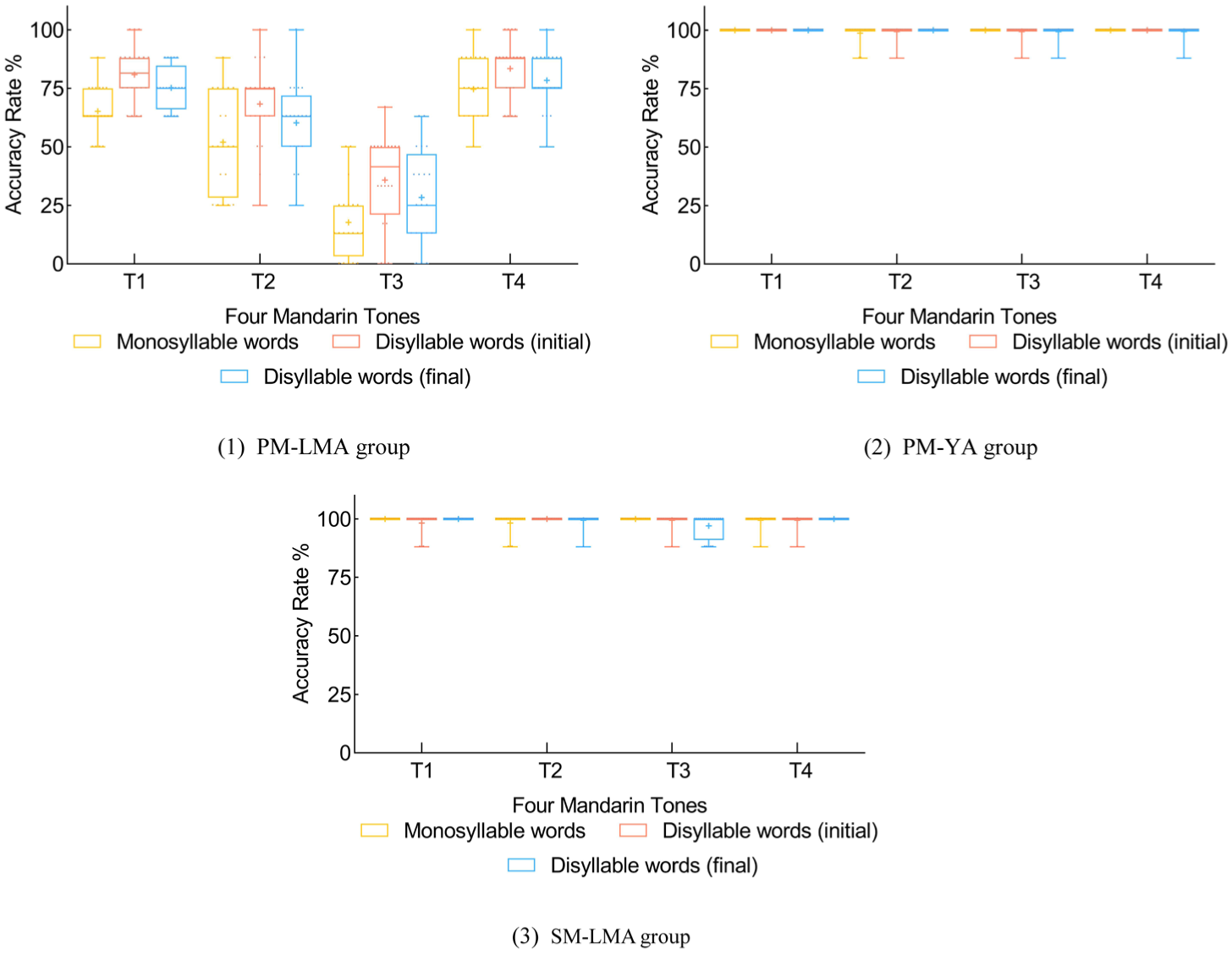
Mean accuracy rates for the four Mandarin tones in monosyllabic words, disyllabic words (initial), and disyllabic words (final) contexts for the PM-LMA, PM-YA, and SM-LMA groups during the reading task. (1) PM-LMA group. (2) PM-YA group. (3) SM-LMA group.
Before detailing the specific error patterns of the PM-LMA group, it is essential to clarify the nature of their observed deviations. In any reading task, tonal errors can theoretically arise from genuine production constraints or incorrect lexical representations. To strictly minimize lexical uncertainty, all stimuli in this study consisted of highly familiar, high-frequency characters, and pinyin was provided during the task to ensure that participants’ performance was not affected by unfamiliarity with the characters. More importantly, the highly directional nature of their production errors perfectly mirrors their deficits in the auditory discrimination task (as detailed in Section 3.3), which relies primarily on acoustic-phonetic processing rather than the lexical retrieval of tones from written characters. This cross-task consistency strongly indicates that their deviations represent systemic, L1-driven production constraints rather than random lexical uncertainty. Consequently, the observed errors in the PM-LMA group are fundamentally treated as genuine production errors reflecting their interlanguage phonology.
A two-way repeated-measures ANOVA was conducted to examine the effects of prosodic context and target tone on the PM-LMA group’s tonal production accuracy. The Shapiro-Wilk test confirmed that the data met the assumption of normality (p > .05 for all conditions). Prosodic context (monosyllabic, initial position in disyllabic words, final position in disyllabic words) and target tone (T1, T2, T3, T4) were treated as within-subject factors. The ANOVA revealed significant main effects of prosodic context, F(2, 38) = 17.178, p < .001, and target tone, F(3, 57) = 107.432, p < .001, indicating that both factors significantly influenced tonal production accuracy. However, the interaction between prosodic context and target tone was not significant, F(6, 114) = 0.374, p = .894. For prosodic context, post hoc comparisons with Bonferroni correction indicated that accuracy rates for monosyllabic words were significantly lower than those for syllables in both the initial (p < .001) and final positions of disyllabic words (p = .002), with no significant difference between the initial and final positions (p = .093). These findings suggest that for PM-LMA speakers, prosodic context plays a crucial role in tonal production accuracy, with isolated syllables being produced less accurately than those in connected speech. Regarding target tone, T3 exhibited significantly lower accuracy (27.5%) than all other tones, regardless of prosodic context (p < .001). Moreover, T1 and T4 were produced more accurately than T2 and T3 (p < .001), while no significant difference was found between T1 and T4 (p = .141). Importantly, as shown by the individual data points in Figure 3, the overall patterns for both prosodic contexts and tonal accuracy are not driven by a few outliers. While absolute accuracy differed across the PM-LMA cohort, the relative pattern of difficulty was consistent, with the majority of participants performing worse in monosyllabic contexts and struggling more with T3 and T2 than with T1 and T4. This systematic error pattern across individuals suggests that the observed tonal challenges represent a highly consistent trend across the cohort rather than random variation. All detailed post hoc comparison results are presented in Table D1 in Supplementary File 4.
3.1.2. Tonal Distance Analysis
A comprehensive acoustic analysis was conducted on participants’ tone productions to systematically quantify the tonal divergence of the PM-LMA group from the PM-YA and SM-LMA control groups, focusing on both F0 contours and temporal-spectral features. Figure 4 presents the mean F0 contours (normalized as T-values) for the four tones across different prosodic positions for the PM-LMA, PM-YA, and SM-LMA groups, highlighting the distinct characteristics of their F0 trajectory patterns. As shown in Figure 4, the tonal contours of the two control groups were virtually identical, aligning closely in both pitch height and contour shape. Broadly speaking, the pitch contours of the PM-LMA group also exhibited a general resemblance to those of the control groups in terms of overall trajectory. T1 exhibited a level contour, T2 showed a rising trajectory, and T3 presented a dipping contour. An exception was observed in the initial position of disyllabic words, where all groups displayed a falling contour for T3. This deviation was attributable to Mandarin’s tone sandhi rule, which modifies T3 into a falling tone when it precedes a non-T3 syllable. T4 was characterized by a falling pitch contour. Despite these general similarities, noticeable acoustic differences existed between the PM-LMA group and the control groups. For T1 and T2, the control groups exhibited consistently higher pitch contours than the PM-LMA group across all three prosodic positions. In terms of contour shape, the control groups’ T1 contour appeared nearly flat, whereas that of the PM-LMA group showed a slight downward declination. Regarding T2, the PM-LMA group’s contours were flatter compared to those of the controls, characterized by a less prominent rising pattern. Within the same prosodic position, the F0 difference between PM-LMA and the controls was smaller for T1 than for T2. The most pronounced differences occurred in T3. In monosyllabic words and the final position of disyllabic words, the inflection point in PM-LMA speakers’ T3 contour appeared earlier than that of the control groups, and the overall contour was noticeably flatter. In the initial position of disyllabic words, both PM-LMA and the control groups exhibited similar trends. However, across all three prosodic positions, the PM-LMA group’s T3 contours remained significantly higher than those of the controls. Among the four tones, T3 demonstrated the largest F0 difference between the PM-LMA group and the control groups within the same prosodic position. For T4, the tone contours across different prosodic positions were highly similar among all groups, with only minimal frequency differences.
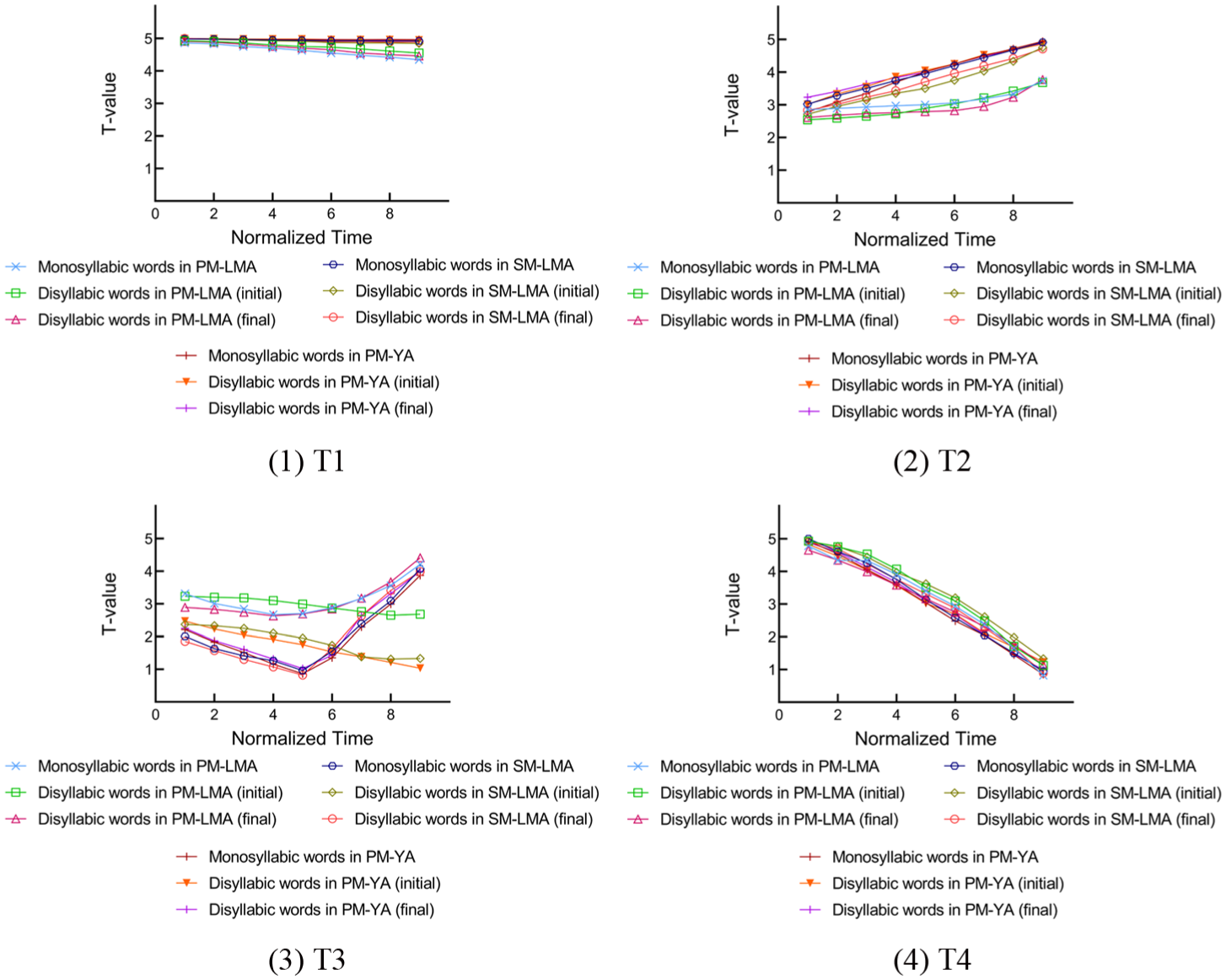
Mean F0 (T-value) contours of the four Mandarin tones, produced by the PM-LMA, PM-YA, and SM-LMA groups across three prosodic positions during the reading task. (1) T1, (2) T2, (3) T3, (4) T4.
Figure 5 displays the tonal distances of the PM-LMA group relative to the two control groups for the four tones across the three prosodic positions. The Shapiro–Wilk test confirmed that the distance data for both comparisons met the assumption of normality (p > .05 for all conditions). Similar to the production accuracy analysis, separate two-way repeated measures ANOVAs were performed for the distances to the PM-YA and SM-LMA groups, treating prosodic context and target tone as within-subject factors. For the distance to the PM-YA group, the results showed significant main effects of prosodic context, F(2, 38) = 41.516, p < .001, and target tone, F(3, 57) = 398.862, p < .001, on tonal distances, while the interaction between the two factors was not significant, F(6, 114) = 1.336, p = .247. A similar statistical pattern was observed for the distance to the SM-LMA group, yielding significant main effects for both prosodic context, F(2, 38) = 51.238, p < .001, and target tone, F(3, 57) = 759.809, p < .001, with no significant interaction, F(6, 114) = 1.235, p = .294.
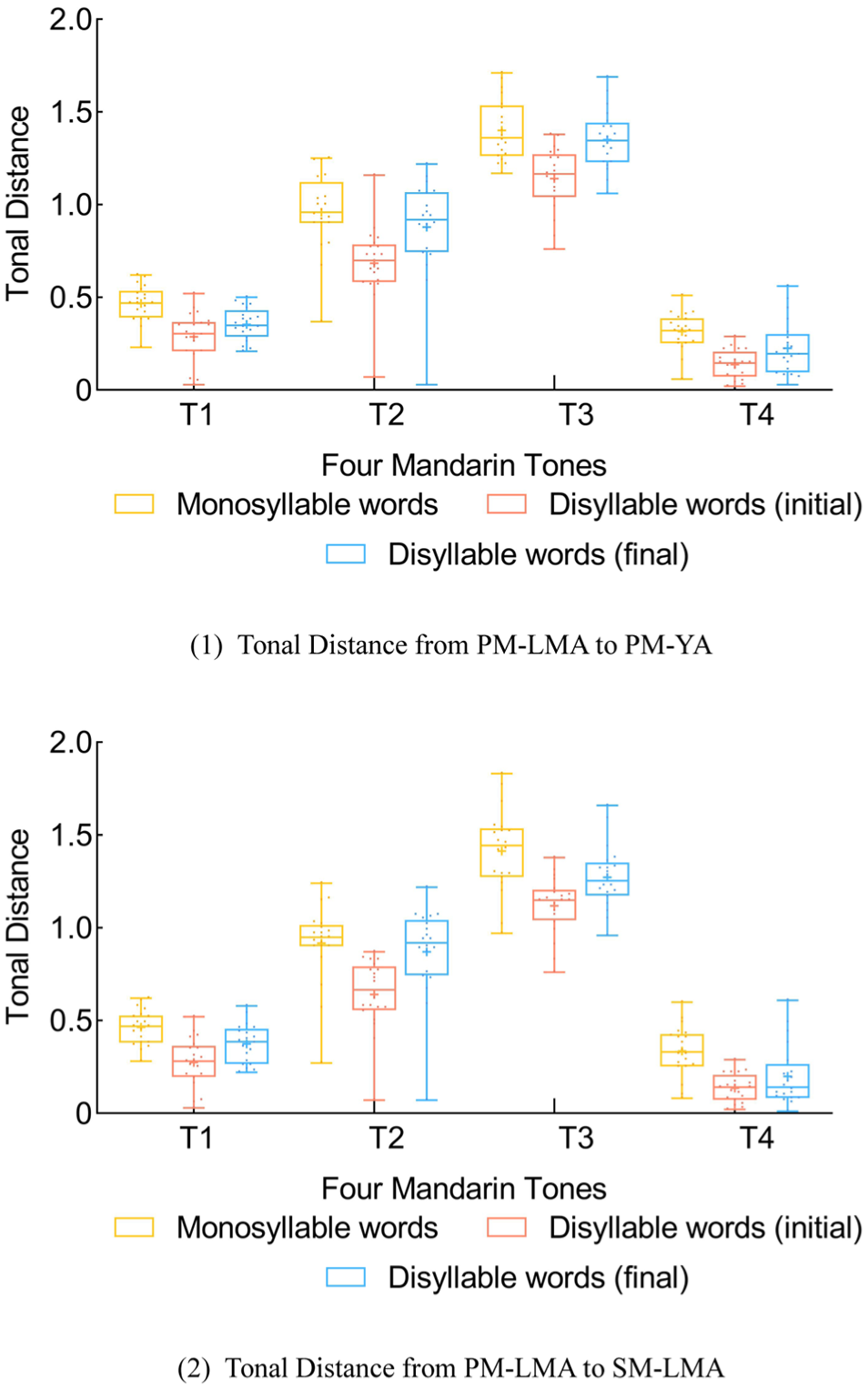
Tonal distances between the PM-LMA group and the two control groups (PM-YA and SM-LMA) for the four Mandarin tones across three prosodic positions. Each tone was produced using 8 base syllables, yielding 32 tokens per participant in monosyllabic and disyllabic-final contexts, and 24 tokens in the disyllabic-initial context. Whiskers represent the minimum and maximum values, with all individual data points shown. (1) Tonal Distance from PM-LMA to PM-YA. (2) Tonal Distance from PM-LMA to SM-LMA.
For both sets of distance metrics, post hoc comparisons with Bonferroni correction indicated that monosyllabic words had the largest tonal distances, followed by syllables in the final position of disyllabic words, and then syllables in the initial position. All pairwise differences emerged as highly significant, with the contrast between monosyllabic and disyllabic-final contexts against the PM-YA baseline yielding p = .003, and all other comparisons reaching p < .001. This pattern suggests that the tonal divergence of the PM-LMA group from both control groups is greatest in monosyllabic words, intermediate in the disyllabic-final position, and smallest in the disyllabic-initial position. With respect to target tone, tonal distances consistently followed the hierarchy of T3 > T2 > T1 > T4, irrespective of prosodic context or the specific control baseline (p < .001). This pattern aligns with the earlier accuracy findings, where T3 showed the lowest production accuracy, while T1 and T4 were produced more accurately than T2 and T3. In summary, the converging evidence from both accuracy and acoustic distance measures suggests that the dipping tone (T3) is particularly vulnerable to L1 interference, whereas the level (T1) and falling (T4) tones exhibit greater stability. Furthermore, the consistent effects of prosodic context across both analyses highlight the crucial role of the phonological environment in tonal acquisition, indicating that connected speech contexts facilitate more accurate and target-like tonal realization. All detailed post hoc comparison results are presented in Table D2 in Supplementary File 4.
3.1.3. Confused Tone Patterns Analysis
Similar to the overall production accuracy analysis, the specific confused tone patterns (tone pairs) across different prosodic contexts during the reading task were analyzed and compared among the PM-LMA, PM-YA, and SM-LMA groups. For each confused tone pattern, a confusion rate was calculated, representing the proportion of instances in which the evaluator misidentified the participant’s intended target tone as another specific tone. For example, if the target tone was T1, but the evaluator perceived the participant’s production as T2 in 10 out of 50 trials, the confusion rate for the T1T2 pattern would be exactly 20%. Consequently, a higher confusion rate indicates a greater likelihood that a tone is misidentified as another, reflecting stronger L1 influence or perceptual uncertainty. A total of six possible confused tone pairs were evaluated: T1–T2, T1–T3, T1–T4, T2–T3, T2–T4, and T3–T4. Figure 6 illustrates the mean confusion rates for each tone pattern in the reading task across the three participant groups. As anticipated, both control groups exhibited near-floor confusion rates, indicating almost no tonal substitution errors. Specifically, for the PM-YA group, the mean confusion rates across all tone patterns and prosodic positions ranged from 0% to 0.31%, with standard deviations ranging from 0% to 1.40%. Similarly, the SM-LMA group demonstrated confusion rates between 0% and 1.25%, with standard deviations ranging from 0% to 2.56%. Given this stable, near-zero error distribution, the data from the two control groups are reported here solely to establish a reference baseline. Because their performance lacked meaningful variance for comparative statistics, they were excluded from further inferential analysis. Consequently, subsequent statistical analyses focused exclusively on PM-LMA confusion patterns.
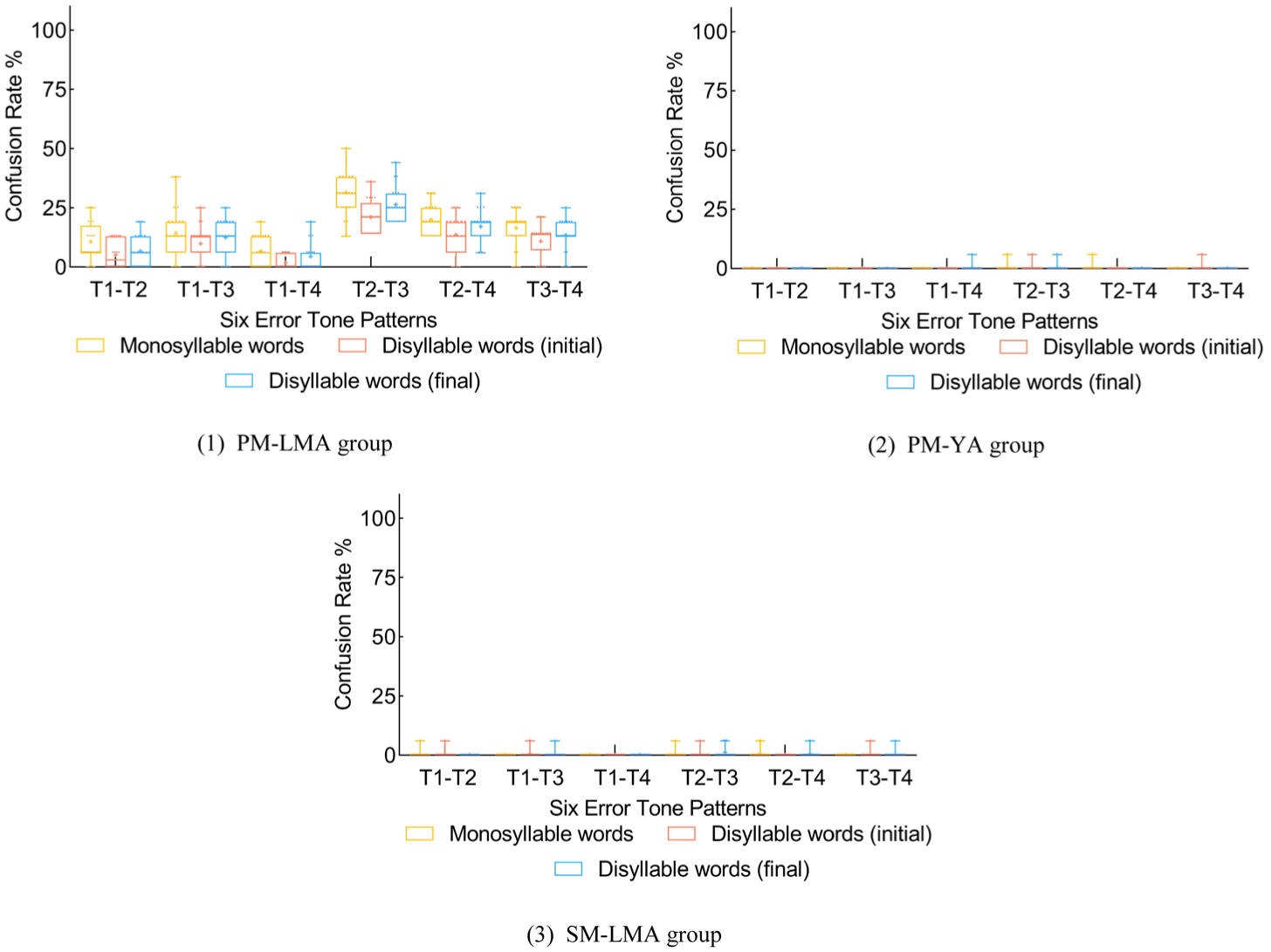
Mean confusion rates for each tone pattern during the reading task for the PM-LMA, PM-YA, and SM-LMA groups. Each tone was produced using 8 base syllables, yielding 32 tokens per participant in monosyllabic and disyllabic-final contexts, and 24 tokens in the disyllabic-initial context. Whiskers represent the minimum and maximum values, with all individual data points shown. (1) PM-LMA group. (2) PM-YA group. (3) SM-LMA group.
To systematically examine the distribution and frequency of these confusion patterns within the PM-LMA group, a two-way repeated measures ANOVA was conducted, treating prosodic context and confused tone pattern as within-subject factors. The results showed significant main effects of prosodic context, F(2, 38) = 27.214, p < .001, and of confused tone pattern, F(5, 95) = 79.625, p < .001, on confusion rates. Post hoc comparisons with Bonferroni correction revealed that syllables in the initial position of disyllabic words exhibited the lowest mean confusion rates, which were significantly lower than those in the final position and monosyllabic words (both p < .001). Syllables in the final position showed intermediate confusion rates, while monosyllabic words demonstrated the highest confusion (significantly higher than the final position, p < .001). This pattern suggests that tones produced in connected speech, particularly in the disyllabic-initial position, are less prone to perceptual confusion than those produced in isolation. Regarding specific tone pairs, the T2–T3 pair exhibited the highest confusion rate (26.2%), significantly higher than that of all other tone pairs (p < .001). This observation is highly consistent with earlier results showing that T3 has the lowest production accuracy and the greatest tonal divergence from the baseline. In contrast, the T1–T2 and T1–T4 pairs yielded the lowest confusion rates (4.3%–7.4%), significantly lower than those of all other confused tone patterns (p = .002 for T1–T2 vs. T1–T3; all other comparisons p < .001), indicating that these tones were rarely confused by the PM-LMA speakers. The confusion rates for T1–T3, T2–T4, and T3–T4 were intermediate, at 12.2%, 16.9%, and 13.6%, respectively. All detailed post hoc comparison results are shown in Table D3 in Supplementary File 4. Overall, these findings demonstrate a strong alignment among tonal confusion patterns, production accuracy, and tonal distance measures. The pronounced confusion between T2 and T3 further underscores T3’s susceptibility to L1 interference, while T1 and T4 remain relatively robust. In addition, the influence of prosodic context on tonal confusion highlights the role of connected speech in reinforcing tonal distinctions and reducing perceptual ambiguity.
3.2. Discrimination Task Analysis
3.2.1. Confused Tone Patterns Analysis
In the discrimination task, both accuracy and confusion rates were calculated for all participants. However, to maintain methodological consistency and facilitate direct comparison with the error patterns reported in the preceding reading task, only confusion rates are reported here. Figure 7 visualizes these data, illustrating the overall confusion rate trends for each tone pair across the prosodic contexts. Similar to the reading task, both the PM-YA and SM-LMA control groups exhibited consistently high perceptual performance, which translates to near-floor confusion rates across all conditions. Specifically, the PM-YA group exhibited minimal confusion rates (range: 0%–0.63%; SD: 0%–1.92%), and the SM-LMA group demonstrated similarly minimal confusion rates (range: 0%–0.31%; SD: 0%–1.40%). Given their stable, near-zero confusion with minimal variability, the data from both control groups are reported solely as a reference baseline and were excluded from further inferential statistics. Consequently, subsequent statistical analyses focused exclusively on the PM-LMA group.
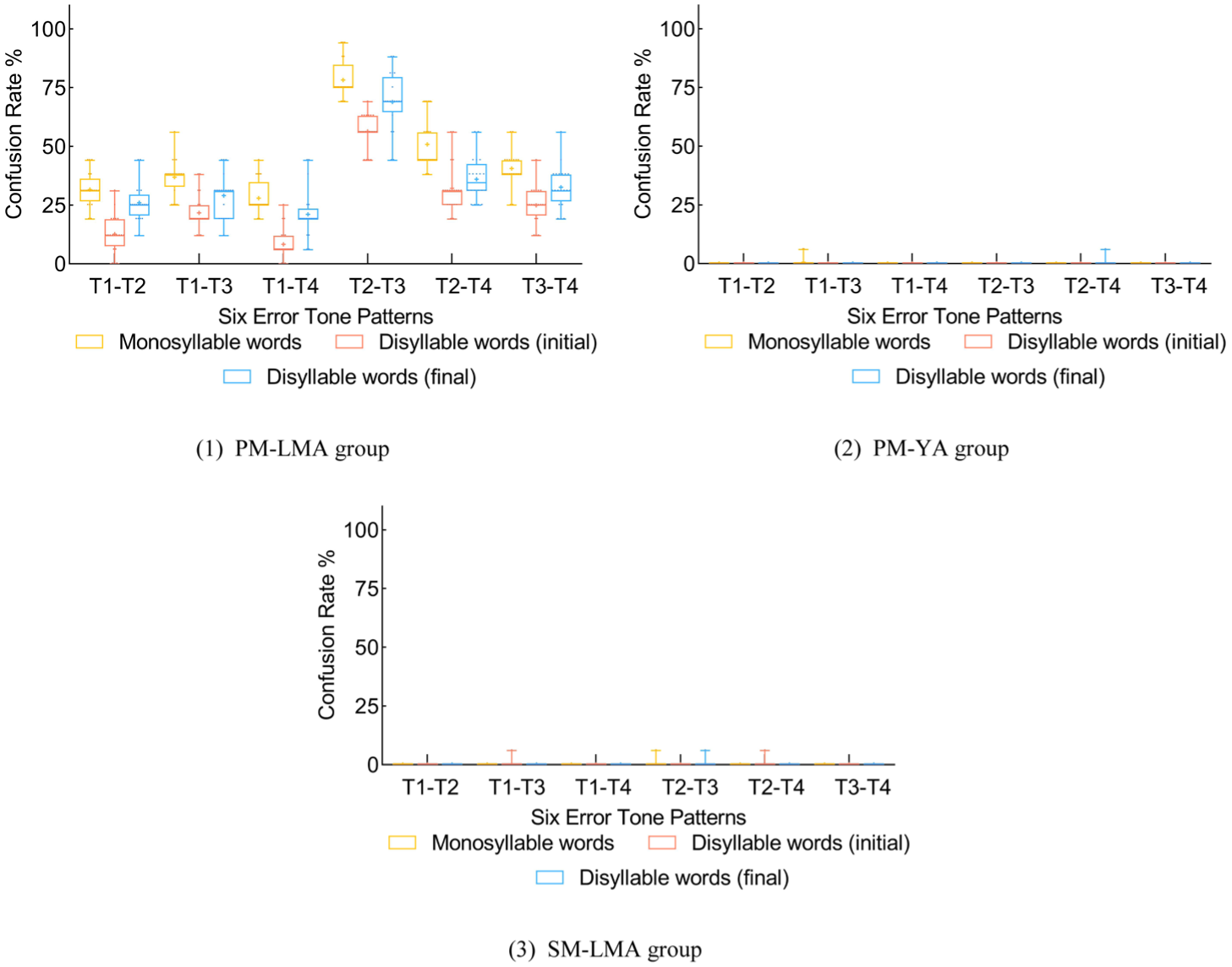
Mean confusion rates for each tone pattern in the discrimination task for the PM-LMA group. Whiskers represent the minimum and maximum values, with all individual data points shown. (1) PM-LMA group. (2) PM-YA group. (3) SM-LMA group.
A two-way repeated measures ANOVA was conducted for the PM-LMA group, treating prosodic context and tone pair as within-subject factors. Both within-subject factors yielded significant main effects. For prosodic context, F(2, 38) = 253.169, p < .001. Post hoc tests with Bonferroni correction indicated that confusion rates were lowest for word-initial syllables in disyllabic words, intermediate for word-final syllables in disyllabic words, and highest for monosyllables (initial < final < monosyllables, all p < .001). This trajectory perfectly mirrors the contextual effects observed in the reading task. For tone pair, F(5, 95) = 232.971, p < .001. Post hoc comparisons demonstrated that the T2–T3 pair exhibited the highest confusion rate (67.8%), which was significantly higher than all other tone pairs (p < .001), with large effect sizes (all pairwise mean differences > 20%). The T2–T4 pair showed a moderate confusion rate (39.6%), significantly lower than T2–T3 (p < .001) but higher than most other tone pairs (p = .030 for the contrast with T3–T4; p < .001 for all others). Following this, the T3–T4 (32.7%) and T1–T3 (29.2%) pairs demonstrated intermediate confusion rates, with no significant difference between them (p = .190). However, both pairs were confused significantly more often than the lowest-tier patterns (p = .012 for T1–T3 vs. T1–T2; all other relevant comparisons p < .001). Finally, the T1–T2 (23.4%) and T1–T4 (19.1%) pairs emerged as the least confused patterns overall, with no significant difference detected between them (p = .089). Furthermore, as indicated by the individual data points in Figure 7, these error patterns are not driven by a few outliers. Just as observed in the reading task, while absolute confusion rates varied, the relative difficulty across prosodic contexts and specific tone pairs was highly consistent across the PM-LMA cohort. This strong alignment between production and perception indicates that the observed tonal challenges represent a systematic and robust trend across the group rather than random individual variation. All detailed post hoc comparison results are provided in Table D4 in Supplementary File 4. Overall, the discrimination task findings indicate that the learners’ perceptual confusion was primarily concentrated in the T2–T3 pair, a pattern that robustly aligns with the results observed in the reading task. In addition, the T2–T4 pair emerged as the second most frequently confused tone pattern, with a confusion rate of 16.9% in the reading task and 39.6% in the discrimination task. In both tasks, the confusion rate for the T2–T4 pair was significantly lower than that of the T2–T3 pair but higher than all other tone pairs, with the sole exception of the T3–T4 pair in the reading task, where the difference did not reach significance (p = .235).
To further explore the underlying mechanisms of these errors, detailed directional data for the PM-LMA group are presented in Table 2, which provides a comprehensive confusion matrix of mean error rates across the three prosodic contexts. To systematically test for perceptual asymmetry across the tonal inventory, six targeted two-way repeated measures ANOVAs were conducted separately for each tone pair, with prosodic context and directional type as factors. These analyses revealed that significant directional asymmetries were highly localized rather than universal. As previously noted, the most striking asymmetry was observed in the T2–T3 contrast, F(1, 19) = 8.148, p = .01, where the misidentification of target T3 as T2 (70.6%) was significantly higher than the reverse error (65.1%). Directional main effects were also detected in the other two dynamic tone pairs. For the T2–T4 pair, F(1, 19) = 4.233, p = .054, target T2 was misperceived as T4 (40.9%) more frequently than the reverse direction (38.5%). Similarly, an asymmetric trend was observed in the T3–T4 pair, F(1, 19) = 3.693, p = .07, with target T4 being more frequently misidentified as T3 (34.0%) than in the reverse direction (31.2%). In contrast, all tone pairs involving the high level tone T1, including T1–T2, T1–T3, and T1–T4, exhibited relatively symmetrical confusion patterns without distinct directionality (all p > .1). These directional findings indicate that learners’ perceptual confusion is not a random bidirectional collapse of tonal boundaries. Rather, it is systematically driven by specific asymmetric mappings. The greatest perceptual difficulty was reflected in the asymmetric assimilation of the dipping tone T3 into the rising tone T2, as well as in the confusion between the falling tone T4 and other dynamic contours.
Mean Directional Confusion Matrix of Mandarin Tones for the PM-LMA Group Across Three Prosodic Contexts.
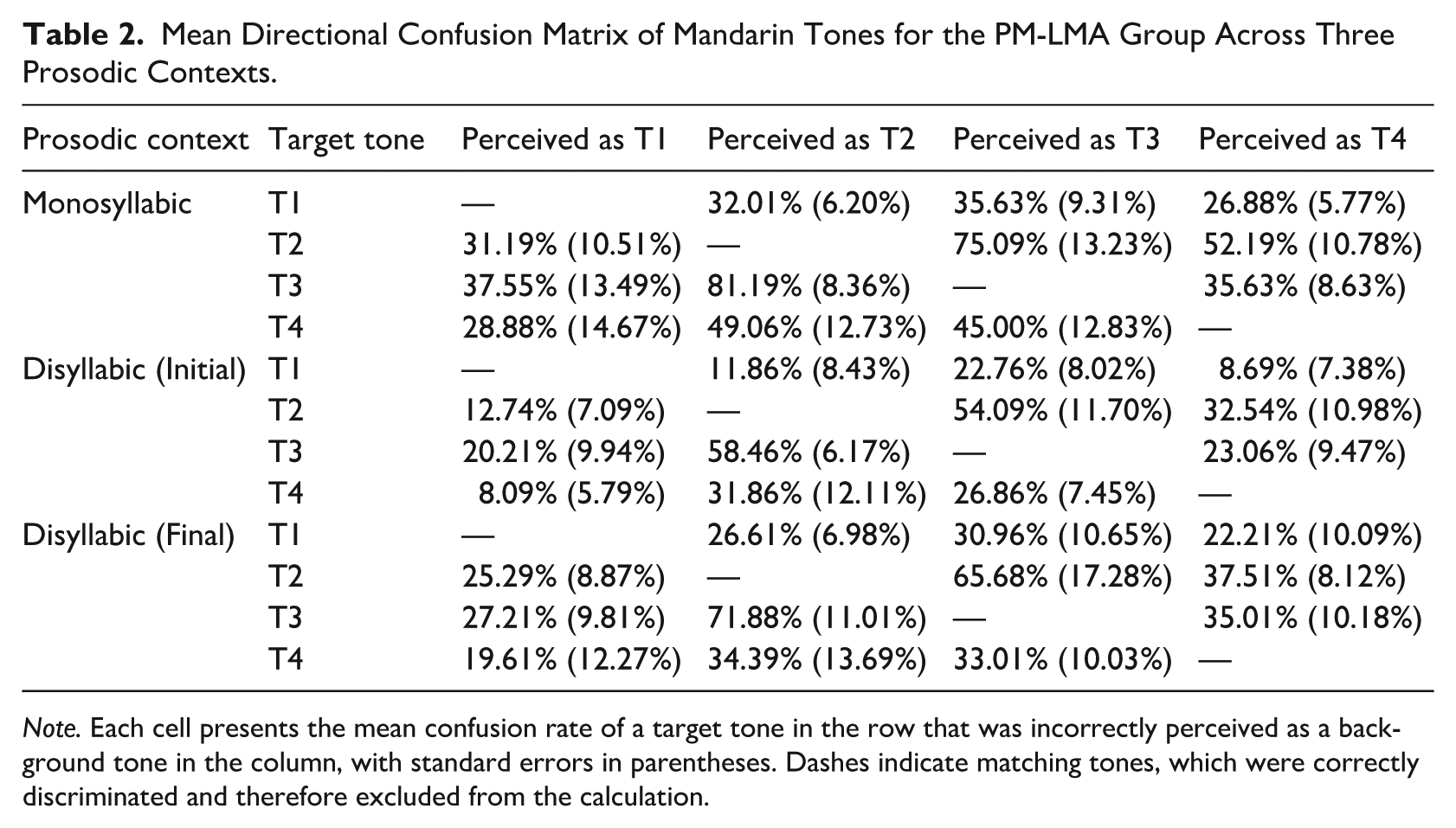
Note. Each cell presents the mean confusion rate of a target tone in the row that was incorrectly perceived as a background tone in the column, with standard errors in parentheses. Dashes indicate matching tones, which were correctly discriminated and therefore excluded from the calculation.
3.2.2. Correlations and Comparison Between Tasks
To investigate the relationship between production and perception, we analyzed the Pearson correlations between individual participants’ overall confusion rates across all six tone pairs in the reading and discrimination tasks. In addition, correlations were examined for each specific tone pair. Table 3 presents the correlation coefficients r and p-values between production and perception confusion rates across the six tone pairs and three prosodic contexts for the PM-LMA group. As shown in Table 3, the overall correlations were significant across all three prosodic contexts (monosyllabic words: p = .002; disyllabic-initial: p = .049; disyllabic-final: p = .019). Notably, monosyllabic words (r = .642) exhibited slightly stronger overall correlations and statistical significance compared to disyllabic words in both the initial (r = .446) and final (r = .520) positions. Moreover, all overall correlations were positive, indicating that higher confusion rates in production were consistently associated with higher confusion rates in perception. However, when the correlations were broken down by the six specific tone pairs, it became clear that the type of tone pair did not systematically dictate the strength of the correlation. In general, the PM-LMA speakers’ production and perception error patterns were correlated to a certain degree, although the correlations for some specific tone pairs did not reach statistical significance.
Correlations of Participants’ Confusion Rates for Specific Tone Pairs Between the Reading and Discrimination Tasks.
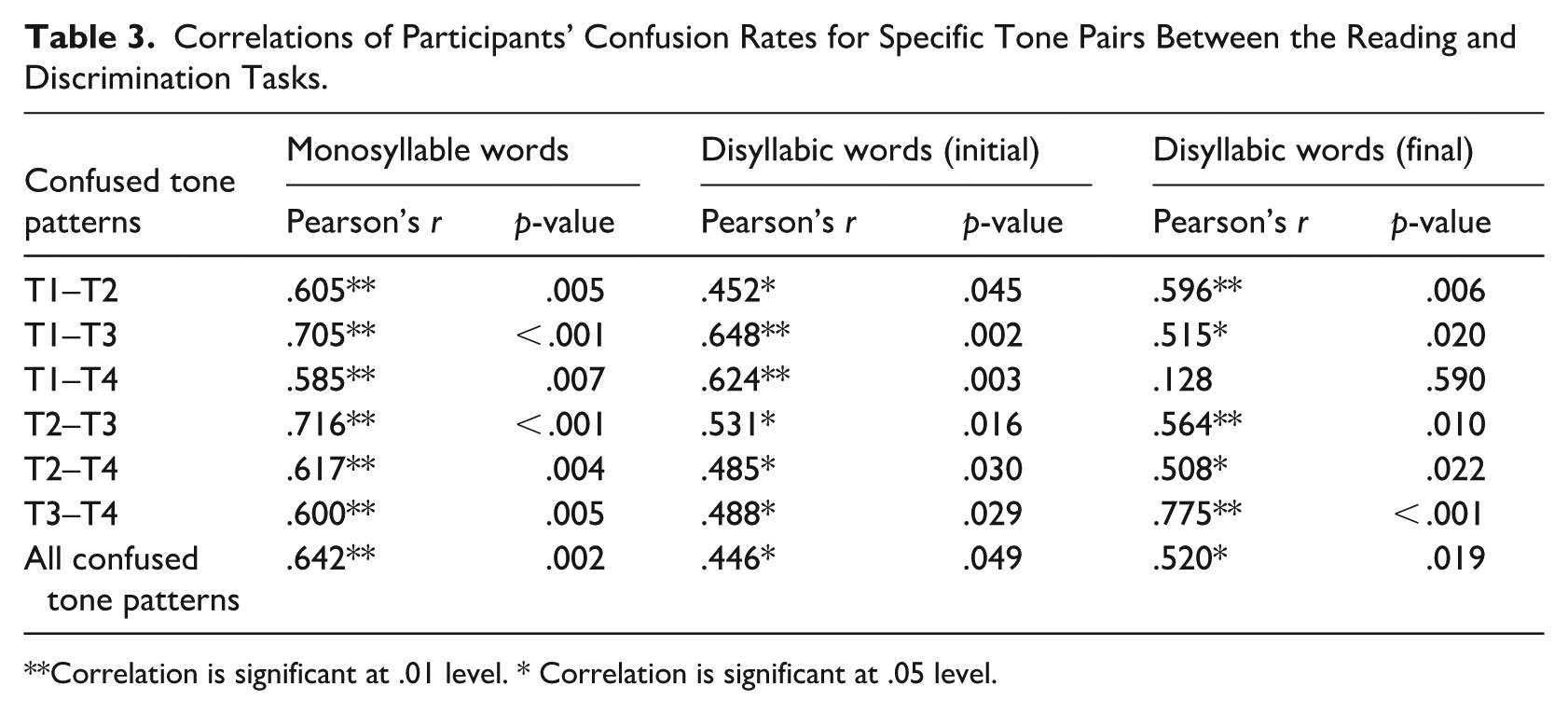
Correlation is significant at .01 level. * Correlation is significant at .05 level.
3.3. The Production–Perception Link
Beyond examining the correlation between reading and discrimination confusion rates, we aimed to further establish a production–perception link for the PM-LMA group across different prosodic contexts using key acoustic features. While the preceding analyses focused on confusion rates, the discrimination accuracy of the tone pairs was utilized for this acoustic modeling, as it serves as a direct index of perceptual distinctness. To align with the nature of the perceptual data, we calculated the acoustic distance between tones within each participant’s tonal space. Instead of using nominal tone category labels, such as the T2–T3 contrast, as categorical predictors, we employed this continuous acoustic distance. This methodological choice was made because traditional categorical labels inherently assume uniform phonetic differences across all speakers, failing to capture the highly gradient and individual-specific nature of interlanguage phonology. By quantifying the actual Euclidean distance between an individual’s own tone productions, we provide a much more precise, speaker-specific measure of the phonetic contrast that shapes their perceptual distinctness. To identify the factors influencing discrimination accuracy, a linear mixed-effects model was employed, with discrimination accuracy as the dependent variable and tonal distance and prosodic context as fixed effects (see Section 2.4 for details). A summary of the perception–production regression model is presented in Table 4, and Figure 8 illustrates how prosodic context modulates the relationship between perceptual distinctness and acoustic tonal distance. The analysis revealed two key predictors of tone discrimination accuracy. First, tonal distance exhibited a strong positive correlation with perceptual distinctness, indicating that greater acoustic differentiation between tone pairs in production led to higher discrimination accuracy (see Figure 8). Second, prosodic context played a significant role, with both initial and final syllables in disyllabic words improving accuracy compared to monosyllabic contexts (p < .001). This effect was particularly pronounced for initial syllables, likely due to their inherent prominence and clearer coarticulatory cues in Mandarin. Notably, significant negative interaction effects between tonal distance and prosodic context were observed at both the initial (p = .043) and final positions (p = .002) in disyllabic words, suggesting that although tonal distance remains a robust predictor across contexts, its influence on discrimination accuracy is somewhat reduced in disyllabic environments.
Summary of the Linear Regression Model for the Production–Perception Link.
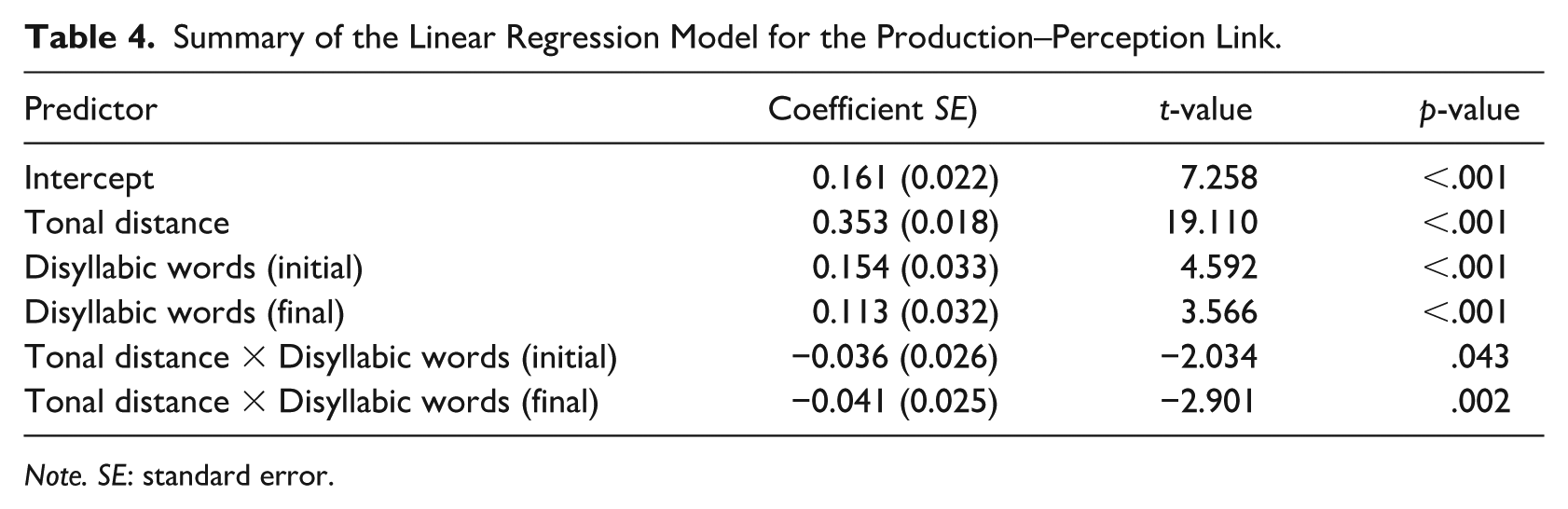
Note. SE: standard error.
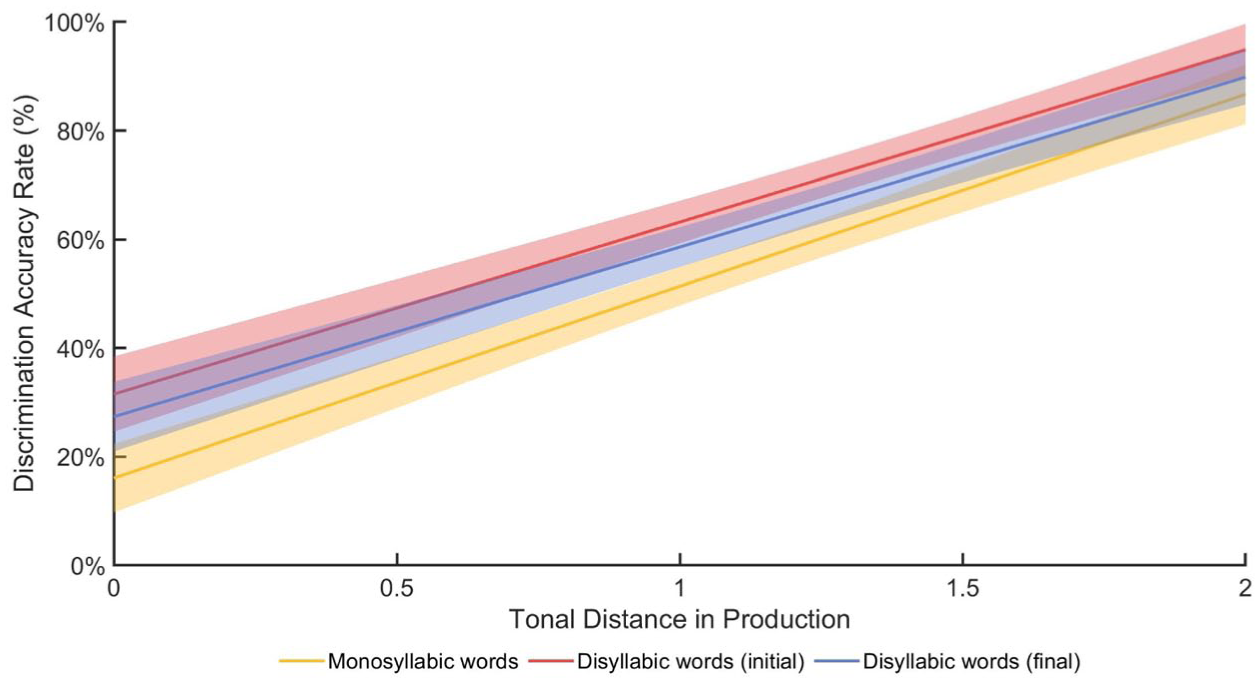
Model predictions of the relationship between perceptual distinctness, measured by discrimination accuracy scores for each tone pair, and acoustic tonal distance, quantified as the averaged Euclidean distance between tones in a tonal space defined by three DCT coefficients and normalized duration, across different prosodic contexts. Shaded ribbons represent 95% credible intervals.
4. Discussion
The present study examined the production and perception of Mandarin tones among late middle-aged native speakers of Puxian Min, focusing on their performance across different prosodic contexts (RQ1), the tone pairs susceptible to confusion and the factors underlying such confusion (RQ2), and the relationship between tone production and perception in this population (RQ3). The following sections discuss these findings in detail.
4.1. The Influence of Prosodic Contexts on L2 Tone Acquisition
To address RQ1, we examined how different prosodic contexts influenced PM-LMA speakers’ tone production and perception. Results from both the accuracy measures in the reading and discrimination tasks, as well as the tonal distance analyses in the reading task, revealed that PM-LMA speakers performed better on disyllabic words than on monosyllabic words, regardless of whether the task involved production or perception. This finding is consistent with the results reported by Pelzl et al. (2022), who found that Vietnamese learners of Mandarin were more accurate in disyllabic word contexts, and it confirms H1. The advantage of disyllabic words likely stems from their richer acoustic and prosodic environment, which facilitates pitch normalization and enables the integration of multiple phonetic cues. Specifically, in disyllabic structures, the first syllable provides predictive information for the second, while the pitch contour of the second syllable serves as a relative frame of reference for interpreting or verifying the tone of the first syllable (Huang & Holt, 2009; Moore & Jongman, 1997). This mutual support enhances tone production and perception accuracy. In other words, disyllabic stimuli more closely approximate natural speech by providing redundant prosodic cues such as continuous F0 movement, rhythmic patterns, and boundary information, all of which can effectively compensate for potential limitations in tone perception.
Importantly, this disyllabic advantage is not solely attributable to acoustic and prosodic factors. Because the study used real words rather than nonwords, lexical-semantic information is inherently present and constitutes a crucial concurrent facilitative factor. In real disyllabic words, the presence of the adjacent syllable significantly restricts the cohort of lexical candidates, providing strong semantic context that aids in tone identification and discrimination. This lexical-semantic facilitation is particularly critical for the PM-LMA group. Given that their phonetic processing of Standard Mandarin tones is inherently compromised by L1 transfer, these learners likely rely more heavily on the semantic context provided by real words to compensate for their perceptual uncertainty. Consequently, the enhanced accuracy observed in disyllabic environments is best understood as a synergistic interplay between enriched prosodic cues and robust lexical-semantic facilitation.
Within disyllabic words, PM-LMA speakers demonstrated better performance on initial syllables than on final syllables, both in production and perception. This finding fully supports H1, which predicted this initial-syllable advantage. Indeed, previous studies on tone production by native Mandarin speakers have shown that in continuous speech, the preceding syllable tends to exert a stronger influence on the following syllable than vice versa. The pitch contour of the initial syllable often affects the tonal shape of the subsequent syllable, causing deviations in its tonal realization. In contrast, the influence of the final syllable on the initial one is weaker (Xu, 1997). This phenomenon may reflect a fundamental primacy effect in lexical processing: both speakers and listeners allocate more attentional resources to initial syllables as perceptual “anchors,” while final syllables receive comparatively less focus. However, this pattern may depend on the learners’ L1. For instance, Hao (2024) found that native English speakers learning Mandarin showed higher accuracy on final syllables than on initial syllables in disyllabic words. This was attributed to the intonational structure of English, where phrase-final pitch cues convey more linguistic meanings than phrase-initial pitch. As a result, English speakers may naturally attend more to the pitch movements of final syllables (Ladd, 2008). A similar final-syllable bias has also been observed in Dutch speakers, who exhibit a similar tendency in Mandarin acquisition (Braun & Johnson, 2011). In contrast, both Puxian and Mandarin are tonal varieties within the Chinese language family, sharing similar lexical and grammatical structures. Like Mandarin, Puxian Min lacks inflectional morphology and instead employs tonal contrasts to distinguish lexical meaning. Consequently, PM-LMA speakers are likely to process disyllabic words in a manner similar to native Mandarin speakers, relying on a left-to-right, segmentally aligned linear processing model and exhibiting the characteristic initial-syllable advantage typical of Mandarin prosodic processing (Shi & Wang, 2021). Moreover, the tone sandhi system of Puxian Min underscores the functional prominence of the initial syllable. As Wu (2010) notes, when two monosyllabic words combine, the tone of the initial syllable changes according to that of the following syllable, while the final syllable generally remains unchanged. This systematic alternation, in which the first tone is conditioned by the second, may heighten PM-LMA speakers’ sensitivity to tonal dependencies initiated at word onset and thereby strengthen the productive and perceptual primacy of initial syllables in disyllabic structures.
It should be noted that in the disyllabic-initial context materials, the tones of the initial syllable were not fixed in either the reading task or the discrimination task. This design ensured ecological validity and lexical variety, but tonal coarticulation effects cannot be fully excluded. In Mandarin connected speech, tonal coarticulation primarily manifests as a carry-over effect, where the F0 offset of the first syllable influences the F0 onset and contour shape of the following syllable (Xu, 1994, 1997). When the first syllable’s tone is not fixed, the carry-over effect varies across trials, making the final syllable’s tone less consistent and less prototypical. This variability can reduce perceptual distinctiveness and partly explain the relatively lower accuracy observed for final syllables compared to initial syllables. Crucially, while tonal coarticulatory variability contributes to a general decline in accuracy at the final position, it does not affect the main conclusions of this study. To test the robustness of our findings, we analyzed subsets of data with identical preceding tonal contexts. The pattern of results remained consistent across these controlled contexts. For example, when examining target tones consistently preceded by T1, where carry-over effects are held constant, the fundamental error patterns were highly similar to the overall results in both the reading and discrimination tasks. The difficulty with the T2 and T3 contrast remained pronounced. In the reading task, the mutual confusion rate between T2 and T3 was approximately 27.5%, and in the discrimination task, the bidirectional confusion rate was approximately 63.6%. This consistent pattern within controlled tonal environments confirms that the severe categorical confusions observed in PM-LMA speakers reflect a stable underlying difficulty with these tonal contrasts, rather than being artifacts of varying phonetic contexts.
In addition, the asymmetry observed between participants’ acquisition of initial and final syllables may have been further exacerbated by evaluators’ perceptual biases during the reading task. Previous research has shown that native Mandarin speakers tend to maintain broader and more stable categorical boundaries for tones in initial syllables (Shi & Wang, 2021). As a result, even when PM-LMA speakers’ tone productions on initial syllables deviate from the target, evaluators in the reading task may still perceive and categorize them as correct. Such perceptual leniency may have obscured the underlying acoustic deviations during evaluation, leading to a discrepancy between the observed accuracy and the actual phonetic quality of the produced tones. This could explain the observed dissociation, where certain tones showed no significant differences in accuracy during the reading task, yet the tonal distances between the PM-LMA group and the control group for these same tones were substantial.
4.2. Potential Factors Contributing to L2 Tone Confusion
Regarding RQ2, the present study aimed to identify which Mandarin tone pairs are most frequently confused by PM-LMA speakers in production and perception, and to examine the factors contributing to this L2 tone confusion. As expected, both control groups demonstrated superior performance compared to the experimental group, maintaining accuracy levels exceeding 95% in both the reading and discrimination tasks. For the SM-LMA speakers, this result is consistent with previous findings where native Mandarin speakers of late middle age exhibited normal categorical perception of lexical tones (Feng et al., 2022). Crucially, the near-perfect performance of the PM-YA group highlights the profound impact of formal education and language exposure. Although they share the same Puxian Min dialect background as the experimental group, younger adults have benefited from structured formal education in Standard Mandarin provided by the modern schooling system. This extensive educational exposure enables them to establish robust phonological representations of Mandarin tones, effectively overcoming the cross-linguistic interference that heavily affects the older and less formally educated PM-LMA cohort. As for the PM-LMA speakers, the T2–T3 pair was the most frequently confused contrast in both production and perception. This finding aligns perfectly with H2, which predicted that this specific contrast would pose the greatest difficulty for them. Furthermore, contrary to H2, T2–T4 also emerged as another error-prone contrast for this group. In the following sections, we systematically discuss the mechanisms contributing to these specific confusion patterns, focusing on target-language phonetic and phonological constraints, L1-driven interference, as well as the roles of orthography and language exposure.
4.2.1. Target-Language Constraints
Previous studies have consistently shown that T2 and T3 are particularly challenging for non-native users of Mandarin, regardless of their primary language background (Hao, 2024; Li et al., 2017b; Yang, 2019; Zhang & Peng, 2017). A likely reason for this universal difficulty lies in the acoustic similarity between T2 and T3. Both tones share a rising F0 trajectory: T2 is characterized by a smooth rise, while T3 involves a falling–rising contour. When the initial fall of T3 is reduced or unclear, its rising portion can closely resemble the contour of T2. This overlap in pitch movement increases the potential for perceptual confusion (Tsukada & Idemaru, 2022). Even though participants were allowed to replay the stimuli during the discrimination task, this did not noticeably reduce the high rate of T2–T3 confusion, suggesting that the difficulty stems from intrinsic phonological similarity rather than insufficient auditory exposure. The hypothesis that T2–T3 confusion is driven by acoustic similarity has been consistently supported by evidence across various language backgrounds and proficiency levels. For example, So and Best (2010) found that Cantonese, Japanese, and English speakers, all unfamiliar with Mandarin, frequently confused T2 and T3. Further research has shown that this contrast remains challenging even after some Mandarin experience (Hao, 2012). Notably, T2–T3 confusion is not limited to L2 learners; it is also observed in native Mandarin-speaking children. Wong et al. (2005) reported that T2–T3 was the most difficult tonal contrast for young native speakers to distinguish. Similarly, Li and Thompson (1977) found that Mandarin-speaking children acquired T2 and T3 later than the other two tones.
Beyond acoustic similarity, the Mandarin tone sandhi rule may also contribute to the difficulty. This rule stipulates that when two T3 syllables occur in sequence, the first one is realized as T2. As a result, the contrast between T2 and T3 is neutralized in such contexts, which may obscure their distinction for PM-LMA speakers. Although our experiment did not include T3 + T3 combinations, a high rate of T2–T3 confusion was still observed. This suggests that the influence of tone sandhi may extend beyond surface-level phonological environments. Long-term exposure to this alternation pattern could shape tonal representations in a way that leads PM-LMA speakers to perceive T2 and T3 as more similar than they actually are, forming a kind of cognitive bias. Even in contexts without sandhi, this entrenched association may cause persistent confusion. Thus, tone sandhi appears to not only affect tonal realization in connected speech but also blur the perceptual boundary between T2 and T3 at a deeper cognitive level (Hao, 2024; Tsukada & Kondo, 2019). The Mandarin tone sandhi rule may also help explain why PM-LMA speakers performed better on the initial syllable than on the final syllable in T2–T3 disyllabic words, as well as in monosyllabic contexts. In this study, T3 in the initial position was typically realized as [21], a stable falling contour that was clearly distinct from T2’s rising contour [35], which likely made the distinction easier. In contrast, when T3 appeared in the final position or in monosyllabic words, its rising tail [214] was more prominent, and the increased acoustic similarity to T2’s rising contour [35] likely led to more confusion.
4.2.2. L1-Driven Interference
While target-language factors likely establish a general baseline of difficulty for contrasts such as T2–T3 and T2–T4, the extreme severity and distinct directional biases observed in the present study may not be fully explained by these universal constraints alone. Rather, these specific confusion patterns appear to also reflect interactions with the learners’ L1 phonological systems. For PM-LMA speakers, such L1 influence may operate primarily through acoustic-driven perceptual assimilation. To understand this mechanism, it is important to distinguish between historical tone correspondences and synchronic perceptual assimilation, as well as to consider how cognate tones were realized in the present stimulus materials. To ensure a robust test of L1 influence, the selected stimuli intentionally reflected the natural and asymmetrical diachronic mappings between the two varieties. For example, the Mandarin T2 and T3 target words used in the discrimination and reading tasks did not consistently correspond to single native tonal categories. Instead, they activated diverse L1 tonal mappings depending on the lexical item. As participants processed these materials, the automatically activated L1 tones often produced substantial category-matching inconsistencies. As a result, learners could not rely on a simple top-down historical transfer strategy that systematically converts a specific L1 category into an L2 target category.
Importantly, PM-LMA speakers consistently exhibited severe T2–T3 confusion across these varied lexical mapping backgrounds. If their perception had been primarily driven by top-down lexical transfer, the error patterns should have varied depending on the specific L1 origin of each lexical item. Instead, the persistent and uniform confusion across different lexical backgrounds demonstrates the dominance of bottom-up acoustic processing over top-down lexical retrieval. This interpretation is further supported by their performance on tones such as T1 and T4. Similar to T2 and T3, the Mandarin target words for T1 and T4 in the present stimuli also activated diverse and inconsistent L1 mappings. However, because the surface acoustic trajectories of T1 and T4, namely high-level versus falling contours, are clearly distinct, PM-LMA speakers were able to discriminate these tones without severe confusion. This contrast suggests that when reliable phonological anchors are unavailable, learners may rely primarily on the degree of surface acoustic similarity between tones during real-time L2 speech perception rather than on lexical transfer. This reliance on acoustic information, however, does not imply that L2 learners process these cues objectively. As Peng et al. (2010) demonstrated, they actively interpret incoming acoustic signals through the phonological framework of their L1. According to PAM, because Mandarin T2 and T3 share highly similar rising acoustic trajectories, listeners are likely to perceptually assimilate them into the same category (So & Best, 2010, 2014) Despite their diverse historical mappings, the extreme difficulty in distinguishing these two tones reflects a classic pattern of Single-Category Assimilation, in which distinct non-native sounds are funneled into the same perceptual category due to specific L1-induced perceptual biases.
The first of these biases involves reduced sensitivity to phonation cues such as creaky voice. In Standard Mandarin, T3 is characterized not only by its dipping pitch contour but also by the frequent occurrence of creaky voice at its lowest pitch target. For native listeners, creaky voice can function as an additional cue for identifying T3, particularly when pitch cues are weakened in continuous speech (Kuang, 2017; Yang, 2011). Among the various acoustic properties associated with creaky voice, the presence of an extra-low F0 appears to be especially important, as it significantly improves native listeners’ identification accuracy for T3 (Huang, 2020). In contrast, in Puxian Min, glottalized or creaky phonation is primarily associated with the short checked Ru tones T6 and T7 rather than with long contour tones (Cai, 2016). As a result, PM-LMA speakers may be less sensitive to this phonation cue in Mandarin and therefore less able to use it effectively during T3 perception. This interpretation is consistent with Cao et al. (2012), who found that non-native listeners often fail to utilize creaky voice efficiently in Mandarin T3 perception. They further argue that creaky phonation can psychoacoustically obscure the perception of the tone’s initial falling movement. Moreover, effectively utilizing the extra-low F0 cue associated with creaky voice requires native-like cue-weighting strategies (Huang, 2020). Lacking such strategies, PM-LMA speakers may therefore be more likely to overlook the low-falling portion of T3 and instead attend primarily to its later rising movement, increasing the likelihood of confusion with the rising T2.
The second of these L1-induced biases may involve cue-weighting strategies shaped by historically cognate tonal categories. Although the lexical mappings between Mandarin and Puxian Min are not strictly one-to-one, some of the Mandarin T3 lexical items used in the present study have historical correspondences with the Puxian Min T3 [453] (Cai, 2016). While the falling phase of this native [453] contour spans a relatively wide pitch range, its phonological identity as a peaking tone crucially depends on the initial rising movement toward the high target. Acoustic and perceptual models indicate that the underlying identity of a tonal contour is concentrated in the trajectory actively approaching its pitch target (Xu & Wang, 2001). Because the peak [5] is the primary target of the [453] contour, the initial rising movement constitutes the essential target-approaching trajectory, granting it greater perceptual salience than the subsequent falling offset. Related work on tonal cue weighting further suggests that listeners preferentially attend to structurally pivotal F0 turning points in contour tones (Jiang, 2023). Because accurate realization of the L1 T3 [453] requires precise tracking of this initial rise, PM-LMA speakers may develop a relatively stable bias toward prioritizing rising pitch movements in perceptual processing. This native cue-weighting strategy treats the rising component as the primary diagnostic anchor, a tendency that may subsequently transfer to L2 processing via perceptual assimilation (Schertz & Clare, 2020). This tendency is broadly consistent with the directional asymmetry observed in the present study’s discrimination task, in which target T3 was misidentified as T2 more frequently than the reverse. This strictly asymmetric pattern may be taken as suggestive behavioral evidence of a perceptual bias, whereby PM-LMA listeners preferentially attend to the later rising portion of Mandarin T3 [14], while downweighting the initial low-falling movement [21], which may be treated as less informative acoustic variation. Under this interpretation, the dipping contour of Mandarin T3 [214] may be partially recoded as a predominantly rising contour, thereby increasing its perceptual proximity to Mandarin T2 [35]. This account is further supported by the production data. Compared with the control groups, PM-LMA speakers produced relatively flattened T3 contours in monosyllables and word-final positions, with reduced dipping movement and a more generalized rising trajectory resembling Mandarin T2 (Huang, 2016), as shown in Figure 4(C). Taken together, these findings are consistent with the possibility that learners may partially converge on a shared or overlapping representational space for Mandarin T2 and T3, which may contribute to the persistent confusion observed between the two tones (Liu et al., 2020).
In addition to these acoustic biases, this categorical merging in both production and perception appears to be further compounded by the tone sandhi system of Puxian Min. As described by Cai (2016), when Puxian Min T3 occurs before T2, T5, or T6, it regularly alternates to a rising contour. This frequent phonological alternation reinforces PM-LMA speakers’ sensitivity to rising pitch patterns and familiarizes them with the categorical linking of dipping and rising contours. As a supplementary top-down mechanism, this native sandhi habit encourages a strategy where Mandarin T2 and T3 are naturally grouped into a shared “rising” tonal schema, neutralizing their contrast in both listening and speaking. This L1-driven phenomenon resonates with broader mechanisms reported in previous studies, which emphasize that L2 speech processing is actively filtered by native phonological knowledge, particularly tone sandhi rules (Hao, 2012; Li et al., 2017b). Specifically, recent studies provide a deeper mechanistic explanation, highlighting that L1 sandhi rules operate as entrenched cognitive mechanisms, which may lead learners to treat acoustically distinct target tones as equivalent (Zhao et al., 2025). Huang (2016) explicitly demonstrated this in tone production, finding that native Southern Min sandhi rules impose strict phonological constraints on L2 Mandarin. These L1 constraints dictate context-specific tone modifications, directly preventing speakers from accurately realizing target L2 contours. For PM-LMA speakers, the persistent T2–T3 confusion appears to be influenced by their native Puxian Min sandhi rules, suggesting that the combined influence of L1 pitch patterns and native dialect rules alters how they produce and perceive L2 tones.
Contrary to H2, for PM-LMA speakers, another tone pair prone to confusion was T2–T4, with a confusion rate of 16.9% in the reading task and 39.6% in the discrimination task. Despite the clear phonetic distinction between T2 (rising tone) and T4 (falling tone), previous research has consistently reported that T2–T4 confusion ranks as the second most frequent error, surpassed only by T2–T3 confusion (Tsukada & Idemaru, 2022; Wang et al., 1999). Some studies with English-speaking participants have suggested that this confusion may be influenced by L1-specific prosodic patterns. In particular, certain varieties of English use a high rising terminal tune to mark declarative statements, which might cause English listeners to perceptually group T2 and T4 together (Fletcher & Harrington, 2001; Fletcher et al., 2002). A similar L1-based explanation may apply to PM-LMA speakers. According to the tone sandhi rules of Puxian Min, rising tones are frequently realized as falling tones in specific phonetic contexts (Cai, 2016). This specific native alternation directly mirrors the asymmetric trend observed in our data, where the rising target T2 was more prone to being misperceived as the falling T4 than the other way around. This type of native alternation likely weakens the functional distinction between rising and falling contours in the mental representation of tones for PM-LMA speakers, thereby reducing sensitivity to their phonetic contrast. This influence is also evident in their Mandarin tone production patterns: across different prosodic positions, PM-LMA speakers’ T2 contours tend to be noticeably flatter, with a less distinct rising slope compared to control groups, as shown in Figure 4(B). This observation indicates that the production of Mandarin T2 by PM-LMA speakers is often characterized by a flattened or incompletely realized rising contour, which is plausibly attributable to the influence of the attenuated and variable rising patterns present in their native tone system.
4.2.3. Orthography and Language Exposure
Beyond auditory processing and acoustic-driven assimilation, the influence of the participants’ L1 also operates on a distinct level: orthography-driven lexical interference. To fully understand the effects of orthographic interference, it is important to highlight the fundamentally different nature of Mandarin acquisition by PM-LMA speakers compared to that of typical foreign language learners. A defining characteristic of this Chinese language context is the shared logographic writing system. Unlike foreign learners who acquire a Mandarin word and its tone simultaneously as a completely novel item, PM-LMA speakers already possess deeply entrenched, character-specific L1 tonal representations. When visually processing these shared Chinese characters, their L1 phonological representations are obligatorily and non-selectively activated (Chu, 2011; Li et al., 2014; Xu et al., 2014). They may unconsciously apply L1 homophones to L2 targets, creating a potent source of negative transfer. Therefore, learners must constantly suppress the automatic retrieval of their native tones in order to accurately process L2 Mandarin targets (Mok et al., 2018).
Finally, this study suggests that long-term exposure to a Chinese dialect-speaking environment may impede the processing of Mandarin tones. Hao (2024) found that while Mandarin learning experience can enhance English speakers’ sensitivity to segmental cues, its effect on tonal cue processing is relatively limited. The improvement of tone perception appears to require more prolonged and immersive exposure, particularly when listeners are faced with tone pairs that pose greater perceptual challenges. In the present study, the participants had no formal Mandarin education and used Mandarin only occasionally in daily life. Their exposure to Mandarin was predominantly passive, with most input consisting of regionally accented Mandarin rather than the standard variety. These input conditions may have limited the development of stable tone representations.
4.3. The Relationship Between L2 Tone Production and Perception
Regarding RQ3, the findings of the present study, based on both correlation analyses of accuracy rates and tonal distance modeling, consistently demonstrate a meaningful connection between production and perception in PM-LMA speakers’ acquisition of Mandarin tones, in line with H3. However, this relationship is not a simple one-to-one correspondence and appears to be strongly modulated by prosodic context. First, the correlation analysis revealed that PM-LMA speakers’ tone production and perception accuracy were moderately correlated overall, suggesting that learners who were able to produce more distinct tonal contrasts were also more accurate in discriminating them. This result is consistent with previous findings in speech acquisition research (Yang, 2015; Yu et al., 2021; Zhang & Peng, 2017). At the early stages of L2 learning, the correlation between tone production and perception may be weak or absent, but it tends to strengthen as learners gain more experience with tone processing (Bent, 2005). In this regard, the PM-LMA speakers, despite some production and perception deviations due to L1 influence, can be considered relatively experienced Mandarin users. Their performance likely reflects a stage where L2 tone categories have partially stabilized, leading to a moderate but reliable production–perception correlation. However, at the level of individual tone pairs, the strength of the correlation was inconsistent and showed no systematic pattern. This may suggest that although production and perception are linked, the degree of their coupling is influenced by the intrinsic confusability and learning difficulty of specific tone categories.
The strength of the relationship between tone production and perception varied significantly across different prosodic contexts. The correlation was found to be strongest in the monosyllabic condition. In contrast, for disyllabic words, especially in the word-initial position, the correlation was weaker. This pattern may be explained by the availability of contextual and coarticulatory cues. In monosyllabic words, the absence of such cues likely forces learners to rely more directly on their internal phonological representations, which strengthens the link between production and perception. In disyllabic contexts, however, both production and perception are possibly shaped by prosodic structure, coarticulation, and contextual predictions. These factors may ease the perceptual demands and, at the same time, reduce the direct reliance on phonological representations, thereby weakening the association between production and perception (Huang & Holt, 2009).
The mixed-effects model based on acoustic features further confirmed that learners’ tone production can reliably predict their perception accuracy, with a significant positive correlation between the two. In other words, when learners can clearly distinguish the acoustic features of different tones, such as a larger physical distance between tones, their perception accuracy improves as well. This finding supports the idea that progress in one mode, such as production, can transfer to another mode, such as perception (Wang et al., 2003). However, the model also showed a significant interaction between tone distance and prosodic position, suggesting that prosodic position modulates the relationship between production and perception. Specifically, although the physical distance between tones generally helps improve perception accuracy, this positive effect weakens in disyllabic contexts, particularly in the word-final position. This phenomenon likely reflects a strong contextual dependency effect in disyllabic environments. Because the preceding initial syllable provides both a relative pitch reference and strong semantic constraints, learners do not rely solely on the acoustic features of the incoming final tones. Instead, they integrate these cumulative contextual and rhythmic cues, which naturally reduce the weight of bottom-up acoustic features in perception. This observation is consistent with the conclusions drawn from the task correlation analysis. It further highlights that tone perception is influenced not only by acoustic differences but also by prosodic structure and contextual information (Hao, 2012).
4.4. Pedagogical Implications and Dialect Maintenance
The findings of this study show that entrenched tonal patterns of Puxian Min persist in late middle-aged speakers. While the near-native proficiency of the younger PM-YA generation highlights the importance of formal education, the specific error patterns observed in our PM-LMA cohort indicate that broad, exposure-based promotion of Mandarin is insufficient. Because learners’ main difficulties are concentrated in a small number of dynamic tone pairs, instructional approaches should move beyond a general model and adopt highly focused teaching strategies. Given the close link between speech perception and production, these targeted strategies can reinforce both processes simultaneously. Training should focus specifically on resolving high-confusion contrasts, especially the T2–T3 pair. To help learners distinguish these overlapping tones, instruction can incorporate secondary acoustic cues. For example, learners can be guided to attend to phonation differences, such as the creaky voice often associated with Mandarin T3, and use it as a reliable cue when pitch cues are ambiguous or unclear. The strong contextual effects observed in our data also suggest a practical teaching approach. Perceptual confusion was highest in isolated monosyllables and significantly reduced in disyllabic words. Therefore, pedagogical materials should prioritize disyllabic contexts at the initial stages of training. Using the phonetic and lexical information present in continuous speech provides learners with support to establish new tonal categories before moving on to the more challenging isolated syllables.
Furthermore, the near-ceiling performance of the age-matched Standard Mandarin control group confirms that these challenges stem from cross-linguistic interference rather than age-related cognitive decline. Targeted phonetic training may effectively bridge the perception–production gap for older learners. At the same time, the findings emphasize the cultural value of local varieties. The persistence of Puxian Min tonal patterns is not merely a sign of learning difficulty but evidence of dialect vitality. Future language initiatives should balance focused pedagogical support to improve Mandarin proficiency with recognition of dialect identity, ensuring that efforts to enhance Mandarin do not inadvertently diminish regional linguistic diversity.
5. Conclusion
The results indicate that for speakers whose L1 is Puxian Min, prosodic context strongly influences both the production and perception of Mandarin tones. Tones in disyllabic contexts, particularly in initial syllables, were produced and perceived more accurately than those in monosyllabic words. Among the four tones, T3 was the most frequently confused, especially with T2, while T1 and T4 remained relatively stable. A moderate correlation was observed between tone production and perception, indicating a developmental link between the two modalities. These findings highlight the interplay between tone production and perceptual processing in L2 learners and underscore the role of native dialect in shaping tone acquisition. Future research could investigate how this relationship evolves over time and explore neural correlates of tone processing in L2 learners to gain insight into changes in their phonological system. In addition, extending this research to speakers of other Chinese dialects would help determine whether these patterns are universal or influenced by specific language experiences.
Supplemental Material
sj-docx-1-las-10.1177_00238309261462539 – Supplemental material for The Impact of Long-Term Chinese Dialect Use on Mandarin Tone Production and Perception: Evidence from Late Middle-Aged Puxian Min Speakers
Supplemental material, sj-docx-1-las-10.1177_00238309261462539 for The Impact of Long-Term Chinese Dialect Use on Mandarin Tone Production and Perception: Evidence from Late Middle-Aged Puxian Min Speakers by Mingjun Ji, Jinwei Lan, Jianhan Lei, Can Zhang, Jin Fang and Boquan Liu in Language and Speech
Supplemental Material
sj-docx-2-las-10.1177_00238309261462539 – Supplemental material for The Impact of Long-Term Chinese Dialect Use on Mandarin Tone Production and Perception: Evidence from Late Middle-Aged Puxian Min Speakers
Supplemental material, sj-docx-2-las-10.1177_00238309261462539 for The Impact of Long-Term Chinese Dialect Use on Mandarin Tone Production and Perception: Evidence from Late Middle-Aged Puxian Min Speakers by Mingjun Ji, Jinwei Lan, Jianhan Lei, Can Zhang, Jin Fang and Boquan Liu in Language and Speech
Supplemental Material
sj-docx-3-las-10.1177_00238309261462539 – Supplemental material for The Impact of Long-Term Chinese Dialect Use on Mandarin Tone Production and Perception: Evidence from Late Middle-Aged Puxian Min Speakers
Supplemental material, sj-docx-3-las-10.1177_00238309261462539 for The Impact of Long-Term Chinese Dialect Use on Mandarin Tone Production and Perception: Evidence from Late Middle-Aged Puxian Min Speakers by Mingjun Ji, Jinwei Lan, Jianhan Lei, Can Zhang, Jin Fang and Boquan Liu in Language and Speech
Supplemental Material
sj-docx-4-las-10.1177_00238309261462539 – Supplemental material for The Impact of Long-Term Chinese Dialect Use on Mandarin Tone Production and Perception: Evidence from Late Middle-Aged Puxian Min Speakers
Supplemental material, sj-docx-4-las-10.1177_00238309261462539 for The Impact of Long-Term Chinese Dialect Use on Mandarin Tone Production and Perception: Evidence from Late Middle-Aged Puxian Min Speakers by Mingjun Ji, Jinwei Lan, Jianhan Lei, Can Zhang, Jin Fang and Boquan Liu in Language and Speech
Footnotes
Acknowledgements
We would like to thank Yanyan Lin for her contribution during the data collection and analysis.

Funding
The authors disclosed receipt of the following financial support for the research, authorship, and/or publication of this article: This research was supported by the Shanghai Education and Scientific Research Project (No. C2021016).
Declaration of Conflicting Interests
The authors declared no potential conflicts of interest with respect to the research, authorship, and/or publication of this article.
Supplemental Material
Supplemental material for this article is available online.
References
Supplementary Material
Please find the following supplemental material available below.
For Open Access articles published under a Creative Commons License, all supplemental material carries the same license as the article it is associated with.
For non-Open Access articles published, all supplemental material carries a non-exclusive license, and permission requests for re-use of supplemental material or any part of supplemental material shall be sent directly to the copyright owner as specified in the copyright notice associated with the article.
