







Abstract
A special course on Marriage, the Family and Human Sexuality was established at Kenrick-Glennon Seminary in St. Louis so as to assist the seminarians in their better understanding of the Church’s teaching relative to natural methods of family planning and women’s health care. This article compares the response at the beginning of this three-credit semester course to the same seven-item questionnaire given at the conclusion of the course. The pre- and postcourse scores were calculated for each of the questions. The scores obtained after the course were all significantly higher than they were before the course with p values ranging from 0.01 to
Nontechnical Summary:
This is an evaluation of a ten-point, seven-question questionnaire that was utilized at the beginning of a course at Kenrick Seminary in Marriage, Sexuality, Creighton Model and NaProTECHNOLOGY. The same questionnaire was given to the students at the beginning of the course and then two to three months later at the conclusion of the three-credit course. The results show that there is a significant improvement in the seminarians’ knowledge and general attitude about natural methods of family planning and suggests that such courses would be beneficial to establish in seminaries throughout the country.
Much has been accomplished in the over forty years of providing Creighton Model FertilityCare System services (which assist couples in the natural regulation of fertility—both to avoid and to achieve pregnancy) and the new women’s health science of NaProTECHNOLOGY (which is a new healthcare approach for women in keeping with God’s plan for the dignity of women, the couple, the unborn child, and the integrity of marriage). One of the crucial needs being met in the past fifteen or twenty years is a more thorough preparation for clergy to provide spiritual support for clients and providers. Through education in Pope John Paul II’s Theology of the Body (John Paul II 1997), we have moved from a time when couples struggle to understand the church’s teaching, to a time when specialized help is available in the spiritual areas of their sexuality.
A new level of confidence in referring clients for guidance in the spiritual aspects of sexuality through the education of priests, seminarians, and Catholic leaders in the Love & Life Unlimited program has been offered through the Pope Paul VI Institute for the study of human reproduction over the last twenty years. 1 At the twenty-fifth anniversary celebration of Pope Paul VI’s encyclical Humanae Vitae sponsored by the Pope Paul VI Institute in Omaha, Nebraska, in 1993, Fr. Lawrence Brennan, at the time the academic dean of Kenrick–Glennon Seminary in St. Louis, suggested that the practical application of the church’s teaching about the natural regulation of fertility and the Theology of the Body needed to be more fully integrated within the seminary curriculum. He wanted a more comprehensive and systematic approach.
In 1997, Fr. Edward Richárd accepted an invitation to attend the Love & Life Unlimited program in Omaha, Nebraska, and, with Fr. Brennan, implemented this course in the Kenrick–Glennon Seminary in St. Louis. The program was developed with the cooperation of the Pope Paul VI Institute and was coordinated with the help of Dr. Thomas Hilgers by blending the curriculum of the Love & Life Unlimited course from the Pope Paul VI Institute with a moral theology course at Kenrick–Glennon Seminary. Diane Daly, RN, CFCE, served as the Creighton Model System faculty and coordinator for the course. Kenrick–Glennon Seminary, in cooperation with the Pope Paul VI Institute, responded to this urgent need of the church by offering a full semester program. It was anticipated that literally thousands of people including women and married couples would be touched as a result of the education that the seminarians received. It has been a privilege to be involved in their formation as priests.
Within the course, Marriage, the Family and Human Sexuality, the theology of Christ’s teaching through the church (provided by moral theologians)—beginning with Genesis, Scripture and Church documents—is followed by information directly related to FertilityCare provided by certified FertilityCare educators, practitioners, and medical consultants. The current schedule includes topics such as an introduction to the Creighton Model FertilityCare System, male and female anatomy and physiology, artificial methods of contraception, social aspects of abortion, the effects of contraception and sexually transmitted diseases, chastity education, the new science of NaProTECHNOLOGY, spiritual, physical, intellectual, communicative/creative, emotional aspects of sexuality, panel discussions with FertilityCare practitioners and couples who provide their testimonies, overviews of other methods of natural family planning (NFP), and establishing the Creighton Model FertilityCare Program in a diocese. A seven-minute homily was prepared and presented by each seminarian at the end of the course.
Over the past ten years, over one hundred seminarians have participated in this course, and it is the purpose of this article to evaluate, quantitatively, the growth in the seminarians’ exposure and knowledge of these programs.
Materials and Methods
First of all, a syllabus for this course had to be developed and is available through Dr. Hilgers. Secondly, we set out to assess in an objective fashion the seminarians’ response to seven questions:
The topic of NFP (Creighton Model System) is relevant to my vocation.
I think I have an understanding of the church’s teaching related to NFP (Creighton Model System) with confidence.
I know the current methods of NFP.
I believe NFP methods are effective to avoid or achieve pregnancy.
I know the impact of NFP on a couple’s marriage.
I know the impact of NFP on family life.
I know how contraception and abortion are linked.
These seven questions were provided to the seminarians as they entered the course and were answered according to a scale of 1–10. These responses were then turned in and scored. At the conclusion of the three-credit course, the same questions were asked a second time as part of their exit from the course. In this fashion, with the design of these questions and the seminarians’ replies, the score was a reflection of the individual’s knowledge which one would anticipate to increase as these topics were addressed during the course. To assess that, the same questions with the same answer profiles were provided to the seminarians as they completed the course. The null hypothesis for this study was that the answers to these questions would reflect a higher level of knowledge and confidence at the conclusion of the course than was there at the beginning of it.
When these questionnaires were completed, they were then entered into a statistical evaluation program using the NCSS Statistical Package (Hintze 2004). The data from the answers at the beginning of the course could then be compared to the answers at the conclusion of the course in an objective fashion, and statistical significance could be calculated.
Results
The comparison of combined scores on the seven-question, ten-point questionnaire at the beginning of the seminary course (pre-) and at its conclusion (post-) were calculated for each of the eight years that were represented in the available data. This is presented in detail in Table 1. For each of the seven questions, there was a statistically significant improvement in scores following the conclusion of the course. The biggest improvement in scores came in response to questions 2, 3, 5, and 6. For questions 1, 4, and 7, the increase in scores averaged less than 1.0 point but were still statistically significant. In areas such as an understanding of church’s teaching relative to natural methods, knowledge of the current methods of NFP, and their impact on a couple’s marriage and on family life, all showed highly significant increases in their self-assessment scores.
Comparison of Combined Scores on Seven-question, Ten-point Questionnaire at the Beginning of the Seminary Course (Pre-) and at Its Conclusion (Post-) for Years 2006, 2007, 2008, 2009, 2010, 2012, 2014, and 2015.
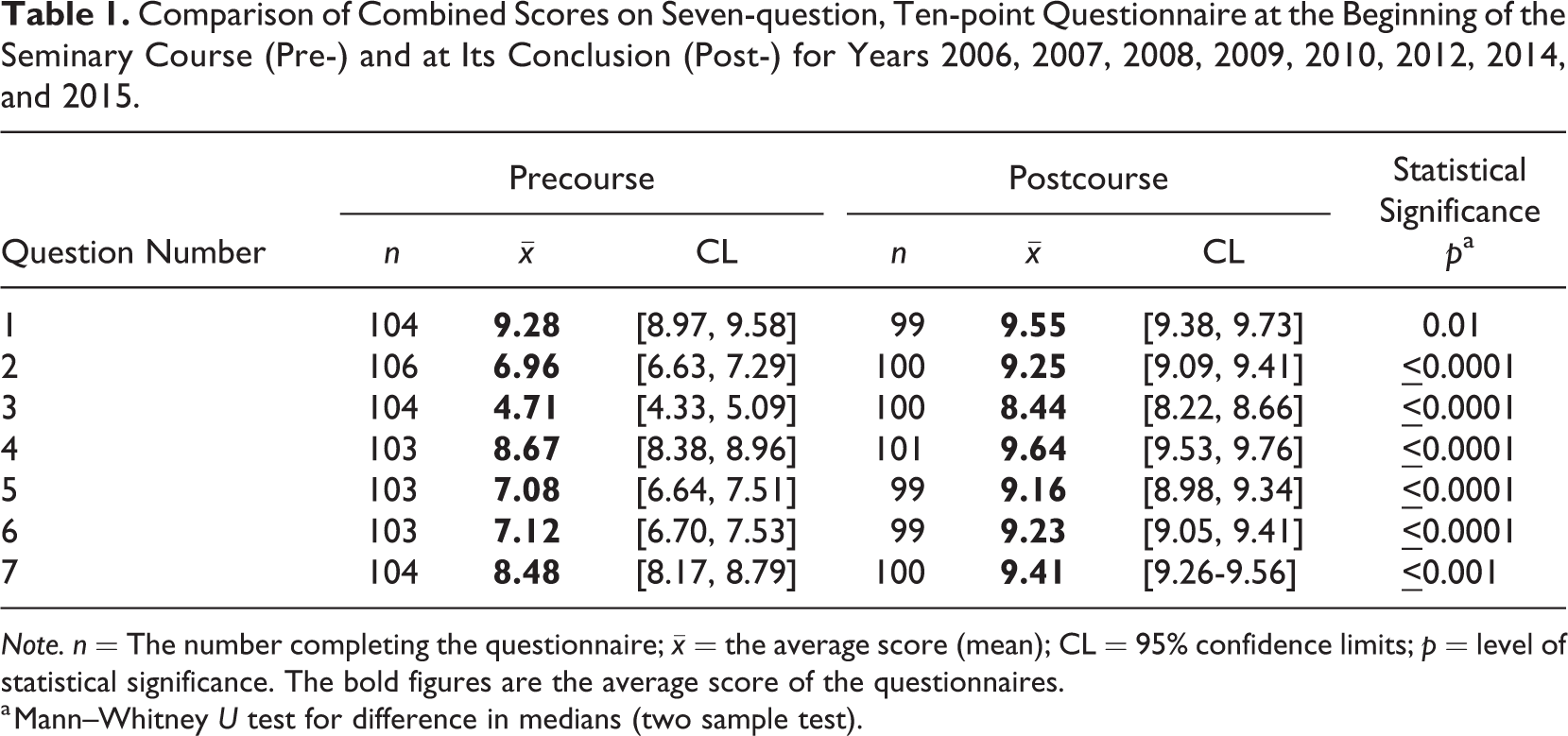
Note. n = The number completing the questionnaire;
a Mann–Whitney U test for difference in medians (two sample test).
In Table 2, each of the average scores at the beginning of the course (the precourse scores) and at the conclusion of the course (the postcourse scores) are identified for each of the years 2006, 2007, 2008, 2009, 2010, 2012, 2014, and 2015. On a year-by-year basis, it is also seen that the responses to questions 1, 4, and 7 were less emphatic than the responses to questions 2, 3, 5, and 6, revealing that many of these questions deal with issues in which the seminarians had a relative lack of knowledge coming into the course. For the years 2011 and 2013, the postcourse assessments were not available; and for 2016, the course was not held as it was being moved from the third to the fourth year of seminary studies. In addition, the seminarians made comments about the course and a relatively representative sampling of the comments are provided in Table 3.
Average Scores on Seven-question, Ten-point Questionnaire at Beginning (Pre-) and End (Post-) of Three-credit Seminary Course for Years 2006, 2007, 2008, 2009, 2010, 2012, 2014, and 2015.
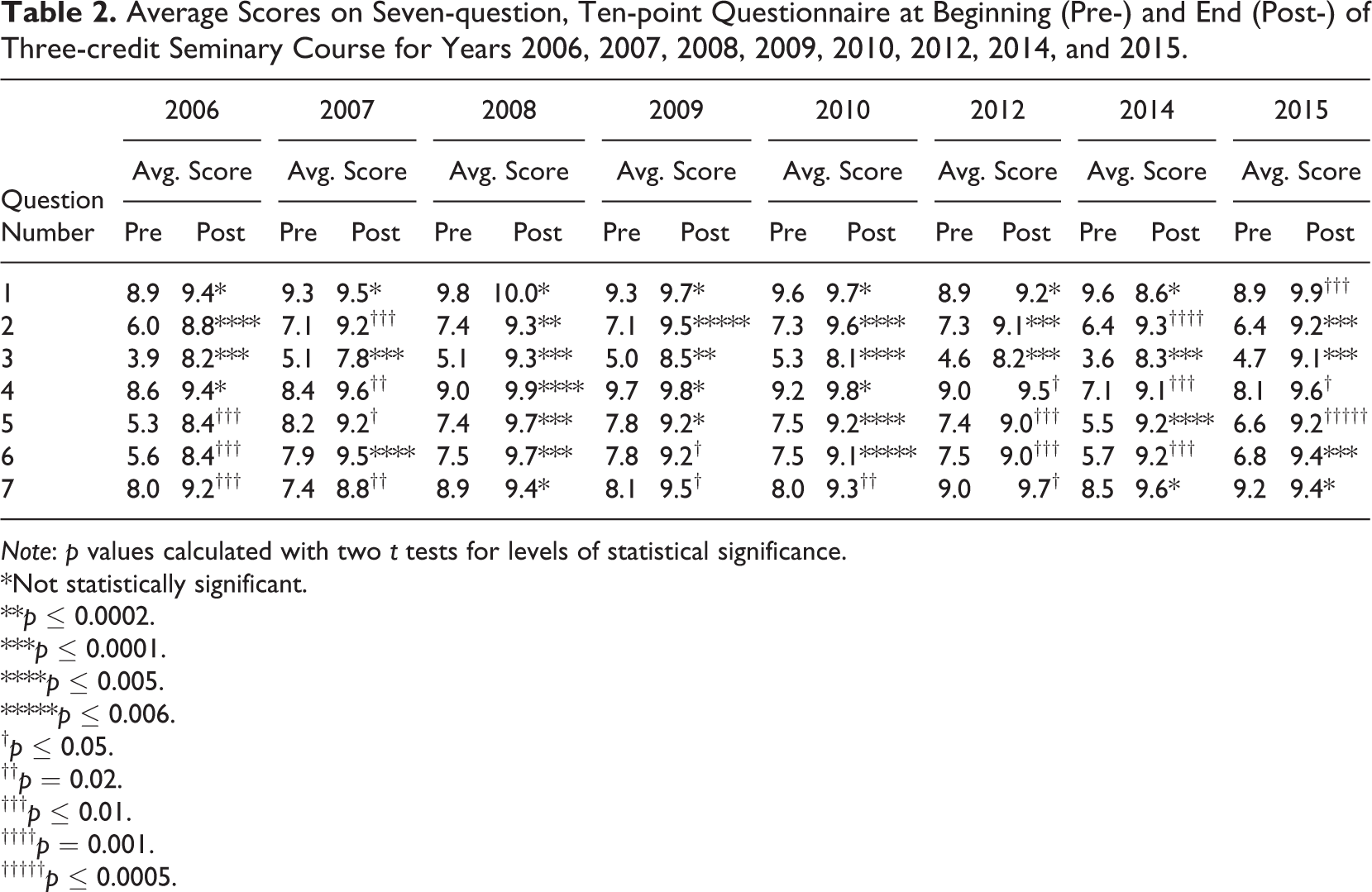
Note: p values calculated with two t tests for levels of statistical significance.
*Not statistically significant.
**p
***p
****p
*****p
†
p
†† p = 0.02.
†††
p
†††† p = 0.001.
†††††
p
A Representative Sample of Comments Made at the Conclusion of the Seminary Course.
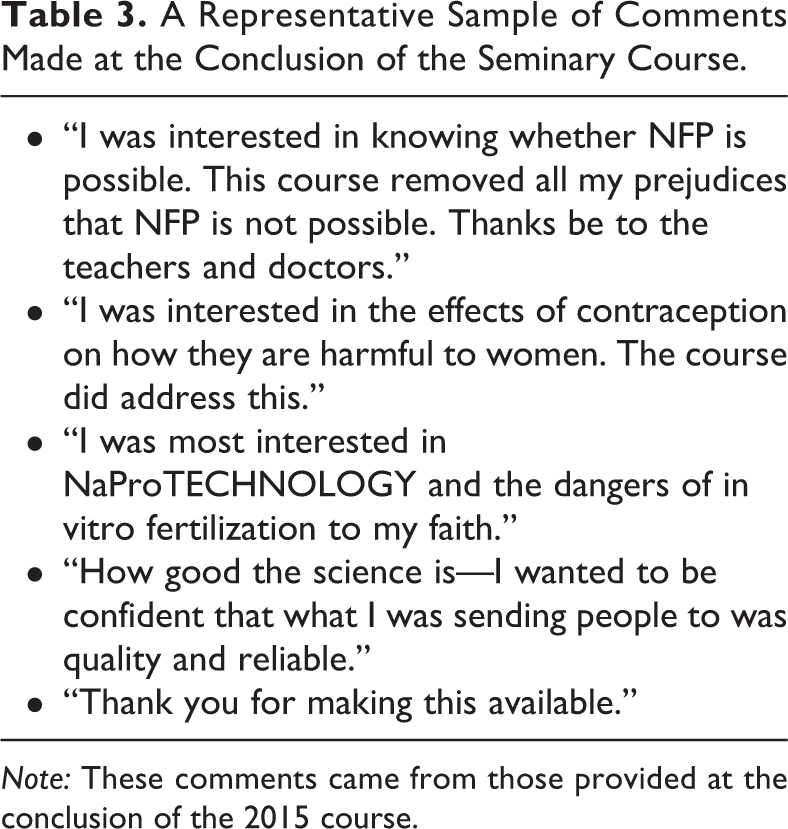
Note: These comments came from those provided at the conclusion of the 2015 course.
Discussion
Curriculum revision in seminaries responds to developments in the field of priestly formation and changing needs of the church and the priesthood. Clearly, one of the most important developments in our time has been the body of teaching known as the Theology of the Body as taught by St. John Paul II during the course of his pontificate. Beginning in the mid-1990s, Kenrick-Glennon Seminary started to integrate this material into its curriculum. The Theology of the Body became an important part of several disciplines within the curriculum. It became an important element in the teaching of sacramental theology both for Holy Matrimony and for Holy Orders. Elements of the Theology of the Body were incorporated into components of the seminarians’ human formation in the course taught on priestly identity, celibacy, and ethics. And, of course, the Theology of the Body is central to a contemporary means of explaining the church’s moral doctrine on marriage, family, and sexuality.
For nearly twenty years, the moral theology course on Marriage, the Family and Human Sexuality has taken advantage of the insights from St. John Paul II’s Theology of the Body in order to help the men preparing for the priesthood to be better servants of the truth about the human person. This renewal of focus coincided with the seminary’s collaboration with the Pope Paul VI Institute for the Study of Human Reproduction in Omaha, Nebraska.
The Pope Paul VI Institute’s program known as Love & Life Unlimited introduces priests and lay leaders by covering anthropology, theology, doctrine, and the basic scientific principles of the Creighton
One of the observations underlying this approach is that the rejection of the truth about sexuality is not only a denial of moral teaching and doctrine as it concerns human behavior but also a rejection of the truth about the human person, which is the subject of action that has a moral quality based in reason. What is meant here is that, in the contemporary milieu, the human person is seen often as having little or no freedom or as having the absolute freedom to create moral truth. Along with this comes a more fundamental error, the rejection of the idea that the body and procreation are good. Seminary formation must confront these ideas in a way that demonstrates effectively that the human body is unique because of the personal dignity of the human being and that human procreation is a fundamental good to be pursued within marriage. It is also necessary to effectively teach that the proper understanding of freedom suffers from a false view of human nature. The doctrinal and theological teachings present some, but not all, important aspects of the truth about marriage and sexuality. Seminarians come to us with minds and hearts open to receive the truths as taught by the church in this moral area. However, even with personal acceptance of the truth of these matters, difficulties remain. We are living in a social context in which the traditional wisdom of the family has been lost in many demographic sectors and in which there is very little collective wisdom and experience available that supports truth about the family and sexuality.
A lack of awareness can exist on the part of some who enter seminaries that it is possible for all to live the church’s teaching with fidelity. The assumption often is that only the most advanced and dedicated believers are able to live this way. It is possible to think that these truths are for a select group of persons who have passed a certain spiritual threshold. These seminarians believe in truth taught by the church, but they are unable to integrate the intellectual reality with the pastoral challenge that comes from an inability to explain the truth well and with the confidence that it can be lived by everyone. To those who have not had the experience of family life lived in the truth, it can be difficult to imagine that lives lived according to this teaching can wrangle successfully with the exigencies brought on by contemporary circumstances. What many in the church and in our seminaries fail to realize are the benefits of the Creighton Model System that by natural right belong to all people. FertilityCare is not simply the church’s or Creighton
The limitations of this study include the relatively small number of participants and the absence of two years (2011 and 2013) from the data set. In the future, a more in-depth qualitative study of the seminarians’ comments on the course and, in addition, follow-up comments and analysis of these priests now that they are out in the world of parish work, academics, and contemporary society would be very helpful.
Footnotes
Declaration of Conflicting Interests
The author(s) declared no potential conflicts of interest with respect to the research, authorship, and/or publication of this article.
Funding
The author(s) received no financial support for the research, authorship, and/or publication of this article.