







Abstract
Filicide-suicide is a special category of homicide-suicide event where the victim(s) are children and the perpetrator is one of the parents or both. It is not extensively documented or adequately defined in literature. In developed countries, shooting is a common method of homicide and suicide. Uses of knives, blunt objects, strangulation, poisoning and drowning are other methods frequently employed by the perpetrator. Homicide by hanging in filicide-suicide is rarely reported in forensic literature. We present a rare case of filicide-suicide, where the mother killed both her children by hanging them one by one from a ceiling fan in the same room and later committed suicide by hanging in another room.
Introduction
Homicide-suicide and dyadic death refer to an incident where a homicide is committed, followed by the suicide of the perpetrator almost immediately or soon after the homicide.1,2 Familicide-suicide can be defined as the killing of one's current or former spouse or one intimate partner and one or more children followed immediately or very soon by suicide by the homicidal offender. 3 When homicide of children occurs in this event, then it may be called filicide-suicide. It is usually considered as a subcategory of homicide-suicide (dyadic death).4–7 Maternal filicide is defined as a child's murder by the mother. Filicidal mothers have been found to have frequent depression, psychosis, prior mental health treatment and suicidal thoughts. 8 Use of firearms is a common method of homicide in developed countries. Uses of knives, blunt objects, strangulation and poisoning are other methods frequently employed by the perpetrator. 9 In India, drowning is another method of homicide, particularly of young children.10,11 Hanging as a method of homicide in filicide-suicide is infrequently reported in literature. We report a first ever case of double homicidal hanging of children by the mother followed by suicidal hanging by her, the perpetrator.
Case report
A 28-year-old married woman had strained relationship with her husband and in-laws since marriage. She had been married for 5 years and her husband was working as a government employee. There was allegation of harassment of the victim for dowry. On the fateful day she went to a local police station and lodged a written complaint of harassment against her husband. She had also told the station-in-charge that if things are not settled, she would commit suicide. After lodging the complaint she called her parents and told them that she was frustrated with her life and would commit suicide. She could not be contacted thereafter by her parents on her mobile. Parents immediately informed the local police station. The police reached her house after about an hour. The bed room was locked from inside. After opening the door forcibly, the police found the lady's body hanging from a ceiling fan with a chunni. (A chunni or dupatta is a long scarf that is essential to many Indian and South Asian women's wear) (Figure 1). The body was in partial hanging position with feet touching the bed. Another ligature material (chunni) was found lying on the bed. After opening the adjacent room the police found the body of a girl child aged 3 1/2 years hanging from a ceiling fan with a chunni (Figure 2). The body of a 2 years male child was found lying in a supine position on the bed in the same room (Figure 3).
Mother's body hanging from ceiling fan. Daughter's body hanging from ceiling fan. Son's body found lying on the bed.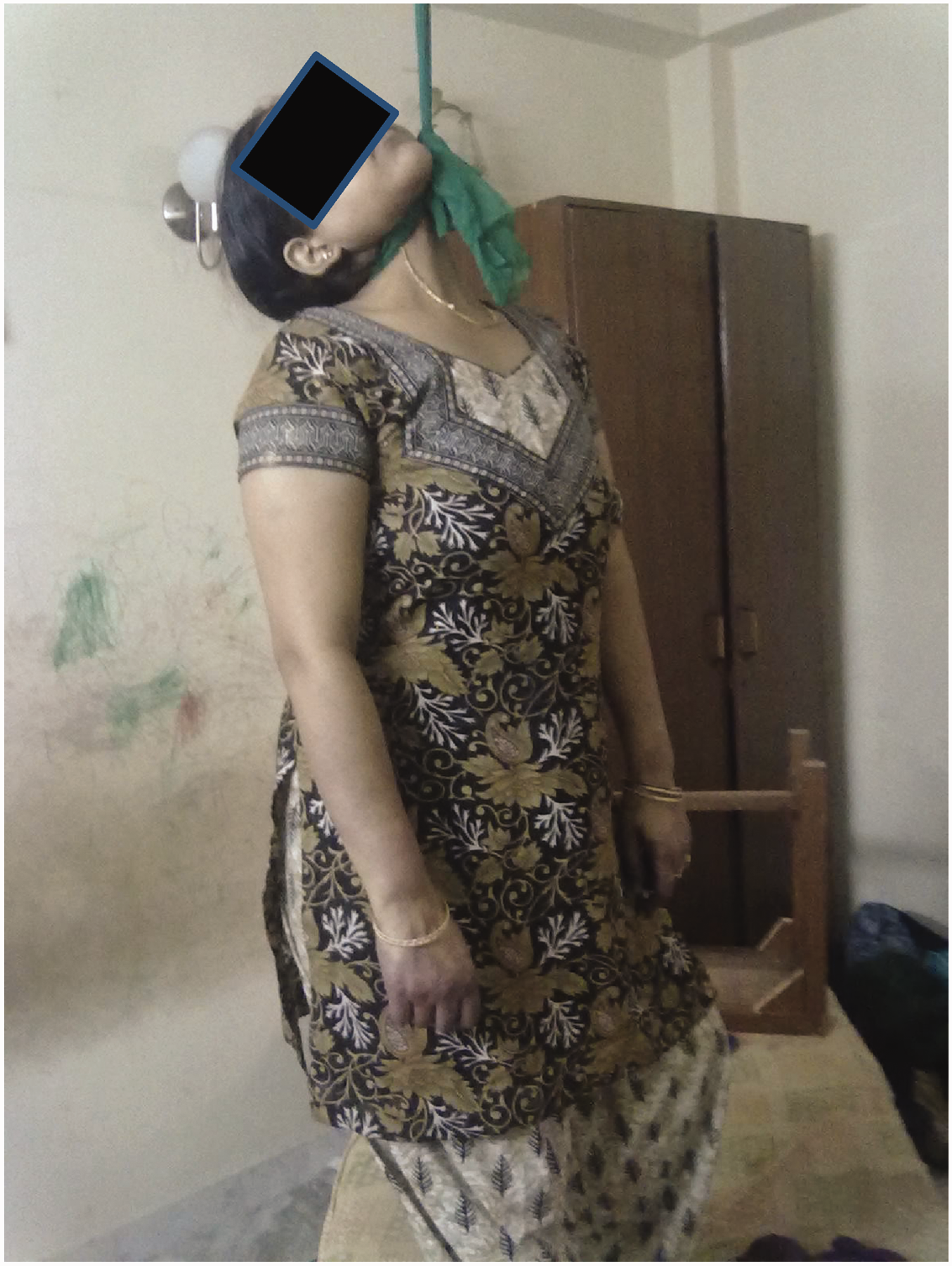
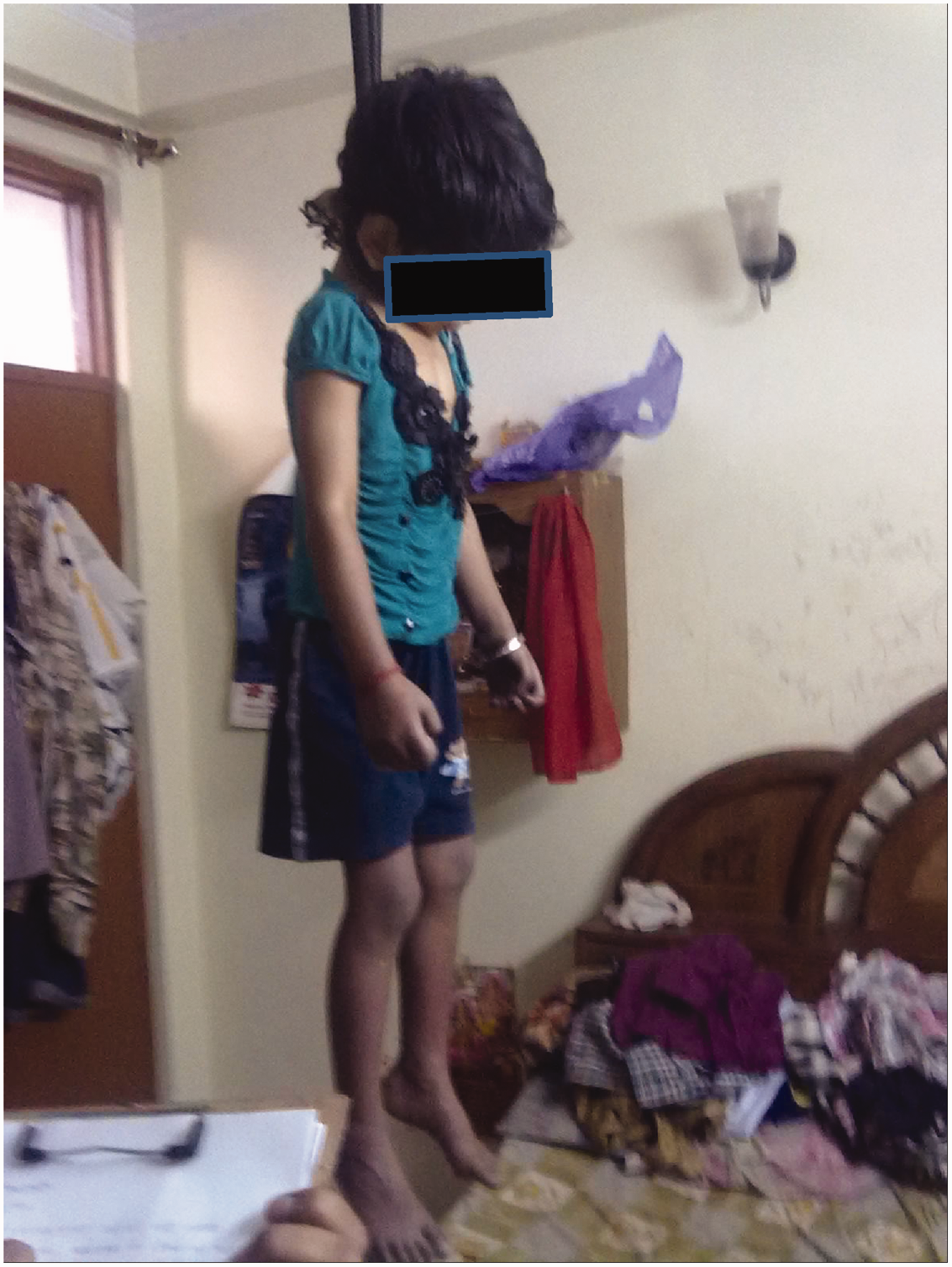
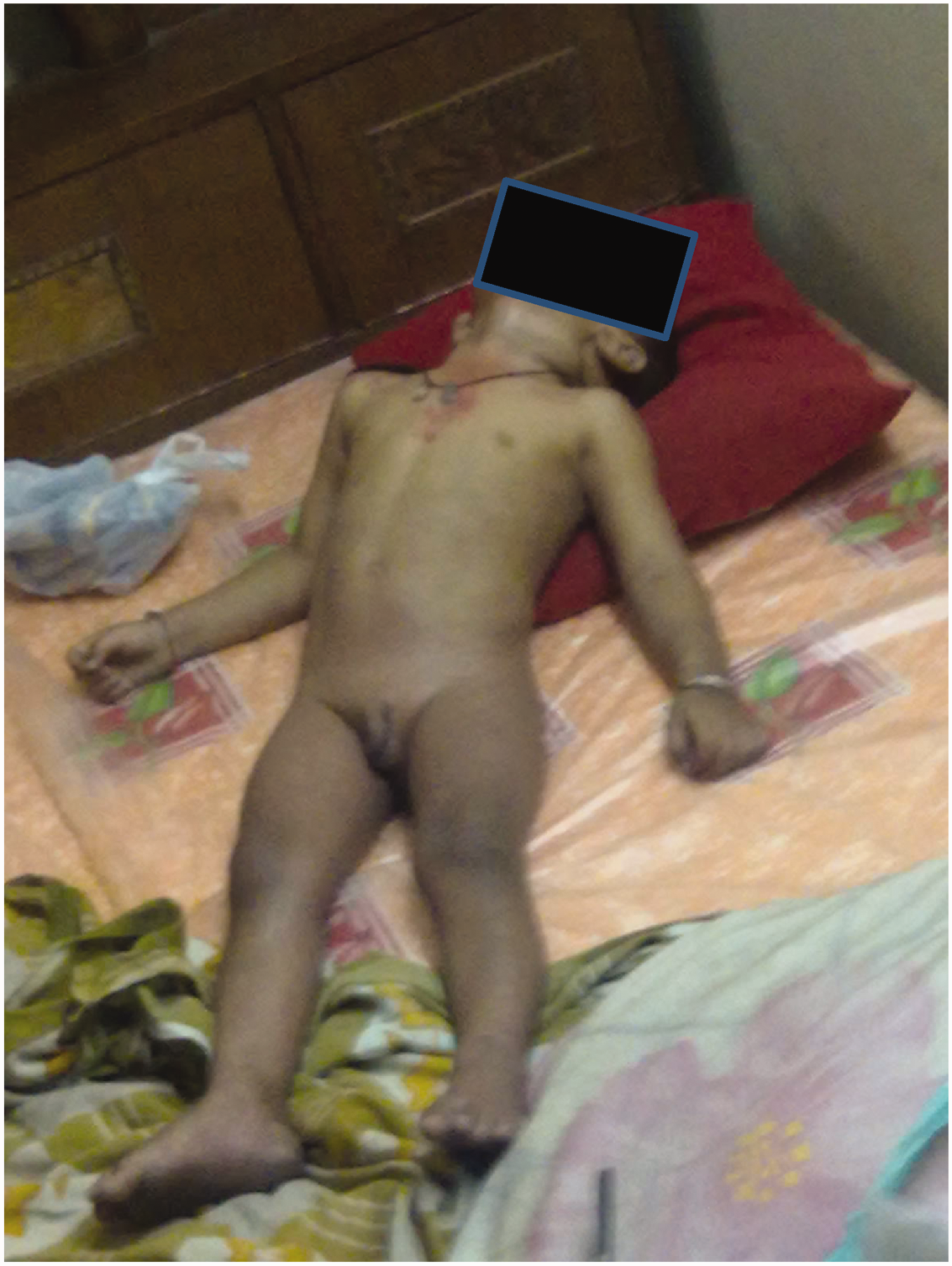
According to the police, the house address given by the deceased in her complaint was wrong, so they took about an hour to trace her house. On further enquiry with neighbours, it was revealed that the same morning she had borrowed one chair from a neighbour and a desk from a nearby tailor's shop to accomplish the act.
Autopsy reports
Body of son
A faint, incomplete, 2.5-cm width ligature mark was present on the front of middle third of neck running obliquely upwards and backwards (Figure 4). On dissection of neck, underlying soft tissue showed no extravasation of blood. Neck muscles and thyro-hyoid complex was intact. Neck lymph nodes and salivary glands were congested. Stomach contained small amount of yellowish brown fluid. Stomach mucosa and internal organs were congested. Cause of death was asphyxia due to ante-mortem hanging by ligature.
Oblique ligature mark on the neck of the son at autopsy.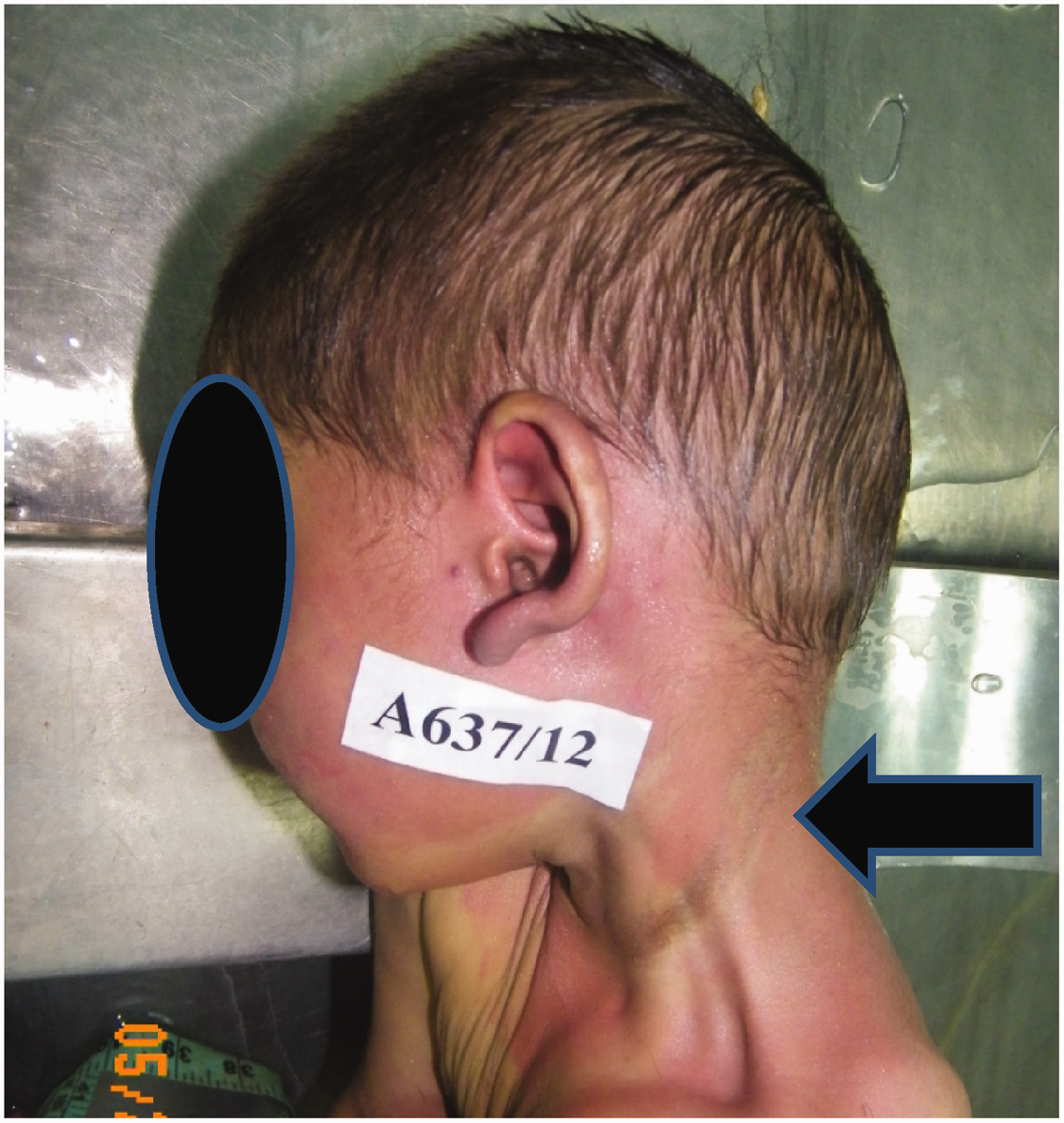
Body of daughter
Dried salivary stains were present near right angle of mouth. Palms and finger nails showed bluish discoloration. A black synthetic chunni was present around the neck. On removal of the ligature material, a faint brownish 3-cm width ligature mark encircling the neck was present over upper part of neck running obliquely upwards and backwards. On dissection, underlying soft tissue showed no remarkable findings, base of the tongue and the tracheal mucosa were congested. All internal organs were congested. Two linear brownish abrasions were present over upper part of left forearm, one over the front and the other over the inner aspect. Cause of death was asphyxia due to ante-mortem hanging by ligature.
Body of mother
Dried salivary stains were present near right angle of mouth. A ligature material (chunni) was present around the neck. On removal of the chunni, a dark brown incomplete 4-cm width ligature mark was found present over upper part of neck running obliquely upward and backward. On dissection, underlying soft tissue showed no remarkable change. Tracheal mucosa was congested. All internal organs were congested. Cause of death was asphyxia due to ante-mortem hanging by ligature.
Discussion
Maternal filicide has occurred throughout history and throughout the world. Maternal filicide is defined as murder of child by the mother. 12 Maternal filicide's perpetrators have five major motives i.e. altruistic, acutely psychotic, fatal maltreatment, unwanted child or spouse revenge. Spouse revenge filicide is the rarest, when a mother kills her child specifically to emotionally harm child's father. 11
A significant proportion (16–29%) of filicides end in completed suicide by the mother. 13 Many other mothers make non-fatal suicide attempts in association with their filicides. These mothers often had evidence of depression or psychosis 14 or had psychosocial stressors of marital discord and lack of support. 15
In a study by Hatters Friedman et al., 16 parental motives for filicide-suicide included altruistic and acutely psychotic motives. Twice as many fathers as mothers committed filicide-suicide during the study period, and older children were more often victims than infants. Records indicated that the parents frequently showed evidence of depression or psychosis and had had prior mental health care. In another study 17 most victims were less than 6 years of age, and there were several cases in which multiple siblings were murdered. A psychiatric motive was determined for more than 85% of the mothers.
The case presented here is a first ever recorded case of such nature in India, where hanging by ligature was used for both homicide and suicide by the perpetrator. According to the investigating officer the mother was being harassed by in-laws and the husband for dowry. Both children were very close to her in-laws and her husband. Being continuously harassed by the in-laws and by her husband, out of depression and frustration, she planned to kill her children. The motive probably was to emotionally harm her in-laws and her husband who were very close to the children, which as per the literature is the most rare form of maternal filicide. 11 The deceased registered a complaint in the police station with the aim of ensuring punishment to her husband and father-in-law after her demise. She must have been under the impression that her last complaint would be treated at par with a suicide note. On the fateful day, she borrowed a chair and a desk and used these as a platform to execute the hanging. The multiple abrasions over the upper and lower limbs of both children suggested struggle by children at the time of hanging.
Footnotes
Funding
This research received no specific grant from any funding agency in the public, commercial, or not-for-profit sectors.