







Abstract
Rao et al.'s mandibular canine index (MCI) is a simple odontometric method which uses the mandibular canine as the key to sex estimation. This index is defined as the ratio between the right canine mesiodistal dimension and the mandibular canine arch width. The aim of this study was to contribute to sex estimation using dental techniques by analysing the MCI efficiency, and to propose a new approach for its use. Measurements were taken from 120 plaster casts (70 females) in the 16–30 year age group. Although statistically significant sexual dimorphism was observed in both the mesiodistal dimension and the mandibular canine arch width, the MCI showed a low accuracy in sex classification (54.2% correct identifications). This accuracy was improved to 64.2% using receiver operating characteristics curve analysis. Yet, despite the better accuracy, these results reinforce the idea that the MCI may not be particularly useful in sex prediction, since it may not reflect the same degree of sexual dimorphism as its absolute measures.
Keywords
Introduction
Teeth are known for being the most resistant structures of the human body and thus play a major role in identifying skeletal remains. The use of dental techniques has been reported as very useful in human identification, and has been used to determine the sex of skeletal remains. Sex estimation refers to the study of the biological and physiological features that define men and women, whereas gender estimation refers to the social roles, behaviours, activities and attributes given by a society as being appropriate for men and women. 1 Previously, the use of several body parameters (e.g. craniofacial morphology and pelvic measurements) was reported to allow an accuracy ranging from 96% to 100% in sex estimation.2,3 However, it is not uncommon to recover only partial human remains, or fragmentary skull and pelvic bones. 4 In such cases, teeth can be especially useful, since they are known to resist a great variety of physical, chemical and biological insults.
It has been stated that teeth have a high degree of sexual dimorphism. 5 In general, men have bigger teeth than female.6,7 Yet, these data are not consensual, and reverse dimorphism has also been found. 8 Sexual dimorphism relies on differences in the diameter of the teeth, 9 but it can also reflect three-dimensional measurements and weight/mass assessment. 10
Mandibular canines have been called the ‘key-teeth’ in human identification.11–15 They consistently exhibit the greatest sex difference among all human teeth, being less affected than others by periodontal diseases. They are frequently the last teeth to be extracted, and also bear a greater chance of surviving severe trauma.3,4,13,14,16 Thus, the mandibular canines are frequently used for human identification, and Rao's mandibular canine index (MCI) is often used as the methodology for sex estimation, being known for its simplicity and inexpensive application. 17 However, there is no consensus on the suitability of the MCI in sex estimation, as different authors have reached different conclusions.2,3,16,17
This study therefore aims to contribute to sex estimation using dental techniques, assessing the reliability and applicability of the MCI in sex prediction.
Materials and methods
One hundred and twenty plaster casts of patients attending the residency clinic of the Faculty of Dental Medicine of University of Porto, Portugal, were studied. Cast models belonged to 70 females and 50 males, ranging in age from 16 to 30 years old. Inclusion criteria were Portuguese population affinity, no signs of periodontal disease (evaluated in the cast models by a measurement inferior to 3 mm from the cement enamel junction to the cast reproduction of gingival tissues), anterior teeth free from caries or any dental treatment and teeth well aligned, with no interdental spacing or open-bite.
All measurements were performed using a digital caliper (PaleoTech Concepts) with a maximum absolute error of 0.5 mm. Caliper beaks were placed along the long axis of the tooth. The mesiodistal (MD) dimension was considered as the greatest distance between contact points on the mandibular canine crown proximal surfaces, d43 for the right canine and d33 for the left. The mandibular canine arch width was measured as the distance between the tips of the mandibular canines (d3343). These measurements were repeated in 14 randomly selected casts within a 24-hour interval with a second observer in order to evaluate intra- and inter-observer variability. Internal consistency of the measurements was assessed using Cronbach's coefficient alpha. Measurements were also validated by pairwise comparison from Spearman's non-parametric correlations and maximum absolute differences.
As proposed by Rao et al., 17 the MCI was then obtained by calculating the ratio of the MD dimension of right mandibular canine (d43) and the inter-canine width (d3343). Additionally, a cut-off value – the MCI standard – was determined following the formula: [(Mean Male MCI–SD)+(Mean Female MCI+SD)]/2. Casts with MCI values up to this cut-off value were reported as female, whereas MCI values above this limit were reported as male. The MCI standard performance in several studies was compared.3,16–19
In order to compare the accuracy of the MCI standard in Portuguese and Indian samples, probability function density graphs were plotted. The performance of alternative cut-offs in sex determination was explored using receiver operating characteristic (ROC) curve analysis. Descriptive statistics of the mesiodistal dimensions of mandibular canines, the inter-canine arch width and the MCI was calculated, and possible sex differences were evaluated using the t-test with the Bonferroni correction (multiplying the p-value by the number of comparisons). Due to the lack of normality of the data and the approximation of the sampling distribution of the sampling mean to a normal distribution for sufficiently large samples (a consequence of the central limit theorem), non-parametric comparison of the groups was also conducted using the Mann–Whitney U-test, which led to the same statistical conclusions as the parametric testing. The level of global significance used was 5%. Statistical analysis was performed using IBM SPSS Statistics v20.0 software and Microsoft Office Excel 2007.
This study was evaluated and approved by the Ethical Board of the Faculty of Dental Medicine of University of Porto, Portugal. Since the cast models were made anonymously, no informed consent form was required.
Results
Cronbach's coefficient alpha was evaluated as >0.9 for all variables (0.94 for d33, 0.97 for d43 and 0.93 for d3343), thus indicating high internal consistency of the measurements. In fact, pairwise correlations between the 14 repeated measurements were >0.85 for all variables and all cases. Furthermore, there were no relevant measurement deviations: from the 42 repeated measurements (three measurements from 14 casts for each variable), >90% of the measurements in both d33 and d43 had a maximum absolute difference of 0.5 mm (i.e. the measurement resolution), while 90% of the d3343 measurements had an absolute difference of ≤1mm.
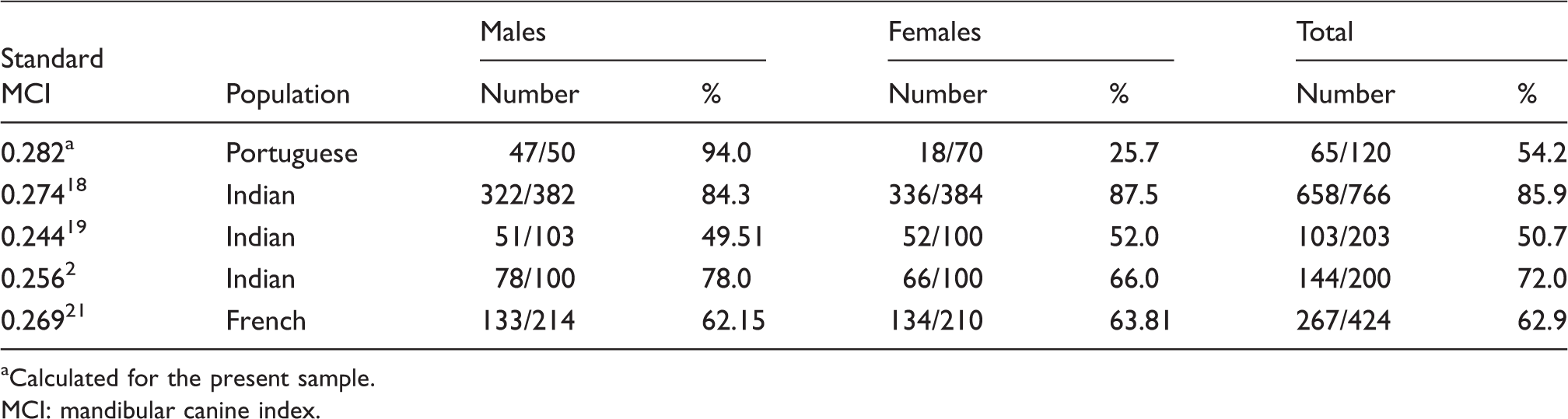
In order to compare the accuracy of the MCI standard in Portuguese and Indian samples, probability function density graphs were plotted (Figure 1). It can be observed that in the Portuguese population, density graphs for males and females overlap almost completely, pointing to the low discrimination power of the MCI. Furthermore, Rao's cut-off point seems inadequate to distinguish males and females. The optimal cut-off value (0.282) allowed a sensitivity value of 94% and a specificity value of 25.7% to be obtained, indicating that 94% of males were correctly classified, whereas only 25.7% of females were assessed accurately. The accuracy of the MCI standard in sex prediction in different population samples is depicted in Table 1. It can be observed that Rao's MCI performance in an Indian population is quite high (85.9%), although two recent studies in other Indian populations observed lower performance values (50.7% and 72.0%). In a French population, in which more similarities with Portuguese population are expected, the MCI performed slightly better (62.9%).
Standard MCI accuracy in sex prediction reported in literature studies, obtained from different population samples. Calculated for the present sample. MCI: mandibular canine index.
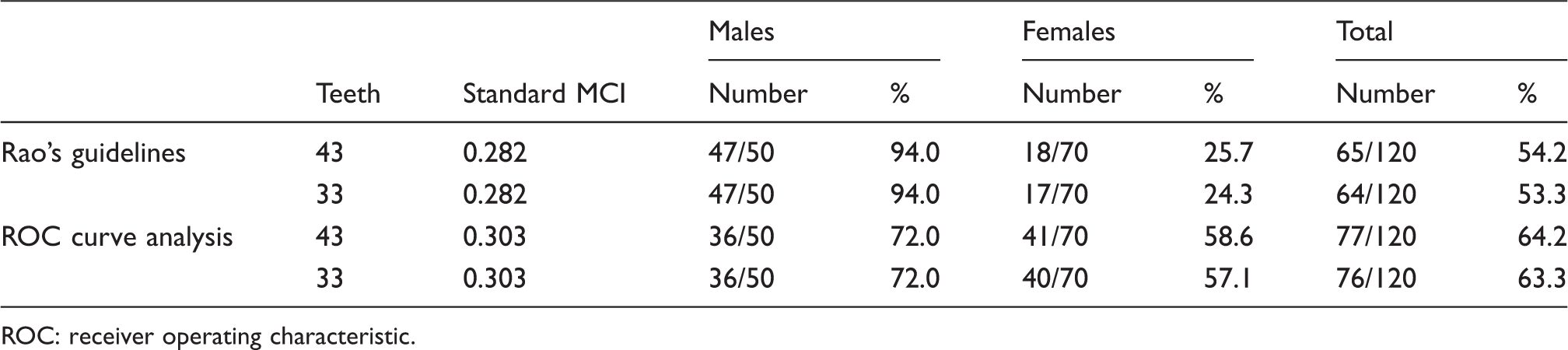
A ROC curve analysis was used to assess the optimal cut-off for identifying males using the MCI. Usually, the MCI standard is obtained using the right mandibular canine mesiodistal dimension. However, as it was unknown if a better performance in sex prediction could be achieved using the right or left mandibular canine, the MCI standard using the left mandibular canine was also determined (Figure 2). Figure 2 illustrates that no relevant differences in MCI performance were observed either using d43 or d33. Furthermore, the area under the ROC curve has a value inferior to 0.75 (0.685) showing a moderate performance in establishing sex classification. However, the sex estimation results using the cut-off determined by the ROC curve analysis (0.303) were better than those obtained using the MCI standard (Table 2).
Receiver operating characteristic curve for the assessment of optimal cut-off values for identifying males using the MCI standard from the right mandibular canine (solid line) and the left mandibular canine (dashed). The marks identify the optimal cut-off values in each case. Standard MCI accuracy in sex prediction in current sample calculated using Rao's guidelines and ROC curve analysis. ROC: receiver operating characteristic.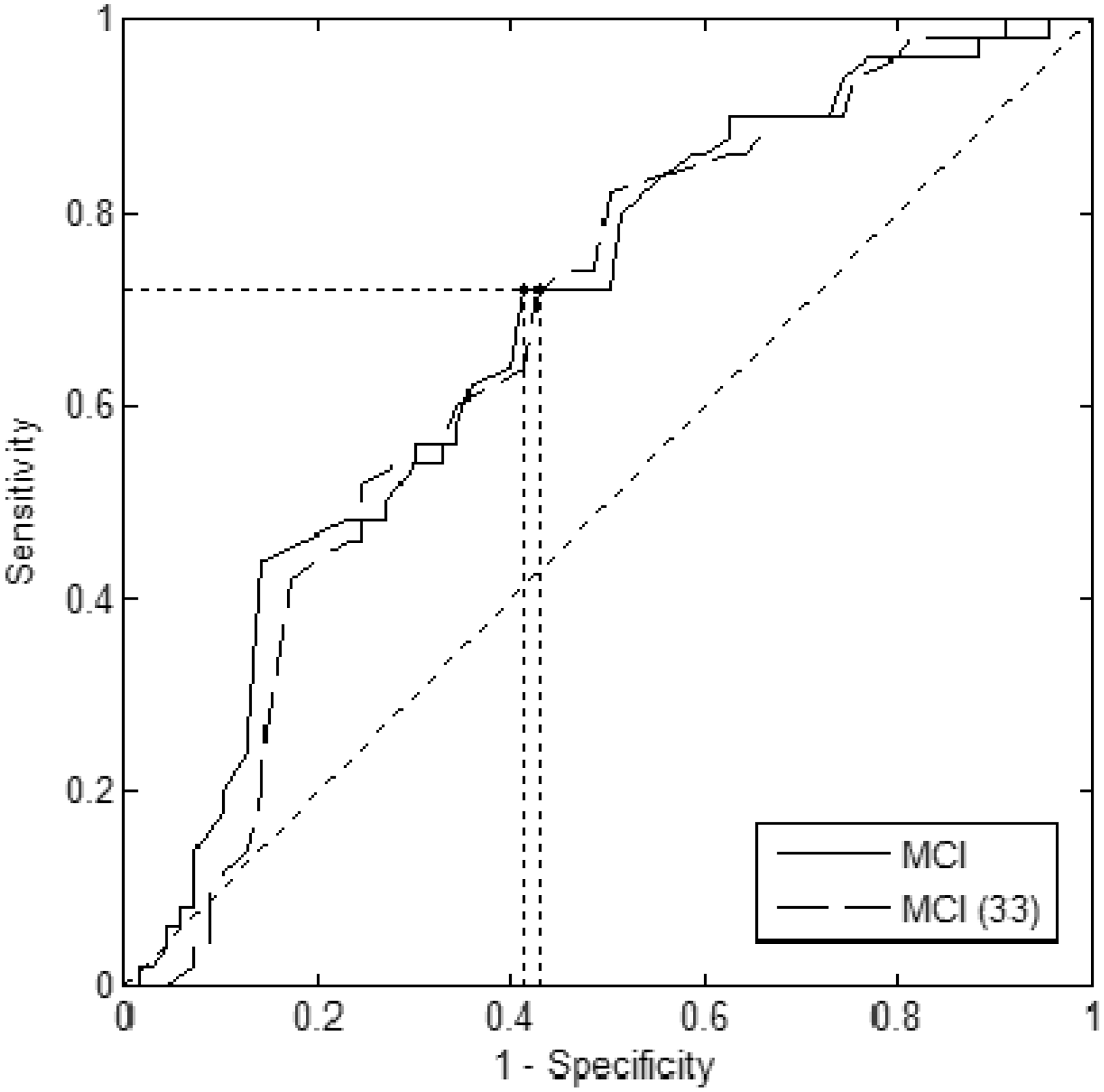
Descriptive statistics of the canine dimensions, inter-canine width and MCI.
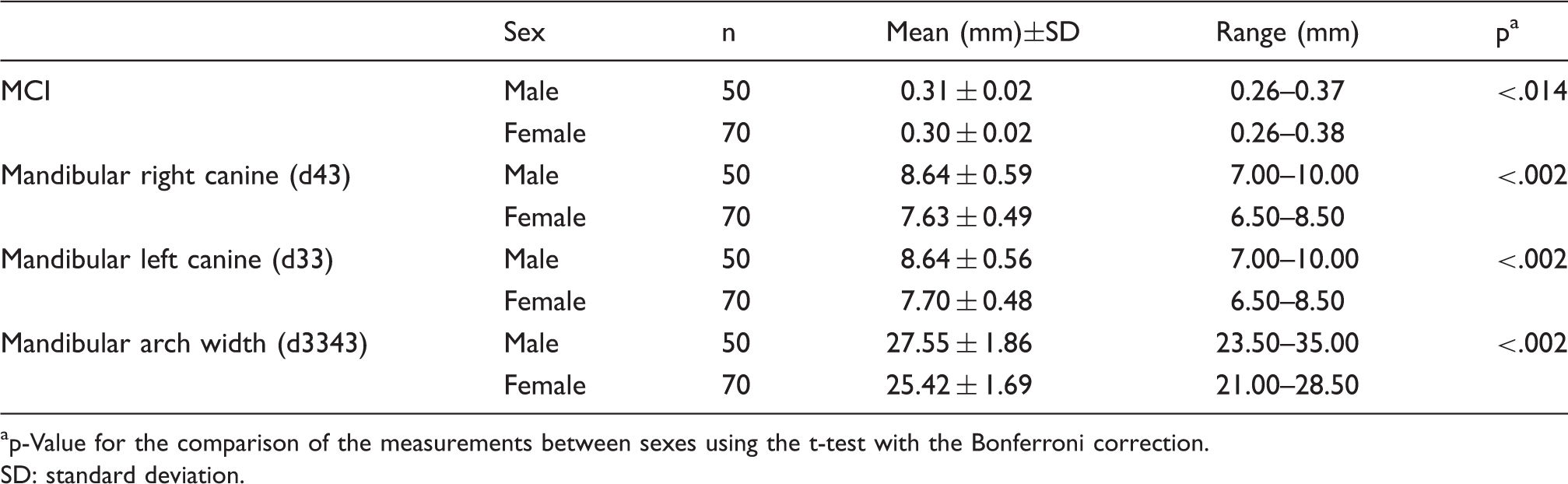
p-Value for the comparison of the measurements between sexes using the t-test with the Bonferroni correction.
SD: standard deviation.
Discussion
Determining a person's sex is crucial part of human identification. Dental techniques are often used for this purpose due to the extraordinary resistance of teeth to hazardous factors, enabling dental techniques to be used in situations where other methodologies cannot be used. Although the use of DNA has become common due to its robust results, the fact is that biological samples are not always available or suitable for DNA fingerprinting. However, according to Acharya and Mainali, 20 teeth should not be used as the sole indicator of sex, even though studies indicate they are a good adjunct for sex estimation.
The canine teeth have been routinely used for human identification purposes because they have shown the greatest degree of sexual dimorphism across numerous populations.4,5,6,9,21–24 Besides, they are the most resistant teeth in the human dentition, which has led to their use alone in sex estimation.11–15,21 Compared to other teeth, canines present higher level of survival and undergo less wear. 24 The reliability of Rao's MCI methodology is perhaps well illustrated in this study by the near inexistence of inter- and intra-observer differences, and data consistent with those from other authors.5,24 A significant relationship was found between sex and canine dimensions as well as between sex and the MCI, which is also in agreement with data from other studies.4,17,22,24 Furthermore, significant differences in the MD width were found, and teeth measurements were systematically wider in men, which has also been found in previous studies.4,13–15,21,25–29
With regard to the MCI standard value for sex determination, contrary to Rao's study, 17 the best cut-point (0.282) performed poorly in sex estimation, identifying 94% of males but only 25.7% of females. This could be explained by population differences, supporting the theory that specific population data should be used for this assessment. 7 Rao's study was carried out in an Indian sample, in which females exhibited MCI values much lower than those of males, with little overlap of frequency curves and with small and similar standard deviation values for males and females in histograms with the normal setting (see Figure 1). In the present sample from the Portuguese population, females exhibited MCI values much higher than Indian females and quite similar to Portuguese (and Indian) males, resulting in a much bigger overlap of frequency curves (see Figure 1). As stated before, these differences may relate to population features, 7 but other factors such as the environmental may also have an influence. For instance, a secular trend could be responsible for the changes. Rao's investigation was conducted in the eighties, and more than 20 years have passed since that first analysis. As with other body features, it is possible that environmental factors have impacted teeth morphology due to an effect on dentin deposition, particularly in females. In this scenario, today, females would have bigger teeth than they used to have, and teeth which had more dentin in their structure (such as canines) would experience the most changes. This would explain why more recent studies conducted in populations from India 16 and France 19 have results similar to those in the present study. In fact, it may be possible that today females in India have an MCI more similar to men as a result of environmental factors such as changing patterns in diet, as described in the current literature. 30 One possibility relates to the exposure of prepubertal children to sex steroids, which would stimulate both female and male development, 31 making MCI values more similar. This, of course, remains to be investigated further.
In an attempt to find a better cut-off value, a ROC curve analysis was performed to identify males. Although the MCI standard is currently calculated using the right canine, the present study also developed a MCI standard value using the left mandibular canine, and no differences were observed. A test with perfect discrimination has a ROC curve that passes through the upper left corner (100% sensitivity, 100% specificity). Therefore, the closer the ROC curve is to the upper left corner, the higher the overall accuracy of the test. The curve in the present study did not fit these guidelines, and a high sensitivity value (i.e. 72% for men) was only achieved with low specificity values (>58% for women); increasing specificity values (>75%) resulted in lowering the sensitivity (<48%). However, in the present sample, this methodology for assessing the best cut-off proved to be better than the one described by Rao et al., increasing the global accuracy by about 10%.
The formula developed by Rao 17 is the sum of the means divided by two, since the standard deviation values are so close that they are almost equivalent. So, the apparent success of Rao's formula could be explained by the MCI average value in women being significantly inferior to that found in men due to the similarity of the standard deviation values between the two groups, and by the symmetrical distribution concerning mean values of both curves (male and female). In fact, in the present study, these characteristics were not found in the data, and the use of the MCI in such conditions was shown to have a moderate performance in sex identification.
This study tried to reproduce the one conducted by Rao as closely as possible, using the same methodology. However, there were some factors that could not be determined which may also be responsible for the differences found. For instance, the age of the population studied by Rao is not known, neither is their socio-economic background. As stated before, it could be that these factors, along with population differences and environmental factors, namely a secular trend, explain some of the differences. This, of course, remains to be investigated, and new approaches accounting for these factors should be performed.
Conclusions
As it currently stands, the MCI proposed in an Indian sample has little utility in sex estimation in the present Portuguese sample, and therefore its application should be restricted. If, however, the MCI standard cut-off value is determined by ROC curve analysis, the global accuracy is increased by about 10%, and the results obtained are better than those obtained by chance. Furthermore, the MCI and the variables that allow MCI quantification were shown to distinguish the groups, in terms of average, suggesting the possibility that canine-related measurements may be used for sex discrimination.
Footnotes
Funding
This research received no specific grant from any funding agency in the public, commercial or not-for-profit sectors.
Acknowledgements
This work was partially supported by the Portuguese Foundation for Science and Technology (FCT) - with national (MEC) and European structural funds through the programs FEDER, under the partnership agreement PT2020 - within IEETA/UA project UID/CEC/00127/2013, CIDMA/UA project UID/MAT/04106/2013 and CMUP/UP project UID/MAT/00144/2013. S. Gouveia acknowledges the postdoctoral grant by FCT (ref. SFRH/BPD/87037/2012).
All dental casts are the property of the Faculdade de Medicina Dentária do Porto, Portugal, and information regarding these data can be provided upon request.