






Abstract
Background
A few studies have demonstrated an inverse relationship between the general population and suicide rates and antidepressant prescribing rates. Correlations between general population suicide rates and prescribing rates of other psychotropic drugs have also been observed. There have not been any studies during the last decade.
Methods
The relationship between adult suicide rates and prescription rates of psychotropic drugs by the broad British National Formulary (BNF) categories, for individual psychotropic drug groups within the BNF categories (e.g. selective serotonin reuptake inhibitors) and for individual psychotropic drugs was examined over a 12-year period (1995–2006) was examined using Spearman’s rank correlation. All data were ascertained from the archives of the Office for National Statistics.
Results
There was an absence of significant correlations between adult suicides rates and rates of prescriptions of psychotropic drugs in the broad BNF categories, individual psychotropic drug groups and individual psychotropic drugs.
Discussion
The findings may be due to methodological errors. Should the findings be accurate, then the following approaches require consideration to reduce suicide rates further: (i) development of strategies to ensure continued prescription of psychotropic drugs at the current level; (ii) development of strategies to improve non-pharmacological measures, including improved mental health services provision for adults, improved assessment of suicide risk, increased availability of psychosocial interventions and restricting the availability of methods of suicide; and (iii) development of strategies to implement improvement in distal risk (e.g. societal socio-economic status) and protective (e.g. societal educational attainment) factors for suicide at a societal level.
Introduction
A high frequency of mental morbidity has been described in people committing suicide. Psychiatric disorders were established in about 90% of suicides, 1 and about 42% of those who committed suicide were previously treated as psychiatric in-patients. 2 Due to the high prevalence of psychiatric disorders in people committing suicide, psychopharmacological treatment has been suggested as a way of improving suicide prevention.3 The majority of suicide victims have a depressive illness.3 The introduction of selective serotonin reuptake inhibitors (SSRIs) during 1990–1995 has impacted on the pattern of prescribing, and a Swedish study reported a significant decrease in suicide rates. 4 Another Swedish study conducted more than a decade later found frequent use of psychotropic medication among people who commit suicide, but antidepressant prescribing was infrequent. Depressive illness is generally under-treated in people who commit suicide.4–7
The issue of treatment with antidepressants and suicide remains controversial and triggers numerous debates. A study carried out by the Center for Drug Evaluation and Research at the US Food and Drug Administration showed that risk of suicidality associated with use of antidepressants is strongly age dependent. Antidepressants seem to protect against suicidal ideation in adults between 25 and 64 years of age, but there is an increased risk of suicidality and suicidal behaviour in adults younger than 25 treated with active treatment compared with placebo. 8
Suicide rates generally increase with ageing.9,10 The suicide rate for both sexes reached a postwar peak in the early 1960s. Rates then declined steadily in both sexes between 1963 and 1975. The overall decrease in suicide rates was associated with a decrease in poisoning with domestic gas, which had been detoxified by this time. 11 A reversal of the decline in suicide rates for both males and females was observed between 1975 and 1980, and demonstrated that this was not due to changes in the recording of ‘undetermined’ death or ‘accidental death’ which may contain concealed suicides. 12 The continuing increase in suicide rates for males of all ages in England and Wales was due principally to an increase in suicide rates in the 25 - to 54-year age group. 13 Following this increase in suicide rates among males until 1990, there was a decrease for both genders between 1990 and 1997.
This decrease may have been related to a decrease in suicide rates that was also noted between 1991 and 1996, and was related to a decrease in the proportion of suicides attributed to poisoning with motor vehicle exhaust gas. 14
The overall decline in suicide rates in adults in England and Wales may have been due to several national initiatives, including: legislation encouraging general practitioners to offer annual physical examinations; the Defeat Depression Campaign organised by the Royal Colleges of Psychiatrists 15 and General Practitioners; the governmental ‘Health of the Nation’ and ‘Our Healthier Nation’ suicide reduction targets 16 ; the National Confidential Inquiry into Suicides and Homicides for England and Wales; the National Service Frameworks for Mental Health; and the National Suicide Prevention Strategy for England.16–20 One of several possible mechanisms explaining the reduction in suicide rates in England and Wales between 1990 and 1997 is the possible reduction in psychosocial stressors 11 due to improvement in the national economy and unemployment levels during this period of time. 21 ‘Care in the community’ was developing, with increasing awareness of risk assessment in relation to suicide.
Several studies have demonstrated an association between changes in prescribing patterns for psychotropic drugs and suicide rates. A Swedish study of suicides in all age groups combined reported a decrease in suicides due to barbiturate poisoning subsequent to a decrease in their sales, whereas an increase in the sale of antidepressants was associated with an increase in suicides due to these drugs. 22 Another Swedish study of suicide in older people reported that an increase in sales of antidepressants in the SSRI category was associated with a decrease in suicide rates in older people. 23 The same study reported an increase in suicides due to benzodiazepines, despite a decline in their sales. 23 A naturalistic study testing the hypothesis based on research until 1991 in Sweden looking into suicides in all age groups combined suggested that an increase in the use of antidepressants, probably due to the introduction of SSRIs, might be one contributory factor for a decline in suicide rates. 24 A further Swedish study reported an increase in the rate of decline of suicide rates in all age groups combined after the introduction of SSRIs. 25 An Australian study also reported a decrease in suicide rates with increased exposure to antidepressants, particularly SSRIs. 26 A review of 16 ecological studies concluded that there was an inverse relationship between suicide rates and use of antidepressants across all age groups. 27 Another study across 26 countries concluded that an increase in SSRI sales of one pill per capita reduced suicide by 5%. 28
However, the most recent English study that has examined the relationship between suicide rates in adults and the prescribing of antidepressants used data that are at least a decade old.11,19 Moreover, there has been a recent debate about the impact of antidepressant prescribing on reducing suicide rates. 29 In view of this, the association between adult suicide rates and the prescribing rates of psychotropic drugs in England and Wales, for the latest 12-year period for which data were available, was examined with the unidirectional hypothesis that a decline in suicide rates will be associated with an increase in the rates of prescriptions of psychotropic medication (antipsychotics, antidepressants and antimanic drugs). It was also hypothesised that a decline in suicide rates will be associated with a decline in prescription rates of hypnotics and anxiolytics (including barbiturates).
Methods
Suicide rates
Data on suicide rates for both sexes in the age band 18–64 years in England and Wales were ascertained for each of the 12 years (1995–2006) from the World Health Organization (WHO) website (www.who.int/whosis/database/mort/table1.cfm). This time period was chosen specifically because a previous similar study had examined the study hypotheses using data until 1997.11,14
National prescribing patterns for psychotropic drugs
Data on the total annual number of prescriptions issued for the broad British National Formulary (BNF) categories for psychotropic drugs and individual drugs within these broad BNF categories for each of the 12 years between 1995 and 2006 for England were ascertained. Data for each year between 1998 and 2006 were ascertained from the Department of Health (DH) website (www.dh.gov.uk/en/Publicationsandstatistics/Statistics/StatisticalWorkAreas/Statisticalhealthcare/DH_4086488#_4). Data for each year between 1995 and 1997 were not available in an electronic format and were ascertained from a DH publication (www.ons.gov.uk/ons/publications/index.html). The data consisted of the number of National Health Service prescriptions dispensed. The broad categories of psychotropic drugs examined were antipsychotics, antidepressants, mood stabilisers hypnotics and anxiolytics. Within each broad psychotropic drug category, individual drug groups (e.g. SSRI and MAOI in the antidepressant category) and individual drugs were also examined.
Data on the total population size for England and Wales for each of the 12 years 1995–2006 were ascertained from the WHO website (www.who.int/whosis/database/mort/table1.cfm). The rates of prescribing of psychotropic drugs by the broad BNF categories, for individual psychotropic drug groups within the broad BNF categories (e.g. SSRIs) and for the individual psychotropic drugs in the general population were calculated by dividing the number of annual prescriptions issued by the general population size for each of the 12 study years.
Data analysis
Spearman’s correlation coefficient (ρ) was used to examine the relationship between suicide rates in both sexes and the annual prescription rates of psychotropic drugs by the broad BNF categories, for individual psychotropic drug groups and for the individual psychotropic drugs within these BNF categories. This approach has been successfully used in previous studies in this area.24,30
Spearman’s correlation coefficient (ρ) was also used to examine the relationship between the study years and (i) the suicide rates in both the elderly age bands for both sexes, (ii) the annual prescription rates for the broad BNF categories of psychotropic drugs (antipsychotics, antidepressants, mood stabilisers hypnotics and anxiolytics), (iii) individual drug groups in the broad BNF categories (e.g. SSRIs and MAOIs), and (iv) individual psychotropic drugs. This allowed examination of the overall trends in suicide rates and psychotropic prescribing over time. This method has been successfully used before.10,17,19,30–32
Results
The median (range) of suicide rates (per 100,000 of relevant age group) for the 12-year study period for males 18–64 years and females 18–64 years was 9.1 (3.6–11.1) and 3.6 (2.7–4.2) respectively.
There was no significant correlation between suicide rates in males and females in both the adult age bands and annual prescription rates for any of the broad BNF categories of psychotropics (antipsychotics, antidepressants, mood stabilisers, hypnotics and anxiolytics). Similarly, there was no significant correlation with any individual psychotropic drug groups and any individual psychotropic drugs.
Changes in rates of psychotropic prescribing over the study years.
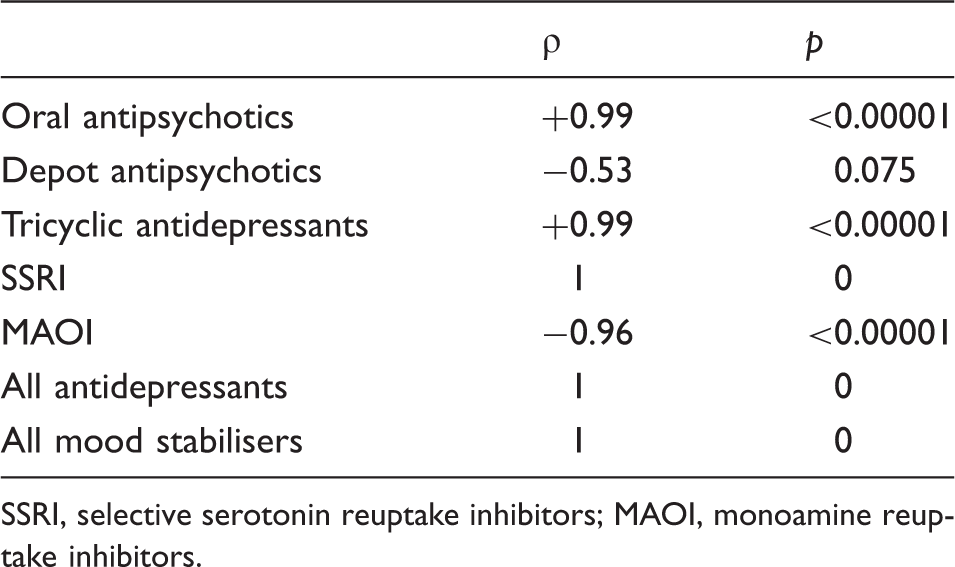
SSRI, selective serotonin reuptake inhibitors; MAOI, monoamine reuptake inhibitors.
Discussion
To our surprise, there was an absence of significant correlations between suicide rates in both sexes in both the adult age group and prescription rates of psychotropic drugs in the broad BNF categories, individual psychotropic drug groups and individual psychotropic drugs.
Methodological issues require consideration before discussing the results. First, the 12-year study period may be comparatively short, and this may have biased the findings due to type 2 statistical error. Second, data on prescribing of psychotropic drugs were for England only, whereas data on suicide rates were for England and Wales. This is unlikely to have influenced the findings, as the absolute number of adult suicides in Wales is comparatively small. Third, data on prescribing of psychotropic medication were for all age groups rather than specifically for adults (aged 18–64 years), as age-specific data on prescriptions were not available, and this may have biased the findings. Fourth, there were no data on compliance, on the accuracy of treatment or the actual number of patients treated, and this has implications for aetiological interpretations of the findings. Fifth, this study examined rates of pure suicides, and this may be an underestimate of the true suicide rates, as accidental deaths and those due to undetermined causes contain concealed suicides.33 Sixth, the correlational analysis undertaken did not control for confounding variables. 29 Finally, the design of the study involved analysis over time, and correlational analysis over time has limitations because the effect of time itself cannot be examined. The study was confined to England and Wales, and the findings cannot be generalised to the rest of the UK or other developed countries.
The absence of significant correlations between adult suicide rates and prescription rates of broad groups of psychotropic drugs, individual psychotropic drug groups and individual psychotropic drugs is in contrast to earlier studies. Studies from Sweden, Australia and England and Wales have reported an inverse relationship between suicide rates and prescription rates of SSRIs.23,26 Increased suicidality in younger age groups up to the age of 25 and prescribing of SSRIs have been reported. 8 The Swedish study also reported an increase in suicides due to benzodiazepines, despite a decline in their sales. 23 The negative findings of this study may be due to the methodological difficulties described earlier.
However, the possibility that the findings are accurate requires careful consideration. First, earlier studies from our group covering the 12-year period between 1985 and 1996, using identical methodology, demonstrated significant negative and positive correlations between suicide rates and a number of groups of psychotropic drugs. Thus, methodological issues alone cannot explain the current negative findings. Second, a few other studies have also reported an absence of an inverse correlation between general population suicide rates and antidepressant prescribing.34–36 Third, it is possible that the psychotropic drugs had an impact on suicide rates, but some other factor, hitherto unknown, and which changes over time, has had an opposite effect on suicide rates, and hence there was no apparent correlation within this ecological design. There is no evidence to support this hypothesis. Fourth, there is the possibility that suicide rates have declined to a comparative low level, and further changes in psychotropic prescribing rates may have little impact on suicide rates. In other words, the optimum impact of changes in psychotropic prescribing may have already been achieved. The inverse correlation between general population suicide rates and use of SSRIs in the United States was present between 1990 and 1999, but was absent between 2000 and 2004. 36 Fifth, the possibility that suicide rates were declining well before there was an increase in the prescription of antidepressants requires consideration. A decline in general population suicide rates preceding the onset of the use of SSRIs has been reported in several countries, 36 although this does not preclude any additional impact of SSRIs on suicide rates. It is therefore possible that previous studies have shown a spurious inverse correlation, which was absent in the current study because there was no further decline in adult suicide rates during the study period. Finally, the role of non-pharmacological factors, including important changes in the provision of mental health services, improved assessment of suicide risk, increased availability of psychosocial interventions, strategies to reduce social isolation and restricting the availability of methods for suicide, may also be important in reducing suicide rates.26,29,37,38 The Royal College of Psychiatrists became more proactive, undertaking suicide prevention and ‘Defeat Depression’ campaigns. ‘Care in the community’ was developing with increased awareness of risk assessment in relation to suicide.
The above arguments, taken together, could be synthesised into a composite explanatory model for the findings. First, adult suicide rates were declining prior to changes in psychotropic prescribing rates. Second, changes in psychotropic prescribing rates, particularly antidepressants, initially had an additional impact on suicide rates in younger adults. Third, as the adult suicide rate reached a threshold of comparative low level, further changes in psychotropic prescribing rates no longer had an impact on adult suicide rates. At the same time, suicide rates were no longer declining further. Finally, the role of non-pharmacological factors, including important changes in mental health service provision, improved assessment of suicide risk, increased availability of psychosocial interventions and restricting the availability of methods for suicide may become important in reducing suicide rates at this stage.11,26,29
Suicide is a rare and often unpredictable event. The findings of an absence of a correlation between adult suicide rates and psychotropic drug prescribing rates in this ecological study do not necessarily imply an absence of causation. However, if the findings are accurate, the following approaches need to be considered to ensure further reduction in adult suicide rates: (i) development of strategies to ensure continued prescription of psychotropic drugs at the current level; (ii) development of strategies to improve non-pharmacological measures, including improved mental health service provision, improved assessment of suicide risk, increased availability of psychosocial interventions and restricting the availability of methods of suicide24,37,38; and (iii) development of strategies to implement improvement in distal risk (e.g. societal socio-economic status) and protective (e.g. societal educational attainment) factors at a societal level to reduce suicide rates.38,39
Footnotes
Funding
This research received no specific grant from any funding agency in the public, commercial or not-for-profit sectors.