







Abstract
The case reported involved a 60-year-old man with psychiatric illness who was found dead at his home. He was almost naked and showed signs of death by violent asphyxiation, which led to the suspicion of homicide. Autopsy findings showed foreign material in the trachea and larynx. However, the partially digested content in his stomach, the study of the gastric content and the microscopic analysis of the airways made it possible to define this as accidental death due to inhalation of material from a diaper. Toxicological analysis detected the presence of phenytoin, valproic acid, and phenobarbital in his blood, with values within the therapeutic ranges. This is certainly a peculiar case, as particularly evident after careful review of the literature on deaths by asphyxiation in psychiatric patients. Furthermore, this study highlights the importance of a full autopsy and microscopic evaluation of any foreign bodies.
Keywords
Introduction
Choking is a form of asphyxia in which the internal airways are obstructed. Choking can be a homicide if a gag is placed in the mouth and/or pushed into the pharynx, and uncommonly it can be used for suicide, although most cases of choking are accidental. 1 ‘Café coronary’ was the term coined by Haugen in 1963 2 for a sudden and unexpected death that occurs during a meal due to accidental occlusion of the airways by food. 3
Choking by aspiration of food material or gastric contents to different extents can be observed with a large variety of deaths. Choking can occur accidentally during a meal, or can occur after ingestion of non-edible substances, particularly for suicidal purposes.4,5 People with mental illness are at a three- to fivefold higher risk of such sudden death compared to the non-psychiatric population. 6
Mentally impaired or brain-damaged patients are at higher risk for café coronaries due to their higher incidence of dysphagia, abnormal eating behaviour, and impulsiveness. 7 Inedible substance ingestion is also commonly observed in children, as well as in patients with psychiatric disorders. This is associated with an increased risk of suffocation and of perforation of the digestive organs, depending on the size and shape of the substance ingested. 8
Case report
A 60-year-old male was found dead in his house, lying on a mattress on the floor. The man was wearing a sweatshirt, a single sock, and a diaper (nappy). The corpse was discovered by his cohabiting partner, who had just returned home, and first alerted the health-care staff and then the police.
Site inspection
During the inspection, the house was seen to be in a filthy and messy state, with various objects scattered around the house, among which there was dog excrement. In this general disorder, boxes of anti-epileptic drugs were noted.
Autopsy findings
An autopsy was performed 48 h later. External examination revealed the presence of bilateral conjunctival bleeding, a linear ecchymosis of about 1.8 cm in width in the region of the left eyebrow and some point hemorrhaging in the left zygomatic region. An ecchymosis of 0.3 cm diameter was noted on the inside of the upper lip, at the level of the only remaining tooth. Some hairs were also found in the hands of the corpse. There were no other traumatic lesions.
In the internal examination, with the tongue moved downwards, within the buccal cavity there were residues of an undefinable material in the oropharynx. Sectioning of the muscle and laryngeal cartilage allowed the same residues to be highlighted within the larynx, and especially within the tracheal lumen (Figure 1).
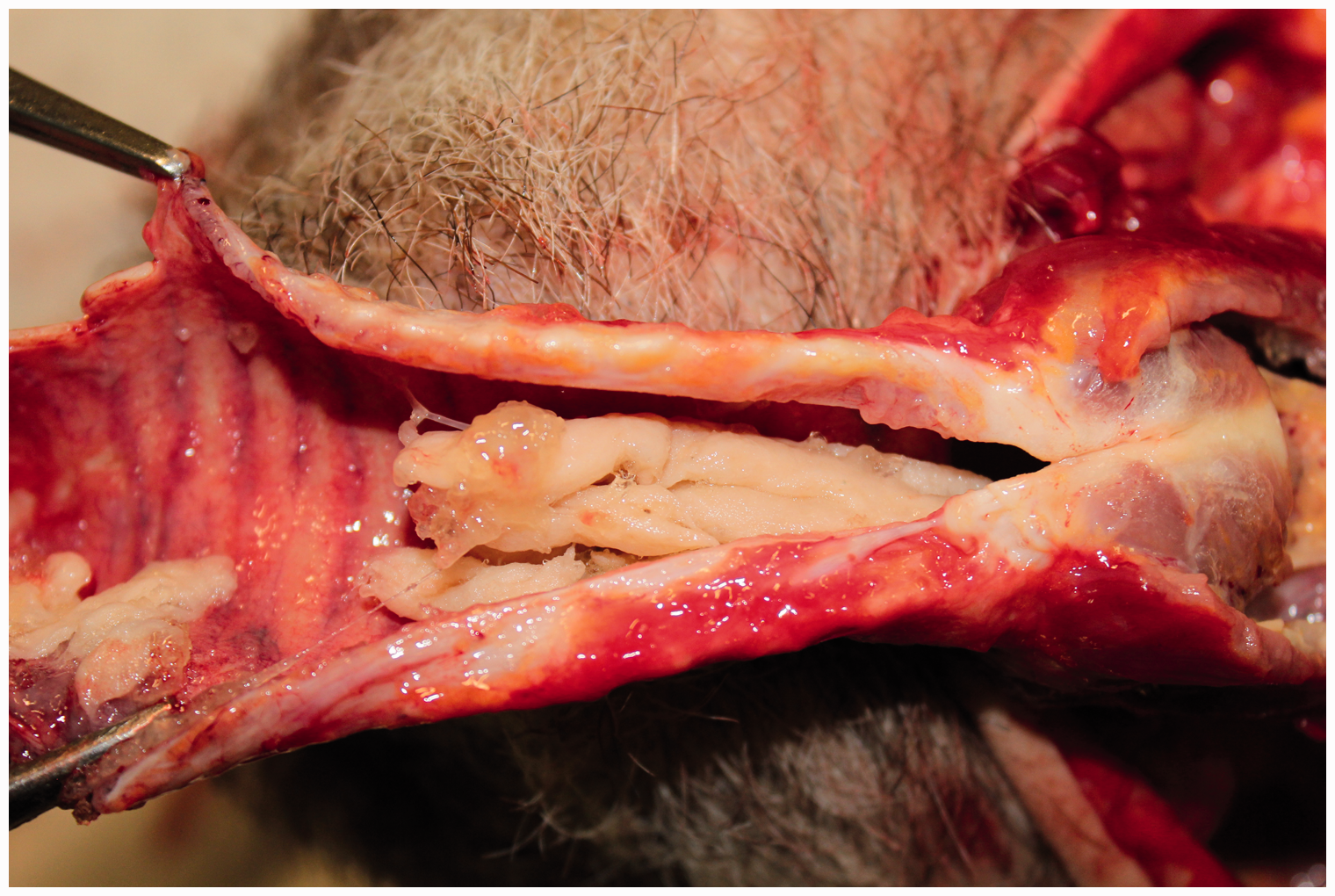
Residues of an undefinable material within the tracheal lumen.
In the sectioning, the gastric cavity contained the same material that was in the trachea, which was partially digested and had a total weight of 200 g (Figure 2). The same residues were noted within the esophageal lumen.
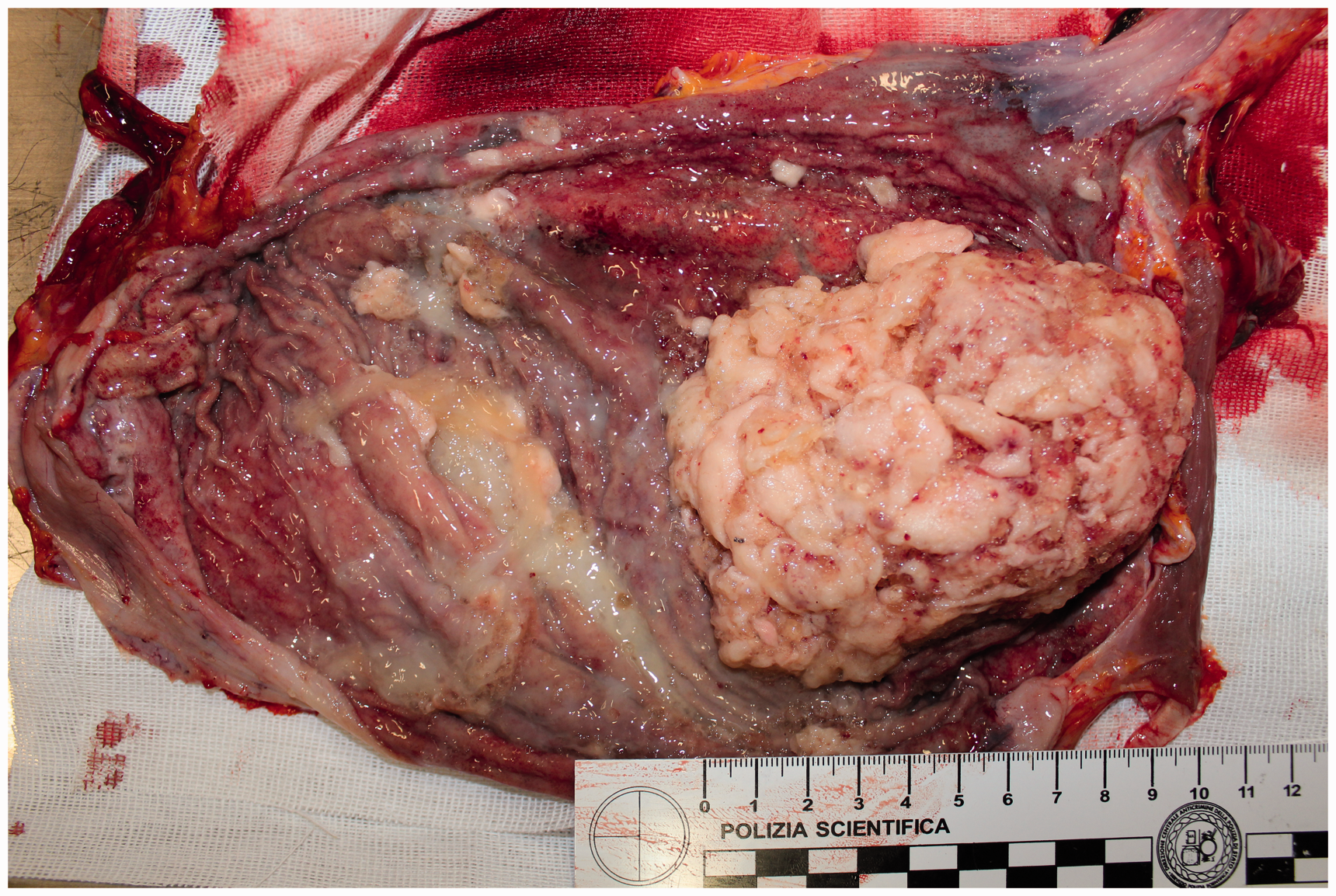
The same undefinable material in the gastric cavity.
No other significant alterations were observed that were relevant to the case.
Histological description
In the lungs, there was hyperextension of the alveolar cavities, with breakage of the inter-alveolar segments, and alveolar lung edema was noted. There was also amorphous granular material in some of the alveoli, and endo-alveolar hemorrhaging.
Toxicological findings
Toxicological analysis was performed on samples of blood at Forensic Toxicology, ‘Tor Vergata’ University of Rome. These were positive for phenytoin, valproic acid, and phenobarbital, with values within the therapeutic ranges. No alcohol or other drugs were detected.
Further analysis
Conventional analysis of the material found in the respiratory and gastrointestinal tracts was performed. This was defined as inorganic material that was composed of cellulose and cross-linked sodium polyacrylate. This was compatible with the absorbent part of a diaper.
Discussion
Intentional ingestion of a foreign body typically occurs in patients with underlying psychiatric problems, who will often repeat this behavior on multiple occasions. 9 Furthermore, in patients with psychiatric disorders, many drugs might precipitate or aggravate swallowing difficulties, thus increasing the risk of death from choking. The mechanisms implicated in drug-induced dysphagia are diverse. These include depression of the level of consciousness, interference with the oropharyngeal phase of swallowing, direct effects on brain-stem neurons, or blocking of acetylcholine release at the neuromuscular junction. Some drugs mediate their effects on swallowing by more than one mechanism. 10 Benzodiazepines can adversely affect swallowing in at least two ways: through a depressed level of consciousness, and through direct inhibition of the brain-stem neurons that regulate swallowing.11–13
The peculiarity of the present case was related to the initial difficulty of defining the cause of death. The first data that emerged from the examination of the body indicated a violent death from asphyxiation due to the detection of buccal excoriation and lateral eye excoriations, and of the hair found held between the fingers. Thus, it was only following the autopsy examination and the histological findings that it was possible to attribute the death to internal suffocation. Asphyxia was produced by occlusion of the respiratory tract by foreign material of a solid nature. The same material that was already partially digested was found in the first sections of the gastrointestinal tract, which indicated autonomous intake by the victim himself. The cause of death was certainly accidental because of the residues of the amorphous material that were identified in the histological examination at the alveolar level. In the case of homicidal suffocation with the introduction of material into the respiratory tract, this material would only be identified in the first section of the airways, as it would not reach the more peripheral branches to the lungs, and it would not be present at the gastric level in such quantities.
Through the qualitative analysis of the material found during the forensic investigations, it was possible to identify its nature and to trace it back to the suffocating medium. Evidently, the man was in a state of severe psychiatric trauma, and under the influence of his central psychotropic drugs, and presumably while also under hunger stimulation, he ate the absorbent content of the diaper he was wearing, crumpled with his hands and found next to him. The alteration of the mechanism of swallowing due to the psychic causes, associated with possible regurgitation, can be considered to be the mechanism that was responsible for his fatal respiratory failure.
An evaluation of cases in the literature emphasises the peculiarity of this particular case. In all of the studies retrieved from the literature, there were no cases where there was any doubt of the death being due to homicide.14–16 Indeed, in the majority of cases, the subjects involved had known psychiatric diagnoses and were followed by family members and supportive structures. However, in the present case, the man was in a general state of degradation and was not being followed by anyone who could provide useful indications that would have helped to establish the cause of death.
Footnotes
Declaration of conflicting interests
The authors declared no potential conflicts of interest with respect to the research, authorship, and/or publication of this article.
Funding
The authors received no financial support for the research, authorship, and/or publication of this article.