







Abstract
Abstract
The importance of autopsies in medical education is multidimensional. In accordance with the existing medical curriculum in India, forensic medicine is a subject taken up during the second year of the MBBS, and undergraduate students of medicine are expected to witness a minimum of 10 autopsies during the third to fifth semesters. This research analyses the perceptions of medical students towards medico-legal autopsy teaching and its significance at one medical institution in India. A total of 450 MBBS students participated in the study and submitted their responses to the predesigned semi-structured 20-point questionnaire on autopsy viewing and its relevance in general. The obtained data were analysed statistically using SPSS software. More than 75% of students agreed that they could appreciate the actual morphology and pathological changes in the human organs. There was a positive response from 54.9% students, who affirmed that autopsy helped refresh and improve their knowledge of human anatomy. More than 60% students agreed to have gained understanding of clinical–pathological correlations and became acquainted with death certification. The majority of the students (53.6%) agreed that autopsy postings made them mentally and emotionally stronger. The present study provides useful evidence regarding the perceptions of medical students towards autopsy teaching, and intends to highlight the utility of autopsies in enhancing the knowledge of medical students and its significance in the medical education curriculum.
Introduction
Medico-legal autopsies are a part of medico-legal investigations and assume significance in administration of justice. In India, medico-legal autopsies are performed at the request of the police or magistrate, with the primary aim of finding the cause of death and helping the investigators in reaching a conclusion about the manner of death. Besides legal implications, the significance of post-mortem examinations in medical education is immense. It has been suggested that autopsy attendance should be a part of undergraduate medical curricula. 1 In accordance with the existing medical curriculum in India, forensic medicine is a subject taken up during the second year of the MBBS, and undergraduate students of medicine are expected to witness a minimum of 10 autopsies during the third to fifth semesters.
The importance of autopsies in medical education is multidimensional. It promotes a better understanding of the anatomy and pathology of organs, death and its causes, and related medico-legal issues. 2 Medical students who witness autopsy benefit not only by experiencing anatomy and pathology first hand, but also by correlating with clinical pathology. 2 Students also learn about ethical and legal issues relating to death and about certifying the causes of death. Attending autopsies can expose students to the emotive aspects of the end of life, as well as helping them to identify issues that may prevent further loss of human lives. Though the advantages of attending autopsies for medical students are many, it can be a difficult and stressful experience for students, both physically and emotionally, 3 especially within the initial period of autopsy attendance during third semester. In this regard, a few researchers have attempted to study the views of medical students about autopsy attendance and its significance.3–6 Similar studies from India are, however, lacking, and hence the present research aimed to add to the existing literature by studying the perceptions of medical students towards medico-legal autopsy teaching and its significance at a leading medical institution in India.
Materials and methods
Prior approval was obtained to conduct this questionnaire-based study of MBBS students from the Institutional Ethics Committee of the medical institution where the study was undertaken. The sample size for the present study was 385. Accounting for a non-response error of 10%, the final sample size was calculated to be 420. A predesigned semi-structured 20-point questionnaire was used to collect the information from the MBBS students. The questionnaire used in the study was designed after due modifications to the standard questionnaires used in similar studies conducted in Malaysia 4 and Nigeria. 5 The first part of the questionnaire sought the personal details of the participating students in the form of age, sex, religion and the semester of the students, and this was followed by 20 specific questions on autopsy teaching and its significance.
The students were briefed on the aims and objectives of the study, and written informed consent was obtained from those who were willing to participate, following which the questionnaires were distributed. The participants’ anonymity and the confidentiality of their responses were strictly maintained. The participants’ responses were collected using a five-point Likert scale (1: strongly agree; 2: agree; 3: neutral; 4: disagree; and 5: strongly disagree) by asking them to mark one of these responses for each item in the questionnaire. Following collection of the completed questionnaires, the information obtained was analysed statistically using SPSS for Windows v11.5 (SPSS, Inc., Chicago, IL), and the results obtained were expressed in proportions. Likert scores of 1 and 2 were grouped together as agreement for comparison of percentage agreement among males and females and students of different semesters. The comparison between sexes was done using Student’s t-test, and the perceptions of the students studying in different semesters were compared using one-way analysis of variance to see if there was any change in the perceptions of students towards autopsy teaching and related issues based on their sex or semester/seniority. Statistical significance was set at p<0.05.
Results
A total of 450 MBBS students (169 male) from fifth, seventh and ninth semesters (150 for each semester) participated in the present study. The responses of the participating students to the 20-point questionnaire used in the study are shown in Table 1. More than 75% students agreed that they could appreciate the actual morphology and pathological changes in human organs. There was a positive response from 54.9% students, who affirmed that autopsy helped to refresh and improve their knowledge of human anatomy. More than 60% students agreed that they had gained understanding of clinical–pathological correlations and had become acquainted with death certification.
Responses of the participating students to the 20-point questionnaire used in the study.
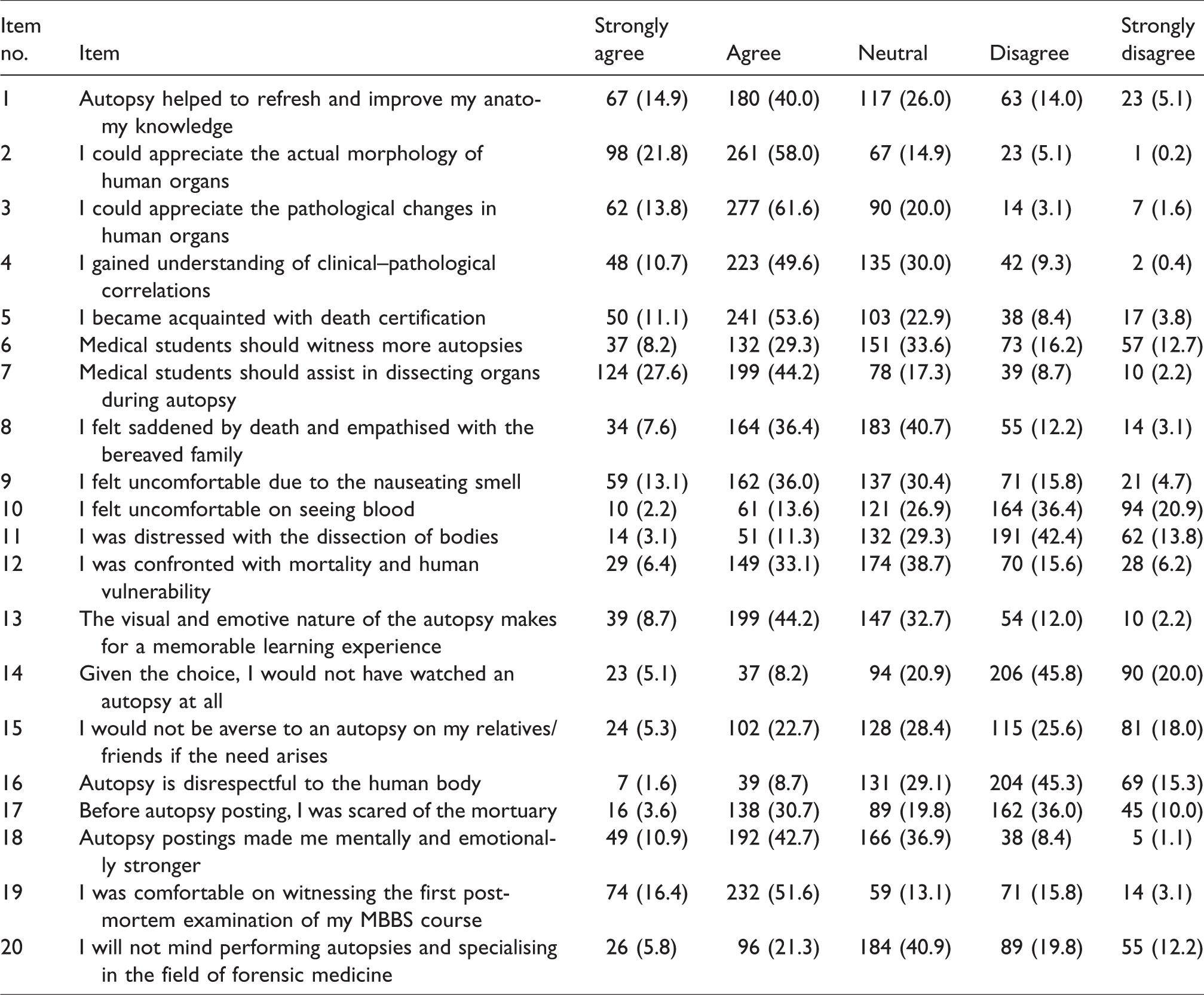
In India, each medical student needs to observe at least 10 autopsies in rotation during their forensic medicine placements. When asked if medical students need to observe more autopsies, there was a mixed response from the students: 37.5% thought they need to witness more, 28.9% disagreed with the statement, whereas 33.6% were not sure. Only 44% felt compassion and were empathetic towards the bereaved family, whereas 15.3% of the students stated a lack of such a feeling. The remaining 40.7% of students gave a neutral response. The nauseating odour emitted upon dissection was uncomfortable for almost half (49.1%) of the students, but only a few felt uncomfortable on seeing blood or during dissection of bodies (<15%). Nearly 40% students agreed that they were confronted with mortality and human vulnerability. Only a minority of students (14.4%) stated that the visual and emotive nature of the autopsy did not make for a memorable learning experience, whereas 13.3% of the students stated that given the choice, they would not have watched an autopsy at all. Nearly three-quarters (71.8%) of the students agreed to active participation and assisting in dissecting organs during the autopsy.
Although 60% of the students disagreed that autopsy is disrespectful to the human body, there was a mixed response from the students when asked if they would be averse to an autopsy on their relatives/friends if the need arises. The majority of the students (53.6%) thought that autopsy postings made them mentally and emotionally stronger. Similarly, 68% of the participants stated they were comfortable on witnessing the first post-mortem examination of their MBBS course, and 46% of the students were not scared of the mortuary before their autopsy posting started. The final question in the questionnaire was designated to evaluate the students’ attitude towards forensic medicine. There were fewer responses (27.1%) where the students stated that they would not mind performing autopsies and specialising in the field of forensic medicine.
Male and female responses on the various items in the questionnaire are shown in Table 2. All in all, the responses of male and female participants were similar on various aspects of autopsy teaching. Statistically significant differences were, however, observed for items 8 and 18 (Table 2), where a significantly larger proportion of female participants felt saddened by death and empathised with the bereaved family (p = 0.017), and felt that autopsy postings made them mentally and emotionally stronger (p = 0.021). Responses of medical students from different semesters on various items in the questionnaire are shown in Table 3. A significantly larger number of the most senior students in the final year of their MBBS felt that autopsies helped to refresh and improve their anatomy knowledge (p = 0.005), and that medical students should witness more autopsies (p = 0.011).
Sex differences for the agreement on the various items in the questionnaire among the participating students.
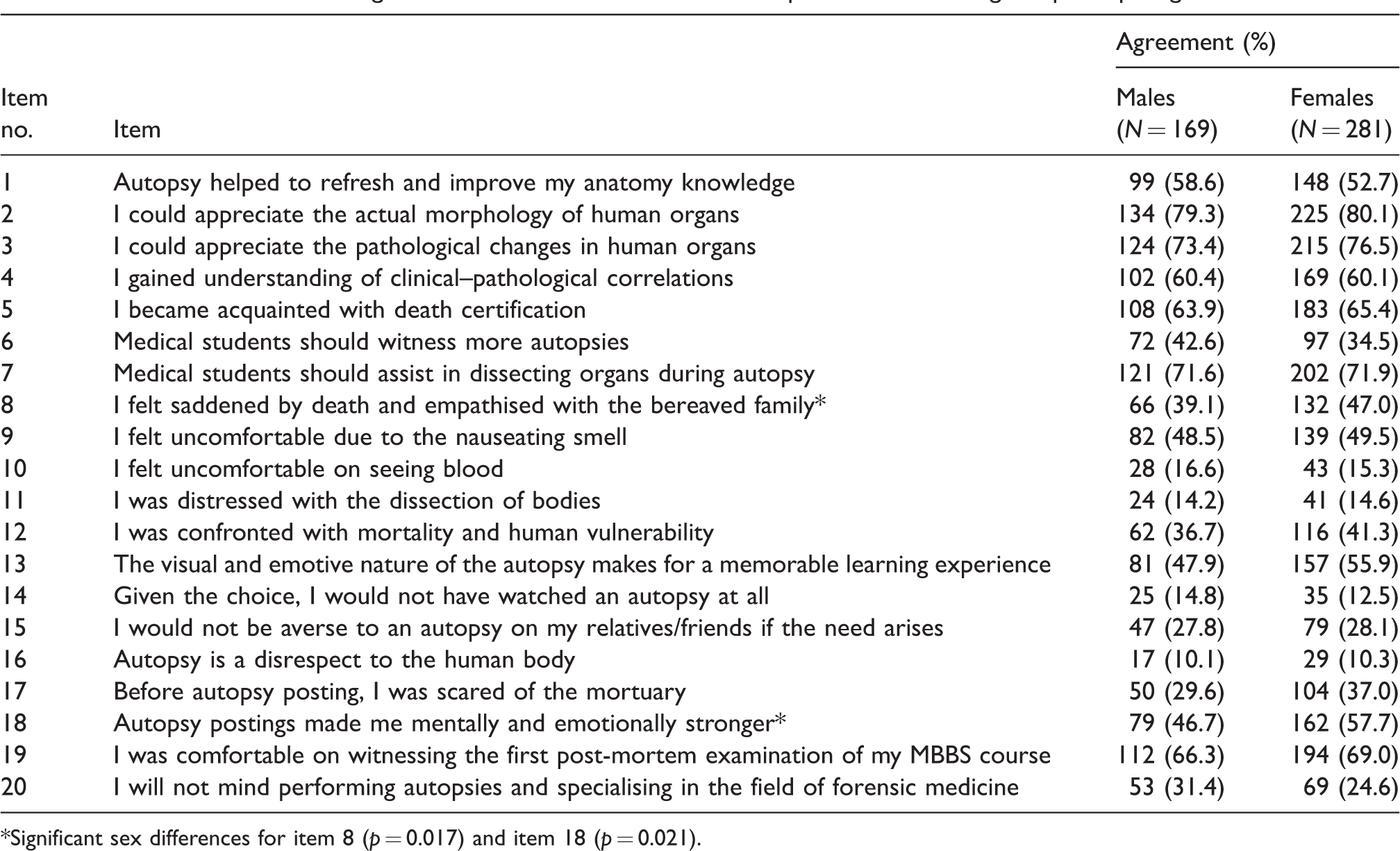
*Significant sex differences for item 8 (p = 0.017) and item 18 (p = 0.021).
Differences in agreement among the participating students in different semesters on various items in the questionnaire.
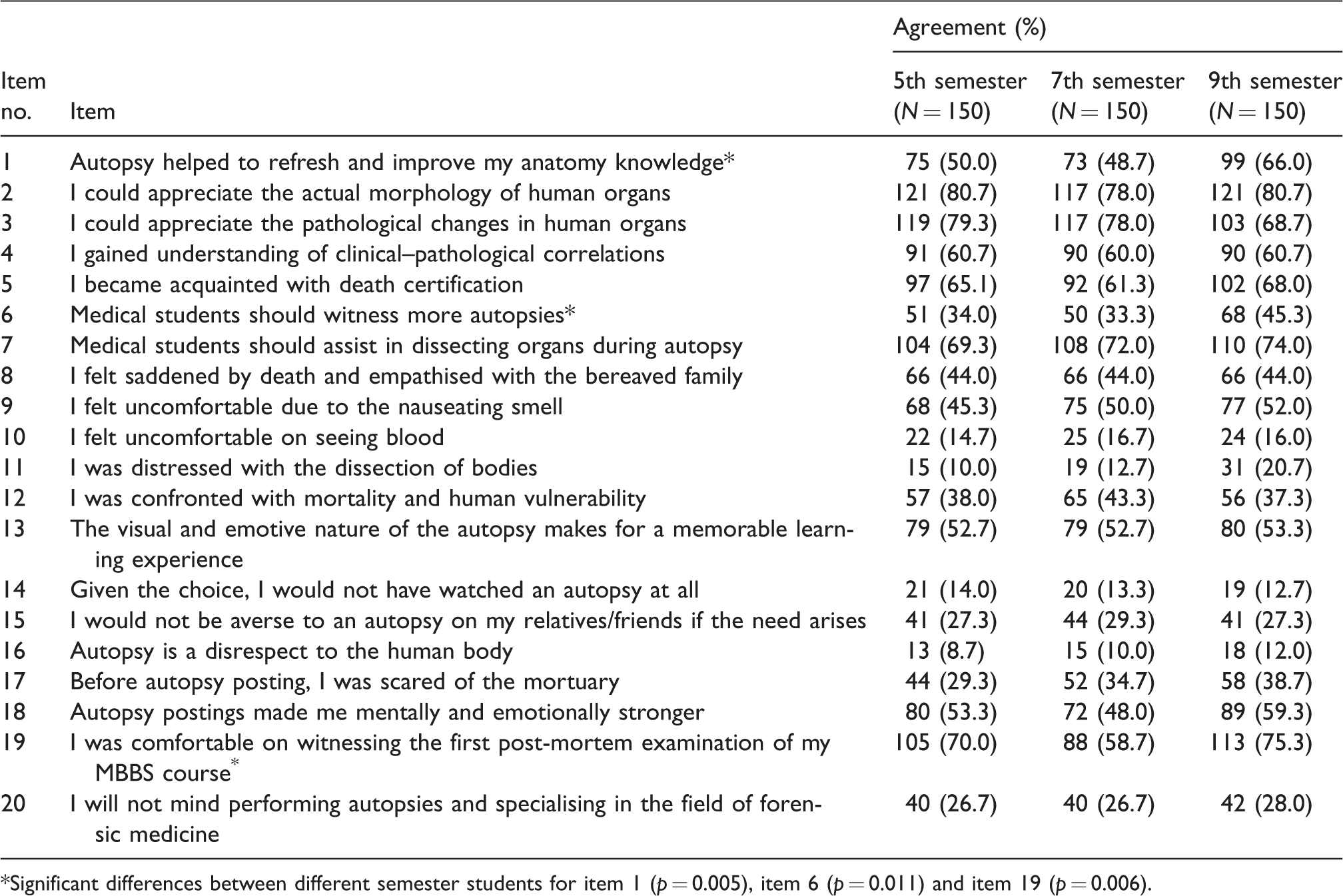
*Significant differences between different semester students for item 1 (p = 0.005), item 6 (p = 0.011) and item 19 (p = 0.006).
Discussion
In India, medical students are involved in three types of autopsies: anatomical, pathological and medico-legal. Anatomical dissections are solely educational and are performed for first-year students, whereas pathological or hospital autopsies are done to establish the cause of death, or underlying pathological process, when a patient dies in hospital without any specific diagnosis, and medico-legal autopsies are done in all cases of unnatural deaths at the request of legal authorities. The cadavers provided for students for anatomical dissection are usually intact without any external injuries. These are usually embalmed for preservation and bathed in formalin to prevent any decay. Anatomical dissection differs from medico-legal autopsy in the sense that the doctor performing a medico-legal autopsy sometimes has to establish the identity of the deceased, note the external and internal injuries, collect vital trace evidence from the body, and determine the cause, manner and time since death, and so on. Unlike cadavers in anatomical dissection, those brought to the mortuary are seldom free of any injury or underlying pathology.
In the course of their careers, medical doctors will encounter numerous medico-legal cases. Performing an autopsy and furnishing a detailed report is a doctor’s duty when required by the law, and for this, he/she is required to have a sound knowledge of autopsy practices. Considering its relevance, MBBS students are required to witness at least 10 autopsies during the second professional MBBS course in India. Autopsies are usually carried out in government hospitals and institutions. In non-governmental teaching hospital lacking autopsy facilities, the medical students are taken to government hospitals on rotation to witness the procedure, or it is demonstrated on a CD-ROM. However, the literature indicates that there are students who obtain a medical degree without witnessing a single autopsy,2,5,7 and there are no clear guidelines on medical students witnessing autopsies during their forensic medicine placements. 8
While anatomic dissections can provide knowledge regarding the morphology of human organs, autopsies aim to establish the underlying pathology. Most students found that autopsy was a useful tool in refreshing their anatomical knowledge and appreciating the gross morphology of the organs. Witnessing autopsies is likely to help students correlate theoretical aspects and visually familiarise themselves with pathology, thereby enhancing the learning process.9,10 Undergraduate medical students are usually not allowed to participate actively in autopsy procedures, or to dissect human bodies and organs. However, it was observed from the survey that most students wanted to participate in dissecting the organs. Medical students’ agreement to participate in the autopsy procedures in the present study reflects their understanding of the importance of autopsy in their medical education.
It is often thought that autopsy procedures are unpleasant and frightening.10,11 However, most of the students in this study were not distressed on dissection of human body and did not think of autopsy as disrespectful to the human body. This may be attributed to the fact that the medical students have already witnessed cadaveric dissections in the anatomy dissection rooms during the first year of the MBBS course. When asked if they would be averse to an autopsy on relatives, the majority of the responses were neutral. A possible reason for the adverse feelings of a student observing autopsy is, as quoted by Benbow, ‘the technicians treated the evisceration of a human being with the same feeling and tact as if gutting a fish … the organs were removed in a way that was intended to shock’. 4 If the technicians or the specialists do not handle bodies with dignity, then it could certainly create a negative impact upon the students.5,11 Any student witnessing such an approach during autopsies is likely to be averse to voluntary body donations for anatomy dissection and for autopsies on relatives in the future. Adapting a humane approach during dissection is the best way to impart learning among students. When witnessing autopsies, students should feel that a sense of professionalism, compassion and respect for the human body is present, even after death. 10
The most senior (ninth semester) students in this study remarked upon the need to observe more autopsies during the MBBS course. This may be due to the fact that they already have a clinical background and have started to understand the role of autopsy, not only in clinical–pathological correlations, 12 but also for commonly encountered medico-legal cases. 13 The other reason might be the inability of the treating physician in some cases to explain the cause of death of the patient to the family of the deceased. 11 In all such cases, pathological autopsies could help the practitioner to find the exact cause of death. However, despite the demonstrated relevance of autopsies, there has been a dramatic decline in the rate of hospital autopsies in recent years,2,14,15 which is a cause for concern. The majority of students answered negatively when asked about their choice of specialising in the field of forensic medicine. This reflects the stance of medical students towards forensic medicine and their general preference for clinical subjects.
The renowned pathologist William Osler advised: ‘use your five senses … let not your conceptions of the manifestations of disease come from the lecture room or words read in a book’. 16 While didactic teaching in forensic medicine can be monotonous, autopsy is an absolute example of problem-based learning in medical education. 17 Autopsy not only allows a medical student to appreciate the anatomy or pathology, it also provides a valuable platform to discuss psychosocial issues related to death and dying. 18 Despite its potential in educating medical students, it is often not used as an effective teaching tool.15,19 This study provides useful evidence regarding the perceptions of medical students towards autopsy teaching, and highlights the utility of autopsy in enhancing the knowledge of medical students and its significance in the medical education curriculum. The study is likely to enlighten medical students and teachers regarding the differences in perceptions of students on the various issues relating to autopsy teaching, which may help in improving the teaching methodologies in medical colleges related to autopsy teaching, as well as help develop a better understanding of the subject of forensic medicine.
Footnotes
Declaration of conflicting interests
The authors declared no potential conflicts of interest with respect to the research, authorship and/or publication of this article.
Funding
The authors received no financial support for the research, authorship and/or publication of this article.