






Abstract
In fingerprint analysis, the determination of hand (right or left) is one of the keys to resolving questions regarding the identity of the donor of the print. It is rare to encounter a complete set of 10-digit fingerprints from the scene of a crime. Although vital and imperative, except for a few studies on whorl patterns, the use of single-digit prints and patterns to ascertain the hand of the donor is scarcely reported in the literature. This research describes a novel approach whereby an analysis of twinned loops was carried out to identify the various parameters that may be helpful in ascertaining the hand of the donor. Bilateral rolled fingerprints from 180 healthy consenting adults belonging to a heterogeneous population of central India were collected. Out of the total of 1800 prints taken, 100 twinned loops (50 on the right hand and 50 on the left hand) were analysed. The following six parameters were considered: the slope of the flow of the apex ridges, the distance between the left delta and the ascending core, the distance between the right delta and the ascending core, mid-core position, the position of the loop and ridge tracing. On applying the chi-square test, the results were found to be statistically significant. Therefore, these parameters were found suitable for the determination of the hand from a single twinned-loop print.
Introduction
Fingerprints are the impressions of friction ridges on the distal phalanges of the fingers and thumb. They are often the most important means of identification found at various crime scenes, such as murder, theft, dacoity (i.e. banditry), rape, burglary, property dispute cases and questioned documents.1–7 Fingerprints provide crucial evidence that can disseminate essential information using various dermatoglyphic features, including pattern types, ridge count, ridge density and fingertip features.8–21
At crime scenes, fingerprints are often not found in a logical sequence. So, it can be challenging to determine whether the print is from the right or left hand.22–26 Determination of the hand (left or right) of a print allows an investigator to reduce the pool of suspects.23,24,26 It may not assist with individualisation per se, but it can offer new avenues for investigation. Fingerprints contain ridges and furrows that form various ridge characteristics that permit the development of different parameters and features that may help to establish the hand of the donor. The use of fingerprint-matching algorithms helps to reduce the time of fingerprint identification once the hand of the donor is established. 27
Literature dealing with the study of parameters for the determination of the hand of a single-digit fingerprint is scarce. While there are studies that deal with whorl patterns,22–26,28 only a few include twinned-loop patterns22,25,28 and study limited parameters. Therefore, this work aimed to study the various parameters in twinned-loop fingerprint patterns to ascertain the hand (left or right).
Methodology
Sample collection
The study was carried out on a heterogeneous population of central India. A total of 180 healthy adults aged between 18 and 60 years who were free from any deformities and disease (such as leprosy, scars or lacerations) affecting the fingers were included in the study.
The subjects were randomly selected. The purpose of the study was explained to them, and they were given the opportunity to ask questions and to clarify any doubts they may have had. Informed written consent was taken from subjects before they were enrolled in the study in accordance with the Declaration of Helsinki. Prints were then collected in an anonymised format.
As per the established procedure, rolled prints were taken. 26 The prints were taken in duplicate in order to avoid any uncertainty at any later point. In this study, twinned loops are considered to study the following parameter to verify the usefulness in the identification of hand. Henry’s Classification system was used. Out of the total of 1800 fingerprints (900 on the right hand and 900 on the left hand) collected, six parameters were studied in 100 twinned loops (50 on the right hand and 50 on the left hand).
The study was approved by the University Research Committee and was conducted in compliance with their ethical standards.
Parameters of analysis
Slope of apex ridge
The slope of the apex ridges in terms of their inclination towards the right side of the print is termed as right slopping, while their propensity towards the left side of the print is termed as left slopping.22,26
Distance between left delta and ascending core
The distance between the core of the ascending loop and the left delta was measured.
Distance between right delta and ascending core
The distance between the core of the ascending loop and the right delta was measured.
Mid-core position
The position of the midpoint of the line drawn between the cores of both the loops relative to the vertical line that crosses the delta line was noted (i.e. right, middle or left). 25
Position of the ascending loop
The location of the ascending loop with the perpendicular bi-sector drawn on the delta line (right side, left side or middle) was noted.
Ridge tracing
Ridge tracing beginning from the left delta to the right delta was done, and the result was noted (i.e. inner, meeting or outer).6,7,24,26
Statistical analysis
Statistical analyses were undertaken by applying chi-square tests (at p < 0.01 significance level).
Result and discussion
In this study, 100 samples (i.e. 50 samples belonging to the right hand and 50 belonging to the left hand) with twinned-loop patterns were analysed with the following parameters: the direction of flow of the apex ridge, the distance between the left delta and the ascending core, the distance between the right delta and the ascending core, the mid-core position, the position of the ascending loop and ridge tracing. The results, as observed, are described in Table 1.
Showing the parameters used for the determination of hand from fingerprints with a twinned-loop pattern.

*p < 0.01.
LS: left side; RS: right side; G: greater; E: equal; L: lesser; Mi: middle; I: inner; M: meeting; O: outer.
All of the studied parameters of the left-hand and right-hand twinned loops showed asymmetry (Figure 1).
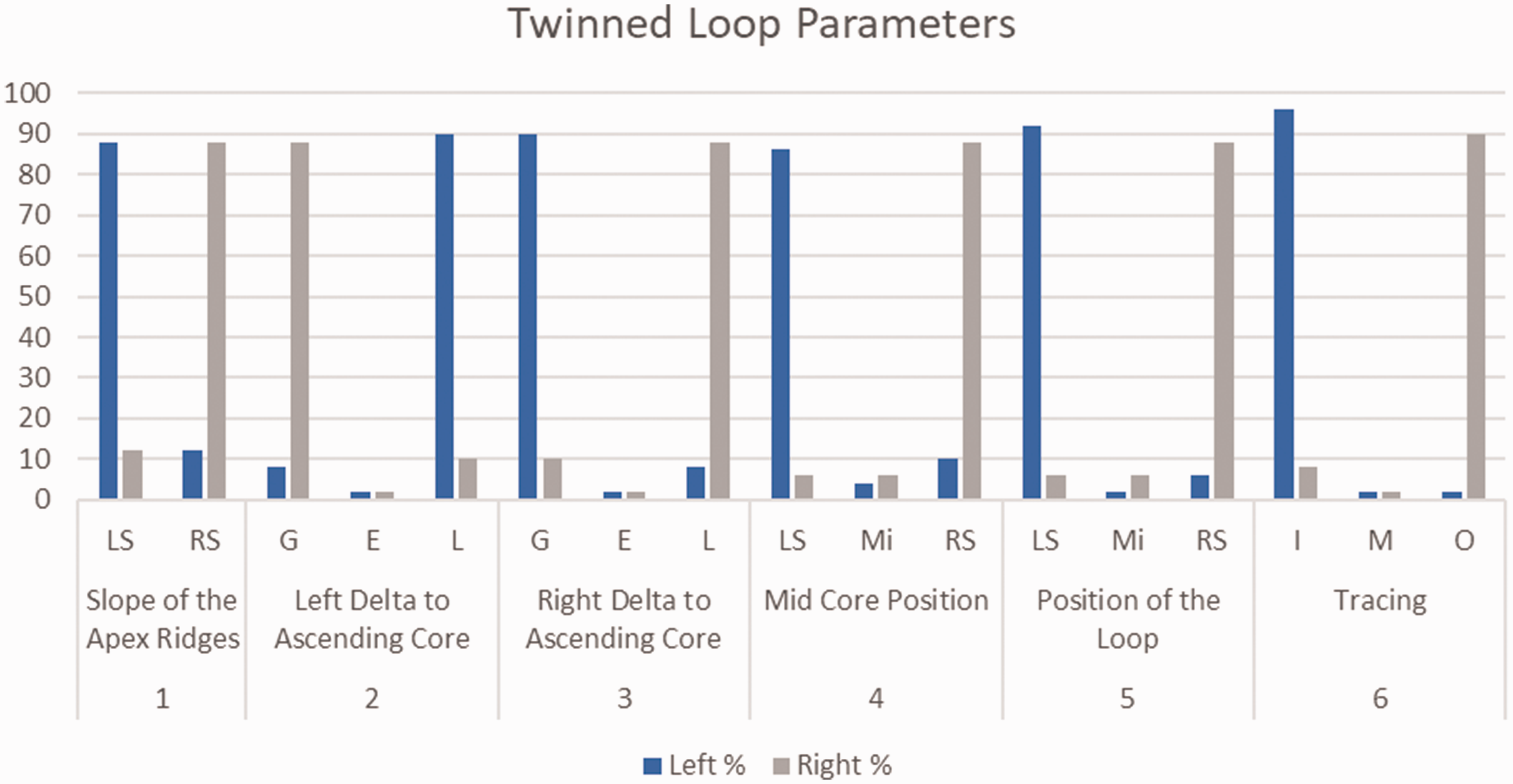
Percentage of asymmetry in the parameters used for the determination of hand. LS: left side; RS: right side; G: greater; E: equal; L: lesser; Mi: middle; I: inner; M: meeting; O: outer.
For the twinned loops on the left hand, the slope of the apex ridges was found to be towards the left side in 88% of the samples, while on the right hand, the slope was found to be towards the right side in 88% of the samples. These results are in accordance with the findings of Singh and Chattopadhyay, which is probably the first such study for the determination of the hand from single-digit fingerprint that reported the downward slope of the apex ridges towards the left side in 84.61% of samples on the left hand and towards the right side in 78.57% of samples on the right hand in Punjabi Jat males. 22
The distance from the left delta to the ascending core was conclusively smaller in 90% of the samples for twinned loops on the left-hand, while it was greater in 88% of the samples on the right hand. The trend reversed when the distance from the right delta to the ascending core was measured, and it was found to be greater in 90% of the samples on the left hand and smaller in 88% of the samples on the right hand.
The mid-core position was towards the left side in 86% of the samples on the left hand and towards the right side in 88% of the samples on the right hand. On the left hand, the position of the ascending loop was towards the left side in 92% of samples and towards the right side in 88% of samples on the right hand.
A total of 96% of the samples on the left hand showed ‘inner’ ridge tracing, whereas 90% of samples on the right hand showed ‘outer’ ridge tracing. The side-specific differences in the ridge tracing of the twinned loops were in agreement with the results of the study conducted on Czechs, Slovaks and Lusatian Serbs by Kralik et al. 25 who found 84% inner tracing on the left hand and 84% outer tracing on the right hand. A few parameters under consideration in the present study could not be compared per se with other studies.
Applying the chi-square test showed that there was a significant association (p < 0.01) of these studied parameters of the twinned-loop pattern on the left hand and on the right hand (Table 1). Inter- and intra-observer variability rates were found to be insignificant (p > 0.01).
Ten blind (unknown) single-digit double-loop pattern fingerprint samples were assessed by two observers independently. From the parameters under consideration, they were able to identify the hand of the print correctly in all the samples.
All the parameters studied were found to show statistically significant radio-ulnar asymmetry and hence may be used for the determination of hand (left or right) from a single-digit fingerprint.
Conclusion
The sloping of the apex ridges towards the left side, smaller distance from the left delta to the ascending core, greater distance from the right delta to the ascending core, mid-core position on the left side, ascending loop on the left side and ‘inner’ ridge tracing would lead to the conclusion of left-handedness of the print (Figure 2).
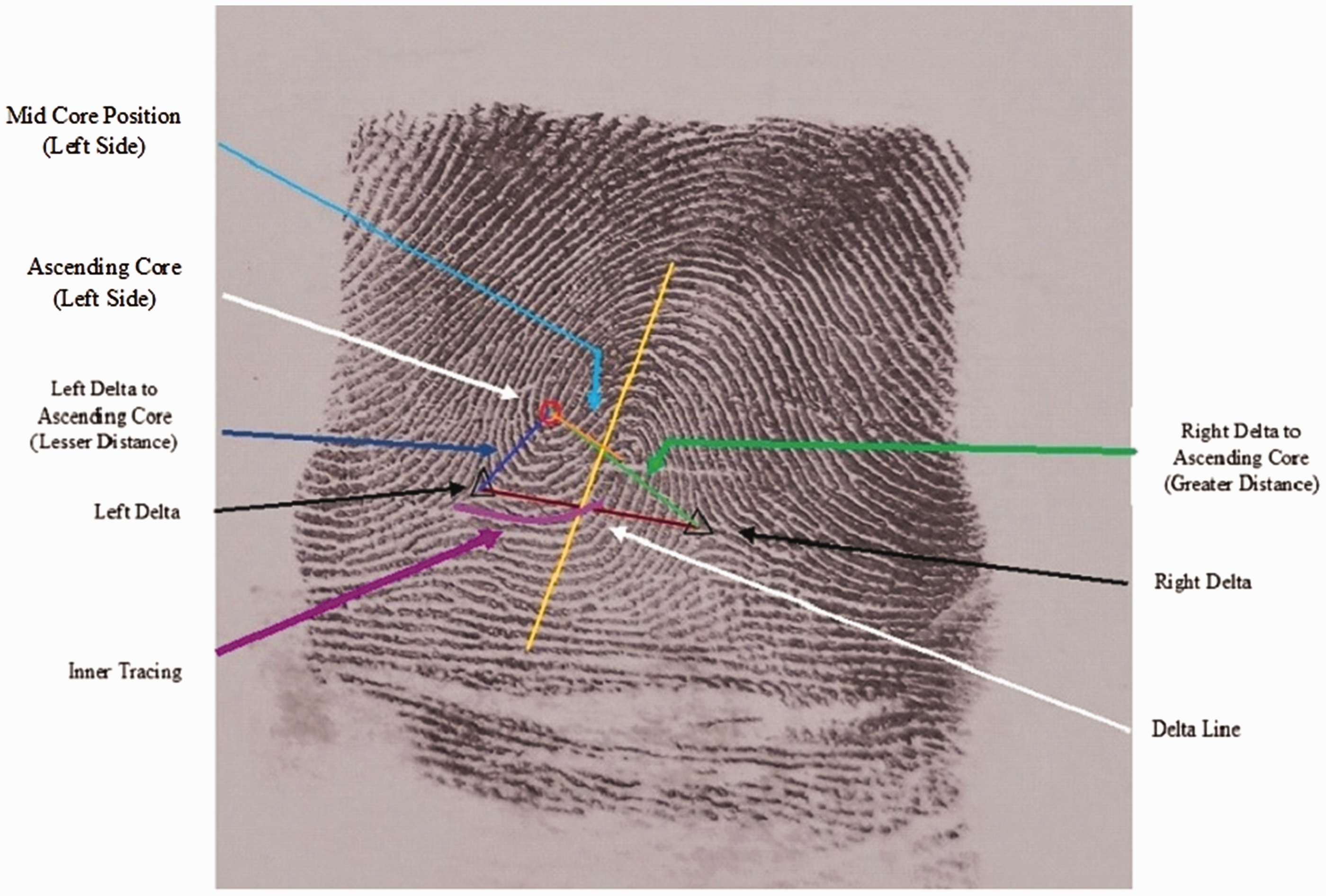
Parameters of the left-hand twinned loop.
The sloping of the apex ridges towards the right side, greater distance from the left delta to the ascending core, smaller distance from right delta to the ascending core, mid-core position on the right side, ascending loop on the right side and ‘outer’ ridge tracing would lead to the conclusion of right-handedness of the print (Figure 3).
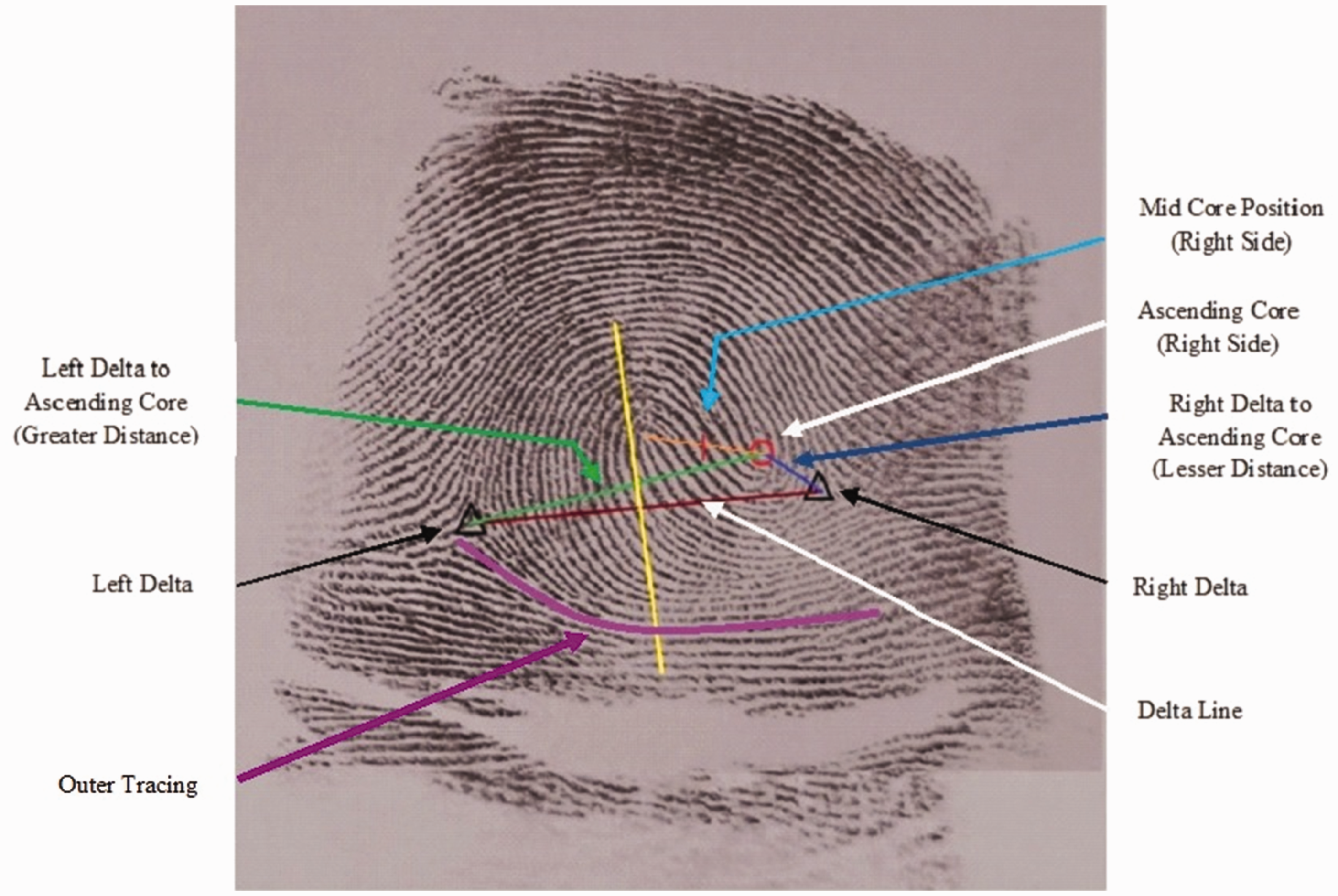
Parameters of the right-hand twinned loop.
The study confirms the findings of the only two similar studies in this specific area,22,25 while also adding newer parameters, thereby aiding the determination of the hand from a single-digit fingerprint. Apart from the crime scene, single-digit prints may be encountered in cases involving burglary, idol theft, automobile theft, cheats, attendance sheets in competitive examinations, pension-related documents, insurance claim-related documents, property-related documents, wills, bank cheques and biometrics attendance. The determination of hand may be used as a criterion for elimination and may quicken the search in cases of criminal investigation and personal identification. In the future, there is a possibility of extending this study for palm prints in public databases such as the Latent Palmprint Identification Database (LPIDBv1.0). 29 The frequency of occurrence may be used to derive a ‘search sequence’ to search the database. Further studies with other pattern types and other discernible parameters are in progress. Population variability may be studied further to ensure the universal applicability of these parameters.
Footnotes
Acknowledgements
The authors wish to thank the participants of the study, who willingly donated their prints for the study, and the reviewers for their comments. N.K. and A.B. gratefully acknowledge the Director, Government Institute of Forensic Science, Nagpur, and Department of Higher Education, Government of Maharashtra, for their encouragement.
Declaration of conflicting interests
The authors declared no potential conflicts of interest with respect to the research, authorship and/or publication of this article.
Funding
The authors received no financial support for the research, authorship, and/or publication of this article.
