






Abstract
In the Eastern Black Sea Region, located in the northeast of Turkey, traditional wooden houses with rich visual and architectural features represent an important aspect of folk building arts. However, fires in these wooden houses, which have a high fire load, pose a significant public health issue, leading to substantial loss of life and property. This study aimed to evaluate deaths caused by wooden house fires over a 10-year-period from a forensic medicine perspective, with the goal of raising social awareness and providing recommendations for prevention and protection. 87.1% of the victims died at the scene. 68.2% of the bodies exhibited fourth-degree (carbonized) burns. 78.8% showed macroscopic soot contamination in the lower respiratory tract. 69.4% had elevated blood carboxyhemoglobin levels, with a mean value of 41.2%. Identification was achieved through DNA comparison analysis in 36.5% of cases. The study determined that 83.6% of the deaths resulted from direct carbon monoxide intoxication, direct burns, or a combination of burns and carbon monoxide intoxication. To accurately determine both the identity of the deceased and the true cause of death in fire victims, a comprehensive investigation is essential. This includes detailed crime scene examination and extended toxicological, pathological, radiological, and molecular genetic analyses alongside autopsy procedures. Strong correlations were identified between blood carboxyhemoglobin levels, soot contamination in the lower respiratory tract (macroscopic and microscopic), and fire-related causes of death. Furthermore, DNA comparison analysis enables 100% accurate identification, even in highly carbonized bodies.
Keywords
Introduction
Folk building arts with significant visual and formal richness are prominently featured in the Eastern Black Sea Region, located in the northeast of Turkey. One of the most notable examples of these arts is the construction of traditional wooden houses, which are made entirely of wood or a wood-concrete mixture (houses with concrete first floors and wooden upper floors).1,2 Due to the region's rugged and steep geographical structure, these wooden houses are often built in scattered rural areas, typically on hillside terrain. More durable wood types, such as pine, spruce, and beech, which are readily available and easy to process in the region, are commonly used in the construction of these houses. However, the high fire load of wooden materials and their low fire resistance significantly increase the risk of fires breaking out and spreading in these homes.1–4
Fires are significant yet preventable public health issues that arise from various causes, posing serious threats to human life and leading to substantial damage and loss of life.5,6 House fires constitute a large proportion of fire-related fatalities,6–8 and most of these incidents are preventable. The most common causes of house fires are accidental, with typical sources including electrical faults, stoves, boilers, chimney ignitions, natural gas leaks, cigarets, matches, welding sparks, fires originating from neighboring homes, sabotage, or natural events.5,7 While deaths from direct carbon monoxide poisoning or direct burns are frequent in fires, accurately determining the exact cause of death or identifying the deceased particularly in cases involving carbonized bodies poses significant challenges for forensic medicine professionals.6–9
Studies on deaths caused by wooden house fires are quite limited in the literature. In our study, cases of deaths resulting from wooden house fires, which were autopsied between 2014 and 2023 at the Forensic Medicine Institute Trabzon Forensic Medicine Group Presidency a reference autopsy center in the Eastern Black Sea Region of northeast Turkey were evaluated from a forensic medicine perspective. The aim was to raise social awareness, propose preventive measures, and contribute to the existing literature.
Materials and methods
Selection of cases, data, and groupings
A total of 4.878 forensic autopsy files performed at the Forensic Medicine Institute Trabzon Forensic Medicine Group Presidency between January 1, 2014, and December 31, 2023, were reviewed. Among these files, 85 forensic cases resulting from 74 separate wooden house fires were identified. Information about the cases included in the study was obtained from archive records and the National Judicial Network Project (UYAP) system. Within the scope of the study, detailed analyses were conducted on crime scene investigation findings, place of death, sociodemographic data, autopsy findings, and radiological, histopathological, and toxicological examinations. Additionally, the identification process and causes of death were thoroughly examined.
Statistical analysis
The statistical analysis for this study was conducted using the IBM SPSS 25 software. Categorical variables were presented as frequencies and percentages, while descriptive statistics for continuous variables were expressed as mean ± standard deviation. Categorical variables were grouped, and percentages were calculated. Depending on suitability, the Pearson Chi-Square test, Continuity Correction, and Fisher's Exact Test were used to compare frequencies. For assessing significance between groups in multiple comparisons, post hoc analysis methods and Bonferroni correction were applied to the chi-square test. The Kolmogorov–Smirnov test was used to check the normality of continuous variables (p > 0.05). For comparing the means of two groups, the Independent Samples T-Test was applied when data followed a normal distribution, while One-Way analysis of variance (ANOVA) was used for comparing the means of three or more groups under similar conditions. In all statistical analyses, p-values < 0.05 were considered significant. The existence of relationships between variables was statistically demonstrated.
Results
Crime scene investigation findings, place of death, and sociodemographic data
In our study, we examined 85 deaths resulting from 74 separate wooden house fires. Of these fires, 77.0% (n = 57) occurred in rural areas, 63.5% (n = 47) took place in fully wooden houses, and 56.8% (n = 42) occurred during the winter months (December, January, February). It was found that 44.6% (n = 33) of the fires were caused by stoves and chimneys. Single fatalities were identified in 86.5% (n = 64) of the fire debris (Table 1).
Distribution of fires (n = 74) and crime scene investigations.

A maximum of three deaths were recorded in a single house. After determining gender and identity, 62.4% (n = 53) of the cases were male, and 37.6% (n = 32) were female, with an average age of 57.6 (SD: 29.8; min: 1, max: 105). It was found that 57.6% (n = 49) of the cases were over the age of 65, and 60.0% (n = 51) lived alone. It was determined that 87.1% (n = 74) of the cases died at the scene, while 12.9% (n = 11) died during follow-up or treatment in the hospitals to which they were taken after the incident. No statistically significant difference was found between burn degrees and age groups, or the issue of living alone (p > 0.05). It was observed that fourth-degree (carbonized) burn cases frequently died at the scene (χ2: 18.859, SD: 1, p = 0.000). Carbonization of the face (χ2: 47.475, SD: 2, p = 0.000) and amputations of extremities (χ2: 45.413, SD: 1, p = 0.000) were common, and the cause of death was frequently a combination of burns and carbon monoxide poisoning (χ2: 32.840, SD: 1, p = 0.000). Statistically significant differences were detected (Table 2).
Relationship between burn degrees and sociodemographic data, external examination findings, scene of death and cause of death.

External examination findings at autopsy and radiological examinations before autopsy
It was determined that 68.2% (n = 58) of the cases had fourth-degree (carbonized) burns, 23.5% (n = 20) had second- and third-degree burns, and 8.2% (n = 7) had first-degree burns. In 50.6% (n = 43) of the cases, limb amputations were detected due to fourth-degree (carbonized) burns, and in 48.2% (n = 41) of the cases, the face was deformed beyond recognition due to fourth-degree (carbonized) burns (Figure 1; Table 2). All cases with fourth-degree (carbonized) burns (n = 41, 100%) and 62.3% of the total cases (n = 53) underwent scopy before autopsy. Surgical/medical materials were detected in some corpses during scopy, which were used for the identification of the cases (Figure 2).

The pictures are of different crime scenes and different bodies. (a) and (b) Carbonized corpses at the scene. (c) and (d) Carbonized corpses requiring autopsy.
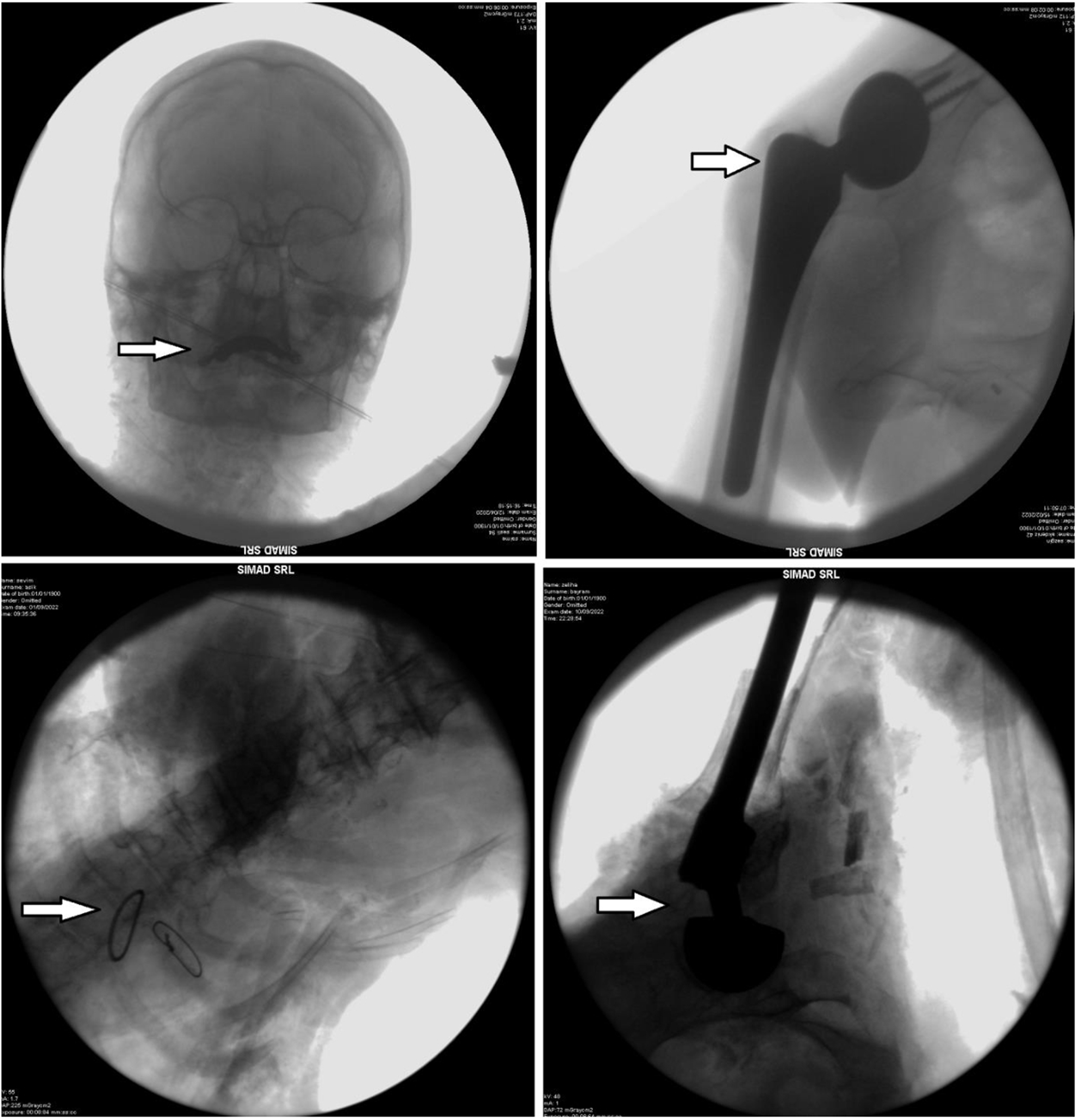
Surgical and medical materials were detected in pre-autopsy radiological (scopy) examinations of different cases.
Internal examination findings, histopathological and toxicological examinations at autopsy
In 78.8% (n = 67) of the cases, macroscopic soot contamination was found in the lower respiratory tract (trachea, main bronchi) during autopsy, and in 28.2% (n = 24) of the cases, microscopic examination of histopathological samples taken from the lungs revealed soot contamination (Figure 3). A statistically significant relationship was detected between the blood carboxyhemoglobin level and the presence of macroscopic soot in the lower respiratory tract during autopsy (χ2: 4.053, SD: 1, p = 0.44). Blood fluid was obtained for toxicological analysis in 90.6% (n = 79) of the cases. Ethanol was detected in the blood in 4.7% (n = 4) of the cases, and carboxyhemoglobin was detected in 69.4% (n = 59). The average carboxyhemoglobin level was determined to be 41.1% (SD: 19.2; min: 7.7%–max: 80.4%). The average carboxyhemoglobin level in those whose cause of death was direct carbon monoxide poisoning was 46.9% (SD: 13.18; min: 26.4%—max: 80.4%). In three cases where carbon monoxide poisoning was considered the cause of death, the lowest blood carboxyhemoglobin levels were 26.4%, 26.6%, and 29.5%, respectively. These cases were found to be accompanied by 287 mg/dl ethanol, asthma, and Alzheimer's disease. In cases found dead at the scene, the blood carboxyhemoglobin level was significantly higher in those whose cause of death was determined to be either direct carbon monoxide poisoning or the combined effect of burns and carbon monoxide (P < 0.05). No significant differences were detected between blood carboxyhemoglobin levels and age or gender groups (P > 0.05) (Table 3).

(a) Microscopic soot contamination in the alveolar epithelium under a light microscope at 100× magnification. (b) Macroscopic soot contamination in the lower respiratory tract at autopsy.
Analysis of 59 cases in which carboxyhemoglobin (COHb) was detected according to their groups.

Identification and determination of causes of death
In 45.9% (n = 39) of the cases, identification was made by family members or relatives, in 36.5% (n = 31) through DNA comparison analysis, and in 5.9% (n = 5) through surgical/medical materials found in their bodies. In 11.8% (n = 10) of the cases, no request for identification was made, although identification information was found in their files. Of the 31 cases for which DNA analysis was performed, DNA profiles were obtained from blood in 25 cases (80.6%) and from bone or muscle tissue in 6 cases (19.4%). For comparison, DNA profiles were obtained from blood or saliva samples taken from the mother, father, or children of the deceased. In all 31 cases where DNA comparison was made, identification was successfully achieved through biological parentage (motherhood and paternity).
Based on crime scene investigation reports, investigation documents, autopsy findings, and radiological, histopathological, toxicological, and biological examinations: 22.4% (n = 19) of the cases were caused by direct carbon monoxide poisoning, 29.4% (n = 25) by direct burns and complications, 31.8% (n = 27) by combined burns and carbon monoxide poisoning, and 7.1% (n = 6) were found to have died from trauma or cardiac pathologies. In 9.4% (n = 8) of the cases, the cause of death could not be determined, and these were reported as negative autopsies.
Discussion
Studies on fires in our region indicate that building fires frequently occur in reinforced concrete structures, with reported rates ranging from 51% to 67%. This is attributed to the numerical and proportional prevalence of reinforced concrete buildings in both our country and region.10–12 Additionally, fire-related injuries are reported to be more common in areas with limited access to modern energy sources.13,14 In this study, we specifically examined fatal wooden house fire incidents to contribute to the existing literature. It was found that wooden house fires occurred in rural areas in 77.0% of cases, during winter months in 56.8% of cases, and in 55.2% of cases due to heating methods such as stoves, chimneys, and electric heaters. As a result, it is crucial for local residents to exercise extra caution when using heating tools and equipment in wooden houses. Additionally, we suggest that measures such as using fire-retardant and protective coatings on wood, ensuring the availability of portable fire extinguishers and fire escape routes, and promoting the use of modern energy sources like natural gas and solar energy would be highly effective in preventing wooden house fires.
Professional fire brigades often face delays in reaching fire scenes in rural areas due to transportation challenges. These delays hinder early intervention, leading to the release of toxic gases and high temperatures, which make extinguishing and controlling fires significantly more difficult.4,15 Therefore, establishing volunteer fire stations in village centers is crucial to ensuring quick responses to fires, particularly in rural areas. In many parts of the world, including Austria, China, Switzerland, France, and Japan, approximately 90% of firefighters are volunteers. 16 While volunteer firefighting is supported in our country, the number of volunteer firefighters remains significantly lower compared to many other countries, though it is gradually increasing. 17 Our study revealed that 77.0% of wooden house fires occur in rural areas, with a majority of cases (62.8%) involving fourth-degree (carbonized) burns. Only 12.9% of the victims were rescued alive from the fire scene, but they ultimately succumbed to their injuries during follow-up and treatment in the hospital. It is worth noting that in large-scale house fires, bodies can become charred within approximately 20 min.18–20 These findings highlight the severe and often fatal consequences of wooden house fires in our region. Given the geographical and settlement characteristics of the region, there is an urgent need for volunteer firefighters in rural areas. Increasing volunteer firefighter participation and providing comprehensive training on fire safety and firefighting techniques are essential steps. We believe that establishing volunteer fire stations in rural areas, equipping them with appropriate firefighting tools, and ensuring prompt and effective interventions by trained volunteers can significantly reduce the loss of life and property caused by fires.
As in the rest of the world, in Turkey, the rate of elderly population in society is increasing day by day due to the decrease in fertility and mortality rates.21–22 Another reality of life experienced by many people today, along with old age, is loneliness. Loneliness with age emerges as an important social problem.21,23,24 57.6% of our cases are in the age group over 65 and 60.0% live alone. It is inevitable that there will be an increase in chronic diseases that will prevent physical movement or cognitive activity in this group of people who live alone and are elderly. We think that this situation both reduces the possibility of getting help in case of fire and causes injuries to be more mortal. Therefore, we think that the problem of loneliness in the elderly, which is an important and conscientious social issue, should be resolved with both psychosocial and socioeconomic support programs.
Macroscopic soot contamination in the lower respiratory tract (tracheobronchial levels) is frequently observed during autopsies, resulting from smoke inhalation during a fire. Microscopic examinations of the tracheal mucosa and distal parts of the lungs also reveal the presence of soot contamination. While the presence of soot in the lower respiratory tract indicates that the deceased was breathing during the fire, its absence does not necessarily mean the person died before the fire. Even without active breathing, passive soot contamination can occur in the upper respiratory tract (around the mouth, nose, and pharynx) and extend to the vocal cord levels.18–20 The detection of carboxyhemoglobin in the blood increases the likelihood of soot contamination in the respiratory tract. 17 In our study, we identified macroscopic soot contamination in 78.8% of cases and microscopic soot contamination in 28.2% of cases in the lower respiratory tract. A statistically significant relationship was found between carboxyhemoglobin levels and soot aspiration. In autopsies, detailed macroscopic and microscopic examinations of the lower respiratory tract provide crucial data for determining vitality and establishing an accurate cause of death.
Carbon monoxide is a colorless, odorless gas often referred to as the “silent killer,” with house fires being a primary source of exposure. It replaces oxygen at the oxygen-binding sites on hemoglobin, binding tightly and preventing oxygen from reaching the tissues. In indoor fires, such as those in residential buildings, carboxyhemoglobin saturation can reach 30% within just a few minutes. It is one of the most common toxic agents causing death in forensic medicine and represents a significant public health issue.25–27 Although studies show some variation, it is generally accepted that a blood carboxyhemoglobin level above 40%–50% indicates death by carbon monoxide poisoning. Carboxyhemoglobin levels between 10% and 50% suggest the person was alive when the fire started. Baseline carboxyhemoglobin levels can also be observed in up to 10% of people.6,14,18–20,26,27 Additionally, carboxyhemoglobin levels of 20%–30% can be fatal, especially in the elderly or those with additional injuries or underlying conditions such as cardiovascular disease, atherosclerosis in brain vessels, or chronic lung disease.18,19,26,27 In our study, the average carboxyhemoglobin level was 46.9% in cases where direct carbon monoxide poisoning was determined as the cause of death, which is consistent with the literature. This value dropped to 26.4% in cases with comorbid conditions, such as alcohol use, asthma, and Alzheimer's disease. Furthermore, we found that carboxyhemoglobin levels were significantly higher in cases that died at the scene compared to those who died in the hospital. This suggests that respiratory support and medical interventions in hospitals help reduce carboxyhemoglobin levels. Therefore, we believe that in cases where death occurs after medical treatment due to burns, examining antemortem blood samples from health institutions where the person sought care following the incident would be valuable in determining the accurate carboxyhemoglobin level and establishing the correct cause of death. Blood carboxyhemoglobin levels play a critical role in diagnosing death, assessing vitality, and determining the origin of death in fire-related fatalities. They constitute one of the most important pieces of data in forensic autopsies.
Fingerprint examinations, dental evaluations, and DNA analyses are considered the primary and gold standard methods of identification. 28 In our country, DNA comparison analyses (molecular genetic examinations) for identification are regulated by legal legislation and can only be conducted upon the request of judicial bodies. 29 Moreover, since there is no national DNA database in our country, comparative samples are required to complete DNA identification. 30 Although these limitations presented challenges in our study, DNA profiles were successfully obtained from all 31 cases for which DNA identification was requested by the judicial authorities. This demonstrates that DNA profiles can be obtained even from highly carbonized corpses, allowing for 100% identification. Radiological examination was performed on 100% of the carbonized corpses, and identification was made through surgical/medical materials detected on the bodies of 5 cases. Additionally, we found that no identification requests were made for 10 of the carbonized corpses, and identification was determined by the judicial authorities. However, we believe that relying solely on this method is not an acceptable approach and may lead to significant misconceptions. Therefore, as determined in our study, we recommend that postmortem radiological examinations and DNA identification be performed routinely, especially in cases involving highly carbonized corpses due to fire.
Although deaths due to smoke inhalation, carbon monoxide poisoning, burns, and subsequent complications frequently occur in fires, deaths caused by traumatic events unrelated to the fire or by natural diseases are also reported. In some cases, the cause of death cannot be determined because body fluids suitable for toxicological examination and tissue samples appropriate for histopathological analysis cannot be obtained due to severe carbonization of the body.6,7,31,32 In our study, we found that 83.6% of the cases, consistent with the literature, died from direct carbon monoxide poisoning, direct burns, or a combination of both. We also found that 7.1% of the cases died from trauma or cardiac pathologies, independent of burns or carbon monoxide poisoning. In 9.4% of the cases, the cause of death could not be determined due to advanced carbonization. Therefore, forensic medicine professionals should be aware that the cause of death may remain undetermined despite detailed postmortem examinations on highly carbonized corpses. All antemortem findings, extended postmortem findings, and crime scene investigation reports should be thoroughly examined, and the reporting process should adopt a multidisciplinary approach. 33 All procedures carried out during the investigation should be clearly stated. We believe that acknowledging the inability to determine the cause of death, specifying the potential causes that could not be identified, and noting that a re-evaluation can be made if new information arises will contribute to a better understanding of this challenging process.
Conclusion
In cases of death due to wooden house fires, determining both the identity of the deceased and the cause of death becomes extremely difficult due to severe burns. Strong correlations are established between blood carboxyhemoglobin levels, the presence of macroscopic and microscopic soot contamination in the lower respiratory tract, vitality, and fire-related causes of death. DNA comparison analysis allows for 100% identification, even in highly carbonized corpses. To determine the true cause of death and the identity of the individual, a detailed crime scene examination, along with extended toxicological, pathological, radiological, and molecular genetic examinations, must be conducted during the autopsy. Despite these comprehensive examinations, forensic medicine professionals should acknowledge that, in some cases, the cause of death may remain undetermined, particularly in highly carbonized corpses, and the incident may need to be reported as a negative autopsy.
Footnotes
Acknowledgements
The authors thank all of the individuals who participated in this work.

Ethical approval
The study was carried out with the approval of the Education and Scientific Research Commission of the Council of Forensic Medicine dated 5th of May 2023 and protocol number 21589509/2023/420.
Author contributions
TV, H.Ç.K planned and designed the study. TV, ME, H.ÇK contributed to the analysis and interpretation of data. All authors read and approved the final manuscript.
Funding
The authors received no financial support for the research, authorship, and/or publication of this article.
Declaration of conflicting interests
The authors declared no potential conflicts of interest with respect to the research, authorship, and/or publication of this article.
Statements and declarations
This study was presented in Ordu, Turkey (16th–19th of May 2024) at the 5. Türk Adli Bilimler Kongresi as an oral presentation
Availability of data and materials
Data supporting the study findings are available from the corresponding author on reasonable request (T. Vural).