






Abstract
Although India gained independence in 1947, its laws, namely the Indian Penal Code (IPC) of 1860, the Code of Criminal Procedure (CrPC) of 1973 and the Indian Evidence Act (IEA) of 1872, were still in use. These criminal laws were primarily inherited from the statutes that were established during the colonial period. These laws were framed according to the crimes and legal needs of that time. Moreover, the 21st century is an era of artificial intelligence, thus the emergence of digital/cybercrimes. Therefore, many of these laws become outdated and ineffective in addressing and solving the contemporary challenges and crimes. Consequently, there was an immediate need to reform the criminal laws in India to address the contemporary challenges and social values that can stand with technological advancements. Addressing these issues in the Indian justice system, the Government of India implemented the three new laws on 1st July 2024, namely the Bharatiya Nyaya Sanhita (replaces the IPC); the Bharatiya Nagrik Suraksha Sanhita (replaces the CrPC) and the Bharatiya Sakshya Adhiniyam (replaces the IEA). The primary aim of these laws is to modernize and streamline the Indian criminal justice system with scientific, forensic and technological advancements and align with the laws of developed countries. The communication explores the objective, application and associated potential challenges of these new laws. It also seeks to explore the provisions of the new laws to find out their possible impact on the Criminal Justice System of India.
Keywords
Introduction and background
The laws are a predefined set of rules made by the government, enforced by the governing authority and regulated by judicial authority to foster a peaceful and harmonious society in the country. More specifically, criminal laws are the backbone for managing and regulating human conduct. In India, the Indian Penal Code (IPC), the Code of Criminal Procedure (CrPC) and the Indian Evidence Act (IEA) were enacted in 1860, 1973 and 1872, respectively. These laws were primarily inherited from British laws in the colonial period of India. The IPC was taken from the laws of England, the Louisiana Civil Code of 1825 and the Napoleonic Code of 1804. Similarly, the CrPC was first implemented in 1882 by the British. The CrPC underwent amendments in 1898, 1923 and 1955 in the British era. However, after independence, the amendment of the CrPC was passed in 1973 and enacted in 1974. Similarly, the IEA was also framed in the British time period with the introduction of the Evidence Bill in 1868. However, after several revisions and modifications, the IEA was passed and enacted on 1st September, 1872. Over time, these colonial-era legislation became outdated (because these laws were framed according to the crime and legal issues faced during the colonial period) and became ineligible for addressing the various legal and criminal issues of 21st-century India. 1 For instance, the technological advancements led to the emergence of new crimes (e.g., cyber-crimes, identity fraud, spoofing, online harassment and financial fraud) and new pieces of evidence (e.g., electronic evidence and digital records), which were poorly dealt with in these colonial laws. Similarly, there were other issues such as the severity of crimes against women and children, environmental crimes, limitations for scientific evidence, lack of proper procedure to be followed after the commission of a crime and arrest of a criminal, similar punishment for minor and major crimes, no scope of the criminal reform, complexity of laws leading to misinterpretation and limited scope for expert testimony.
Therefore, addressing the issues faced by the Indian legal system, the Government of India reframed these laws and implemented the Bharatiya Nyaya Sanhita (BNS) (replaces the IPC), the Bharatiya Nagrik Suraksha Sanhita (BNSS) (replaces the CrPC) and the Bharatiya Sakshya Adhiniyam (BSA) (replaces the IEA) from July 1st, 2024, after approval from the President of India on December 25th, 2023. The BNS seeks to transform and modernize the Indian criminal legislation by incorporating effectiveness, increased efficiency and fair justice for all. Complementing the BNS, the BNSS aims to tackle the procedural issues of public safety and national security in a more efficient and technological manner. Furthermore, the BSA comes with the technological reformation to include digital and electronic shreds of evidence, enhancing the transparency, impartiality and inclusiveness of the evidentiary material (Figure 1). The new Indian laws are meant for modernizing the legal system and aligning it with international standards. The impact of new laws on the judiciary, enforcement authority, forensic science and civil society is profound. Although these reframed laws bring a paradigm shift in the Indian criminal justice system, the burden on forensic science experts and forensic science laboratories has been increased as these laws rely more on forensic evidence in crime cases, for example, ‘digitalisation of processes, videography of search and seizure, and forensic scientist integration’. 2 The present communication seeks to explore the potential impact of BNS, BSA and the BNSS on forensic science, the criminal investigation system and the justice delivery system of India.

Diagrammatic representation depicting the key aspects and potential impact of BNS (the Bharatiya Nyaya Sanhita), BNSS (the Bharatiya Nagrik Suraksha Sanhita) and BSA (the Bharatiya Sakshya Adhiniyam) on the criminal justice system of India.
The old laws—IPC, CrPC and the IEA and their limitations
Despite limitations in addressing contemporary issues, the colonial-era criminal laws faced many challenges due to their complicated and debated provisions, which were outdated in today's India. For instance, ‘IPC contained the severe and rigid punishments with limited scope for rehabilitation or alternative sentencing’. 1 Section 4 of the BNS introduces the scope of community service for minor crimes. Furthermore, various contemporary crimes, for example, cybercrimes, online frauds and financial frauds, were not addressed effectively in IPC. 2 In the parallel line, section 377 (IPC), section 309 (IPC) and section 497 (IPC) were debated and outdated. Section 377 (IPC), which advocates and criminalizes the unnatural sexual acts, that is, ‘consensual sexual acts between consenting adults belonging to the same sex’ 3 was also a crime (categorized as ‘unnatural offence’ and ‘against the order of nature’) and liable to prison of up to 10 years, or life imprisonment, and fine. In the pioneer case of Navtej Singh Johar versus Union of India 2018, the honourable Supreme Court of India decriminalized this section and described it as ‘irrational, indefensible, and manifestly arbitrary’, securing the rights of LGBTQ + members. 4 Similarly, section 497 IPC, which criminalized adultery, was debated for legally punishing only a man for consensually having physical relations with a married woman. This law was also debated and struck down in the case of Joseph Shine versus Union of India, 2018, for ‘treating a woman as a private property of her husband’ 5 and violating articles 14, 15 and 21 of the Constitution. Furthermore, section 309 IPC, applicable for attempting suicide, prescribes the punishment for up to 1 year. 3 This law was minimized in 2017 with the enforcement of the Mental Healthcare Act, 2017, which presumes that ‘the severe stress on a person who attempted suicide and such person is not to be punished under section 309 IPC’. 6 These three sections are repealed in BNS. Further, section 376 DA and section 376 DB of IPC define the punishment for different-aged gang rape victims separately, that is, punishment for gang rape on a woman below 16 years of age (376 DA, IPC) and punishment for gang rape on women below 12 years of age (376 DB, IPC). This raised a concern regarding the brutal and heinous crimes against women above 18 and those above 16 years of age. The crime against women cannot be judged based on the age of the victim. Furthermore, sections 8, 10, 323, 325, 376 DA and 376 DB are repealed in BNS. 7 Additionally, the rigid punishments with limited scope for rehabilitation or alternative sentencing were major limitations in the IPC, which are now checked in the BNS. Section 4 BNS introduces the scope of community services as a punishment for minor crimes or as an alternative to imprisonment for minor crimes. Community services are beneficial not only for society but also for the criminal. It provides a chance/scope for criminals to realize his/her mistake and improve. It alternatively gives a broader scope of changing the criminal psychology (opportunity for a normal life), protecting his/her human rights (giving minor punishment for minor crimes) and the fundamental right of life as given by Article 21 of the Indian Constitution.
The CrPC, 1973, was a procedural code directing and advocating the procedure to be followed after the conviction of a crime. The complexity, limited scope for discretion, accessibility issues, criminal-centric approach and rigid laws result in limited dispute resolution, no scope for a rehabilitative approach and no scope for social services as punishment for minor crimes, which were some of the major limitations faced by the CrPC in the contemporary era. For instance, section 41 (arrest without warrant), section 167 (detention during investigation), section 174 (police inquest in unnatural death), section 309 (day-to-day trial) and section 437 (conditions for granting bail in non-bailable offences) are the provisions that were debated over time. 8 For this, the BNSS introduces the concept of e-FIR, zero-FIR, fast trials and video-recording in search and seizure of evidence during investigations. 9 These provisions made the justice delivery system more reliable, efficient and speedy.
Similarly, the IEA (1872) dealt with the various types of evidence, their reliability and admissibility in the court of law. 10 There were various inherent challenges faced by the IEA. To name a few, the exclusion of hearsay evidence which can provide relevant leading information to the investigation, rigid rules for admissibility of secondary evidences, limited scope for electronic and digital evidences, gender biased terms, rigid rules for victim competency prevent the potential witness to testify in the court, disproportional placement of burden of proof on accused only, lack of guidelines for transparency in evidence collection and seizure, limited scope for expert testimony, no clarity regarding recognition of modern forensic methods, for example, voice samples, video surveillance etc., limited scope for plea bargaining and alternative dispute resolution. For instance, section 22A (when oral evidence as to content of electronic records are relevant), section 82 (presumption as to document admissible in England without proof of seal or signature), section 88 (presumption as to telegraphic messages), section 113 (proof of cessation of territory), section 166 (Judge's power to put questions or order production) are deleted due to their irrelevancy or debated nature. 11
The limitations in IPC, CrPC and the IEA led to the reformation of these laws and the enactment of three new criminal laws in India, namely, BNS, BNSS and the BSA in July 2024.
Key provisions in BNS, BNSS and the BSA
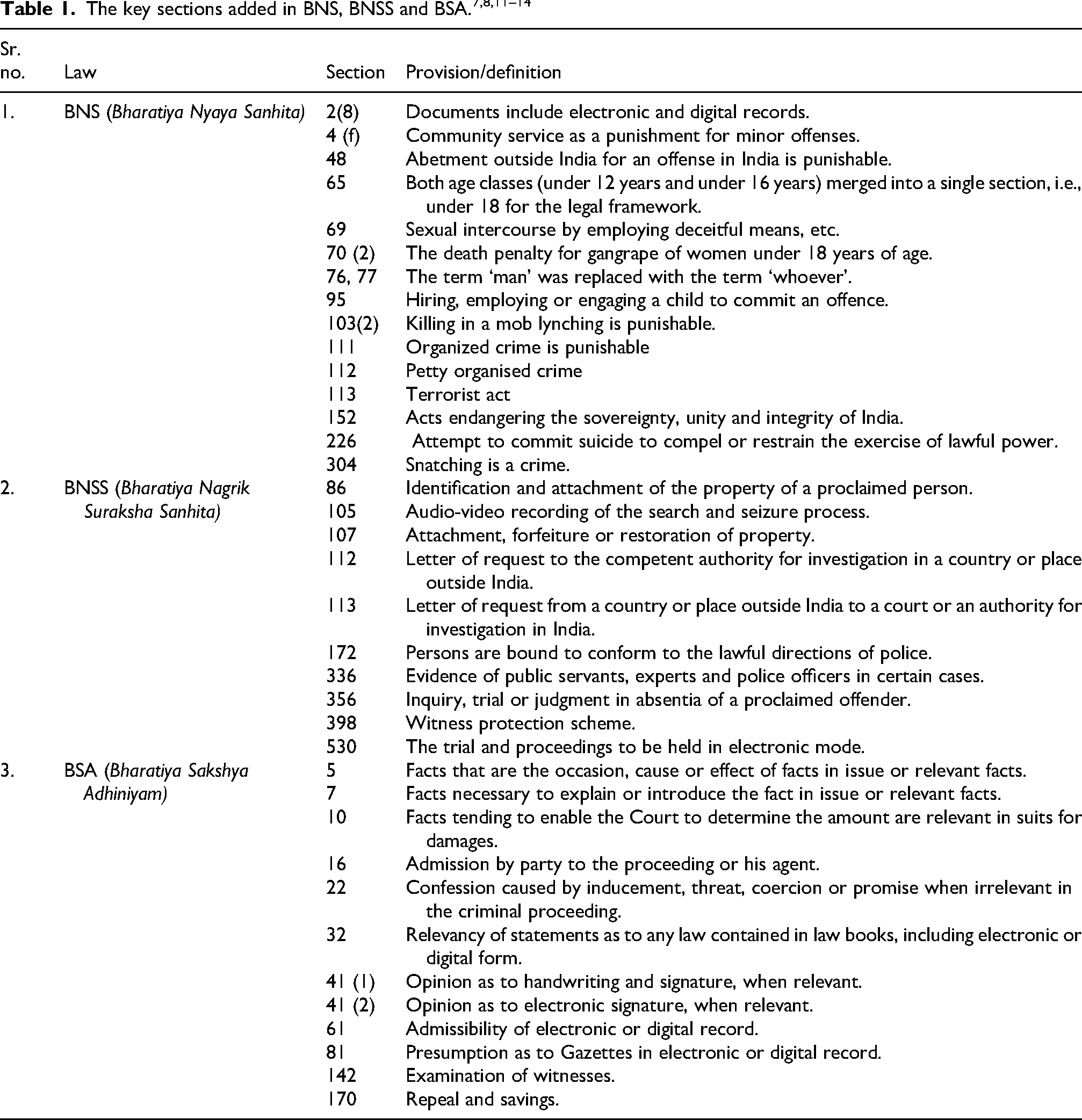
There are various new, changed and repealed provisions in BNS, BNSS and the BSA, with the aim of modern and efficient the criminal justice system. These new laws have increased the punishments for 33 offences, increased the fine for 83 cases and introduced mandatory minimum punishments for 23 offences. 1 The BNS has key provisions for victims, including a victim-centric approach and zero tolerance for crime against women and children. The new provisions and modified provisions in the new criminal laws that have a potential impact on the judicial system are detailed in Table 1.
Aligning with international standards
The BNS, BNSS and BSA incorporate several provisions that are promising not only in reforming the Indian legal system but also in aligning the Indian judicial system with international standards. The concepts of some provisions are either shared with global laws or inspired by international practices. For instance, community services (section 4 BNS) are inspired by the United States (US), Canada, the United Kingdom (UK) and Australia. Further, the clarity in guidelines and use of gender-neutral terms for crimes against women and children align with the US and the UK. The inclusion of digital and electronic evidence and cyber-crimes is similar to the cybersecurity and data protection laws of the USA, EU and the UK. Inclusion of organized crime, waging war against the state, terrorist acts (section 111 BNS) shared similarities with the RICO Act (Racketeer Influenced and Corrupt Organizations Act) of the USA, anti-terror laws (EU Directive 2017/541 on Combating Terrorism) of EU and the Terrorist Act 2000 of the UK. In a similar line, criminalizing mob lynching (section 103 (2) BNS), introducing Plea bargaining (section 290 BNSS) are similar to the laws of the US, UK and South Africa. 15 Similarly, provisions in BNSS are also inspired by laws of other developed countries, which promise alignment with the judicial demands of the 21st century. The concept of zero-FIR, electronic-FIR and digital policing (section 173 (1) BNSS) that allows registration of FIR at any police station ‘irrespective of territorial jurisdiction’ either orally or by electronic communication. 16 Further, the time-bound investigation, inspired by the US and the UK, mandatory forensic investigation in the offences that are punishable by at least 7 years of imprisonment or more (section 176 (3) BNSS), are all inspired by the laws of the US, the UK and Canada.17,18 Further, the expanded definition of evidence to include the electronic and digital records (audio-video) (section 2 (1) (a) BNSS), digitization of court trials and judicial proceeding (section 530 BNSS), digital (audio-video) recording of the search and seizure process of crime scene and evidence (section 105 BNSS), will help to enhance not only the reliability, transparency, quality and efficiency of the criminal investigation but the faith of people in judicial and police system.
The BNS, BNSS and BSA aim to modernize the scientific investigation system and stand on the same platform as the laws of other developed countries. In this context, the admissibility and the authenticity of the digital and electronic evidence are similar to the Federal Rule of Evidence 901 and 902 of USA; section 31.1 to 31.8 Canada Evidence Act; Regulation (EU) No 910/2014 of the European Parliament.19,20 The introduction of the concept of witness testimony by audio-video means in BSA is also similar to sections 32–35 of the Criminal Justice Act 2003 of the UK and the Evidence (Audio and Audio Visual Links) Act 1998 of Australia.21,22
Increased focus on forensic science
The BNSS has a primary focus on the technological reformation and forensic science for the efficient and reliable criminal justice system. This can be explained by section 176 of BNSS, which describes and standardizes the procedure to be followed for the investigation of a crime. It is made mandatory by section 176 (3) that in the investigation of offences carrying more than 7 years or more punishment, forensic experts must mandatorily visit the scene of the crime and collect the evidence. Various crimes, for example, rape, murder and dowry death, come under this section. Section 176 (3) also mandates the videographic recording of the crime scene evidence collection process in offences carrying a punishment of 7 years or more. 9
The section 176 (3) of the BNSS states that ‘on receipt of every information relating to the commission of an offence which is made punishable for 7 years or more, the officer in charge of a police station shall, from such date, as may be notified within a period of 5 years by the State Government in this regards, cause the forensic expert to visit the crime scene to collect forensic evidence in the offence and also cause videography of the process on mobile phone or any other electronic device. Provided that where a forensic facility is not available in respect of any such offence, the State Government shall, until the facility in respect of that matter is developed or made in the State, notify the utilisation of such facility of any other State’. 9
Similarly, section 105 of the BNSS requires the ‘audio and video recording of the search and seizure process, which also includes the process of preparing a list of seized items and signature of witnesses’. 23
The increased workload on forensic scientists and forensic laboratories can be combated with the establishment of regional forensic laboratories in each district, the recruitment of more forensic staff and crime scene experts in each district and the training of forensic professionals with the short-term training programme, workshops and conferences. In this regards, the Union Government of India established Central Forensic Science Laboratories for handling criminal cases, National Forensic Science University and its various campuses for education and research purposes. 24 Further, the recruitment of forensic experts in each police station and the court for assisting investigating officer and judiciary in scientific criminal investigation and understanding the scientific reports, respectively, should be implemented.
Potential impact of BNS, BNSS and the BSA on the criminal justice system of India
The most significant impact of new laws is the broadening of the definition of evidence. The new laws broaden the definition of evidence to include digital and electronic records explicitly. This expansion of the evidence definition is crucial in dealing with the crimes of contemporary times, that is, cyber-crimes and digital financial frauds, and other crimes that are dependent on digital evidence. The clear guidelines regarding the admissibility and circumstances of admissibility of digital evidence will enhance the conviction rates in cybercrimes. For example, the various digital records, that is, ‘emails, text messages, and digital documents are now explicitly recognized as valid forms of evidence, provided they meet certain authenticity criteria’. 2
The new criminal laws are more victim-centric, protecting the rights of victims and ensuring victim rehabilitation through compensation and financial support. The measures to protect witnesses are also ensured in the law. The laws ensure the protection and anonymity of the witnesses. These preventive measures will result in a higher number of victims reporting to the police and the court for justice, and a fearless testimony of witnesses with respect to the crime.
Furthermore, issues like tampering with the evidence are also checked in the laws by making it mandatory to video-record the crime scene investigation, evidence search and seizure process. This will ensure transparency and reliability of the criminal justice system. Moreover, the integration of technology and scientific evidence will ensure a reliable and efficient investigation process, leading to higher conviction rates. Considering the increased use of electronic and digital media and platforms, the inclusion of electronic and digital records as admissible forensic evidence will also improve the conviction rates in digital crimes, cybercrimes, etc. Moreover, the quality of justice delivered will be improved by reducing the wrongful or inconclusive results/convictions by mandatorily involving forensic experts in serious offences. 2
Further, the introduction of community services will give an opportunity to the criminals to improve and change their criminal psychology (opportunity for normal life) and protecting his/her human rights (giving minor punishment for minor crimes). This will also reduce the workload on the judiciary.
Ensuring the strengthened legal system, the establishment of forensic science laboratories and educational institutes with the latest infrastructure and technology will result in timely analysis of evidence and quick justice, because delayed justice is justice denied. Further, the Artificial Intelligence (AI)-based evidence in the realm of new technology should also be given consideration in the laws, for example, AI models trained on handwritten evidence, signatures, face images or other related evidence.
Potential challenges faced by BNS, BNSS and the BSA
The new criminal laws have potential benefits in enhancing the efficiency of the judicial system. However, the laws may face challenges to effective implementation. The first and foremost hurdle is the lack of awareness among people about these laws. This can be overcome by arranging the awareness camps for laypersons and awakening them about the protection of human rights, witnesses and victims by the new laws. Government can also arrange the training programmes, workshops and lectures for the forensic experts, police personnel and other stakeholders. Further, there is a concern about the digital privacy of individuals. These laws emphasize the use of digital and electronic records for criminal investigation; however, this can be misused. Therefore, there is a need for a stringent check on the use and access of digital and electronic records. Another major concern is the uniform applicability of laws in all the states to ensure uniform laws and justice to all. For instance, the applicability of some provisions (e.g., video recording) in these laws is entrusted to the state itself. It is up to the state to implement the laws or not within time period.
Conclusion
The Union Government of India implemented the criminal laws, namely BNS, the BNSS and the BSA, on 1st July, 2024, with the aim to modernize the Indian criminal justice system with forensic and technological advancement. The present communication reviewed the possible impact, challenges and implications of these criminal laws on the Indian judicial system and forensic science. The authors are of the opinion that the integration of forensic science and digital advancement in criminal laws will improve conviction rates, quality of justice and timely justice. The authors also emphasize that there is an immediate need to awaken and educate laypersons, police officers, forensic experts and medico-legal experts for the efficient implementation of these laws.
Footnotes
Acknowledgements
The principal author (Nandini Chitara) is thankful to the University Grants Commission for funding the PhD in the form of a research fellowship. Rakesh Meena is thankful to the NFST, Ministry of Tribal Affairs, Government of India, for funding the PhD in the form of a research fellowship. Ankita Guleria is thankful to Department of Science and Technology (DST), Government of India, for awarding INSPIRE Fellowship under grant number IF190719 for pursuing PhD. Damini Siwan is thankful to the University Grant Commission (UGC) for awarding JRF (Junior Research Fellowship) for pursuing PhD. Akansha Rana is grateful to Panjab University Chandigarh, India, for providing the fellowship in the form of a Panjab University Research Scholarship for pursuing PhD. Ayushi Srivastava is thankful to the University Grant Commission (UGC) for awarding JRF (Junior Research Fellowship) for pursuing PhD. Kewal Krishan is supported by the UGC Centre of Advanced Study in Anthropology (CAS II), awarded to the Department of Anthropology, Panjab University, Chandigarh, India and RUSA 2.O grant awarded by Ministry of Education, Government of India, to Panjab University, Chandigarh, India.
ORCID iDs

Authors’ contributions
Nandini Chitara and Kewal Krishan conceived the idea of writing this viewpoint. Nandini Chitara, Rakesh Meena, Ankita Guleria, Damini Siwan, Akansha Rana, Ayushi Srivastava, Tej Kaur, Priyanka Chitara and Kewal Krishan wrote the initial draft of the manuscript and finalized the Manuscript. Kewal Krishan supervised the present work. Nandini Chitara, Rakesh Meena, Ankita Guleria, Damini Siwan, Akansha Rana, Ayushi Srivastava, Tej Kaur, Priyanka Chitara and Kewal Krishan read and approved the final manuscript.
Author's note
Nandini Chitara is also affiliated at Biology Division, Regional Forensic Science Laboratory, Panchkula, Haryana, India. Ankita Guleria is also affiliated at Department of Forensic Science, University Institute of Allied Health Sciences, Chandigarh University, Mohali, Punjab, India.
Funding
The authors received no financial support for the research, authorship, and/or publication of this article.
Declaration of conflicting interests
The authors declared no potential conflicts of interest with respect to the research, authorship, and/or publication of this article.