






Abstract

My hero, Benjamin Disraeli, gave a political speech which lasted for three and a quarter hours; he did it without notes and he drank two bottles of white brandy during his talk. Now, I am not going to do anything like that. I am not going to speak for more than two hours (laughter), and my first break with tradition is that there will be time for questions and comments from the floor at the end.
This Society has had a long line of very eminent Presidents, particularly in the judiciary, mainly men, a few women, with their reputations made in the courts. The doctors were forensic pathologists known from the criminal arena, and I think I am the first Civil “Medical Expert” to become President. That in itself tells the story of the last 20 or 30 years, and I am going to talk about being an expert witness I have seen so many strange and wonderful things, some of which I will share with you, but only the ones that can be reproduced in the Journal. My title is
My first civil case was about 22 or 23 years ago and I remember it as though it was yesterday. It was a young man with accelerated hypertension, that is a very fierce form of hypertension with blood pressures of 240/150. He had been given a newish drug called captopril, which we were all very excited about; it was the start of a new group which has turned out to be tremendously important and, to cut a long story short, he crashed his blood pressure, he wasn't monitored and he thrombosed his anterior spinal artery and was left paraplegic. So, this was my first case and in due course I was summoned to a conference with Counsel. The Chambers were very grand indeed and I remember the quality of the tea and the coffee and the Wedgewood china, there were five sorts of chocolate biscuits. It was just fantastic, like Tea at the Ritz and I was terribly impressed. Then the senior Counsel came in, he was a QC and I was told with reverence he had just come from the Houses of Parliament, where he had been fixing government, or something like that. We all sat down and, before the conference, he turned to me and he said “Just remind me, what is the difference between systolic and diastolic blood pressure?” I was absolutely amazed. I was young and green, as Dylan Thomas said, but I knew that this could not be right. I knew he hadn't read the papers and I realised that he didn't really know what he was doing. This experience led me to “Mansell's first law of lawyers”, which put simply is “The quality of the legal advice is inversely proportional to the quality of the coffee” (laughter) – I want to hear from experts at the end of my talk whether that has been your experience as well.
The story of medical negligence: I had tended to think of it really as the last 30–35 years, AvMA and so forth and I will come back to that, but first I will go back even further to a man called Dr Lewis Sayre, who was an orthopaedic surgeon in America in about 1870 ( Figure 1 ).
Dr Lewis Sayre
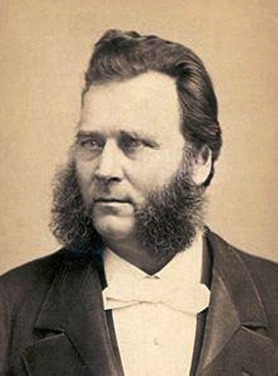
He was a formidable, bulky, large man who clearly enjoyed his food – the unkind saying was, as some of you know, “An orthopaedic surgeon has the strength of a horse and twice the intelligence.” Well, he became the first Professor of Orthopaedic Surgery in America. In 1870 a mother brought her six-year old daughter to see him, and she had a large abscess around her hip which he drained. The child suffered quite a lot of pain and the mother took the child and they flounced out of his surgery. The parents were very unhappy and he was sued for medical malpractice, and the medical expert who spoke on behalf of the claimant was one Dr Warne. Now, I am afraid that Dr Warne was not quite the medical expert that one might hope for today. First of all, when he got into the witness box it turned out that he wasn't a doctor. He was actually a druggist's clerk who had read a few books. He was an alcoholic. He had a £100 financial interest in the case because of some rather murky dealings with a previous operation that Dr Sayre had been involved with and when he got into the box he declared that he was too unwell to answer questions. So that was really the end of the case, as you can imagine. Dr Sayre won, and won handsomely, and indeed he was so angry about it that he put the case into a book. The preface of the book was written by Dr Samuel Gross, who was Professor of Surgery at Jefferson Medical College, who commented:
“I sincerely congratulate you upon the successful issue of the villainous suit against you for alleged malpractice. A few more such verdicts will go far in putting a stop to such outrageous and unjustified prosecutions.”
And he went on:
“It has always appeared to me that a lawyer who will permit himself to bring suit for malpractice against an honourable medical man must be essentially a base, unprincipled man. Some members of the American Bar are, unfortunately, too prone, for the sake of a paltry fee, to encourage and engage in such prosecutions.”
So there you are. You probably think not a lot has changed since then, although the fees are not as paltry as they were.
As I said, the modern era of civil medical negligence dates backs to AvMA, which was originally Action for Victims of Medical Accidents. They have just had their 30th anniversary. AvMA was formed following a terrible surgical disaster at a North London hospital which was translated into a play which got very wide publicity and it led Arnold Simanowitz and, I think, Ian Kennedy to the formation of AvMA. Now, this was before I was involved with MedNeg and it was a time when the injured patient really couldn't find a medical expert to speak on their behalf. Any medical expert – and I have heard Roger Clements speak about his experiences – who did take up the cudgels on behalf of the injured patient was likely to be ostracised, and I can tell you that in my very early days it was made clear to me that I was never going to be President of the Renal Association, but then I never wanted to be President of the Renal Association anyway. This was a time when the medical defence organisations were very powerful, possessed unlimited resources and the odds were stacked against the patient.
Well, times have changed, certainly as a result of AvMA and what it did. They encouraged lawyers to see medical negligence as a specialised area that needed training, needed accreditation, and of course Experts; in Council we have just been discussing this rather vexed question of where tomorrow's Medical Experts going to come from and I am going to return to that later on.
So my experience is about 22 or 23 years old and I came in at the end of the “bad old days”, when court appearances were very frequent, the medical experts were regarded as “hired guns”, there was no disclosure and it was often trial by ambush. I got hooked on MedNeg after my first couple of cases, and of course I was completely untrained when I started although it didn't seem to really matter. It all really changed in 1995 with the Woolf civil procedure reforms which brought in things like early disclosure; the two sides knew what the other's case was going to be based on. Trial by ambush still exists in Ireland, as I can testify, although I have to say I have never actually got beyond the court door in Ireland; I have stood two inches this side of the door to the court, but we never actually made it into the court because (surprise, surprise) the four Counsel managed to settle the case just before we were due to go in.
Another part of the Woolf Reforms was, of course, expert meetings. The experts were made to sit down together with an agenda and decide what they agreed, what they disagreed and what could not be compromised. The lawyers were terrified of putting the experts in the same room together and the early Rules were that the solicitors could be there as well. Now, the solicitors were there only to give legal advice, they were not there to act as advocates for their side, and they were absolutely terrified of what the experts might get up to and with good cause. One of my very early conferences involved me for the Claimant and a very senior and eminent nephrologist for the Defence, to whom I looked up and who has subsequently become a good friend and remains a colleague. I had my male solicitor with me, my colleague had a lady solicitor with him and we discussed the case at some length. I have got to be anonymous here. So we discussed the case and after about 45 minutes my colleague turned to the lady solicitor and he said “You know, I have been listening to what Martin said and, you know, I think he is right” (laughter). You can imagine that this lady solicitor became absolutely apoplectic; she was almost lost for words and I thought she was going to go for him. So that was the end of the case and we won handsomely, and that was that. But of course the lawyers are no longer there and they now hope and pray that the experts can deal with things slightly better than in those days.
The other thing that I am going to refer to later is conditional fee arrangements for lawyers. Now, my recollection is that it was about 1995/2000 that this came in – I am happy to be corrected. But I remember all the discussion about what a terrible thing this was. It was an American idea. Conditional fees were not quite as bad as contingency fees, but it would never, ever happen in this jurisdiction and it was just anathema that it should. Times change!
The NHS Litigation Authority was created, about 1995, and the Chief Executive, I remember, came to talk to us. Everybody had high hopes for the NHSLA that it was going to provide speedy resolution of cases that deserved to be resolved. A Judge has said “Justice delayed is justice denied”, and I think everybody was aware of that and these cases did, and do still, drag on for decades. It was hoped that it would limit costs and that it would become a very powerful tool concerning issues around patient safety, clinical governance, risk management, because the NHSLA was going to develop a huge knowledge base, comparable to that of the defence organisations, which could and should have been used to take the issue of patient safety forward. Well, was it successful? Not in my opinion. To me it was a great disappointment. I thought then and I think now that it is a pretty monolithic organisation, a bit like the MDOs. I think the NHSLA does defend the indefensible. They seem to have unlimited resources, and I have to contrast the NHSLA with my experience when I was at University College Hospital, which is about 15 years back. We had something called the Clinical Claims Review Group, which was run by the Medical Director. There were about 15 or 20 consultants who looked at the legal letters that came in every week with complaints, one of us was delegated and they said “Write a report; bring it back; let's talk about it”. After a very short period of discussion the answer might come back “The hospital made a mistake, an adverse event occurred, the patient deserves compensation”, and the hospital lawyer would be sent to have discussions with the patient to try and settle it before it started off on the legal motorway; I believe that it was very successful. We had AvMA come and sit in on several occasions; we had many other Trusts come and sit in to see how it worked but again that fell by the wayside. So, to finish with the NHSLA, the patient safety side of the coin has never been properly examined. Now, I heard the previous Chief Executive speak just a couple of weeks ago and he was asked if the NHSLA achieved the patient safety objective and he said no. I think he was quite right, they didn't really do it and he gave two reasons. He said there wasn't the finance there to do it and they were unable to link with the databases of the MDU and the MPS to put together a meaningful body of information from which conclusions could be drawn, a great disappointment, in my view. Now there is a new lady running the NHSLA and I would have thought in due course we should have her to come and talk to the Society.
So medical negligence carries high passions and high stakes and, to paraphrase Princess Diana, there are at least seven partners in this rather edgy and unhappy marriage. First of all you have got the injured patients, or their next of kin. They want “to win”; that is what is driving them. We can talk about the reasons why people go to litigation and everybody quotes the classic Lancet study, which I think was probably AvMA-derived, where they interviewed several hundred people who had gone to law and they said “Why, what were the reasons?” I think, in order from the top, the main reasons were an explanation; an apology; so that it never happens to another patient again; and money. Money was right at the bottom of the list, except for child cases of cerebral palsy, where, as you can imagine, it was at the top of the list. Well, is it true today? I don't think so from my experience. Of all the cases that I do about two-thirds is claimant, one-third is defence, and my impression is that revenge comes fairly high up on the list. What I understand and what the lawyers don't is that medical negligence from the patient's point of view is a very personal matter. Lawyers have said to me “Why do people get so worked up about it? I'm a lawyer; I have malpractice insurance. If I do someone's conveyancing badly so that they lose money I tell them ‘You can sue me’, and they sue me and they get money, and that's that”. The lawyers tend not to understand the deeply personal and intimate relationship between the doctor and the patient and how easily love turns to hate.
Where are the doctors in all of this? Well, the doctors are understandably paranoid. We are facing multiple-jeopardy, from the GMC, from the Trust, from the courts, from the police, from Monitor; one could go on. The doctors set out in the morning to do their best; that is why they are doing the job, they are not setting out to damage the patient intentionally. The other thing is that today I think we have unreasonably raised patient expectations; there is a school of thought that you need never die; you will live forever in perfect health and mobility, etc. So the doctors are victims of their own success in that respect.
Now, what about the lawyers? The lawyers are adversarial; that is how it works in this country and generally speaking there is a direct correlation between the success of the lawyer and the money involved. If you are for the claimant, the more money you get the better. If you are for the defence, the less money you have to pay out the better. As the Godfather said, it's law, not justice, but that's how things are.
The Trusts, where do they stand in all of this? The Trusts are essentially fire-fighting the rising tide of medical negligence claims. It takes up a huge amount of time and resources. Clearly the money is the major part of it and they don't have the ability to learn the lessons from, for example, the repetitive cases that are occurring in a particular hospital with a particular doctor. All of this knowledge is being wasted.
So, what about the Government? These are hard times, I know that money is very tight, and I sometimes feel that they would just like the problem to go away. The Government pays lip service to the idea of justice for all but that's about it.
The judiciary? The Jackson Report comes into effect very soon. Legal aid effectively has been declining and will finish. I think there will be some rump of legal aid for a little bit of family and children, but no more than that. From where I stand the judiciary have been rather complacent regarding the Government's wish to wind down legal aid. That is a personal view.
The police? The police are getting very keen on the idea of medical manslaughter – I have been involved in one case – and also corporate manslaughter – that takes us into the question of reckless negligence. How do you define it? I don't really understand these discussions. I have sat and listened to them, but I am very uneasy at the police involvement in what are really matters of clinical care.
Finally, society? I think Professor Furedi has just written a report for the Centre for Policy Studies, and he refers to things like greedy lawyers, ambulance chasers and commented that they need to be reined in. He did raise the question of no fault compensation which people have been interested in for at least 20 years but I think that is something which is not really going to provide any good solutions. It is always said that defensive medicine is a bad thing and that litigation leads to defensive medicine, but I can see the other side of the coin; what is so bad about medicine that is based on evidence, guidelines, protocols? If that is defensive medicine perhaps it is not such a terrible thing.
The courts cannot function without experts. There is a recognition that experts need training. They need training in a bit of the law; they need to know how to write reports, they need to know about going to court, although I would say that in medical negligence court appearances are so unusual that all the worries that I used to have about standing up in court are a thing of the past. My experience, such as it was, is that a court appearance is no worse than doing a grand round with a bunch of aggressive academics in the audience who are just sitting there waiting to score points off you. It may be that medical experts in the criminal courts are dealt with more lightly and more gently than other types of experts. To be an effective medical expert you have to be able to stand aloof and to remain objective about the problem that you are going to talk about. There are some experts, just as there are some lawyers, who work either for the defence or for the claimant, and I find this quite extraordinary, because you have to keep in touch with the other side if you are going to be having discussions with them and negotiating with them; you have be able to appreciate their standpoint. The medical expert needs to be a bit of a maverick, you could say a bit arrogant actually, because often you find yourself speaking against very eminent senior men that you respect.
Since the Jones v. Kaney verdict, experts have lost their immunity in court. It is an important judgment. Now, we the experts are told by the lawyers “If you do your job properly, if you write good reports, if you read the notes you will never get into trouble”. But there is a very bad press attached to Jones v. Kaney. In the past I used to go and speak to junior doctors/young consultants about clinical governance, risk management, litigation, and there was a lot of interest in becoming a medical expert as a career, not as a full-time career but in the way that most people do it as an extra. That seems to have disappeared completely. It has become a very unattractive option, and there remains the question of where are tomorrow's experts going to come from? Consider child protection: after the recent events that have taken place you cannot get people to fill consultant paediatrician posts that cover child protection. The courts need many reports on the children who are at risk. The suggestion that there could be some sort of a committee providing expert reports from a hospital was just too ridiculous for words, really and the original Woolf idea of a single joint expert has never really caught on either.
Renal litigation, which is what I do, used to be very rare when I started out 20–25 years ago. Renal patients were a small select group. They were very grateful to have been treated with dialysis, for example, and the idea of bringing a legal case if you were injured was just unthinkable. That has changed. It has changed because times have changed, there are more patients around, and of course the renal patients have a lot of things done to them; they're having dialysis, they're having transplants, they're having many operations, there is scope for adverse events, and not unreasonably they may go to law. It is interesting that nephrology is the lowest of the six risk groups for the MDU. My premium that I pay to the MDU is the lowest that it can be, and I think orthopaedic surgeons and obstetricians are probably right up there at the top.
The renal medical expert community is a small one; there are only about five or ten of us who regularly do such cases, and I would only regard about half of them as proper medical experts. I suppose because I have been doing it for so long I keep seeing the same cases and there are certain topics on which I have written more than ten reports; for example, hearing damage and balance damage due to gentamicin. Gentamicin is a very good antibiotic but you have to know what you are doing when you use it. Patients with lithium: lithium is a bit out of fashion today for bipolar disorder, but there are still quite a number of patients who have been on it for 20 or 30 years and they do get chronic renal failure. The issues are very interesting ones about the quality of life off lithium, continuing with lithium, involving the patient in the decision-making process. Ulcerative colitis and mesalazine, that is a favourite. Mesalazine is extremely good to control inflammatory bowel disease, but it does cause renal failure.
I will mention two things that are coming along to watch out for in the future. Maximum conservative management of patients with end-stage renal failure is, if you like, the renal equivalent of the Liverpool Care Pathway. It is about the best management for patients, often elderly, who you can either treat with dialysis or you can treat with maximum supportive therapy. In the last eighteen months I have done two cases where the issues around management of end-stage renal failure, ending of life, have been to the fore.
And the final thing that I will just mention briefly is that there is almost certainly a link between an unusual disease called retroperitoneal fibrosis and asbestos. It hasn't quite hit the courts yet, but I have no doubt that it is going to.
So I have had a lot of fun from my medical negligence experience. It has taken me mainly into the civil realm, with occasional trips to high-security prisons. It is very good background if you have an interest in risk management/governance. I have been involved in the defence in two murders, which I never expected when I started out. One was a lady who gave antifreeze to her husband and didn't quite manage to kill him. She got 30 years, so that must be regarded as a failure for me. The other one was a murder in Liverpool where the severely injured patient in fact died because of lack of care in the hospital, so the lawyer was very pleased that the charge of murder was reduced to manslaughter. So I suppose I can call that a success.
The law and medicine interface is a very interesting one. It is a bit like the Taylor and Burton marriage in Who's Afraid of Virginia Woolf? So, you see, there are two Woolfs in my talk tonight. I like lawyers, let me be quite clear. I do think that law and justice are a central pillar of society. I am not quite sure that the adversarial system is the best way to do it, but that is what we have. Lawyers tend to be very hard working, they're obsessional and I don't think it is a very easy way to earn a living.
So I am going to just take my final point, which is about conditional fee arrangements for lawyers, and I am going to read you a letter, suitably anonymised, that I received about a month ago:
“You may recall having prepared a report for my client. Unfortunately, his claim will not succeed and he will not recover any damages or costs. In these circumstances, I wonder whether you would be kind enough to consider reducing or waiving your fee. I enclose your fee notes for your convenience. I look forward to hearing from you shortly and would like also to take this opportunity to thank you for your assistance in respect of this matter.”
In the discussion I want to hear from you what I should have said.
I have mentioned that CFAs for lawyers were anathema when they first came in, this American invention. The CPR in 2005 put an absolute prohibition on conditional fees for experts, and the reasons are obvious. I mean, you can imagine going into the witness box and in the first question the lawyer will say “Dr Mansell, if you win this case, how much do you get? If you lose this case, how much do you get? And you are asking the court to believe that you are an objective expert”. So it is just ridiculous. However, in the Jackson Reforms, which come into operation next April, contingency fees for lawyers are okay for the most contentious work. They are recognised to be highly undesirable for expert work, “save in exceptional cases where the court gives authorisation”.
Well, I keep asking lawyers this question “Do you think conditional fees for experts will ever come in?” and I keep getting “No, no, no it's unthinkable”.
I do understand that my specialty of nephrology is not lily-white and I do have some insight of the realities of life. I am aware that some of the lawyers here will feel that you have been traduced mercilessly and so my first break with tradition as President is that I am very happy to hear comments and questions from the floor.
Thank you very much. (Applause.)
Discussion
Well, I think you have all been extremely polite and well mannered. I have waited for 20 years to criticise the lawyers and I feel I have got it off my chest tonight. So I would suggest that we go in for drinks and canape's, and I see that didn't speak for two hours, or even three. (Laughter.) Thank you. (Applause.)