






Abstract

Keywords
I will look first at victims in an historical context and then the recent changes and trends as we move forward into a new era for victims. I have just been appointed Chair Voice, of the Victims and Witness Service in Northamptonshire. We have obtained funding to support victims and witnesses and intend to deliver services for victims and witnesses designed by victims and witnesses. I will take you through the research we have done and the work we are doing going forward. But there is no such thing as a free lunch or free canapés, and what occurred to me was that, rather than the traditional questions at the end of this session, I thought I would use this as an opportunity to pick your brains. I have the great brains of medicine and law sitting here in front of me tonight and I want to use your experiences to inform the work we are doing, because we are very much at an embryonic stage. You all have expertise in this field. In your professional life you might work with victims, you might work with offenders. At a personal level you may have been a victim of crime; you may know someone or be close to someone who has been a victim of crime; and as a citizen you have an interest; you are the taxpayer that will be funding this work going forward, and you are also a member of a community. We are all members of lots of different communities and how crime impacts on communities and how communities can impact on crime is something that we should all be thinking about as responsible citizens. So at the end of my talk I am going to ask you for your observations, your experience, and your ideas for further research. We intend commissioning further research into how we can improve the victim‘s journey through the justice system, and if any of you have any ideas for practical solutions I would be really grateful for your thoughts.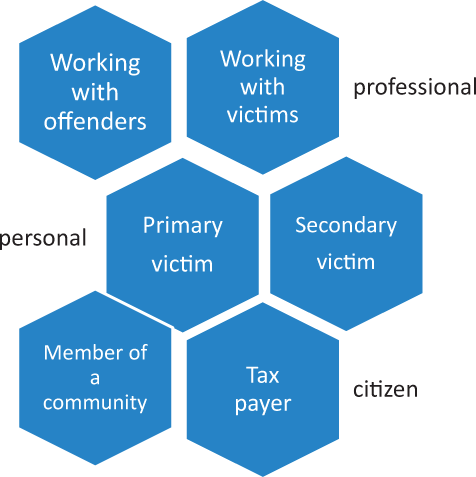

So I thought rather than spring it on you at the end, there you are, those are the questions you are going to be asked and, if you all sit in silence, I will pick on people and make them answer. (Laughter)
In the run-up to the 800th anniversary of the Magna Carta in 2015 we can’t avoid a quote from the Magna Carta itself.
“To no one deny or delay right or justice”, and that must include the victims of crime, not just the right of the accused to a fair trial.
What is “justice”? There are so many ways of defining justice, what justice means, and what justice looks like, but I am going to suggest that we consider a fairly simple principle, from Thomas Aquinas: “Justice is a certain rectitude of mind whereby a man does what he ought to do in the circumstances confronting him”.
Aquinas describes a moral inner core; it is about fairness; it is about doing the right thing; and I think as a society we all agree that we should do the ‘right thing’ by victims. I think we all have that as a starting point, but how we achieve that is the difficulty. There are competing and conflicting interests and other tensions and that is where we perhaps lose our way. It is that conflict and that tension that I want to ask you to think about tonight.
As long as there has been crime there have been victims; but in the past victims have been more involved in resolving the outcomes of crime than in recent years. There has always been a tension between payments to victims as a punishment or payments as compensation. One of the earliest legal codes, the Hammurabi-Babylonian Code of 1754 BC, not only had an idea of compensation as punishment but compensation by society, “if persons are stolen, then shall the community…pay one mina of silver to their relatives”. So an idea that society was involved in compensating crime is an ancient concept. Although “and they shall be put to death”, is the most common outcome. Compensation to victims was recognised in other systems for example Wergeld, up until the 9th century, had a tariff system, if you did commit a crime there was an amount of compensation to pay, but over time the death penalty was more widely used. There was a system of penalty payments to the family of a murder victim. The recognition of the victim needing to be compensated has been there since the earliest societies.
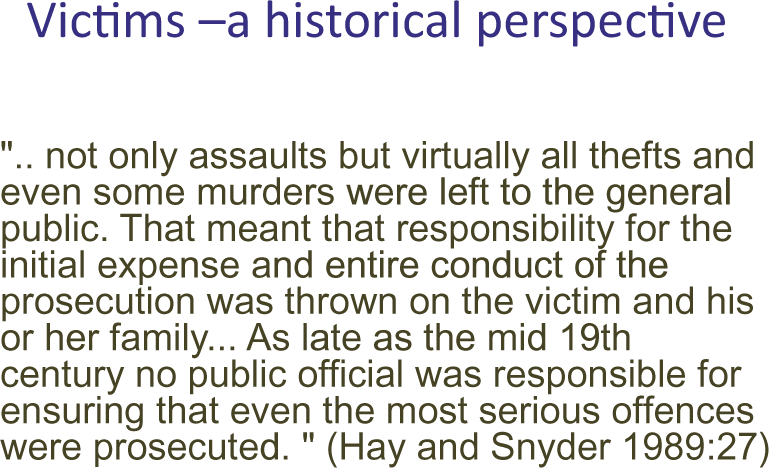
Before the State took on the role of investigating crime and prosecuting criminals it was the responsibility of the victim to bring the prosecution. As described by Hay and Snider, in this country we had a system where the victim was central to the criminal offence because the victim or their families had to take action. But that meant that justice was only available to those who could afford the protection of the law. I won’t draw parallels to modern day legal aid, but certainly that sense of “You have to take responsibility and if you cannot, too bad”, and the implications of that for society were considerable.
In the 19th century we see the rise of the public Criminal Justice System, where society said this is so important that society will take responsibility. A police force is formed and, shortly after that, a public prosecution service starts to develop. It is not the families taking action, it is the State itself.
What is the purpose of the Criminal Justice System? Obviously it is to prosecute criminals and to protect the innocent; to decide the level to which people should be punished and the level to which they should be helped to stop offending. That balance between punishment and rehabilitation has been the subject of much debate. However at some point consideration of the rights of victims started to be forgotten. Society’s focus has been on the prevention of crime and the punishment of crime but it has not considered the needs of the victims of crime.
In the 20th century the Nuremberg Trials described by Lord Birkett as “the greatest trial in history” was also notable for its absence of victims. Susanne Karstedt at the University of Leeds, says Victims have been absent in traditional and national criminal justice for a long time, they were invisible in transitional and international criminal justice after World War II. The Nuremberg Trials were dominated by the perpetrators, and documents were mainly used instead of victim testimony,
Recognition of victims’ rights
In the 1970s, in America, there was recognition that the victims of crime needed empowerment and to have their needs met and understood. Ronald Reagan’s Task Force on Victims of Crime in 1982 was an early forerunner. The report said “the innocent victims of crime have been overlooked, their pleas for justice have gone unheeded, and their wounds – personal, emotional, financial – have gone unattended”, and I think that remains true today. Thirty years on and very little has changed. There is concern about the operation of the State, there is concern for the perpetrator, but the victim has largely been forgotten.
In 1985 the UN “Declaration of Basic Principles of Justice for Victims of Crime and Abuse of Power” outlined international best practice for treatment of victims, and we can start to see a development; a recognition that things have to change and the need for restorative justice.
Perhaps the most interesting development in the 1970s was the concept of restorative justice, which is reactive to crime. I believe it began when a probation officer said, let’s get the victims of the crimes and the criminals together and make a reconciliation, to make both parties better understand; the criminals to understand the impact of what they have done, and the victims to find peace, in the sense of putting things right.
Since the 1970s the simple concept of restorative justice and of the offender and the victim sitting in a room with each other has developed. It has grown in terms of complexity and outcomes: there are many variants of restorative justice being practised. But the basic principle remains the same, it is about communication and understanding another’s perspective and the evidence shows that victims can find consolation and a sense of healing from these discussions, if it works well. The difficulty is the lack of research to demonstrate the impact on reoffending and longer term impact on victims.
Another development has been restorative practice, and though the terms are used interchangeably, they are not quite the same thing. Restorative practice moves away from that idea of victim and offender of the same crime working together. Restorative practice aims to be proactive and look for solutions before a crime has been committed rather than reacting to the consequences. It seeks a positive way forward the aim is to build relationships and a sense of community to prevent conflict and wrong-doing.
Some years ago I assisted a charity, Victims’ Voice, which deals exclusively with victims of murder and manslaughter. I was asked to take part in sessions the charity was running during the development of what became the Coroners and Justice Act. Victims Voice got together groups of interested parties to look at the inquest procedure. A bereaved family would meet with those who were involved in the coronial system, for example, coroners, mortuary assistants, pathologists, police officers etc. None of the participants would have been involved in the death of that family's loved one. The bereavement was not recent and the family had come to terms, as far as they were able to, with their loss. The family were able to explain what they saw as the faults of the process. All those who play a critical part in frontline delivery of service to recently bereaved people; listened to the bereaved family explain what had happened to them, setting out the problems and difficulties in the process they had unwillingly been brought into. The professionals in the room had been to many inquests and so for them this was not a new experience in contrast with the bereaved family had only been to one inquest; and in looking at that process everyone could identify issues, quite often issues that could easily be solved.
You would see recognition around the room and somebody would say “Oh, yes, I recognise that. That is something that we could address by doing this”. It was a very small project; and it couldn’t reach enough people to really effect major changes; but getting those people together, having taken the heat out of it (because the original professionals were not present, so there were no hurt feelings to protect) meant that we could actually get ideas to on how to change and improve the process. We cannot underestimate the importance of listening to victims. No one can fail to be moved by hearing first hand accounts, not only of the impact of the crime, but also of the impact of the aftermath. There is a recognition and an understanding, and that can be used to positive effect going forward.
An area where I suggest restorative practice could be particularly useful is where there are instances of anti-social behaviour. Anti-social behaviour is very difficult to deal with as a criminal matter. It is really a social and a community matter; for example, I represented the widow of an elderly man at an inquest. The couple had lived in the area for many years. They had spent the last 2 years terrified of local youths, who weren't doing anything overtly but were causing real distress. You will have driven past similar houses where there is a camera on the outside, because the residents feel insecure. An elderly couple are locked in their house and they are terrified to go out.
At the inquest it emerged that the elderly man had run out to chase youths from his garden. The youths had repeatedly gone into the garden calling the couple names, quite childish behaviour but these youths were very intimidating. The elderly man had a heart attack and died. There was no causal link to the death, but I had been asked by the coroner to represent the family so that the family felt that it was put to the youths who were giving evidence what they had done. But a Coroner's court is not really the right environment to deal with a problem like this and what we have to do as society and as communities is to say we need to address this. This is an example of where restorative practice could be really useful. These young boys were 13 or 14; they were part of a family in the same community as the elderly couple and that community should say something to the parents and the parents should want to deal with that behaviour. Nobody wanted a tragic outcome, but it happened through thoughtlessness and a lack of care. I think it is about the community itself being involved in restorative practice and the community saying “we will change things”.
In the UK the first Victims’ Charter was published in 1990, and I cannot say that in my years in practice I saw the impact of that charter. However, it was a start.
There is goodwill but it has not translated into any real difference for victims of crime. There have been regular reviews and updates and in the Domestic Violence, Crime and Victims Act 2004 there was the potential to appoint a Victims’ Commissioner and that was done in 2010. We lost the first Victims’ Commissioner because she took part in the process in looking at the clean-up of the London Riots, so Baroness Newlove was appointed on 21 December 2012, and that is progressing, but quite slowly. The most recent Victims’ Code of Practice and a Witness Charter was published in 2013.
Its true that I have encountered much goodwill and indeed a lot of support from the Crown Prosecution Service and the police. A lot of money has been spent in recent years on trying to address Victim's needs, but we have not yet seen any real difference in outcomes. The Parliamentary Ombudsman, Dame Julie Mellor, complains that “Victims … have spoken to us about how they have been left feeling powerless and shattered”. So 20 years but no real action, no real sense of feeling for victims that things are changing.
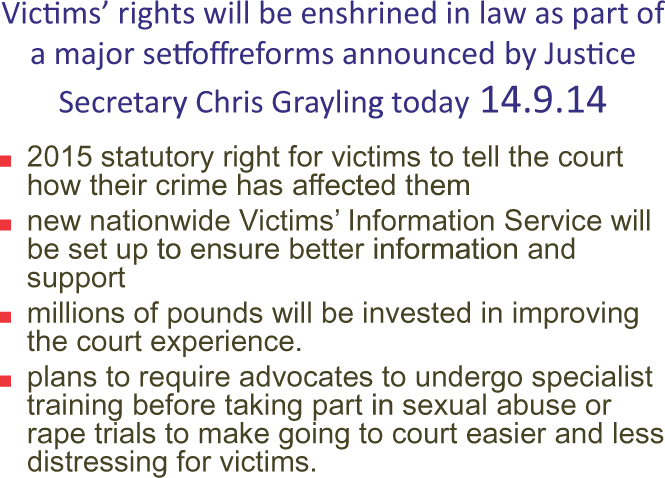
Chris Grayling announced on the 14 September 2014, was that there is to be new legislation in 2015. Victims will have a statutory right to tell the court how the crime has affected them. We have all heard of the recent problems regarding Victim Impact Statements. The biggest problem is not how they are dealt with when read out to the court but that quite often they are not even read out. I was talking to some volunteers who help victims to prepare impact statements. It is a very emotional process for victims, terribly difficult, and if the victims find that their statements are not even read out in court; they understandably feel very angry. There is a tension between how far you put the onus on the victim to go through this process. Do you make the victim feel that if they don’t prepare a statement they are letting their loved one down, or letting society down? If you do put them through that process, then it needs to have some clear outcome.
Giving Victims a right to tell the court the impact the crime has had on them only takes us so far but “So what?” I hope that the new legislation will say how the statement will in future impact on sentencing guidelines. There is going to be a new nationwide Victims’ Information Service set up to ensure better information and support. The problem we have in Northamptonshire, which I will come to, and the problem throughout the country is that there are lots of pockets of different people doing different things. There are charities, local groups; all with goodwill but the victims do not find it easy to access the services – we need a one stop shop for victims to access all the support and help they require. Millions of pounds are apparently to be invested in improving the court experience. Courts will be modernised to include separate waiting areas, and where those attending have easier access to information, but that is a very costly project. We know that there are problems with the existing court buildings. Take for example the Magistrate's court in Northampton: it was built in the 1930s; it was a court building/fire station/swimming pool all built in a row when Northampton Prison was demolished. There are courtrooms and a single area where the victims, the witnesses and the accused intermingle. And it is not just the accused, it is the accused’s supporters who can be intimidating, even if the accused is in the dock and has been brought from prison, the accused's relatives and supporters will be there and victims can find that very intimidating. The court in Northampton is next to the main road and smokers stand outside in a big cluster outside the front of the building. The victims and witnesses have to fight their way through to get into court. Millions of pounds would need to be invested for new court buildings fit for purpose, and I think that is unlikely in the current climate.
The original proposals in the Coroners Bill made provision for purpose-built coroners’ courts but it never happened.
One proposal is to require advocates to undergo specialist training and accreditation before taking part in sexual abuse or rape trials to make going to court less distressing for victims. It is a fine aspiration but it is not without cost-how will that cost be met? The next question that needs addressing is what is the right training? What are the right outcomes? There is still a long way to go.
As part of the new Victims’ Information Service we aim to set up the online “one-stop-shop” where complaints can be submitted, feedback given about experiences and cases tracked from the police station to court. We all know that IT solutions are not easily or cheaply delivered. It is hoped to set up a helpline and website with information about the services available in the area including restorative justice, the criminal justice scheme and victims’ rights.
Vulnerable witnesses will also be given greater opportunity to give evidence away from the court building, and it is planned to roll out nationally pre-trial cross-examination for child victims, subject to the ongoing evaluation of ongoing pilots, I think that is achievable and at reasonable cost; but much will depend on the evidence that emerges from the pilots.
Another idea is to have a shorter waiting time for compensating victims and an extension of compensation by offenders: a good idea, but there are potential difficulties in how that is to translate in practice. The tension is always between making offenders pay compensation if the only way they will have the money to pay is by going out and committing another crime. Not many offenders have resources, many are unemployed.
Transparency and accountability: I believe there are steps being taken towards that and that this will happen.
Certainly police forces are recognising that need and trying to move towards it, and the CPS similarly. However at the current time many stakeholders do not have the money to deliver basic services.
Police and Crime Commissioners (PCCs) – the Police and Crime Commissioner of Northamptonshire has appointed me – PCCs are taking on a lot of these responsibilities and powers and bidding for funding and want to take on projects to support victims.
All courts and staff who work with victims will have as an explicit part of their job the requirement to focus on the service they provide to those affected by crime. We can make that happen, but what we require of courts and staff who work with victims will need to be given clear and achievable targets and the success or failure will largely depend on how well those targets are set.
So I am optimistic. I hope the proposed legislation will bring be sufficiently well resourced to achieve all it should do for victims.
On the positive side there is a cost saving in all of this because early intervention with victims and their problems will potentially save money downstream. Even more importantly, one of the things that we have recognised through research is the reluctance of individuals to come forward and report a crime. If crime is not reported, then a perpetrator can and will go on and commit more crimes. We need early reporting of crime for early detection.
And finally: what price justice? Because, if we really want justice for victims, shouldn’t this be a priority? I acknowledge that there are many competing priorities, the National Health Service, education and legal aid and deciding who gets resources is a difficult decision.
Voice, the Victims and Witness Service in Northamptonshire
Our position in Northamptonshire:
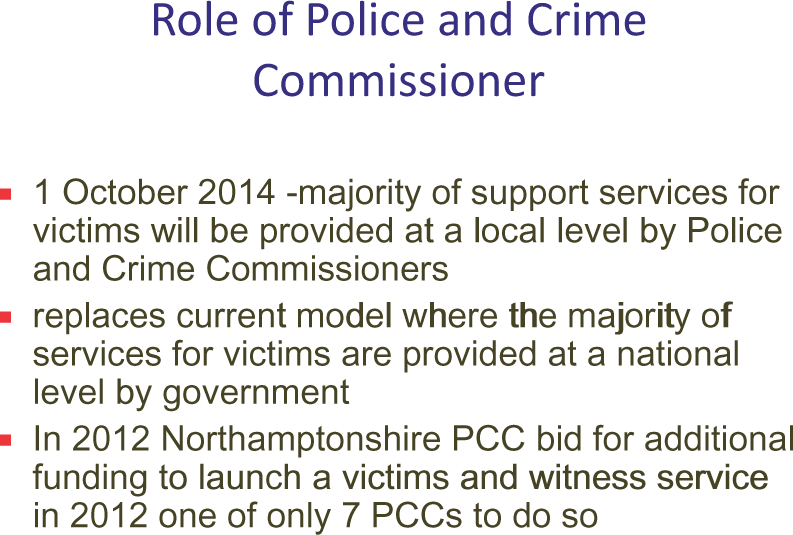
From 1 October 2014 there has been a transfer of support services for victims to the Police and Crime Commissioners which replaces the current model where most services for victims are provided at a national level by Government. The hope is that moving services to local levels will better address local needs. When Northamptonshire bid for additional money, there were only seven Police and Crime Commissioners who did so.
The Northamptonshire Police and Crime Commissioner commissioned Angela Sarkis to carry out research to look at the position in Northamptonshire, and her report was published in September 2013. There were 94 recommendations! I am not going to go through all 94 tonight but I will pick out a few of the highlights.
Topics Sarkis considered:
Anti-social behaviour; Domestic violence; Sexual offences; Hate crimes
Areas Sarkis considered:
Fairness and diversity; Roads victims; Young victims; Service experience; Police; Courts and crown prosecution service; Support services; Restorative practices; Engaging with victims;
Ms Sarkis made recommendations for the police, the courts and the Crown Prosecution Service; support services; and on restorative practices and engaging with victims.
One difficulty highlighted that is quite common across a range of crime is the victim experience of having to tell the next person and the next their story all over again. You report an incident, someone comes to your home and you say “These youths have done…” this, or whatever, and they go away again. Then the next person comes and you have to start from the beginning. Victims find this very distressing and they lose confidence in the system. It is a waste of police officers’ time, in that they are having to re-learn what has already been done and track down information on their systems.
There is also a problem with co-ordinating the responses from different organisations. The plan is to eventually take the responsibility for co-ordination away from frontline staff, the police, who we want to focus on detecting crime. A one stop shop manned by specialist operatives can save time and money and provide a better service for victims by easing their burden at a time of distress. It was also recognised in the case of anti-social behaviour that many of the help groups already in place simply don’t recognise this as a crime. So they are not offering help and support to victims of anti-social behaviour, which means there is a need to educate those service providers.
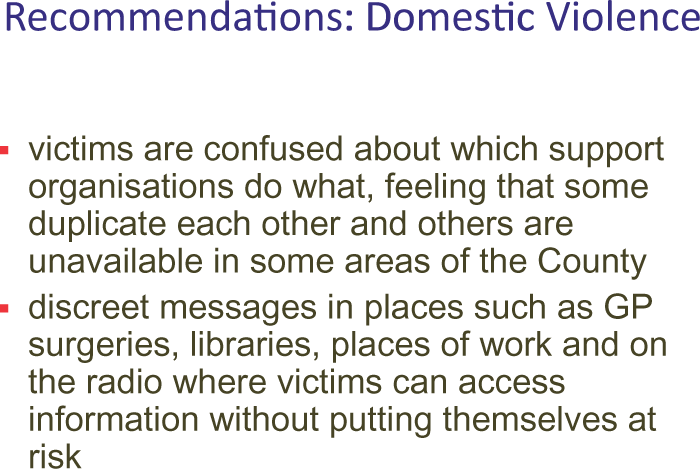
Another area of concern was domestic violence. What is domestic violence? Simply defining domestic violence generates debate. In Northamptonshire we have patchy support coverage. If you live in one part of the county there is more support available to you than in another part of the county. As with all crime many services for victims overlap and whilst all of the different organisations do a very good job, not every victim of domestic violence is able to locate the appropriate service. The difficulty for domestic violence victims is that they need to avoid putting themselves in yet more danger. One recommendation is for discreet messages placed that can be accessed without drawing attention to the fact that you are accessing the service. A victim of domestic violence does not want to take home a leaflet on domestic violence, but having that information more readily available would be a positive boon to victims of domestic violence. We believe domestic violence is still under-reported and typically a series of minor incidents go unreported until there is one incident of serious injury or even a fatality. Lives could be saved with earlier intervention.
All too often the onus is on the victim to collect or show evidence of their victimisation. The report recommends that the police take that responsibility from victims. It is not for victims to investigate the crime. And where victims are in this country with uncertain or insecure immigration status, whether or not they are married to somebody who has secure status, there is more local authorities can do to help such victims.
In sexual offences, the first responder will be a police officer, but most police officers do not have the necessary specialist training to deal with the situation, which needs sensitive handling. However officers need not be a specialist, but they need training to deal with the immediate situation, and then to refer the victim to an appropriate department or specialist officer who should carry out the further investigations. At the present time there are not enough specialist officers in Northamptonshire, but that is something the force are committed to improving. It is also particularly true in the case of child sexual exploitation. There are a relatively small number of cases, but more specialists are needed. It is also recommended that all victims of serious sexual assault and rape attending specialist centres are able to be examined by a doctor of the same gender.
In Northamptonshire (as in many other areas) victims of serious sexual assault and rape attending specialist centres may not be examined by a doctor of the same gender as there are not have enough female GPs trained in this area of work. We need to persuade more female GPs to undertake this training.
Another area of difficulty for victims is their relationship with the Crown Prosecution Service, who discontinue cases for reasons that are not always clear to victims. Often a complicated process has led to a decision to prosecute or not prosecute and those decisions can be controversial as between the CPS and the police – and also for the victims, who may not understand why a decision was reached. There is a right of appeal, but that is not widely understood. If the CPS decides not to proceed, victims can appeal that decision and seek a review at no cost. Thus, the report recommended that in serious rape cases the CPS should explain face to face why it was decided to discontinue and to make victims aware of their right to appeal and to seek a review of the decision.
Victims of a sexual assault, may find it an ordeal to attend a police station and report the offence. Victims do not want to be telling the whole waiting room and the front office counter all about the offence. Front office counter staff in police stations are not police officers, they are civilian staff, and so there needs to be an easier and more private point of contact and privacy for that initial encounter.
Victims of historical sexual abuse is a relatively new phenomenon. People are coming forward after many, many years of silence and we need to have the expertise and the training in place to deal with this. It is hoped that next year a specialist help line will be set up in conjunction with Rape Crisis Northamptonshire to provide specialist counsellors to make it easier for victims to report crime and to receive the support victims of all sexual abuse need and deserve.
Another rising trend that is not really recognised and understood, along with a lot of online crime, is online exploitation. This is a whole new area that needs to be looked at, a new type of crime we have not experienced before.
Hate crime is another concern – it is pernicious. We have particular pockets in Northamptonshire where it is more prevalent than other areas and where it is identified as an ongoing problem, this needs to be tackled more effectively. We need to have a system whereby officers are sensitive to and aware of these problems and tackle them by being more victim friendly at the outset and ensure issues are flagged on systems, investigated and that attending officers are appropriately briefed.
Young victims. It has been recognised that child victims and child witnesses have particular difficulties and over the years we have tried a number of ways to improve the way that young victims are dealt with in the criminal justice system. The evidence shows that young people are reluctant to report crimes. They find it intimidating and difficult and they may lack the support and assistance we would hope they would have. One of the recommendations is that young people should be more aware of what is available and directly engaged in the development and delivery of the services to be used by them.
Social media is very popular with young people and it should be used to explain to victims the services available. There is also a suggestion that young people might feel more comfortable reporting crime online. Restorative practice could be used to prevent bullying in schools, and develop positive role models to help ensure that bullying doesn’t escalate into a really serious crime if it is dealt with at an early stage when a problem is emerging.
There are also recommendations about restorative practices and Northamptonshire wants to be known as a “Restorative Practice County” – That might be a little logo you see as you enter the county! We want a large-scale increase in the use of restorative justice, but this will require funding from a series of agencies that we have to persuade to come in with us on this project. We need to make sure that this is actually working, and one of the steps we will take is to monitor how successful we are and whether we do achieve what we set out to achieve.
We have established the Institute for Public Safety, Crime and Justice in conjunction with the University of Northamptonshire. Which is going to be a “local evidence hub” for restorative practice; and that has now been launched, but at the time of the recommendation it was on our wish list.
What of the response to the Sarkis research? Well, it is very positive. We have had positive engagement from the police, the CPS, the Courts Service and a range of other stakeholders. We have now launched the Victims and Witness Service as Voice, and further research is to be commissioned.

Voice aims to provide:
End-to-end comprehensive and joined up service – from the time of the offence to resolution; Single point of contact available as and when victims and witnesses require it, accessible to all Designed by and with victims and witnesses.
People using the service know how it should look; we don’t. Whilst we deliver the service, we also get tunnel vision about how well we are doing when perhaps we are not doing as well as we think.
Voice will provide a single umbrella organisation which we have to set up. Voice will look at supporting victims of crimes that haven’t previously been considered, such as anti-social behaviour, and will extend this to victims and families of serious and fatal RTAs. One of the pro bono activities I have undertaken for 16 or 17 years is working with the Road Victims Trust, in Bedford, which supports bereaved families at coroners’ courts and provides advocacy. The impact of road traffic death isn’t fully understood and appreciated, and that is something we need to develop.
The service also intends to liaise with criminal justice agencies, provide an access point for restorative practices and training for frontline practitioners in the skills needed to support victims particularly as their needs are better understood and new methods of service delivery are required.
In August 2014 we awarded the contract to Victim Support to provide the first stage of this one-stop service. It was launched on October 1 and it has a slow build-up as people are becoming aware of the service. It is going to operate six days a week at the present time but that is going to be extended. Victim Support Services and Witness Care are going to be located in the same building to look at referrals for victims of all types of crime and victims of serious and persistent anti-social behaviour. We are also creating a partnership with Road peace to support victims of road traffic accidents.
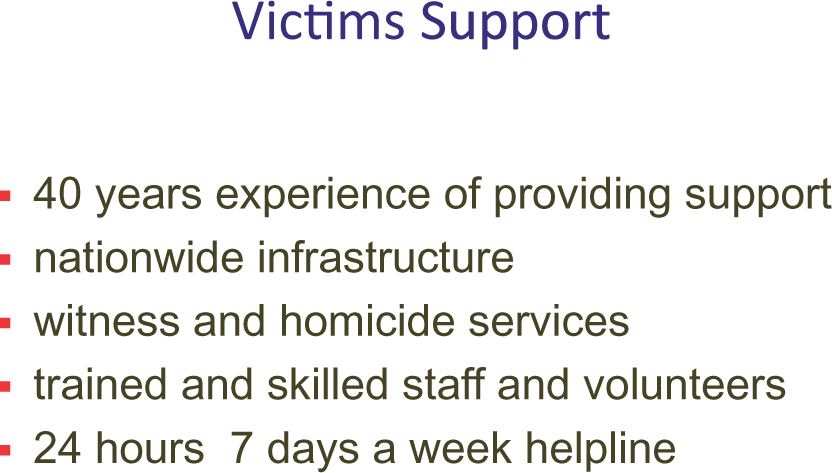
Victims Support is a well-known name, with 40 years’ experience of providing support to victims. They have the infrastructure; we are not recreating, we are using the skills and expertise already there. Victim Support have trained skilled staff and volunteers and we are aiming for a 24-hour 7-day a week helpline.
Witness Care has also been in existence for quite some time. They help witnesses get to court; they support victims at court and also witnesses at court as they navigate the court process. They already have links with the Police, the CPS, the Courts Service and the Witness Service.
We are building partnerships with other groups: for example with the Sunflower Centre in Northamptonshire (domestic violence), Serenity (sexual assault), Road Peace (RTAs), and all these groups and organisations which already exist and who are already giving an excellent service. We do not intend to use funding to duplicate their activities but to provide a sort of glue between them so that from the victim’s point of view there is a single portal, just one point of entry.
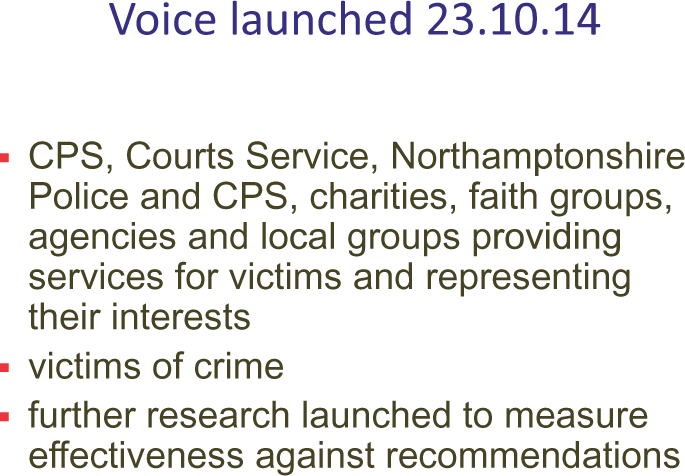
Voice itself was launched on 23 October 2014. We had engagement from all of the major stakeholders, but the most memorable part of the day was listening to three victims, who each had 5 minutes, saying very simply “This is how this crime impacted on me”.
We are developing our own wish list for the legislation, some of which has already been outlined. But as always there are more questions than answers. In addition to the questions on screen I would also like you to consider other aspects.
A gender choice of forensic examiner, but how do we improve recruitment to this type of work? We would like a single assessment of needs to be undertaken at the earliest opportunity. But should this be a specialist assessment? Should this be a medically qualified assessment? How much expertise is needed to do that initial triage and to move people forward to the right service? Another issue is whether or not it will only apply to direct victims, or should it apply to family members? In the case of road traffic deaths, will it apply to the bereaved family? How do you define a “victim”?
Personal impact statements; how should they be used, and how will it be developed? We want something more robust than is being suggested. We think there should be a greater incidence of restorative justice available to all victims regardless of the stage reached in the criminal justice process. We think there is a case for bringing it in before conviction, because if this process takes place earlier then the healing of the victim can take place far earlier. It is unlikely to involve the actual offender pre conviction, but that does not mean that positive action cannot be taken early in the process, so I hope you will take the challenge and give me ideas that I can take back to Northamptonshire. We are only a tiny county but we hope to lead the way in our treatment of victims. Thank you. (Applause)
Discussion
Thank you everybody. I am now going, to your all great relief, to stop talking and I hope you will join us for drinks and canapés in the room at the back.
(Applause)
Footnotes
A meeting of the Society was held at the Medical Society of London, 11 Chandos Street, Cavendish Square, London, W1G 9EB, on Thursday, 6th November 2014. The President, Ms Linda Lee, was in the Chair.