







Abstract
We analysed the recorded cases of suicides committed other than by hanging in prison in Milan. A retrospective analysis was conducted on 25,512 autopsies performed from 1993 to 2019, selecting all the suicides in prison but our attention was focused solely on cases where an alternative mode to hanging was used. From a total of 97 suicide events in prison, 15 were consistent with the established search criteria: 6 victims died from plastic bag suffocation, 4 by direct inhalation of butane gas, 2 associated plastic bag suffocation to inhalation of butane gas, one committed suicide with an edged weapon, one by self-burning and, finally, one by voluntary ingestion of a food to which he was allergic, with the intent of inducing an anaphylactic shock. Our analysis has shown that the landscape of prison suicides is diverse, not limited solely to hanging. Therefore, it is necessary for the forensic scientific community to raise awareness of potentially unusual suicide methods in prisons and, in the same way, for the Penitentiary Administration to put adequate preventive measures and strategies in place.
Introduction
In Italy, suicides in prisons are increasing, and are 12 times higher than that in the general population. 1 This situation is made worse by intrinsic structural problems, the most common of which is overcrowding 2 and long procedural delays. 3
Suicides can, unfortunately, occur during the detention regime and are labelled as “critical events”. 4 National 5 and international6,7 standards guarantee the right of detainees to be treated humanely and require maintenance of an adequate level of attention and surveillance.
Public health concerns inevitably arise regarding the potential measures and strategies needed to reduce self-harm. Prison staff may be suspected of misconduct, prompting severe implications for the deceased's family, public opinion (high media interest), law enforcement agencies and institutions. It is important to determine whether there is any State liability 8 and carry out complex and accurate medico-legal investigations to ascertain what injuries were suffered by the victim. 9 It is universally known that most prisoners commit suicide by hanging. 10 However, recently forensic pathologists have had to deal with more unusual means.
We retrospectively analysed all the prison suicides between 1993 and 2019 other than those by mechanical asphyxia from hanging. Our analysis aimed (1) to make the forensic scientific community aware of these unusual suicides in prisons and (2) to encourage the Penitentiary Administration to ensure adequate preventive measures and strategies are in place.
Materials and method
Procedure and analysis
We reviewed 25,512 autopsies performed in 27 years (1993–2019) at the Institute of Forensic Medicine of the University of Milan. From 4498 suicides, we extrapolated those committed in detention focusing solely on cases other than hanging mechanical asphyxia. Victim data analysed were gender, age, medical history, drug use, cause of death, any previous suicidal ideation and suicide attempts. The collected data were analysed by calculating frequencies and percentages.
Setting
Milan's city has three prisons: the Bollate prison, the Opera's maximum-security prison, and the San Vittore corrective centre. The Bollate prison houses a women's section and an advanced department for sex offenders and receives those inmates already sentenced, redirecting them to work and providing them with education and cultural care programmes. Its capacity is 1251 people, with an average occupancy of 1142 inmates. Opera's maximum-security prison houses some High-Security departments and a “section 41 bis” in which the “hard prison” regime is in force. It can hold 918 people, with an average presence of over 1200 inmates. The San Vittore accommodates individuals awaiting trial or transferred to Milan for procedural rules; it has a capacity of 745 people with an average occupancy of over 800 inmates.
Ethical approval
All subjects enrolled in this study underwent a judicial autopsy to clarify the cause of death. Collection of health information and the sampling and subsequent forensic analyses were, in all cases, authorised by the investigating judge. Under Italian law, these cases require no ethical authorisation but the subjects' anonymity must be guaranteed.
Results
Between 1993 and 2019 there were 97 prison suicides (2.1% of all suicides equal to 0.4% of all autopsies): 82 were by hanging with 15 (15.4% of the total intra-prison suicides) dying by other means (Figure 1). Six were in Milan Opera Maximum Security Prison, five in San Vittore and four in Bollate. Six inmates suffocated themselves using a plastic bag secured around their necks with shoelaces (plastic bag suffocation – PBS), four by inhaling butane gas, two from PBS associated with inhalation of butane gas and one from cuts to the left wrist. Two chose unusual methods: one deliberately ingested a peach knowing he had a severe allergy to self-induce an anaphylactic shock. The last one set himself on fire using a lighter and sprinkled alcohol over his body.
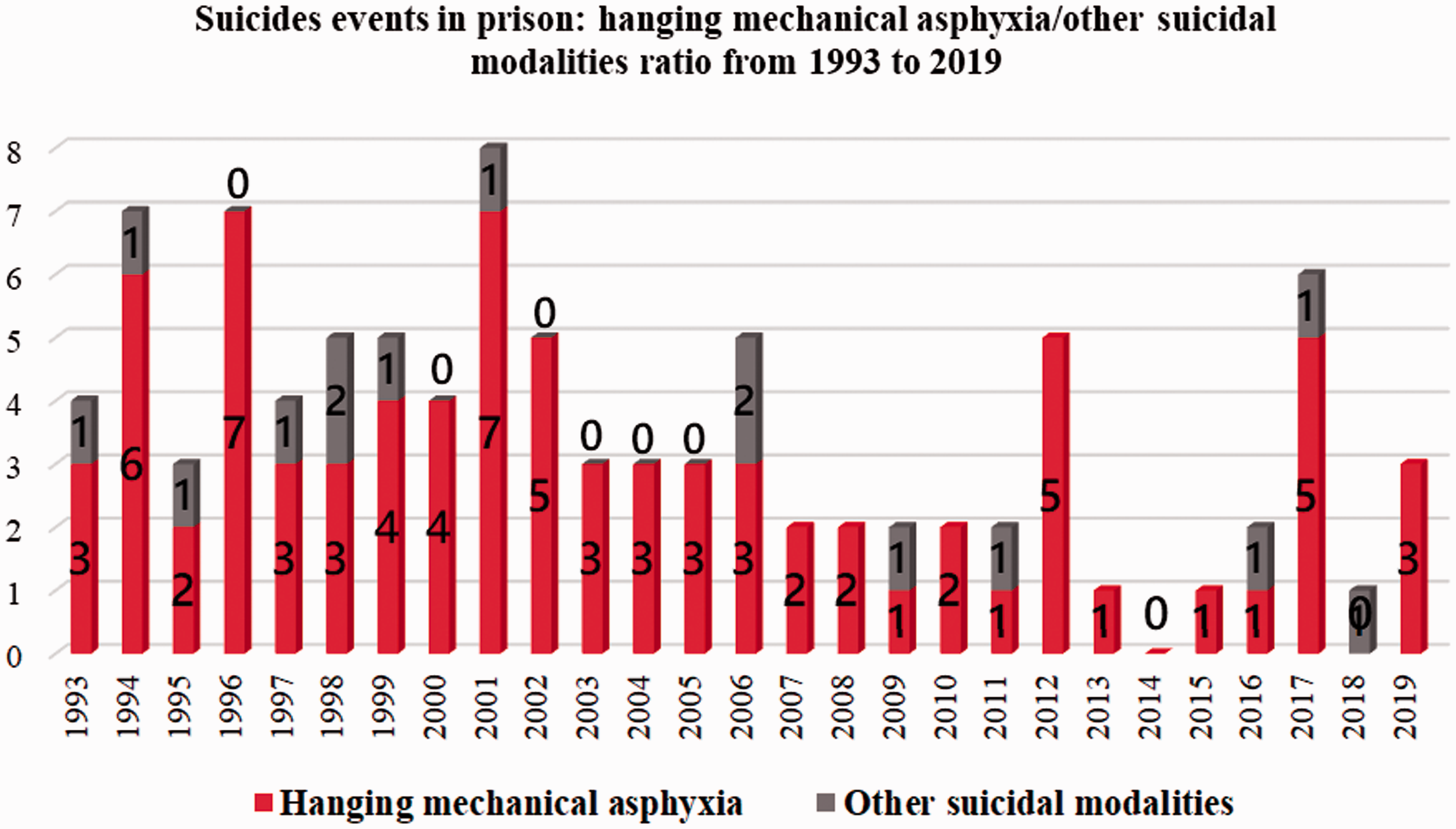
Graphic representation of suicides events in prison from 1993 to 2019, with the detail of the ratio between hanging mechanical asphyxia and other suicidal modalities.
Victim analysis
Fourteen victims were Caucasian (10 Italians, 3 Romanians and 1 Tunisian); one was African (Congolese), 12 were male and two female, with a ratio of 4:1. The youngest was 21, the oldest 67. The commonest age group was aged 20–29 (7) followed by 40–49 (5) and then 30–39 (2).
Analysis of health records showed that 9 out of 15 had at least one pre-existing condition: 6 were suffering from one medical condition, i.e. depression (2 cases), drug addiction (2 cases), high blood pressure (1 case) or epilepsy (1 case); three were affected by several concomitant pathological conditions, i.e. depression and multiple sclerosis (1 case), drug addiction and alcoholism (1 case) and depression, drug addiction and alcoholism (1 case). Most were being treated with pharmacological therapies: anxiolytics (2 cases), antidepressants (1 case), antihypertensives (1 case), antiepileptics (1 case), or methadone via rehabilitation programmes (4 cases). Four had manifested suicidal ideation, and three had made earlier suicide attempts.
Autopsy analysis
All the victims underwent judicial autopsy within three days of discovery. In all cases, the investigating judge ordered histological and toxicological analysis for post-mortem investigation. On external examination, all the bodies were in a discrete state of nutrition and conservation.
Cyanosis of the face and conjunctival petechiae were documented in the victims who committed suicide using PBS only, direct inhalation of butane gas, and the combined use of plastic bags over the head and inhalation of butane gas. Where the plastic bag was secured with shoelaces around the neck, a characteristic furrow and small skin abrasions were highlighted in the neck area. These victims’ autopsy examinations showed typical signs of death from asphyxia, such as very fluid blood, plurivisceral congestion, petechiae and pulmonary oedema. Histological investigations showed microscopic findings consistent with the declared cause of deaths: intra-alveolar oedema, foci of interstitial and intra-alveolar haemorrhages, emphysematous areas, focal atelectasis and alveolar macrophages. In all cases, cause of death was identified with PBS or acute butane intoxication.
In the suicide by self-burning, the victim set himself on fire with a lighter after sprinkling his body with alcohol. External examination revealed severe third-degree burns on 95% of the body. Death resulted from multi-organ failure after surviving for a week.
In one case the detainee had self-inflicted deep cuts on his left wrist with a razor blade and died from haemorrhagic shock. External examination showed almost absent hypostasis and diffuse pallor of the body. Four continuous full-thickness skin injuries were observed on the left wrist's volar surface, with a major transversal axis. The edges of the wounds appeared clean and infiltrated with blood. Histological investigations unequivocally demonstrated the vital reaction. The left cubital vein's complete transection was observed on internal examination, and all viscera appeared intensely pale.
In the unique case of death caused by an allergy of which the victim was well aware, a hand-written farewell note was found in his prison jumpsuit’s pocket saying he intended to kill himself by eating peaches as he knew he had a serious allergy to them. External and internal examinations were not definitive on the cause of death but histological investigations were highly suggestive of anaphylactic shock as was oedema of the glottis, intrapulmonary haemorrhages, and mastocytes in the glottis, myocardium and both lungs by immune-histochemical investigations (using anti-tryptase serum and anti CD117 serum).
Forensic toxicological analysis
Chemical-toxicological investigations on all samples taken during autopsy examination (femoral blood, cardiac blood, urine, bile, gastric contents, brain, lungs, liver and adipose tissue) were performed following the Institute of Legal Medicine of Milan’s protocols. The search for toxic volatile organic substrates was carried out, including ethanol levels in plasma and assessment of non-volatile organic toxicants to detect any pharmacologically active toxic substances.
High levels of alcohol in plasma were present in 2 of the 15 victims (blood alcohol content between 1.7 and 2.5 g/L). In four other victims, there were therapeutic levels of methadone. In two cases, benzodiazepines (bromazepam, alprazolam) taken as anxiolytics were present in addition to psychostimulants (caffeine, cotinine and nicotine).
To detect aliphatic hydrocarbons (butane), the collected samples (blood, brain, lung, liver and adipose tissue) were immediately placed in previously calibrated 10 mL vials, sealed with Teflon and metal flange, stored at –20° C until analysis. They were then analysed by gas chromatography (HS/GC) using an Agilent 6890 and Agilent 5973 mass detector. Four cases (the inmates who committed suicide by direct inhalation of gas through cans) had high concentrations. In the six cases with PBS and butane gas association, the concentrations of this gas were high if not peremptorily lethal.
Discussion
We analysed the 15 prison suicides in Milan committed without self-hanging (15.4% of all the suicides). Among these PBS, associated or not with the inhalation of aliphatic hydrocarbons such as butane, was most common. There was a single case of suicide with a razor, a self-burning and a self-induced anaphylactic reaction. A complete and detailed forensic approach is essential to clarify the circumstances, 8 the means and cause of death in prison, to verify whether the death was an unusual suicide rather than homicide, accident or natural causes. 11 To this end, in 2017, the National Association of Medical Examiners (NOME) developed recommendations to be followed by the medical examiner investigating a death in prison to ensure consistency and reliability of investigations. 12 They state the most suitable procedures to be performed, underlining all potentially useful investigations in these cases: photographic surveys, radiographic analysis, archiving and collection of evidence, histological, toxicological and microbiological investigations are often indispensable.
In the deaths from asphyxia (PBS, inhalation of butane gas, PBS associated with inhalation of butane gas), the forensic and toxicological investigations enabled us to determine that death occurred by suffocation due to the adherence of the plastic bag to the breathing orifices associated or not with a toxic-anoxic mechanism by replacing the alveolar oxygen with butane gas. This gas has high toxicity and fat solubility. It is rapidly distributed to the respiratory system and the brain through the blood–brain barrier, causing sudden death from cardiac arrhythmia, vagal inhibition, respiratory depression and anoxia. 13 Suicides resulting from just the direct inhalation of butane gas are incredibly problematic diagnostically. So the results of toxicological analyses are vital to diagnosis. In all the cases of suicide by asphyxia, histological investigations were supportive and highlighted coherent microscopic pictures of asphyxia in the lungs. In the more unusual suicide cases, histological investigations also provided a valid contribution, sometimes being decisive particularly in the case of self-induced anaphylactic shock where external and internal examinations did not reveal anything relevant whereas the microscopic immunohistochemical investigation did provide evident markers of an anaphylactic reaction, such as the positivity to anti-tryptase and anti CD117 serum, as well as widespread presence of mast cells.
Some inmates committed suicide in unusual ways; in all cases, they applied lawfully owned objects in daily use, such as plastic bags, shoelaces, alcohol, lighters, razor blades, food and cans of butane gas. Although these methods were unusual, most of them are considered not “risky” in prison, and there is no regulation on the possession of them. Nonetheless, these examples show that they can be lethal if misused. Awareness of their potential to harm seems not yet sufficiently high for them to be more regulated. In particular, we were surprised that the unconventional tool most used here was a butane gas cylinder for camping stoves which are available to prisoners under the same Penitentiary Administration, under the regulation referred to art. 13 of the DPR 30 June 2000 n. 230. 14 Prisoners can use personal stoves in their cell to heat liquids and food already cooked and to prepare drinks and foods after signing away liability by the Prison Administration for its improper use. Therefore, it is rare for prison staff to be accused of negligence where cans are used for suicidal purposes. Restrictions on the use of camping gas cooking stoves in the cell can only be applied in exceptional situations. They are also regarded as helpful to a prisoner's re-education, which is the ultimate aim of detention.
In Italy, the need to replace camping gas cooking stoves with electric stoves is currently under discussion. However, the cost of adapting cells to have electrical connections that do not exist today and energy consumption (per capita allocation) are key limiting factors. Further, these changes would lead to the failure of the supplemental services, through which inmates can buy food to cook in their cells. The financial loss for Prison Administration is another inhibiting factor. Even though valid alternative solutions exist, to date, the Prison Administration is prioritising building new jails to deal with prison overcrowding, rather than spending money on the existing ones to make them safer and pleasanter.
In conclusion, our analysis showed that the range of prison suicides is diverse, not limited solely to hanging, and the forensic scientific community needs to be aware of the possibility of unusual suicides arising while prison administrations should take adequate preventive measures and strategies to avoid these deaths occurring.
Footnotes
Declaration of conflicting interests
The author(s) declared no potential conflicts of interest with respect to the research, authorship, and/or publication of this article.
Funding
The author(s) received no financial support for the research, authorship, and/or publication of this article.