







Abstract
An Air India Express Flight AI1344 travelling from Dubai to Calicut (Kozhikode), when attempting to land, unfortunately, overshot the runway and crashed causing many casualties as the impact caused the aircraft to break up into multiple pieces. The response to a disaster, specifically an aviation disaster, is highly complex. It involves multiple government agencies and calls for a truly inter/multidisciplinary response from diverse domains including forensic experts, fire experts, aeronautical engineers, humanitarian experts who must together form an ideal post-rescue recovery team. The author was intricately involved in the recovery mission launched after the above air disaster. This case study considers the process of collecting and managing the personal effects of those affected along with the various challenges involved.
Keywords
Introduction
The covid pandemic did not just bring a healthcare crisis but unprecedented challenges affecting our way of life. Tourism was halted, businesses shut and universities closed their doors. As a precautionary measure, the Government of India, like other nations, banned all international flights on 22 March 2020, the day the first “Janata curfew” (Public curfew) was observed. 1 This was immediately followed by a nationwide total lockdown. A global lockdown sent shockwaves and induced immense panic among ex-pats living outside their countries for various reasons, such as jobs, business, education and even those travelling for leisure.
A large number of Indians who found themselves stuck in different nations wanted to return home. To assist them, the Ministry of External Affairs launched a mission called “Vande Bharat Mission” in May. 2 The first flight took off from Abu Dhabi, UAE on 7 May 2020 and the operator was Air India, which is a Government-owned enterprise; the Vande Bharat Mission is still ongoing and is currently in the sixteenth phase.
The incident
Phase 5 of the mission was operational during August 2020. One flight of Phase 5 was IX1344, scheduled to fly from Dubai, UAE to Kozhikode, Kerala on August 7. It was due to land at the Kozhikode International Airport but crashed at its second landing attempt.
Various aspects of aviation disaster management
Disasters are highly chaotic events and disaster management is crucial to minimise their impact. Aviation disasters are complex to handle and the response has to be inter/multidisciplinary. An aviation accident is defined by the International Civil Aviation Organisation as an occurrence associated with the operation of an aircraft, which takes place from the time any person boards the aircraft with the intention of flight until all such persons have disembarked, and in which a) a person is fatally or seriously injured, b) the aircraft sustains significant damage or structural failure, or c) the aircraft goes missing or becomes completely inaccessible. 3
There are many aspects of aviation disaster management: they include casualty management, psychological and extended care of the victims, family assistance, recovery of human remains (HR), disaster victims' identification, recovery and processing of personal effects (PE) and their repatriation, aircraft wreckage management, and recovery of flight data recorder and cockpit voice recorder, which are integral to the crash investigation.
PE may be cargo, checked-in luggage, cabin luggage and items normally worn or carried on the person. Passengers’ PE are important, not only from a monetary or compensatory point of view, but because they may have a sentimental value as well. Examples of typical PE are a passport, medical documents, a photograph, a book and a piece of jewellery.
The compensation guidelines in case of loss, delay or damage to the PE are clearly set out in Montreal Convention 1999 (MC99). 4 The Directorate General of Civil Aviation (DGCA), which operates under the guidance of the Ministry of Civil Aviation, is the nodal agency looking after the matters related to both national and international flights in India. DGCA is governed by the Carriage By Air Act, 1972 5 which embodies MC99 in Chapter 4A. Essentially, PE management is carried out from three perspectives; humanitarian, compensation and forensic.
Kenyon International Emergency Services (KIES) 6 was entrusted with PE recovery and management by Air India Express. 7 The author was deployed to the plane crash site as a member of the Go team of KIES.
Aim of the mission
The aim of this humanitarian mission was to recover and process the PE and at the same time recover any incidental HR left at the crash site.
Objectives of the mission
The objectives of the mission were PE recovery, photography, sanitisation, segregation, making an inventory, photography, packing, labelling and repatriation.
Risk elements
A risk assessment was carried out to understand the nature of the hazards at the incident site and to institute measures to deal with them. Hazards may include fire (aviation fuel), physical injury from sharp and broken pieces of aircraft, electrical hazard, extreme weather, dangerous chemical spillage, biological hazard (Covid-19 and insect/microbial infestation), topographical hazard (the tail portion of the aircraft was on a slope), psychological hazard (post-traumatic stress disorder) and wildlife hazard (wolves, snakes and scorpions) made the mission more challenging. Risk reduction measures involved: deployment of a fire truck, use of personal protective equipment including Tyvek® (DuPont™ Virginia, USA) overalls, facial shields, face masks, safety shoes and safety gloves. A first aid kit and automated external defibrillator device were on standby throughout. The mental well-being of the team members was ensured by a psychologist every week.
PE management
See Figure 1. The Go team was divided into multiple sub-teams. PE were scattered around the incident site and many PE were still inside the broken plane. The team at the incident site coordinated with the engineering team that assisted to gain access inside the cargo and passenger compartment. The incident site team physically searched and recovered the PE. The crash site as well as the plane was divided into sectors and searched using the ”Fingertip search” method. The photography of the items was conducted in situ at the crash site prior to being moved.
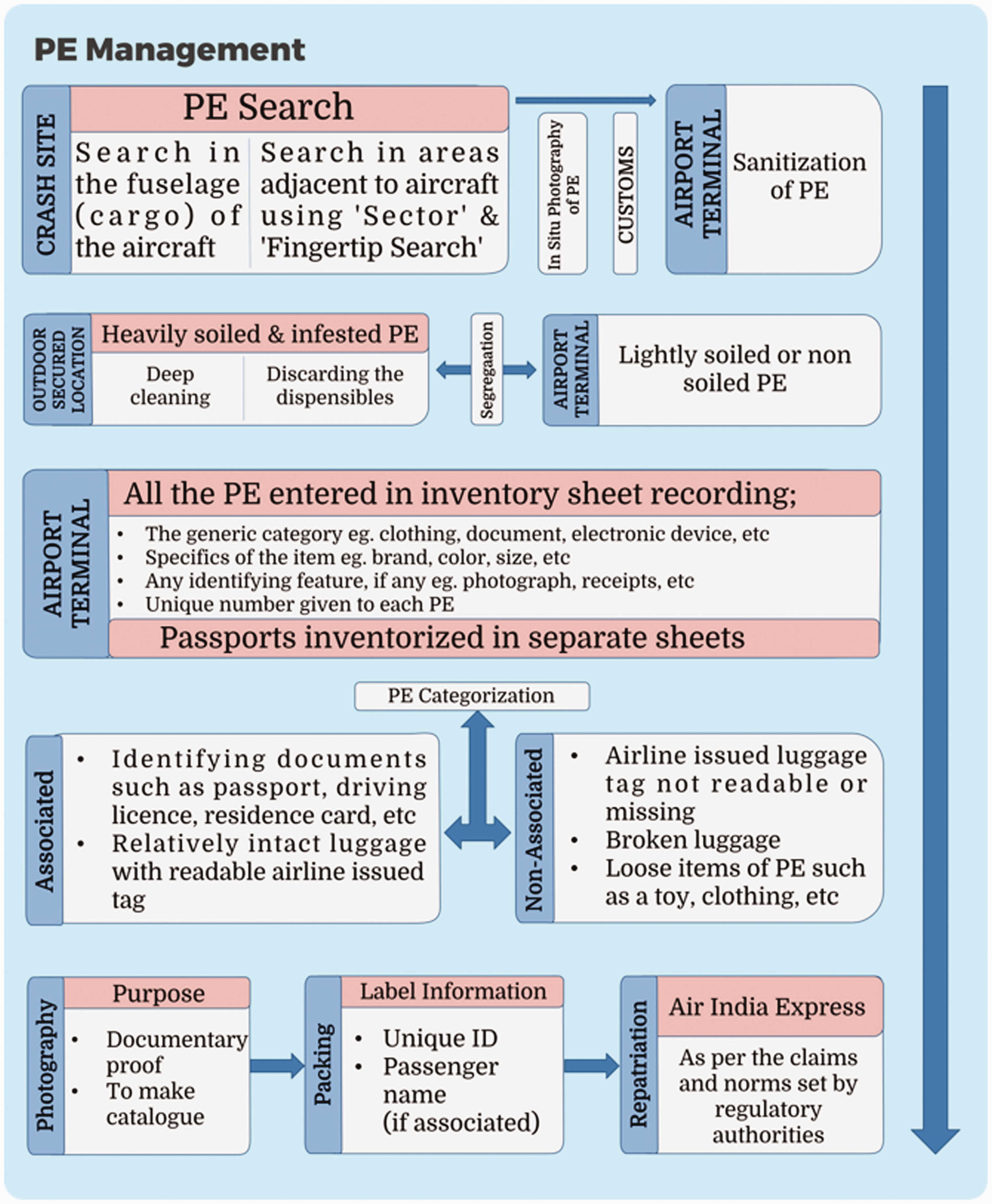
Personal Effects Management.
The recovered PE were brought from the site to the designated PE processing area (airport terminal) through the customs, where another team sanitised the recovery to neutralize the biological hazard. All the teams were diverse in nature comprising forensic experts, medical professionals, forensic odontologist, ex-armed forces, firefighters, aviation veterans and disaster experts.
The PE were sorted depending upon the extent of the damage. Next, all the items of PE were entered in inventory sheets which maintained the chain of custody (COC) as well. A unique identification (ID) number was given to each PE. The unique numbers were allotted by a dedicated person to avoid duplication of the numbers. Afterwards, all the PE were photographed individually as well as in groups (if they were from a common source).
Afterwards, PE were categorised into associated and non-associated. The luggage that was relatively intact (with airline issued luggage tag) and any identifying PE such as a passport, driving licence, residence card, medical documents, boarding pass, tickets, etc., were “associated” in nature. Any luggage which did not have the airline tag, broken luggage and loose items of PE were categorised as “non-associated”. A separate inventory sheet was maintained for recovered passports.
Many items, especially items of clothing from the broken luggage, were wet and soaked due to incessant rain at the incident site. Efforts were made to clean, dry and return as many clothes as possible. Excessively soiled pieces of clothing developed mould on them and a decision was taken to dispose of them by incineration.
Eventually, the items were packed in new suitcases and labelled indicating the unique ID number and passenger name (if associated). All the PE, both associated and non-associated were handed over to Air India Express for repatriation. A flow diagram as depicted in Figure 1 summarises the PE management process.
Discussion
The ultimate aim of any PE management operation is to recover, process and return the items promptly. During the recovery process at the incident site, all PE, as well as small aircraft debris, need to be removed to clear the site and restore day-to-day operations. Each item of PE removed from the incident site (including the consumable items which are potentially contaminated) must be entered in the inventory sheet and photographed. However repatriation of each and every item of PE is not possible, nor it is advisable. Consumable items such as food and beverages, medicines, cosmetics, etc., are not returned for health concerns. Such items are safely destroyed to eliminate any bio-hazardous situation. This process greatly increases the administrative workload.
Observing and noting every detail is a must while inventorying, specifically anything which can identify the person (passport, ID card, letter, tickets, boarding pass, documents), anything which has sentimental value (toys, letters, religious books, artefact, etc.) and monetary value (phone, watch, wrist band, cash, coins, jewellery, etc.).
Tricky situations can arise during PE processing, such as one during this mission. A damaged, tightly shut pressure cooker was recovered. As the possibility of travellers stowing valuables such as cash or jewellery could not be ignored, every effort was made to open the damaged and distorted pressure cooker.
In case of a broken item such as an old ancestral watch, depending on the feasibility and the specific wishes of the owner, the following solutions are recommended;
Restoring/repairing the watch to the best condition possible. Replacement of the watch with a new one of the same make and model. Monetary compensation of the watch.
The first option is a commendable humanitarian gesture, going out of the way to mend the damages. It is very well appreciated by the owners of the PE.
PE management is not just about search and recovery at a risky incident site. The challenges continue to persist further. For the timely completion of a PE processing mission, great administrative efforts are needed; in the form of compiling the huge data of recovery, maintaining a large number of photographs, maintaining the COC forms, secure storage of PE till repatriation, safe disposal of PE that will not be repatriated and creation of catalogues of the PE that will be shared with passengers by the airline company for claims purpose. Catalogues are an important tool for the identification of the rightful owners of PE. In the case of competing claims, the airline companies have their own set of rules laid down to settle such disputed cases.
Conclusion
The response to disasters, specifically aviation disasters, is highly complex, involving multiple government agencies and calls for a truly inter/multidisciplinary response. Personnel from different domains such as forensic experts, fire experts, aeronautical engineers, humanitarian experts, etc., form an ideal post-rescue recovery team. The efforts in the management of this disaster are worth noting since the PE of the victims are often disregarded and PE management does not find a place in many guideline documents.8,9 PE management should be a standard procedure in other types of transportation mishaps, not only for compensation purposes but from a humanitarian perspective. 10
Deployment of doctors with training in forensics and disaster management at such incident sites is crucial not only for the recovery of HR but for PE too. A forensic odontologist is suitable for such a mission due to certain key qualities and skills such as empathy towards the community including their PE (a humanitarian requirement), attention to detail, ability to work in teams and in adverse conditions, etc. The keen eye of the forensic odontologist proved crucial in the recovery of minute objects including an intra-oral radiograph, a ring, etc., from a huge pile of aircraft wreckage, which forms the crux of the mission. To the best of the author’s knowledge, this was the first aviation disaster in India where a forensic odontologist was part of the core recovery team.
Permission
The required permissions have been taken for the publication.
Footnotes
Acknowledgements
The author acknowledges Kenyon International Emergency Services for giving an opportunity to serve humanity. Special thanks to Kathy Ricker, Team Member Manager for coordinating all the efforts.
Declaration of conflicting interests
The author declares that there is no conflict of interest.
Funding
The authors received no financial support for the research, authorship, and/or publication of this article.