






Abstract
Suicidal cut throat injuries are uncommon; when they do occur they are usually caused by a knife or a razor. A hand saw as a means of suicide is most unusual and the resulting irregular and serrated wound margins, depth of injury. Associated anatomical damage must be analysed to distinguish a suicide from a homicide or accident. The psychological factors contributing to such an extreme choice of weapon should also be explored. We report a case of suicide by throat cutting using a hand saw along with a review of the forensic, and psychological extent of other such incidents.
Introduction
Suicide remains a global public health concern. Methods vary and depend on individual, cultural, and circumstantial factors. Suicidal cut throat injuries are rare and represent a significant challenge in forensic practice. Usually, sharp-edged implements such as knives and razors are used to self-inflict neck injuries, a handsaw is highly unusual, due to the effort required, the pain caused, and the prolonged nature of the act. It poses a unique challenge in forensic evaluation. We present a rare case of suicidal cut throat with a handsaw, highlighting the injury pattern, medico-legal considerations, and psychiatric aspects of such an extreme act. The irregular, serrated wound margins, extent of tissue damage, and associated anatomical disruption distinguish this case from more commonly reported self-inflicted neck wounds. Understanding the forensic findings and psychological background can assist with distinguishing self-inflicted injuries from homicidal or accidental wounds. In addition, the case emphasises the need for improved mental health awareness and suicide prevention strategies to identify individuals at risk of employing such desperate and violent methods.
Case report
The body of a 42-year-old male, a carpenter by profession, was found inside his house which was locked from inside. The body, first seen by the deceased’s wife through a window, was lying on a bed in a pool of blood with a handsaw (Figure 1) beside it. This was after she returned from work. There was no disorder in the room. The deceased had suffered from depression since he lost his son 5 years. earlier. He was not on any medication. For the last 15 days he had appeared quite restless and emotional, and once told his wife to look after his son and get him married.
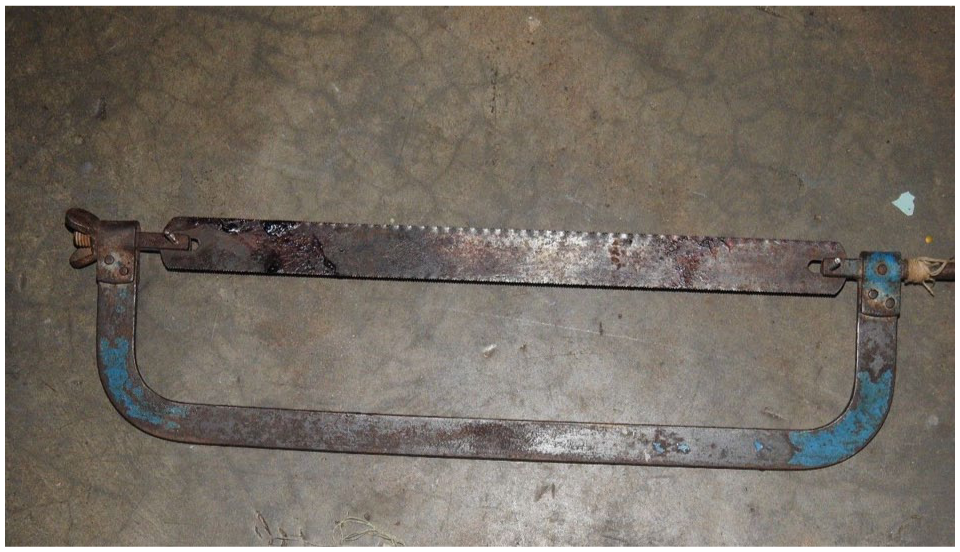
Hand saw found at the crime scene.
Autopsy examination revealed the body of a middle aged male with fully developed rigor mortis. Post mortem lividity was present over the back and dependent parts of the body sparing pressure points. It was fixed. A cut throat gaping injury of 14 × 4 cm, with serrated margins and ragged tissue edges was present on anterior and lateral parts of the neck (Figure 2). On approximation it was 15.5 × 0.5 cm in size. More specifically, the wound started 4.0 cm below the right angle of the mandible and ended 4.5 cm below left angle of mandible It was oblique and descended from right to left.
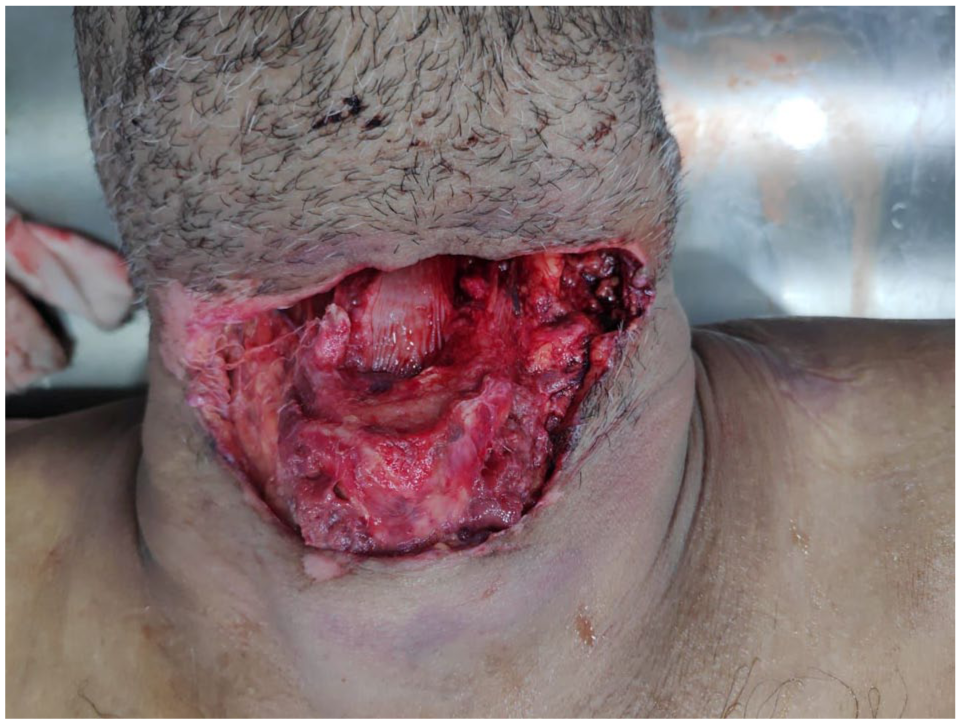
Cut throat injury by handsaw.
The external carotid artery, the internal jugular vein, and the internal carotid artery on both sides were severed. Trachea was completely transacted at the level of superior cornu of thyroid cartilage with injury reaching to the posterior wall of esophagus. No suicide note or drugs were found near the body. The cause of death was exsanguination.
Discussion
Suicides involving handsaws are exceptionally rare in forensic practice, with only a few documented cases. This may be attributed to the method’s inherent difficulty, the physical pain involved, and the availability of less traumatic means. In one of the few published cases, a 54-year-old male with schizophrenia was found in his workshop with fatal body injuries. He had used a screwdriver to inflict several stab wounds, particularly to his neck. Further, two superficial cuts on the front of the neck, characterised by wave-like linear scratches, were attributed to a handsaw found near the body. 1 In another case a 76-year-old man with a history of psychiatric illness was found dead at home. He left a suicide note and a handsaw. The autopsy revealed sharp injuries to the anterior neck, including irregular cuts through muscles, the thyroid, trachea, and left internal jugular vein, along with hesitation wounds. The cause of death was traumatic neck injuries, and the manner of death was suicide. 2 Gloulou et al. 3 in their study present two cases of suicide involving hand saws. Both individuals were carpenters with histories of psychiatric disorders and previous suicide attempts. Fatal injuries caused by power saws are rare. In most cases, they are accidental; suicides using a power saw are very rare. Cioffi et al. 4 reported a case of suicide by a young obese woman using an electric jigsaw; she suffered from major depression with psychotic features. In a similar case reported by Zribi et al., 5 a 30-year-old carpenter was found dead lying on the floor of his workshop next to a router saw; he had two gaping and deep wounds in his head.
In a similar case a 32-year-old female, suffering from depression was found dead in her room with a circular saw beside her right hand. The autopsy revealed a large gaping wound measuring 15.5 cm in length on the right side of her neck. The right external carotid artery, the right internal jugular vein, and the right internal carotid artery were cut with injury reaching to the cervical vertebra. Therefore, the cause of death was exsanguination. 6
In our case the deceased was a carpenter, who became depressed after his son’s 5 years earlier and started drinking alcohol regularly. He was often irritable, slept excessively and there were regular altercations with his wife over money to buy alcohol. Fifteen days before his death he told his wife to take care of his elder son and get him married. On the penultimate day he stayed awake the whole night (Information gathered from Psychological Autopsy).
Despite the small number of cases reported in literature, many characteristics found in these reports were similar to our case, namely, the deceased was a male, suffering from psychiatric disorder who was found with injuries to his neck. The neck wound had serrated margins and ragged tissue edges, typical of those caused by a handsaw. Death scene investigation (door locked from inside, no sign of a third party intervention), absence of any defensive injuries and the pattern of the wound were consistent with self-inflicted injuries. The toxicological analysis did not reveal presence of any substance.
Conclusion
Suicidal cut throat injuries involving a hand saw are rare so providing details of such cases, will assist professionals involved who may be able to better understand the factors leading to such incidents and to devise better prevention strategies and support systems for those at risk.
Footnotes
Declaration of conflicting interests
The authors declared no potential conflicts of interest with respect to the research, authorship, and/or publication of this article.
Funding
The authors received no financial support for the research, authorship, and/or publication of this article.
