






Abstract

Jazz Singing: Developing Artistry and Authenticity
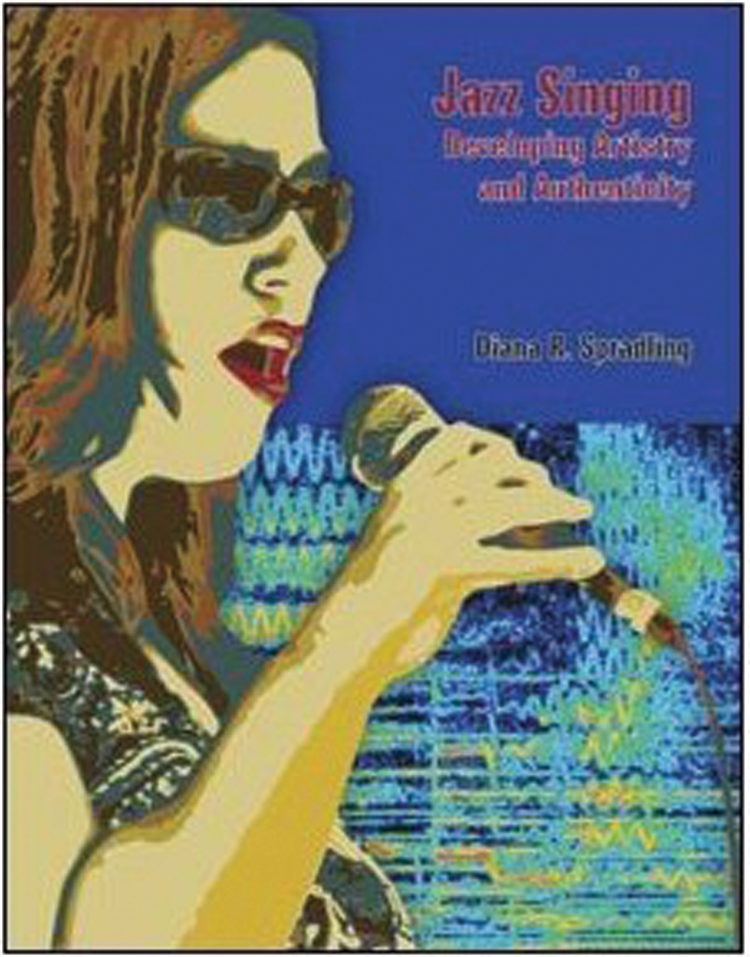
by Diana R. Spradling. Edmonds, WA: Sound Music Publications, 2007; www.smpjazz.com.
Written for the vocal pedagogue (teacher and choral director) and avid student, Diana Spradling’s Jazz Singing: Developing Artistry and Authenticity integrates vocal pedagogical research with the classic Swingers and Crooners: The Art of Jazz Singing, by Leslie Gorse. One of the rules of thumb in studying the craft of singing or learning to play any instrument is to learn from those who came before you, and Spradling’s book takes this advice to heart.
The work is presented in three parts: Part 1 defines the “parameters of the art of jazz singing” on the basis of voices from the first generation of modern jazz singers (Frank Sinatra, Nancy Wilson, and Ella Fitzgerald, to name a few). The second part explores the physicality of singing, including vowel production, text treatment, vibrato usage, and breath management and presents exercises as well as microphone techniques. Part 3 dissects the songs and techniques of modern jazz singers identified in part 1—techniques like the art of scat. In this section, Spradling invites Justin Garrett Binek, jazz faculty member at the University of the Arts in Philadelphia, to contribute an analysis of six solos by Ella Fitzgerald, Mel Tormé, Sarah Vaughan, Betty Carter, Mark Murphy, and Bobby McFerrin.
Young and inexperienced singers as well as choral directors will likely find something new in reading this book. For instance, did you know that there are nine ways a jazz artist uses vibrato? (pp. 35–36). Also, reticent singers who fear “switching” from classical to jazz singing might find Spradling’s vocal exercises and tips useful, such as how to achieve optimal resonance and desired timbre for the art form (pp. 21–22). Tips on strengthening the male falsetto voice and a checklist for choral directors are also great reference elements in the book.
Jazz Singing: Developing Artistry and Authenticity is heavy on examining techniques associated with jazz singing. A significant portion of the book refers to the use of spectrograms, the visual representations of sound measuring intensity and frequency patterns. If you like to look at spectrograms, this part of the book will be fascinating to you. Having said this, did jazz artists learn to sing jazz through studying these? No, they learned while exploring the joys of singing and through music-making. Understanding this, Spradling says, “If we are to teach valid jazz concepts, we must understand what jazz singers do physically and vocally. Being able to imitate is no longer enough” (p. 133).
Overall, this textbook is a good supplemental work for use with a vocal pedagogy class or for the vocal enthusiast wanting to safely explore the art of jazz singing.
Music and fine arts administrator,
Second Presbyterian Church
[The reviewer was the
director of education and outreach,
Center for the Performing Arts,
Carmel, Indiana, when this
review was written];
Extraordinary Measures: Disability in Music
by Joseph Straus. New York: Oxford University Press, 2011; www.oup.com.
Disability has been perceived in a variety of ways throughout history, depending on a multitude of social and political factors at play. Examining disability as cultural construction, Joseph Straus’s Extraordinary Measures: Disability in Music explores the varied ways in which disability has affected and enriched composition, performance, listening, and analysis. This book serves as a valuable resource, not only to teachers who frequently work with students with disabilities but also to all musicians who wish to gain a deeper understanding of the ways in which diversity affects our varied musical endeavors.
Throughout the book, the concept of “normality” is explored metaphorically in both bodily and musical terms. Straus’s academic expertise is evidenced throughout the book with frequent, relevant citations to support the positions he asserts. Interpreting chromatic tones outside principal keys as “tonal problems” akin to “abnormality,” Straus posits that these elements serve to provide musical interest, thus necessitating some sort of treatment for resolution or accommodation. Specific examples are analyzed in the works of Beethoven and Schubert, whose own experience with disability might have influenced their compositional process.
Likewise, Straus continues to examine concepts of “normal” and “abnormal” through varied sources of music theory analysis. He writes, “The central metaphor of the music theories surveyed here is that a work of music is a human body, a living creature with form and motion, and often with blood, organs, limbs, and skin as well” (p. 103). Discussions of embodiment, more common in philosophy and linguistics, are considered as they relate to the work of Heinrich Schenker and David Lewin. Although Straus’s book is not designed to offer specific pedagogical suggestions, teachers interested in kinesthetic relationships to music learning might find this section particularly informative.
While composition and analysis can be understood within a disability paradigm, Straus argues that performance also has parallels within the experience of disability. Anyone performing music onstage is subject to the gawking scrutiny that individuals with disabilities experience in everyday life. Musicians who happen to be disabled not only subject their musical skills to audience scrutiny but also perform their disability in varying degrees. Straus emphasizes that while disabilities may result in unique characteristics or behaviors, these very features can serve to enrich musical understanding and interpretation. Arguing that Glenn Gould’s eccentric behaviors might have been due to a form of autism, Straus examines ways that this condition could have inspired unique interpretations that generations of pianists have tried to emulate. Likewise, quotes from Thomas Quasthoff and Itzhak Perlman illustrate how disability can inform career paths and decisions about disability advocacy. Similarly, Straus argues that disability can affect listening in unique ways that provide rich, new perspectives on typical listening experiences.
Throughout the book, Straus provides well-reasoned arguments that stimulate thoughtful reflection on teaching, musicianship, and the human experience. In the spirit of inclusion, this is one of the rare books that speaks to all musicians, regardless of their individual interests or pursuits.
Assistant professor,
music education,
College of Music,
University of North Texas,
Denton;
Where Music Helps: Community Music Therapy in Action and Reflection
by Brynjulf Stige, Gary Ansdell, Cochavit Elefant, and Mercédes Pavlicevic. Burlington, VT: Ashgate, 2010; www.ashgate.com.
Community music therapy is a branch of traditional music therapy that has been met with some hesitancy. People may ask whether it is “right” to have vulnerable people perform in public. Some also say that therapy is about finding the “real” self, and therefore, performing is unauthentic. Other issues against it include its focus on social as well as health issues, the use of nontraditional music therapy practices, and the ethical issue of asking somewhat more fragile individuals to perform. The authors and researchers of this book show how “music’s healing powers emerge from within communities of practice” and “where and how music offers us ways of making environments hospitable” (back cover). The different approaches and case studies provide interesting viewpoints that all support community music therapy and its ability to “provide a foundation for marginalized groups in relation to self-growth and the experience of becoming citizens with some influence,” as Cochavit Elefant says (p. 214). Elefant, who heads the music therapy program at the Graduate School of Creative Arts Therapies at the University of Haifa, goes on to share that “The opening of wider circles is what Community Music Therapy would like to be identified with, expanding conventional music therapy practices and entering into new and sometimes unknown areas. The professional definitions and boundaries of the music therapist are expanded from working with individuals and groups towards socially oriented roles” (p. 90). Gary Ansdell, head of research at the Nordoff-Robbins Music Therapy Centre, similarly writes, “The development of Community Music Therapy discourse is, however, opening up a professional and theoretical discussion within music therapy to the potentials and problems of working with clients across the full continuum of private to public music therapy, and to the place of performance practices within this spectrum. It is also linking (or re-linking) music therapy as a practice, discipline, and profession more directly to broader current debates on cultural politics in relation to health, social care, and social action” (p. 162).
Each case study is thorough in its explanation of how community music therapy aligns with established music therapy practices, while also providing a better means of helping people become who they need to be in the society where they live. Those in music therapy wishing to use the community music therapy model, those who wish to create social awareness through music therapy, or others wishing to include “vulnerable” people in a performance will find the information and research in this book encouraging, helpful, and practical.
General music teacher,
Leesburg Elementary School,
Leesburg, Indiana;
Some Liked It Hot: Jazz Women in Film and Television 1928–1959
by Kristin A. McGee. Middletown, CT: Wesleyan University Press, 2009; http://www.wesleyan.edu/wespress/.
Kristin McGee’s Some Liked It Hot: Jazz Women in Film and Television 1928–1959 uncovers the histories of American all-girl jazz bands in an attempt to explain women’s exclusion from the jazz canon. All-girl bands, including the Midwest’s Harlem Playgirls and Chicago’s Ingenues, were lucrative live acts and were ideal film subjects due to their aural and visual appeal. After comparing the instrumentation, repertoire, style, and visual representations of all-girl band film appearances, McGee describes the raced, classed, and heavily gendered film representations that often contradicted their live performances. For example, data from programs and reviews reveal a hot jazz repertoire and frequent instrumental doubling, but films downplayed women’s musical abilities, constructing women as physically appealing yet musically simple. McGee asserts that although films succeeded in breaking traditional gender barriers by promoting modern professional women musicians, the films better succeeded in trivializing their musical capabilities by relying on feminized arrangements and characterizing women as either highly sexualized or childlike. Women generally appear nonthreatening to all-male ensembles in these films, but McGee also found rare examples of women’s bands exhibiting their skills and versatility.
Unavoidable problems of this project include a lack of preserved film and sound recordings. All-girl bands were praised foremost as live acts. Their visual appeal worked in their favor as film subjects and against them as record artists. The extensive appendix is impressive documentation of all-girl band film appearances, but McGee posits that the lack of sound recordings hurt their reception during the canonizing of jazz. McGee illuminates two events that excluded all-girl bands from the jazz canon. First, visual fascination overshadowed women’s musical abilities and caused them to be later interpreted as gimmicky. Second, the fleeting return in popularity of all-girl bands in 1950s television variety shows solidified the association of women’s jazz with light pop.
Kristin McGee’s Some Liked It Hot has teaching-tool potential due to the easy availability of all-girl band film examples via YouTube. I recently used McGee’s book as material for a lecture in my Women and Music class that is populated with women’s studies and music majors. My students immediately connected with the Melodears and followed McGee’s analysis as I led them through several videos. When asked to analyze a video as a class, my students picked up on several details from McGee’s book, including the camera’s distracting attention to the conductor’s body.
Some Liked It Hot ends with a convincing case for reinstating women in jazz history as McGee reflects on her life as a jazz musician. As long as jazz is associated with men, gender barriers are prolonged for women artists. The perceived exoticness of professional women musicians and fascination with women’s bodies continue to distract modern audiences from women’s musicianship. I agree with McGee that this is true of jazz, but I believe it extends across genres and needs to be addressed in the music education community.
Musicology/ethnomusicology
doctoral candidate,
University of Georgia, Athens;
Instrumental Music Education: Teaching with the Musical and Practical in Harmony
by Evan Feldman and Ari Contzius. New York: Routledge, 2011; www.routledge.com.
Instrumental Music Education: Teaching with the Musical and Practical in Harmony is a great new addition to the how-to-be-a-band-or-orchestra-director genre. Evan Feldman and Ari Contzius, with contributions by Mitch Lutch, have created an excellent book. It was designed as a college textbook for instrumental music education majors, but could also serve as a superb resource for the experienced educator.
The organization of this book makes it very easy to read and understand, as well as making it a great reference resource. It is divided into three units: “The Process of Teaching Instrumental Music,” “Directing Bands and Orchestras,” and “Administrative Issues.”
The first unit discusses teaching music. It presents a “sound-to-symbol” teaching system based in philosophy, teaching theory, and well-cited research as well as practical approaches to teaching basic musicianship. The information and techniques are so thorough and clear that any teacher would be able to incorporate all the techniques discussed in the book immediately.
The second unit examines the practical issues of daily life as an instrumental music teacher. Topics such as classroom management, curriculum and grading, repertoire and score study, rehearsal technique, and motivation are discussed in an understandable, detailed, and practical manner. The information presented could be used in the classroom quickly and easily. For students, examples and sample scripts are presented to provide even greater clarity and understanding of applicability.
The third unit contains the administrative aspects of the job. Again, considerable detail is provided. This section of the book is especially valuable to young teachers and is the kind of resource I wish I would have had when I began teaching. Some of the best information for a beginning teacher is in the music budget chapter, which discusses purchase orders, bids, and budget requests—topics frequently omitted in other textbooks.
This book has many virtues. One that particularly struck me was the discussion of some of the more controversial and disagreed-on topics, including music education philosophy, competition, and the incorporation of popular music. Also impressive is the methodical process of presenting the “what, why, and how” for every topic presented and the equal discussion of band and orchestra settings.
This is a comprehensive book, full of terrific information, advice, and sources. The book includes multiple resources, including an accompanying CD of audio files and a companion website that contains two additional chapters, job-search information, rhythm flashcards, and many instructional and pedagogical videos as well as a foreword by Frank Battisti. A nice selection of activities and assignments is included for each chapter, many of which require higher-level thinking, application of materials, and problem solving. Throughout the book are informational figures, examples, scenarios, and sample scripts to help the reader better understand and apply the material. Suggestions for further reading are also provided for each topic. This would be a great textbook for a college instrumental music methods class and a valuable resource for any instrumental music teacher.
Associate director of bands and
music education instructor,
Iowa State University, Ames;
Richard Wagner and His World

edited by Thomas S. Grey. Ewing, NJ: Princeton University Press, 2009; http://press.princeton.edu/.
For the past twenty years, Bard College (located in Annandale-on-Hudson, New York) has put on a Summer Music Festival that undertakes the exploration of a single composer’s life, works, and times. The activities of the festival are complemented by the publication of a book of related articles, essays, and letters, edited by a leading music scholar and published by Princeton University Press. In 2006, the book series was awarded a Special Recognition Deems Taylor Award from ASCAP for “outstanding print, broadcast, and new media coverage of music.” Thomas S. Grey, editor of Richard Wagner and His World, continues the excellent work of this series, and does so with the composer who is, perhaps, among the most difficult to put into a cultural context. Wagner (1813–1883) envisioned himself as taking up the mantle of Beethoven and sought to have as profound an impact on music as Beethoven had.
Grey does a masterful job of providing the reader with a variety of materials, including original essays as well as translations of essays, reviews, and letters of those who both supported and castigated Wagner. As he acknowledges, a single volume cannot provide sufficient depth, but Grey does provide a rich framework by which readers can both be introduced to various contextual elements of Wagner and deepen their existing knowledge of the composer. Nonetheless, Grey’s goal in Richard Wagner and His World is to place Wagner’s activities—musical, theatrical, critical, polemical—into their cultural context. He does this by organizing the material into six parts.
Part 1 is made up of newly written essays that delve deeply into topics with which the reader might already be somewhat familiar, such as Wagner’s early years in Paris, which profoundly influenced his development as a thinker and artist; the role of war and politics on Wagner; and reconciling Wagner’s music within modern Jewish history. These essays are well researched and provocative, focusing on a specific point, but illuminative of broader insight into Wagner, providing the reader has a general background and knowledge of Wagner and his works.
In part 2, Grey translated and, especially important, annotated several contemporary writings that offer a window into influences on Wagner: Wilhelmine Schröder-Devrient and her mimetic performance skills, the symbiotic relationship of Wagner and the French Symbolist movement, Wagner’s late-life dream of moving his family to America, and the reminiscences of Newell Sill Jenkins, the American dentist who attended Wagner during the last eight years of his life.
The documents of parts 3 through 5 are commentaries on Wagner’s music, ranging from the hugely influential review by Franz Liszt of the overture to Tannhäuser to an essay by Eduard Hanslick, a contemporary of Wagner who was not a fan of Wagner’s idiom. Much of this material has never been translated, or the translations are out of print, so Grey’s choices are particularly germane. It must be reiterated that Grey’s introductions are critically important for placing his choices into the context not only of their time but also in the ongoing debate surrounding Wagner and his works, both musical and political.
Part 6 contains, again masterfully done by Grey, Wagner’s complete program notes, which provide some perspective on Wagner’s overarching concept for his works.
Richard Wagner and His World is an excellent book and will be of interest and use not only for performers and scholars of music but also for those doing interdisciplinary work in history, philosophy, and social studies, and many others—which is exactly the way Wagner approached his work, as Grey’s wonderful book makes evident.
Associate professor of music
Fairfield University,
Fairfield, Connecticut;
Bands of Sisters: U.S. Women’s Military Bands during World War II (American Wind Band Series, no. 3)
by Jill M. Sullivan. Lanham, MD: Scarecrow Press, 2011; www.scarecrowpress.com.
Bands of Sisters is an exciting account of women’s military bands in the United States during World War II. Traditional accounts of the history of music education have underrepresented the contributions of women musicians. Historians have especially neglected the stories of female band musicians even though women performed in town bands, school bands, and professional touring bands in the nineteenth century and gained valuable experience during the school band movement of the 1920s. When the U.S. government realized that more manpower was needed to win World War II, women were encouraged to join the civilian and military workforce to “free a man to fight.” Each branch of the military formed women’s bands.
Jill Sullivan, an associate professor of instrumental music education at Arizona State University in Tempe, has done extensive research on the history of women’s instrumental ensembles from the nineteenth century through World War II. For Bands of Sisters, she interviewed seventy-nine members of women’s military bands, gathering information on their education, motivation for enlisting, military experiences, and the lifelong impact of these military band experiences. Bands and drum and bugle corps were part of the WAC (Women’s Army Corps), Coast Guard SPAR (Semper Paratus Always Ready), MCWR (Marine Corps Women’s Reserve), and the Navy WAVES (Women Accepted for Volunteer Emergency Service). Several of the women who became military band conductors had been music teachers before the war. Band members had experience in high school and college bands and participated in basic training and music training in the military.
Women’s military bands performed for parades, bond drives, and radio broadcasts and in hospitals. The band members formed additional ensembles (choirs and swing bands) to entertain troops. In addition to maintaining a demanding performing schedule, the musicians had additional duties as clerical workers, guards, maintenance crew members, and truck drivers.
The chapter “Music for the Injured Soldier” will be especially interesting for music therapists. Near the end of the war, WAC band members were reassigned to military bases on the Atlantic and Pacific coasts to welcome home injured men, and bands from several military branches performed in hospitals. The musicians entertained the men and encouraged them to participate in music activities.
The photographs on the hardcover are excellent. The center of the book includes thirty-two photos of bands performing in various venues, which would have been more effective if they were larger and interspersed throughout the book. The book also includes an appendix listing the women interviewed, endnotes at the end of each chapter, a bibliography, and an index.
Bands of Sisters will be of interest to anyone who has played in a band, directors of instrumental ensembles, and the general reader who is interested in the contributions of women to music education. I hope that future books will expand our knowledge of women in bands during other historical periods.
Independent scholar,
Wayzata, Minnesota;
Alternative Approaches in Music Education: Case Studies from the Field
edited by Ann C. Clements. Lanham, MD: MENC/Rowman & Littlefield Education, 2010; https://rowman.com/RLEducation.
Alternative Approaches in Music Education explores some of the creative ways music educators across the United States are approaching emerging practices in music teaching and learning. The book is divided into two main sections: “PreK–12 Case Studies” and “School to Community and Higher Education Case Studies.” Each case study discusses how a music educator approached the music needs of his or her school or community through nontraditional (not band, chorus, or orchestra) music classes or groups. The topics vary from pop music to multicultural music, and from music technology to film scoring. Many differing ideas are presented in real-world case studies.
An educator who implemented the specific music “alternative” wrote each case study. The educator includes the reasons for the new approach to music, the issues and challenges he or she faced while working with the new program, and a discussion of whether there is a future for the program. The end of each case study includes a thorough reference list for those who may have a continuing interest in that type of program.
Initially, I was disappointed that the case studies did not provide more specifics on how to start the program in my community, such as where to find the supplies, listening and viewing examples, and instruments. Then I came to realize that the book was not designed to inform the reader about how to implement the programs in the book; instead, it is designed to provide ideas to a music educator who is searching for methods that can reach more students or include more cultures. Many current music educators, myself included, have been asked to teach classes that we may not have received preparation for in our degree programs. This book is an excellent resource for an educator who has been asked to implement a music and technology course, or who simply has been asked to offer a course that is not a traditional music class.
The case studies are written in a scientific manner, not in a literary style. It is useful to glance through the table of contents and select the studies that are most interesting or most pertinent to the reader. The writing style of each case study varies slightly, so the format is not consistent.
This book would be most useful to music educators who are looking for new options or methods of teaching music to students, or to college professors interested in showing future music educators that music education is not limited to band, chorus, orchestra, and general music.
Band and music teacher,
Western Heights Middle School,
Hagerstown, Maryland;
Jazz Matters: Sound, Place and Time since Bebop
by David Ake. Berkeley: University of California Press, 2010; www.ucpress.edu.
Jazz performer and scholar David Ake nudges, prods, and provokes readers toward fresh and sometimes irreverent thoughts in Jazz Matters: Sound, Place, and Time since Bebop. Scholars as well as jazz enthusiasts will find each chapter challenging and compelling. Although well researched with extensive endnotes, it is far from a dry read. It smartly challenges common beliefs and myths regarding the perception of jazz and its place in American and world culture.
The book is laid out in two parts. Part 1, “Sound and Time,” contains three chapters. Chapter 1 traces the perception of both John Coltrane, the person, and his music as “transcendent.” Coltrane has been viewed by some as a jazz deity. Ake takes the reader from the hard-bopping Coltrane of Giant Steps to the voice behind Ascension, a spirit-filled voice less involved with self and ego, exploring and expressing the infinite. While jargon like “being subjectivity” in this chapter may get in the way of clarity, I found the chapter overall to be thought-provoking and interesting.
I especially enjoyed chapter 2, “Making Sense of the ‘Creak’ on Miles Davis’s ‘Old Folks.’” It is hard to describe the skillful way in which Ake uses one odd musical moment to develop a treatise on unintentional sonority. At approximately 1:15 into the track “Old Folks” on Davis’s Someday My Prince Will Come album, there is a “quiet but clearly audible groan of wood laboring under the weight of a person in motion” (p. 37). The chapter explores what this sound might mean, especially in an age when supremely talented ears listened to, edited, and produced this track and released it with this accidental, unscripted sound. If someone had described this chapter to me, I would have chuckled that such silliness is what happens when academics are required to publish. But I savored the chapter and raced to the recording to hear the creak in the song.
Chapter 3 was unconvincing in its challenge of the common notion of jazz as music to be venerated. Ake’s discussion of groups, like Sex Mob, who “reject importance and ironic distance” as inherent traits in jazz (p. 55) stands in seeming contradiction to previous references to jazz as a transcendent medium.
Part 2 is called “Place and Time.” “Race, Place, and Nostalgia After the Counterculture . . .” looks at two jazz innovators, Keith Jarrett and Pat Metheny, exploring their seminal role in creating a jazz sound less grounded in bebop and blues and more influenced by the rural heartland. A similar idea resurfaces in the final chapter, where Ake explores the growing European influence on American jazz identity, particularly, jazz musicians in Paris.
Teachers should feel warm affirmation after reading “Rethinking Jazz Education.” Here, Ake shatters the cliché “Those who can, do, and those who can’t, teach” as he asserts that schools are now a primary venue for jazz performance and innovation. College and school programs are now more prominent than nightclubs in the development and dissemination of jazz. Jazz Matters is thoughtful and, whether you agree with its arguments or not, engaging. It offers unique insights that will capture and challenge jazz enthusiasts of all stripes.
Director of instrumental music,
Boston College High School;
Quick Reference for Band Directors
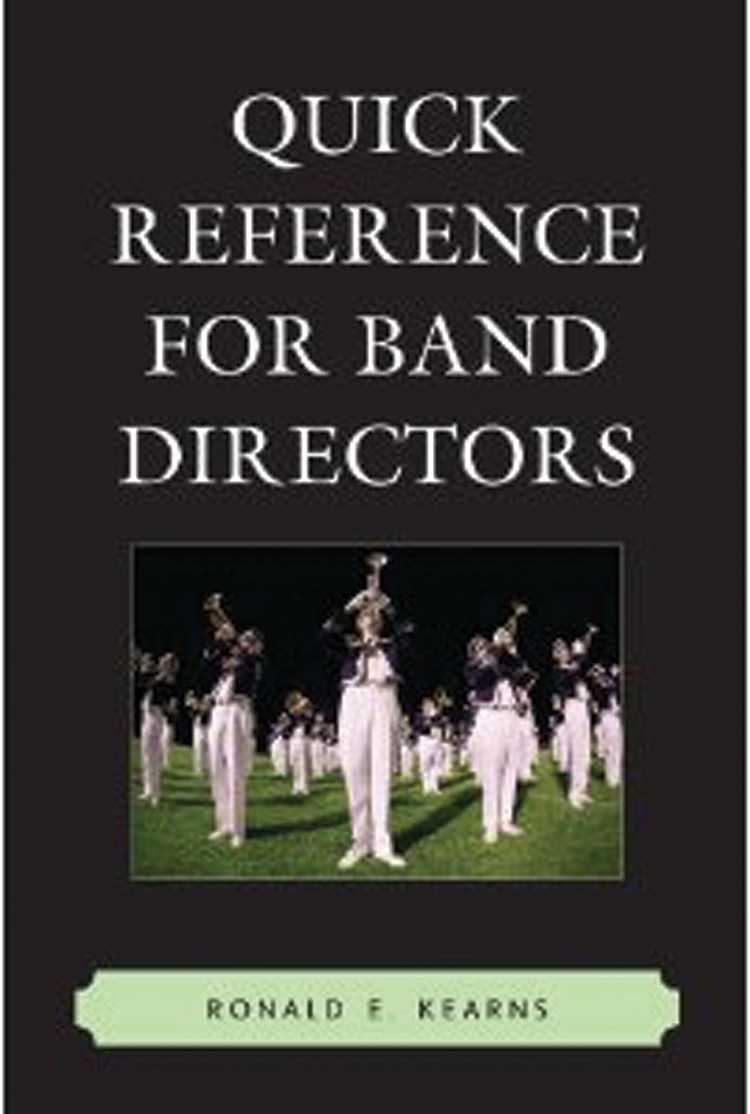
by Ronald E. Kearns. Lanham, MD: MENC/Rowman & Littlefield Education, 2011; https://rowman.com/RLEducation.
Author Ronald E. Kearns clearly states the purpose of Quick Reference for Band Directors in the book’s preface: “to give band directors a quick reference for building or maintaining a program” (p. xiii). Although he expected this book would be most useful for high school band directors, Kearns devoted one chapter to developing an elementary program and another to having a successful first performance. His tone is direct and conversational. The twenty-two chapters are complete in themselves, and the detailed table of contents enables the reader to go directly to the chapter related to his or her immediate need.
The book is organized in two parts. In part 1, the chapters are full length, ranging from three to twenty-nine pages. This variation in chapter length is a bit perplexing. The very short chapters, including “Creating a Handbook for Band and Classroom Management,” seem to follow the intent of the book to be a “quick reference.” Other chapters, such as “Developing a Jazz Ensemble,” are more than twenty pages in length. This inconsistency will leave the reader looking for additional sources about topics that are addressed more summarily. In part 2, the same chapters are re-presented in a condensed version. This repetition feels unnecessary because so many of the chapters are short in their original version, and because Kearns’s frequent headings makes it easy to locate topics within the original chapters.
At times, Kearns makes generalizations that do not apply to many regions of the United States, particularly in reference to the ubiquitous elementary pull-out lesson: in many schools, program cutbacks have pushed back beginning band to the middle school level, where it may meet daily as a class. Also, Kearns often refers to district music supervisors, which are also now absent in many areas. Another point of concern is inaccuracy in stating that double reeds are not meant to be pushed all the way into the instrument (p. 108).
The author’s thirty years of teaching experience is most evident in his recommendations for managing boosters organizations, recruiting, being a colleague within the whole-school environment, and the focus on musicality in all types of band settings. With separate chapters on small ensembles, marching band, and jazz band, Quick Reference for Band Directors encompasses the breadth of ensembles a high school director is expected to be familiar with. Many chapters conclude with lists of composers and publishers, which will be useful for younger directors who may need guidance in repertoire selection. Kearns’ matter-of-fact writing style should make this text an accessible resource for developing band directors.
Assistant professor and
Director of music education,
Georgia Southern University,
Statesboro;
Rhythms of the Game: The Link between Musical and Athletic Performance
by Bernie Williams, Dave Gluck, and Bob Thompson. Milwaukee, WI: Hal Leonard, 2011; www.halleonard.com.
Those interested in improving their own performance skills or their ability to teach performance skills should take a look at Rhythms of the Game. This easy-to-read book explores links between performance in baseball and music in an entertaining and eloquent way.
Each short chapter focuses on one aspect of performance or preparation. The authors engage the reader by using memorable stories about baseball and music to illustrate key ideas about practice and preparation, useful mindsets for performance, and the lifelong process of improvement. The use of personal anecdotes brings the general concepts to life, and this, coupled with the brevity of the chapters, makes the book easy to read and comprehend.
Additionally, guest authors provide supplemental vignettes that reinforce or expand upon core ideas. Some vignettes include more anecdotes or personal philosophies from other musicians and athletes, and these alternate perspectives add to the richness of the book. Other guest authors provide excellent summaries of key ideas linked to performance psychology. For example, Don Greene presents a minilesson on brainwave activity and its impact on peak performance that is easily understood without any prior knowledge about the topic or of specialized vocabulary (pp. 132–33).
As one who has struggled with performance anxiety in the past, I find many of the concepts discussed very insightful, relevant, and useful. I appreciate the clear, intelligible language and the authors’ focus on positive outlooks; the book will be invaluable to me in teaching as I try to help my own students overcome their performance difficulties.
For those who love sports and music, exploring the special connection between the two could be interesting, at least; at best, it could be very powerful in terms of learning how to maximize performance skills. Even for those musicians without a strong connection to sports, the valuable knowledge in this book is well worth pursuing.
Assistant professor of piano pedagogy,
Crane School of Music,
SUNY Potsdam,
Potsdam, New York;
English and German Diction for Singers: A Comparative Approach
by Amanda Johnston. Lanham, MD: Scarecrow Press, 2011; http://scarecrowpress.com.
English and German Diction for Singers: A Comparative Approach is written as a text for undergraduate- and graduate-level voice students and vocal coaches. The book is divided into four sections. At the end of each chapter, exercises are presented to check for understanding. The answers to the questions are located in an appendix. Even though the book provides in-depth detail in the pronunciation of English and German languages with respect to vocal performance, author Amanda Johnston does not presume to replace the study with a native speaker and/or native vocal performer. She also acknowledges the different dialects of each language as well as the historical changes that both languages have encountered.
The first section is an introduction to the International Phonetic Alphabet (IPA), vowel classifications, organs of speech, and points of articulation. The application of IPA and discussion of the articulators of vocal production are used throughout the remainder of the book.
The second section of the book focuses on the English language. Johnston explores the diction of the spoken word and further discusses recommendations for solo vocal performance. Vowels are discussed in detail, including the brightness and placement of monophthongs, influence of r in vocal performance, and the vowel proportion of diphthongs and triphthongs. Every consonant and consonant blend unique to the English language is explored with specific contexts and musical examples supported the author’s advice for musical performance. Johnston recommends that the final chapter be used for study by advanced-degree students. In the closing of the section, she highlights specific “pitfalls” unique to vocal performance in the English language. Much energy is devoted to the physical description of the production of each vowel sound and the articulation of each consonant. Focusing on the German language, the third section of the book mirrors the structure of the second section. The fourth section compares and contrasts German and English vowel and consonant sounds and includes performance modifications for the operatic stage.
The appendixes include a glossary of phonetic and anatomical terms used throughout the book, tongue twisters in English and German for practice of vowel and consonant sounds, graded levels of repertoire for study in English and German lyric diction, the answers to the exercises for each chapter, bibliography, a removable flashcard of English and German IPA symbols (with a corresponding word of reference), and an index referring back to the text.
English and German Diction for Singers: A Comparative Approach is a musical, linguistic, and physical explanation of vocal production in English and German for singers. Each sound is prefaced with a brief description, three to five words or short phrases to isolate the sound, phonetic spelling using IPA, and for German, the English translation of the word(s). Musical excerpts of German art songs are presented with IPA printed below the text. The explanation of the position of the mouth, tongue, and lips for each vowel and consonant is extremely detailed. This information is beneficial to both voice teachers and choral conductors desiring to develop a choral unified sound. This textbook, paired with the study of conversational German, is a useful tool for music educators and vocal performers.
Kodály music specialist,
Carter Academy for the Performing Arts;
Aldine Independent School District,
Houston, Texas;
How Do Books Get Reviewed in “For Your Library”?
Do you have a recently published book on music education or music history or a related topic that would be of interest to music teachers? Send a copy for consideration for review to Caroline Arlington, NAfME, 1806 Robert Fulton Drive, Reston, VA 20191. (Review copies must be submitted to NAfME without charge. Copies of books chosen for review are given to reviewers and cannot be returned.) Be sure to include the publisher’s name, city, and state, as well as the web address.
For information on how NAfME members can review books for Music Educators Journal, go to www.nafme.org. Find the “Book Review Guidelines” under Music Educators Journal.