Abstract

Photo by Doreen Birdsell

This issue of Music Educators Journal is the second in the centennial volume. We are marking this milestone in a manner nearly identical to the commemoration of the fiftieth volume in 1963–64. As then, each issue of the one hundredth volume contains an article or two related to the history of MEJ. Most important, though, is the symbolism in what we are not doing now, and what was not done fifty years ago: You will not find an entire issue devoted to historical facts and figures about the journal. Instead, the practical work of teaching music remains the focus through the journal’s many articles, columns, and supporting features. The historical and celebratory content reflects, appropriately, one facet of the complex work music educators do daily, as they did in the decades from 1914 to 1964 and during the five decades since. The content of MEJ is designed to promote the development of music education (what could be), include reports from the field (what is), and provide application of lessons from our past (what was). We accordingly strive to intertwine all three perspectives within the pages of this issue and volume. As then-MENC president Alex H. Zimmerman wrote to open the fiftieth volume celebration, the mission of MEJ has always been “simply to advance the cause of music education” (September–October 1964, Vol. 50, No. 1, p. 41).
Some comparisons between the 1963–64 and 2013–14 volumes are quite interesting. The earlier volume included six issues, and the current volume will include four. Where MEJ was the only journal received by all Association members in 1963, current NAfME members receive both MEJ and Teaching Music. The circulation in 1964 was 57,500 copies, and the current circulation is just over 66,000 printed copies plus the electronic versions now available to viewers across the globe. The cover images for the issues of both volumes are minimalist in design and without political comment (the first color photo appeared in Vol. 39, on the cover of the January 1953 issue). The 1963–64 covers did not include much text, while the current covers announce all major articles in each issue. There was no commemorative cover during the fiftieth anniversary celebration; there will be one in June 2014. The February–March 1964 issue contained 188 pages; the September 2013 issue contained 100 fewer.
In the February–March 1964 issue (Vol. 50, No. 4), an introduction to reprints of important past articles included the following sentence: “In reading early issues of the magazine one is struck by the similarities—or, more correctly, parallels—of issues that existed for music educators in the teens of this century with those that confront music educators today” (p. 45). This introduced reprinted articles from the founding editor of the journal, Peter Dykema (1917), and Charles Farnsworth (1919). Both pieces were titled “The Importance of School Music” and spoke to the philosophical and practical struggles of the emerging music education profession. We are similarly reprinting important articles in each issue of the one hundredth volume. In this issue, drawing from the second quarter-century of our history, we reprint Leon Mones’s 1958 piece “Music and Education in Our American Democracy.” Mark Fonder, a former MEJ Editor, selected the article as one of the most important in the period from 1939 to 1964.
The September 2013 “From the Academic Editor” noted the importance of the burgeoning music industry during the early years of MEJ’s existence. The relationship between advertising dollars and academic/musical concerns has remained a topic of discussion through the first hundred years. In the January 1964 issue (Vol. 50, No. 3), former MENC Executive Secretary and MEJ Managing Editor Clifford Buttleman offered a detailed history of the financial and organizational development of the journal. In April–May 1964 (Vol. 50, No. 5), chairman of the Editorial Board and future MENC president Wiley L. Housewright wrote that the journal content had grown more “substantive” in recent years, referencing both professional content and the “tangible support of the music industry” (pp. 40–1). A fuller account of the growth in advertising served as the capstone article in the fiftieth anniversary commemoration. Titled “The Journal and Music Industry: A Fifty-Year History of Cooperation,” the June–July 1964 article (Vol. 50, No. 6, pp. 46–52) provided a historical overview of the content, imagery, and financial support provided by advertisers. Among the fascinating details:
The Summy-Birchard Company advertised on the back cover of every issue during the first fifty years.
Advertising content has reflected changes in society, notably during the period of World War I.
The first college to advertise in the journal was the Northwestern University School of Music in 1919.
Finally, journal content has consistently explored the appropriate use of developing technologies in music classrooms. The June–July 1964 retrospective of advertising included the image and text shown in Figure 1. The pairing encapsulates the relevance of MEJ’s past for its present and future. One cannot help but wonder about the instructions given to the artist in 1921, the technologies used by the caption writer in 1964, our current use of technology, and MEJ’s consistent, forward-oriented commitment to “simply advance the cause of music education.”
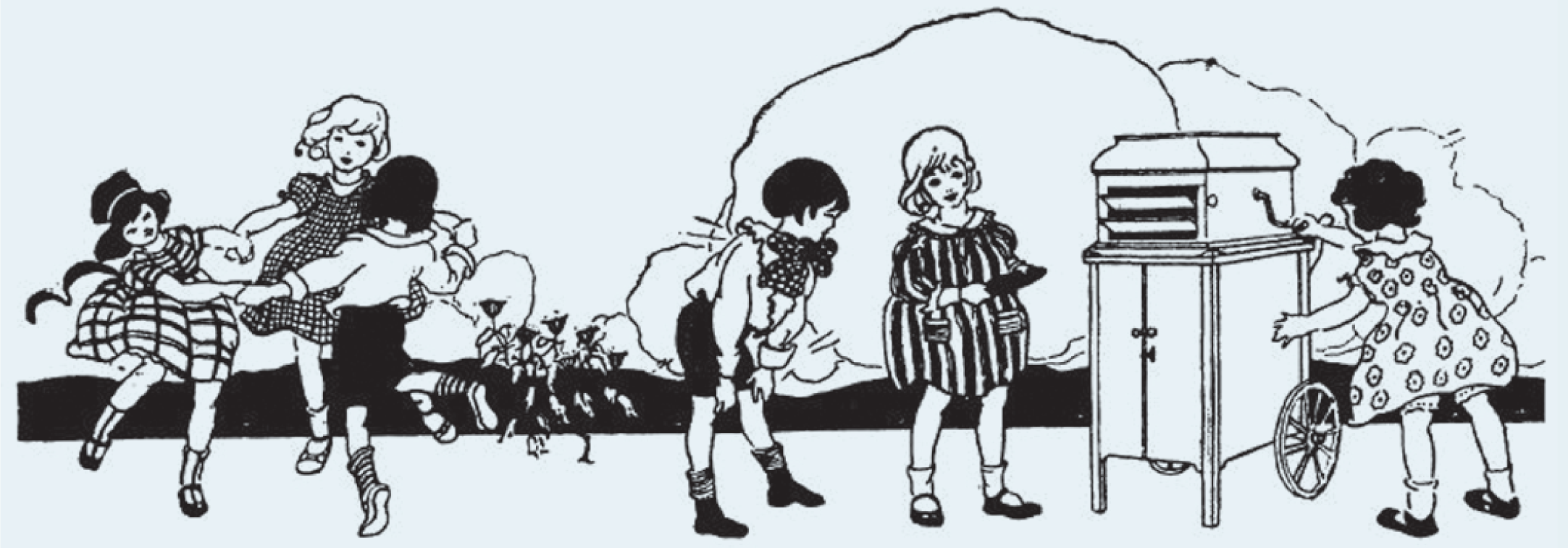
A reprint of a 1921 Columbia Graphophone Company ad illustration as published in the Music Educators Journal 50, no. 6 (June–July 1964): 46.