






Abstract
This article offers instrumental directors at all levels some suggestions for the use of movement to facilitate beat competency. We use the term beat competency to refer to a musician’s ability to play with a consistent sense of pulse and balanced subdivision, as well as the eventual ability to bring that sense of pulse to reading rhythmic notation. We discuss movement instruction with a focus on the ideas of Rudolf Laban. We present instructional strategies for movement through Laban’s concepts of flow, weight, space, and time. The final section of the article addresses the challenges in using movement in instrumental music and provides suggestions for working with large ensembles as well as focusing on performance.
This article provides band and orchestra directors at all levels with suggestions for the use of movement to facilitate beat competency. The term beat competency refers to a musician’s ability to perform with a consistent sense of pulse and even subdivision, as well as the eventual ability to bring that sense of pulse to reading rhythmic notation.
How can music teachers help their students play with a consistent sense of steady musical pulse? Calling upon experts and their own experience, the authors offer a number of suggestions for the classroom.
In the chapter “Rhythm and Movement” in Teaching Techniques and Insights for Instrumental Educators, Joseph Casey, the book’s editor, suggests movement (beyond foot-tapping) as a strategy for building skills in many areas of rhythm.
1
He suggests using movement without instruments and prior to notation to help students attain rhythmic feel, rhythmic sensitivity and general instrumental readiness.
2
The chapter goes on to share insights from well-known band directors who also support movement instruction in instrumental music. Supporting the use of movement to enhance beat competency, he cites the following individuals: Have them get out of their chair. . . . Let’s say you are playing Folk Song Suite by Vaughan Williams, and it’s just a rhythmic disaster. Get them standing and swaying back and forth or moving in a march-like fashion. (Larry Rachliff)
3
I have them move (for example, sway) with the music. They may be more inhibited about movement than singing. I sometimes play a recording, and they move to the music as they feel it. I find that movement is very effective. (Robert Floyd)
4
Researchers have found that movement instruction may have a positive effect on an instrumentalist’s ability to maintain a steady beat as well as subdivide the beat. 5
Although many pedagogues have suggested sequences and strategies for teaching movement,
6
Deborah Rohwer from the University of North Texas at Denton stated, The instrumental music program, however, has not ordinarily stressed this form of basic kinesthetic learning [movement]. Instrumental instructors often assume that students have developed elementary rhythmic ability before the age of instrumental ensemble participation.
7
Rohwer used an experimental design to show that sixth-grade band students in a treatment group receiving movement instruction were able to increase their rhythmic skills (tapping to a musical stimulus and performing rhythmically on instruments) more significantly than were students in the control group who received non-movement-based instruction. Her conclusions suggested: From this study, the most basic and important finding for music educators is that steady beat skills can be improved. Even with beginning band students, such as sixth-graders, who may be less accustomed to kinesthetic learning than are preschool-age or early-elementary-age students, movement activities may develop psychomotor awareness and lead to more steady performances. Movement activities designed for students in their younger years may provide a rhythmic foundation that will enable even further rhythmic growth.
8
While movement instruction may be beneficial in developing a range of skills that includes prediction and anticipation of phrasing and understanding dynamics and articulation, the focus of this article is primarily on the benefits to beat competency.
Movement for All
Modern dance theorist Rudolf Laban was in favor of movement for all citizens.
9
While he worked specifically with trained dancers, he was an advocate of movement as expression for the ordinary person: He developed the concept of the movement choir and promoted it throughout Germany. Movement Choirs are not singing ensembles; they are a group of movers with a common intent. These choirs consisted of a large body of people with various levels of training ranging from professional dancers to amateurs. The focus on these blocks of individuals was to “play” and create an experience in the joy of shared movement.
10
Among the many movement pedagogues, including Emile Jaques-Dalcroze and Phyllis Weikert, Laban created a movement vocabulary that seems to be the most readily applicable to instrumental ensemble. His concepts are currently enjoying a surge of interest among instrumentalists because of their ability to inform conducting. 11 The same concepts that have proven valuable to conductors may also provide similar benefits to music teachers and their students.
Rudolf Laban
Working in central Europe in the first half of the twentieth century, Rudolf Laban described all movement in terms of the four core elements of flow, weight, space, and time. He used these elements, usually in combinations, to describe the physical energy behind every movement. Laban applied these descriptors to improve the efficiency and safety of factory workers, rehabilitate polio victims, and create the first effective system for documenting movement, called Labanotation or Laban Movement Analysis.
Music practitioners often use these four elements to structure movement experiences that help develop coordination and steady beat. 12 Teachers who use Laban’s sequence find that learners tend to first develop control and consistency in flow (moving freely across the beat), then weight (having a strong or light impact on your surroundings), space (the areas and directions of movement as well as moving in a straight or curvy pathway), and finally, time (the ability to control movement that gets faster or slows down). Learners who can move purposefully, demonstrating the first three effort elements, are ready to work to control time. 13
Instructional Strategies
Flow and Weight Activities
Flow activities assist students in learning to regulate their movement across the beat and throughout a musical phrase. In the band or orchestra setting, flow and weight movement activities might be done using a recording of a piece being learned in the ensemble as the movement prompt. Or some students may be asked to play while others move. The physical motions that assist in the development of steady beat may eventually transfer directly to an understanding of appropriate flow for phrasing and weight for bowings and articulations (e.g., accents, marcato).
Suggested Flow Activities
In a flow activity, the goal is continuous fluid movement that does not stop. Students might visualize a school of fish in the ocean or a plastic shopping bag in a windstorm. The movement may be rapid or slow, but it should be smooth, helping the student integrate adjacent parts of the body; for example, a movement that starts in the left shoulder can move smoothly down the arm, through the elbow, then the wrist, and out the fingers. All of these activities can be performed while also coordinating inhalations and exhalations with the musical phrases. Yoga or meditation music works well to accompany these activities, but any music that has a sense of smooth melodic lines and long phrases may be appropriate.
Suggested Weight Activities
The purpose of weight activities is to help students experience the contrast between strong and gentle impacts. Focus first on the two extremes, then on being able to easily alternate between the two. A strong impact is leaving a heavy footprint or punching a punching bag; a gentle impact is tiptoeing across a carpet or brushing an eyelash off a cheek. Just as we try to guide students to think before they speak and to make good choices, we want them to be intentional about the impact they have on the world around them and to be able to regulate that impact.
Creating an awareness of contrasts in weight through movement can help students manage this movement goal with large motions and motor skills; they can then transfer that to small motions and to fine motor skills, such as finger technique, sticking, bowing, and articulation. Music with terraced dynamics and dramatic contrasts, such as the song “John Jacob Jingleheimer Schmidt,” can help students feel contrasting weight. Lullabies, chorales, and ballads generally use gentle weight techniques, while strong weight can often be felt in fanfares, marches, and dramatic symphonic pieces, like “Russian Sailor’s Dance” from Gliere’s The Red Poppy, “Baba Yaga” from Moussorgsky’s Pictures at an Exhibition, and “Montagues and Capulets” from Prokofiev’s Romeo and Juliet.
Elasticity-of-Time Activities
Learners who can master the elasticity of time—clapping their hands to show a beat that is getting faster or stepping accurately to a beat that is getting slower—probably will develop the physical control to regulate time and maintain a steady beat. 14 Although band and orchestra directors tend to suggest that changes in tempo for an ensemble are related to “watching” a conductor, we suggest that ensembles in which members are able to speed up together and slow down together do so because of an ability to audiate the elasticity of time as a group. The pace of the speed (tempo change) is set by watching the conductor, but the ability for an ensemble to move together is facilitated by solid and collective rhythmic audiation. With that goal in mind, the activities in the section below are suggested.
Suggested Activities
For time-related movement, try to use an easily observable gesture, such as those from the basic body percussion repertoire: stepping, patting, clapping, snapping. This may seem counterintuitive, but spend time on this activity with a gesture that makes little or no sound. When students are loudly stomping their feet or patting their legs, we have observed that the dominant students tend to impose their rhythms on the rest of the ensemble, and weaker musicians tend to go along with what they hear externally rather than develop their audiation and inner sense of pulse. To individualize instruction and allow for differentiated learning, it is best for the movement to be silent and for you to assess accuracy by watching rather than by listening.
Repertoire that helps explore the elasticity of time can be any piece that has an obvious ritardando or accelerando. In “The Twelve Days of Christmas,” we usually include an accelerando as we sing backward from 12 to 6, pause after 5, then accelerate again until the big ritardando in the last phrase. Some of Dvorák’s Slavonic Dances have clear tempo shift—and it seems that some of the Czech conductors are greater risk takers in making these contrasts. The Swedish folk dance “Fjaskern” (Hurry-Scurry) is a perfect example of a long, gradual accelerando (the music is found on Phyllis Weikart’s Rhythmically Moving recordings).
Macro/Micro Beat and Melodic Rhythm Movement Activities
Instrumental music teachers often have students clap rhythms before performing them on their instruments. There are several alternative ways that students can create rhythm through movement that enable them to use larger muscle groups and to experience the coordination of macro beats, micro beats, and melodic rhythm.
Movement can also be used to help students feel the difference between downbeats and upbeats and experience the physical effort required to sustain long sounds as well as the mental effort required to count beats during sustained sounds. As suggested above, using movement to articulate rhythm also provides visible evidence, which teachers can use to gauge students’ readiness to perform from notation. The activities suggested below can be performed using counts, Kodály syllables, Gordon syllables, or Takadimi syllables (for an explanation of the latter, see the June 2013 Music Educators Journal for Brandon Keith Wood’s article, “South India Solkattu and Western Music Pedagogy: Creating New Rhythmic Perspectives,” pp. 63–67).
Sequence 1
(These movements are taught through demonstration before notation is introduced.)
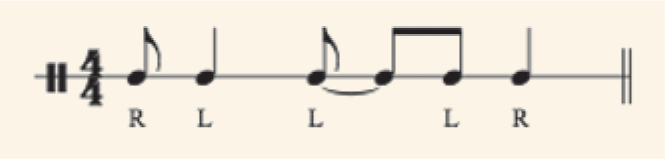
1. Tap heels and pat hands on lap (using the right hand for sounds occurring on beats and the left for sounds occurring on the ands) while counting out loud. This method is effective for articulating fast rhythms that are awkward to clap (Figure 1).
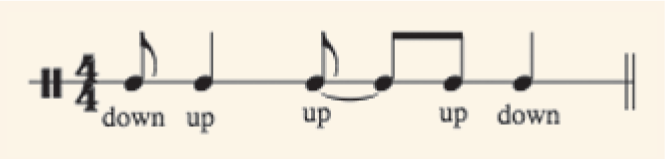
2. Tap heels, hold left hand stationary over left thigh, and pat right hand down for notes occurring on downbeats and up against the palm of the left hand to articulate sounds occurring on upbeats. Then, chant or count out loud (Figure 2).
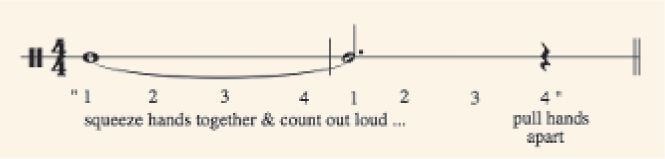
3. Tap heels and clap hands while chanting or counting out loud. This traditional way of articulating rhythm can be refined by squeezing hands together vigorously and counting throughout sustained sounds as well as by pulling hands apart to simulate releases and rests (Figure 3).
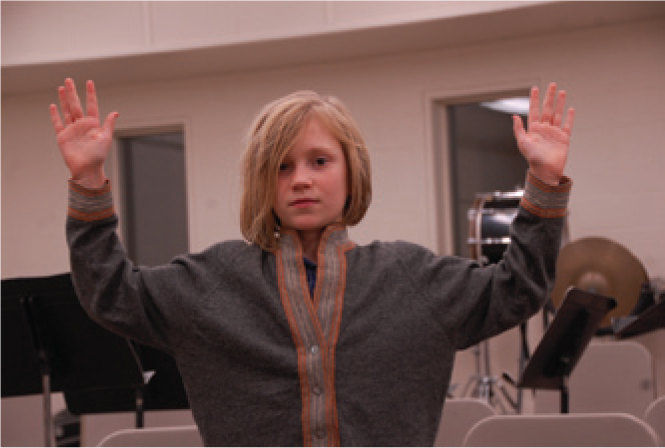
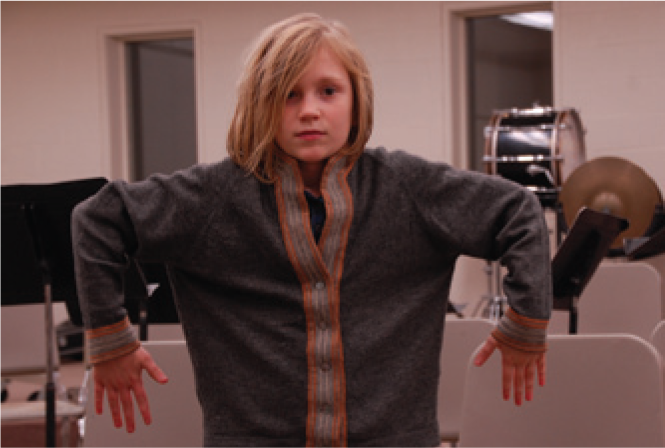
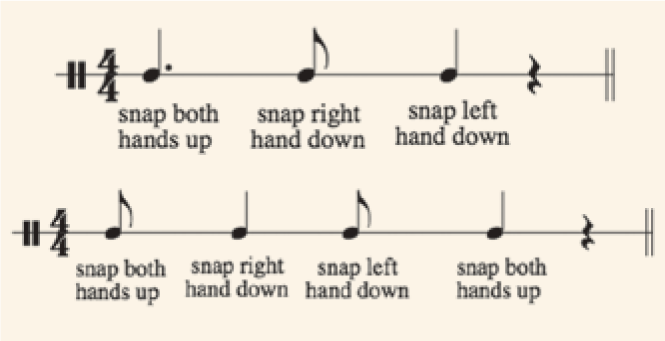
4. Snap hands up with fingertips pointing up and palms facing forward (Figure 4a). Create rhythms by snapping hands down with fingertips pointing down and palms facing back (Figures 4b and 4c).
5. Encourage students to choreograph their own motions to articulate the rhythms being studied and to teach them to the class.
Sequence 2
(This sequence is adapted from Jump Right In: The Instrumental Series by Richard Grunow, Christopher Azarra, and Edwin Gordon [Chicago: GIA, 2001].)
With instruments placed safely on the floor or in the cases, students begin to move their heels to a macro beat.
Students begin to tap the tips of the fingers on their legs to a duple or triple micro beat. Instruct students to use “spider fingers” so that the micro beat can be seen but not heard. This will facilitate audition rather than imitation.
Teacher states: “Repeat after me.”
Teacher performs duple or triple patterns, such as  , on a neutral syllable (e.g., bah) and have students repeat.
Imitation can also be used to introduce rhythm syllables or counts for the rhythmic vocabulary being developed.
Once students have become fluent in imitating rhythm patterns, ask them to improvise their own original responses to the teacher’s prompt. Students’ improvised responses should be the same length, be in the same tempo, and use the same rhythmic vocabulary as the original patterns. Improvisation is best done with neutral syllables and provides excellent readiness for introducing notation.
Working with Older Students
The sequence of flow, weight, space, and time is also recommended for older students. Many high school band programs have an obvious “movement” connection in the marching band. These teachers often focus solely on macro beat in the marching band setting, and more time should be devoted to using movement to teach subdivision as well as general musicianship that can be achieved through flow, weight, and space movement. Since it is most often the micro beat that remains constant in mixed meters, it can be very efficient to devise chanting and movement activities that begin with the steady micro beat, then layer on accents defining groups of twos and threes before adding the macro beat.
Activities for Older Students
If the instrumental teacher is creative and innovative in the teaching of movement, students will be willing to move. If movement has been part of classroom music and beginning band/orchestra, it will seem normal to secondary students. If not, you will need to create an environment in which students feel safe and supported when moving their bodies. We have found that if students believe movement instruction is going to help them grow as musicians and they are all learning together in a spirit of teamwork and mutual respect, the activities can be very beneficial. The following are strategies to help lessen anxiety about movement with older students:
When working on flow movement, consider a sports analogy to give students a guideline for how to move. For example, with recorded music playing in the background, instruct students to “flow” as if they were playing football, or baseball, or tennis. This takes away some of the “fear” of free, fluid movement.
Allow students to bring in “their” music (school-appropriate, of course) for movement activities.
Have students stand in a circle facing away from one another during movement activities to provide less opportunity to “watch” others.
Assign students to small groups, and have them create movement to show macro and micro beats to music in a variety of meters.
Challenges in Instrumental Music
Several issues often inhibit the use of movement to teach rhythm in instrumental music. These include (1) the large number of students in instrumental music classes, (2) the pressure to read notation right away in beginning instrumental music, (3) the pressure to perform many concerts in secondary instrumental music, (4) a lack of understanding regarding how to use movement as an instructional strategy to teach rhythm in instrumental music, (5) the physical setup of a rehearsal room, and (6) directors’ fear of student resistance to movement activities. This section includes a list of a few strategies for addressing these challenges.
Not all students have to be “moving” at the same time. Consider having half the ensemble play, sing, or clap while the other half moves.
Many movement activities can be done while seated or with subtle movement (i.e., shoulder or wrist).
Consider a “movement day” every few weeks where you move chairs and stands out of the way to create room for a movement lesson. If students have a repertoire of tunes, excerpts, and exercises that they can play without notation, they can transition directly from a movement activity to incorporating the same concept while performing on instruments.
Establish a procedure for spreading out. With instruments on chair (or floor), move students on the end of each row toward the front to expand each row, and every other student to the back or sides of room. With planning, most groups can find room to move and get to this space quickly and efficiently.
Use the perimeter of your rehearsal room setup to make a large circular shape, allowing students to step to the macro beat, tap to the micro beat, and chant accompaniment rhythms, ostinato, or tricky syncopations you want to address. You can also create a stomp effect by going to the walls of the room, keeping a steady beat, and tapping rhythms on the walls, chairs, and lockers.
Focusing on Performance
Using more movement in instrumental instruction need not detract from the performance goals in band and orchestra classes. More movement will lead to more solid individual musicianship, and the ensemble will perform more rhythmically as a result of the movement instruction. In beginning band and orchestra, the first several concerts can be performed without notation (learning tunes and bass lines by ear), allowing more energy to be devoted to good musicianship. Even at the high school level, some by-ear playing can be part of the curriculum. There is a marching band in the Midwest that spent the first day of band camp learning four tunes for the show by ear. The second day of band camp was spent creating bass lines for the tunes, and later in the fall term, several students created additional “harmony” parts for the score.
Concerts could include movement activities or short demonstrations for the audience regarding the rhythm and movement work done by the ensemble in preparation for the performance. Parents and other audience members could be taught to perform the rhythmic movement activities that the students learned so that they can experience the learning process personally and develop a firsthand appreciation of the challenges involved. Consider teaching the historical background or folk dances that a piece is based on to the students and having them teach their parents during the concert.
Moving toward Competence
Although movement is listed only in the new PreK–2 National Standards for Music Education, many music educators would consider it a core activity for all music classes. Since movement activities are a fundamental means of learning in most elementary music classrooms, most students begin instrumental music with some experience of learning through movement.
Many conductors, researchers, and pedagogues recommend movement as a central means of developing the rhythmic skills of young instrumentalists, 15 and teachers can begin to experience the benefits of movement activities even within the confines of limited rehearsal space. Once teachers see how dramatically students can improve their beat competency by moving, they may be inspired to take the chairs and stands away more often to enable their students to experience movement as a natural and effective means of music learning. Try it in your classroom soon!