







Abstract
Creating, performing, responding, and connecting are often central foci in the development of music education curricula. While these meta-organizers provide a sense of direction for planning instruction, greater depths of knowledge and skill could be achieved if these actions were viewed as means rather than ends in music education. The profession needs a more artistically driven mind-set to ensure that engagements with performing, creating, and responding support both intellectual and musical growth. A critical examination of each organizer reveals specific capacities that should be nurtured as students discover/explore the relationships between music and feeling. These musical capacities can help students clarify artistic goals, enhance artistry, expand expressivity, and build technical skills. This article examines how teachers can actively engage K–12 students in the development of these capacities as they compose, perform, and listen to music.
Keywords
Creating, performing, responding, and connecting are means through which we gain personal and communal understandings of human experience. We make meaning as we sing, play instruments, compose, listen, and improvise because these direct engagements with music allow us to connect to a very special world of implied and explicit sound-based significance. In this musical world, we find opportunities to explore and share who we are as individuals—not only with those in our own cultural circles but with ever-broadening circles of human contact and interaction.
Many curriculum development efforts have featured creating, performing, and responding as meta-organizers. 1 Too often, the activities they highlight have become ends rather than the means to higher levels of understanding. Singing, playing, composing, improvising, listening, and notating as activities do not in and of themselves assure meaningful musical experiences. Neither do these activities automatically lead to feelingful experiences or meaningful encounters with music. To make meaning in any area of music, we must sharpen our emotional acuity, engage our expressive potentials, and create with artistry. These processes are the foundational components of our musical capacities; they are the doorways to meaningful artistic actions and understandings that allow us to “make special” 2 the experiences of our lives. As such, one of our key missions must be to facilitate creating, performing, and responding activities for the express purpose of helping students find and make these individual and collective meanings.
In what ways can music educators nurture the musical capacities of their students and help them discover links between feeling, expressivity, and artistry?
In the practice of music education, we devote a high degree of instructional attention to topics of technique, perception, and production while undertaking most of the required artistic decisions ourselves. The former aspects are concrete, easy to specify, and highly measurable, while the latter reveals autocratic instructional practices designed after the professional conductor–ensemble model. 3 Following this template, our score study–oriented preparation suggests that we should make interpretive decisions, identify what students should perceive in listening lessons, and design composition tasks assigning the use of tools and techniques. Despite the historical practices that we follow, we also know that very little can be achieved if students are not fully engaged—cognitively and emotionally—within the music-making experience. Students prioritize and crave experiences in which they can find personal meaning. 4 Pedagogy designed to match this psychology would focus on those things about music that are most engaging: the actions in which humans exercise autonomous artistic agency.
Realizations from Emerging Pedagogies
The publication of the National Standards for Arts Education in 1994 increased interest in composition as a component of preK–12 music curricula. Although the inclusion of composition activities in school programs remains somewhat limited, 5 initial forays into teaching composition often raise questions for teachers reflecting on the students’ musical learning and their creations. Teachers worry that students’ work is perfunctory and lacking in expressivity while students complain that the work seems far removed from the music they enjoyed listening to and performing. In most cases, these challenges can be traced back to a misguided focus.
Teacher-Centered Practice
Teachers often create lessons based on their own personal experiences as music students. 6 They commonly draw on studies in music theory as a point of reference. As teachers attempt to ensure student success, they outline steps within the compositional process, specify the inclusion of key musical components, and define final products. The resulting guidelines, crafted with the best of intentions, can contribute to student frustration as they experience a lack of artistic autonomy and find themselves hemmed in by musical decisions imposed on their creative process. While varying degrees of guidance can be both necessary and helpful, compositional counsel does not have to follow the prescriptive nature of theory-oriented practices.
Music theory and composition constitute subdomains with different objectives. Composition seeks to create music using familiar sounds in new ways or inventing combinations of sounds not previously heard. Conversely, theory involves the study of what composers have created. It is forensic; this means that by its very nature it is element-dependent and deconstructive. In the best instances, the application of analysis reveals how expressivity was achieved; in the worst cases, theorization simply identifies techniques. Composition lessons that focus on a reversal of theoretical analyses—taking the elements of music and using them as a starting point for building block type construction—may spur the creation of compositions, but too often they do so at the expense of expressivity. How did music education come to so universally adopt this approach?
Misplaced Emphasis
Emphasis on “dynamics, timbre, form, rhythm, and pitch” as the so-called “elements of music” began with the Manhattanville Music Curriculum Project (MMCP) in the late 1960s. 7 The creators of the MMCP applied the process of curriculum development suggested by music educator and philosopher James Mursell in Basic Concepts in Music Education 8 and psychologist Jerome Bruner in The Process of Education 9 to match the reforms of science and mathematics spurred by the 1957 launching of Sputnik. This approach required the identification and organization of the most fundamental elements of a discipline into a spiral curriculum. However, as is often the case, the process of curricular reform initiated in non-art subject areas did not gracefully capture the unique nature and value of music.
In attempting to identify fundamental elements, music was positioned as phenomena to be analyzed while its more human dimension, its meaningful dimension, was set aside. An uneasy relationship developed when it came to using these elements as a basis for creation in music. Musicians rarely thought about elements discretely because in and of themselves they were meaningless. Moreover, even when all of the elements were found to be present within a piece, the work might not be expressive or engender a musically artistic or satisfying experience.
The elements, then, are not music’s fundamentals. They are useful for thinking about and talking about music but not as useful for thinking within sound. They are helpful for describing some aspects of music but less useful when holistically considering a musical experience. Identifying the elements in music requires “thinking about” and objectifying music rather than “thinking within” and making experiences with music personally meaningful. Their use advances the Cartesian hierarchy that divides mind and body. 10
Some would argue that the essence of musical experience is ineffable 11 and that the elements draw us closer to musical experience by increasing our understanding. We wish to suggest that emphasis on the elements as currently exercised has actually had the opposite effect; it has obfuscated the expressive potentials of musical experience by reducing the experience to the naming of discrete parts. We suggest that these practices inadvertently negate students’ musical autonomy and their ability to fully connect with music’s expressive potentials. As such, our Eurocentric pedagogy of the elements is a framework demanding a conformity that devalues student individuality and denies access to the full range of values, diversity, and practices that music has to offer.
To reframe our pedagogies, we must consider the following questions: What is it about music that draws us more deeply into our experiences with it? How might we more holistically approach musical experiences and the nature of music itself? and, in other words, How can we help students know music from within the musical experience?
A New Foundation
To answer questions about foundational ways of knowing in music, we need to first consider how do people know at all? Human knowledge is predicated in the physical self. Positioning the body as the mediator of all experience, cognitive neuroscientist Antonio Damasio 12 explains that when the body senses change in its core homeostatic systems, signals result that are processed by the brain and constitute “the feeling of what happens.” This becomes our conscious awareness and allows us to make meaning from our experiences.
There are many changes for the body to mediate when engaged with music. These changes are most easily identified when cast as foundational percepts—the principles on which human-music interactions are built. The five principle pairs include motion–stasis, unity–variety, sound–silence, tension–release, and stability–instability 13 (see Figure 1). Each pair exists on a continuum, and the totality of what they collectively circumscribe is best characterized as flexible and relative. While it is true that some pairs may feature more prominently than others within a specific work, the mere absence or presence of a particular pair is an insufficient criterion for determining its value. Rather, value is found in the shifting parameters of sound and in the nature of that change as it is experienced in the body. These shifts in feelingful state connect via the “mind–body continuum” 14 to give rise to music’s expressive power.
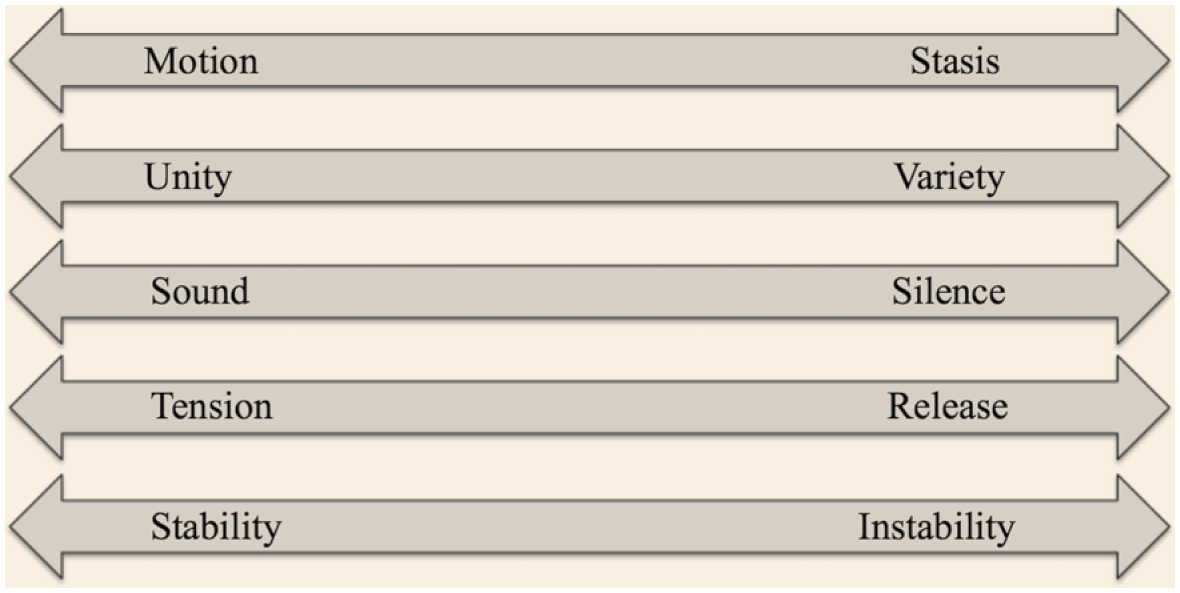
Principle Pairs Continua
The elements of music in isolation do not offer meaning-making potential. Simply composing, identifying, or performing certain pitches for specific durations is not artistry. However, when the elements are artistically crafted, perceived, and interpreted, they capture a relational balance between principle pairs. Changes in this balance draw our attention and allow for meaning to be made. The feeling of increasing melodic motion, the appearance of a translucently thin timbre, and a tempo that hints of instability may suggest a compounding tension that moves from bodily perception to meaningful construct. Indeed, it is when the elements of music are artistically crafted to constitute and reveal the juxtaposition of musically expressive principles that we experience music’s ability to evoke human feeling.
The Musical Capacities
Our ability to focus our attention, apprehend music’s expressive potentials, and artistically assemble sounds into music that holds meaning for us reveals our musical capacities. While the exact nature of capacities is differentiated by musical role, each is available to all human beings. In this section, we describe the specific capacities evidenced in the roles composer, performer, and listener before considering the ways in which multiple roles may be invoked in rapid succession.
Musical Capacities of Composers
Feelingful intention, musical expressivity, and artistic craftsmanship are the primary capacities of composers 15 (see Figure 2). These capacities play key roles in inventing, testing, and selecting sounds that invite feelingful response. Throughout the process of composition, composers apply their artistic skills in evaluating the merit of each idea within the larger musical work. They consider the expressive potentials of their musical gestures, weighing shapes, positioning, and sonic strengths, before advancing to next moment of invention. In this, composition is a recursive process involving multiple moments of inspiration, generation, and reflection.

Composer Capacities
Composition is inherently based in the interplay between sound and feeling. The experiential foundation of the composer, ability to empathize with the experience of others, and ability to imagine what might be felt in a variety of settings and contexts comprise the capacity of feelingful intention. Even when the choices made by the composer find root in intuition rather than conscious thought, the organization of sound for expressive ends is a deliberate, biological act. 16
Musical expressivity is evidenced as sound-feeling combinations that evoke somatic response and understanding by using the same principle pairs introduced previously: motion–stasis, unity–variety, sound–silence, tension–release, and stability–instability. These principle pairs underlie nearly all of music’s expressive power. To enact this capacity, composers must be able to imagine sounds and their feelingful potentials as they change over time. Which sounds will unify the feelingful character of the piece, and which will add variety? Which sounds are best suited to build tensions, and which serve to resolve them? How might a particular set of sounds expand a sonic texture from hushed to strong presence while simultaneously setting up a key moment of silence? Musical expressivity is not limited to a one-to-one partnering of sound and feeling but to each feeling’s journey in sound from its introduction through its unfolding and to its conclusion.
These carefully selected sounds become effective when they are constructed, shaped, and refined. In this process, composers use a variety of tools and techniques to build individual sounds into relationships imbued with the potential for meaning-making. The capacity to rise above mere construction and create opportunities for others to explore and make meaning of sounds is what sets “artistic craftsmanship” apart from mere craft.
As teachers and students work together to develop compositional capacities, composers should be invited to discuss their particular feelingful intentions and the strategies they use to capture those feelings in their work. Through these discussions, both composer and peer audience learn about compositional tools and techniques, sound choices, and effective use of feelingful intention. Each discovery contributes to the composer’s developing sound palette. These practices might unfold as described in Figure 3.
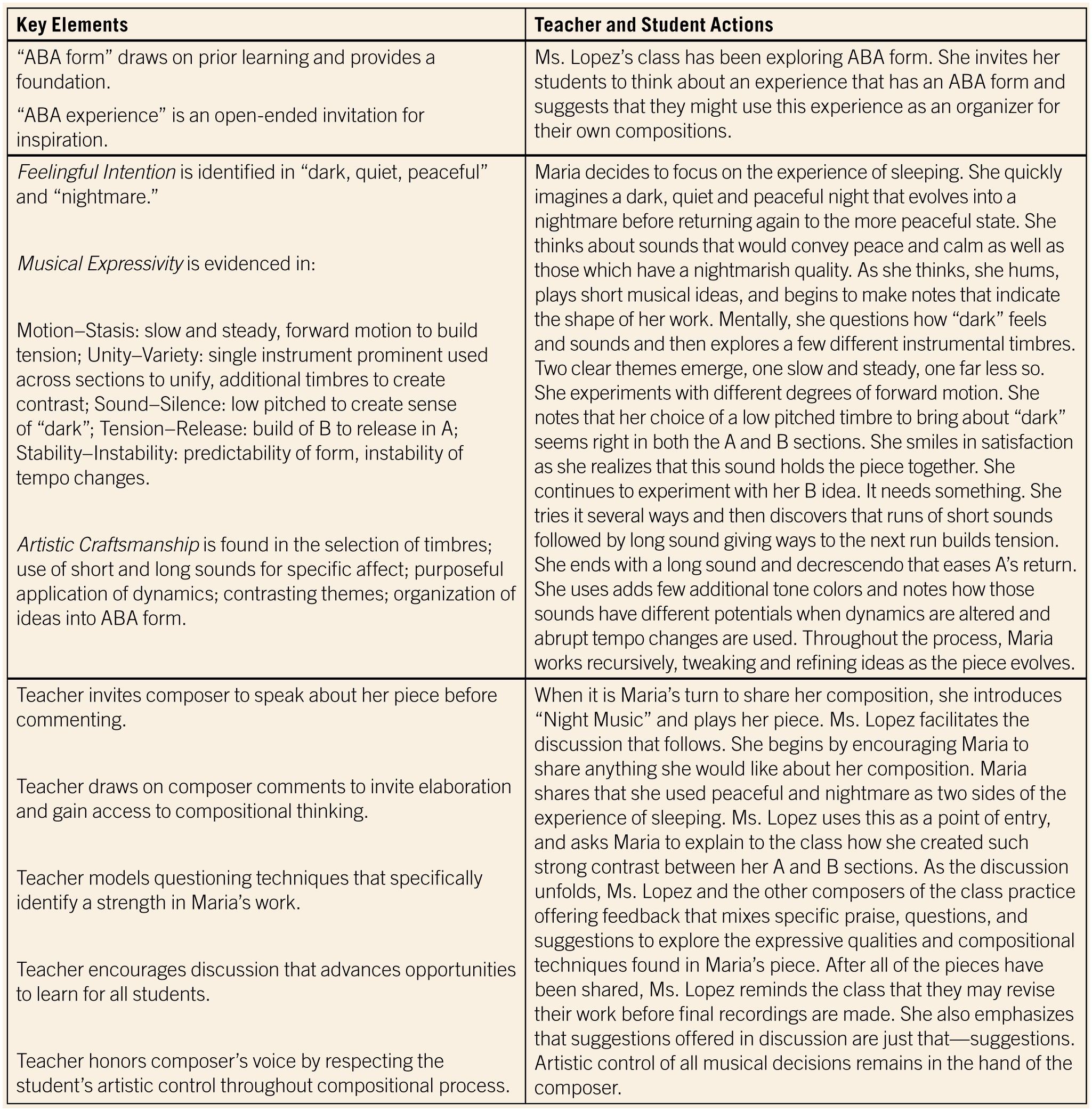
Project “Night Music”
Musical Capacities of Performers
Music performance is a domain rich with artistic potentials. Whether the performance is digitally or acoustically oriented, one or more performers must engage in anticipatory sonification, musical mediality, and artistic interpretation to bring a musical work to sound. These performance capacities are influenced by personal, social, and cultural factors. As such, a wide variety of interpretations may exist for any given work.
Anticipatory sonification (see Figure 4) is the ability to recognize feelingful potentials in the relational structures of music. As a performer prepares music for presentation, certain ideas arise that allow for possible differences in interpretation that evoke or change feeling. In considering which ideas to implement, the performer may identify relationships within the work but may also be guided by information about the composer, the music, and contextual frames surrounding its creation. As empathetic understanding is applied to this information, the performer imagines the feelingful potential of each option and makes a tentative choice among the options.

Performer Capacities
The ability to influence connections between individual sounds and sounds within the musical context is the work of performers. The performer is situated between the intentions of the composer and the imagination of the listener. In this position, the performer exercises musical mediality. The performer seeks the points of increased or decreased motion, unifying factors as well as contrasting ideas, sections of increasing or decreasing stability and tension, and ways to alter the sound of his or her instrument to effectively shape the musical experience.
The knowledge and skill that performers draw on to shape and nuance sound in ways that will evoke meaning is the capacity of artistic interpretation. The performer’s ability to create sounds within a presentational context facilitates the musical experiences of the performer and others who hear the performance. The more informed and delineated the performer’s interpretation is, the more it influences the performer’s own reaction to the work as well as that of any listeners. Effective teachers can facilitate the development of the skills of interpretation. They do this by encouraging performers to develop their own ideas and interpretations while helping them determine which are the more evocative and feelingful options.
While American schools routinely feature ensembles performing at very high levels of artistry, they sometimes do not succeed in creating performers capable of making their own interpretive decisions. Learning the skills necessary to undertake informed musical performance in the absence of a teacher-conductor takes practice. Teachers can help students acquire the skills of anticipatory sonification, musical mediality, and artistic interpretation through instructional techniques that range from description and discussion to coached independence. A few of the strategies that prepare students for independent music-making are listed in Figure 5. These skills provide a foundation for lifelong participation in a variety of performance contexts.
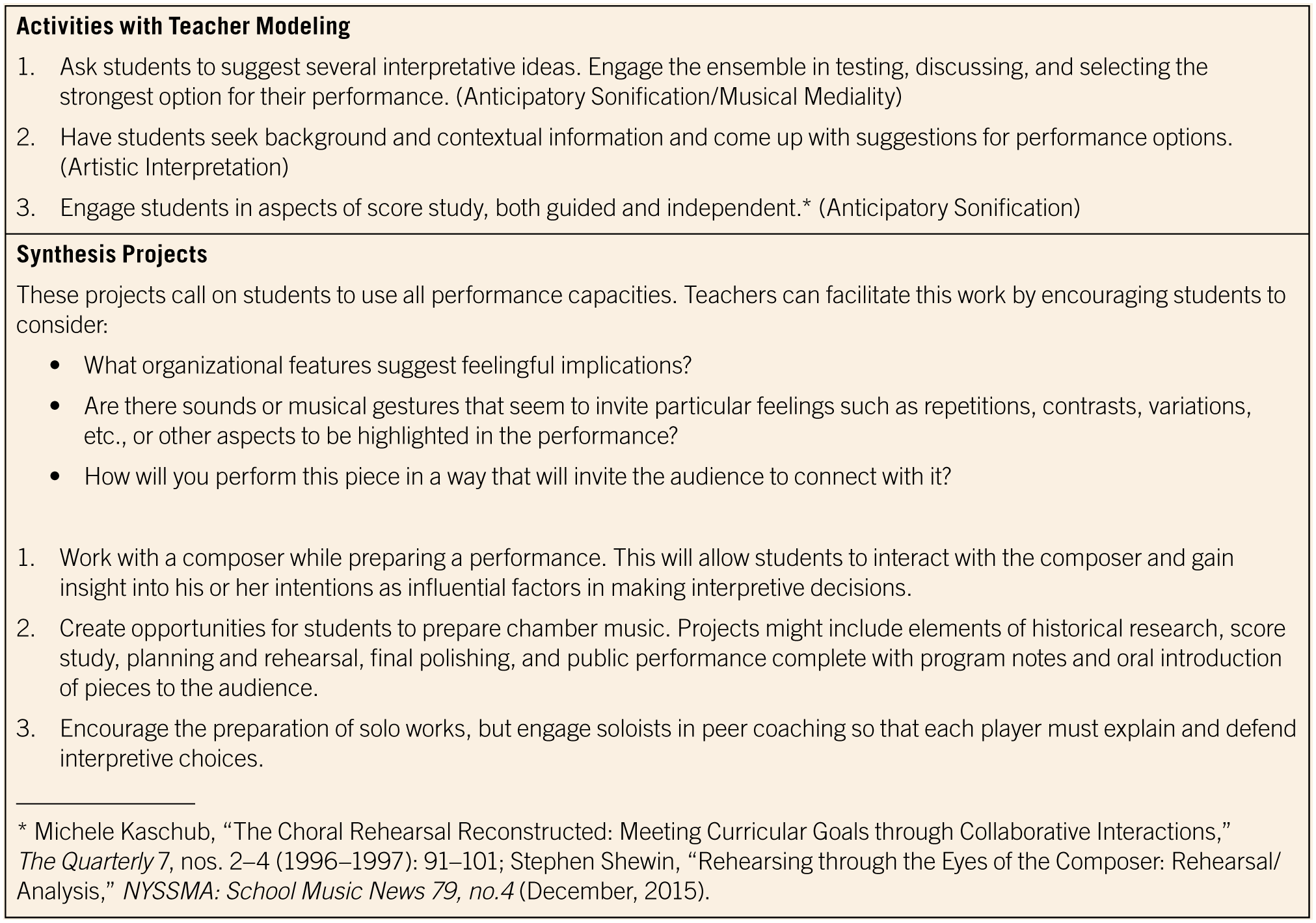
Guiding the Development of Performance Capacities
The Musical Capacities of Listeners
The capacities of purposeful attention, musical impressivity, and artistic perception (see Figure 6) allow listeners to actively engage in the act of creating their experience of music. As each listener find relationships within music and experiences the feelings raised within that process, he or she may also consciously or subconsciously become aware of how the resulting feelings are similar to feelings that have been experienced previously. The meaning of music then becomes—for the individual listener within this specific time and context—tied to prior learning and experiences.

Listener Capacities
When we listen with purposeful attention, we focus our thoughts on specific musical sounds and events. As Peterson explains, “[d]uring music listening, the listener constructs mental objects that not only correspond to auditory events presented by a performance, but also legitimately differ from the mental representations of other listeners.” 17 In this process, both conceptual and perceptual information is noticed through all the channels of mind and body. Simply gathering information, though, is insufficient; listening requires a particular type of engagement from the brain that hearing does not.
The brain is physiologically designed to continuously collect auditory input and compare that information to other forms of input being gathered, but the choice to listen places mindful emphasis on this process. Musical impressivity is revealed in our awareness of what we are experiencing as the brain identifies patterns, draws connections between sound and feeling, and makes meaning from our experience. Social and cultural norms may strongly influence the meanings made in this process, but the exact nature of the association drawn by listeners between sound and feeling reflects each person’s perceptual skill set and previous experience.
Acts of artistic perception require more than simply noticing sounds. As we listen, we make thoughtful decisions about the ways in which familiar and novel sounds are positioned and related to other sounds. Peterson observes that this process appears across musical roles: “The thinking in and with sound that generates such a mental model is the music making carried out by listeners, just as the thinking in and with sound that generates a composition is the music making carried out by composers.” 18 In this thought process, listeners use the sounds they chose to construct relationships in which they find and situate meaning.
It is important to consider the roles of purposeful attention, musical impressivity, and artistic perception as teachers and students work together to develop their individual listening capacities. When engaged in musical listening activities, teachers and students should discuss the strategies they use in deciding exactly what to listen to as the music unfolds. Listeners may note specific sound choices or gestures that leave them with a feelingful impression. Furthermore, they may identify techniques used by composers or performers to enhance the feelingful impact of these gestures. Attention to these details allows students and teachers to move beyond elemental identification to discover how feelingful connection and responses are shaped and influenced. Figure 7 offers a few questions that can spur the development of listener capacities.
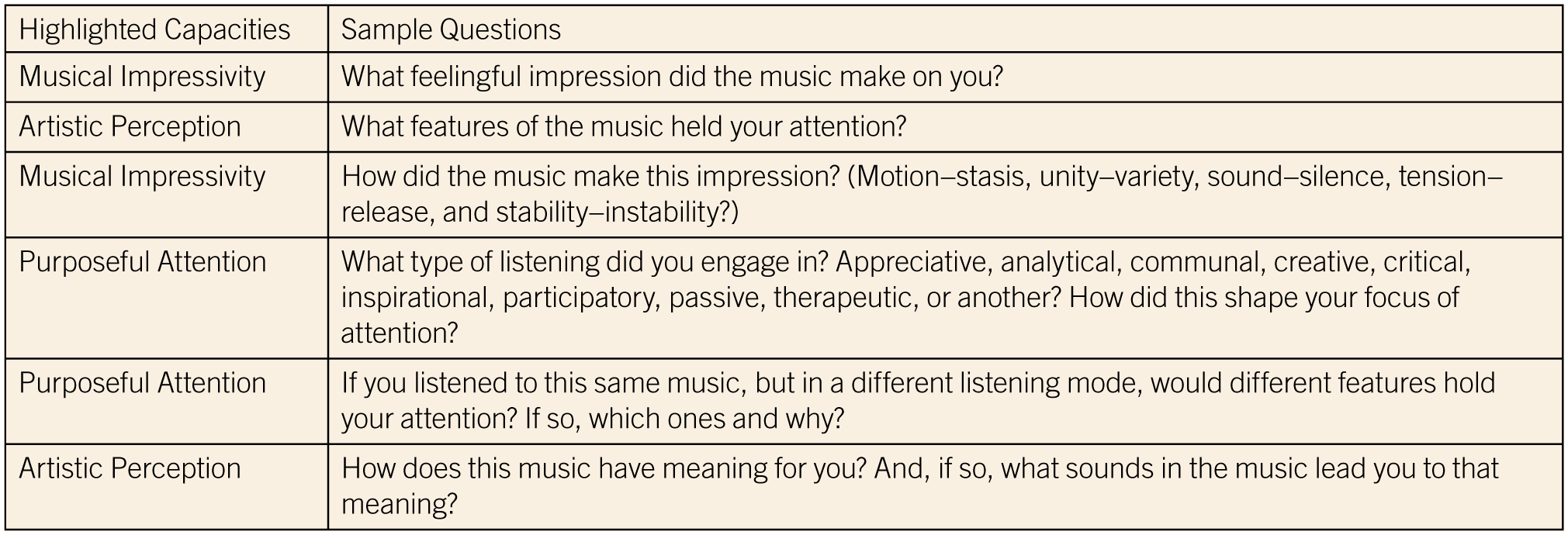
Questions for Developing the Capacities of Listeners
The Dynamic Nature of Musical Capacities
It is very difficult for anyone engaged in music to inhabit a single role. Music-making and the capacities that support it are dynamic in nature and execution. Listeners who tap their feet or drum on their steering wheels are adopting performer actions as they contribute their own sounds, performers who wonder why a composer has crafted a line in a particular way are exploring the composer’s intent, and composers who imagine their work as it will be experienced by an audience assume the listener’s ear.
The musical capacities have common somatic roots. Each role features a capacity that requires attention to feeling, an awareness of the connection that exists between sound and corporeal feeling, and sounds that are to be crafted with artistry. These shared origins allow for the millisecond shifts between roles. Perhaps the clearest example of this dynamic interplay is found in the role of improviser.
When we consider improvisation, we often fall sway to the visual image of performer and think of the improviser as such. Yet, the invisible work of the improviser involves anticipatory listening and composition in the moment. Improvisers must be able to imagine sounds that are yet to come and move in that direction. They must artistically craft the sounds they are contributing to the larger soundscape as they perform them. This is accomplished without benefit of the composer’s ability to revise and edit. Indeed, the improviser is deeply engaged in rapid role shifts and concurrent acts of generation and reflection.
Given the importance of role-specific and complementary capacities, it is critical that teachers and students engage in an exploration of each of the primary roles as well as the shifts that occur between them. Students who pursue one way of thinking to the exclusion of others may miss insights that potentially inform and shape their musical decisions within their primary role. When students feel knowledgeable, their musical self-concept improves. They gain confidence and feel empowered to exercise the types of artistic agency necessary for lifelong music-making in any role.
Musical Capacities as the Big Picture
When we focus on the development of musical capacities, we allow for a “resonance between the situations, the social relationships, the settings, the musics, and [the musickers] as emerging aesthetic agents with feelings, desires, moods” 19 that shape and are shaped by musical learning. As teachers, we can create opportunities for students to consider exactly what it is about music that allows them to tap into its expressive power. Ultimately, it is not about the varied roles and capacities but the power of music experience itself to deepen and enrich human existence.
The potential for meaning-making found in all types of musical engagement is heightened when students can purposefully draw on their musical capacities to find and make significant connections. Their explorations are likely to involve realizations about the uniquely felt experiences of music, the sounds and musical gestures that constitute the sonic environments they inhabit or wish to create, and the tools and techniques best suited to achieve their artistic aims. They will experience great satisfactions and musical victories but also encounter challenges and stumbling blocks. Consequently, they can benefit from the presence of experienced guides.
Artistically driven practice requires teachers who are committed to actively exploring each musical role with students. We must adopt a “learning together” mind-set that allows all participants in a musical learning environment—teacher and student alike—to explore feeling in a focused way. We must engage with musics from around the world and throughout time with an awareness of how sounds influence and can be used to impact human feelingful experience. We must welcome technical “How do I . . . ” questions and meet them with specific tools in the “need-to-know” moment that marks the potential for powerful learning. The actions that we take to facilitate the development of every student’s musical capacities are a powerful determinant not only of immediate musical products but also of each student’s lifelong engagement with music.