






Abstract

Listen Up! Fostering Musicianship through Active Listening
by Brent M. Gault. New York: Oxford University Press, 2016; https://global.oup.com/academic/product/listen-up-9780199990511?cc=us&lang=en&
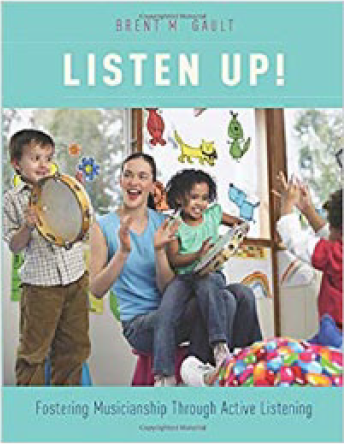
Listening to music is one of the most important ways to have interaction between people and music. The main purpose of Listen Up! Fostering Musicianship through Active Listening is to help elementary and secondary music teachers develop students who actively participate in music appreciation and who strengthen their musical skills, all while absorbing music concepts in the process.
Author Brent M. Gault is a professor of music education at Indiana University in Bloomington. Gault takes Jerome Bruner’s three-step process for representing learning as a basis for understanding the meaning of active listening and the deep connections that can be made by selecting music based on students’ musical preferences, personalities, and learning styles.
The following three teaching patterns are common among music teachers and learners:
Focusing on music skill development: Students are expecting to develop their music skills to a degree that is as professional as possible, which can easily dampen students’ interest in learning music.
Focusing on games and activities: Whether it is a singing game or a story game, the purpose of learning music is to make children as happy as possible in class. This serves to maintain students’ interest in learning, but it is likely that students will forget the point of what is being taught, and they may not even realize what they should be learning.
Following teaching plans but with teacher input and adaptation as needed: Thinking about sequencing in teaching doesn’t mean adhering inflexibly to the time and content of each step in teaching plans.
Obviously, none of these three teaching styles alone can both give students sufficient opportunities to engage in music actively and learn music theory and skills. Therefore, twenty-three sample lesson plans are included in this book. Each case was fully analyzed according to the title, composer or performer, musical concepts or experiences, musical skills or behaviors, and appropriate age level. Even if readers are not expert teachers, as long as they follow the descriptions and directions in these lesson plans, they will learn from doing so and will find it possible to adjust their teaching behaviors and notice dimensions, problems, and solutions that they might not have noticed before. For example, in “Walking Song,” in Lesson 2, the point of tapping the beat is to teach/learn steadiness (p. 5), but kindergartners may not be ready to acquire this concept directly. Therefore, Gault encourages teachers of very young children to set up possible scenarios (e.g., walking in a park or climbing a tree) by showing pictures of these activities to students and then leading them to walk to the beat, perceive its stability, and listen to the story. When a teacher integrates various kinds of information (e.g., beat, meter, form, tempo, beat-related motions) into a story while walking, students have the chance to perceive, absorb, and use music in multisensory ways.
It can be hard to make changes in the way we do things, but Listen Up! can help readers take the first steps toward helping students engage in aural, visual, and kinesthetic learning modes and move toward listening to music actively.
Doctoral candidate in music education,
The Ohio State University, Columbus;
A Sousa Reader
by Bryan Proksch. Chicago, IL: GIA Publications, 2017; http://giamusic.com
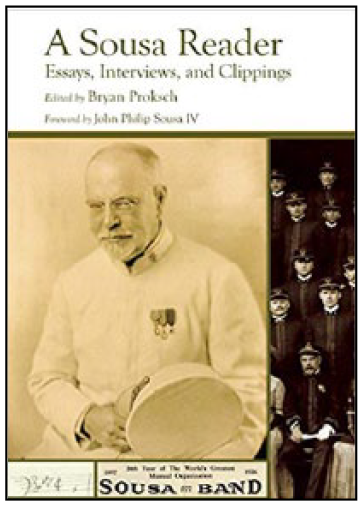
Bryan Proksch’s A Sousa Reader is a concise and wide-ranging introduction to the treasure trove found in Sousa Press Books, a “bookcase-sized collection of thousands of pages gathering probably over ten-thousand items,” housed in the Sousa Archives and Center for American Music at the University of Illinois in Champaign. The book suffers, however, from a lack of perceptible logic in the way these materials are curated for the reader. The sections of the book are organized chronologically, but a topical organization appears within that timeline. The result is that we see Sousa’s attitudes and beliefs on a subject during a particular period of his career, but it is rarely possible to see how (or if) those attitudes evolved through time.
Proksch’s stated goal is to “offer a taste of the variety of items held in this wonderful collection” (emphasis added). It accomplishes this goal but somehow without guiding the reader to a deeper understanding of Sousa or his beliefs—or to an understanding of what can be learned from his life and career for application to present-day wind bands. Without knowing the Sousa Press Books firsthand, I suggest that a more complete chronological collection of Sousa’s essays (without editorial omissions) or a collection that is organized topically instead of chronologically would be more helpful. The current collection relies exclusively on Sousa’s writings for a public audience; no personal correspondence is included.
Proksch’s academic standard, however, is beyond reproach. The book is heavily annotated and footnoted. Sources are provided for everything Sousa references in his writing, which surely must have been a tremendous amount of work. Proksch manages also, within a 175-page summary, to provide a sizable number of Sousa quotations on a variety of applicable subjects, ranging from the government’s role in the arts (which Sousa believed should be essentially nonexistent), leadership (“men of intelligence are naturally more easily led than driven”), programming, competition, copyright protection, and the list goes on. It is a valuable glimpse into the mind of this complicated and uniquely American man.
Director of bands and music education,
Wesley College, Dover, Delaware;
How Can I Review a Book for For Your Library ?
For information on how NAfME members can review books for Music Educators Journal, go to bit.ly/MusicEducatorsJournal and click on “Book Review Guidelines.”
To request a list of items available for review, please e-mail Caroline Arlington at