






Abstract
What tools are available to foster independent and critical thought in the music classroom? We propose that visual mapping—a method of representing relationships and associations between a main concept and other ideas, subtopics, or examples—is an ideal tool for doing exactly this. After examining the principles and usefulness of mapping in a variety of contexts, we discuss several specific ways in which mapping might be implemented in teaching music. We argue that the central strength of mapping is its ability to encourage users to be explicit and metacognitive about their knowledge. As such, it can be part of a constructivist stance whereby the instructor creates a student-centered classroom in which learners are active, engaged participants in their education.
Keywords
Here are some ideas to encourage students to reflect on their learning and take ownership of the music-making process.
Photo of Joshua Groffman by Jessica Van Tassell

Photo of Zora M. Wolfe courtesy of the University of Pennsylvania Graduate School of Education

NAfME is glad to offer one hour of professional development recognition to you for reading this article. Please follow the link below and complete a short quiz to receive your certificate of completion.
Mapping is the use of visual representations to organize and show relationships and associations between ideas. 1 Such maps typically begin with a main idea, to which other concepts, ideas, subtopics, or examples—called nodes—are added and linked with connecting words or phrases. How nodes are connected and placed can clarify relationships and hierarchies of ideas or patterns among concepts. Because mapping is two-dimensional, it allows for creativity and flexibility of thought to show the complexity of ideas and relationships, in contrast with the linear nature of traditional notetaking. Figure 1 is an example of a basic map on the concept of school.
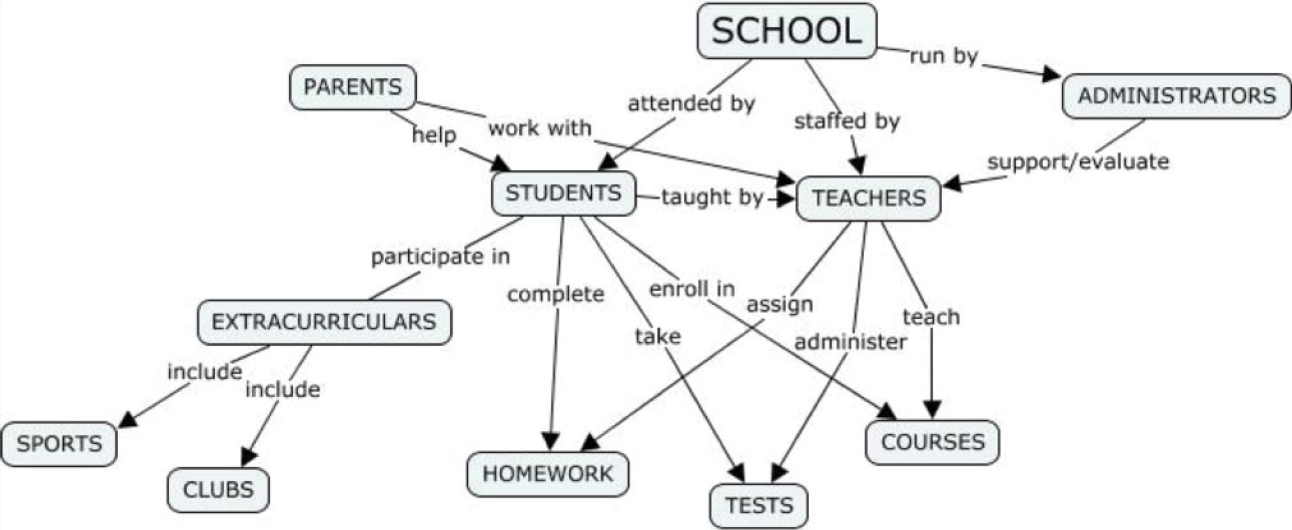
Concept Map: “School”
Mapping is used in a number of different settings, including K–12 classrooms, higher education, business, and industry, and in a variety of different disciplines, including nursing, economics, business, mathematics, and the sciences; its advantages and benefits as a pedagogical tool have been well documented. 2 Although brainstorming maps have been suggested as a tool for teachers to plan music instruction, mapping in the field of music has not been fully explored, particularly as something in which students can engage. 3 We believe the time is right to consider how different forms of mapping might be a natural fit for the field because of the way they align with some of the most important and basic functions of music teaching and learning.
We argue that because mapping prompts users to be metacognitive about their knowledge, it can be part of a constructivist stance to music teaching, in which learners are active, engaged participants in the student-centered classroom. In this vein, it is additionally useful in promoting what the National Association for Music Education (NAfME) calls music literacy by helping students independently create, perform, respond, and connect through music. 4 We examine two particular types of mapping, highlighting possibilities for how they might be used for learning in different musical contexts: first, the use of mind maps for collaborative repertoire selection in large ensembles and, second, how concept maps have been applied in our teaching of music fundamentals. Here, mapping provides a method for promoting deeper understanding of course content and linking musical terminology to music as it is heard and performed.
Active Learning
The central strength of mapping is that it creates an explicit, visual representation of thinking. The act of grouping terms around a central concept or idea and diagramming their relationship to one another prompts students to articulate their understanding of a subject in a concrete way. For this reason, we believe mapping can be part of the ongoing conversation surrounding active learning and the student-centered classroom. Across secondary and higher education generally, there is evidence that pedagogy that relies heavily on rote memorization, and “teaching as telling” will result in less learning than pedagogy that emphasizes “building a bridge” between students and their knowledge 5 —that is, students must be active participants in their learning, incorporating new knowledge alongside skills and content they already possess. The emphasis on active learning is undergirded by the theory of constructivism, which holds “that knowledge is formed as part of the learner’s active interaction with the world, and that that knowledge exists less as abstract entities outside the learner than constructed anew through action.” 6 Instruction with a constructivist perspective is often called student-centered teaching because it envisions the teacher as facilitator rather than the teacher as knowledge-giver. A student-centered classroom emphasizes self-reflection, peer evaluation, and problem solving in the context of music-making. 7 Sheila Scott, a professor specializing in elementary music education, notes that a constructivist stance is not inconsistent with carefully considered direct instruction (i.e., teaching-as-telling). Rather, she says, effective instruction will often combine both: “Content knowledge obtained in a teacher-directed manner interfaces with student-centered perspectives when students apply this knowledge in an active and cognitively conscious manner as questioners and problem solvers.” 8 We therefore suggest that mapping, because of the ways it encourages students to be “cognitively conscious”—intentional and explicit about their thinking—may be a useful activity to move toward a constructivist teaching stance.
The most recent 2014 Music Standards reflect a constructivist vision of music education as well. The Standards are centered around four Artistic Processes: Creation, Performance, Response, and Connection. Their constructivist orientation—particularly an emphasis on metacognition—is evident from their stated goal for instructors to “engage their students in higher-level thinking leading to authentic musical decisions.” 9 Over the course of their musical education, students are envisioned engaging in the four processes first with scaffolding from the instructor and progressing to making aesthetic and technical decisions for themselves. 10 Dee Hansen, director of graduate studies at the Hartt School of the University of Hartford, and Leslie Imse, chair of the music department at Farmington Public Schools in Connecticut, note that the path to independent, authentic musical action thus runs through metacognitive thinking; “[t]o authentically participate in music, students must actively pay attention to and think about their music-making through self-assessment and self-regulation.” 11
Hansen and Imse further note that teachers are now often evaluated on their ability to implement a student-centered classroom, with its attendant emphasis on engagement and conceptual knowledge. 12 Yet, it can sometimes be difficult to imagine how active learning and a constructivist stance might be implemented, particularly within the confines of large ensemble instruction and instrumental education; Joseph Shively, a professor of music at Oakland University in Rochester, Michigan, advocates that incoming teachers may benefit from increased discussion of concrete examples of what a constructivist mindset may look like in practice. 13 In the remainder of this article, we relate how we believe two varieties of mapping, mind maps and concept maps, can be useful in implementing a student-centered approach to music instruction.
Mind Maps and Repertoire
Visual mapping is divided into several subtypes, of which mind maps and concept maps are most applicable to music teaching. Whereas concept maps show “systematic relationships among sub-concepts relating to one main concept,” mind maps are looser, showing “subtopics of a domain in a creative and seamless manner.” 14 Mind maps allow students to imagine and explore associations between topics and can accommodate images and color as well as “emotions, feelings, and other affective concepts.” 15 They are ideal for providing structure in a brainstorming session, where the layout of ideas around a guiding central concept prevents the sketching from devolving merely into a jumble of words scrawled on a paper. In addition, creating mind maps collaboratively with others helps to create shared understandings of ideas, situations, or workflows, facilitating better interaction between group members. 16
Sandra Snow has suggested that a conductor brainstorm and map different musical interpretations of a piece and then connect teaching strategies to plan a rehearsal. 17 Such mapping need not be limited to the conductor-teacher of an ensemble, however. Instead, as we seek to develop students’ ability to participate authentically in ensemble performance, including in student-led ensembles, mapping may be a crucial piece in building independent decision making about something like repertoire selection. Figure 2 is a sample map students might construct from the framing question, “How should we select music for our next performance?” Building a program is something that can be done in isolation by the instructor, with students handed the music afterward. By engaging them in the repertoire selection process via mapping, however, students are encouraged to think through the variety of aesthetic, technical, and logistical parameters that go into shaping an effective concert. Through its visual design, open layout, and flexible content, mapping encourages quick, creative thinking; at the same time, it allows students to structure and manage their thinking about a complex task.
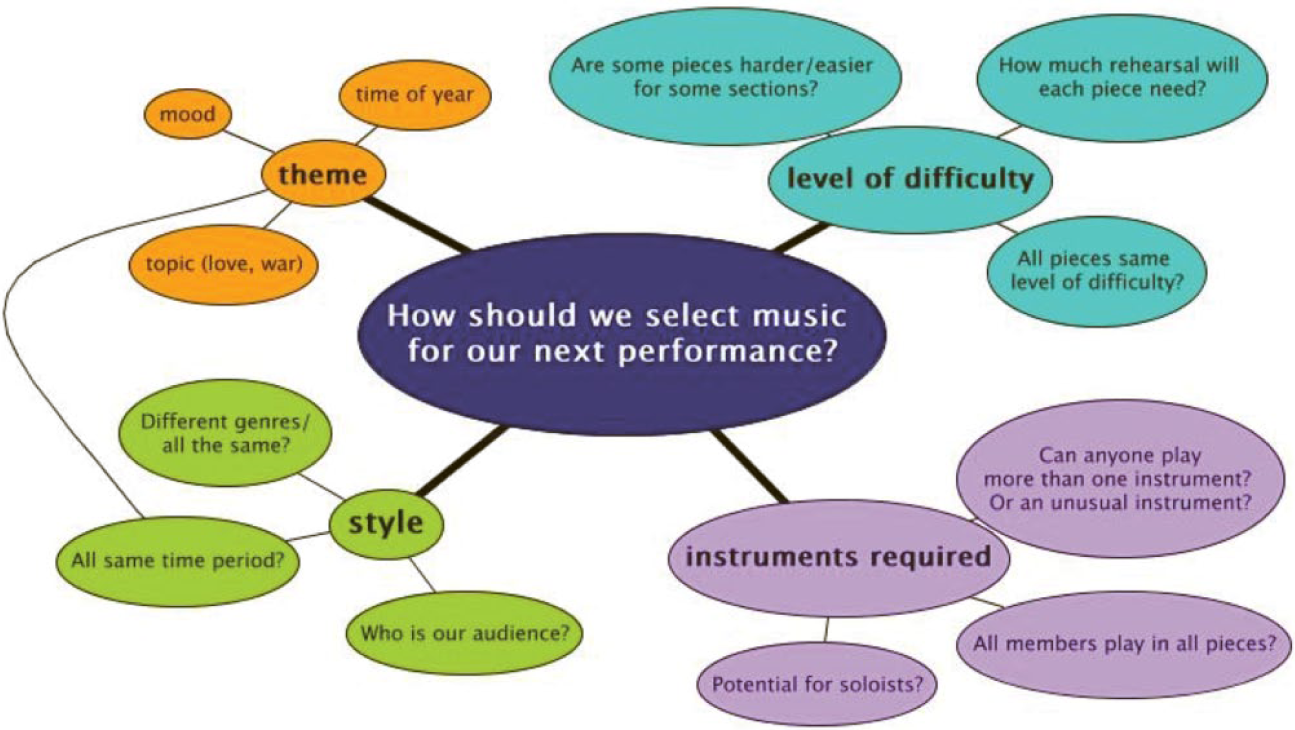
Selecting Concert Repertoire Mind Map
Elsewhere in large ensemble and chamber music settings, each musician must navigate his or her part within the group; authentic participation will involve understanding and agreeing on what role the student is to play among many voices. Here, too, mind maps could be useful in allowing group members to come to a shared understanding of their respective roles. Mapping might also be useful in other aspects of creativity, such as exploring different interpretation possibilities for the performance of a piece in applied lessons or sketching out a new work for composition lessons.
Concept Maps
Concept maps, as distinct from mind maps, visually represent the relationships between concepts and hence promote understanding of those concepts themselves and the domain to which they belong. 18 Lee Freeman, a professor in management studies at University of Michigan–Dearborn, and Leonard Jessup, a former professor in the School of Accounting, Information, and Business Law at Washington State University, report that concept mapping activities can be helpful in eliciting what students already know about a topic as well as making connections to new knowledge; furthermore, students report enjoying concept mapping because it is both intellectually interesting and different from other typical classroom activities. 19
In addition to the general advantages of concept mapping, we arrived at using it specifically in our teaching of a music fundamentals class for a variety of intersecting reasons. Fundamentals is a term-heavy subject—in a general music, AP music theory, or college fundamentals course, students can be expected to become adept at identifying key and meter signatures, scales, modes, and basic harmonic functions, all of which bring a wealth of vocabulary and concepts with them. In keeping with a student-centered classroom, we sought a way to actively engage students in their learning of these terms that did not rely exclusively on lecture, notetaking, and testing. Doing so would allow students to grasp the material more deeply, with the conceptual understanding that is necessary for higher-level thinking, and would also make learning more enjoyable for students.
What does higher-level thinking in music fundamentals look like? A conceptual understanding of music theory knowledge suggests an ability to use the descriptive terms of fundamentals with sophistication, to independently and accurately apply them to descriptions of music. 20 As Jackie Wiggins points out, there is a distinction to be made between labels we apply to descriptions of music and the concepts embodied by those labels; often students may be able to hear music accurately—and even describe musical phenomena in plain, nontechnical language—before they master formal musical labels. 21 Making the transition to using formal terms to reflect the actual processes of music requires a nuanced understanding of individual terms as well as how they fit together within the overall scheme of theory knowledge. Students, for instance, frequently confuse rhythm for tempo: In describing the difference between the first and second theme of Beethoven’s Waldstein sonata (see Figure 3), Dr. Groffman noticed that they frequently report that “the tempo of the piece is slower.” In actuality, the rhythms are slower in the second theme, while the underlying tempo remains the same. The students may be hearing the passage accurately, but because of a small but important misunderstanding about the precise meaning of the terms tempo and rhythm as well as their relationship to each other, they are not yet able to use the descriptive tools of music fundamentals to communicate their hearing. Concept mapping may help them to make tangible connections between musical labels and concepts; as Davies argues, “If students can represent or manipulate a complex set of relationships in a diagram, they are more likely to understand those relationships, remember them, and be able to analyze their component parts.” 22 As we hope to show in the following, we found concept mapping to be a powerful way for students to demonstrate how they understand theory concepts and relate them to one another. Importantly, it also allowed us to integrate intellectual concepts with music that students can hear, create, and perform themselves.
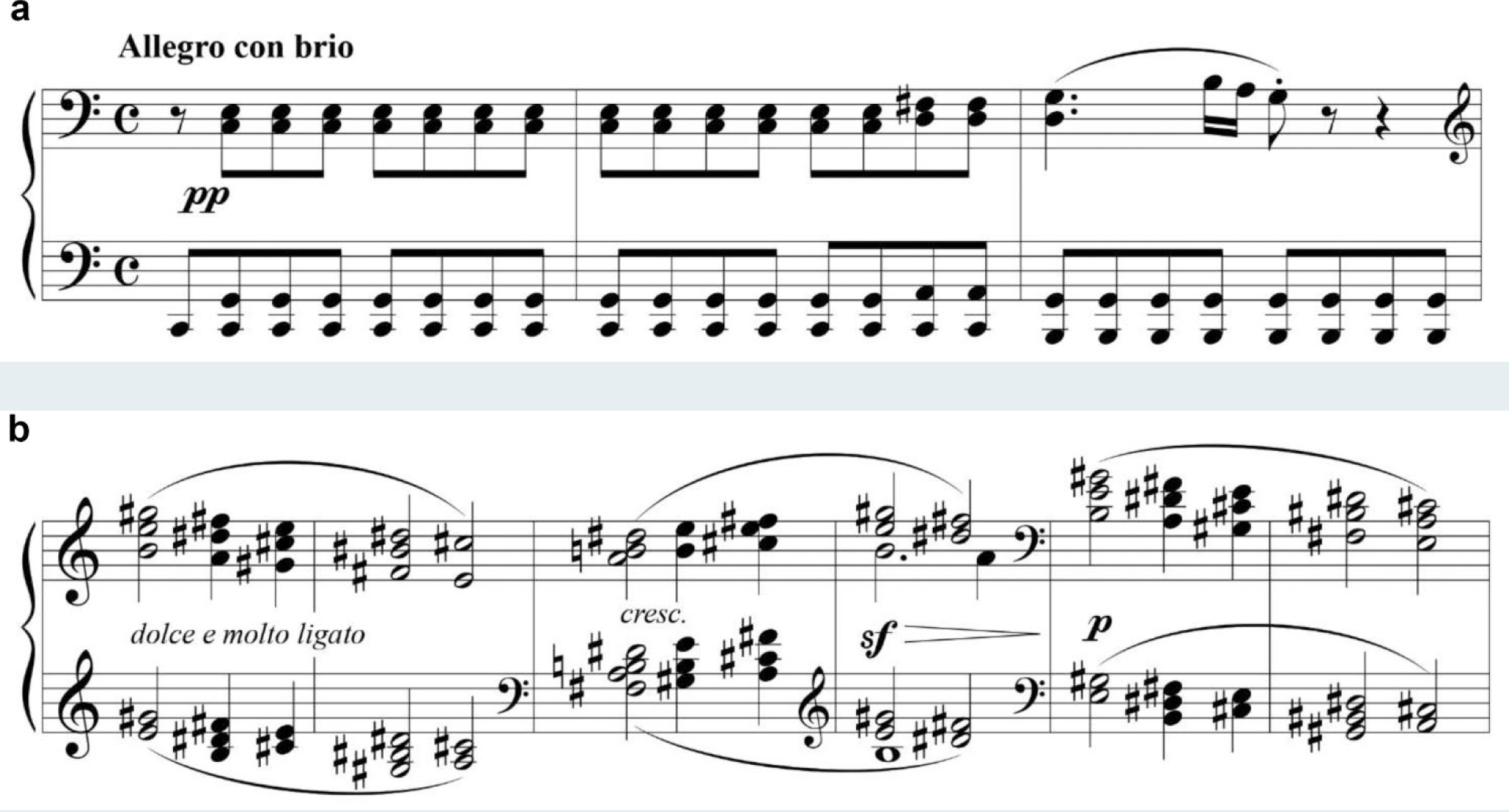
(a) First Theme of Beethoven’s Waldstein Sonata. (b) Second Theme of Beethoven’s Waldstein Sonata.
Concept mapping, as a unique skill and method of representing knowledge, is not necessarily something that comes naturally to students. Instructors need to be explicit about explaining the elements of a concept map and how to create informative maps. In the process of teaching how to create maps, instructors also need to provide feedback and help students critique their own maps. Dr. Groffman elected to introduce mapping early in the course, giving students plenty of opportunities to benefit from the skill and improve at it. It took several iterations before students developed a level of comfort with the skills and discovered that it was useful for learning in music.
Dr. Groffman introduced the idea of concept mapping in the second week of his music fundamentals class. In explaining the skill to students, he said that he wanted to distill it to as few basic principles as possible and ended up stressing three essential elements: 23
To disentangle the skill of concept mapping from theory knowledge, the first concept mapping activity dealt with a topic students understood intimately: school. Dr. Groffman initially supplied students with a short list of terms. Working as a class, we connected the guiding concept of school to students, teachers, and courses and added linking phrases to explain their relationship to one another. Breaking into groups of two, students then expanded on the basic map by generating additional nodes and connecting them, including ideas such as extracurriculars, sports, parents, administrators, tests, and so on. Figure 1 shows a sample concept map from this initial mapping activity. 24 For homework, students then tried their hand at a basic music-related concept map using terms derived from our lesson on the different parameters, or elements, of music: music, pitch, melody, harmony, time, rhythm, and form. Because this was their first attempt at concept mapping for a grade, Dr. Groffman scaffolded the assignment by supplying the terms to the students and keeping the number of terms relatively small. Figure 4 shows a sample map from this activity.
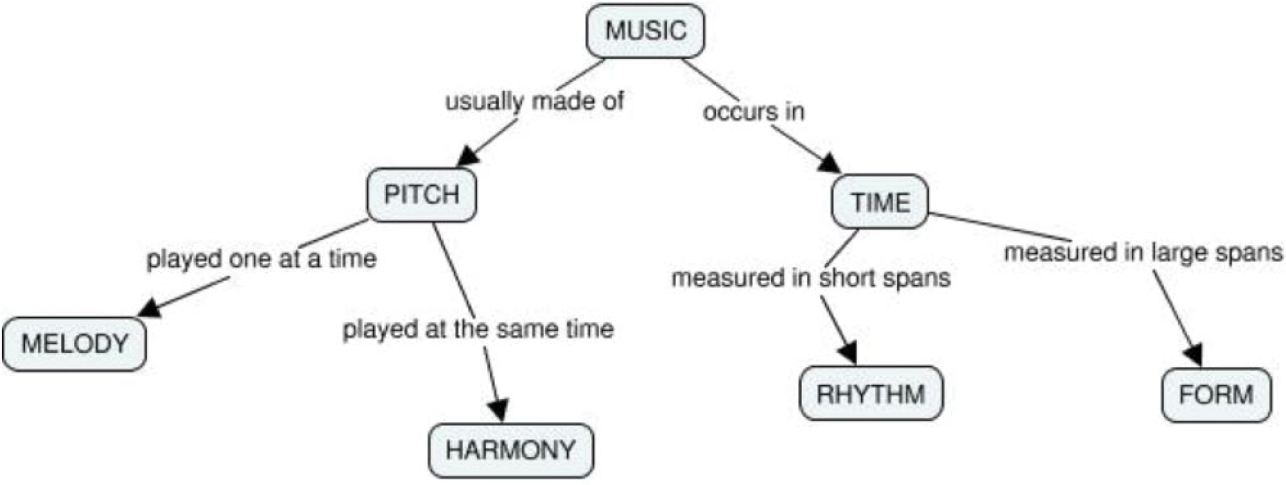
Concept Map: “Elements of Music”
Once students have grasped the essentials of concept mapping, it can theoretically be used at a variety of stages of learning course material. As an evaluative tool, concept maps can be used in assessing students’ understanding of a subject by scoring concept maps based on the complexity and richness of understanding they demonstrate. More complex concept maps will have more concepts and valid relationships between them, more branchings, and more levels of hierarchy; crosslinks—connections between nodes on the same level of hierarchy—are also typical of more complex, integrated understanding. 25 Mapping can be made into an iterative process: Students can be asked to revisit their initial concept maps and revise and add to their maps as new information is presented and deeper understandings emerge.
In our experience, however, concept maps have proved most ideal for formative assessment. During formative assessment, instructor and students together gauge students’ understanding of a concept as part of the learning process (i.e., not for a grade); it is an opportunity to fill in gaps in understanding and strengthen students’ knowledge before they are assessed on a test. Formative assessment is an opportunity to promote metacognitive thinking as well. As we have previously argued, students learn best when they “build” knowledge for themselves and integrate new concepts alongside ones they already understand; concept maps are valuable because they allow students to demonstrate very concretely exactly how they have thus far built and integrated course knowledge. Using concept maps at the formative assessment stage can give students and instructor a valuable and timely perspective on their learning.
Figure 5, a map of the guiding concept of pitch generated by two students working as a pair, demonstrates the usefulness of mapping in formative assessment. The pair demonstrate valid connections in some areas but also some spots where they can improve, particularly in their thinking about the term interval. For instance, the linking phrase separated into between pitch and interval is vague and reveals an incomplete understanding of what an interval is. Also, minor third and major third should be connected to the interval node, along with half-step as examples of intervals; the students again are showing an incomplete understanding of the interval concept. Viewing this concept map, then, gave Dr. Groffman a quick but thorough overview of student understanding and provided a starting point for a discussion of clarifying points.
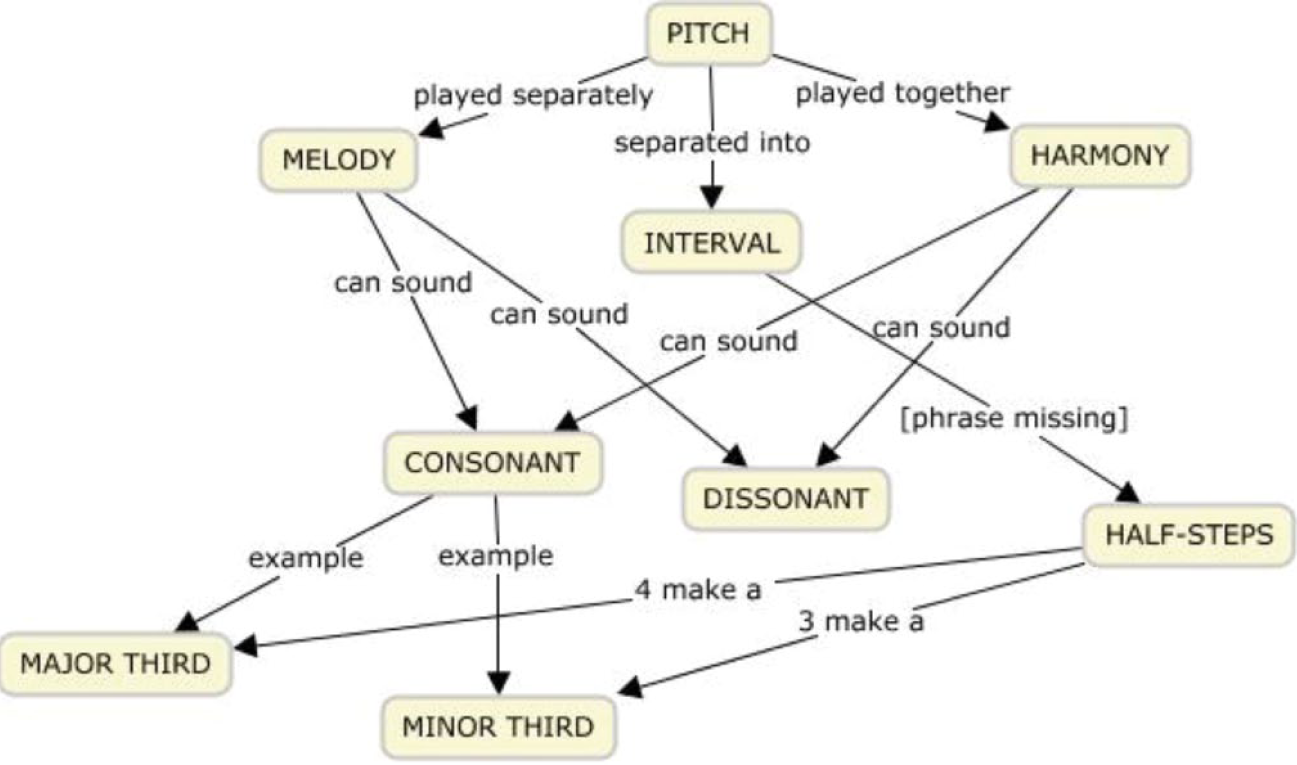
Student Concept Map: “Pitch”
At other points in the term, concept maps allowed for students to participate in formative assessment by working together to gauge their own understanding of terms. Concept maps are useful in implementing a constructivist pedagogy in which students collaborate, pool knowledge, and act as resources for one another in building knowledge of a complex subject. As with mind maps, working collaboratively with others on a concept map can deepen understanding as more minds add additional ideas and connections between concepts to develop a richer map. In one activity later in the semester, Dr. Groffman gave students a more complex task by supplying only the initial, guiding concept (major scale). They were then responsible for generating their own “parking lot” of terms related to the concept and constructing the map. Students initially worked alone to brainstorm terms and generate an initial draft of the map; they then partnered up and pooled their terms with another student, constructing a new map on the same concept; finally, they worked in groups of six, integrating three separate versions of the map to construct a final group product. With each iteration, students had to compare maps and sort out any discrepancies, justifying to each other why they diagrammed the concept in the way they had. In several instances, discrepancies led to broader discussions and clarifications of misunderstandings of definitions of terms and how they related to one another.
One final possibility for concept mapping that we found especially useful was to combine concept map groupwork with multimedia mapping. 26 The goal with an activity like this was to ask students to make a link between the descriptive terms they were learning in class with actual instances of music that they created and/or performed. This, again, was an opportunity for formative assessment: Since the ultimate goal of teaching fundamentals is to grasp terminology for the purposes of applying it in describing, creating, and performing music, multimedia concept mapping provides a chance to gauge to what extent students are learning to do this successfully.
Example 1 is a sample multimedia assignment from Groffman’s fundamentals course requiring students to demonstrate an understanding of course concepts and connect those concepts to recorded musical examples. This activity follows an inquiry activity in which students work in groups to uncover the basic ideas behind the concept of the minor mode and its relationship (in terms of key signature and intervals) to the major mode. It thus creates an opportunity for students to review and reinforce their understanding of the idea of mode, but by adding the requirement that students find and perform musical examples that illustrate each concept on the map, it pushes them to move beyond simple rote memorization of term definitions. Instead, they must use listening and performance skills to link concepts to actual music examples; it is here that the power of mapping to address a situation like the aforementioned confusion between rhythm and tempo becomes evident.
Example 1. Sample Assignment: Concept Map with Multimedia
Instructions: Working in groups of four, use Cmap Cloud to create a multimedia concept map in two stages, as described in the following. When you are done, e-mail your map to me, using the “E-mail Link to Cmap” feature in Cmap Cloud.
Create a concept map that contains the following terms: mode, affect, major scale, natural minor scale, key signature, parallel minor, relative minor, tonic, tendency tones
These terms are just to get you started; you should include all of them, but you should also include at least three additional terms that will make your map clearer or more useful in representing the concept of “mode.”
Each term in your concept map should be illustrated with an audio musical example. You should include each of the following in your examples:
One or more examples of a recorded song (any genre) that you link to from YouTube, Spotify, or SoundCloud.
One or more examples recorded by your group on the instrument(s) of your choice. Upload your recordings to Box and link to them in your concept map. You may compose the example or play an example you find elsewhere (be sure to indicate the composer and piece title).
One or more sung examples recorded by members of your group. Upload your recordings to Box and link to them in your concept map. You may compose the example or play an example you find elsewhere (be sure to indicate the composer and piece title).
This activity thus promotes the 2014 Music Standards’ stated goal of making a tangible link between “conceptual understanding” and “the actual processes in which musicians engage.” It also provides a fun break from normal classroom activities, taking on the loose feel of a scavenger hunt as students break out to trawl for examples on You-Tube, compose and record examples in practice rooms down the hall, and reconvene to pool the resources they have generated. Through this design, the activity also provided an ideal opportunity to implement what Elizabeth Cohen et al. call the “multiple ability” classroom. 27 Although academic activities such as notetaking and test-taking often rely on linguistic and logical skills in particular, the music classroom affords an opportunity for activities engaging a wider array of abilities. Some music students who are uncomfortable with skills such as reading comprehension, synthesizing knowledge from various sources, and writing may nevertheless excel at hearing, composing, and performing harmonies, rhythms, and melodies. The multimedia concept map can be an ideal place for all of these abilities to come into play by allowing students with different strengths to contribute meaningfully to a group task. In doing so, it builds confidence and enthusiasm for learning, even among previously low-achieving students. By incorporating concept mapping into lessons, instructors are providing multiple means of engagement, representation, action, and expression, aligning with the guidelines for Universal Design for Learning that encourage teachers to develop lessons addressing the needs of all learners from initial design.
As the previous discussion has made clear, mapping can be a novel and powerful method for promoting deep engagement with the core processes of music. Already in use in other disciplines throughout levels K–12 and in higher education, mapping may be a useful technique for music educators to implement in their classrooms. These educators’ exploration of mapping may be enriched by comparing notes with colleagues in other disciplines who have already done so. When implemented as described previously, we believe mapping can be firmly rooted in musical knowledge and skills while fostering an active learning environment for student engagement. As students grow comfortable with mapping, they grasp its creative possibilities, benefit from the opportunities it affords to work together, and come a little closer to understanding how they can themselves take authentic ownership over their own music-making.
Footnotes
Joshua Groffman is an assistant professor of music specializing in composition and theory at the University of Pittsburgh at Bradford in Pennsylvania; he can be contacted at