







Abstract
Students often enter secondary schools with increased autonomy over course selection and how they meet graduation requirements. Those who once participated in school music may discontinue music studies for a variety of reasons. Music teachers should be mindful of factors that may affect a student’s ability or desire to participate in school music. This article discusses these factors and suggests practices to increase access to music education for all students. By examining practices and considering ways they can be altered or expanded to provide more options and be more inclusive, music educators may be able to provide more opportunities for all students.
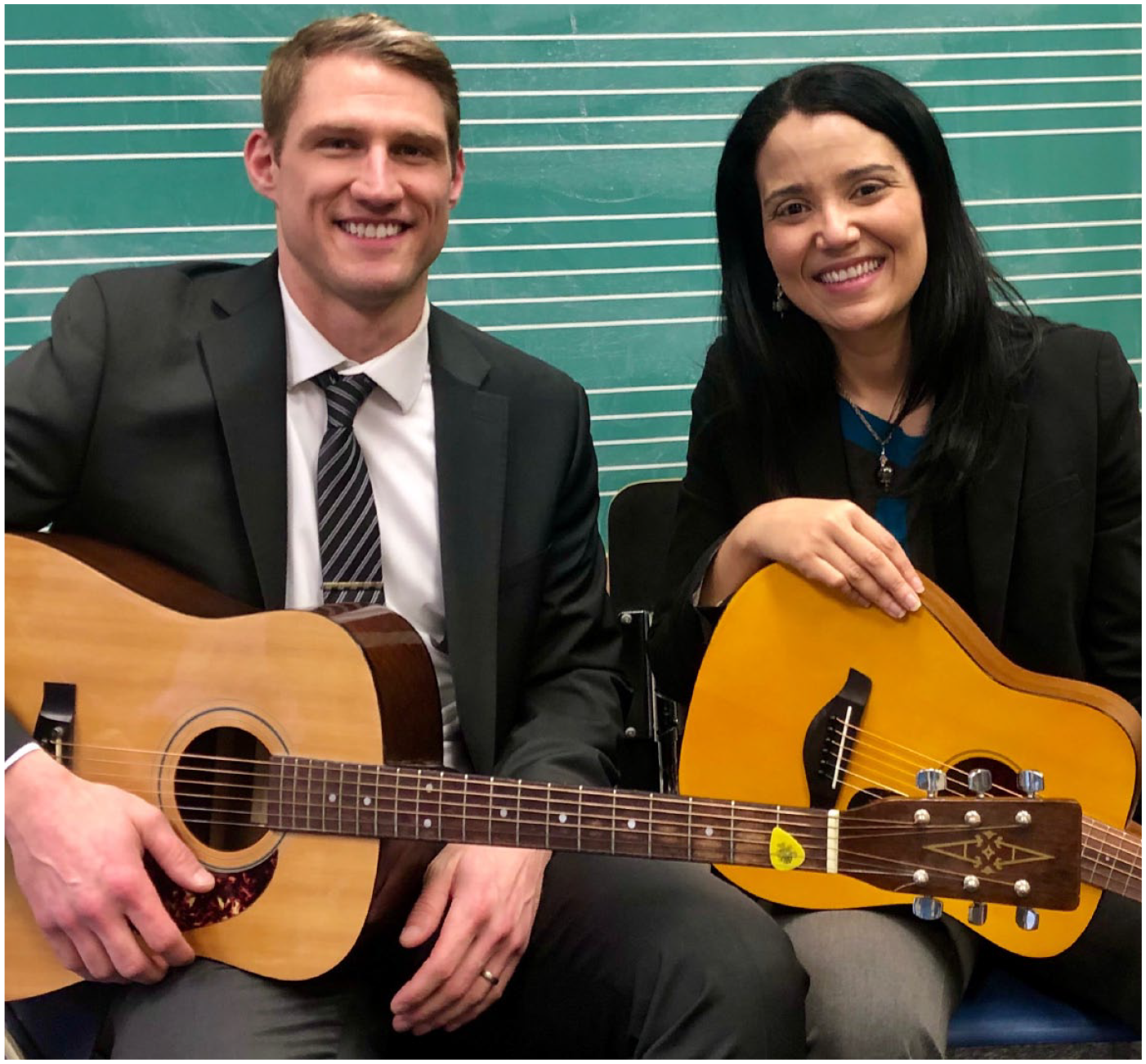
Photo of Mara E. Culp (R) and Matthew Clauhs courtesy of the authors
How can we help improve all students’ access to and participation in secondary school music?
NAfME is glad to offer one hour of professional development recognition to you for reading this article. Please follow the link below and complete a short quiz to receive your certificate of completion.
Although school music is not always compulsory, many schools require participation in music through the primary grades. 1 At the secondary level, students typically elect to participate in music, which may mean joining an ensemble or enrolling in classes such as guitar, piano, music appreciation, theory, or music technology. 2 Yet, even when students wish to participate, barriers may exist that prevent their participation at the secondary level.
Given the ubiquitous nature of music in our society and its important role in art, entertainment, spirituality, and education, it is imperative that music teachers examine ways to empower students to continue developing musical knowledge throughout their school experience. Students are inherently musical and enter classrooms with a passion for music that is expressed in ways not always recognized in formal school music settings. In this article, we discuss factors that can influence participation in secondary school music and suggest practices to increase access for all students. By illuminating potential barriers and offering suggestions for pathways through them, we aim to empower music teachers to examine their music programs alongside stakeholders in the community (e.g., students, parents, community members, administrators) to effect meaningful change and promote an inclusive model of music education in their schools. Before developing solutions, teachers must consider the nature of the community, the potential barriers faced in a specific context, and the most appropriate ways through for that setting.
Secondary School Music Enrollment
Music education scholars have reported and interpreted trends in secondary school music participation at state and national levels using preexisting data sets. David Williams reported negative enrollment trends in band, orchestra, and chorus in Florida, 3 and John Kratus reported negative trends in California. 4 Much of this literature resulted in a classification of “the other 80 percent”—a reference to the percentage of students who do not participate in school music at the secondary level. However, at the 2018 Music Research and Teacher Education National Conference, Kenneth Elpus and Carlos R. Abril presented a more optimistic view of secondary school music participation using a more recent data set from the National Center for Education Statistics. 5 According to Elpus and Abril, 35 percent of the sample, most of whom graduated in 2013, were enrolled in at least one music class in high school. In examining ensembles, they reported the following participation rates: any ensemble (24 percent), choir (13 percent), band (11 percent), and orchestra (2 percent). The researchers also found that students from the highest socioeconomic backgrounds were more likely to participate in band and orchestra than were students from lower socioeconomic backgrounds. We aspire to help expand all students’ musical engagement in school by providing suggestions that will help address such potential barriers.
Access to Secondary School Music
Unique circumstances may contribute to students’ ability or desire to participate in secondary school music. Financial constraints, parental involvement, course/ensemble structure and offerings, repertoire selection, and scheduling may all affect a student’s interest or ability to participate in a program. In separate studies, researchers Veronica O. Sichivitsa and Megan E. Clay Constantine listed some considerations that could influence a student’s participation in school music in terms of internal and external factors. 6 We will also unpack several of these factors and provide suggestions we believe can assist music teachers in understanding how to structure experiences to increase students’ access to and participation in school music.
Economic Considerations
Socioeconomic status (SES) is significantly associated with student participation and retention in school music. 7 Researchers have shown that students whose families have a lower SES are less likely to persist in school music or participate in school music at the secondary level. This tendency might be explained in part by the fees that may accompany musical participation (e.g., instruments, trips, uniforms, lessons). Additionally, students who work to contribute financially to their families may have less time to attend rehearsals/performances and therefore would be less able to participate in secondary school music.
Suggestions
Music educators may be able to alleviate some or all of the financial stresses of music participation by finding ways to provide materials and activities at a reduced cost or for free to all learners. Adopting practices that reduce financial obligations for all recognizes that removing such strictures can benefit everyone and increase students’ and families’ engagement in school music. Some organizations and charities have historically provided instruments at no cost to families or school districts. 8 Instruments, uniforms, and other materials could be collected through donations at concerts and other school events and redistributed via lottery or a school-based garage sale. 9 To incentivize such contributions, school districts could provide letters to allow families to claim tax deductions for donations. Proceeds from fundraisers and/or resources from music booster organizations could also be used to subsidize other costs related to musical participation (e.g., entry fees, school trips, technology). Finally, music teachers could reconsider grading policies that depend heavily on attendance and practice completed outside the school day—which can negatively affect students who use afterschool hours to work or lack suitable spaces to practice 10 —by working with administrators.
Parents/Guardians
Parents and guardians can have a tremendous influence on children’s aspirations, including participation in school music. Based on the results of a research study, Sichivitsa found that elementary children valued music more, developed better musical self-concepts, and had more previous music experience if their parents exhibited higher levels of musicianship and supported musical study. 11 These qualities of the parents contributed to students feeling “motivated to continue studying music in the future.” 12 As such, students may be less likely to continue in school music if they believe their parents do not support their participation (e.g., parents prioritize other academic subjects at the expense of music study). Students may also be less likely to participate in a school music ensemble if their parents are unable to provide transportation to rehearsals and concerts or lack necessary financial means. Furthermore, students from two-parent households may be more likely to participate 13 and continue in band; 14 time and money may be more limited when children have one parent or guardian. While research demonstrating a relationship between parental involvement makes a compelling case to involve parents in their child’s music education, research-based strategies to involve parents to increase students’ participation in school music appears to be limited. As such, we suggest the following strategies to engage parents in the school music program.
Suggestions
Teachers should consider how they can involve parents in ways that help them feel included by honoring their schedules, opinions, and contributions. Parents may appreciate attending open houses where they can interact with music teachers and learn about the program. Because some parents and guardians may have limited Internet access, it is important that hard copy invitations for open houses and all important events be delivered to families. Considering that parents might have different work schedules (e.g., day, night, overnight), music teachers could exercise flexibility in scheduling musical open houses. This might include multiple open houses at different times of the day as well as evenings. Because parents may have had negative past experiences with school music or harbor false assumptions about the music program, interacting with them on a personal level and informing them about options for their child may help to build bridges.
Interacting with parents will also help teachers become aware of the ways parents could become involved with the program. For example, parents could help with concerts (e.g., accompanying, lighting, organizing refreshments), chaperoning trips, or fundraising. 15 Parents could be invited to perform, support students, or otherwise share their musical experiences. Additionally, parents could perform and practice with students or find additional avenues to facilitate their children’s musical journeys, 16 such as assisting with new music classes.
Traditional Ensembles and Repertoire
Today, large traditional ensembles may be the only choices students have to participate in music at the secondary level. 17 Yet, students may not be motivated by the experiences characteristic of many large ensembles, such as certain kinds of repertoire, instrumentation, emphasis on re-creation over creation, and a director-led rehearsal. 18 Others have argued that these claims are exaggerated and maintain that large-ensemble experiences play a vital role in school music programs. 19 To embrace multiple viewpoints, teachers can adopt an approach that celebrates both tradition and innovation.
Traditional ensemble models provide opportunities for a performance-based approach to teaching and learning. However, the performative nature of music-making in traditional settings often extends beyond the rehearsal space to involve an outside audience. The pressure of public performance and ratings can incentivize teachers’ inclusion and retention of students considered high-performing by traditional standards—those with strong backgrounds in reading Western staff notation and advanced technical facility on a band/orchestral instrument or singing in classical style. When ensemble directors are encouraged to produce performing groups that are “only as strong as their weakest link,” they may perceive others’ participation as negatively affecting the group’s perceived musical quality or performance ratings. In such instances, the spirit of music-making suffers as students who do not conform to narrow standards may face barriers to participation. As such, it is likely many students—such as late beginners; students with exceptionalities; students who do not read staff notation, play a traditional band/orchestra instrument, sing in a classical style, or enjoy performing on stage for an audience; or students whose interests are outside band/orchestra/choir—may not be drawn to and/or included in traditional ensembles.
Ensemble repertoire is inextricably connected to curriculum in many secondary music ensembles. In fact, conductor H. Robert Reynolds wrote: “The music you choose becomes, in large part, the curriculum that you and your students follow toward a sound music education.” 20 However, the music selected as part of the curriculum may be offputting to students—particularly when they have musical preferences beyond the canon of traditional school band, orchestral, and choral music. Students from historically marginalized groups may also struggle to see themselves represented in the music curriculum when the repertoire does not reflect the members of the school. Such absent figures can send messages to students, parents, administrators, and the community—implicitly signaling who and whose music belongs in school settings.
The ways in which repertoire is presented to traditional ensembles may also pose barriers. A high school student may feel overwhelmed by learning to play an instrument and read standard music notation for the first time, especially when surrounded by peers who do so with ease. Such repertoire also requires a very specific instrumentation, which is rarely flexible and may not accommodate students who wish to learn nontraditional instruments. In these ways, repertoire in traditional ensembles can pose barriers to participation.
Suggestions
In recent years, alternative ensembles—those that are not traditional bands, orchestras, or choirs—have gained momentum in schools across the United States. These emerging ensembles may include but are not limited to mariachi, African drumming, steel pan, and popular music groups. A new strand of emerging ensembles labeled “modern band” has served more than 650,000 students across the United States, driven by the nonprofit organization Little Kids Rock. 21 Bryan Powell and Scott Burstein, 22 who work for this organization, explained that modern band “has two simple guiding attributes: repertoire and instrumentation” and that the repertoire is “student-centered first and foremost, reflecting the music that students listen to on their own and with others.” The instrumentation of a modern band often includes guitar, bass, keyboard, drums, vocals, and technology but is flexible and adapts to current trends in music and the individual learning goals of the students. While the typical modern band includes standard rock/pop instrumentation, the goal is often for students to have ownership of the curriculum—a practice that may be used in traditional settings as well. If a student group is interested in hip-hop, the instrumentation may include more technology (e.g., synthesizers, sequencers, drum machines) than acoustic and electric instruments.
Within and in addition to these modern band efforts, music teachers can also provide multiple entry points to begin music study in other music course offerings. 23 Providing new course offerings may require additional teaching staff or preparation on the part of the teachers. To keep up with demand for new music electives and experiences, teachers can take part in professional development (e.g., that found at state, regional, and national conferences) to expand their skill sets. Ideally, increased enrollment and participation will correlate with increases in teaching positions, 24 just as decreasing enrollment tends to correlate with decreases in teaching positions.
In traditional ensembles, teachers can infuse the curriculum with repertoire and materials that represent individuals from diverse backgrounds, in terms of gender, social class, ethnicity, sexual identity, and race, among others, to help all students begin to see themselves represented 25 and better connect to the music classroom. Teachers may be able to accomplish this goal by offering a greater variety of ensemble experiences—such as the alternative ensembles described previously—and incorporating music from diverse composers. 26 Music teachers could follow the lead of international music festivals—more than forty in all, including the BBC Proms—that pledged a 50:50 gender split in programming new music by women and men by 2022. 27 In February 2017, National Public Radio aired a story written by Solvejg Wastvedt on how Minnesota’s Spring Lake Park High School band directors made a commitment for one year to only purchase music written by composers of color and to perform the works of women and minority composers on each concert. 28 Because the music of women composers and composers of color may be less readily available from publishers, school music programs having the financial means to do so might consider commissioning works from these underrepresented groups. Instituting such policies may help to expand the musical horizons of all students while increasing students’ connectedness to the ensemble and repertoire by helping them appreciate that music is from and for all people.
Scheduling
Still, even when students want to participate and have parental support and the financial means to do so, scheduling can prove a difficult barrier to overcome. High school choir director Kevin Meidl reported music class enrollment decreased after implementing a block schedule in 69 percent of high schools responding to his survey. 29 Reporting on the scheduling patterns of students who completed more than one music ensemble credit during high school, music education researcher Vicki D. Baker identified challenges to scheduling music ensembles during high school reported by freshman music majors. 30 Among participants who reported difficulties, obstacles related to scheduling conflicts with other courses were recounted most frequently. 31 Music education scholar Daniel Isbell explained how scheduling problems can manifest in small schools due to the schools’ inability to offer classes in multiple time slots. 32 Furthermore, participation in extracurricular activities may be higher in smaller schools, 33 and as mentioned previously, some students may also need to spend hours outside of school working. Hence, music educators should carefully consider such factors when scheduling activities during and beyond school hours.
Suggestions
Creative scheduling can help improve student access to school music. Offering extracurricular music classes outside of normal instructional hours may work in some settings but not others. Furthermore, it could suggest music study is secondary to other coursework; it is also likely to conflict with students’ afterschool work or other activities. Some scheduling conflicts could be avoided by offering multiple sections of a class instead of one or two large sections offered at one time. This may not be possible with some large ensembles, but if teachers worked with smaller groups in chamber or alternative ensemble settings, many scheduling conflicts could be eliminated. Teachers may find success by teaching seven or eight small sections throughout the day rather than one large ensemble once a day. These groups could be combined for performances. This solution may work best for directors who teach one or two large ensembles and multiple private or small-group lessons throughout the day. We recognize that although private or small-group lessons may be common practice in some areas of the United States, it may not be typical of all regions. In any scenario, communicating with guidance counselors may also help reduce scheduling barriers. 34
Another way to reduce scheduling barriers may be through interdisciplinary learning. Interdisciplinary learning has gained momentum in recent decades, and secondary music teachers may be able to create interdisciplinary courses. Depending on school and state guidelines, students may be able to earn credit in multiple subject areas through interdisciplinary coursework, 35 and teachers should work with administration to determine if this could be a viable option for music classes at their school. Conversely, music educators could work with other faculty to integrate music into existing courses. For example, students could sing songs in a language course, trace a musical genre’s development in a history course, or examine how music is associated with identity in a psychology course. If interdisciplinary learning is adopted by a school district, we recommend that teachers request additional and/or shared planning time. Whichever model is deemed appropriate, adding music to a course could help to ensure that students have music as a part of their curriculum.
Involving the Community
Before music educators begin to generate solutions to increase enrollment and retention, they should understand their community. Teachers should not assume what works in one setting will automatically transfer to another. Although rock bands may be effective for some, students at another school may enjoy a songwriting class that does not require live performances. Different school structures call for different approaches. Some teachers may have autonomy, whereas others need to make formal proposals before enacting changes. In either case, it would behoove the teacher to have administrator support 36 and information about student interest before proposing changes.
Along these lines, music teachers should listen to the voices of marginalized students 37 —populations that are often underrepresented in our school music programs. Seeking to encourage inclusion in music education spaces, music education scholars Mara E. Culp and Karen Salvador outlined ways that music teachers can honor individual differences on the NAfME Music in a Minuet blog. 38 Their suggestions include avoiding assumptions and overcoming biases, knowing students as individuals, fostering participation that reflects your school community, ensuring that repertoire and materials reflect your learners, structuring classroom practices and policies to create inclusive learning environments, and honoring the needs of individuals. 39 These are worthwhile concepts to keep in mind as we consider ways in which we might reduce barriers and foster inclusion for a wide array of learners in secondary music education.
Suggestions
Community support can be important for the growth and development of school music programs. 40 Knowing students and the community would assist music teachers in learning what they find valuable. Attending community functions would help music teachers understand the musical experiences valued by the community and how they are authentically enacted. Talking with students and families would help teachers gather additional information. Conversations could start informally with students currently enrolled in music but should extend to gain insights from students who are not enrolled. Visiting homerooms and talking with students during lunch, between classes, or after school in the bus/pick-up line may be a great way to begin such conversations. Teachers could also consider hosting events where students and community members can voice opinions. Providing questionnaires to stakeholders in paper and digital forms that address (a) why students are or are not involved in school music, (b) how stakeholders are involved in music outside of school, (c) scheduling concerns, and (d) new music class preferences could also assist teachers in gathering input. Such information would allow the teacher to formulate plans that align with the needs and interests of the community.
After understanding interest and potential barriers to participation within the community, the teacher could brainstorm potential courses, repertoire, and materials. Understanding the school’s master schedule 41 as well as working with guidance counselors and other school personnel would help determine when such a course could be offered 42 and how to secure the necessary spaces, materials, and equipment. Together, stakeholders could devise ways to provide any costly materials to students. Finally, a letter could be sent home, and caregivers of interested students could be contacted personally. Such considerations could help promote students’ ability to participate in music ensembles by reducing obstacles associated with scheduling, ensemble model, interest, familial support, repertoire, and finances. Tailoring courses to the needs and interests of the students at a particular school might help to balance representation across many demographics in secondary school music.
Welcoming Students in Music
Although music is often compulsory in elementary school, students may face obstacles to participation in secondary school music. Factors affecting enrollment may include those related to parents/guardians, finances, repertoire, ensembles, and scheduling, among others. In addition to these factors, music educators should continue to consider ways their ensembles and practices reflect students’ personal and varied identities and individual preferences. 43 Enacting changes that meaningfully consider potential obstacles and the community may help to increase student involvement in secondary school music by reducing barriers to access.
Students deserve to see themselves represented in the curriculum and to expand their horizons to learn about diverse musical cultures. Yet, “built into the fabric of schools are curricular, pedagogical, and evaluative practices that privilege the affluent, White, and male segments of society.” 44 Music educators can and must challenge these practices to address systemic issues of inequality in thoughtful and sensitive ways. Decisions about changes to a music curriculum should consider the needs and desires of the particular population in a given setting to maximize efficacy, relevance, access, and equity.
Although Elpus and Abril noted racial and socioeconomic disparities in secondary school music participation, 45 researchers have suggested such disparities could be reduced by diversifying the opportunities of performing ensembles and electives. 46 When initiating new programs and offerings, we should continue to investigate factors that affect participation so that we do not replicate barriers in our reformed curricula. As we strive for balance in our programs, we must consider how listening to the voices in our communities might serve to increase their access to and participation in music-making throughout their lives.
Footnotes

Notes
Mara E. Culp is an assistant professor of music teaching and learning in the Eastman School of Music, Rochester, New York; she can be contacted at