






Abstract

Alan Lomax (Photo by David Gahr).

Anna Lomax Wood, Alan Lomax’s daughter (Photo by Odysseus Chairetakis).

In a time of attention to diversity, equity, and inclusion in music education practice, the Global Jukebox offers a brand-new set of resources for K–12 learners and their teachers. Star-Songs and Constellations (https://theglobaljukebox.org/?starsandconstellations) is a stockpile of resources that are sequenced and ready-made for in-person teaching and online learning experiences in music and its sonic, cultural, and social meanings. The open-access lessons from all around the world can be found online, at no charge, at https://theglobaljukebox.org and are intended to guide learners on their journeys in knowing music of American and global cultures through thoughtful listening, participatory musicking, vocal and instrumental performance, and creative-expressive experiences that evolve from the studied selections. Threaded into the midst of the musical experiences are contextual descriptions about the people and places from which the music comes. The curricular thrust of Star-Songs and Constellations is to provide instructional matter and method for growing intercultural understanding through the study of music and its meanings, functions, and values so that students (and teachers) may come to know music as cultural expression.
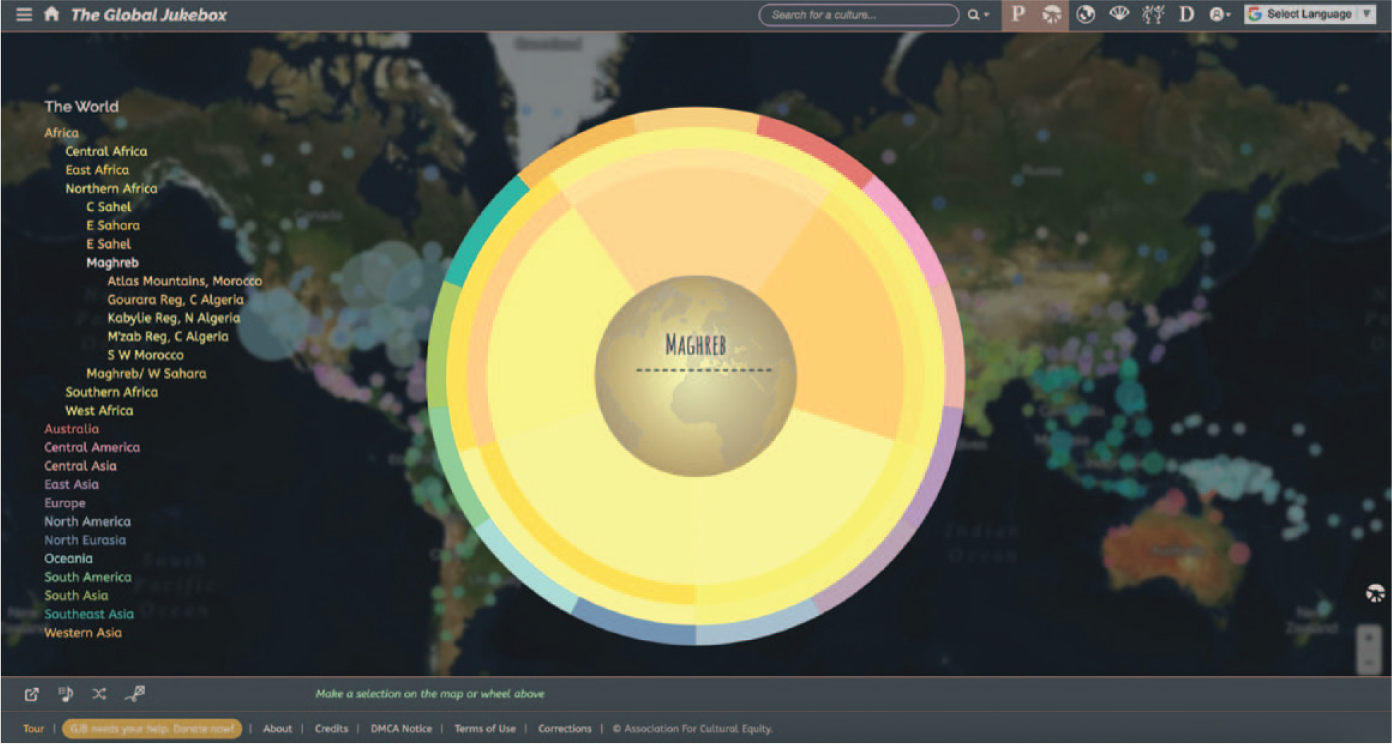
Global Jukebox color wheel.
The Global Jukebox
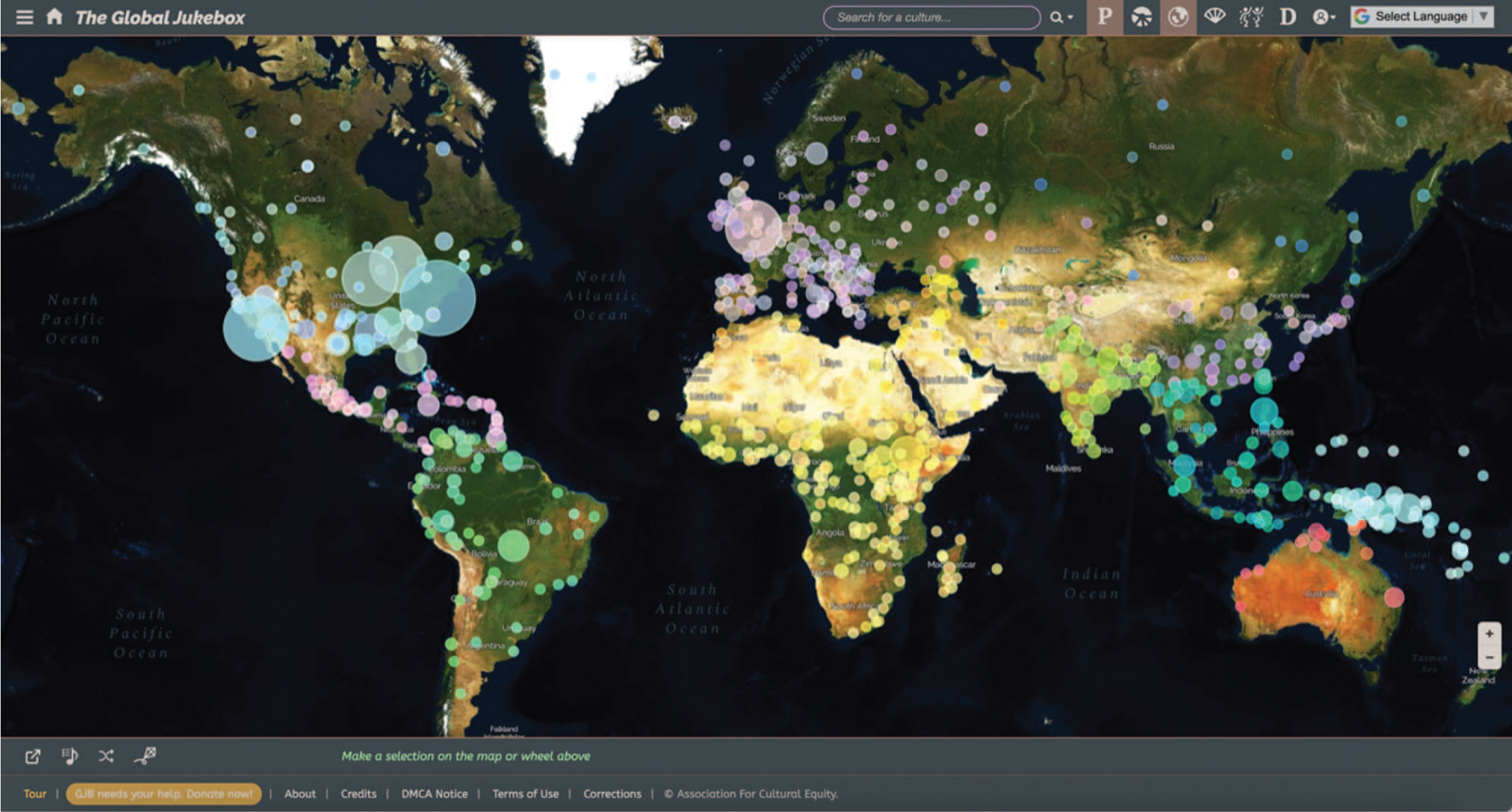
The Global Jukebox is a colorful wheel of musical cultures, offered also as a map of the musical world. It features a wide assemblage of short, recorded selections of music from the full array of continents, countries, and cultures that the world has known and is expressly intended to honor musical traditions of people’s heritages and histories. It was conceived by Alan Lomax (1915–2002), a music scholar, writer, and producer who spent his life researching and promoting unrecorded and structurally unrecognized music, dance, and oral traditions. 1 Based on his many decades of research in the expressive folk arts of music and dance, the Global Jukebox continues to grow as a public-facing component of the Association for Cultural Equity, a not-for-profit entity founded by Lomax in 1983, now under the direction of his daughter, anthropologist Anna Lomax Wood. Although the Global Jukebox is a rich source of ideas for scientists and scholars, it is also a musical treasury to be tapped for listening and learning about the world of many musical colors. All these years past the weighty research and recordings of Alan Lomax, Star-Songs and Constellations is the realization of a vision by the creators of the Global Jukebox to reach out and teach younger generations of learners something of the beauty of the world’s diverse musical cultures.
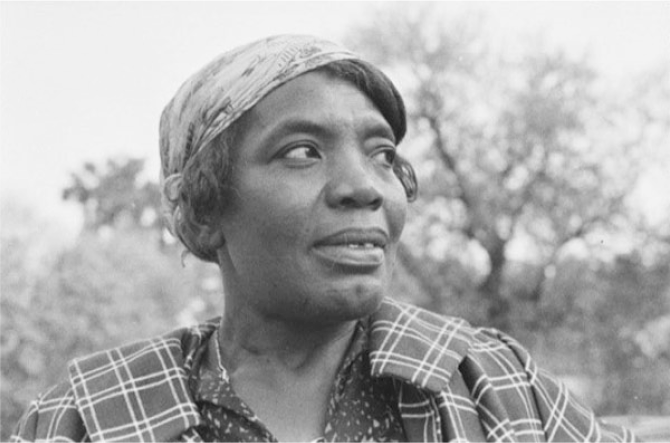
Bessie Jones (Photo by Alan Lomax).
Star-Songs and Constellations
Star-Songs and Constellations is a curricular collection of more than forty learning pathways that spring directly from recordings in the Global Jukebox. This latest educational initiative was designed by Patricia Shehan Campbell and Clayton Dahm of the University of Washington as an open-access curricular core of K–12 “lessons” that integrate facets of World Music Pedagogy (WMP) into customizable slide sets. As ethnomusicologists and educators, they have crafted sequenced lessons that address topics of music because it reflects the American story of multiple cultural communities and because music can reveal both similar and distinguishing features of people and cultures in the Americas, Africa, Asia, Europe, and the Pacific region. They have taken into account the importance of developing cultural sensitivity and human empathy through musical experience and study and have crafted the program so to open ears, minds, and hearts to the wider world of music and culture. Within the Star-Songs and Constellations program, the ideals (and recordings) of the Global Jukebox are joined together with the principles of culturally responsive teaching and the dimensions of WMP to provide a more equitable and representative musical education for all learners.
Clayton Dahm (Photo by Hannah Bleecker).

Photo of Patricia Shehan Campbell by Natalie Wallace.

Content and Organization
Designed with in-person music classes in mind but highly adaptable for online learning, “star”-songs can be engaged with à la carte or used together as a unit. A variety of “constellations” are available that group a handful of star-songs together into a larger unit, if so desired. Constellations include groupings by musical qualities (“Dynamics,” ornamentation—“Plain and Fancy,” and ensemble size—“All Alone and Altogether”), by geography (“Caribbean” and the American South—“Southern Journey”), and by pertinent qualities for music teachers (“Flexible Arrangements” and “Hello Songs and Singing Games”). Although these constellation units are rich yet not wholly captured by just a handful of songs, one can begin to connect the dots in these encounters, experiencing, for example, Caribbean music through the classic stylings of “Chan Chan” from Cuba and the Dominica jing ping ensemble heard in “Annou Hele Houle.”
Within the Star-Songs and Constellations program, a slide set is defined as a grouping of eight to ten slides that have been tailored for use on a classroom screen. Each slide set features a song or musical selection from the Global Jukebox, and every set is replete with embedded audio, images, prompts to guide teaching and learning, and suggestions for extending further the musical and cultural learning by students. Slide sets can be used to introduce or delve deeply into songs, selections, styles, and musical cultures. They are meant for brief exposures or longer lingerings, to experience just once or to be returned to for further experiences. Although already chock-full of activity, Google Slides can be added to, built on, and/or customized by teachers (or students) who may wish to add material, be it further audio, photo images, videos, or projects, that will extend and personalize the teaching/learning experience. There is an instructional manual that accompanies the slide sets, underscoring principles of orality and music as a key expression of cultural heritage. In addition to external resources, song metadata are provided whenever available to inform understandings of the contexts of these songs.
Global Jukebox map.
World Music Pedagogy, Applied
Standard practices of WMP are woven throughout the lessons. 2 In this way, the learning pathway for a star-song selection like “El Jarabe Loco,” “Kak Ivana,” “Ya Souki Hakim,” or “Early in the Mornin’” runs through multiple dimensions: attentive listening, engaged listening (participation), enactive listening (performance), creative musical activity, re-creative practice, and the integration of activities that embrace music for its cultural meaning. There are notational transcriptions for many of the selections, but because so much of the world’s folk and traditional music is learned by ear, the accent is on learning by ear instead of by note. Thus, it is through repeated listening that students develop their understanding and skills so that they can sing, play, and create new expressions within the style of the studied piece. The application of all five WMP dimensions is advisable for a more thorough going understanding of the star-songs and musical selections, and yet any one of the dimensions offers musical experience and insight that can suit the interests and needs of students of various circumstances and contexts.
An Unrestricted Program
The Star-Songs and Constellations collection is not restricted by age or grade level because the resources are easily editable and customizable so that materials can be used in elementary, secondary, or even tertiary contexts with adaptation. Whether working with learners in general music, instrumental, or choral settings, music educators will find that the resources offer possibilities for engaging more holistically with the contexts and meanings of diverse musical expressions in their classrooms. The educational materials are centered on music, and yet they may well be of use to teachers beyond music education. Teachers of social studies, foreign languages, and more might be interested in perusing the relevant contents and adapting as the case may be. For music educators, partnering with other classroom, subject, and specialist teachers may well be a way forward in strengthening the experience of students learning music in culture (and as culture).
Cultural Awareness via Music
Given that teachers are thinking deeply about curricular transformation in K–12 schools, prospects for developing intercultural understandings and global competence have never been more timely. The lessons from the Global Jukebox, whether wrapped around single star-songs or constellations of musical and cultural themes, are relevant to music programs that are heading toward greater attention to musical and cultural diversity. In the case of any archival collection of recordings, convenient answers within the rich resources are not readily available, but through thoughtful pedagogical applications, the music comes alive again and is relevant to learners of every age and experience. In the Star-Songs and Constellations program, possibilities are present for knowing music and culture even as further awarenesses can also be honed by students as relevant to ethnomusicology, the recording industry, folklore, and cultural heritage.
As a way to engage with the rich Global Jukebox archive, Star-Songs and Constellations can be adapted to fit the needs of students and teachers as well as scholars and scientists. Less of a prescriptive sequence than a set of ideas to animate teaching and learning, look to the stars and their constellations to guide inspired learning opportunities for students.
Footnotes
Notes
Patricia Shehan Campbell is the Donald E. Peterson Professor of Music and Clayton Dahm is a doctoral student in music education at the University of Washington in Seattle; they can be contacted via