







Abstract
Music educators are responsible for teaching students with an array of personality types and must be able to reach them all. Introverted or quieter students may constitute up to 50 percent of participants in a given music class or ensemble. In this article, we discuss differences between extroverted and introverted music learners and synthesize research findings into commonsense teaching strategies that support a variety of student personalities. Music educators can make small adjustments to their existing practices to ensure all students grow and thrive, even the quieter ones.
Photo of Josef Hanson by Trey Clark
Photo of Cameron Ross by Andrew Daley
Jason, a ninth-grade trumpet player, was excited about his concert band performing “My Shot” from the musical Hamilton. The arrangement featured a trumpet solo he really liked. When the day came to rehearse the song, the band director asked if anyone in the trumpet section was interested in trying the solo part. No one raised their hand. Due to his introverted nature and preference for contemplating opportunities before acting on them, Jason needed a moment to ponder whether or not to volunteer. Just as he decided to raise his hand, the director gave the part to someone else. Jason saw the opportunity (“his shot”) quickly pass him by due to his more introverted nature and reluctance to speak up. One day a few weeks later, the student who was given the solo was absent and the director asked if anyone else wanted to try it. Having had time to think it through, Jason raised his hand, and the director invited him to attempt it. He played it well and eventually earned the opportunity to perform it in concert.
How can music educators help all students participate fully in the classroom, including those who are less outgoing than their peers?
How many other students like Jason potentially miss out on opportunities due to their inward-focused personalities? Many music students are more passive, prefer to think before they speak, and do not enjoy attracting attention in large-group settings. Consequently, they often shy away from opportunities and find themselves overshadowed by their more outgoing and impulsive peers, regardless of talent or ability. These students are commonly referred to as introverts, and music educators may be surprised to discover that as many as half their students exhibit introverted personality preferences despite also demonstrating an affinity for musical performance and expressivity.
In American society, a distinct bias toward extroversion exists—what author Susan Cain dubbed “the extrovert ideal.” 1 Extroverts are the faces we usually see on television, in online entertainment, and in politics and other positions of power. The leading role in a television show or movie, the heroic captain of a sports team, and the fast-talking politician are just some of the extroverted personas elevated by media and popular culture on a daily basis. Due in part to this influence, students may believe that successful people are supposed to be outspoken and that something is wrong with those who are not. Studies on the personalities of individuals in the United States indicate that as many as half have a more inward-focused disposition than that of their peers. 2 Suffice it to say there are likely more introverted individuals around us than we may think.
In the classroom and rehearsal hall, music educators are responsible for teaching students with an array of personality types and must be able to reach them all. The music classroom can serve as an incubator for diverse personality types—a place where such differences are nurtured and celebrated. However, in many classrooms, introverted students are often overlooked in favor of the more assertive, participatory extroverts. 3 Teachers often miss engagement opportunities with quieter students, largely because the culture and daily pace of American schooling is not always kind to those who like to process their thoughts before speaking up. In the story presented earlier, what if the director was better equipped to engage students like Jason? What if a culture existed in which all students felt comfortable communicating, participating, and expressing themselves as they prefer? A teacher may be successful in creating a positive classroom environment, but a deeper commitment to understanding individual personality differences among students is also necessary if every student is to be engaged fully.
Given the importance of this topic, the purpose of this article is to provide research-informed insights and concrete strategies to help music educators better understand and reach students with a preference for introversion. After discussing foundations and terminology, we turn our focus to musicians’ personality tendencies and stereotypes before presenting implications for teaching practice. Throughout, we aim to illustrate how introverted music students can thrive in interactions with their teachers and peers.
Foundations/Terminology
The first step to improving the music learning experiences of introverted students is attaining a better grasp of key concepts and terminology. According to psychologist David Funder, personality is an individual’s “characteristic patterns of thought, emotion, and behavior, together with the psychological mechanisms (hidden or not) behind those patterns.” 4 A student’s personality can strongly influence their success in school both in terms of academic achievement and social development. 5 Psychoanalyst Carl Jung first popularized the terms introverted and extroverted in the early twentieth century as part of his seminal research on personality types. 6 An introvert is “an individual whose conscious and unconscious attention and attitude is oriented toward their internal world.” 7 In educational contexts, introverted students often prefer to process information inwardly, work alone, and take time to formulate their responses and track their progress. Conversely, an extrovert is “predominantly engaged with the external world and its objects.” 8 Extroverted students are more likely to think aloud or be outspoken, enjoy attention and public validation, and tend to seek active collaboration and even conflict. Table 1 displays common traits of introverts and extroverts, which are not necessarily mutually exclusive.
Common Traits of Introverts and Extroverts
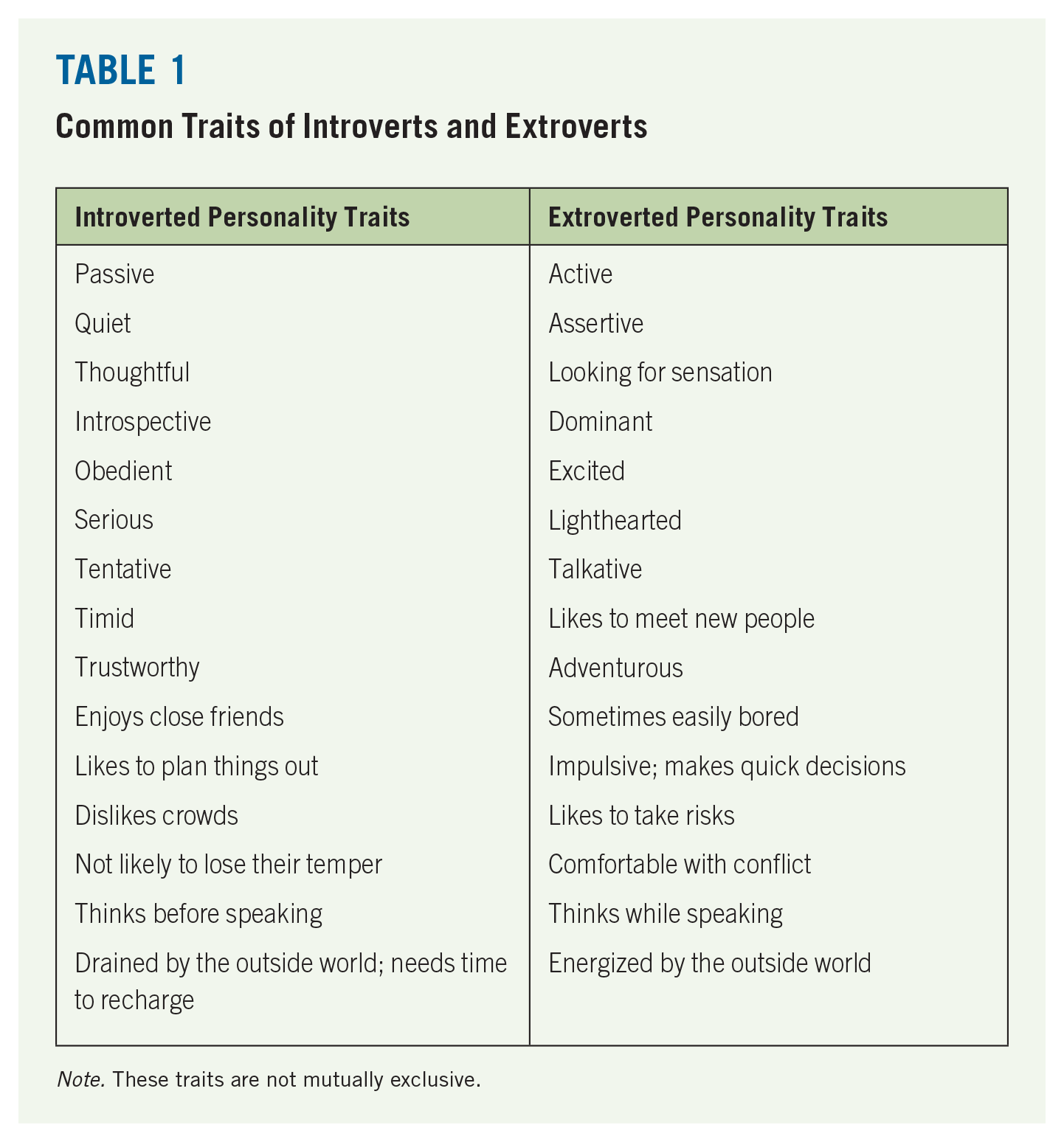
Note. These traits are not mutually exclusive.
Jung’s central idea was that introverted and extroverted aspects of personality exist on a continuum within all people, with differences manifesting based on the extent to which an individual prefers to focus their energies on the inner versus outer world. This view differed from historical notions of introversion as a disorder or deficiency. According to Jung and those he influenced (including Isabel Briggs Myers, cocreator of the famed Myers-Briggs personality tests), strong tendencies toward introversion or extroversion are common and healthy variations in personality style. 9 Additionally, a few researchers have used the term ambivert to describe a personality type squarely in the middle of the introvert/extrovert continuum, but the idea has not yet achieved widespread acceptance within the scientific community. 10
Although it is common to hear introverted students referred to as “shy,” there is an important distinction to be made. Introversion reflects a preference for how to engage with the world around oneself, whereas shyness is defined as a form of social anxiety that is rooted in fear. According to researchers Marian Condon and Lisa Ruth-Sahd, shyness “is a painful trait that can inhibit social interaction and the public demonstration of competencies.” 11 An introverted music student might prefer to limit social interaction during a rehearsal break; a shy student would fear the same situation due to a perceived risk of social disapproval and the feelings of anxiety that accompany it. In short, shyness does not offer much in the way of benefits and is associated with a range of negative outcomes such as avoidance, anxiety, depression, poor academic performance, and even physiological responses such as sweating and dizziness. 12 To be sure, this degree of shyness is a relatively rare occurrence; in contrast, some experts estimate that upward of 50 percent of the general population may overtly or more discreetly hold a proclivity toward introversion—a preference for a more inward orientation. 13 In fact, many successful leaders, changemakers, and musicians identified as introverts, including Abraham Lincoln, Rosa Parks, Frédéric Chopin, and Jimi Hendrix. 14
What factors contribute to an increased likelihood of an introverted personality preference in a student? First, it is important to note that physical, cognitive, or social-emotional challenges that affect a student’s ability to communicate and interact are not indicators of introversion. 15 After all, personality types like extroversion or introversion are based on preference, and students who experience difficulty communicating due to a physiological or psychological issue—such as students with autism—are not exerting a preference. Education researchers James C. McCroskey and Virginia P. Richmond identified four potential sources of true introversion. 16 Heredity likely plays a role and may well be the strongest determinant. Childhood reinforcement is another source, especially for students who grow up in authoritarian households where they are expected to be “seen but not heard.” Later-born children in large families may tend to be more introverted, as may children brought up in an ethnic or cultural context that does not place a premium on assertive verbal expression the way many North American cultures do. Of course, differences in communication development might also be at the root of introversion in students. McCroskey and Richmond remind us that “not all children develop the facility for language and communication at the same rate”—indeed, some children may have discovered that staying relatively silent avoids embarrassing communication errors and earns praise for compliance from teachers at school. 17 Last, modeling may be a considerable factor in a student’s preference for introverted or extroverted behavior. A child emulates the communication patterns of their parents, family members, and friends. If those people are especially quiet (or boisterous), it makes sense that the child will imitate that behavior. Other studies indicate brain differences as the root cause; introverts tend to use the frontal lobes of their brains more frequently than extroverts, who demonstrate more neural activity in the temporal lobes. 18
Historically, teachers have tended to show a bias toward more active, talkative, and otherwise extroverted students. Researcher Robert J. Coplan described this bias in stark terms: Whoever designed the context of the modern classroom was certainly not thinking of the shy or quiet students. With often-crowded, high-stimulation rooms and a focus on oral performance, the modern classroom is the quiet student’s worst nightmare. If a teacher asks a question and [a quiet] student doesn’t answer right away, the most common thing is the teacher doesn’t have time to sit and wait, but has to go on to someone else, and in the back of their head might think that [the] student is not as intelligent or didn’t do the homework.
19
Because of this common bias, many introverted students feel they need to “fake” a more extroverted manner in order to survive and excel in American schools. Introverted/extroverted personality distinctions cannot always be determined based on how students present; indeed, many introverts have become skilled at presenting as extroverted in educational or social situations as circumstances demand, only to revert to their true selves afterward. Often, systems of schooling in Western culture approach quiet or more inward students from a deficit perspective. The fact is, although oral communication is important to many aspects of personal and professional success, there is no credible link between a person’s preference for extroversion and their overall intelligence. 20 On the contrary, the opposite has been found to be true regarding academic achievement: Introverted students tend to slightly outperform their extroverted peers in high school and college. 21 Therefore, it is important for all teachers—but especially music educators, who tend to work with larger groups of students in time-constrained scenarios where efficiency is prized—to examine their biases and avoid practices that could disadvantage quieter students.
Personality Types
A wide spectrum of personality types can be found among musicians. Music education researchers have attempted to separate fact from fiction regarding many of the personality tendencies and stereotypes associated with student musicians and ensembles. Conductor and educator Christin Reardon MacLellan reviewed studies that used the Myers-Briggs Type Indicator to measure personality type preferences among high school band, string orchestra, and choir students. 22 In these studies, student personality preferences were analyzed within the four Myers-Briggs dichotomies: Extroversion–Introversion, Sensing–Intuition, Thinking–Feeling, and Judging–Perceiving. On the whole, findings indicated that students across ensemble types tended to prefer extroversion over introversion (but only slightly), intuition over sensing, feeling over thinking, and perceiving over judging. Although it is important to remember that preferences for introversion and extroversion can vary in any type of ensemble depending on context and membership, MacLellan found that choir and orchestra students in particular identified more strongly with certain personality types. Orchestra students leaned more toward introversion, a finding also reported years earlier in a study of student string players. 23 Choir students were more likely to be extroverted, echoing previous research findings that showed strong preferences for extroversion among choir members due in part to the ensemble’s focus on group interaction, communication, friendship, and belonging. 24 Clearly, it is imperative that music educators develop instructional, performance, and assessment approaches that accommodate different personality preferences.
That being said, some studies have indicated that neither instrument nor ensemble choice associates consistently with personality type. One study of German orchestra members revealed few personality differences among members of different sections, noting only that members of string sections tended to be more conscientious. 25 Using the Junior Eysenck Personality Questionnaire, music education researchers Robert Cutietta and Peter McAllister determined that there was little relationship between personality type and continuation of instrumental study among grades 7 through 12 band and orchestra students. 26 Another study showed that three personality tendencies—extroversion, agreeableness, and openness—manifested uniformly among vocal and instrumental students who participated in a study of the “Big Five” personality traits. 27 Researchers in Croatia found no significant differences in personality traits among classical and heavy metal musicians, although both groups demonstrated greater extroversion, agreeableness, and intellect than nonmusicians. 28 Although broad-based personality associations with instrument choice or ensemble membership seem inconclusive at best, teachers will find that each music class or ensemble features a unique personality dynamic that needs to be explored and understood first, before adaptations can be developed.
Stereotypes and misinformation regarding musicians’ personalities can originate among musicians themselves, often within the classes and ensembles music educators lead every day. An interesting group of studies sheds light on the perceptions musicians have of one another. In John Booth Davies’s seminal study of perceptions held by orchestra musicians, string players viewed brass players as extroverted and uncultivated, and brass players viewed string players as oversensitive, touchy, and neurotic. 29 Psychology researchers R. Scott Builione and Jack Lipton conducted research on woodwind ensemble, concert band, and string orchestra students’ perceptions of their musician peers. They found that woodwind players were viewed by other ensemble members as timid, brass and percussion players as loud and extroverted, and strings as intelligent and serious. 30 A similar study of popular musicians found that pop and rock band members viewed vocalists as the most extroverted and disagreeable and bass players as more introverted and emotionally stable and that an in-group bias existed across the board in which judgments of those who played the same instrument or held the same position in a band were consistently more favorable. 31 Music educators should seek ways to inhibit these stereotypes from influencing teaching and learning by openly discussing erroneous assumptions and providing examples that dispel this type of musical personality typecasting.
Implications for Educators
The reality is that all of us teach a significant number of students with preferences for introversion in our classes and ensembles every day. However, too often we end up making planning decisions and structuring our day-to-day teaching activities with the more extroverted students in mind because they are the learners who provide us with immediate feedback in response to our teaching ideas and are often more likely to stray off task. 32 To remedy this bias toward extroversion and honor the preferences of all learners, consider the following simple modifications to create a climate more accepting of quieter students:
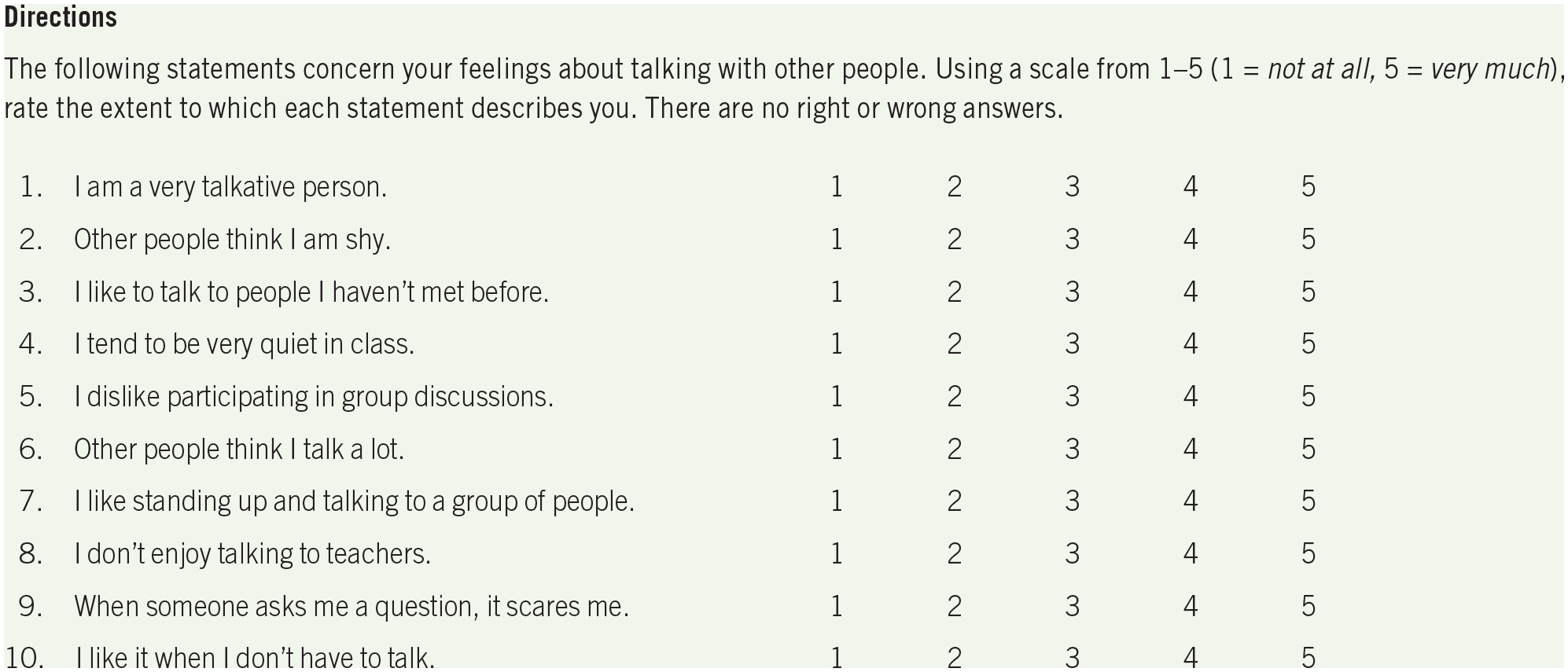
An Informal Self-Assessment of Preferences for Introversion/Extroversion, Intended as a Self-Reflective Activity and Conversation-Starter for Students
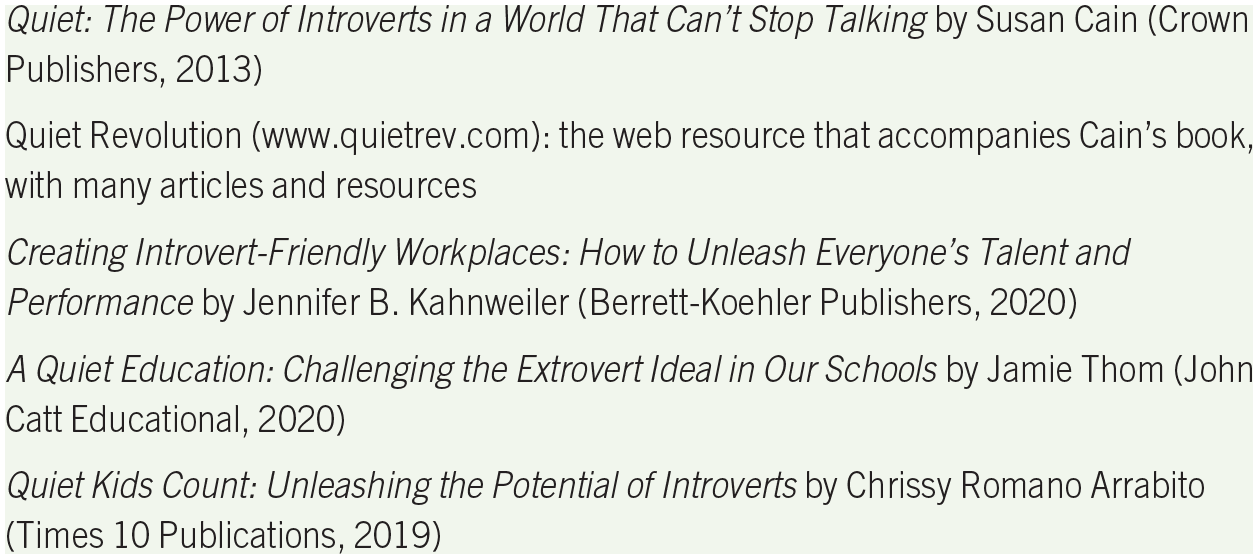
Recommended Resources on Introverted/Extroverted Personality Preferences
Maximize Learning
All students deserve a music learning environment that is comfortable, democratic, and sensitive to their needs. As education professor Nicki Monahan stated, “our goal is not to turn introverts into extroverts, or vice-versa, but to maximize learning for all students and to help them develop skills [such as] teamwork, problem solving, and interpersonal communication.” 39 Becoming attuned to music students’ varying personality preferences is essential to helping them develop as musicians, learners, and contributors to a more just world.
Footnotes

Notes
Josef Hanson is an assistant professor and coordinator of music education at the University of Memphis in Tennessee; he can be contacted at