






Abstract


Today, we find ourselves at a unique time in history when, like most things, music education and education as a whole are experiencing a period of great transition. We are likely on the precipice of what is to become the new normal for the foreseeable future. During the past few years, and especially during the worst of the pandemic, we learned many valuable lessons about what it means to be a music educator and how there are more ways that we thought possible for students to create, perform, respond, and connect to and through music. We also experienced profound joy and gratitude when we could make music together again in person, which reinforced the idea that being part of a musical community was critical to students and music educators alike. Another positive result of all we have been through is the reinforcement of the idea that music is a vital means of transforming our emotions, sense of belonging, identity, and culture.
I believe now is the time for each of us to consider what our students now and the generations to come truly need regarding an equitable and relevant music education. It is imperative we make time for introspection, and perhaps a little soul-searching, about how we are currently nurturing our students’ musical growth and what might change to make our teaching and interactions more responsive to the students who are not currently in our ensembles and music classes, thereby expanding our reach. Also, demographic shifts are happening in schools, and the teacher workforce is not representative of the students in today’s classrooms. We know students learn best when they can see themselves and their culture represented in the materials, the teacher, and the music they make. Perhaps we need to not only focus on who is in our music classes and ensembles today but also consider who will be in those spaces tomorrow. After all, we know that tomorrow is only a day away.
It was with this optimistic yet reflective vision for the future that I chose
The thoughts that I have presented so far in this article are not new. During the Forging the Future of Music Education Symposium, Dr. Marie McCarthy from the University of Michigan eloquently shared perspectives from several moments in our association’s history—such as the Tanglewood Symposium and the publication of the Housewright Declaration—that outlined many of same challenges and goals that have been discussed for decades. The needs are well known, but a path to creating lasting change, especially in today’s educational climate, is what is needed. To that end, the Blueprint for Strengthening the Music Teacher Profession was also shared during the Forging the Future Symposium. This report was the result of two and a half years of research that examined (1) the systemic barriers for potential preservice music educators to enter the profession by gaining admittance to a music education program, (2) the challenges music education majors face during their degree programs, and (3) the need for support and mentoring during the critical first five years for novice music educators in the profession. The project, led by Dr. Deborah A. Confredo, Dr. Cecil L. Adderley, and Dr. Carlos R. Abril, examined the practices at twenty-four colleges and universities from across the United States (eight of which were Minority-Serving Institutions), by conducting extensive interviews with music education faculty about their perspectives on the challenges and mitigation strategies for each of the three focus areas. Input was also gathered from the NAfME and state MEA leadership representing PK–12 music educators, program leaders, and higher education faculty during the 2022 National Assembly. The result is a very robust report that outlines many ways to widen the pathways into and through the music teaching profession. The report calls for many constituencies to be involved in the work, including, but not limited to, practicing PK–12 music educators, music program leaders, administrators, parents, legislators, music and arts education partner organizations, and college and university music faculty and administration. Literally everyone who has a vested interest in music education has a place in the Blueprint. I strongly encourage everyone to read the Blueprint (or at least the Executive Summary) and subsequently become involved in the transformational work that is outlined for all of us.
During my opening remarks at the National Assembly, I reported that the state of music education is strong and likewise the state of the National Association for Music Education is strong. I also recognize there are many challenges, barriers, and realities our profession faces, some of which were included in this article. However, there is more work being done now at the national level and by the state music education associations to support music educators than ever before. Our advocacy and public policy efforts at the state and federal levels continue to garner new relationships and build support for music as a well-rounded subject, and our research community continues to provide evidence and data that support music’s place in the school curriculum. As a result of these efforts, and many more, membership continues to grow, and collectively we are doing all we can to best serve the profession. NAfME’s new Strategic Plan (bit.ly/StrategicPlanNAfME) and the Blueprint (bit.ly/NAfMEMTPI) point to an even brighter future where every student can develop their musical and creative self across multiple music literacies. As adults, these students may have the opportunity to build more musically minded communities and contribute to the creative economy, which in turn continues the cycle of support for music in schools (see Figure 1). This reality may not be far off if together we strive toward a musically vibrant tomorrow.
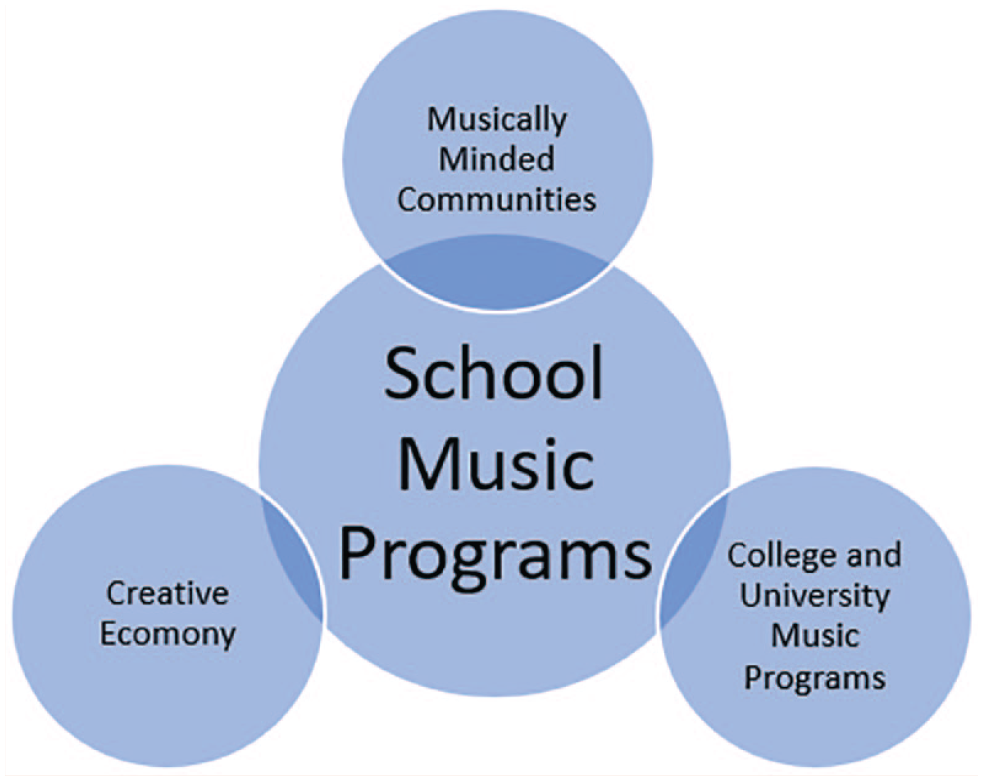
Circles of Influence for School Music Programs