







Abstract
One way to build a comprehensive, inclusive, and equitable music education is through the inclusion of popular music in curricula. However, it can be challenging for teachers to bring popular music into the classroom for many reasons. We suggest that since many teachers are educated in the Orff Schulwerk approach, this can be one way to teach popular music in the classroom. In this article, we discuss the similarities between Orff Schulwerk and popular music education, share our rationale for creating a weeklong course on popular music and Orff, describe how it was structured, and share resources. We invite teachers to build relationships with their students, talk to students about what and who they are listening to, start with activities that are comfortable for them and their students, and know that music standards can easily be achieved through teaching and learning about popular music.
Keywords
Photo of David Dockan and Martina Vasil by David Miller
Music educators in the United States have recently made great strides in providing a more comprehensive, inclusive, and equitable music education to students through the inclusion of popular music in curricula. 1 This has been largely through the efforts of innovative teachers and nonprofit organizations such as Music Will, 2 formerly known as Little Kids Rock. However, many teachers still struggle to teach popular music for many reasons: their own and society’s negative views on popular music, uncertainty about how to integrate popular music and facilitate the learning processes, limited resources such as time and professional development opportunities, and institutional constraints. 3 At the elementary level, there seem to be fewer resources for bringing popular music into the classroom, and teachers need support in gaining skills and knowledge on how to teach popular music.
One way to easily bring popular music into the classroom is through Orff Schulwerk and popular music education (PME). This is because there are many similarities between the ways of learning and teaching in both Orff Schulwerk and PME. Orff Schulwerk is an elemental approach to music education where students actively make and create music through speaking, singing, moving, and playing instruments (i.e., those commonly found in elementary music classrooms, such as xylophones, hand drums, metallophones, bass bars, and recorders). 4 Elemental means that the music consists of simple sequential structures, such as short, melodic/rhythmic ostinati and simple musical forms (e.g., AB or rondo) that are inextricably connected to movement and speech. 5 This learning empowers students to be creators and stakeholders in the classroom.
PME is the range of approaches to teaching and learning popular music, 6 where music is learned informally. The definition of informal learning used here is Green’s, in which (1) music is learned aurally, through listening and imitating recordings; (2) learning takes place in friendship groups; (3) skills and knowledge are acquired through self-study or peer teaching; (4) learning is integrated (learners are performers, composers, improvisers, and listeners, with an emphasis on originating music); and (5) learners choose the music themselves. In contrast, when music is learned formally, instruction is typically teacher led, and curricula are more structured with clearly defined learning objectives that afford less flexibility and spontaneity. 7 Formal music instruction is also usually more prescriptive as opposed to democratic. Both informal and formal learning can be found within music classrooms, 8 so it is helpful not to think of them as a dichotomy but along a continuum. 9
Furthermore, it makes sense to bring popular music into the classroom through Orff Schulwerk because many elementary music teachers use this approach. Almost 3,000 elementary music teachers are educated in it through the American Orff-Schulwerk Association (AOSA). 10 This represents only the teachers registered for and formally taught through AOSA. The number of individuals exposed to Orff Schulwerk is greater because of its wide inclusion in teacher preparation programs and in-service music teacher professional development opportunities provided in every state by local Orff Schulwerk chapters.
There is a need for professional development and resources to help elementary music teachers bring popular music into the classroom so they can provide a more comprehensive, inclusive, and equitable music education for all students. In this article, we describe how Orff Schulwerk and PME are pedagogically similar and easy to implement in the classroom, discuss why and how we created a course on Orff Schulwerk and PME, and share lesson ideas and resources.
Orff Schulwerk and PME
Understanding the overlap in pedagogies used in Orff Schulwerk and PME can make it easier for elementary music teachers to implement both approaches when bringing popular music into curricula. The first shared characteristic is that music is learned aurally, through listening and imitating a model. The model can be the teacher, a student, or a recording/video of a song. For listening and imitation to be successful with a recording, it often needs to be transposed into a different key to fall in a safe range for children’s voices or to work on pitched instruments (i.e., xylophones, glockenspiels, and metallophones). Often, only a portion of the recording is needed for imitation, so teachers need to clip and loop the audio file. Transposition, clipping, and looping can be done with the Google Chrome extension Transpose or through other software such as Soundtrap or GarageBand.
The emphasis on aural music literacy highlights that both PME and Orff Schulwerk focus on making music rather than reading music. “Orff argued that the introduction of musical notation be postponed until the need arose for a symbol system to notate children’s original music.” 11 Forms of notation other than traditional staff notation, such as iconic notation or tablature, are often used in both Orff Schulwerk and PME. Many popular musicians never have the need to read standard notation. A well-known example of a popular musician who cannot read traditional staff notation is the English songwriter and performer Paul McCartney, best known for his work with the Beatles.
Another shared characteristic of Orff Schulwerk and PME is that learning takes place in friendship groups. When a popular music group is started, it is likely because the members know each other and get along (although history shows that the longevity of these groups varies wildly). There is a lot of group work in Orff Schulwerk classrooms due to the focus on composition. When teachers allow students to work in self-selected peer groups, they tend to take more risks and be more engaged and productive in their work. 12 However, elementary teachers may consider a balance between teacher-selected groups and learner-selected groups to avoid having certain students in the classroom consistently left out.
In PME and Orff Schulwerk, skills and knowledge are acquired through self-study or peer teaching. Frazee, a well-respected practitioner of Orff Schulwerk and author, stated that teachers who use Orff Schulwerk include time for student reflection and music analysis during class; students are asked to reflect on their performances or compositions and make critical decisions about what musical steps to take next. 13 Reflection on composition is an important time for students to engage in self-study, talk with peers, and make choices in the classroom. 14 In PME, much learning is student-directed as students work through recreating existing songs as covers or composing original music. A group member may work on a riff at home and bring it back to share with the group, or group members may work in pairs or as a whole group to refine a song. 15 Elementary music teachers can allow more time for peer and self-study by building in “think–pair–share” moments in class, where students share their work with each other, allow time for group work and reflection on compositions, and provide more self-directed time in class. For example, when learning a short melody on a soprano xylophone, the teacher may say, “Take 30 seconds, and see if you can figure out the melody on your own.”
In both Orff Schulwerk and PME, student learning is integrated: learners are performers, composers, improvisers, and listeners, with an emphasis on creating music through musical exploration and co-constructing content. In both approaches, teachers tend to act more as facilitators of the music-making process, inviting students to contribute ideas and make musical decisions rather than conducting students or directing learning each step of the way. 16 Teachers step in when students need help and know when to hold back to let students solve their own musical problems. 17
Ideally, in both Orff Schulwerk and PME, learners choose the music themselves. German musician and music educator Carl Orff advocated for the use of music with which children are familiar in the classroom. 18 Orff teacher Brigitte Warner similarly thought that first using music familiar to children was the best way to connect them later with unfamiliar music. 19 An emerita professor of music education at the University College London Institute of Education, Lucy Green discovered that this was at the root of how popular musicians learn and extended her examination in classrooms in the United Kingdom. 20 However, student-chosen music is not always used in classrooms due to time restraints, the age of the students, and the teacher’s sense of control. 21 It can be difficult to release some control of the classroom repertoire due to concerns about musical content and lyrics. Surveying students and parents to learn about preferred music, paying attention to “kid culture” (e.g., being aware of the music in current children’s movies, shows, and video games), and talking to students during recess, lunch, and car duty can help elementary music teachers bring more student-chosen music into curricula. When the process becomes more democratic and students aid in the selection of repertoire, this creates more of a student-centered classroom.
Beyond both approaches using informal learning, both PME and Orff Schulwerk center on inclusivity in the classroom. Orff believed that every child is musical and thought that music education should include children of all musical abilities. 22 This is evident in Orff Schulwerk, as the instruments typically used are easy to play, and the emphasis on creativity allows everyone to succeed musically within their capacity. 23 The same occurs in classrooms using PME. Using popular or student-preferred music helps create an environment that validates and includes more students’ musical identities. 24 Validating student-preferred music redefines what is considered quality music to include the vernacular music of today. 25 By validating musical identities and musical preferences, teachers who use popular music are more inclusive; researchers have reported higher participation among nonwhite students, students with low socioeconomic backgrounds, and students not currently engaged in school music when schools offer popular music programs. 26
Last, both approaches provide ample opportunities for social-emotional growth. Musical exploration is central to the Orff Schulwerk and is used to help children develop both musically and emotionally. 27 PME, particularly through songwriting, also allows time for students to develop and process their emotions in the classroom. 28 Both approaches promote relationship skills, self-awareness, and social awareness through collaboration.
Rationale for Creating a Course on Orff Schulwerk and Popular Music
We wanted to create a course on teaching popular music to help elementary music teachers provide a comprehensive, inclusive, and equitable music education. This can be described as culturally responsive pedagogy:
an approach to teaching that incorporates attributes and characteristics of, as well as knowledge from, students’ cultural background into instructional strategies and course content to improve their academic achievement. A primary aim of culturally responsive pedagogy is to create learning environments that allow students to use cultural elements, cultural capital, and other recognizable knowledge from their experiences to learn new content and information to enhance their schooling experience and academic success.
29
Culturally responsive pedagogy has three pillars: student learning, cultural competence, and critical consciousness. Orff Schulwerk and PME support these three pillars. First, student learning is enhanced when the music they prefer (often popular music) is included in curricula because students are more interested in the material. 30 Further, students’ identities are attached to their musical preferences. 31 Students may lose interest in school music if their musical identity is labeled as flawed or disliked by the teacher but may be more invested when their preferences are validated. 32 Orff Schulwerk and PME both highlight students being successful quickly, which helps bolster student learning and engagement. Next, cultural competence occurs when teachers create space for students of different cultures to be themselves and use students’ cultural information as a tool for learning. 33 When teachers use student-preferred music (popular music), this allows students to draw on previous knowledge and scaffold their learning from what they already know while maintaining cultural integrity. 34 Orff Schulwerk and PME promote this cultural competence by allowing students to work in collaborative environment where they are sharing their experiences and expertise while the teacher is acting more as a facilitator. Last, teachers address critical consciousness when teaching popular music. This happens when they allow students to critique the social norms evident in music and students become critically conscious of the world they are navigating. Critical consciousness can be seen through the topics brought up in the music or the responses students have to the music. 35
When teachers bring popular music to the elementary classroom, their performance and teaching processes can sometimes reflect the dominant power structures of Western European classical music ensembles due to the training that most teachers have had throughout their education. This style of teaching and learning tends to be teacher-centered (formal instruction) and has a rigid pedagogy (formal learning). As previously mentioned, both Orff Schulwerk and PME use informal learning and center students as stakeholders and creators of their learning. Teaching popular music through PME and Orff Schulwerk helps direct the focus toward the students and creates an experience closer to how popular musicians learn. 36 This shift of power and the use of students’ preferred music as repertoire reflect the tenets of culturally relevant teaching.
Description of the Course
We designed a five-day course, Orff Schulwerk and Popular Music, based on the structure of the AOSA teacher education courses: 75 minutes for recorder, 75 minutes for movement, and 225 minutes (about four hours) of basic/pedagogy daily (AOSA 2022). We looked at the AOSA curricular goals for the basic/pedagogy, recorder, and movement classes and adjusted the content by integrating popular music and media and replacing the recorder with the ukulele.
Basic/Pedagogy
In the basic/pedagogy classes, we focused on speech, singing, unpitched and body percussion, pitched percussion, orchestration and composition, and pedagogy. The repertoire for speech and singing was popular music and media. The selection for this material was partially from experience with our own students and from the interests of the participants in the course. This allowed the teachers to experience a process of democratizing the classroom. We used unpitched, pitched, and body percussion to explore the different beats, bass lines, riffs, and melodies in popular music. This was done through an Orff approach of kinesthetically learning the notes through movements, body percussion, and singing, then transferring that to the instruments through listening and imitating the specific part from a prerecorded track. For orchestration and composition, we used digital audio workstations, specifically Soundtrap, to create resources for informal music learning. Our pedagogy focused on informal music learning and how it works with learning and teaching processes used in Orff Schulwerk.
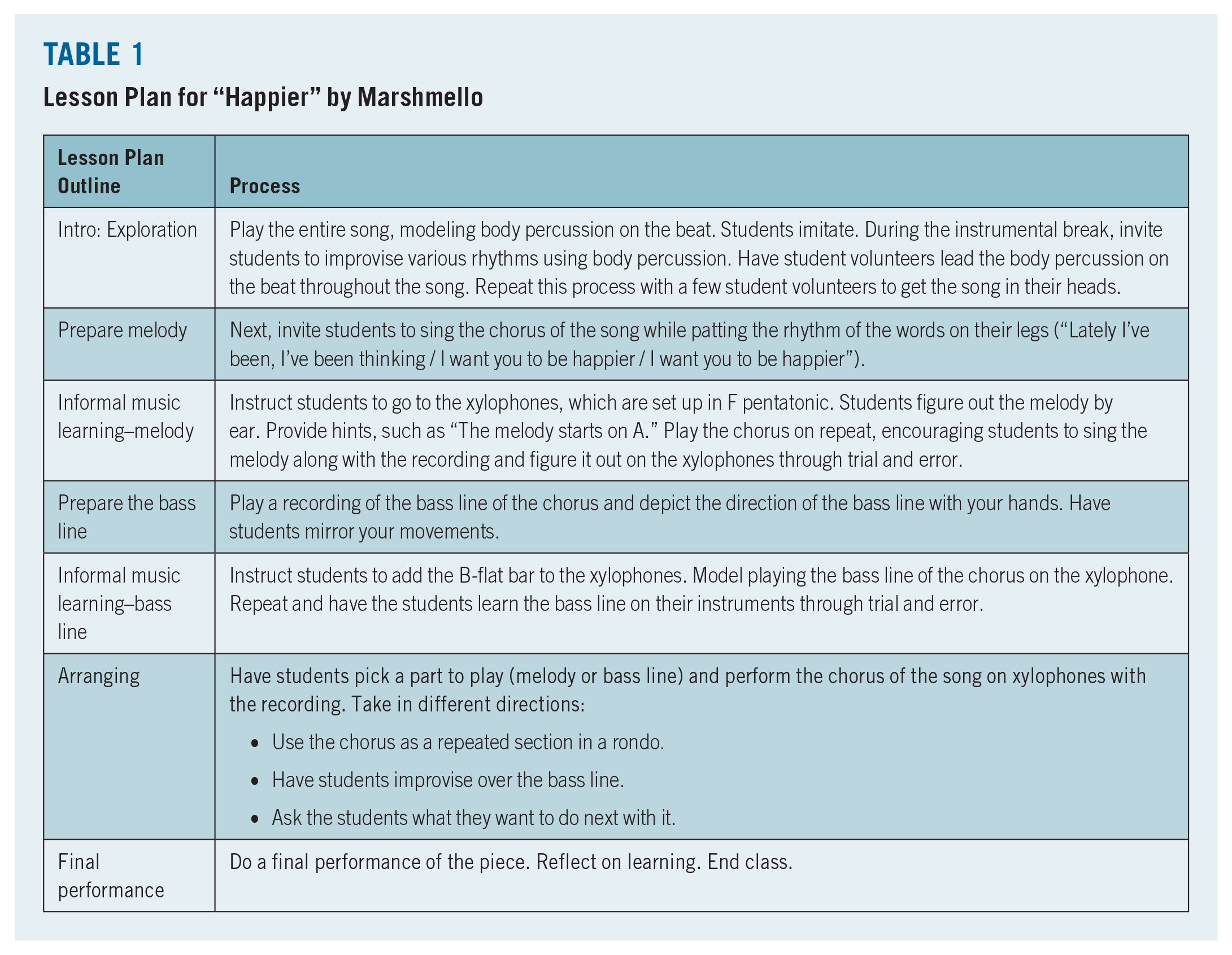
The process for building an arrangement began with us finding what students liked to listen to and sifting through to find ways to use those songs in the classroom. For the example here, we selected “Happier” by Marshmello because it was a song our K–12 students preferred and was recognizable by the teachers in our course. Next, we found ways to accompany the song with body percussion and improvisation while it played. The chorus’s melody was reviewed with speech and singing. Then through body percussion, the melody was prepared for xylophones. Instead of providing notation for the students, we present an audio clip of the chorus melody on repeat so students can learn the melody on xylophones aurally. The bass line is then learned from a similar process. Using a recorded audio clip of the bass line on repeat, the teacher prepares the students for the bass line through moving to and singing the bass line. While this creates the arrangement for the music, the true Orff portion of this “Orffestration” is allowing the students to create through arranging a form, improvising solos, and becoming stakeholders in the music creation (see Table 1).
Lesson Plan for “Happier” by Marshmello
Movement
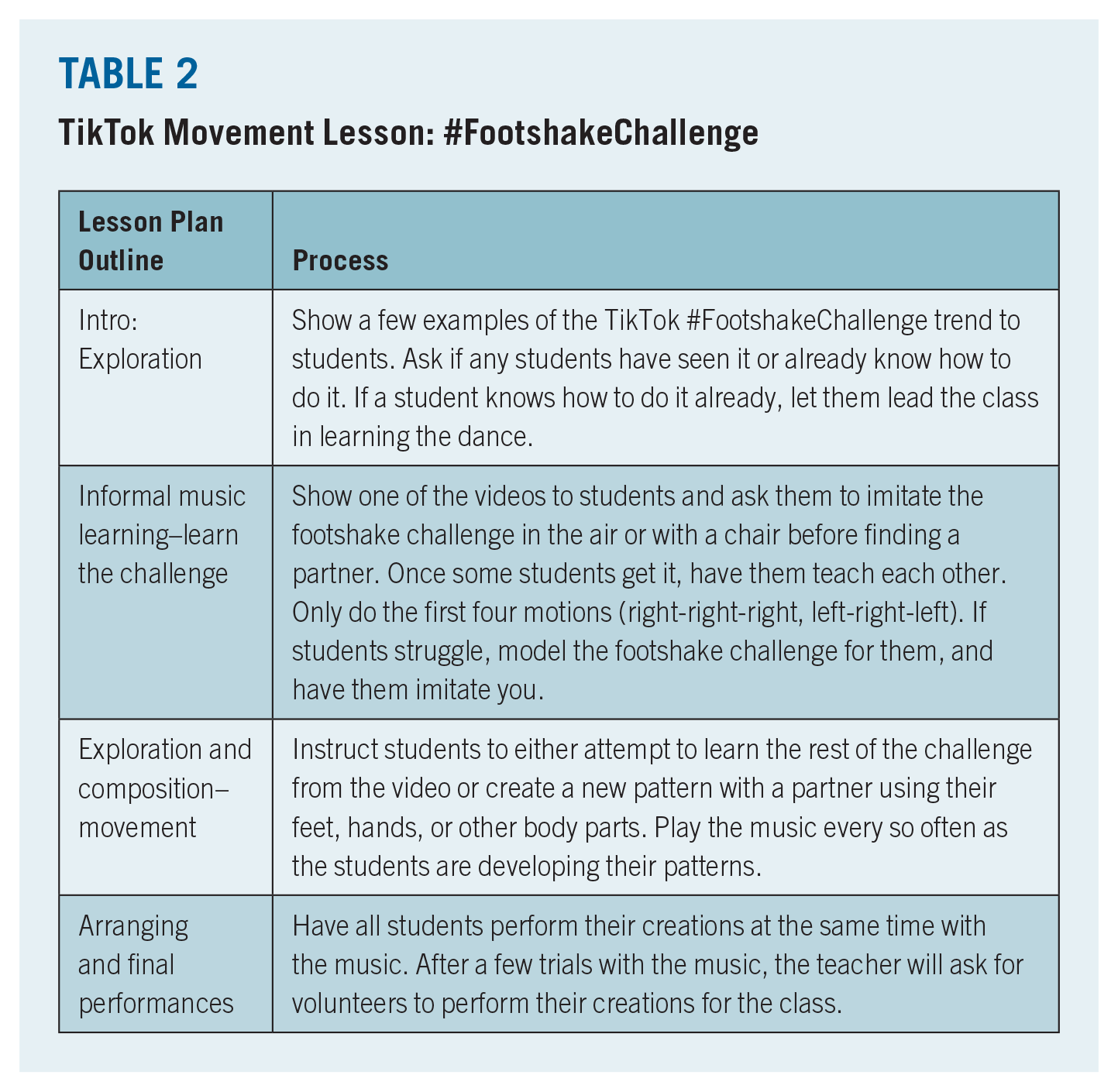
In movement classes, we used images, poetry, and music from popular media as inspirations for creative and choreographed movements. For creative movement, the teachers in our class chose gestures and movements to match words from modern poetry and to illustrate emotions evident in song lyrics. For the choreographed movement, one source of inspiration was TikTok, a social media platform where users create short videos to share with others. On this platform, users learn dances through an informal process of repetition and imitation. The teachers experienced how students learn creative and choreographed movements from TikTok and then created lessons to teach to their peers. This allowed teachers to focus on their movement awareness and pedagogy for teaching students to develop their movement abilities through a new lens of popular media. The example lesson below uses the #FootshakeChallenge from TikTok (see Table 2).
TikTok Movement Lesson: #FootshakeChallenge
Ukulele
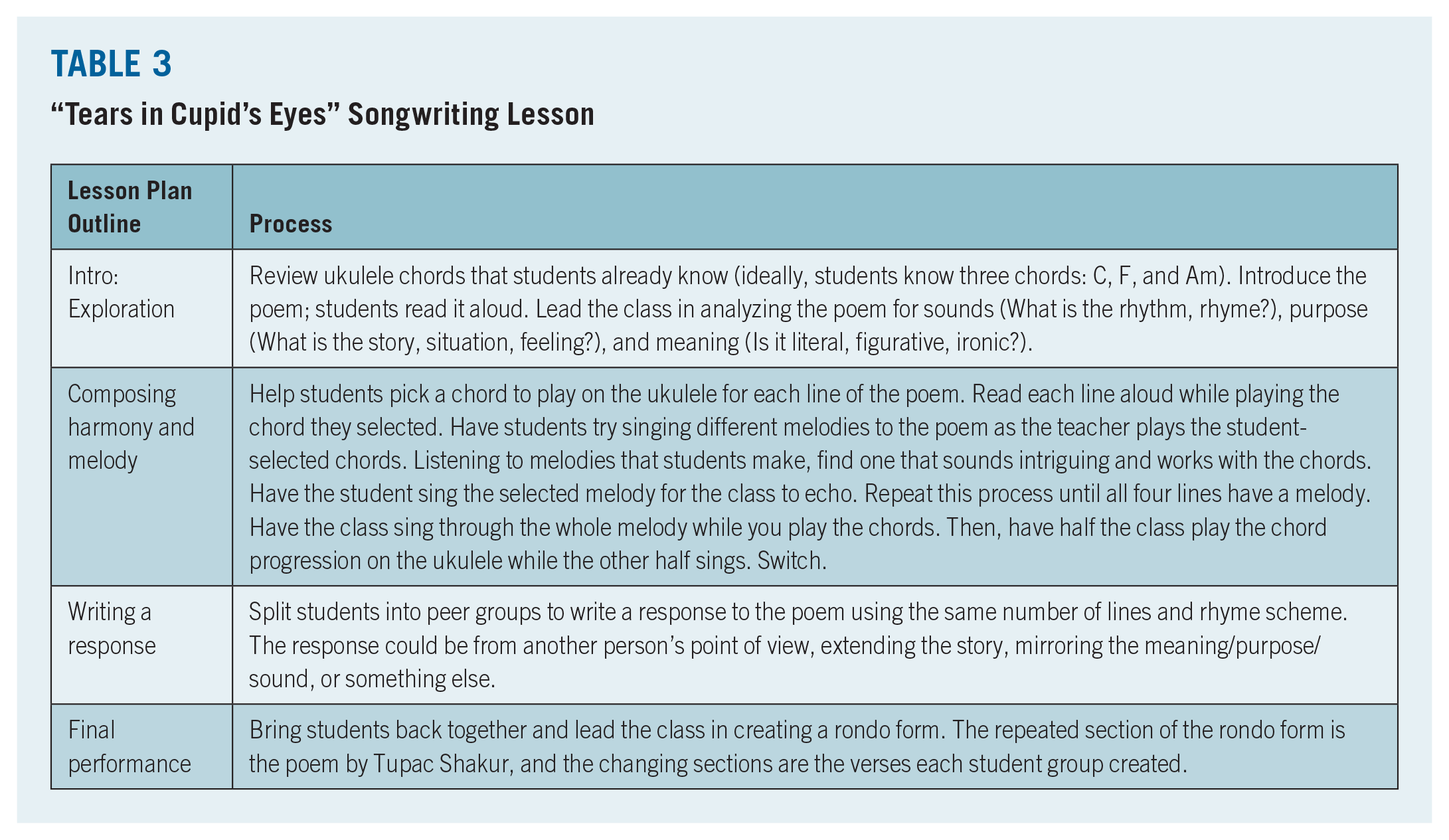
Finally, we taught the ukulele through elemental and approachable pedagogy. We introduced the ukulele as an accompaniment instrument with the C, Am, F, and G chords to both songs the teachers knew and new songs. After using the ukulele as an accompanying instrument, it was used as a melodic instrument. This started with using open strings to figure out melodies with sol–la–mi songs and progressed to playing riffs from popular songs. Learning riffs lead to tablature, a form of music notation that tells the musician which frets to depress on which string. The final use of the ukulele was for songwriting. The songwriting process included using a poem, choosing chords, creating a melody, and writing a response modeled after the poem.
Table 3 shows an example of our lesson using poetry as a stimulus for songwriting. The poem is from American rapper Tupac Shakur’s book of poetry, Rose from the Concrete, and is titled “The Tears in Cupid’s Eyes” with the subtitle “4 Jada.”
“Tears in Cupid’s Eyes” Songwriting Lesson
Suggestions for Teachers
Teaching popular music through Orff Schulwerk and PME is one way for teachers to bring student-preferred music into elementary music curricula. Teachers may consider our suggestions for best practices for bringing popular music into the classroom. First, teachers should get to know students through informal conversations, observations, or surveys of parents and the community. After learning more about students, teachers can guide student learning by highlighting student strengths and growing student weaknesses. Imagine having a student who can play a drum kit but allowing them only to play a steady beat. Now, imagine allowing that student to provide a backbeat for the class. Doing so is providing differentiated instruction for gifted and talented students and keeping students engaged; students need to actively be challenged to remain invested and to grow. 37
Second, the easiest way for teachers to choose repertoire is to talk with the students about what they are listening to. Another way to find what students are listening to is to look at TikTok trends, Billboard charts, and YouTube music. The discussion about the appropriateness of lyrics is often brought up; this is a decision teachers must make knowing their own students and community. If there is a song with offensive language, a teacher can consider using an instrumental version or a radio-edit version, or they may consider a discussion with students about what kind of music is appropriate to share in school and for their school community.
Third, teachers should start with activities that are comfortable for them and their students. From there, teachers can then try to add new ideas and pedagogies to classroom experiences. For example, if a teacher is most comfortable with moving, then they should start using popular music and media with movement activities. Teachers should also consider students’ prior knowledge and musical experiences and start with something that would also meet their comfort levels.
Fourth, teachers need to know that music standards can be easily achieved through popular music. In any music lesson, a song or piece of music is a stimulus creating a response that could become a plethora of possible musical activities: movement, body percussion, playing instruments, singing, and more. The fundamentals of music that are the focus in elementary school—steady beat, rhythm, melody—can be highlighted using students’ preferred music as the stimulus. Music rudiments can be taught with more student investment because using student-preferred music validates their musical identity.
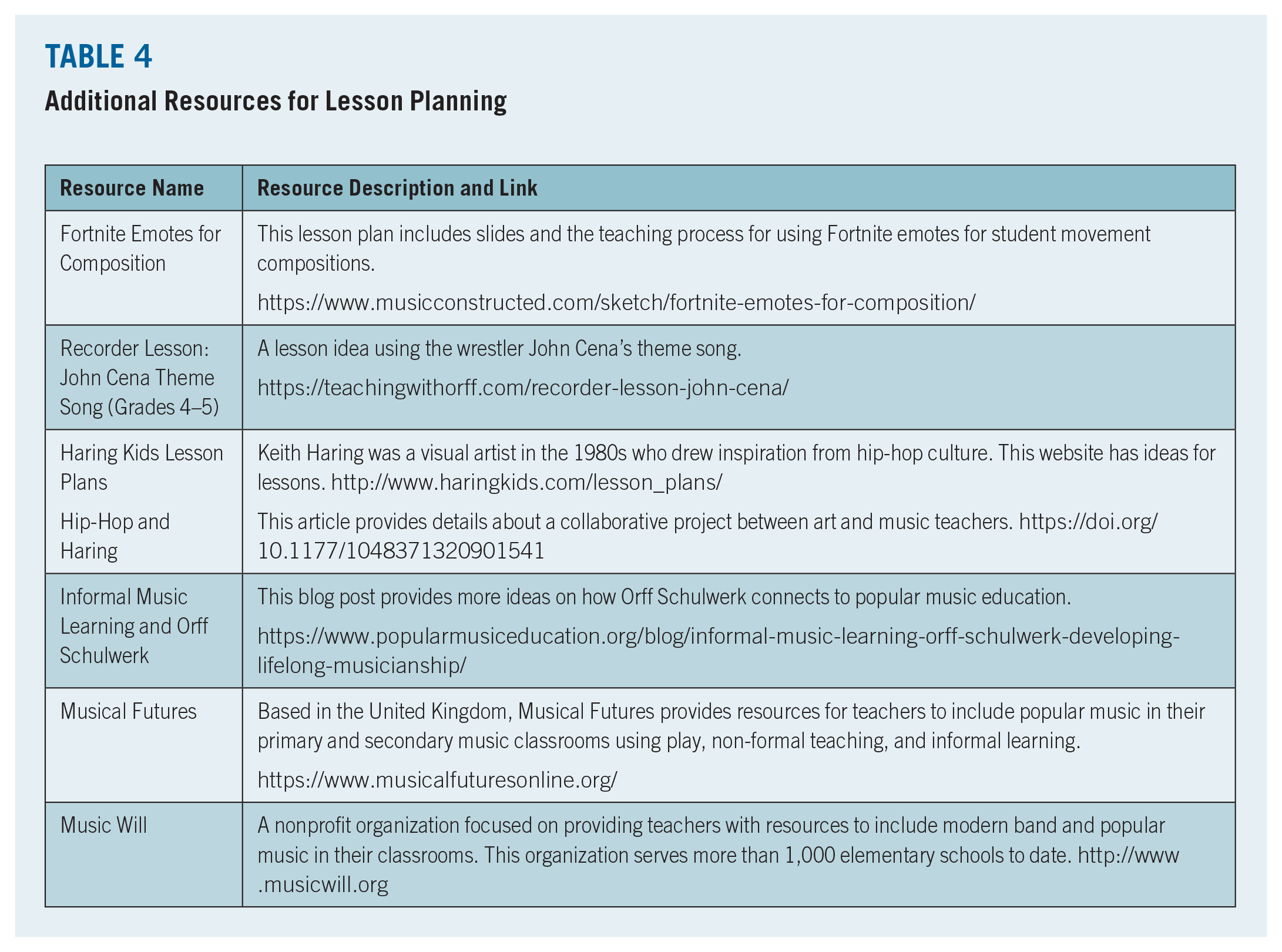
We have compiled a list of additional resources for lesson planning, including blogs, articles, and more lesson plan examples (see Table 4).
Additional Resources for Lesson Planning
Be Emboldened!
In this article, we discussed how PME and Orff Schulwerk can be used to bring popular music into the elementary music classroom and thus reflect culturally relevant teaching. Through describing our five-day course on popular music and Orff Schulwerk and offering suggestions, we hope that teachers will be emboldened to bring more student-preferred music into their classrooms. We anticipate that the resources we provided will be useful for teachers and serve as models for how lessons can be crafted with student-preferred music and student-centered pedagogies in mind. While we acknowledge that there are many ways to bring student-preferred music into the classroom, we invite you to try blending PME and Orff Schulwerk.
Footnotes

Notes
Martina Vasil is an associate professor of music education at the University of Kentucky in Lexington. David Dockan is a doctoral student in music education at the same institution. They can be contacted at