






Abstract
If official figures overstated the growth of banking output in the UK in the recent boom, does this mean that GDP growth was overstated too? The answer is no. It is truer to say that if banking output was overstated then the output of some other industry or industries must have been understated, leaving GDP relatively unaffected. The reason is that the Office for National Statistics measures the real growth of GDP primarily from the expenditure side. And from the expenditure side most of the problematic part of banking output drops out since it constitutes intermediate consumption not final expenditure. Consequently, the effect of any mismeasurement of banking output on GDP growth in the boom of 2000–7 is likely to have been small; GDP growth might have been overstated by about 0.1 per cent per annum.
1. Introduction
It is frequently argued that the output of the banking industry was overstated during the boom. Bankers were selling financial products of low or no social value (‘toxic rubbish’) to ignorant or greedy clients. So if banking output were measured correctly it would be seen to have grown more slowly than the official figures from the Office for National Statistics (ONS) suggests. Consequently, since banking is a large industry in the UK, the growth of real GDP must have been overstated too. If this argument is correct, it would have serious consequences, not just for our view of the recent past but also for our view of the likely future. For if British growth in the run-up to the crisis was slower than we originally thought, then our view of the likely future path of GDP should be correspondingly more pessimistic, even when the economy has fully recovered from the Great Recession which began in 2008.
The purpose of this article is to show that this argument is wrong. Even if the premise is correct (‘Banking output has been overstated’), the conclusion (‘GDP growth has been overstated’) does not follow. The error in the argument derives from a failure to understand how the ONS actually constructs its estimates of real GDP. Closer to the truth would be the assertion: ‘if banking output has been overstated, then the output of some other industry or industries must have been understated’. Briefly, the reason why the argument is wrong is that the Office for National Statistics measures the real growth of GDP primarily from the expenditure side. And from the expenditure side most of the problematic part of banking output drops out since it constitutes intermediate consumption, not final expenditure. 1
This article first discusses the two approaches which the ONS uses for its estimates of real GDP: the expenditure approach (GDP(E)) and the output approach (GDP(O)), also sometimes called the production approach. Then it moves on to explain how banking output is measured. Section 4 quantifies the size of the likely error in GDP due to mismeasurement of banking and finds it to be small. Section 5 offers some brief conclusions.
2. ONS methods of measuring the growth of real GDP
The ONS measures nominal (current price) and real (chain-linked) GDP from both the expenditure side, GDP(E), and from the output side, GDP(O). Nominal GDP(E) is the sum of nominal final expenditure on the various components (consumption, investment, government, exports and imports, the last with a negative sign). Alternatively, nominal GDP can be measured from the output side as the sum of nominal value added in all the various industries (including banking). In principle, nominal GDP(E) must equal nominal GDP(O), aside from errors and omissions (and abstracting from the fact that expenditure is normally measured at market prices but output at basic prices). 2
From the expenditure side, the growth of real GDP(E) is a weighted average of the growth rates in real terms of the various components of final expenditure (with imports again entering with a negative sign); the weights are the shares of each component in nominal GDP (nowadays with chain-linking the weights change every year). From the output side, the growth of real GDP is a weighted average of the growth rates of real value added in each of the various industries (including banking). In principle, the growth of real GDP(E) should equal the growth of real GDP(O), aside from errors and omissions. In fact, this will not be the case even in the absence of errors and omission since the ONS uses real gross output indicators to measure real value added (i.e. single not double deflation: see below).
In practice the two nominal estimates differ from each other as do the two real estimates. So there is a need for reconciliation on both the nominal and real sides. The nominal reconciliation is done using supply and use tables and is not in question here. 3 The real reconciliation gives primacy to GDP(E) and adjusts GDP(O) to conform to it. The National Accounts bible, National Accounts: Concepts, Sources and Methods (ONS, 1998), is quite clear on this point. It states: “In the UK economic accounts, the expenditure approach is used to provide current price and volume measures of GDP” [paragraph 11.164, emphasis added]. A more up-to-date statement is provided in the the 2010 Blue Book, page 91 (ONS, 2010):
“The output approach provides the lead indicator of economic change in the short-term. However in the longer-term, it is required to follow the annual path indicated by the expenditure measure of real GDP (usually within 0.2 per cent of the average annual gross value added growth). To achieve this, balancing adjustments are sometimes applied to the output based gross value added estimates. An examination of the chained volume gross value added and expenditure measures of GDP shows what are considered to be excessive differences in growth for a number of recent years. The output-based estimate grew less quickly than the expenditure measure in 2006 but more quickly in 2007 and 2008. The largest difference in growth between the output and expenditure GVA measure was 0.6 per cent, which occurred in 2008. To reduce these discrepancies, a number of balancing adjustments have been made to the chained volume gross value added annual growth rates.”
For example, a downward adjustment of 0.9 per cent was applied to what was called Business Services and Finance under the previous Standard Industrial Classification (SIC). This and adjustments to other sectors reduced the growth rate of GDP(O) by 0.6 per cent in the 2010 Blue Book's estimate for 2008. In general, such adjustments are applied to private services, never to production industries or government services.
In other words, annual estimates of GDP growth are based entirely on GDP(E). The annual growth of GDP(O) is adjusted to be consistent with that of GDP(E). In the past exact consistency was enforced. Nowadays a difference of up to 0.2 per cent per annum is tolerated.
As far as I am aware, the ONS has never justified the primacy it gives to GDP(E) over GDP(O). But two reasons seem compelling:
To measure real GDP, you need price indices (deflators). These are much better on the expenditure side where the ONS can take advantage of its long-standing and well-developed consumer and producer price index programmes. By contrast the ONS lacks good price indices for many corporate services, including for example banking; no price quotations are collected for specific products so true price indices cannot be constructed. Hence the use of proxy price indices like the CPI or the GDP deflator for many corporate services.
Even in the absence of errors and omissions, the growth of GDP(O) won't equal the growth of GDP(E) as it should, because within GDP(O) real value added is measured by single not double deflation (except for agriculture and electricity). Only with double deflation is the growth of GDP(O) equal to that of GDP(E) in principle (Oulton, 2004).
Quarterly growth of real GDP
By contrast, the quarterly growth of real GDP is based on that of quarterly GDP(O). But it must aggregate up over the quarters to be consistent with the annual estimates which are based as we have seen on GDP(E). 4 In other words, GDP(O) determines the pattern of growth within the year but growth between years is determined entirely by GDP(E).
All this is at Blue Book time, when annual real estimates of GDP(E) are available. But between Blue Books no such reconciliation with real GDP(E) is possible for the most recent quarters. So, for these quarters, quarterly GDP growth is based entirely on the output side estimate. For example, at the time of writing (January 2013), estimates for the first three quarters of 2012 and all four quarters in 2011 are based wholly on GDP(O) as is the annual estimate for 2011, the latest year covered in the 2012 Blue Book. This is because the latest Supply and Use Tables go up only to 2010. That is, the quarterly estimates for 2011 and 2012 and the annual estimate for 2011 are not (yet) based on a complete nominal balancing of the income, expenditure and output sides of the national accounts (Lee, 2012). 5 This is another reason to treat recent quarterly figures for GDP growth with caution.
3. ONS methods of measuring banking output
The current ONS methodology distinguishes three types of financial services provided by the banking industry. First, Financial Intermediation Services Indirectly Measured (FISIM); second, fees and commissions; and third, what are now called Net Spread Earnings (NSE), which form part of the category labelled ‘dealing profits’ (see below on this third category). The basic data are collected by the Statistics and Regulatory Data Division (SRDD) of the Bank of England who supply them to the ONS for use in estimating GDP.
Starting with the 2008 Blue Book the ONS has implemented the Eurostat standard for measuring FISIM in the national accounts, which in turn implements the 1993 System of National Accounts (SNA); the new methodology was also applied to the back data so there is no discontinuity over the period considered here. 6 Essentially, banks are considered to supply a service to their customers both through deposits and loans. The service is measured by the difference between the lending or borrowing rate and a reference rate, which is currently Bank rate. The current price estimate of FISIM is the appropriate interest rate margin multiplied by the value of the stock of deposits or the stock of loans. The chained volume measure of FISIM (real FISIM) is the interest rate margin in the base year multiplied by the real stock of loans or deposits; the real stocks are the nominal stocks deflated by the GDP deflator. Due to chain-linking, the interest rate margins normally change each year. In the current methodology FISIM can be purchased by households, 7 domestic corporations, and the rest of the world. But FISIM purchased by domestic corporations is classified as intermediate consumption and so does not feature in the expenditure measure of GDP. Intermediate consumption of FISIM was 44 per cent of total FISIM in 2006, down from 56 per cent in 1993. FISIM accounted for 66 per cent of total banking output in 2005, down from 72 per cent in 1992. Incorporating FISIM into the national accounts has added about 1.7 per cent to the level of GDP, but up to 2004 anyway had only a minimal effect on the GDP growth rate. 8
Conceptual issues relating to FISIM
The methodology of the 1993 SNA for measuring FISIM has been criticised from a conceptual point of view. It is claimed that the reference rate is too low because it is the riskless rate. Instead a rate which reflects risk should be used. This would have the effect of compressing the interest rate spread and so reducing the size of FISIM, in the US case by 21 per cent. 9 If adopted, this proposal would reduce the contribution of banking output to GDP growth by reducing its weight while leaving banking output growth unchanged.
A second conceptual criticism is that rising profits in banking reflect the increasing assumption of tail risk (Haldane et al., 2010). On this argument the profits are real enough, but they will inevitably be followed by losses at some date. The current methodology does not take this into account. But if we think it should, then perhaps GDP should be risk-adjusted. In this case the implications would go well beyond banking; for example BP's past profits could be criticised as excessive for the same reason (the Deepwater Horizon disaster) and so UK GDP (or at least GNI) might have to be marked down. 10
Whether or not these conceptual criticisms are valid, the ONS has to implement the internationally agreed methodology which is also now the one mandated by Eurostat. So even if the criticisms come in time to be accepted, it will probably be many years before they are adopted into the internationally recognised System of National Accounts.
Mismeasurement and capital gains
A basic principle of national income accounting is that capital gains and losses should not be included in GDP. However since banks engage so extensively in asset trading there is a suspicion that the Gross Operating Surplus that the ONS calculates from the data supplied by SRDD has included some capital gains during the boom, even though these should have been stripped out (Weale, 2009). If true, this would be a real error in the national accounts, and the internationally accepted methodology for measuring banking output is not being applied correctly.
The concern here relates to Net Spread Earnings (NSE). Consider spot trading in foreign exchange for example. In the good old days a bank would aim to have a net exposure to foreign currency risk of zero at the end of each trading day. The bank would still hope to make money from its foreign currency operations but only by ensuring that the buy rate was usually below the sell rate. So NSE should only reflect that kind of profit. With the enormous growth of options and ever more complex derivatives in recent years, it is much harder to distinguish the regular profits of intermediation from capital gains (or losses) as a result of speculation on own account. In fact, the profit and loss survey which SRDD uses to measure NSE asks the banks themselves to say what proportion of their trading profit is NSE. 11
4. The effect of possible banking output mismeasurement on GDP growth
It is possible therefore that banking output has been overstated due to overstatement of NSE, or for other reasons. But, as we have seen, the crucial issue for GDP is how much final expenditure falls on the financial services provided by the banking industry and what proportion of final expenditure might be mismeasured.
Table 1 shows some basic numbers for the banking industry (‘Financial service activities, except insurance and pension funding’, industry 64 in the Supply and Use Tables) since 2000. 12 In 2007 value added was 5.00 per cent of GDP at basic prices and total final expenditure (TFE) net of imports was 4.44 per cent of GDP; intermediate consumption was 3.20 per cent of GDP (source: ONS, 2012). 13 The value added and final expenditure shares both rose over the boom period 2000–7. 14 And output and productivity in that industry were apparently also growing very rapidly over this period; real GVA in banking grew at 7.41 per cent while GDP grew at only 2.95 per cent per annum. 15 So it is tempting to ask what would be the effect on measured GDP growth if in reality banking output had only grown at (say) the same rate as the rest of GDP, using the value added share as the weight for this industry. But this calculation would yield the wrong answer since 73 per cent of final expenditure on banking services net of imports in 2007 was made by households. As argued above, measurement error is likely to be much less important here since households mainly buy plain vanilla products (current account deposits, and credit and debit card services), i.e. their expenditure is mostly just FISIM. 16 So it is likely that any measurement error is concentrated on exports, which are mainly to foreign-based corporations, including banks, net of imports (payments by UK resident banks and corporations to foreign-based banks). Here is where we would expect to find the ‘toxic rubbish’. 17 Such sales accounted for 0.45 per cent of GDP at basic prices in 2000, rising to 1.19 per cent at the peak of the boom in 2007 (see table 1 again). So rather than applying a weight of 5.00 per cent (the value added share) to any error in measuring banking output, we should be applying a weight of at most 1.19 per cent.
Final expenditure on, intermediate consumption of, and gross value added in banking services: proportion of GDP at basic prices, per cent
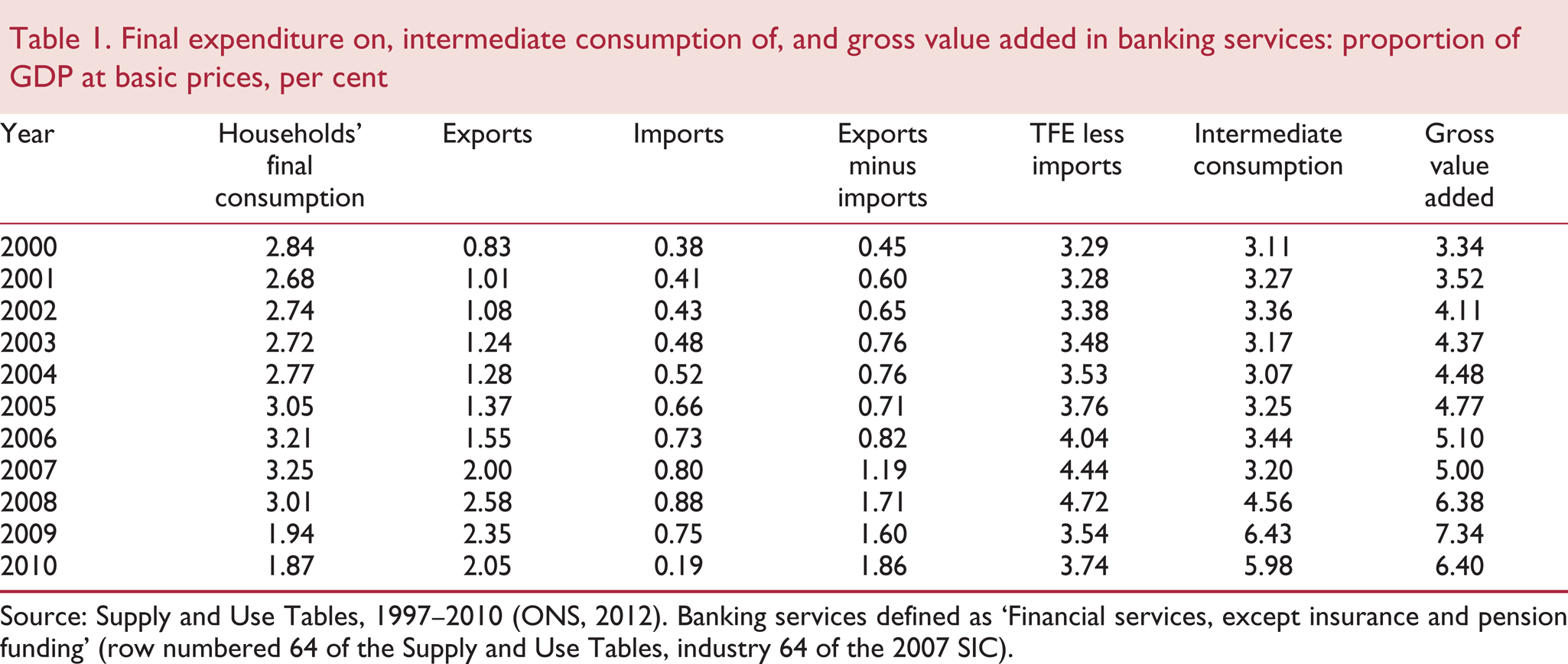
Source: Supply and Use Tables, 1997–2010 (ONS, 2012). Banking services defined as ‘Financial services, except insurance and pension funding’ (row numbered 64 of the Supply and Use Tables, industry 64 of the 2007 SIC).
Suppose that instead of growing at its actual rate, this category of financial services had grown at the same rate as the rest of GDP. 18 Then one can calculate that real GDP would have grown at 2.84 per cent per annum instead of at its actual rate of 2.95 per cent per annum over 2000–7. So hypothetically, if the dubious part of financial services had grown just at the same rate as the rest of GDP, then GDP would have grown more slowly, but only by 0.11 per cent per annum.
5. conclusion
The main conclusion is that any overstatement of banking output is unlikely to have had a large effect on the estimated growth rate of real GDP; a simple calculation suggests the overstatement of GDP growth might have amounted to 0.11 per cent per annum over 2000–7. So, on this account, we should not revise down our estimate of future growth in the UK. Having said this, it is highly undesirable that there should be so much doubt about the true contribution of such an important industry as banking. To improve on the current situation we need progress on the conceptual disputes around FISIM. For the ONS, the agenda should be to develop better deflators for banking (and for other industries within corporate services) and to implement double in place of single deflation for the estimation of real value added.
Finally, this article has been focused on a narrow issue, the one stated in the title. It should not be taken as denying that the financial crisis was the cause of the Great Recession. And its conclusions are quite consistent with the view that the crisis may have caused permanent damage to UK capacity, as I have argued elsewhere. 19
Footnotes
1
For brief definitions of these and other technical terms in national income accounting, see the Appendix at the end.
2
Nominal GDP can also be measured from the income side as a sum of payments to labour, gross operating surplus (profit) and mixed (self-employment) income (GDP(I)). But once nominal GDP(I) has been reconciled with the other two nominal measures there is no independent measure of real GDP from the income side.
3
See  for an account of the current price balancing process. The 2012 Blue Book gives GDP in 2011, but the latest (2012) Supply and Use Table goes up only to 2010. So there is as yet no complete nominal reconciliation between the output, income and expenditure sides for 2011. Hence the Blue Book shows a statistical discrepancy between the income and expenditure sides of £1.7 billion in 2011.
4
The Denton method is used to ensure consistency between the annual and quarterly figures. The Denton method ensures that the quarterly series add up to the annual total while preserving to as great an extent as possible the pattern of quarterly growth rates, both within a given year and between the fourth quarter of one year and the first quarter of the next: see , chapter 6, for an exposition.
5
The statements in this paragraph have been confirmed by an email from Pete Lee of the ONS.
6
See Begg et al. (1996) for a discussion of the issues surrounding the treatment of banking in the 1993 SNA. discusses the implementation of the new approach to banking in the UK case.
7
However, when a household takes out a mortgage for house purchase, the FISIM attributed to this is counted as intermediate consumption. The reason is that house-owning households are considered to be running small enterprises which receive income from themselves in the form of the imputed rent of owner-occupiers. Part of this revenue is then deemed to be paid out in the form of FISIM to their banks. So a house price (but not quantity) boom fuelled by easy credit won't raise GDP(E), except to the extent that a rise in the relative price of houses increases the weight attached to the growth of real imputed rent. (The weight is nominal imputed rent as a proportion of nominal GDP.) Real imputed rent can't have grown very rapidly in the UK during the boom since not many new houses were built.
9
Basu et al. (2008). Their argument has been disputed by .
10
11
SRDD's Profit and Loss form requires banks to report dealing profits, and within that NSE, for each of foreign exchange, securities and derivatives. NSE “should capture the difference between the sale/purchase price and the mid-market price at the time of the transaction”.
12
The definition of this industry, which is part of Section K of the 2007 SIC, is wider than the ordinary notion of banking. As well as commercial banks it includes the central bank, holding companies, venture capital and some but not all companies involved in asset management, such as unit trusts and investment trusts.
13
Higher figures are often quoted but these must be for the whole financial services sector which includes also ‘Insurance and reinsurance, except compulsory social security and pension funding’ (industry 65 of the 2007 SIC) and ‘Activities auxiliary to financial services and insurance activities’ (industry 66). Aggregating all three industries together to form section K of the 2007 SIC would raise the GDP share to 10.4 per cent in the current reference year 2009. By way of comparison, value added in manufacturing (section C) was 10.5 per cent of GDP in 2009 and value added in wholesale and retail trade (section G) was 11.1 per cent.
14
The shares of the banking industry's GVA in GDP and of intermediate expenditure on banking services continued to rise in 2008 and 2009 before falling back a bit in 2010. This is probably an artefact of the steep decline in Bank Rate, from 5.75 per cent in 2007Q3 to 0.5 per cent in March 2009 and thereafter.
15
Real GVA in banking (industry 64) comes from an ONS spreadsheet entitled PUBLICATION_DATA_2012Q2M2 (2). xls. These data are compatible with the 2012 Blue Book.
16
Some toxic rubbish was sold to households in the form of Payment Protection Insurance (PPI). The compensation bill for mis-selling of this stands currently at £15 billion, according to the BBC (5 March 2013: http://www.bbc.co.uk/news/business-21654732). According to , Table 2.3, 23 per cent of PPI gross weekly premiums in 2007 were for mortgages and so should not be counted as final expenditure. However the Supply and Use Tables deduct only FISIM from the imputed rent of owner-occupiers. It appears then that all PPI (which would be measured as premiums less claims) is counted as part of final expenditure by households.
17
18
Here I assume that nominal net exports of banking services are deflated by the GDP deflator.
Appendix: glossary
Double deflation Under double deflation the real GVA of an industry is estimated by first calculating its real gross output (nominal gross output deflated by a price index for that industry's output) and then subtracting intermediate inputs, each deflated by an appropriate price index. See also single deflation.
Final expenditure Expenditure which is considered part of GDP (e.g. stationery or electricity purchased by households; purchases of new buildings and machinery by businesses; expenditure by government in providing health and education services to households; exports of goods and services).
FISIM Financial Intermediation Services Indirectly Measured; a measure of the services provided by the banking industry via loans and deposits.
GDP deflator The price index for GDP, derived by dividing GDP in current prices by the chained volume measure of GDP (real or chain-linked GDP).
GDP(E) GDP measured from the expenditure side; in current prices, total final expenditure minus imports, i.e. final consumption by households and government plus gross investment plus exports minus imports.
GDP(O) GDP measured from the output side; in current prices, total GVA of all firms, households and government.
GNI Gross National Income (formerly and still often called Gross National Product (GNP)); a measure of the income received by a country's citizens; GNI differs from GDP mainly by the addition of net property and labour income from abroad.
GVA Gross value added; the value of sales (inclusive of taxes on production) minus the cost of bought-in goods and services (intermediate consumption), the latter at purchasers’ prices. In current prices, the total of GVA across firms, households and government adds up to GDP at basic prices.
Imputed rent of owner occupiers Notional payment made by an owner-occupier household to itself to measure the value of the benefit derived from living in the household's home; part of final consumption by households. After deducting intermediate consumption (composed entirely of FISIM in this case), the remainder constitutes a form of income (‘mixed income’) to the household and also a form of GVA which is counted as part of GDP(O).
Intermediate consumption Purchases of goods and services by business on current account (e.g. office stationery or electricity), for incorporation into products sold to customers.
NSE Net Spread Earnings; dealing profits of banks derived from trading in foreign exchange, securities and derivatives for clients; in principle excludes capital gains or losses arising from speculation on own account.
ONS Office for National Statistics, the agency which produces the UK's national accounts
PPI Payment Protection Insurance; insurance which supposedly protected borrowers from a change in their circumstances which might otherwise lead to default.
SIC Standard Industrial Classification; currently the 2007 version is used.
Single deflation Single deflation is when the growth of the real GVA of an industry is proxied by the growth of its real gross output, where the latter is nominal gross output deflated by the appropriate price index for that industry's output. See also double deflation.
SNA System of National Accounts; the internationally agreed set of principles and practices for constructing national accounts, negotiated under the joint supervision of the UN, the OECD and the IMF. The ONS currently uses the 1993 version, in the form mandated by Eurostat (known as ESA 1995). The 2008 SNA is due to start being implemented in the next few years.
SRDD Statistics and Regulatory Data Division; the Division of the Bank of England which (amongst other things) collects the raw data on the banking industry.