







Abstract
Anxiety toward one’s own death has been extensively studied and conceptualized. However, the fear of death of others particularly of spouse in later life, which may be worse than individual’s death anxiety, has not been investigated. The present research aims to study spousal death anxiety among Malaysian middle-aged and older couples. The study subjects, consisting of 300 couples aged 50 years and older, were obtained from a national cross-sectional survey entitled “Poverty among Elderly Women: Case Study of Amanah Ikhtiar” conducted in Peninsular Malaysia. Women reported significantly higher levels of spousal death anxiety than their partners t(299) = 2.48, p < .05. About 45% of older men and 52% of their spouses reported high spousal death anxiety. The results of two separate stepwise regression analyses yielded a two-variable model for men and a four-variable model for women. The most important concern of older men that may increase spousal death anxiety was caregiving issues. For older women, financial security following widowhood was most important factor toward spousal death anxiety. The findings suggest that the majority of the older couples are prone to death anxiety of their spouse and factors contributing to the fear of death of spouse are different for men and women.
Introduction
The fear of death is a universal feeling that has existed from the beginning of the human history. According to Terror Management Theory, while human beings are driven to survive, they are also aware that they will finally pass away. This awareness of inevitableness of death may cause death anxiety (Cicirelli, 2002; Greenberg, Solomon, & Pyszczynski, 1997; Hossain & Gilbert, 2010; Yuksel Erdoodu, 2008). In light of the awareness of the inevitability of death, individuals’ death anxiety or fear of one’s own death has been extensively investigated, and there are numerous conceptualizations used in the literature (Bath, 2010). For example, Tomer and Eliason (1996) developed a comprehensive model to understanding death anxiety. The model hypothesizes three antecedents associated to death anxiety. First, determinants past-related regrets, which refer to those achievements that have not been reached in the person’s lifetime. Future-related regrets that contribute to death anxiety, because premature death prevents from achieving important goals in the life. Lastly, meaningfulness of death refers to one’s concept of death and ability to make sense of it.
From the actuarial point of view that older adults are closer to death, individual’s death anxiety among the elderly has been studied extensively in recent years in a wide array of areas. A review of the recent theological and biopsychosocial studies shows that several factors influence personal death anxiety among older adults. For example, ego integrity (Hui & Coleman, 2013), physical and psychological problems (Fortner & Neimeyer, 1999), age, gender (Abdel-Khalek & Al-Kandari, 2007; Depaola, Griffin, Young, & Neimeyer, 2003; Wass & Myers, 1982), ethnicity (Depaola, et al., 2003; Wass & Myers, 1982), living arrangement (Madnawat & Kachhawa, 2007; Missler, et al., 2011; Ron, 2010), and religiosity (Ardelt & Koenig, 2006; Chan & Yap, 2009) are related to death anxiety.
As mentioned above, the concept of and factors leading to personal death anxiety in later life have been studied from several points of view and found that fear of death decreases with aging because the inevitability of own death is accepted (De Raedt, Koster, & Ryckewaert, 2013; Maxfield, et al., 2007). However, there is limited scientific investigation on fear of death of significant people in one's life, particularly family members and spouse, which may be worse than fear of own death (Bath, 2010; Gire, 2002). Therefore, it is imperative to study spousal death anxiety in later life. The findings may help older adults to be physically and emotionally prepared for dealing with spousal death anxiety and consequently reduces negative effects of spousal death.
Theoretical Framework: Spousal Death Anxiety
As mentioned earlier, several studies have investigated one’s own death anxiety; however, fear of death of others, in particular spouse in later life, has not yet been comprehensively studied. In light of the limited special theory to study spousal death anxiety, theoretical framework for the present study was developed based on the related theories and literature review to uncover the possibility of the fear of death of spouse.
Attachment Theory
In accordance with the attachment theory, as couples get older, their dependency to each other increases. Such dependency may be accompanied by separation anxiety and fear of losing partner. Older men become more dependent on instrumental support from their spouse. However, older women become more dependent on financial support from their partner (Bradley & Cafferty, 2001). Therefore, it seems that dependency may increase the worry of losing spouse.
Marriage Function
It is well known that the marriage is one of the most important resources for the production of comfort, stimulation, and affection for husbands and wives. As people get older, their awareness of inevitability of death and being widowed increase that it negatively affects their physical and mental health (Utz, Reidy, Carr, Nesse, & Wortman, 2004). Men generally receive substantially instrumental and health-enhancing support from the marriage in terms of housekeeping and care services (Chesley & Poppie, 2009). Therefore, widowed men more than widowed women, are more likely to experience instrumental disability after losing their partner. On the other hand, older women typically gain more financial support from their marriage. Thus, the death of a spouse may have greater financial strain for widows than for widowers (Angel, Douglas, & Angel, 2003; Angel, Jimenez, & Angel, 2007; Ha, Carr, Utz, & Nesse, 2006; Van Grootheest, Beekman, Van Groenou, & Deeg, 1999).
Remarriage After Death of Spouse
Another factor that may lead to fear of death of spouse in old age is remarriage after death of spouse. However, older men are more likely to compensate for the loss of affection by seeking new partners, older women are less likely to receive affection from a new partner, because of demographic patterns (Carr, 2004). Older women particularly get higher levels of behavioral confirmation from their husbands. Therefore, death of husband causes to loss of an important source of behavioral confirmation. Due to the shortage of men in older age, older women have less chance to remarry and consequently less likely to find a new source of behavioral confirmation (Schaan, 2013). It is found that older men have approximately five times chances to remarry after widowhood than are older women (Lee, DeMaris, Bavin, & Sullivan, 2001).
Sociocultural Context
The last factor, which may lead to spousal death anxiety, is sociocultural context. Since each person has a unique constellation of culture, social context, and connections shape reaction to death and impending death, therefore, sociocultural definitions and expectations may influence how to deal with anticipatory grief (Rosenblatt, 1988). For example, in traditional family structures, women mostly focus on the housewife’s tasks and raise their children. Therefore, they depend greatly on the income of their spouses for the production of status. Thus, they are aware that death of husbands leads to loss of status and consequently incites fear of death of spouse. On the other hand, as it is mainly women’s job to carry out household chores in the traditional family structures. As such, becoming widowed especially hampers widowers in the production of comfort (Schaan, 2013).
According to the mentioned above, it can be postulated that spousal death anxiety may exist in old age and then it affects older men and women differently.
Methodology
The data for this study, consisting of 300 couples (300 males and 300 females) aged 50 years and older, were obtained from a national cross-sectional survey entitled “Poverty among Elderly Women: Case Study of Amanah Ikhtiar” conducted in Peninsular Malaysia. A detailed description of the methodology has been previously published elsewhere (Momtaz, Hamid, Masud, Haron, & Ibrahim, 2013). Briefly, the survey fieldwork took place from June 2010 to December 2011. The survey employed a two-stage proportional stratified random sampling technique. At the first stage, the enumeration blocks were selected and at the second stage the living quarters were selected. Finally, selected older couple from each living quarters was interviewed. All selected couples were interviewed in their homes by trained interviewers.
Measures
Spousal Death Anxiety
The respondents were asked to respond to the following statement: “I am afraid of the death of my spouse” on a 5-point Likert format from strongly disagree to strongly agree.
Factors Affecting Spousal Death Anxiety
Respondents were asked to rate their worries on the following eight themes based on a 5-point Likert format. These themes were dependency, loneliness, abandonment, caregiving issues, financial security, medical expenses, daily expenses, and financial independency. Reliability analysis using Cronbach’s alpha yielded high internal consistency for men (α = .923) and for women (α = .920).
Chronic medical conditions
Respondents were asked if they had any of the following chronic medical conditions, for which they had received treatment by a physician, within 12 months prior to the interview. These conditions were hypertension, heart disease, diabetes, asthma, kidney disease, arthritis, cancer, stroke, and depression. The number of chronic medical conditions was used in the present analysis.
Data Analysis
All data were analyzed using the Statistical Package for the Social Sciences (SPSS, Version 21). Prior to conducting the analysis, missing values, outliers, and assumptions of normality were evaluated and met. Descriptive statistics such as mean, standard deviation, and frequency were used to summarize and describe the data. Bivariate analysis was conducted to assess association among study variables. Finally, two separate multiple stepwise regression analyses were used to identify the most important factors contributing to spousal death anxiety for older men and women.
Results
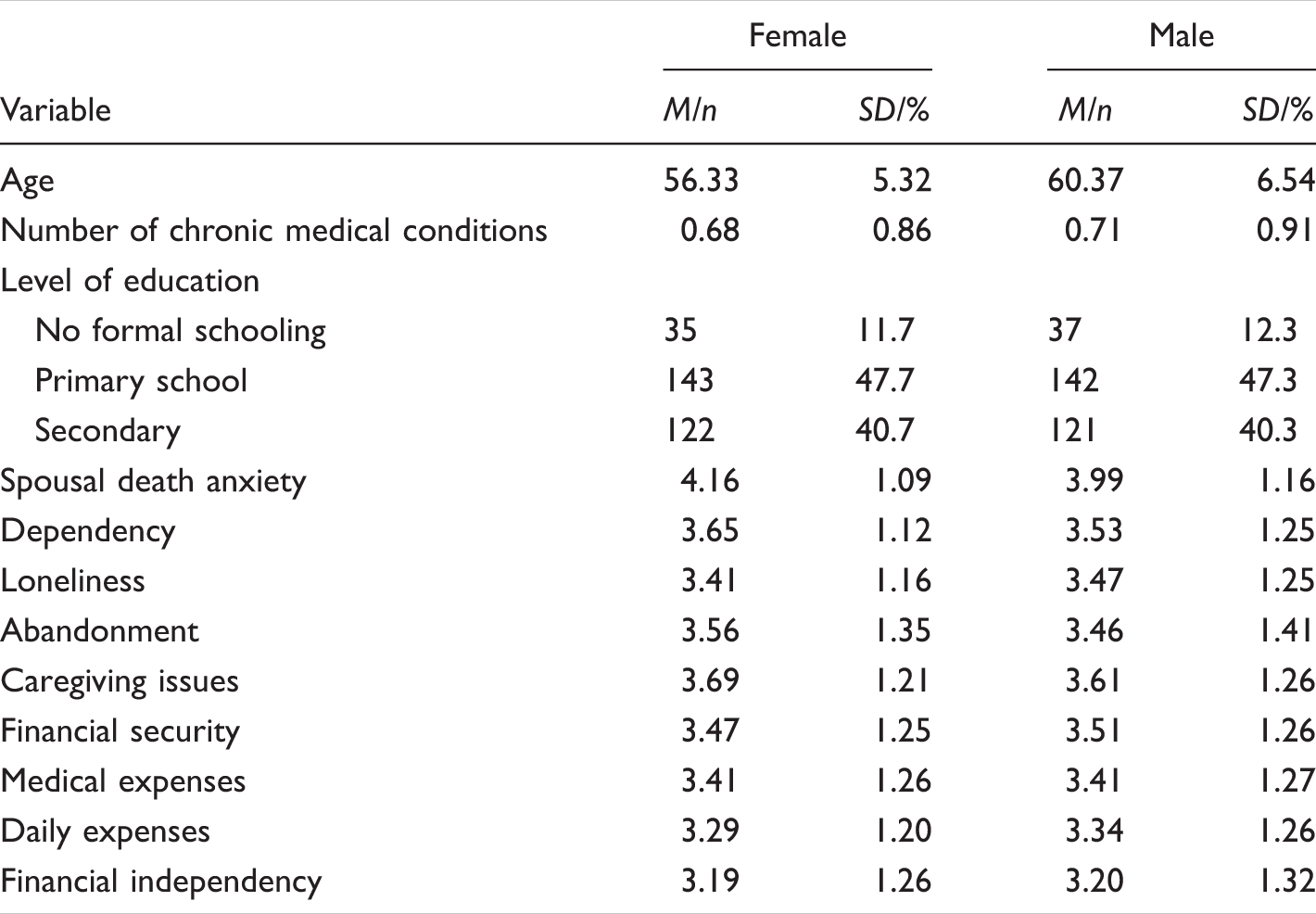
Descriptive Statistics of Study Variable by Gender (300 couples).
Bivariate Correlation of Study Variables for Men and Women.
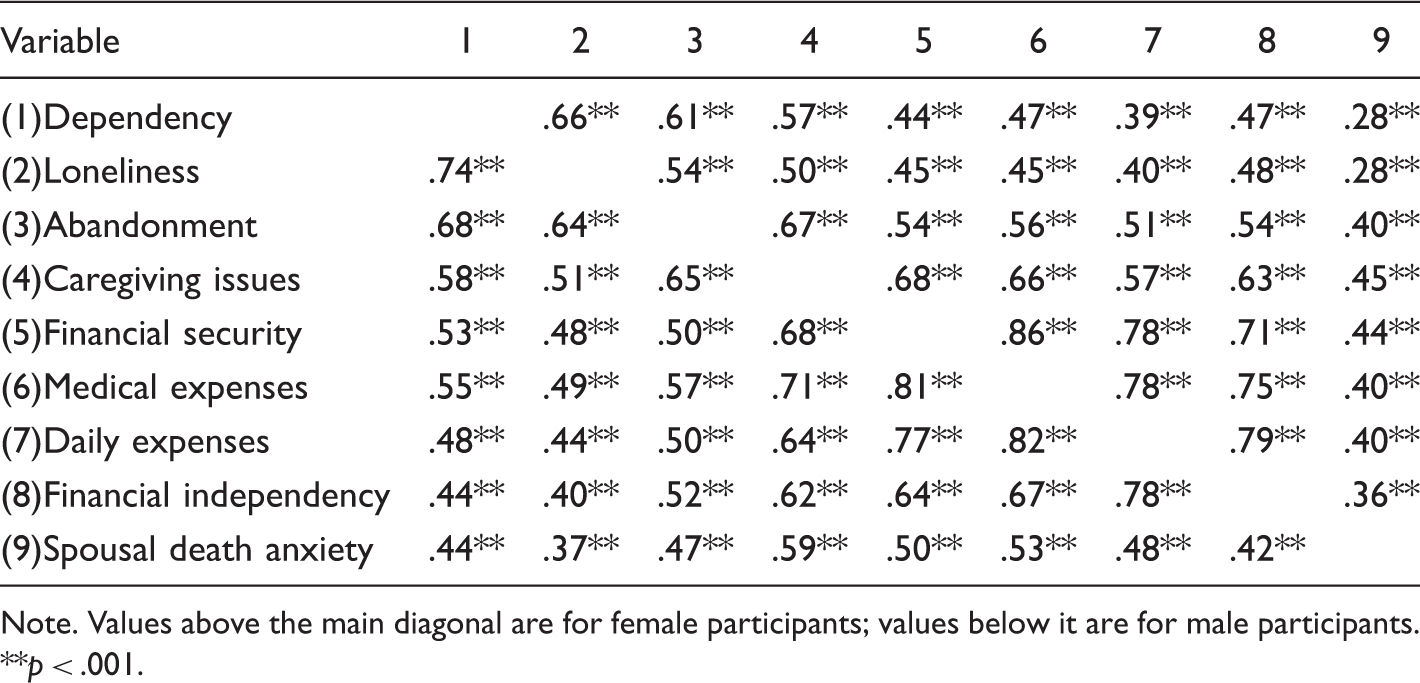
Note. Values above the main diagonal are for female participants; values below it are for male participants.
p < .001.
Results of Stepwise Multiple Regression Analysis
Factors Affecting Spousal Death Anxiety Among Older Men
Stepwise Multiple Regression Analysis Summary, Older Men.
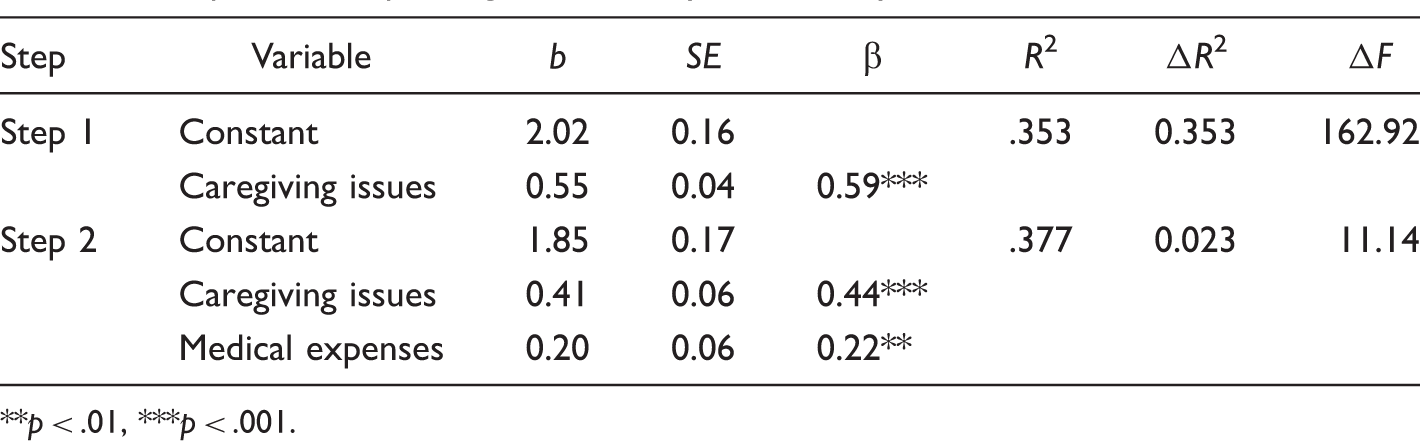
p < .01, ***p < .001.
Factors Affecting Spousal Death Anxiety Among Older Women
Stepwise Multiple Regression Analysis Summary, Older Women.
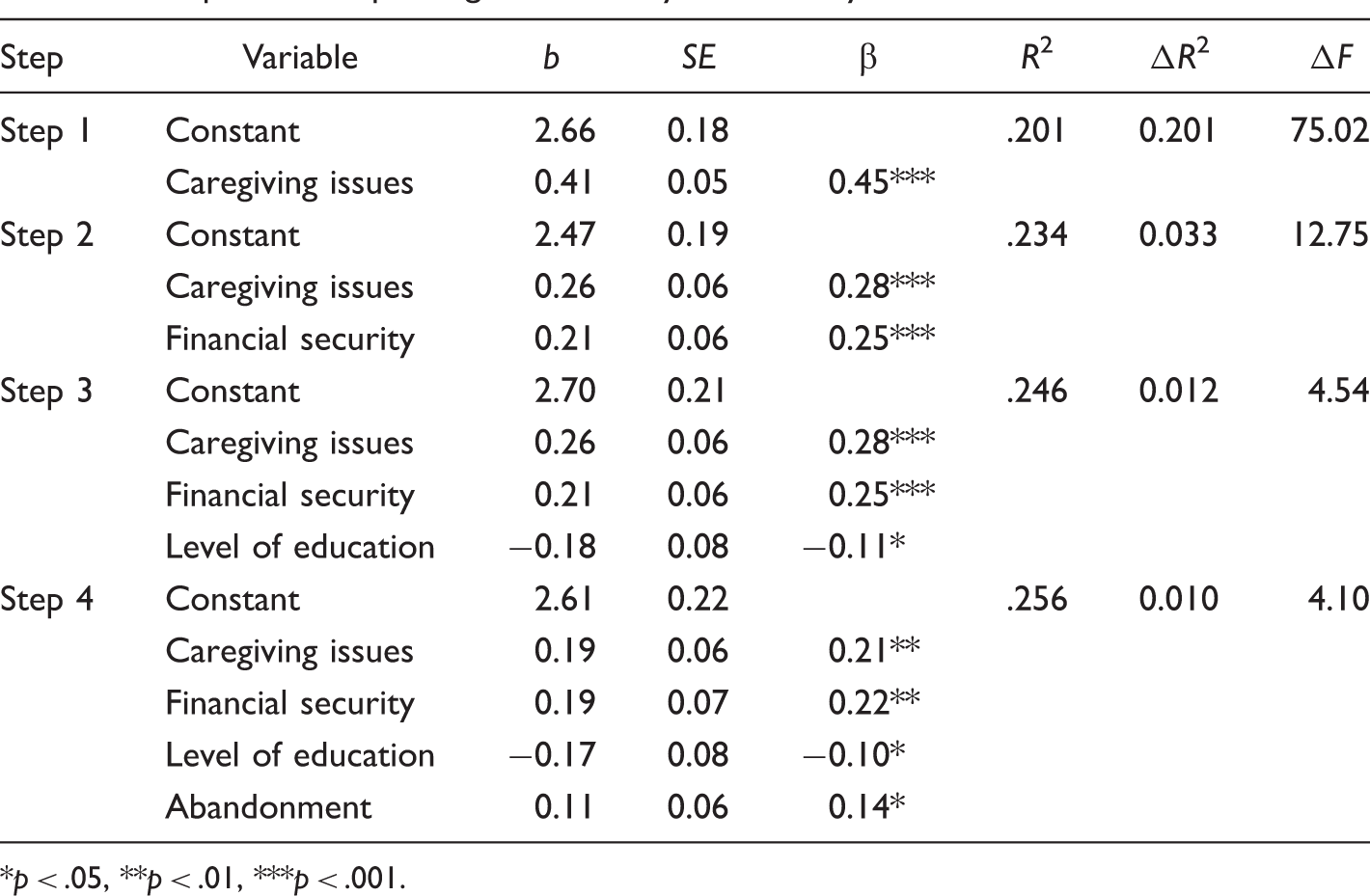
p < .05, **p < .01, ***p < .001.
Discussion
The present study aims to investigate the prevalence of and factors associated with spousal death anxiety among Malaysian middle-aged and older couples. The findings revealed that about 52% of older women and 45% of their husband reported high spousal death anxiety.
The main aim of the current study was to identify most important factors contributing to spousal death anxiety according to gender. Findings from stepwise regression analysis revealed that caregiving issues and medical expenses might contribute to spousal death anxiety among older men. As mentioned earlier in the theoretical framework section, in general, men receive substantial instrumental and health-enhancing support from their spouse. Therefore, older men may feel spousal death anxiety due to anticipating lose instrumental support and care services following death of their partners (Angel, et al., 2003; Bradley & Cafferty, 2001; Chesley & Poppie, 2009).
As it could be expected, among older women, the results from stepwise regression analysis reveal that financial security was found to be the most important factor contributing to the fear of death of spouse, followed by caregiving issues, level of education, and abandonment. This finding is in accordance with the developed theoretical framework. As mentioned in theoretical framework, women typically gain more financial support from marriage and become more dependent on financial support from their husband. In addition, women traditionally focus on the housewife’s tasks and raise their children, so they depend greatly on the income of their spouses for the production of status (Schaan, 2013). Thus, the death of a spouse may have greater financial strain for women (Angel, et al., 2007; Ha, et al., 2006). In addition, another factor that found to be significant factor toward fear of death of spouse among older women is abandonment. It seems that women older women are less likely to receive affection from a new partner because of demographic patterns (Carr, 2004). Older women particularly get higher levels of behavioral confirmation from their husbands. Therefore, death of husband causes to loss of an important source of behavioral confirmation. Due to the shortage of men in older age, older women have less chance to remarry and consequently less likely to find a new source of behavioral confirmation (Schaan, 2013).
Limitations of the Study
Although our study used a large community-based sample of older couples, it has some limitations that should be acknowledged. One of the most important limitations that may influence the findings of the present study is that spousal death anxiety was measured using a single item. However, it is noteworthy to mention that measuring death anxiety by a single item may minimize the subjective distress associated with longer questionnaires (Abdel-Khalek, 1998). Another limitation that may provide avenue for further studies is that attachment style of older couples that may influence the fear of death of spouse was not measured. Therefore, it is suggested that future studies include attachment style as a predictor of spousal death anxiety in later life.
Conclusions
Since previous studies have mostly focused on individual’s own death anxiety or assessed the impact of death of spouse on well-being of surviving partners, or assessed fear of death of spouse among end stage patients, the current study is one of the few studies that have attempted to reveal the spousal death anxiety among the community-dwelling older adult. Spousal death anxiety can be identified as fear of what will happen after death of spouse to survivor partners, which is shaped according to the sociocultural context and relationships (Evans, 1994). The findings from this study suggest that the majority of older couples are prone to death anxiety of their spouse and factors contributing to the fear of death of spouse are different for men and women. Understanding of the most important contributing factors to the fear of death of spouse may be used in developing programmes for dealing with spousal death anxiety and consequently reduces negative effects of spousal death.
Footnotes
Declaration of Conflicting Interests
The author(s) declared no potential conflicts of interest with respect to the research, authorship, and/or publication of this article.
Funding
The author(s) received no financial support for the research, authorship, and/or publication of this article.