Abstract

In a recent article, Green and Mohler (2013–2014) found that students who read a brief short story evaluated the story more positively when they believed that the author was dead (rather than having recently moved residence). Cameron, Yang, and Lester (2005) noted that the popularity and the sales of the products of artists increased after the artist died by suicide, and they gave the examples of the poets Anne Sexton and Sylvia Plath and the singer Kurt Cobain, as well as the presumed suicides of Marilyn Monroe and Elvis Presley (Goldman, 1990). It is of interest, therefore, to explore how people evaluate artistic products if they believed that the artist died from suicide versus natural causes such as a heart attack.
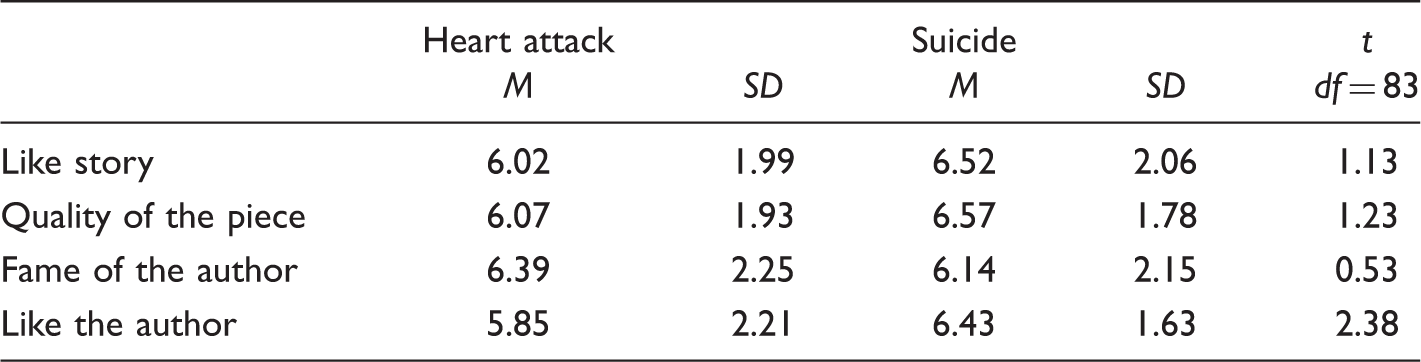
A simplified version of the questionnaire used by Green and Mohler was administered to 85 students enrolled in a psychology course. There were 24 men and 61 women, with a mean age of 21.3 years (SD = 2.5). They were given the same story used by Green and Mohler (Peacelike Mongoose, Thurber (1957) which has 237 words), and a shortened version of the questions used by Green and Mohler. They were given the instructions: On the next page is a short story by an American author. This was one of the last pieces he wrote for, soon afterwards, he died of a heart attack/suicide. The students were asked to rate the article on a scale of 0 to 10 for (a) how much did you like the story, (b) rate the overall quality of this piece of literature, (c) as best you can, guess the fame of the author, and (d) based on what you read today, how much do you like the author? Forty-on students received the heart attack version and 44 students the suicide version, which were given out randomly in class.
Differences in the Ratings of the Story by Mode of Death of the Author.