







Abstract
Much of the scholarly literature sees death as a taboo topic for Chinese. To test this assumption, this study held seven focus groups in the Greater Toronto Area in 2017. It found that the majority of the older Chinese immigrant participants talked about death freely using either the word death or a euphemism. They talked about various issues including medical treatment and end-of-life care, medical assistance in dying, death preparation, and so on. A small number did not talk about death, but it seemed their reluctance was related to anxiety or discomfort or simply reflected a choice of words. The study concludes death as taboo could be a myth, at least for older Chinese immigrants.
Death is understood to be one of the biggest taboo topics for Chinese people (Fan, 2018). For example, the 2019 film, The Farewell, shows a Chinese family not telling the grandmother about her diagnosis of cancer. The scholarly literature also shows Chinese families object to telling family members about an incurable disease or even a poor disease prognosis (Cheng et al., 2019; Jie et al., 2019; Zhu, 2005), and doctors often follow the wishes of the families (Tse et al., 2003). Those persons who know their diagnoses avoid talking about them in the community (Sarpel et al., 2018), especially as many believe talking about death and dying will invoke bad luck (Hsu et al., 2009). In fact, even thinking of the word death may bring bad luck (Chan & Chow, 2006, p. 2). People may go so far as to avoid the number “four” (e.g., in house numbers, car license plate numbers), as its pronunciation is close to 死, meaning death or to die (F. Chen, 2012). When people do talk about death, they often use euphemistic expressions (H. S. Huang et al., 2018). The death taboo seems to be a strong one, even in Chinese migrant families. For example, a Canadian home care provider was reportedly “yelled at” by a daughter for talking about death openly in front of her father, the Chinese patient, saying that “Chinese people don’t like to talk about dying” (Nielsen et al., 2015, p. 375).
However, there are some contradictions. For example, there is evidence that older people prepare for their own deaths (Y. Liu & van Schalkwyk, 2019) and discuss end-of-life care (H.-L. Chi et al., 2018). In a study of older patients in China, the majority were willing to talk about death and dying, and about one third indicated that they were not afraid of death (Q. Chen et al., 2017). Furthermore, death-related materials are not always associated with bad luck; some even believe that seeing or dreaming of a coffin, especially during Chinese New Year, may bring good luck. Coffin, pronounced guan cai, carries the connotation of promotion and wealth. Consequently, mini coffin souvenirs are commonly sold in Chinese shops or online. 1
The scholarly literature on death as a taboo topic has certain limitations. First, it tends to fall into the trap of cultural essentialism (Anderson et al., 2009; Nielsen et al., 2015). Many scholars suggest Chinese people avoid talking about death whenever possible. As will be demonstrated in this article, however, discussions of death should be broken down into the following specific questions: whose death and what causes of death are we talking about, with whom, when, where, and how? Second, the literature takes the death taboo for granted without providing convincing evidence. For example, the use of euphemisms is invariably treated as evidence of avoidance, but as this study demonstrates, euphemisms do not prohibit people from talking about death, nor does it mean “death” and “dying” are taboo words. Furthermore, some practices, for example, avoiding the number “four,” may be related to death anxiety, but they may also simply be cultural expressions, not necessarily expressing a fear of death. Third, some studies suggest death is more commonly taboo among older people or those with dying family members, but studies of older adults, especially immigrant seniors, are rare, so this claim cannot be substantiated.
If death is a taboo topic, this directly influences the well-being of older adults and their family members, especially as communication about end-of-life care is “key to understanding and making rational decisions” (Thomas, 2001, p. 42). The central question investigated in this study is whether death is indeed a taboo topic, particularly referring to older Chinese immigrants in Canada. Canada has a sizable Chinese population; at the time of the 2016 Canadian population census, there were approximately 190,000 Chinese aged 65 and older, accounting for 13% of all Chinese Canadians, with 97% born outside Canada. 2 Specifically, this study investigates if older immigrant adults talk about death and, if so, how they talk about it, and what death topics they discuss. To a limited sense, it also investigates the questions of with whom, when, where, and under what circumstances they talk about death. This study is not concerned with actual behaviors dealing with death and dying, such as death rituals, funerals, treatment of remains, and so on. Guided by grounded theory, it thematically analyses discussions of seven focus groups (46 immigrant Chinese participants) conducted in the Greater Toronto Area from May to July 2017.
Literature Review
Taboo refers to something prohibited by custom rather than by law (Farberow, 1963/2017). It often involves emotionally disturbing topics, such as concerns with the protection of individuals who are in danger, or with the protection of society from those who endanger it (Steiner, 2004). Freud (1918) categorizes sex and death as two main categories of taboo. Gorer (1955), one of the first writers on the death taboo, argues that until the 20th century, death was no mystery; mortality was high, and the cemetery was at the center of everyday village lives. However, 20th-century society began to repress the acceptance of death, and death became invisible, hidden, and a new taboo (see also Gorer, 1965, and death as “new sex” by Foltyn, 2008). Philippe Ariès’ (1974) analysis of Western attitudes to death from the Middle Ages onward suggests modern Western society tends to hide death from terminally ill patients, and death has become shameful and forbidden. In The Denial of Death, Becker (1973) similarly argues that people deny and conceal death. 3 Greenberg et al. (1986) derived what they termed terror management theory to empirically test Becker’s theory of death denial, arguing that people need to mitigate the terror caused by death anxiety. One coping strategy is psychological distancing through the use of euphemisms (McCallum & McGlone, 2011).
Scholars continue to dispute whether death is a taboo topic in modern Western society. A recent article argues that talking about death is considered morbid (Nyatanga, 2018), and another says “societal taboo around death has worsened” (Lakasing, 2014, p. 243). But other scholars, like Walter (1991, 2017), Kellehear (1984), Zimmermann and Rodin (2004), and Sayer (2010), assert that the taboo of death or death-denial is questionable. While Kellehear (1984) points out the uncritical use of the term and the concept of “death-denial” in the 1980s, Tradii and Robert (2019) argue in a recent review essay that heterogeneous factors are grouped together and labeled as “denial”, and the death-denial concept remains extremely loose. Walter (1991) says that a death taboo once existed but is disintegrating and is now limited to individuals or certain occupational groups. Similarly, R. L. M. Lee (2008) asserts the death taboo thesis fails to address the shifting context of death discourse. Paul (2019) specifically investigates children’s experiences and finds that the death taboo thesis lacks nuance, confining and misrepresenting their experiences. Finally, Troyer (2014), a specialist in death studies, argues that death is not taboo in Western society, but “we’re just not encouraged to talk about it.”
What about China? Does the general understanding of a death taboo actually apply to Chinese societies? Following David N. Keightley’s argument, Olberding and Ivanhoe (2011) maintain that in early China, as evidenced in Confucianism and Daoism, death was a natural feature of life. They assert that it was different from the Western belief of death entering or disrupting an earlier, happier state of the world, with mortality having no place or meaning. Writing about pre-Qin China, M. Liu (2010) points out that various philosophical schools had different attitudes to death. While Confucianism focused on grief and reasoning, Daoism stressed detachment and unrestraint, Moism centered on sacrifice, and Legalism featured impersonality (see also Hai, 2008; Sun, 2017; Zhang & Hu, 2011). Kang’s (1994) list of attitudes to death in pre-Qin China include the following: (a) death as a transformed form of life, (b) pursuit of eternity and avoidance of death, (c) existence of afterlife and interaction between the worlds, and (d) confrontation of death and overcoming it. In work on life and death in later Han China, Y. Yu (2005) notes a longing for longevity and fear of death, and the corresponding concept of an afterlife and the wish to go to paradise as a celestial being.
In contemporary Chinese societies, both scholarly literature and media reports endorse the death denial thesis. As mentioned earlier, many suggest that the Chinese culture prohibits people from talking about death (Lu & Zhang, 2015). For example, Cheng et al. (2014) maintain that in traditional Chinese cultures, it is considered disrespectful, even sacrilegious and blasphemous, to mention death. Chow and Chan (2006) argue that the Chinese do not talk about death, because doing so could attract evil spirits, bring bad luck, or even cause early death. Numerous other scholars and journalists agree that talking about death is seen as bringing bad luck (R. Braun & Nichols, 1997; X. Chi, 2018; Hsu et al., 2009; Wang, 2018). Those who do so will be cursed or punished (Xue et al., 2011), and a coping strategy is to avoid talking about it, or talk about it indirectly, not naming the dead, not looking at funeral cars going by, not visiting families who are grieving (F. Chen, 2012; J. Huang, 2016; Li, 2006; Yick & Gupta, 2002), not having a palliative care facility in the neighborhood (M. Yu & Dai, 2019) and so on.
The scholarly literature on the death taboo among Chinese immigrants is sporadic, occasionally based on anecdotes and with mixed findings. For example, in their study of Chinese immigrants and Chinese Americans in New York City, Yick and Gupta (2002) suggest death is a taboo topic. Another study of Chinese Americans by R. Braun and Nichols (1997) shows that many immigrants believe talking about death brings back luck, but younger generations and long-time U.S. residents are more Westernized. In an ethnographic study of four Chinese immigrants with terminal cancer and their caregivers in Ontario, Canada, Nielsen et al. (2015) found the death taboo has complex features. An interesting finding was that the health-care providers they studied believed death was a cultural taboo for these immigrants, but, in fact, the Chinese care recipients made contextually informed decisions.
Literature on older Chinese immigrants’ attitudes to death and dying is rare. Studies are limited to those who are bilingual or have no language barriers. There is no systematic and convincing evidence that death is a taboo subject. Many scholars simply assume death is taboo for Chinese. Meanwhile, Chinese research participants say death is a cultural taboo among Chinese, but they still talk about it. Is this a methodological problem of the selectivity of participants who are more willing to talk about death? Or is the cultural taboo of death disintegrating?
Methods
The study’s analysis was based on 46 participants in seven focus groups, part of a larger research project on the health and well-being of Chinese seniors in Canada. The focus group method was selected because it can stimulate discussion and generate a wide range of views (Kitzinger, 1994; Morgan, 1996). Furthermore, some themes may only appear in the focus group context (Guest et al., 2017).
With help from community service providers, researchers recruited senior participants from the Chinese community in the Greater Toronto Area. The criteria were mentally intact immigrants aged 65 and older. The principal investigator (PI) ensured participants varied demographically so as to reach theoretical saturation (Charmaz, 2014; Morse, 1995). The study was approved by the ethics review board of the University of Toronto. Demographic data were collected at the beginning of the focus groups.
Three graduate research assistants and the PI, all bilingual with the ability to speak different Chinese dialects, conducted the focus groups together or separately. Five groups were conducted in Mandarin and two in Cantonese. At the start of a session, the group moderator explained the purpose of the research and reviewed ethics concerns. The sessions began with a round of introductions; participants gave a brief migration history and explained their living arrangements. The discussion then proceeded to family relations, filial piety, and advanced care plans. The latter naturally prompted the topic of death and dying. Overall, they talked freely about many issues, including death and dying. The focus groups lasted about 2 hours, with participants taking washroom breaks as needed. The participants used identifiers rather than their names during the discussions to insure anonymity in the later transcripts.
Unlike medical professionals who may directly ask terminally ill patients about death and dying (e.g., H. S. Huang et al., 2018), the PI and research assistants asked these participants about their advanced care plans. This served the same purpose, as it often led to discussions of death and dying, with participants spontaneously mentioning death preparations or funeral plans. In a small number of cases, participants initiated the topic of death and dying. For example, a female participant (FG5P3FTW) 4 mentioned her will and funeral at the beginning of the introduction in her focus group. The moderators used euphemistic expressions when talking about death, until participants themselves started to use the words “death” or “dying.”
Transcriptions of focus groups were verbatim, with Cantonese translated into Mandarin. Data analysis was based on multiple reading of the transcriptions and involved multistage analysis at different levels. Based on the grounded theory and thematic analysis approach, the PI started with open and axial coding and moved on to search for common themes (V. Braun & Clarke, 2006, 2014; Corbin & Strauss, 2015). All data analysis used Nvivo 12. Memos were coded in English, and quotations were translated into English for the purposes of this study. The analysis led to the emergence of several themes. Only the death taboo is reported here.
Quantitative content analysis was used to extend the thematic analysis (Vaismoradi et al., 2013, 2016). When data were coded under the theme of death taboo, the use of the word “death” or euphemisms for death became an obvious subtheme. It became necessary to count the number of times “death” or euphemistic expressions appeared in the discussion, as did counting the number of people who used the word “death” or a euphemism. When a person used both “death” and euphemisms, the case was counted as using “death.”
This study was written as themes emerged during data analysis. Choice of the quotations started with the initial reading and memo writing, continued through rereading for content analysis, and was finalized at the time of writing of this study. Although writing started with the assumption of a death taboo for Chinese, this soon changed to “weak taboo” and “contextual taboo,” with the death taboo thesis ultimately questioned entirely.
Findings
Out of a total of 46 participants in the seven focus groups, 28 were women and 18 men; 18 were aged 65 to 74, 21 aged 75 to 84, and 7 aged 85 and older. Most were married (27), followed by widowed (11), single (6), and one each for divorced and remarried. Close to half (19) had a university degree. More than half (25) were Canadian citizens, 19 were permanent citizens, and 1 did not specify his status. Twenty were immigrants from mainland China, 12 from Hong Kong, and 14 from Taiwan. All but one person from Hong Kong came to Canada before 1997. Those from Taiwan migrated to Canada in the 1980s and the 1990s. The majority of those from mainland China (17 of 20) were recent immigrants, arriving after 2000, with only 3 arriving in the 1990s. Forty-four participants reported their health status, with less than 40% either very healthy or healthy, and over 60% “not that healthy” or “seriously sick.”
Straight Talk or Euphemisms?
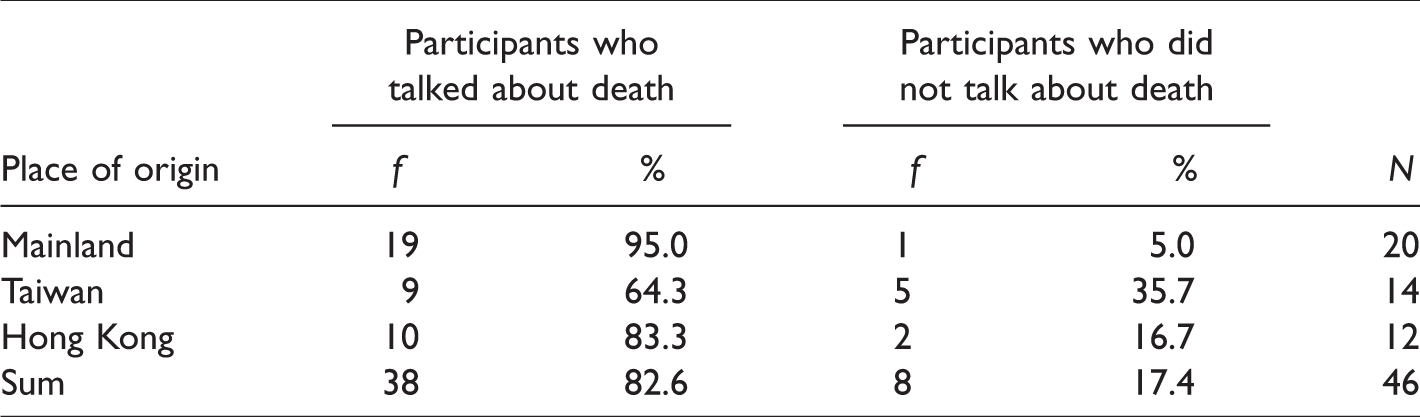
The majority of participants talked about death with or without prompting questions. The content analysis indicated that among those from mainland China, all but one talked about death. Over four fifths of participants from Hong Kong talked about death, as did about two thirds of those from Taiwan (Table 1). In other words, over one third of the participants from Taiwan and a significant proportion of participants from Hong Kong (16.7%) did not talk about death. A closer look at the group discussion transcripts revealed the following characteristics of the eight older adults who did not participate in conversations on death: (a) all but two self-reported as physically not that healthy; (b) three did not talk much about any issues; and (c) the husband of one participant, who was also present, talked about death.
Number and Proportion of Participants Who Talked and Did Not Talk About Death.
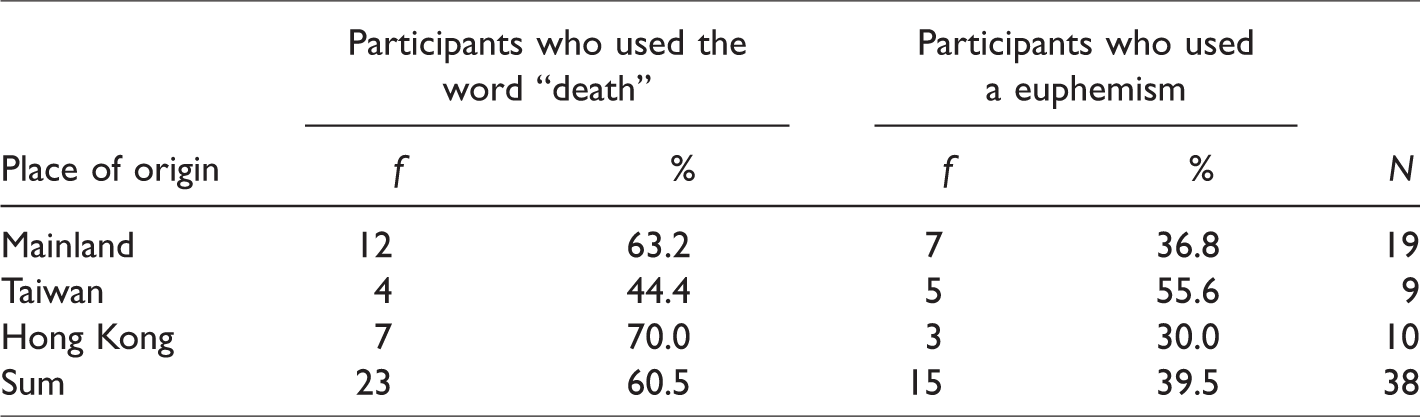
Among those 38 participants who talked about death, 70% of those from Hong Kong used the word “death”; those from mainland China who did so accounted for 63% and those from Taiwan close to 45%. Among those who talked about death, 56% of those from Taiwan used euphemisms, compared with 37% of those from mainland China and 30% of those from Hong Kong (Table 2).
Number and Proportion of Participants Who Used the Word “Death” or a Euphemism Among Those Who Talked About Death.
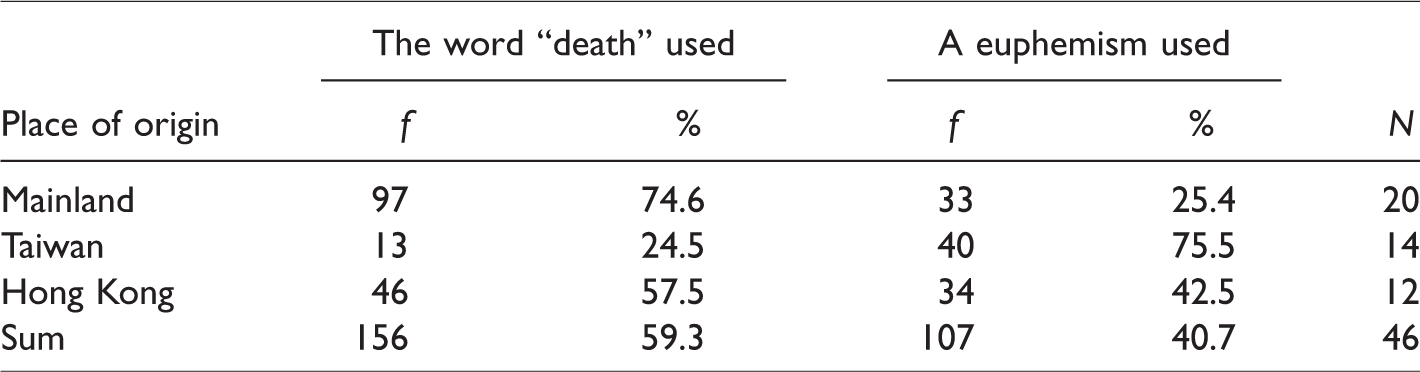
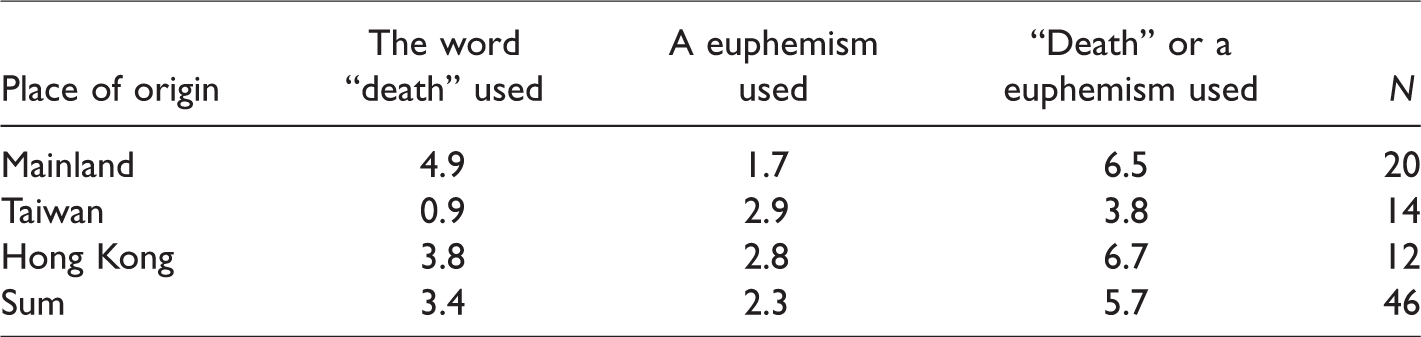
Out of all participants, those from mainland China used the word “death” or a euphemism a total of 130 times; three quarters were “death,” and one quarter were euphemisms. Participants from Hong Kong used the word “death” or a euphemism 80 times; more than half were “death” (57.5%), and less than half were euphemisms (42.5%). Those from Taiwan used the word “death” or a euphemism 53 times; one quarter of the time, they used “death” and three quarters of the time, euphemisms (Table 3). On average, participants said the word “death” or used a euphemism in their conversations 6 times, with those from mainland China and Hong Kong referring to death the most, 6.5 and 6.7 times, respectively, and those from Taiwan the least, 3.8 times (Table 4). On average, those from mainland China used “death” 4.9 times per participant, those from Hong Kong 3.8 times, and those from Taiwan, 0.9 (Table 4). The tables suggest the participants originally from Taiwan were least likely to talk about death, or they talked less about death and used more euphemisms. Those from mainland China were most likely to talk about death, and they spoke directly, less often using euphemisms. The participants from Hong Kong were somewhere in between.
Frequency and Proportion of the Word “Death” or a Euphemism Used.
Average Number of Times the Word “Death” or a Euphemism Used per Participant.
When participants talked about death, they used either the word “death” (死 si) or euphemistic expressions, as shown in Tables 3 and 4. 5 Some directly used the word “death” when talking about death in general. They also used it when talking about their own death or the death of a loved one. For example, one participant said, “Everybody has his/her day of death.” Another said, “What would I do when I die?” Still another said, “My father died of cancer.” The following is a list of direct references to death: “I seldom thought of [the question] how I would die;” “I died once . ;” “We cannot predict death;” “Just send me for cremation after I die;” “If you die, die early than your spouse . ;” “I will go to a nursing home if I am not dead by then;” “I don’t know how you would feel when you are dead;” “Can you die fast when you want to die?” “I did not know how to tell [an English speaking health-care provider] when my wife died;” “The long waiting list in Canada will make you die;” “I am waiting to eat, waiting to sleep, and waiting to die.”
Other people preferred euphemisms. One female participant (FG7P5FHK) introduced herself and mentioned that she lived with her only daughter as her husband had “gone.” Another participant (FG7P1FHK) said her son and daughter-in-law coresided with her in her house, and she had made a will (平安紙 literally “peace paper”) to ensure the inheritance when she was “no longer in this world.” It seems participants avoided saying the word “death” for various reasons. Some avoided mentioning their own physical or psychological discomfort, and others may have been trying not to cause discomfort to listeners. For some, the euphemisms seemed habitual. Use of specific words may also have had connotations of intelligence or level of education. For example, those with a higher level of education might use “去世”(pass away, Chinese from mainland)or “过世” (pass away, Chinese from Taiwan), while others might use the word “gone.” Some used “death” to talk about their own death but preferred a euphemism to refer to their loved ones. For example, one participant (FG1P4FMainland) said, “I would choose 安乐死 (euthanasia) if I die. I would prefer . after I die.” In contrast, when talking about her father’s death, she said, “My father had passed away.” Another participant (FG6P6TW) said, “You may die waiting to see a specialist.” But he said the following about his wife’s death, “My wife suffered blood cancer. She was gone 10 years ago.”
It may be that death is not a taboo word when death and euphemisms are used interchangeably, but when a person uses only euphemisms consistently in conversations, death might be a taboo word for him or her. In the following, a participant from Taiwan (FG6P6TW) uses “go” 7 times: When an older person wants to go (走), let him go (走) and complete (走) the last path of his life. Do not send him to a nursing home or apply tracheostomy. He will have to go (走) someday, right? I will tell my children, not to apply tracheostomy on me when I go (走) in future. I want to go (走) fast when it is time for me to go (走). (FG6P6TW)
Death Topics
Focus group participants discussed various topics, including perceptions of death and dying, death preparation, medical assistance in dying (MAD or MAiD 安乐死), dealing with remains, funeral arrangement, inheritance, and so on. Some talked about how they would die, though one (FG4P5FMainland) indicated that nobody liked to die. One participant (FG4P1FMainland) mentioned the unpredictability of death; another said that “one dies when time comes”; still another (FG1P1Mainland) said that she did not know how she would die. One participant (FG1P6MMainland) mentioned that it would be great to die a natural death.
Some participants specifically said that they would not like to be resuscitated at the end of their lives. A man originally from Taiwan (FG5P5MTW) said that he had made his will, with the assistance of his lawyer; in it, he specified that he did not want resuscitation or a tracheotomy at the end of his life. A woman in the same group (FG5P6FTW) agreed. She said she would tell her children that she would not like a tracheotomy, and she wanted to “quickly go” (痛痛快快走). She said thar she would not be like her mother-in-law who lived 6 years in a vegetative state before death. Other participants (FG7P3FMainland, FG7P1FMainland, FG6P3MTW, FG6P6MTW, and FG5P2FTW) expressed similar ideas.
Twelve participants, 11 of them from mainland China and 1 from Hong Kong, talked about medically assisted death (MAiD) as an option. They discussed the legalization of MAiD in Canada in 2016, the year before the focus group. They indicated their support of the legalization and said that they would opt for this “when their time arrives.” One woman from mainland China (FG2P5FMainland) said that MAiD was her best option. She said, Do not resuscitate me when I become unconscious, when I have tubes around me, and when I cannot make it any more. Do not save my life at that time. 安乐死最好 (the MAiD would be the best option). One consideration is that I can do it here in Canada, while you cannot do that in China. FG1P7MMailand: I have one question without clear answers. At this age of mine, I have been seriously thinking how I would die. Everybody will die someday. But I wish to die without much suffering. My father died of cancer, miserably. I had neighbors and colleagues died of cancer, all suffering a lot. Now I am in Canada, living a comfortable life. I hope I will also have a comfortable death. I would choose MAiD, which is not easy [to access]. I wish I could have a needle and then go. FG1P1FMainland: No, you might not make it. You might be moved to a palliative care. They (health-care providers) may apply painkiller on you. They will make you go comfortably. You may ask them to relieve your pain. FG1P6MMainland: Natural death would be the best. FG1P7MMailand: Now we can do it (MAiD). I have also bought a burial plot myself. I have no other worries. When my time arrives, that is the time for me to die with MAiD. That’s it. No more mess in this world!
A female participant who came from mainland China in 2003 said she was happy living with her daughter and grandchildren in Canada and wanted to be buried there. She said: I live mostly in Canada ever since I landed here. I go back to China only occasionally, since my family is here. I do not like staying alone at home. So I come out to the community, and sing and dance, and make handcrafts, and be happy together with friends. I have thus stayed, and become a Canadian citizen in 2014. I have purchased my burial plot, and want to stay here till the end of my life, and after.
Death Is Not a Taboo Topic for Older Migrants?
One participant (FG7P1FHK) specifically explained that death was not a taboo subject for older immigrants. The reason, in her words, was that they had opened “the door of heart,” that is, they were open-minded: We are very open-minded that we sit around and talk about death. We would not say, don’t talk with me about those unlucky matters. But when you are in Hong Kong or mainland China, do not mention it. It doesn’t matter here. If my son or daughter said they had purchased 福地 (the happy land),
6
I would be very happy. He [the grandson] is great, and can provide a lot of help. I sometimes talk to him that Grandma would get older and older, and will ultimately die. He said why you would always speak death? Grandma, do not talk about death. I said what if I became homeless one day? He said, you can rely on me. He said nobody purchased their own burial plot when they were still alive. I did not know if Cantonese did not do that. We Shanghainese all purchased their burial plot early. They even purchased their coffin, meaning longevity wood 寿材.
Participants from mainland China referred to atheism when they talked about death. One participant (FG2P3MMainland) said that he had thought about death several times, but he did not believe there was a spirit after death. Nevertheless, he would love to have his ashes buried in his home town, under the family cypress tree.
Discussion
This study investigated whether death is a taboo topic for older Chinese immigrants. Analysis of the focus group discussions revealed that death was not a taboo, at least for some participants. Most, if not all, freely discussed various matters related to death. Many used the word “death” and mentioned issues of medical treatment and end-of-life care, MAiD, death preparation, dealing with remains, funeral arrangements, and so on. Several had already made a will, purchased a burial plot, and signed a Do Not Resuscitate document. At the same time, other participants used euphemisms, avoiding the direct use of the word “death,” and some did not talk about death at all. Why they did so calls for further investigation. Some may have been uncomfortable talking about death. Or perhaps some older immigrants simply used euphemisms because of their habitual choice of words over the life course. Different use of euphemisms may also represent speakers’ social attributes, including class, religion, or level of education. Another possibility is the status of the deceased (e.g., 驾崩 refers to death of a sovereign as 夭折 refers to death of a child). Or yet again, it may reflect regional differences.
The refusal of a small number of participants to talk about death did not seem to be caused by time constraints of the focus groups. Silence fell when others talked about death in the same group. The silence might have reflected death anxiety, as most of those who remained silent had self-reported as not healthy or seriously sick. But the silence has a number of possible explanations (Johannesen, 1974; Valle, 2019). As Allan Kellehear (1984) notes, people avoid death as a subject of conversation because it is upsetting, not because societies are death-denying. Moreover, in this study, some participants who were not healthy or were seriously sick were willing to discuss death. Studies on the relationship between physical health and death anxiety have mixed findings, with some reporting no direct relationship, and others demonstrating negative correlations (Ding et al., 2020; Fortner & Neimeyer, 1999; Neimeyer et al., 2004). In this study, diverse attitudes and responses appeared at the individual level.
The analysis suggests the following possibilities: (a) death is not taboo for Chinese immigrants; (b) older adults may not talk about death under just any circumstances, but will talk about it with their peers; and (c) older adults may talk about death during a focus group discussion, to researchers, for the purpose of knowledge production. Older adults are also likely to be more comfortable talking about death with close family members, care professionals, and service providers. Older immigrants, especially those who arrived in Canada after retirement, will need to think about advanced care plans. With some exceptions (e.g., sudden death, dementia), they will need to talk with their peers, family members, close friends, and professionals to make decisions and get support. They cannot afford to avoid these questions.
Ultimately, the study’s findings suggest the death taboo is a myth, a possibility that is backed up by other recent work. One study found that some of those who believe death is taboo or not a common topic will still talk about it (e.g., Yick & Gupta, 2002), and another found both younger and older immigrants are open to discussions about their own death (Han et al., 2018). Nielsen and her colleagues’ (2015) study of Chinese Canadians, mentioned previously, found it was the service providers, not the immigrant Chinese patients, who had stereotypical views on attitudes to death. Finally, R. Braun and Nicholas’ (1997) study of Asian Americans discovered participants was willing to talk about death, thus refuting the researchers’ “expectations of reluctance” (p. 354).
The majority of focus group participants did not seem to think talking about death would bring bad luck. Of course, some did not discuss death, but this is not an indication of a taboo topic. It would be misleading to say Chinese culture prohibits people from talking about death, as Confucianism, Daoism, and Buddhism all mention death. Some scholars cite the passage “不知生, 焉知死” (while you do not know life, how can you know about death) from Analects (Legge, 1893, p.241) as evidence that Confucius avoided talking about death, thus explaining why Chinese generally avoid the topic (Lu & Zhang, 2015; Wei et al., 2019). However, Confucius discussed death on many occasions. The meaning of the quotation, according to Ivanhoe (2011), is that for Confucius, to understand the significance of death, we must understand the meaning of life.
People could simply be cautious, avoiding the topic under certain circumstances, for example, at festivals, weddings, or birthday celebrations. It may be wise to use euphemisms when talking with older adults, especially if they use euphemisms. Those cautions do not indicate a death taboo. Talking or not talking about death carries various social meanings. It may mean a curse, an insult, humiliation, or abuse but also sympathy, remorse, respect, and politeness. Context is an important issue. We need to know whose death is being discussed, who the discussants are, and where and when the discussion is taking place. To illustrate, talking about death in general, for example, as a natural phenomenon, should be easier than talking about the death of loved ones or one’s own death. It may be particularly difficult for parents to talk about the loss of their children (Cacciatore et al., 2017; Cao et al., 2018; L. Chen et al., 2017; Zheng et al., 2015). Talking about natural death at an old age may be easier than talking about accidental death or certain causes (e.g., suicide, murder). It should be easier to talk about death with professionals than with strangers or even acquaintances.
Without falling into the trap of superficial stereotypes (Meagher & Balk, 2013), subcultural or subethnic differences might also play a role in attitudes and responses to death. This study’s focus group discussions indicated different attitudes for older immigrants from mainland China, Hong Kong, and Taiwan. Those from mainland China and Hong Kong seemed more open and free than their counterparts from Taiwan. Given the differences in history, economy, politics, and subculture, this calls for further study. Future studies on immigrants’ attitudes and responses to death need to take into account not only a subculture filtered by structural factors and historical forces of home societies but also the role of multiculturalism in the host society or the role of individual life trajectories over different life stages.
Implications
The movie The Farewell indicates that for Chinese, death is not an individual event but a family event. Thus, professional and nonprofessional caregivers may want to talk with family members first before talking with patients (S. K. Lee, 2009). Doing so is not because death is a taboo topic. It is not to deprive individuals of their rights. It is rather to provide better services. Talking with families provides detailed information about the individual and how to talk to him or her about treatment, death, and death preparations. Family members may also be in a better position than the medical staff to reveal the truth to loved ones (Xue et al., 2011), but when patients want the truth, doctors may well inform them. As Tse et al. (2003) suggest, “There may be little to justify doctors colluding with Chinese families, and ‘culture’ should not be used as an excuse to avoid tackling collusion” (p. 342). Nevertheless, it is a different matter when older persons themselves choose not, or are not ready, to talk about death. In such situations, truth telling becomes both a legal and an ethical issue (Gold, 2004; Xue et al., 2011).
Footnotes
Acknowledgments
The author would like to thank Kwong Y. Liu, Maria Chu, Mabel Ho, William Leung, and Tracy Wu of Yee Hong Centre for Geriatric Care for their help in recruitment of participants, and the following students for their research assistance in data collection and transcribing the interviews: Dora Huang, Vivian Leung, Deng-min Chuang, Weijia Tan, and Lingzi Chen. The author also thanks Elizabeth Thompson and John Troyer for their comments and suggestions. Earlier version of this article was presented at the workshop on Ageing, End of Life Care and Social Policy, Chinese Academy of Social Sciences, Beijing, China, June 20 to 21, 2019.
Declaration of Conflicting Interests
The author(s) declared no potential conflicts of interest with respect to the research, authorship, and/or publication of this article.
Funding
The author(s) received no financial support for the research, authorship, and/or publication of this article.
