







Abstract
In this study we examined a case where twelve participants conducted farewell ceremonies for their deceased relatives. Taking a qualitative approach, we used interviews and questionnaires to focus on life stories that involve grieving. Specifically, we asked about experiences of the grief process as related to choice of music. Our results indicate that the role of music in farewell rituals is important for the grieving process in several ways. Firstly, music was associated with positive memories of the loved one and gave rise to experiences of recognition. Secondly, music facilitated active participation in the grieving process through choosing farewell music together with a relative. Thirdly, selecting music for the funeral in advance, together with their loved ones, was also experienced as hopeful, comforting and consoling before, during and after the bereavement.
Music is of great importance to people and holds significance in connection with death and farewell ceremonies as part of human experience, in particular, when conducted for a close relative (Krout, 2003). But there has been little attention in research into the importance of music choice at funerals and farewells when it comes to the grieving process for close relatives. In this article a research project on music as consolation is introduced with an overview on earlier research in the fields of music and death, music therapy, music psychology and rituals.
The government agency Statistics Sweden (2019) have stated that about 90,000 people die in Sweden each year, and music is used in one form or another in 99 percent of all parting occasions. For many, a farewell ceremony can be an important part of the grieving process. Including music in rituals can help create meaningful experiences and positively affect experiences on a physical level (Parkinson, 2009). Music, often taking the form of songs, can articulate sentiments and to create symbols that help close relatives cope with the sadness of their loss (Parkinson, 2009), and features in both religious and civil contexts. In Sweden, the most common forms of burial are conducted: a) by the Church of Sweden (about 80%), b) by another Christian order (about 10%), c) by order of another religion, or by civil burial (about 8%). The Swedish Church (2019) as well as other organizations in the community have established activities with grief groups for closely related surviving adults, children and young people. The programmed activities continue for up to half a year after the bereavement.
According to Adamson and Holloway (2012) in today’s society we have seen secularization regarding funerals and also a focus on the meaning on rituals. It remains of significant importance and that the psycho-social-spiritual relation is strongly involved in our ceremonials, which means the need of a new vocabulary. Therefore, it is possible to argue that music fills the gap in which psycho-social-spiritual variables are involved.
Bruin-Mollenhorst (2018) have discussed how lyrical content is important with regard the deceased persons’ identity and emotions. The authors show that the lyrical content is less important than other aspects such as emotional and social. The hermeneutic tool has been used to better understand the meaning of the content of the music piece for the next of kin.
The complexity of how music can be used during a funeral is described in Bruin-Mollenhorst (2018), where meanings, functions, motivations of choices, and the specific role of music have been studied. Researchers have used various foci but almost all of them zoom in specifically on the event of the funeral. Another meaning of music has been explored in Adamson and Holloway (2012), where it was found to function to break up of spoken words sections during the funereal ceremony. This forms part of Bruin-Mollenhorst’s (2018) functional description of the meaning of music.
In Caswell’s research (2012), the different ways in which music can be used during a funeral has been explored and examined. Five specific uses of music have been presented as the following: “a) music as a means of control; b) music as a means of inclusion and exclusion; c) music as a source of collective activity; d) music as a means of creating or shifting emotion; e) music as a means of evoking the memory of the deceased person.” These uses are part of the complexity described by Bruin-Mollenhorst (2018).
This study builds on an evidence that music therapy can serve a basic and important function, for example, that music can provide consolation. From a historical point of view, music has been associated with therapy in various cultures and societies for thousands of years and its healing function has been described as affecting both body and mind (Thaut, 2015).
O'Callaghan and Michael (2015) have shown that formal practices of processing grief through music therapy have increased in recent years. Such expressive therapy forms have been growing in regard as a helpful tool to release emotions during grieving. One important thing that this therapy offers is an opportunity for the client to define their grief. Supported by O’Callaghan and Michael (2015), the therapist’s role is to reflect and validate the client, be cautious toward client reactions and to support those affected to express their grief. Another therapeutic method of processing grief is Guided Imagery and Music (GIM) developed by Helen Bonny (1989). The method selects musical pieces that construct a music journey, which can stimulate cognitive images for the client which that they can then express in conversation.
DeNora (2012) undertook an ethnographic case study in England over a three-year period, describing music use with patients in palliative care. The study was conducted with patients and their relatives. DeNora’s work has demonstrated that music therapy in palliative care is a dynamic tool that can contribute to increased communication between therapist, patient and relatives; and offers valuable opportunities for socializing at the end of life: “I conclude that music opens up opportunities for action, and social relation at end of life” (p. 92).
Krout (2003) studied the importance of music therapy for close relatives: When loved ones are anticipating the patient’s impending death, they may find it difficult to express feelings, thoughts, and last wishes. Music therapy is a service modality that can help to facilitate such communication between the family and the patient who is actively dying, while also providing a comforting presence. (pp. 129–134)
Research in music psychology has shown that an individual who suddenly hears a familiar song or piece of music can recall memories of significant life events (Gabrielsson, 2013). A strong identification with music is related to a sense of being understood and present, which has a mindful therapeutic function: “When music takes over the outside world disappears, time stands still, the only thing is the music and myself, here and now” (Gabrielsson, 2013, p. 109). The recognition that this effect of music implies can thus have a powerful effect, particularly if the music is performed live. Studies have shown that live music has a stronger impact compared to recorded music (Bojner Horwitz & Huss, 2016; Theorell & Bojner Horwitz, 2019).
Music psychology researchers Juslin et al. (2010) have described personal music use and the underlying mechanisms behind the role that music plays in one’s emotional life: “Real-world research has shown that music is often intentionally used by listeners to regulate their moods and emotions” (p. 849). Related to the research team, a person's well-being can be affected when they choose music. Their study showed elevated levels of certain biochemical substances in the body of the listener: cortisol, oxytocin, dopamine and serotonin, in conjunction with the listening to self-selected music. On this basis, Juslin et al. believe that intentional use of music can have positive health effects.
For Ruud (2001), it is common for grief to give rise to questions about the meaning of life. Ruud has emphasized that there is a need for those who suffer loss and grief to be given the opportunity to express and explore questions about life and death.
Dyregrov (2009) stated that from a historical point of view, a rite is an act used in cults and religious ceremonies in all societies and religions, in life-changing events or in prayers and sacrifices to gods. Dyregrov stressed that the rituals of major life events, such as in death, can be helpful for people in order to express their feelings, which is an important component of the process of creating common memories and interpretations of events. The rituals can therefore contribute to cohesion in families and in communities. Lerneus (2017) has argued that there is a great need in contemporary society for rituals to process grief.
Little attention has been given to the post-mortem relationships and “continuing bonds” between the living and the dead. As seen in Mathijssen’s work (2018), relocation towards objects and materials and social spheres and norms of the social environments have been subjected to research in relation to separations and transitions. This is part of much-needed rituals, according to the researcher (Mathijssen, 2018). An element of this exploration of meaning may be rituals around death. Valkare (2016) described rituals as: “Ritual is the aspect of human behavior that establishes, marks, confirms and transmits value” (p. 109). In connection with a ritual passage, for example a confirmation or a wedding, there is a transfer of a person's symbolic and intangible value in the social context (Valkare, 2016).
Adamson and Holloway (2012) and Aggedal (2009) have stated their belief that the choice of music at a funeral is the clearest way that families and friends can show who the person was in life. Relatives appear to exert a great deal of influence when it comes to choosing music, and it is important to know how and why this selection also may affect the grieving process by the bereaved. The present study is interested in how music and music choices function in the processing of grief, before, during and after the death of a close relative, in order to cope with the bereavement. Ultimately, we investigate whether or not the music that is selected for, and used in, farewell ceremonies are of importance, and whether it can be an effective tool for grieving.
The purpose of the study is to explore the importance of music in the grieving process. The following research questions are asked: In what ways do close relatives relate to music at farewells? How does music play a therapeutic function during the grieving process of the close relatives? What role does the music play for the grieving process for the close relatives if the deceased made the musical choice?
Method
We used a qualitative approach in which we collected narratives (Hydén & Hydén, 1997) and then analyzed them from a hermeneutic perspective (Ricoeur, 1976, 1993), focusing on grief process and crisis theory (Cullberg, 1986). Participants life stories constituted the empirical data, based on the principles of hermeneutics, which emphasizes understanding and interpretation in light of preunderstandings. The study was informed heavily by work undertaken in the humanities, which is a discipline that studies people as cultural and social creatures who necessarily exist in social contexts (Ödman, 1994).
A hermeneutic approach means that the researchers interpreted participant narratives on the basis of the researchers own understanding and preunderstanding. Skott (2004) has discussed hermeneutics also in terms of a theory of interpretation that deals with the human ability to create understanding and meaning. Hermeneutics has undergone a shift from its original use in biblical interpretation to become a philosophy and method employed in many disciplines (Bojner Horwitz et al., 2003; Ödman, 1994; Ricoeur, 1976, 1993; Wheeler, 2005). Interviews with informants can lead to multiple answers, and individuals may construct different narratives in relations to an experience at different points in time. Ödman (1994) has argued that when individuals who have experienced similar events meet, different understandings of the events are brought into confrontation and negotiation, which gives access to a broader understanding of meaning.
Narrative research focuses on the story in terms of its content and structure, and how this relates to sense-making. Adapted from Skott (2004), the analysis of stories is a study in meaning-making processes in which we all engage. A participant who recounts her/his life story simultaneously shares her/his individual perception of the world. Understandings and preunderstandings interact between participants and researchers, meaning that all stories are created in the dialogue of the research practice. As described by Sohlberg and Sohlberg (2013), a story can therefore be understood as a process. This idea is central to the methodology of narrative study. The analysis stems from the search of similarities and differences. A number of themes emerged in the narratives of participants, and these formed the basis for the findings.
Analysis of the collected data was supplemented with follow-up questions by telephone 14 months later, in order to collect complementary quantitative data via a Visual Analogue Scale (VAS) questionnaire. The scale has been subject to extensive psychometric testing and has been used in the measurements of pain (Yang et al., 1991). The VAS scale is easy to fill in and helped us in a quantitative way to understand a qualitative change of time. We sought answers regarding how the participants interpreted the grieving process more than a year after the interviews. This VAS questionnaire was administered 14 months after the interviews. The research leader contacted the participants to explain the VAS questionnaire, which participants had received by mail. The participants marked the degree to which they agreed with statements posed by the researchers on a centimeter scale (Theorell & Bojner Horwitz, 2019; Theorell et al., 2019). The following four questions were asked: How important was the music at the farewell ceremony for helping you handle your grief at the time of the funeral? How important was the music at the farewell ceremony in relation to helping you handle your current grief? How significant was the fact that your close relative chose their own music for the farewell ceremony in relation to helping you handle your current grief? How significant was it for your capacity to handle your current grief if the music was performed live during the farewell ceremony?
Participants
The participants were voluntarily taking part in grief groups coordinated by the Swedish Church. These groups were mixed-aged and designed to help participants explore music while in grief. These pre-established groups served as a recruitment pool for the present study. Participants were divided in study groups by age and location: two different cities; younger (35–45 years), middle age (46–65 years) and older (66–90 years) (cf. Table 1). The criteria for selection was that a) the participant had lost a relative, b) had had some kind of farewell ceremony (ten church burials and two civic burials) and c) that the participant was in the first year of the grieving process. The group participants did not know each other before participating in the grief groups and members were choral singers or played a musical instrument at amateur level. Two had an interest in dance classes. Most of them expressed that they liked to listen to recorded music or attend live music concerts.
illustrates the gender of the deceased and the age of the relatives, weather the burial took place in a church or in a civil ceremony, and if the funeral music was perfomed live or played back from a recording.
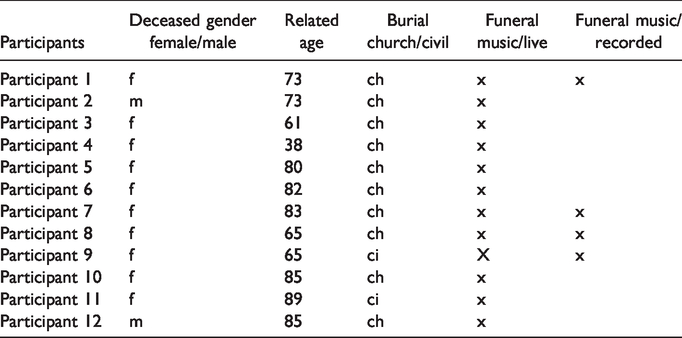
Each grief group had met six times (one and a half hour every week). After the final session with the grief groups, the lead researcher approached the participants to ask if they would like to be included in the present study. Four participants per group gave their consent to participate and which meant a total of twelve individual participants: ten women and two men. The participants are identified by participant number in the reporting of findings that follows. The interviews were semi-structured, lasted 60–90 minutes and conducted in parish homes belonging to the Swedish Church. They were recorded, transcribed and printed out for analysis. The recorded files were deleted immediately after transcription. The interviews were semi-structured using the following questions: In what ways do you, as a relative, relate to music at farewells? In what ways does music play a therapeutic function (if any) during your grieving process? What role does music play in your grieving process, if your close relative made the musical choice before the funeral?
The results of the analysis are illustrated by quotations from the interview material linked to various themes under three main headings. All twelve participants were given the opportunity to speak about their experiences from different funerals related to their grieving process. They shared their views on how music featured as a part of their experience before, during, and after the funeral as shown in Table 1.
Table 1 illustrates the gender of the deceased and the age of the relatives, whether the burial took place in church or in a civil ceremony, and if the funeral music was performed live or played back from a recording.
The participants were told about the study and how it would be reported and gave their consent to their participation. The ethical rules of the Swedish Research Council have been taken into account by ensuring that the participants know that their participation in the study is based on voluntary consent (cf. Swedish Research Council, 2019) and that they can revoke their participation at any time. The participants were informed that their privacy would be protected by treating details of their involvement with confidentiality and de-identification. The individuals' identities are thus not traceable. The participants agreed that the conversation was recorded and treated strictly confidentially. The results of the interviews are quoted anonymously. All participants gave their written consent. The guidance of the Helsinki Declaration was followed.
Results
The results of the analysis are illustrated by quotations from the interviews and are organized into themes under three headings: 1) Experiences of music before parting; 2) Experiences of music during funeral; 3) Experiences of music after funeral.
Experiences of Music Before Parting
Theme: Communication Difficulties About Music Choices
The following quotes reveal the various difficulties that the bereaved parties faced in choosing music for an upcoming funeral: It was not possible to talk about the funeral with the wife so as not to worry her, and she could not have such a conversation. It is easier if you can talk before – I could not with my wife. It's hard to talk about what kind of music you want to have at the funeral. (2)
1
My wife suffered from severe dementia and it didn't work to talk to her about death or music at the funeral so as not to worry her. (2) Due to severe illness and taking medication my wife was not contactable towards the end so we could not talk about death, music or last wishes. (12)
Theme: Pronounced Communication About Music Choices
These quotes show the value of communicating music choices with relatives: We could talk about everything and I am extremely grateful for that. We have nothing left unresolved. When you have experienced as a near relative that you have planned the music wishes together, that is extremely important. (3) Just before he was sick, we had talked about where he would be buried – and partly that the priest would not be high church in thought and practice. My husband didn’t want any funeral at all – we talked about it – preferably he would just disappear – he was not a churchgoing man, but he liked hymns and was very good at music. (5) He loved – oh, what's his name – Sinatra – there were lots of songs – one called ‘Something’ – he played it a lot. My husband wanted us to play it at the funeral. That song by Sinatra was played on record but otherwise the cantor played live organ music. (7) My husband had said that the funeral music should be as serene as possible. There was never any discussion about the music. All our three kids said it was OK. (1) My husband wanted “Imagine” by John Lennon for the funeral, which we had as wedding music when we got married. (3)
Theme: Written Information About Music Choices
These quotes show the value of writing down the desired music choices: When we knew that my dad did not have much time left, we wrote down in a Word document the music he liked. (3) My near relative had written down what music she wanted at her funeral. Her handwriting became more and more crooked, but there was her wish. (1)
The Importance of Music Before Parting
Four participants had planned and selected music for the funeral along with their, now deceased, relative. They expressed their satisfaction with the music and the ceremony. Four out of twelve participants had cared for their near relatives at the end of their lives. Two participants said that they did not have the opportunity to talk about important issues with their relatives due to illness at the end of life. Two other participants who cared for their relatives at home had planned and chosen farewell music together with the relatives towards the end of their life. It emerged from the interviews that four participants, sometimes together with the near relative at the end of his or her life, chose music and song lyrics that could somehow describe a person as well, as if to summarize them, and serve as a reflection of them through their taste in music. Some of the music chosen by the participants referred to the deceased's place of origin or a personal memory. Four participants selected their own favored music to play during the farewell ceremony.
Experiences of Music During Funeral
Theme: The Connection of Music to the Life of the Deceased
The following quote shows the value of choosing music that mirrors, or connects with, the life of the deceased: I don't remember hymns, but we would have liked Dan Andersson and Evert Taube, as their music corresponded to my husband’s life. Andersson matched his origins from Dalarna and ‘So Shimmering Was Never the Sea’ by Taube reflected his interest in the sea. (6)
Theme: Music That Strikes and Touches
In these quotes, the powerful nature of music is highlighted: I didn't know I could be so affected by the tranquil organ music during the funeral, so I cried throughout the ceremony. (8) My mother sat at my father's deathbed, even though she had severe dementia and didn't understand that he would die, reciting Hymn 217. (3) After the death (of my child) I couldn't stand hearing music “(during the funeral).” I felt and feel that there are no words that can describe my feelings. (4) He [a person telling about another person] did not know that he could be so affected. (8)
Theme: The Role of Music at Civil Farewell Ceremonies
These quotes describe how music was used in civil burials: It was a civil farewell ceremony. The most churchlike were songs my husband had sung in Sunday school … That´s where something spiritual came about anyway. He wasn’t religious so we didn’t go to church every Sunday, but we went occasionally when beautiful music was being played, and when we travelled, we gladly went to churches and lit candles. (9) We said farewell to my husband at home with the family - it was a fine moment. I have a son-in-law who is a good guitar player. My husband had many times but jokingly said that at his funeral we should play the song ‘Take Me to the Sea’ – because he loved the sea. My son-in-law couldn't promise to play it, but he would try to learn the song - and he managed to do it. (10) Both the lyrics and the music were crystal clear. I immediately felt that I had found my song. It has been most relevant to me. I feel that the intro to the song gives me strength. A phrase in the song reads: ‘Who comforts you when I'm gone?’ I have chosen it as a ringtone on my phone. (3)
Theme: Different Functions of Music
These quotes describe the transformative function of music: You have to allow yourself time to reflect. The music allows you to stop and listen for a while. Music fulfills a meditative purpose. (1) We sat down at the coffin in the church and I suddenly heard my husband's voice sing along to the lyrics: ‘I do the best I can.’ I could no longer hear the artist sing. I just heard my husband singing. Then I cried like a water tap turned on. (1)
The Importance of Music During Funeral
All twelve participants in the survey had incorporated music and hymns into a church or civil burial ceremony. All participants expressed thoughts or opinions on the function of music during ritual ceremonies. One participant described an unusual incident at a funeral when a seemingly uncommunicative man suddenly regained the memory of his dead wife when he heard singing of a beloved song of theirs. In front of the surprised funeral guests, he made an emotional speech to his deceased wife and then sank back into silence.
Recorded music was often used in instances where the music selected was a song or genre that the relative used to enjoy. Hymns and songs with sacred or secular lyrics are performed whether it is a church or civil burial ceremony. Many felt that music at a funeral was very important in making the ceremony as successful as possible. Three participants said that music was more important to them than other parts of the ceremony, such as readings from the Bible and liturgical prayers. The majority of participants expressed that they were satisfied with both the choice of music and the performance of the ceremony regardless of its form.
Experiences of Music After Funeral
Theme: Music That Arouses Overwhelmingly Strong Emotions
This quote describes how music had become very emotionally charged, and thus turned out to be too difficult and painful to listen to in the process of grieving: It went quiet! For me, the music was silent. After the child's death it was silent. I can't handle music. I used to play the flute and enjoy opera and concerts, but now it doesn't work – I can't – and I'm so sorry for it. (4)
Theme: Music as a Reminder of the Deceased
These quotes describe how music has become an aid to remembering the deceased. It is joy actually and sadness – but I can only accept my husband's death. I think it's good now. The whole funeral was a family affair and I think it’s lovely that it was noticeable that there were songs from the repertoire my husband and his side of the family had sung, and it became a reminder of him and his life. There was one song: ‘Fairy Tale of the Heart’ that we had. It was very much appreciated and loved because his and also my relatives sang a lot and listened to lots of music. (11) When we went sailing, my husband and I used to sing a children's song from Sunday school that we had as funeral music. I walk around and sing it and then I think of him. (9) When I listen to the song today, I still only hear his voice. I don't hear the artist. (1)
Theme: Music That Relieves Feelings of Sadness
These quotes describe how music constituted part of the grieving process: I don't feel as depressed now as I did after the death and the funeral. It feels great to listen to the music, there has been a change within me. (1) To me, music has been a way of grieving and is part of the grief process. Music channels so many emotions that you cannot and need not put into words. (3)
The Importance of Music After Funeral
Shared time for planning and talking to the next of kin played an important role in the grief process of the participants. The participants described the importance that the farewell music had for them in their grieving. Five participants felt that music had a symbolic meaning. For many of the participants, it felt easier to listen to the music during a later stage during the grieving process. Farewell music was associated with well-being during the grief process. Selected pieces of music felt comforting. A participant said that she and her husband had enjoyed dancing to music by Elvis Presley. She recounted how, when she hears one of his songs today, it evokes positive memories. This means that the music seems to offer her a sense of belonging. Two participants told us that listening to a particular piece of music elicited sensations of a missing relative. A participant, who had chosen a special song for the farewell, thought that the lyrics and music conveyed strength and energy, supporting her during the grief process. Another participant, who told us about memories of music from her childhood, described that music was a medium for her to mourn. For her, music was a natural part of the grief process in that it channels strong feelings of grief and loss.
Table 2 illustrates the median, minimum and maximum of the VAS-scale (from 0 – 100 mm), of the participants answers to the four questions where 0 represents no significant meaning, and 100 represents high significant meaning.
The table illustrates the median, minimum and maximum of the VAS-scale (from 0 – 100 mm, where 0 represents no significant meaning, and 100 represents high significant meaning), of the participants answers to the following four questions:1. How important was the music at the farewell ceremony for helping you handle your grief?2. How important was the music at the farewell ceremony in relation to helping you handle your current grief?3. How important was the fact that your loved ones chose their own music for the farewell ceremony in relation to helping you handle your grief?4. How important was it for you to handle your grief if the music was performed live during the farewell ceremony?.
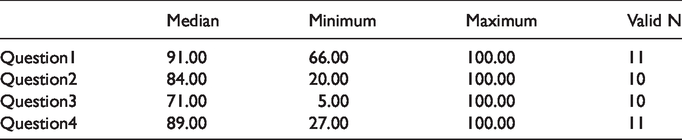
Figure 1 shows the sum of the four questions in a boxplot, where 0 represents no significant meaning, and 100 represents high significant meaning.
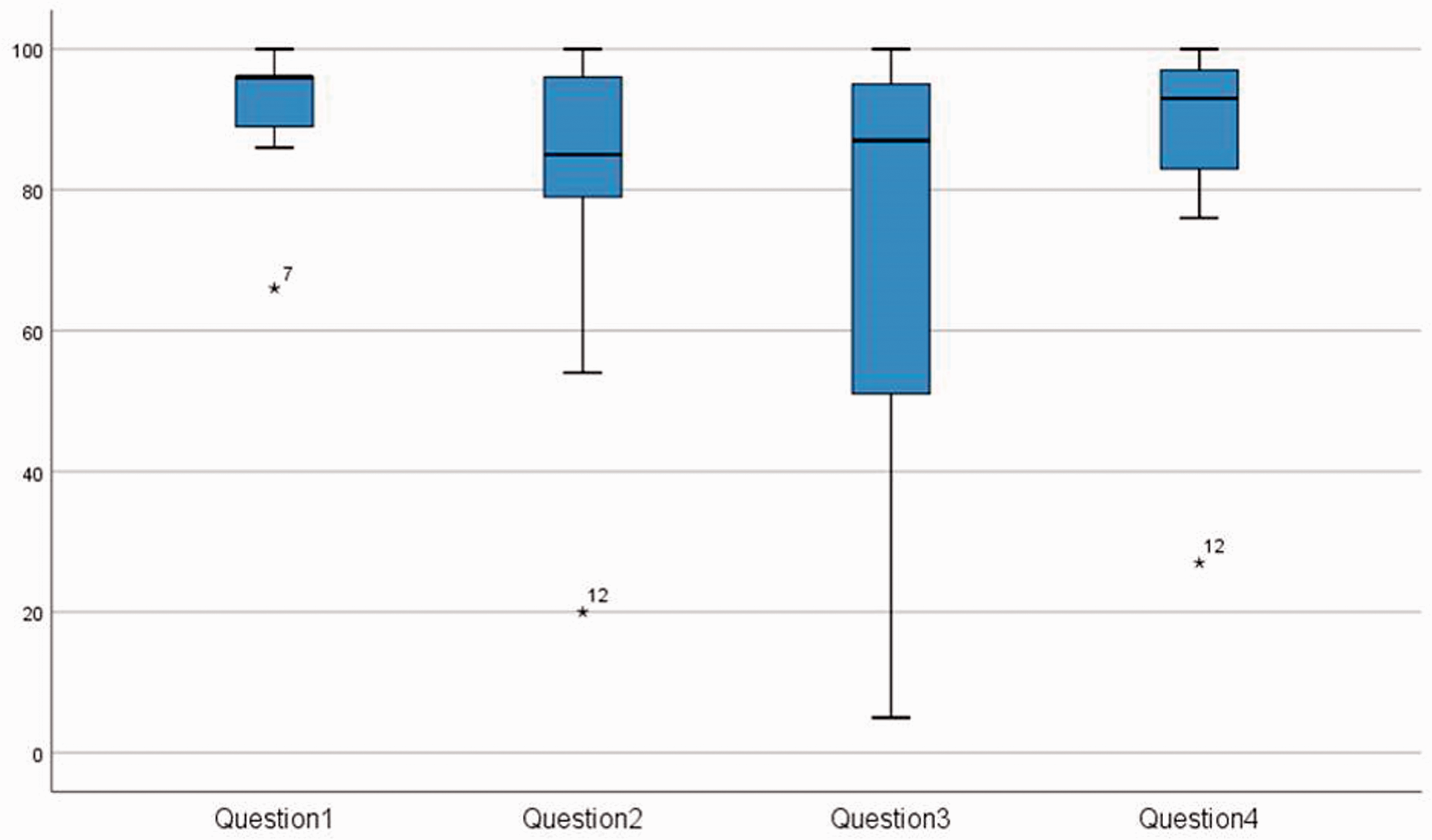
Figure 1 shows the sum of the four questions in a boxplot, (where 0 represents no significant meaning, and 100 represents high significant meaning).
The majority of the twelve participants chose with secular lyrics, from different genres, for their relatives' funerals. Conversely, two participants chose to sing songs with a sacred meaning and hymns at civil farewell ceremonies. During the interviews, it emerged that those who had time to talk and plan the music for the farewell ceremony together with their near relatives before the loss thought that the music had played an important role for them as next of kin. Eight of the participants talked about music, songs, an artist or a style of music that the deceased had listened to with them or that it reflected the personality of the deceased. Three participants said that they had chosen a particular song because the lyrics corresponded to the person's place of origin or their interests.
The criteria that governed the choice of music for several of the participants in the survey were that they were based on live or recorded music that the deceased had listened to previously. Four of the participants used recorded music. Several participants said that they liked to hear music they had previously listened to together with their deceased relatives: The recording should preferably be with the artist that we had listened to together. (7) Funeral music gives one time to think. The act itself does not take that long. (1) Often you are in a state of stress due to tension. It's so easy to miss out on anything. If you have a lot of music, then it is possible to just be in the moment. No matter what song and music it is, it fulfills a function that no other parts do. (3)
Visual Analogue Scale
The music that was played during the farewell ceremony had an important impact on the relatives’ grief process, both during and after the parting. On the VAS scale, the responses show a high average on the question of whether it influenced the participant’s grief process that the deceased had chosen music for the farewell ceremony. For the majority of the bereaved, it emerged that it was of great importance for the grief process if the music was performed live during the farewell ceremony.
Discussion
Our results indicate that the role of music in ritual farewell is important for the grieving process in many ways; therapeutically, emotionally and symbolically. The music was associated with positive memories of the loved one and gave rise to experiences of recognition. It facilitated active participation in the grieving process through choosing farewell music together with a relative and it was experienced as hopeful, comforting and consoling before, during and after the bereavement. We have introduced a research project on music as consolation, along with an overview on earlier research in the fields of music and death, music therapy, music psychology and rituals. It is worth noting that since the conduct of our study, we have witnessed the onset of the covid-19 pandemic. This study could therefore serve as a foundation to explore how music can play a role in supporting patients, health care personnel, morticians and bereaving relatives.
The Importance of Music During a Farewell Ceremony
The participants’ narratives have shown that music is of great importance to the bereaved in multiple ways when they are saying goodbye to their loved ones. Cullberg (1986) has argued that a farewell ceremony is important for participants to find the strength to live on with their grief. This is supported by Dyregrov (2009), who demonstrated that a ritual in connection with a death can be important in terms of granting time to grieve, but also for creating cohesion in families and in communities at large. The analysis of the interviews indicates that a farewell ceremony can help the bereaved to process grief and to plan for the future. Some participants in the study said that musical elements during the ceremony played a meditative function to provide time and space for the grief. The participants said that music and songs have become important through their interpretative and symbolic role in funerals, in line with a need to explore questions about life and death that arise in grief (see also, Ruud, 2001).
The Importance of Communication at the End of Life
The results of the study show how music mediates communication between a person and the relatives at the end of life. Those relatives who had the time and opportunity to plan the ceremony and choose music for the farewell in advance together with the dying person expressed that it was a help for them in processing their grief. The process of planning, including the selection of music together with the dying individual can create order in the midst of chaos, which can be a therapeutic function, facilitating the process grief even before death (Cullberg, 1986). It also meant finding time to talk about the last wishes of the next of kin and about important issues for the participants.
In a study conducted with a hospice in the United States, Krout (2003) claims that it can be difficult to talk to relatives about their feeling and final wishes before death. He believed that music therapy with relatives can open up a space for conversation and a moment to be present with one another at the end of life. Two of the participants said that their dying relatives were cared for in a palliative ward. Both of these participants recounted that it was very difficult to communicate with the dying person at the end of their life. Due to strong medication or long-term dementia, they felt it was too late to discuss important issues with the next of kin. Music therapy could have been initiated at an earlier stage in the course of their respective diseases. Two other participants who cared for sick relatives at home had the opportunity to plan the music for the farewell ceremony together with their dying relatives. The latter participants gave examples of valuable interaction between them towards the end.
Music and Strong Emotions
A younger participant expressed that she found herself unable to listen to music at the funeral ceremony after a traumatic loss. Gabrielsson (2013) has stated that feeling an identification with a song can have a therapeutic significance, and research in music psychology shows that music has a lot of meaning and can be associated with positive memories, which provides a sense of recognition when one hears it on later occasions. One story that illustrates this is that of the uncommunicative man who suddenly was moved, and able, to give a speech when he heard a beloved song at the funeral of his deceased wife. This is an example of event memory or episodic memory. In brain research, the notions of episodic memory or event memory describe how music can awaken repressed memories linked to special events that were important earlier in life (see also Gabrielsson, 2018).
Affected by Music
One participant told us about a son who – to his own surprise – was greatly affected by the music at his father's funeral. When he heard the tranquil organ music being played, the son of the deceased lost control of his emotions and burst into tears. This example shows that music can trigger suppressed emotions (Gabrielsson, 2013), but not only music that is previously known as seen in our results. Another participant associated a song with a significant memory of when she and her husband had danced to music by Elvis Presley. When the woman suddenly heard the piece of music again, she recognized it as “hers” (see Gabrielsson, 2013). The music gave the grieving woman a sense of belonging and identification, which further affirms that music can play a therapeutic function.
The Symbolism of Music
It may be observed that music and songs at funerals are becoming popular. The participants in this study said that they had chosen the music for the ceremonies and made it clear that they often chose music and favourite songs based on personal criteria, with lyrics pertaining to different interpretations of the deceased’s life (see Jeffner, 1982, 1993). One participant, for example, selected a song that referred to a particular landscape that reflected the deceased's place of origin. For many of the participants, self-selected songs at the ceremonies had a symbolic function, describing feelings of yearning for the next of kin. The accounts from the interviews show that self-selected music, which is associated with common memories, can give a sense of identification, which also is in line with Gabrielsson’s work (2013). As seen in our study, self-selected music can have a therapeutic significance for a person during the farewell ceremony and during the overall grief process.
Several of the participants in the study used recorded music at the funeral services. This may suggest that people prefer recorded music if it can be associated with important memories together with the deceased relative. Today, the role of music in a church burial ceremony has changed and has been given a significant self-care function (see Bishops Meeting, 2006). Participant’s narratives show us that the boundaries have been blurred between sacred and secular lyrics. The participants in the grief groups stated different motives for their choice of music and lyrics with a sacred or secular content as farewell music.
The Role of Relatives in Music Selection
In the analysis of the interview material, it was observed that the participants who revealed that they were involved in the choice of music for the funeral thought that farewell music could summon memories that convey feelings of belonging (Gabrielsson, 2013). Special songs chosen for the parting can thus evoke significant memories. One participant in particular remembers certain songs that she associates with positive memories. This allowed her to identify with the music and feel recognition (ibid). Another participant had chosen a self-selected song that was played at her husband's funeral (‘Stillness and Closeness’ by the Swedish artist Åsa Jinder), as a ringtone on her phone. The song symbolizes her feelings: each time she hears it, it conveys power and energy, which gives her a sense of greater well-being. This finding therefore supports research in music psychology has shown that self-selected music listening can increase well-being (Juslin et al., 2010).
The Role of Music in the Later Stages of the Grief Process
Drawing on Cullberg’s work (1986), we can understand grief as causing symptoms similar to a depression. Music chosen by relatives can serve to distract a grieving person from their anguish. In the explanatory model for the four phases of crisis theory, Cullberg states that the grief process is a) significant and b) has various phases. The VAS estimate in this study clearly indicates that the grieving process of the participants has been shaped by music. The fact that two participants had the opportunity to talk to the dying person at the end of life, and that the dying person had been able to choose the music for the farewell ceremony, appears to have made a great positive impact on the participants grief process.
The Role of Music Therapy in the Grieving Process
Music therapy is considered a powerful tool in the grieving process. International research by O'Callaghan and Michael (2015) and also by Reynolds (2006) has shown that music therapy in an expressive and receptive form, as well as encouragement of musical creativity, are methods that can be helpful in processing grief. The idea is to discourage pushing away grief. Some research has indicated that increased professional music therapy is needed for music therapy with grieving people (O'Callaghan & Michael, 2015). In a literature-based study by Starenvik Curman (2016), the author argued that expressive and receptive music therapy is an effective tool for facilitating the grieving process. Ruud (2001) also explains that music therapy can convey a spiritual sense of hope and courage for those who are grieving.
Norwegian psychologist Dyregrov is known for his work with children in mourning. Dyregrov (2009) states that; “Even children experience strong feelings of sadness and depression when a close relative dies” (p. 11). Musical therapeutic work can be a powerful tool that can awaken and help process strong emotions when it is difficult to express grief verbally (Dyregrov, 2009). The Norwegian musicologist and psychologist Ruud (2001) describes that, “Music therapy with grieving people can be like a force from the outside that can convey a transcendental spiritual experience” (p. 74). As per Ruud, musical experiences at farewell ceremonies can be important to give the bereaved a sense of meaning, hope and courage. As seen in the general population in Germany, very few have spent time contemplating death and dying, with some suggesting that death education programs may be important to incorporate into school curricula (Strupp et al., 2019).
Grief and Visual Images
Two participants spoke of visual perceptions after the death of a close relative in connection with the hearing of music that the deceased relative used to like. In extant research, it appears not uncommon for grief-related perceptions or for the participants to experience having a conversation with the deceased (Grimby & Johansson, 2009). One explanation for this phenomenon may be that music elicits memories that were associated with a lost relative, along with feelings of loneliness and sadness. The symbolic function that music plays can in a way be compared with that of flowers. In hospices, members of a patient’s family or other caregivers sometimes engage in arranging flowers, and this has been found to relieve stress and other associated experiences during mourning (Lavin et al., 2020).
Grief Process According to Crisis Theory
Crisis theory is relevant in examining the grief process and in answering the study's research questions. Cullberg (1986) describes grief as an experience of pain after a loss, such as that when a relative or friend dies. This work shows that the grieving process can manifest itself with symptoms similar to depression and can be divided into four different phases. This classification can be used to gain an understanding of the behaviors of a grieving person (Cullberg, 1986). All life stories are unique and therefore processing of grief in the four different phases can manifest in various ways, for example, a person may demonstrate denial and experience feelings of unreality. The important thing is to try to avoid pushing grief away (Cullberg, 1986). Crisis theory can be used in grief groups to give the participants greater understanding and insight into their own reactions and feelings. Grimby and Johansson (2009) describe that it is not uncommon for survivors to experience perceptions of the deceased within the first year of grief.
The Role of Music in Grieving
Music is important as a means for grieving people to part with a loved one. It is important that relatives are willing to participate. It reinforces the importance of music in ritual farewells. Regardless of differences in the forms of parting, music can be a powerful tool that helps people express grief. For the bereaved in this study, it appears that the grief process was moved in a positive direction in those cases where the dying person prepared for the funeral and selected the music. It also appears that it could be important for the survivors' grief process if the music was performed live during the farewell ceremony. Furthermore, we have seen that, potentially, instrumental (wordless) music at ritual farewells has a capacity to bring people together to a greater degree than other types of music. Regardless of our different life experiences, values and beliefs, music – just like the physical space in which the farewell ceremony takes place – can function as a bridge between people (Maitland et al., 2012).
Conclusion
Our results indicate that the role of music in farewell rituals is important for the grieving process in several ways. Firstly, music can be associated with positive memories of the loved one and give rise to experiences of recognition. Secondly, music facilitates active participation in the grieving process, through choosing farewell music together with a relative. Thirdly, selecting music for the funeral in advance, together with loved ones, can be experienced as hopeful, comforting and consoling before, during and after the bereavement.
Directions for Future Research
Continued research into the use of music in bereavement and grief is important. This study has shown that music plays a major role in the processing of the experience of grieving, but we still know very little about the ways in which music has significance in the event of death for people with different cultural backgrounds and diverse experiences of life. Incorporating other forms of data, such as quantitative measurements of stress hormones such as oxytocin, and questionnaires regarding meaningfulness could also add meaningful data that could contribute to the funeral music industry and for those preparing for funerals.
Footnotes
Acknowledgments
Many thanks to all the bereaved persons who participated in this study. Without their narratives, the study, and its findings, would simply not have been possible.
Declaration of Conflicting Interests
The author(s) declared no potential conflicts of interest with respect to the research, authorship, and/or publication of this article.
Funding
The author(s) received no financial support for the research, authorship, and/or publication of this article.
