






Abstract
Some authors suggest the existence of links between the mechanisms of defense and attitude toward death, however, mechanisms underlying these relationships are not well understood. The objective of the present research was to investigate whether psychosocial ego development is a partial mediator in the association between mechanisms of defense and death attitude. The study included participants (N = 382) aged 19–85 (M = 47.02, SD = 16.19). Three measures were used: Defense Style Questionnaire-40, Psychosocial Inventory of Ego Strengths, and Death Attitude Profile-Revised. Findings partly confirmed the hypotheses. Psychosocial ego development is a partial mediator in positive relationships between maladaptive defenses and fear of death, death avoidance, and escape acceptance. Psychosocial ego development is also a partial mediator in the positive association between more adaptive defenses and approach acceptance. The study provides novel information on the mechanisms underlying the association between defense mechanisms and multidimensional death attitude.
Keywords
Introduction
The perspective of death is a concern that troubles almost every person to a greater or lesser extent. Existential authors suggest that attitude toward death can be associated with various psychological problems and even psychopathological symptoms (e.g. Becker, 1973; Pyszczynski et al., 2004; Yalom, 1980). Studies indicate that, in fact, fear of death, denial of death and non-acceptance of death are related to poor psychosocial functioning in adulthood (e.g. Brudek & Sekowski, 2019; Nakagi & Tada, 2014; Parker, 2013; Sękowski, 2019). Moreover, fear of death may underlie some psychopathological syndromes, especially during middle and late adulthood (Iverach et al., 2014; Lingiardi & McWilliams, 2017). Therefore, there is a need to look for predictors of attitude toward death in adults. Their disclosure would make it possible to focus psychological support interventions on developing personal strengths that reduce the maladaptive and increase the adaptive dimensions of attitude toward death in people whose problems are expressed, among others, through severe fear of death.
The theory that can allow a better understanding of the determinants of attitudes toward death is the concept of psychosocial ego development. Although attitude toward death was not the main problem addressed by Erikson, he referred to this topic in various contexts, both discussing clinical cases and subsequent stages of life cycle. For example, he presented a therapy for a preschool boy characterized by ego weakness, whose main symptom was an increased fear of death (Erikson, 1950). He described adolescence as a period in which you may develop attraction to death in the context of the state of identity diffusion (Erikson, 1959). He believed that the stage of development at which man is especially confronted with mortality is the period of old age, when the individual is challenged by the threat of losing bio-psycho-social integrity (Erikson, 1950, 1959). Although Erikson himself did not consider middle adulthood as a period of particular susceptibility to existential fear, later authors pointed out that Erikson's generativity can be seen, among others, as a way of dealing with the awareness of death in middle age. Generativity is to provide a sense of self-transcendence and symbolic immortality, protecting against fear of death (Kotre, 2004; McAdams & Logan, 2004; Sekowski, 2020).
Complex and multidimensional attitude toward death can be perceived as a phenomenon conditioned by individual life experiences, the specificity of the life phase, as well as a quality of defense mechanisms and the functioning of the ego (Akhtar, 2010; Colarusso, 2014; Sekowski, 2020). Erikson describes a number of normative development crises during which there is a conflict between phase-specific tendencies. Progressive and constructive trends in further psychosocial development collide with regression tendencies, which are potentially psychopathological and may lead to a developmental impasse (Erikson, 1950, 1959). It can be said that every period in the course of life is associated with the activation of life and death drives (Freud, 1920) – or the will to live and will to die (May, 1976) – in a specific context of psychosocial challenges that a person faces at a given stage of development. In view of the above, each phase described by Erikson may appear as a time of development of two attitudes remaining in a dialectical relation: the attitude toward life and the attitude toward death (Sekowski, 2020).
Many authors theorized about the relationship between defense mechanisms and attitude toward death (e.g. Becker, 1973; Pyszczynski et al., 2004; Segal, 2006; Wong & Tomer, 2011; Yalom, 1980). The definition of defense mechanisms in the fifth edition of the Diagnostic and Statistical Manual of Mental Disorders (DSM-5) identifies: (i) essentially non-adaptive defenses and (ii) relatively adaptive defenses that may be beneficial or disadvantageous to functioning, depending on their severity, context and flexibility (American Psychiatric Association, 2013). From the point of view of psychosocial theory, the tendency to experience excessive fear of death, denial of death, and seeing death as a solution to problems of life can be understood as the result of the breakdown of the ego's defensive and adaptive abilities, expressed in high intensity of non-adaptive defenses, and probably also low intensity of relatively adaptive defenses (Sękowski, 2019). Researchers report that personality resources, expressed in different coping mechanisms, can influence one's attitude toward death (e.g. Mikulincer & Florian, 1995; Razini et al., 2017; Wittkowski, 2016). Similarly, maladaptive defenses may intensify (and adaptive defenses may lower) the level of less adaptive aspects of death attitude, that is fear of death, denial of death, and the perception of death as an escape from the suffering of life. On the other hand, it can be assumed that the tendency to use adaptive defenses may increase the neutral acceptance of death, while the tendency to use maladaptive mechanisms may decrease it (see Wong et al., 1994).
The quality of defensive functioning of the ego can also play an important role in solving psychosocial crises (Cramer, 1999; Vaillant, 2012). Erikson describes how a resilient personality can constructively work through subsequent crises, which results in progressive changes in the experience of self, others and society, and thus the evolution of psychosocial ego development (Erikson, 1950, 1959). These changes – resulting from a constructive solution to the conflict between syntonic and dystonic tendencies at subsequent stages of life – are expressed in the emergence of a new quality of functioning of the ego at every stage of life, referred to as ego strengths or ego virtues. Defense mechanisms can promote or inhibit psychosocial development, which takes place on the basis of an individual's abilities to tolerate and integrate experiences of a conflicting nature (Hy & Loevinger, 1996). Adaptive defenses, unlike maladaptive ones, allow one to deal with internal and external conflicts, and also foster optimal adjustment to the environment and successful personality development (Block & Block, 2006; Diehl et al., 2014). Vaillant reported that immature defenses are negatively related – while mature mechanisms are positively related – to psychosocial maturity in people, affecting the ability to master adult developmental tasks described by Erikson (Vaillant, 2012; Vaillant & Drake, 1985; Vaillant & Milofsky, 1980). Also Cramer (1999) reports that the maladaptive mechanisms of denial and projection are negative predictors of the level of ego development.
Clinicians focused on adult development theorized that the successful development of the ego in the course of life co-creates resilience that allows one to deal with the prospect of one's death in an adaptive way (e.g. Colarusso, 2014; Erikson, 1950, 1959; Jaques, 2006; Sękowski, 2019). Research results essentially confirm these approaches, pointing to the effects of psychosocial maturity and ego strengths on various dimensions of attitude toward death in adults, especially a reduction of fear of death (e.g. Ardelt et al., 2013; Brudek & Sekowski, 2019; Nakagi & Tada, 2014; Parker, 2013; Sękowski, 2019). In addition, Vaillant (2017) reports on the positive relationships between good psychosocial functioning and creating prospection of the afterlife in the elderly group.
Basing on Erikson’s (1950, 1959) concept, enriched with contribution of other authors (Sekowski, 2020; Vaillant, 2012, 2017), as well as the results of research on the relationships between mechanisms of defense, psychosocial ego development and attitude toward death, I hypothesized that the relationships between defense mechanisms and selected dimensions of death attitude can be explained by assuming the existence of a partial mediator, namely psychosocial ego development. In other words, I expected that defense mechanisms affect attitude toward death both directly and indirectly - by supporting or weakening psychosocial ego strengths. I also adopted two specific hypotheses. First, I assumed that psychosocial ego development is a partial mediator in the relations between maladaptive (positive relations) and adaptive (negative relations) mechanisms of defense and fear of death, death avoidance and escape acceptance of death (hypothesis 1). Secondly, I hypothesized that psychosocial ego development is a partial mediator in the relations between maladaptive (negative relations) and more adaptive (positive relations) mechanisms of defense and neutral acceptance as well as approach acceptance of death (hypothesis 2).
Earlier studies indicate that women are more afraid of death than men. In addition, the level of acceptance of death increases with age (Sękowski, 2019; Wong et al., 1994). Therefore, I additionally analyzed the relationship of key variables with gender and age, and also controlled these two sociodemographic variables in the tested mediation model.
Method
Participants
Three hundred and eighty-two people from Poland (214 women and 168 men), aged between 19 and 85 years old (M = 47.02, SD = 16.19), were examined. Participants (N = 382) lived in the following places of residence: 37.7% in the countryside, 32.7% in a large city (over 100,000 inhabitants), and 29.6% in a small town (up to 100,000 inhabitants). The personal situation was as follows: 58.6% of the sample were married, 21.7% were single, 6.6% were in an informal relationship, 6.6% were widows or widowers, 6.3% were divorced and 0.3% did not report. In addition, 47.4% had higher education, 45.8% had secondary education and 6.8% had primary education. The professional situation of the participants was as follows: 58.6% worked, 24.9% were retired, 13.9% were university students, and 2.6% were unemployed.
Participants also rated their economic situation and subjective health on a four-point scale from very good to very bad. Regarding the economic situation: 84.8% rated their situation as good, 6.5% as bad, 6.5% as very good, 1.6% as very bad, and 0.5% did not report. In addition, 79.1% rated their health as good, 11.8% as very good, 8.6% as poor, 0.3% as very poor, and 0.3% did not report. Regarding religiosity, 76.4% were believers and religious practitioners, 18.8% were non-practitioners, and 4.7% were non-believers. Among the participants, 40.3% declared that they had experienced a life-threatening situation, 78.5% have experienced the death of a loved one during their life (including 72.8% – loss of a relative and 37.4% – death of a loved one from outside the family), and 35.6% of participants reported that he or she remembered a situation in which a close family member had suffered from a life-threatening illness.
Procedure
This study was approved by the institutional review board of the Institute of Psychology, the John Paul II Catholic University of Lublin. The snowball sampling method was used. The head of the research project invited twenty psychology students of the John Paul II Catholic University of Lublin to participate in the study, as well as to conduct research on participants in their social environment. Individuals living in the Mazowieckie, Lubelskie, Pomorskie and Malopolskie voivodeships in Poland were examined. Informed consent was obtained from the participants first, and if granted, the research was carried out anonymously and individually using the paper-pencil method. The set of tools provided to the participants included: (i) an instruction explaining the purpose of the research, (ii) a personal questionnaire containing questions about the socio-demographic characteristics of the participant and questions related to subjective health and economic situation, and (iii) three research tools for measuring defense mechanisms, psychosocial ego development, and attitude toward death.
Measures
Mechanisms of Defense
Defense Style Questionnaire-40 (DSQ-40; Andrews et al., 1993) is a 40-item tool for measuring defense styles and mechanisms. DSQ-40 measures 20 defense mechanisms, and two items correspond to each. The respondent marks the answer on a nine-point Likert scale. The results for a given defense are calculated by averaging the result of two items. The results in the dimensions of DSQ-40 (so-called defense styles) are calculated by averaging the results within the defenses that co-create a given dimension. In the original version of the tool, defense mechanisms were divided into three styles: mature, neurotic, and immature (Andrews et al., 1993); however, the validity of a three-dimensional interpretation of the DSQ-40 has been questioned in the literature (e.g. Cazan & Clinciu, 2015; Prout et al., 2018). For this reason, the study used a more reliable version of the questionnaire developed by Prout et al. (2018) in which two styles were distinguished: (i) the maladaptive style, which includes the following defenses: autistic fantasy, somatization, passive aggression, displacement, acting out, projection, undoing, devaluation, splitting, denial, dissociation, and reaction formation; and (ii) the adaptive style, which consists of items relating to the mechanisms of suppression, humor, rationalization, anticipation, sublimation, pseudoaltruism, idealization, and isolation. A previous study indicated the good validity of the two-dimensional version of DSQ-40 in a sample of college students (Prout et al., 2018). Cronbach's alpha coefficients obtained in the study are α = .75 for the maladaptive subscale and α = .62 for the adaptive subscale. The study uses the Polish version of DSQ-40 (Sękowski, 2019).
Psychosocial Ego Development
Psychosocial Inventory of Ego Strengths (PIES; Markstrom & Marschall, 2007) is used to measure Eriksonian ego strengths. PIES consists of 64 items rated on a five-point Likert scale. The tool consists of eight subscales: (i) hope vs. withdrawal; (ii) will vs. compulsion; (iii) purpose vs. inhibition; (iv) competence vs. inertia; (v) fidelity vs. role repudiation; (vi) love vs. exclusivity; (vii) care vs. rejectivity; and (viii) wisdom vs. disdain. Each subscale consists of eight items (half of them are reversed), rated on a five-point Likert scale. The tool can also be used to calculate the general outcome, or psychosocial ego development (64 items, 32 of which are reversed). The authors of the tool define ego strengths as internal qualities indicating psychosocial maturity, well-being, and lack of psychopathology, which allow one to deal with life's challenges and to benefit from them. A previous studies indicated the good validity of the PIES in a samples of adolescents (Markstrom & Marschall, 2007; Sękowski, 2019), college students (Flak, 2011), and adults (Sękowski, 2019). In the study, the total score of PIES was used, and Cronbach's alpha coefficient was α = .88. The study used the Polish version of the tool (Flak, 2011; Sękowski, 2019).
Attitude Toward Death
Death Attitude Profile-Revised (DAP-R; Wong et al., 1994) is a questionnaire for measuring the multidimensional attitude toward death. DAP-R consists of 32 items (rated on a seven-point Likert scale) creating five dimensions. The first dimension is fear of death, i.e. sense of threat associated with the perspective of one’s own finitude. The second dimension is death avoidance, or avoiding thinking and talking about death. Neutral acceptance, i.e. perception of death as a natural and integral part of life, is the third dimension of DAP-R. The fourth dimension of the scale is approach acceptance, or faith in a happy afterlife. The last, fifth dimension of DAP-R is escape acceptance, i.e. perception of death as a solution to problems in the face of perceiving life as full of pain and suffering. A previous studies indicated the good validity of the DAP-R in a samples of adults (Brudek et al., 2020; Sękowski, 2019; Wong et al., 1994). The reliability coefficients obtained for the subsequent subscales in the present study are: α = .84 for fear of death; α = .87 for death avoidance; α = .94 for approach acceptance; α = .80 for escape acceptance; and α = .53 for neutral acceptance. Due to the poor reliability of neutral acceptance subscale, it was excluded from further analysis. The study used the Polish version of DAP-R (Brudek et al., 2020; Sękowski, 2019).
Data Analytic Strategy
Analyses were conducted in SPSS.25 and AMOS.25. First, the data were evaluated for normality. All distributions of variables approximated normality (skewness < |.76| and kurtosis < |.71|). Pearson correlations were conducted to explore the relationship between the key variables. Independent samples t-tests were used to verify whether there were differences between female and male respondents in the analyzed variables. Relationships between age and key variables were tested using the Pearson’s coefficient. Next, structural equation modeling was used to examine the relationships between defense mechanisms, psychosocial ego development, and attitude toward death controlling for age and gender. Both the direct paths between defense mechanisms and death attitude, as well as indirect paths through psychosocial ego development were explored. In evaluating the path models, the maximum likelihood chi-square statistic (χ2) was examined. A non-significant result indicates that there is no significant discrepancy between the model and the data. Moreover, fit indices were calculated, including Root-Mean-Square Error of Approximation (RMSEA), the Tucker–Lewis Index (TLI) and Bentler Comparative Fit Index (CFI). The suggested cut-off criteria for a good fit are as follows: RMSEA ≤ 0.05 (MacCallum et al., 1996), TLI ≥ 0.90, and CFI ≥ 0.95 (Hu & Bentler, 1999). To assess mediation, the present study employed a bootstrapping approach, n = 5000 bootstrap samples (Preacher & Hayes, 2008). This approach produces estimates of the standard errors of parameter estimates and a bias-corrected confidence interval of the mediation effects. All confidence intervals reported below refer to 95% bias-corrected confidence intervals (Preacher & Hayes, 2008).
Results
Firstly, the correlations between the measured variables were analyzed. Descriptive statistics of all variables and bivariate Pearson correlations between key variables are presented in Table 1.
Means, Standard Deviations, and Correlations Between Variables (N = 382).
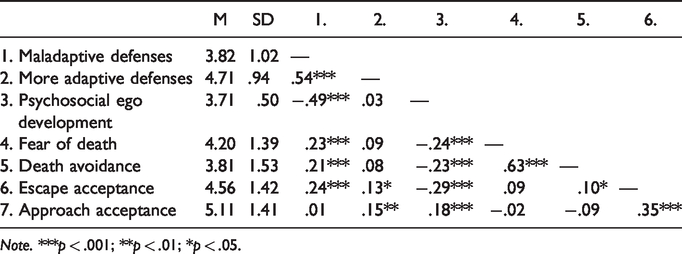
Note. ***p < .001; **p < .01; *p < .05.
Independent sample t tests were used to compare female with male respondents on all variables. Compared with men, women had a higher level of fear of death, t(380) = 2.26, p < .05, d = .24. There were no significant differences between female and male participants regarding other variables (ps > .05). In addition, the Pearson correlation coefficient was used to calculate the relations between age and the key variables. Age is significantly associated with escape acceptance (r = .33, p < .001) and approach acceptance (r = .12, p < .05). There were no significant correlations between age and other key variables (ps > .05).
Finally, path analysis was conducted to test the relationships between defense mechanisms and attitude toward death with psychosocial ego development as a mediator (controlling for age and gender). In the first step, the model tested the effect of maladaptive and adaptive mechanisms of defense on four dimensions of death attitude controlling for age and gender. Maladaptive defenses were a positive predictor of fear of death, death avoidance, and escape acceptance. The positive effect of adaptive mechanisms on approach acceptance was also shown. Other paths were not statistically significant in this step of the analysis (see Figure 1).

Empirical Model of Relations Between Mechanisms of Defense, Psychosocial Ego Development and Attitude Toward Death (Controlling for Age and Gender).
In the second step, the hypothetical model was tested with the mediator (psychosocial ego development) in significant relationships between defense mechanisms and death attitude revealed earlier (see Figure 1). The model resulted in an insignificant chi-square statistic (χ2 = 2.903, df = 4, p = .574), suggesting that there is an insignificant discrepancy between the model and the data. Moreover, RMSEA indicated a good fit (RMSEA = .000). TLI and CFI also indicated a good fit of the model to the data (TLI = 1.014, CFI = 1.000).
To explore mediations, the indirect effects were tested using bootstrapping. The mediation analysis revealed that the indirect effects of maladaptive defenses on fear of death (ab = .17, 95% CI [.05, .27], p < .05), death avoidance (ab = .18, 95% CI [.03, .29], p < .05), and escape acceptance (ab = .21, 95% CI [.11, .32], p < .01) via psychosocial ego development were significant. The results also showed a significant indirect effect of adaptive mechanisms of defense on approach acceptance (ab = .11, 95% CI [.06, .18], p < .01) via psychosocial ego development. These mediations were partial because after considering the psychosocial ego development as a mediator in the model, significant paths from defense mechanisms to selected dimensions of attitudes toward death remained significant, although their strength weakened (see Figure 1).
Discussion
The study confirmed the assumption that psychosocial ego development plays the role of a partial mediator in the relations between mechanisms of defense (both maladaptive and adaptive) and selected dimensions of attitude toward death. The obtained results partly confirmed the hypothesis that maladaptive and more adaptive defenses affect death attitude in adults both directly and indirectly through successes or failures in solving developmental tasks. My analyses indicated that, in fact, psychosocial ego development partially mediates all significant relations between defense mechanisms and attitude toward death; however, contrary to my supposition, maladaptive defenses were not a significant predictor of approach acceptance, and there were no effects of more adaptive defenses on fear of death, death avoidance, and escape acceptance. Neutral acceptance subscale had poor reliability in my study, which made it impossible to include this dimension of attitudes toward death in the model and to partially verify hypothesis 2.
According to hypothesis 1, psychosocial ego development was a partial mediator in the relationships between maladaptive defenses and fear of death, as well as death avoidance. Maladaptive defenses may to a certain extent affect the increase of these dimensions of attitude toward death in an indirect way, by weakening psychosocial ego strengths. These results can be understood in reference to the theory according to which the successful development of the ego in the course of life co-creates resilience that allows one to deal with the prospect of one's death in an adaptive way (e.g. Colarusso, 2014; Jaques, 2006; Sekowski, 2020). Maladaptive mechanisms may prevent constructive resolution of development crises, contribute to the weakness of ego identity, and thus this kind of defenses may lead to a negative image of one's own life as not lived the right way, which may result in an increase in existential anxiety (Erikson, 1950, 1959; Parker, 2013). In this indirect way, these defenses may increase the fear of death, as well as strengthen the avoidance of thinking and talking about death. This mechanism may be particularly important in the second half of life, because confronting one's mortality and overcoming the fear of death is an important development challenge in the course of crises in middle age and in late adulthood (Erikson, 1950, 1959; Jaques, 2006; Sekowski, 2020).
The obtained results also suggest a partial direct effect of maladaptive defenses on fear of death and avoidance of death. Clinicians described the relationships between maladaptive or immature defense mechanisms, denial of death, and the fear of death (Jaques, 2006; Segal, 2006). They depict the mechanism of a vicious circle in which maladaptive defense does not allow for constructive coping with aging and mortality, and the fear of death can reinforce the primitive defensive structure and make it more rigid. Also Wittkowski's (2016) results indicate that maladaptive coping strategies based on emotional dismay and resignation (e.g. a tendency to escape from the situation, retreating from others, ruminating, expressing self-blame and self-pity, feeling helpless, and giving up) positively correlate with the fear of death and dying in adults.
My research also revealed that – in accordance with hypothesis 1 – psychosocial ego development is a partial mediator in the relationship between maladaptive mechanisms of defense and escape acceptance of death. Maladaptive defenses may result in at least two types of failures that are related to each other: (i) failures in resolving conflicts in everyday functioning, and (ii) failures in solving developmental life challenges described by Erikson and other authors (Erikson, 1950, 1959; Jaques, 2006; Vaillant, 2012). The consequences of the first type of difficulty and the related frustrations one wants to escape may explain the direct effect of maladaptive defenses on escape acceptance. The second type of failure can explain the partial mediation of psychosocial ego development in this relationship. The accumulation of dystonic ego features due to the negative resolution of subsequent development crises may lead to non-fulfillment in important areas of functioning (e.g. intimate and family relations, work and career), reducing quality of life (Vaillant & Drake, 1985; Vaillant & Milofsky, 1980). In such situations, escape acceptance of death may be a manifestation of states of destructive pessimism (Jaques, 2006) and despair (Erikson, 1950, 1959), resulting in the perception of death as a solution to life's problems (Sękowski, 2019; Stillion & McDowell, 1996; Wong et al., 1994).
Contrary to hypothesis 1, maladaptive defenses were not a predictor of approach acceptance. Faith in the afterlife is a dimension of attitude toward death that is closely related to religiosity. The lack of a relationship between pathological and immature defenses and the religious understanding of death may result from the fact that specific religious coping methods, the derivative of which may be the belief in the afterlife, may be either positive and adaptive (i.e. the belief that difficult experiences strengthen faith), or negative and maladaptive (i.e. difficulty in finding positive meanings in hard experiences as a result of seeing God as a hostile power; Prout et al., 2018).
My results, in accordance with hypothesis 2, indicate that psychosocial ego development is a partial mediator in the relationship between more adaptive defenses and approach acceptance of death. The demonstrated partial direct effect of adaptive mechanisms on faith in the afterlife is consistent with Vaillant’s (2017) speculation that adaptive defenses, such as anticipation and altruism, favor prospection of life after death. In addition, relatively adaptive defenses support psychosocial ego virtues, which can strengthen approach acceptance in adults. The results obtained in the study complement the currently non-conclusive results of research into the effects of psychosocial development on approach acceptance. Researchers previously reported that selected ego strengths are positive (Brudek & Sekowski, 2019; Nakagi & Tada, 2014; Sękowski, 2019), negative (Nakagi & Tada, 2014), or insignificant predictors of belief in the afterlife (Ardelt, 2008; Parker, 2013). However, to the best of my knowledge, no research has been carried out to date on the effect of the general level of psychosocial ego development on approach acceptance of death. It should be noted, however, that most study participants indicated they were religious, and in such people, faith in the afterlife can be an integral part of the worldview, and a derivative of a coherent and integrated ego identity.
Contrary to my hypothesis, it has not been confirmed that more adaptive defenses are a negative predictor of fear of death, death avoidance, and escape acceptance, i.e. the three dimensions of the attitude toward death that may be a consequence of poor adaptation (Sekowski, 2020). This lack of significant relationships can be explained by the ambiguous nature of more adaptive defenses: DSM-5 indicates that defenses in this group can be either adaptive or non-adaptive, depending on the severity, flexibility, and circumstances of use (American Psychiatric Association, 2013). This description of mechanisms of defense corresponds to my results, indicating that relatively adaptive defenses correlate moderately and positively with maladaptive defenses. Perhaps the lack of relationships between relatively adaptive defenses and fear of death, death avoidance, and escape acceptance may result from the fact that flexible and adequate use of these defenses may actually lower the severity of these three dimensions of attitude toward death, while rigid and intensive use of such defenses may even deepen these aspects of death attitude.
The study has some practical recommendations. My results suggest that effective psychological interventions for reducing the intensity and severity of fear of death, denial of death, and escape acceptance in adults using maladaptive defense mechanisms should focus on the psychosocial functioning of the client or patient. In some cases this can be an important clinical task because a maladaptive attitude toward death may be a symptom of some psychopathological syndromes in adults, especially in the second half of life (Iverach et al., 2014; Lingiardi & McWilliams, 2017). Depending on the individual's life situation, interventions may focus on stimulating different ego strengths (see Sękowski, 2019). For example, intimacy can be strengthened by promoting involvement in relationships with loved ones. Generativity and care can be stimulated by promoting passing on knowledge and skills to others and becoming involved in activities that will leave a legacy, as well as encouraging making contributions to one’s community, or assuming responsibility for others and nurturing that responsibility. Wisdom and ego integrity can be strengthened by supporting the reflectiveness of the individual, and working together with them through their life story, which always includes both successes and failures. Given my results and gaps in this literature, there is a need to undertake research on the effectiveness of psychological interventions focused on psychosocial ego strengths in adults with severe death anxiety, denial of death, and escape acceptance of death.
There are several limitations to the current study. First, the study sample was selected using the snowball method because it is a simple and cheap recruitment technique, and not because it is the optimal form of sampling in research on psychosocial constructs in the population of healthy adults. For that reason, and taking into account the fact that the study was conducted in Poland, my findings should be generalized to other populations with great caution. Secondly, the key variables were measured only with self-report questionnaires that are subjective and vulnerable to biases such as the participants' mood or social desirability (Podsakoff et al., 2003). In addition, although the use of structural equation modeling provides some evidence for my hypotheses, it is impossible to determine strictly causal and temporal relations between the measured constructs, given the correlational and cross-sectional nature of the study. Moreover, conceptual and psychometric limitation ensues from the fact that defense mechanisms partly overlap with some aspects of psychosocial ego development and some dimensions of attitude toward death (e.g. death avoidance), which may result in an inflation of the relationships between DSQ-40 subscales, PIES overall score, and DAP-R subscales. Finally, the low reliability of the neutral acceptance subscale of DAP-R made it impossible for me to include one dimension of attitude toward death that is very important from the point of view of theory in my statistical analyses.
Despite these limitations, the current study provides novel information about the factor that may underlie the relations between maladaptive and adaptive mechanisms of defense and adults’ attitude toward death. Various aspects of my study design, such as the measurement of different dimensions of death attitude and the usage of structural equation modeling, allowed me to demonstrate mechanisms of relationships between important psychosocial constructs that had not been studied together in earlier empirical research. My results emphasize the need to further explore complex associations between defense mechanisms, Eriksonian ego strengths, and attitude toward death. Future work should employ a longitudinal design and be conducted on different clinical and community samples in different cultures, selected so as to best reflect the structure of the studied population, and use various types of interview and self-report measures.
My study shows that two types of defense mechanisms seem to be differentially related to various dimensions of attitude toward death via psychosocial ego development in adults. Understanding these complex associations may have consequences for psychological counseling and therapeutic interventions aimed at reducing fear of death, denial of death, and escapist attitude toward death in people who use maladaptive mechanisms of defense.
Footnotes
Declaration of Conflicting Interests
The author(s) declared no potential conflicts of interest with respect to the research, authorship, and/or publication of this article.
Funding
The author(s) received no financial support for the research, authorship, and/or publication of this article.
